
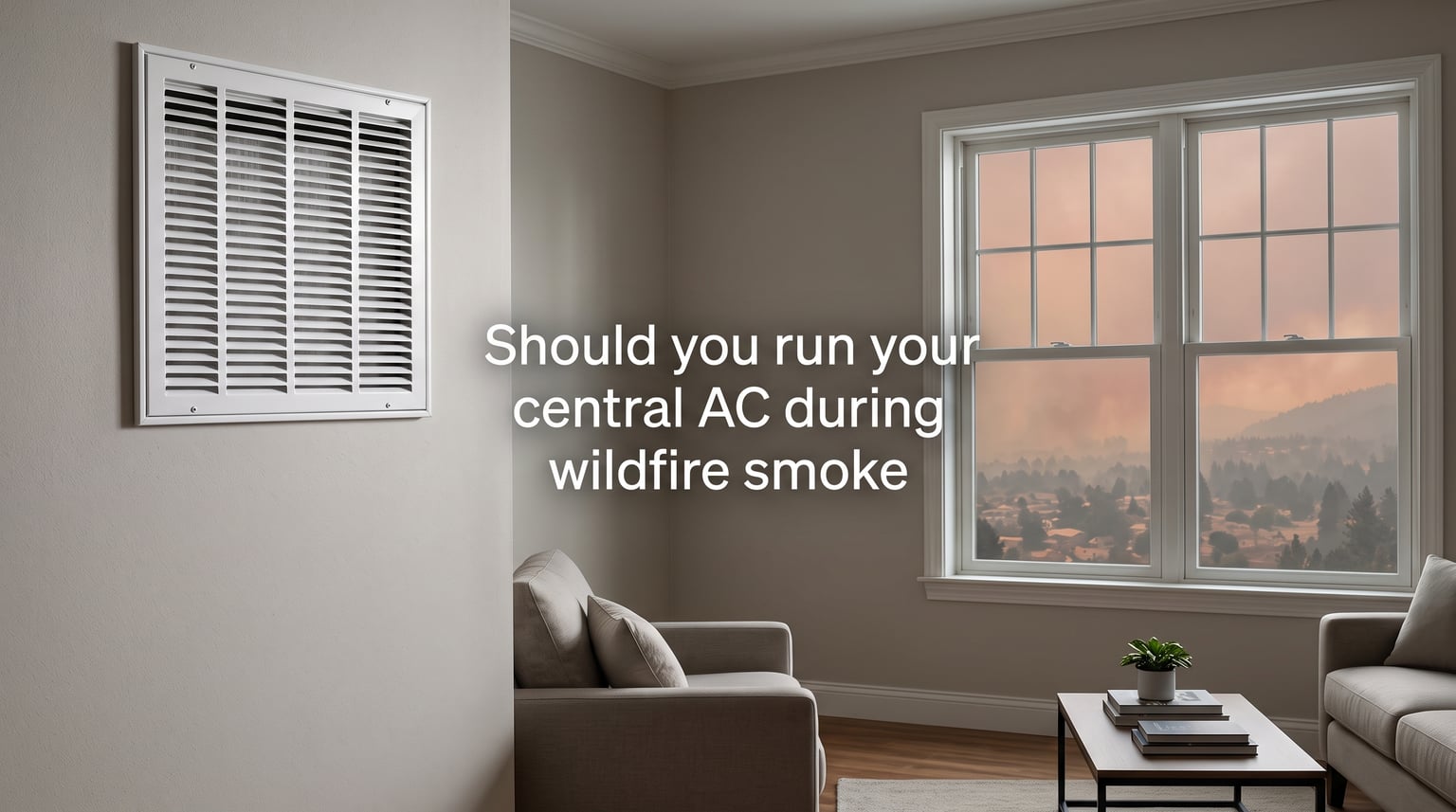
Yes—most homes should run central air conditioning during wildfire smoke, provided the system is recirculating indoor air and any outdoor-air intake is closed. A compatible higher-efficiency HVAC filter can catch some smoke particles as air moves through the system, while cooling helps you keep windows and doors shut.
The answer changes if your system deliberately brings in outdoor air, has a damper stuck open, or you are relying on equipment that exhausts indoor air and pulls replacement air through leaks. In those cases, first limit the outdoor-air path, then cool and filter the house as conditions allow.
If you are asking should you run your central AC during wildfire smoke because the house smells smoky, treat the question as both a cooling and indoor-air-quality problem. This guide explains what central AC does, what it cannot do, and the practical steps that reduce smoke exposure indoors.
Quick check: Look at local air-quality reporting before opening windows or switching on ventilation equipment. Official EPA and AirNow guidance is particularly useful when conditions shift over a few hours.
Table of Contents
Yes, you should run your central AC during wildfire smoke when it recirculates indoor air
A conventional split central AC system normally takes air from rooms through return grilles, passes it through a filter and cooling coil, then sends it back through supply vents. It does not work like an open window, and its standard cooling cycle is not designed to pull outside air into the home.
That indoor loop is why running AC during wildfires is usually better than shutting it down in a sealed, hot house. Air keeps passing through the installed filter, temperature stays safer during heat, and closed windows have less reason to be opened for relief.
There is an important limit: central AC is not a HEPA-level whole-house smoke-removal system just because it is running. The amount of particle reduction depends on the filter, how well the filter fits, how often the blower runs, duct leakage, and whether outside air is entering elsewhere.
Warning: Do not assume every HVAC system is indoor-only. Homes with mechanical ventilation, fresh-air dampers, energy-recovery ventilators, or commercial-style systems may bring in outside air by design. Check the controls, documentation, or ask an HVAC professional if you cannot identify the setting.
Yes, keeping the home closed is part of the AC strategy
Close exterior windows and doors before smoke becomes heavy, then keep them closed while outdoor air quality is poor. Also check less obvious openings: a fireplace damper, pet door gaps, dryer vents that do not close fully, and an attached garage door can all contribute to unwanted air movement.
Heat and humidity still matter. In a hot spell, safely cooling the home can prevent heat stress, especially for older adults, young children, pregnant people, and people with heart or lung conditions who may also be more affected by smoke.
If cooling is unavailable and the house becomes dangerously hot, follow local public-health instructions for cleaner-air cooling locations. Reducing smoke exposure should not mean tolerating unsafe indoor temperatures.
Central AC usually recirculates indoor air rather than drawing smoke indoors
The phrase central air conditioning smoke can sound alarming, but the basic path is straightforward. A return vent pulls indoor air toward the air handler, the filter catches part of the airborne material, the coil cools the air, and supply ducts return that air to the rooms.
Air leaks in ducts or around the air handler can weaken that benefit, particularly when equipment is in a vented attic, crawlspace, or garage. Still, leakage is different from the normal purpose of a central AC system; it is a maintenance issue, not proof that central air automatically brings outside smoke indoors.
Some systems add outdoor air through a separate intake or ventilation device. This may be controlled by a fresh-air damper, a ventilator, a thermostat setting, or a building automation control, so the place to look is not always the AC condenser outside.
Recirculation means the system keeps reusing room air
Recirculation mode AC settings limit outdoor-air exchange and keep the system working mainly with air already inside the building. The wording varies by thermostat and equipment: look for “recirculate,” “indoor air,” “fresh air,” “ventilation,” “outside air,” or a damper control.
A thermostat fan setting is related but not identical. “Auto” runs the blower when cooling calls for it, while “on” runs the blower continuously; neither label by itself confirms whether a fresh-air damper is open or closed.
Continuous fan operation can move more air through a suitable filter, but it also uses energy and may raise indoor humidity in some systems after the cooling cycle ends. If humidity becomes uncomfortable or condensation appears, return the fan to auto and rely on normal cooling cycles unless a qualified technician gives different advice.
Outdoor-air equipment needs a more careful decision
An energy-recovery ventilator or heat-recovery ventilator normally exchanges indoor and outdoor air for ventilation. During a severe smoke event, its manufacturer guidance or a qualified HVAC technician can tell you whether it has a smoke or recirculation setting and when temporary shutdown is appropriate.
Do not block an intake with plastic, tape over a combustion appliance vent, or disable a system blindly. Gas appliances, fireplaces, and attached garages have safety requirements that are separate from smoke filtration.
If you smell smoke strongly at supply vents while windows are shut, note when it happens and investigate. The cause may be an outdoor-air intake, a leaky return duct, a dirty filter, pressure differences, or smoke entering the house through another gap and then circulating.
Recirculation mode is the setting that limits new smoky outdoor air
Start with your thermostat or ventilation control, not the outdoor condenser. The condenser is the unit outside that releases heat; it is not the part that normally delivers outdoor air to your rooms.
- Close windows and exterior doors. Check that sliding windows and window locks are fully seated, because a small unlatched gap can matter when wind drives smoke toward the house.
- Set cooling to a comfortable, safe temperature. Letting the home overheat often leads to opened windows, which defeats the indoor-air plan.
- Find the fresh-air or ventilation setting. Select recirculation, indoor air, or the setting that closes the outdoor-air damper, if your system has one.
- Check the filter compartment. Confirm that the filter is installed in the correct direction, is fully seated, and has no visible bypass gap around its frame.
- Watch indoor conditions. If smoke odor rises, symptoms worsen, or the system behaves unusually, reassess the air path rather than simply lowering the thermostat.
The best HVAC filter for wildfire smoke is only useful when air actually passes through it. A bent filter, a loose rack, or a missing filter lets air go around the media instead of through it.
Practical test: With windows closed, stand near a supply vent when the system starts. Normal airflow should not smell sharply smoky. A persistent smoke odor is a reason to check outdoor-air controls, filter fit, and duct condition.
Recirculation does not mean sealing off every source of air forever
During the smoky period, the priority is to reduce exposure to outdoor particles. When local air quality improves, normal ventilation may again be appropriate, especially for homes that become stuffy or have indoor pollutant sources.
Follow local alerts rather than guessing based on sky color alone. Smoke levels can be high even when the view looks clearer, and conditions can improve or deteriorate rapidly with wind changes.
People often use the phrase “three-minute rule for AC” to mean waiting about three minutes before restarting an air conditioner after switching it off, a habit intended to avoid short cycling and pressure stress. It is not a wildfire-smoke rule and does not tell you whether to open or close a fresh-air intake.
Wildfire smoke is harmful because PM2.5 can remain in indoor air
Wildfire smoke contains gases and particles, including fine particulate matter known as PM2.5. These particles are small enough to travel deep into the lungs, which is why smoke can affect health even when it is mostly kept outdoors.
Indoor air is usually cleaner than outdoor air when windows and doors are closed, but it is not automatically clean. Particles can enter through gaps, open doors, ventilation systems, and air leaks, then linger in rooms without adequate filtration.
Symptoms can include eye or throat irritation, coughing, wheezing, shortness of breath, headache, fatigue, or a burning smell sensation. Wildfire smoke can trigger migraines for some people, and anyone with new chest pain, serious trouble breathing, confusion, or symptoms that feel urgent should seek medical care promptly.
People with higher health risk need a lower-exposure plan
Children, older adults, pregnant people, and people with asthma, chronic obstructive pulmonary disease, heart disease, or other lung conditions may be more sensitive to smoke. Keep prescribed medications and an asthma action plan available, and follow advice from the person’s health-care team.
Pets can also be affected by poor air quality. Keep outdoor time brief when conditions are bad, and avoid assuming a garage, porch, or shed is a cleaner place just because it is enclosed.
Prolonged smoke can also be mentally draining: closed windows, canceled routines, and uncertainty can interfere with sleep and concentration. A predictable indoor routine, brief check-ins on official air-quality information, and one cleaner room can make the period more manageable.
Warning: A home air-quality monitor can show trends, but it is not a diagnosis tool. If a person is struggling to breathe or has severe symptoms, act on the medical concern rather than waiting for a monitor reading to change.
A compatible MERV 11 to MERV 13 filter can reduce smoke particles
MERV is a rating for how well an HVAC filter captures particles across specified size ranges. For wildfire smoke, guidance commonly focuses on MERV 11 through MERV 13 filters because they capture more fine particles than basic low-MERV filters.
Higher is not automatically better for every system. A denser filter can create too much resistance for an older or lightly sized air handler, reducing airflow and potentially straining equipment; check the system manual or consult an HVAC professional before moving to a much higher rating.
HEPA filters capture very fine particles at a much higher standard, but most central HVAC systems are not built to accept a true HEPA filter without system-specific design changes. A portable HEPA air purifier in a closed room can complement central air rather than replace it.
MERV 8, MERV 11, and MERV 13 serve different roles
- MERV 8: A common basic residential choice that catches larger dust, pollen, and lint. It provides less fine-particle capture than the filters usually preferred for smoke periods.
- MERV 11: A meaningful step up for finer airborne particles and often a reasonable smoke-season option where the HVAC system supports it.
- MERV 13: Provides stronger fine-particle filtration and is often recommended for smoke reduction when it is compatible with the equipment and fits tightly.
These ratings describe filter media performance under test conditions, not a promise that a house will reach a particular PM2.5 reading. Smoke reduction also depends on air flow, hours of operation, outdoor leakage, room size, and how many people open doors.
A well-fitted filter matters as much as its rating
Write down the filter’s exact dimensions and rating before smoke season, then keep a replacement on hand. A filter that is too small or installed backward leaves a bypass path; air takes the easier route around the filter.
Follow the airflow arrow printed on the frame. In many systems, the arrow points toward the blower or air handler, but the label on the equipment should be the final reference.
Do not stack filters together to “double filter” the system. That can sharply reduce airflow, and it does not solve fit problems around the filter rack.
These signs mean the filter may need changing sooner
- The filter surface looks visibly gray or loaded with fine dust.
- Airflow from supply vents feels weaker than usual with the same thermostat setting.
- The system runs longer than normal without cooling well.
- A smoke odor persists after outdoor conditions improve and the home has stayed closed.
- The manufacturer’s normal replacement interval arrives during an extended smoke episode.
Visual inspection is useful, but do not wait for a filter to become completely dark or clogged. Smoke events may load filters faster than a routine calendar reminder, so inspect more often during active periods and replace when needed.
A dirty filter does not mean the ducts need automatic cleaning. Duct cleaning is a separate decision that should be based on evidence of contamination, airflow problems, construction debris, pests, or a technician’s inspection—not on marketing pressure after every smoky day.
Central AC, window units, and portable ACs handle smoke differently
Central air is generally the simplest option during smoke because it usually recirculates indoor air through a whole-home filter. The key exceptions are systems with dedicated outdoor-air ventilation or leaks that bring in smoky air.
Window AC smoke behavior depends on the unit and installation. Close any fresh-air vent or outdoor-air lever, check that side panels and the window opening are sealed, and clean or replace the unit’s filter according to its instructions.
A window unit’s built-in filter often protects the machine from dust but may not capture fine smoke particles as well as a properly selected central HVAC filter or a portable HEPA purifier. Keep the unit running for cooling if it is sealed and set not to bring in outdoor air, but do not rely on it alone as smoke filtration.
Portable ACs need attention to pressure and hose setup
A portable AC with one exhaust hose sends indoor air outside. That can create negative pressure, which draws replacement air into the house through cracks, door gaps, and other openings; during wildfire smoke, that replacement air may carry particles with it.
Two-hose portable units separate intake and exhaust paths more effectively and may reduce that negative-pressure problem, but the window kit must still be tightly sealed. Forum discussions repeatedly describe smoke intrusion around portable-AC panels and hose connections, so inspect those points rather than assuming the kit is airtight.
If a portable unit makes the room smell smokier while outdoor air is poor, turn it off temporarily if the room can remain safely cool, improve the seal, and consider a different cooling location. Do not tape over an exhaust hose or block it, because the appliance needs that path to operate safely.
Evaporative coolers and whole-house fans usually are poor choices in smoke
Evaporative coolers, often called swamp coolers, cool by moving outdoor air through wet pads and into the home. That outdoor-air flow can bring smoke indoors, so they are generally not the right choice when outdoor air quality is unhealthy.
Whole-house fans also pull outdoor air in through open windows and exhaust indoor air into the attic. Keep them off during a smoke event unless local authorities say outdoor air is clean again.
Heat pumps in cooling mode often behave like central AC and recirculate indoor air, but system design still matters. Look for a separate ventilation control or ask the installer about your model’s outdoor-air path.
Best practice by equipment: Run sealed central AC on recirculation; close fresh-air vents on compatible window units; scrutinize portable-AC window kits; and avoid outdoor-air-dependent coolers and whole-house fans while smoke is present.
A clean air room gives you one lower-smoke place to rest
A clean air room is a room you keep especially protected when smoke lasts for hours or days. It is useful when you cannot make every room equally clean, or when someone in the household needs a lower-particle place to sleep, work, or recover.
- Choose a small, easy-to-close room. A bedroom with few exterior doors is often easier to manage than an open living area.
- Close windows, exterior doors, and the fireplace damper. Use a rolled towel at a noticeable door gap only if it does not interfere with safe exit or normal door operation.
- Run central AC with its compatible filter. Keep the system in recirculation if that control is available.
- Add a portable HEPA air purifier if you have one. Select a unit intended for the room size and run it as directed by its manufacturer.
- Keep particle sources out. Do not smoke, burn candles or incense, fry foods, or vacuum with a machine that lacks good filtration in that room.
Keep doors to the clean air room closed as much as practical. Every entry can bring in particles from the rest of the house, but the goal is meaningful reduction, not a perfectly sealed laboratory.
Watch humidity as well as temperature. Central AC usually removes moisture while cooling, but an oversized system, a continuously running fan, wet clothes drying indoors, or a humid climate can still leave a room damp; avoid adding unnecessary moisture during the smoke event.
Air purifiers complement central filtration
An air purifier wildfire smoke plan works best when the purifier has particle filtration such as HEPA and is sized for the actual room. It cannot offset an open window or a large gap around a portable AC panel, so fix entry points first.
Avoid devices that intentionally generate ozone. Ozone is a lung irritant, and adding an irritant indoors is not a sound response to wildfire smoke.
If you cannot get an air purifier, the same clean-room basics still help: close openings, run compatible central filtration, and reduce indoor particle production. The objective is lower exposure, not a claim of zero smoke indoors.
Closing openings and reducing indoor particle sources keeps smoke out of the house
During the smoke period, skip activities that make additional indoor particles or fumes. Avoid smoking or vaping indoors, burning wood or candles, broiling or frying heavily, and using a fireplace; cook with a microwave, slow cooker, or other lower-smoke method when possible.
Keep bathroom and kitchen exhaust fans off unless needed to control moisture or odors, because they can pull replacement air through gaps. If you must use them, run them only as long as necessary and check nearby windows and doors for leaks.
Vacuuming can stir settled particles, particularly with a vacuum that leaks dust. Delay nonessential cleaning until outdoor air improves, or use a vacuum with effective filtration and move slowly without aggressive dusting.
Warning: Never run a generator, charcoal grill, camp stove, or gasoline-powered tool in the house, garage, basement, or near an open door or window. Carbon monoxide and combustion fumes are a separate life-safety hazard.
Smoke odor is a clue, not a complete measurement
Odor can be useful because it tells you something may be entering the house, but people perceive odors differently and some harmful particles have little smell. Use official outdoor-air reports and, if available, a reliable indoor particle monitor to guide decisions.
When outdoor air improves, ventilate gradually if local guidance supports it. Open windows on the cleaner side of the home when conditions are good, then return HVAC settings to their regular arrangement.
An HVAC inspection is sensible when smoke odor or performance problems persist
After smoke clears, inspect the accessible filter and replace it if it is loaded or due for replacement. Check that vents are open, listen for unusual blower noise, and notice whether cooling performance has changed.
Call a qualified HVAC technician when you have persistent smoke odor from vents, weak airflow, repeated system cycling, visible soot around the air handler, evidence of duct damage, or uncertainty about an outdoor-air damper. Tell the technician that the concern began during wildfire smoke so they can inspect the relevant components.
Routine duct cleaning is not a universal post-smoke requirement. Ask for a clear explanation of what contamination or mechanical issue was found and what result the proposed work is expected to deliver.
These answers address common questions about running AC during wildfire smoke
Should I turn on my AC during a wildfire?
Yes, run a typical central AC system if it recirculates indoor air and any outdoor-air intake is closed. It can keep the house cool and move air through a compatible HVAC filter, but it does not make indoor air perfectly smoke-free.
Will my air conditioner filter out wildfire smoke?
A central system with a properly fitted, compatible MERV 11 or MERV 13 filter can reduce some smoke particles as indoor air cycles through it. Basic filters capture less fine particulate matter, and most central systems cannot use a true HEPA filter without design changes.
Does central AC bring in outside air?
Most residential central AC systems mainly recirculate indoor air. However, a separate fresh-air intake, ventilation system, open damper, or duct leak can introduce outdoor air, so verify how your system is configured during smoke.
What MERV filter should I use for wildfire smoke?
MERV 11 through MERV 13 is commonly recommended for improved fine-particle capture during smoke events, provided the filter is compatible with your HVAC system. Check the manual or consult a qualified technician before installing a denser filter.
Should you open windows during wildfire smoke?
No, keep windows and exterior doors closed while outdoor air quality is poor. Open them again only when local air-quality guidance shows conditions have improved and the home needs normal ventilation.
Can wildfire smoke trigger migraines?
Wildfire smoke can trigger headaches or migraines for some people and can also irritate the eyes and airways. Reduce exposure, follow your usual clinician-approved migraine plan, and seek urgent care for severe or unusual symptoms.
What is the 3 minute rule for AC?
The three-minute rule generally refers to waiting briefly before restarting an air conditioner after it is switched off, to reduce short cycling. It is unrelated to wildfire smoke and does not replace setting a system to recirculate indoor air.
Yes, central AC can support a lower-smoke indoor space during a wildfire
Should you run your central AC during wildfire smoke? Yes, if it recirculates indoor air, the outdoor-air path is closed, and the installed filter is compatible with your equipment. Pair it with shut windows, fewer indoor particle sources, and a clean air room when conditions are severe.
Check official air-quality updates, inspect the filter more often during smoke, and get HVAC help for persistent odor or airflow trouble. Those steps give your home its best practical chance of staying cooler and less smoky until outdoor conditions improve.