
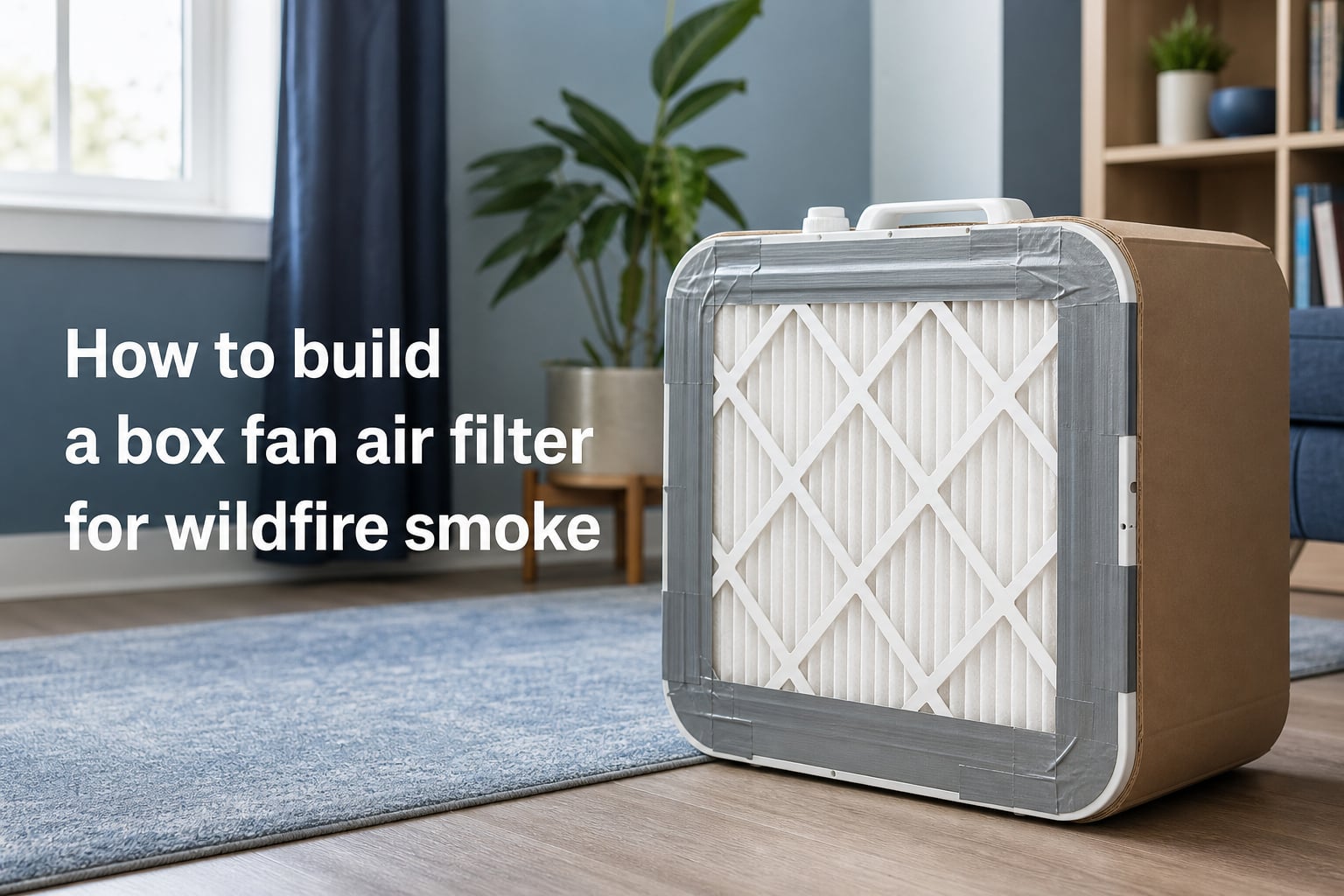
A box fan air filter for wildfire smoke is a simple DIY air purifier: tape a correctly sized MERV-rated furnace filter to the intake side of a box fan, then run the fan on its lowest practical setting. It can lower airborne particle levels in one closed room, giving you a useful layer of wildfire smoke protection when outdoor air is poor.
The basic build takes little technical skill, but the details matter. The filter must face the right direction, every edge needs to be sealed, and the fan needs safe placement and fan-only operation.
This guide explains the one-filter setup first because it is the fastest version to assemble. It also explains when a Corsi-Rosenthal box may make more sense, how to choose among MERV 8, MERV 11, and MERV 13, and how to judge whether the unit is doing enough for your room.
Table of Contents
A box fan filter captures wildfire-smoke particles, not every indoor pollutant
Wildfire smoke contains PM2.5: very small particles that can move deep into the lungs. A box fan pulls room air through the filter, where the filter media catches a portion of those particles before the air returns to the room.
That means this device is for particulate capture, not for every problem created by smoke. It does not replace leaving an evacuation area when officials direct you to leave, and it does not reliably remove gases and odors without a separate, substantial activated-carbon component.
Think of it as a room-cleaning device rather than a whole-house fix. Keep exterior doors and windows closed as conditions allow, reduce other particle sources such as frying or burning candles, and run the filter where people spend the most time.
Quick answer: Put the filter on the back, or intake, side of the fan. The fan should pull air through the filter; do not tape the filter over the side that blows air out.
What you need is a square box fan, a compatible filter, and ordinary tape
Use a standard square box fan in sound working order and one pleated HVAC filter that matches the fan’s face as closely as possible. A typical pairing is a 20-inch fan and a 20-inch by 20-inch filter, but measure the fan’s outer grille before buying or opening the filter.
- One square box fan with an intact grille, cord, plug, and controls
- One pleated furnace filter, preferably MERV 13 if the fan can move air through it
- Wide painter’s tape, masking tape, or duct tape to seal all four edges
- A piece of clean cardboard for a shroud
- Scissors or a utility knife for the cardboard
- Optional: a marker, ruler, and four short pieces of tape for corner reinforcement
A pleated filter has a stiff cardboard frame and folded filter media. Do not substitute a loose sheet of filter material, a filter with a broken frame, or a household item that was not designed to pass air safely.
Check the airflow arrow printed on the filter frame before you begin. In this setup, that arrow should point toward the fan, because air travels from the room through the filter and into the fan.
Warning: Do not put a filter on a fan that has a damaged cord, loose grille, scraping blades, burning smell, or unreliable switch. A DIY air purifier cannot make a failing electrical appliance safe.
How to build a box fan air filter for wildfire smoke in six steps
The aim is to make the fan draw room air through the entire filter face instead of around its edges. Work on a clean, flat surface so the filter frame stays square.
Step 1: Inspect the fan and find the intake side
Unplug the fan and identify its intake side. On most box fans, the intake is the side where air is pulled in; the other side pushes air outward.
Turn the fan briefly on before assembly if you need to confirm the direction, then unplug it again. Check that the grille is fixed in place and that the blades spin without rubbing.
Step 2: Orient the filter so the arrow points toward the fan
Lay the filter against the intake grille with the printed airflow arrow facing the fan. The full filter frame should sit flat against the grille, with no large gap at a corner.
It is easy to reverse the filter when the frame printing is hidden by tape. Mark the room-facing side with a small note before you cover an edge, especially if you expect to remove the filter for storage.
Step 3: Tape every edge to stop bypass air
Start with one strip of tape along each of the four filter-frame edges. Press half the tape onto the filter frame and half onto the fan housing or grille rim, without pushing tape into the fan blades.
Add short tape strips at the corners if they lift. The goal is a snug seal, because gaps let unfiltered air bypass the media and reduce the real-world filter efficiency.
Do not cover the front of the filter with tape. The pleated media needs its full surface area to collect particles and keep resistance as low as possible.
Step 4: Cut a cardboard shroud for the exhaust side
Place cardboard over the side of the fan that blows air out and trace the outside shape. Cut the cardboard to fit the fan face, then cut a centered circle that leaves a wide cardboard border around the fan opening.
Tape the cardboard shroud around its outside edges only. The shroud blocks some of the dead space around the fan’s circular blade area, so more of the fan’s work is directed through the useful opening.
The circle does not need to be perfect. Leave enough cardboard around the circle to cover the grille corners, and keep the shroud clear of the blades and any moving parts.
Tip: Make the shroud from a flat, clean cardboard box rather than flimsy paperboard. If it bows toward the blade area, replace it with a firmer piece.
Step 5: Place the unit where the room air can circulate
Set the finished filter upright on a stable, dry floor or a solid low surface. Give both sides room to breathe: do not press the filter against a wall, curtain, bedding, or furniture.
A central spot is often useful, but a location near the people sleeping or working in the room can also be practical. Keep the cord out of walkways and leave enough clearance that nothing can fall onto either side.
Step 6: Run the fan and check for airflow problems
Plug the unit directly into a wall outlet when possible and start at a low fan speed. Feel for a steady stream of air from the shroud side and listen for unusual rattling, rubbing, or electrical noise.
The filter should remain firmly attached and should not pull into the blades. If airflow seems weak, first check that the filter is on the intake side, that the arrow points toward the fan, and that no tape covers the pleats.
MERV 13 is the first filter rating to look for during wildfire smoke
MERV means Minimum Efficiency Reporting Value, a rating used for HVAC filters. In plain terms, higher MERV ratings generally capture more small particles, but a denser filter also creates more resistance for the fan.
For a box fan air filter wildfire smoke setup, MERV 13 is commonly the preferred target because it offers stronger small-particle filtration than lower-rated household filters. Availability changes during smoke events, so it helps to know what the alternatives can and cannot do.
MERV 13 offers stronger fine-particle capture when airflow remains acceptable
A MERV 13 filter is a sensible first choice for PM2.5 reduction when it fits the fan well and the fan still moves a clear volume of air. Use a clean filter rather than an old filter pulled from a heating or cooling system.
Not every MERV 13 filter has the same thickness or resistance. If the fan sounds strained, runs unusually hot, or delivers very little airflow, stop and reassess the setup instead of assuming a higher rating is always better.
MERV 11 is a reasonable fallback when MERV 13 is unavailable
MERV 11 can be a practical alternative during filter supply shortages. It generally provides less fine-particle filtration than MERV 13, but a well-sealed MERV 11 unit that moves plenty of air can still improve indoor air quality.
For short-term use, one available filter is usually more useful than waiting for an ideal one while smoke is already indoors. Replace the filter when it becomes visibly loaded or airflow falls.
MERV 8 is a last-resort option for smoke particles
MERV 8 is more common and may let a fan move air easily, but it is less suited to the smallest smoke particles. Use it only when better options are unavailable, and treat it as a lower-filtration temporary measure.
Do not confuse a MERV number with a promise about your entire room. Performance also depends on the fan’s airflow, how tightly the filter is sealed, room size, outdoor smoke entering the room, and how long the unit runs.
Safe operation means fan-only use, clear space, and routine checks
Safety concerns are justified because a fan and filter create resistance the fan was not originally designed to handle. A careful setup reduces risk, but it does not make unattended or damaged equipment appropriate.
Use a fan with a thermal cutoff and follow its instructions
Many modern fans include a thermal cutoff, a component intended to interrupt power if the motor overheats. Check the fan label or manual for its safety information, and do not bypass, alter, or assume the presence of this protection.
Choose a fan that is in good condition and has its original safety grille. If its documentation says not to attach anything to it, follow that direction rather than building around it.
Run the fan only in its normal fan mode
Never use a fan that includes a heating function as a filter unit while heat is on. This build is for a plain fan moving room-temperature air, not for a heater, a kitchen exhaust device, or any appliance with a hot element.
Do not place the unit near a stove, fireplace, candle, radiator, wet area, or flammable clutter. Keep children and pets from poking through the grille or tugging on the filter and cord.
Monitor a new setup before relying on it overnight
Stay nearby for the first period of operation and check the fan housing periodically for unusual heat, smell, sounds, or a drop in airflow. Turn it off and unplug it if anything seems wrong.
Use a wall outlet rather than an overloaded power strip. If an extension cord is unavoidable, use one that is undamaged, rated for the fan’s electrical load, and laid where it cannot be crushed or covered.
Warning: Do not leave a homemade box-fan filter operating unattended if you have not confirmed that the fan, filter, shroud, outlet, and cord remain cool and stable in normal use. Stop use at once if you notice overheating or a burning odor.
Room size determines whether one filter can provide enough air changes per hour
CADR, or clean air delivery rate, describes how much cleaned air a device supplies. Air changes per hour, often called ACH, estimates how many times the air volume of a room is cleaned or replaced in an hour.
You do not need laboratory instruments to use these ideas. A smaller closed bedroom is easier for a DIY air purifier to help than an open-plan living area connected to several rooms.
As a rough planning method, multiply room length by width by ceiling height to estimate room volume. Compare that volume with the airflow information available for your fan or with an indoor particle monitor, if you have one, while remembering that a filter lowers the fan’s free-air flow.
Run the unit continuously during an active smoke period if it remains safe to do so. Close interior doors to create a cleaner room, and consider a second unit for a much larger space rather than expecting one fan to clean an entire home.
Maintenance means replacing a loaded filter and preserving the seal
Check the filter daily during heavy smoke and weekly during lighter use. A gray or darkened surface is expected, but a visibly clogged surface, sagging frame, odor, or declining airflow means it is time to replace it.
Turn off and unplug the fan before touching the filter. Remove tape slowly, discard the used filter according to local waste instructions, and wash your hands after handling it because it may hold collected particles.
Fit a fresh filter with the airflow arrow toward the fan and retape all four edges. Reuse the cardboard shroud only if it is clean, dry, stiff, and not bent toward the moving blades.
Troubleshooting starts with direction, gaps, and room sources
A weak airflow problem usually means excessive resistance or a blocked path
First confirm the filter arrow faces the fan and the filter is on the intake side. Next look for tape across the pleats, a shroud touching the grille, furniture crowding the filter, or a loaded filter that needs replacement.
If the filter is thick and airflow is very low, do not cut the filter media or remove its frame. Choose a compatible, clean pleated filter with an appropriate rating instead.
A smoky room may still have uncontrolled outdoor-air leaks
A DIY filter cleans particles that are already inside, but it cannot keep up if a large amount of smoky air enters continuously. Close windows and exterior doors, check obvious gaps, and avoid running exhaust fans that pull replacement air from outdoors when conditions are poor.
Cooking smoke, incense, candles, and vacuuming can also raise particle levels indoors. Pause those activities while you are trying to make one room cleaner.
A noisy setup needs stabilization rather than more tape on the blades
Rattling often comes from a loose shroud corner or a filter frame that is not flat against the fan. Unplug the fan, retape the outer frame, flatten or replace the cardboard, and verify that nothing is near the blades.
Never reach through the grille while the fan is plugged in. If the fan itself rattles or rubs with no filter attached, retire it from this job.
A Corsi-Rosenthal box can clean more air but takes more filters and space
A Corsi-Rosenthal box typically uses several filters arranged as the sides of a box with a fan on top. More filter surface area can reduce resistance and improve cleaned-air output compared with a single-filter build.
The one-filter fan is easier to put together quickly and takes less floor space. The multi-filter box is worth considering for a larger room or sustained smoke event, provided you can assemble it securely and safely with the filters available.
A DIY filter and a HEPA purifier solve related but different needs
A certified portable HEPA purifier is purpose-built, usually has published performance data, and may be easier to select for a stated room size. A box-fan filter can still be a useful supplemental or emergency option when a commercial device is unavailable or when you need another cleaner room.
Neither approach removes the need to reduce smoke entering the building. If anyone has severe breathing symptoms, chest pain, confusion, or trouble breathing, seek urgent medical help rather than relying on indoor filtration alone.
Common questions have practical answers
How do you make a box fan air filter for wildfire smoke?
Tape a clean pleated filter to the intake side of a working box fan with the airflow arrow pointing toward the fan. Seal all four edges, add an optional cardboard shroud to the exhaust side, place the unit in a closed room, and run it at a safe fan speed.
Is MERV 13 good for a box fan air filter?
MERV 13 is commonly the preferred choice for wildfire-smoke particles because it provides stronger fine-particle filtration than lower MERV options. Check that the fan still moves air well and does not run unusually hot with the clean filter attached.
Which side of a box fan does the filter go on?
Put the filter on the intake side, where the fan pulls air in. The airflow arrow printed on the filter frame should point toward the fan so room air passes through the filter before reaching the blades.
Is it safe to leave a box fan filter running overnight?
Only use a sound, clean fan with an intact grille and cord, clear space around both sides, and a stable filter attachment. Monitor a new setup first, use fan-only operation, and turn it off immediately if it smells hot, makes unusual sounds, or has weak airflow.
How often should I replace the filter on a box fan air purifier?
Replace it when it is visibly loaded, damaged, odor-producing, or causing a clear drop in airflow. Check it daily during heavy smoke because replacement timing depends on smoke levels, room conditions, and hours of use.
A well-sealed box fan filter is a practical cleaner-room tool during wildfire smoke
To build a box fan air filter for wildfire smoke, attach a clean MERV 13 filter to the fan’s intake side with its arrow facing the fan, seal the edges, and add a cardboard shroud on the exhaust side. Use it in a closed room with clear space around it, then inspect the fan and filter often.
Start with the room where someone sleeps or spends the most time. Pair the filter with closed windows, fewer indoor particle sources, and attention to local smoke and health guidance for a stronger indoor-air plan in 2026.