
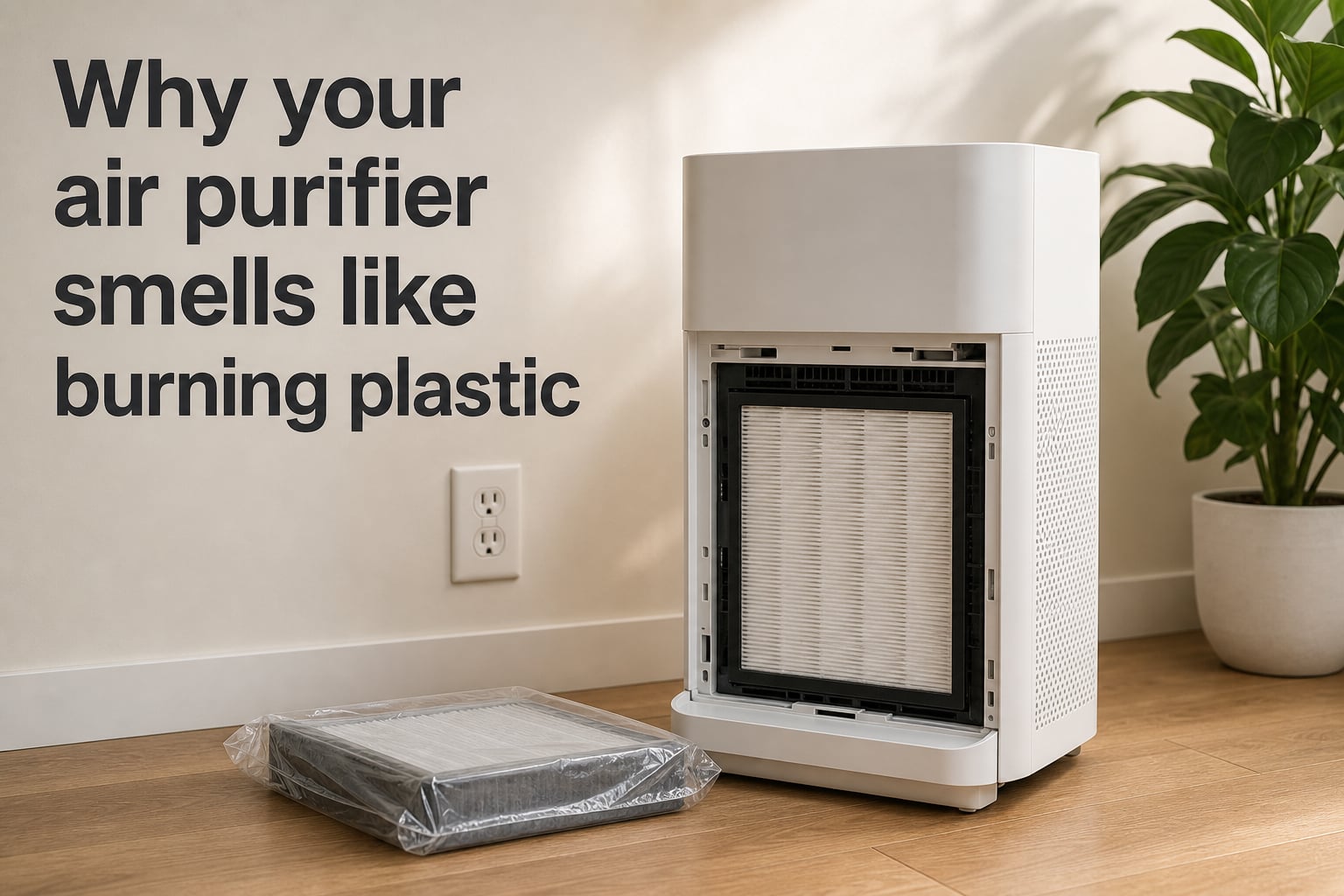
If your air purifier smells like burning plastic, unplug it first if the odor is sharp, gets stronger, or comes with heat, smoke, or a strange sound. A faint plastic or glue-like smell from a new unit can be off-gassing, but restricted airflow, an overheating motor, or an electrical fault needs a different response.
This guide separates the normal new air purifier smell from the signs that mean the purifier should stay off. You will check the filter packaging, the filter condition, the room around the unit, and the symptoms that matter before deciding whether to air the unit out or contact the manufacturer.
The distinction matters because odor alone does not identify the source. In forum discussions, some people report that a new purifier’s chemical smell triggered headaches or allergies, while others report a mild plastic-and-glue smell that faded after normal use.
Table of Contents
A burning-plastic odor usually comes from either new materials or unwanted heat
An air purifier can smell like plastic because new plastics, adhesives, coatings, or filter materials release volatile organic compounds, often called VOCs. This off-gassing is most often described as mild, chemical, plastic-like, or glue-like rather than as a sharp smell of something actively burning.
The more concerning path is heat. A blocked intake, filter packaging left in place, a badly loaded filter, dust buildup, a stressed fan or motor, damaged wiring insulation, or a circuit-board issue can create a hot plastic or burning-electronics odor.
Start by judging the smell and the unit’s behavior together. A low-level odor that declines while the purifier runs normally is different from a smell that appears suddenly in an older unit and grows stronger as fan speed increases.
Off-gassing is the usual explanation for a mild new-plastic odor
Off-gassing means gases leave newly manufactured materials and enter the surrounding air. The purifier’s housing, foam seals, adhesives, and new HEPA filter media can all have a detectable smell when first unpacked.
Activated carbon is meant to adsorb gases and odors, but a new carbon filter may have its own dry, dusty, charcoal-like, or factory smell. That does not mean the purifier is making smoke, although it can be unpleasant in a bedroom or a small closed room.
A sharp hot-electronics odor points to heat, not ordinary off-gassing
A smell that resembles hot wiring, hot rubber, melting plastic, or burning electronics deserves a stop-and-check response. It is more concerning when the casing feels unusually hot, the fan slows or surges, the unit rattles, or the odor starts only at a higher fan setting.
Do not rely on your nose alone. Some fault smells are faint at first, and normal new-material odors can be intense enough to bother sensitive people, so the visible and operating symptoms decide the next step.
Why your air purifier smells like burning plastic is usually clear after you compare the odor, timing, and symptoms
The quickest way to classify the problem is to look at when it began, what it resembles, and whether the purifier is heating up or behaving differently. The patterns below are a guide for action, not a diagnosis of internal electrical components.
- Mild plastic, glue, or chemical smell from a newly opened purifier
- New-material off-gassing is a likely explanation. Ventilate the room, confirm every piece of packaging is removed, and watch for a steady decline rather than a stronger smell.
- Sharp burning plastic, hot rubber, or hot-electronics smell
- Overheating, blocked airflow, or an electrical issue is possible. Unplug the unit and do not restart it until you have completed the external checks and reviewed the manual’s support instructions.
- Musty, sour, wet-dog, or dirty-laundry smell
- A damp or contaminated filter, accumulated dust, or a nearby room source is more likely. Check the pre-filter and filter condition, then follow the manufacturer’s cleaning and replacement directions.
- Ozone-like, bleach-like, or stormy sharp smell
- An ionizer, plasma setting, or other air-treatment feature may be involved. Turn that feature off if the model allows it, then see whether the odor stops.
- Smoke smell that is strongest near a window, kitchen, garage-facing wall, or open door
- The purifier may be pulling in or redistributing an existing room odor. The source needs attention; the machine cannot make a combustion source safe.
Carbon monoxide does not have a dependable smell, including a burnt-plastic smell. Treat a burning odor as a purifier or nearby-source problem, but use working carbon-monoxide alarms for carbon-monoxide protection rather than scent as a warning system.
A new purifier can have a short break-in smell, but it should not worsen
Many competing guides describe an early break-in period of roughly 24 to 72 hours for a new plastic smell. User discussions add that some mild odors fade over one to three weeks of normal operation, especially when a unit is used in a ventilated area rather than sealed in a small room.
Those ranges are not a promise that every odor is normal. A scent that becomes more acrid, remains equally strong, appears after the purifier has been working normally for a while, or causes persistent irritation is a reason to stop treating it as routine break-in.
I would also pay attention to the pattern after a filter change. A replacement filter can have a new-material odor at first, but a new sharp burning smell immediately after installation can also mean the filter is still wrapped, misaligned, or blocking the air path.
A declining odor with normal operation is the reassuring pattern
Place the purifier on a hard, level surface with clear space around its intake and outlet. Run it only while you are nearby for the first few sessions, ventilate the room if outdoor conditions allow, and check that the odor is becoming less noticeable rather than more noticeable.
Keep the unit out of a cramped cabinet, away from fabric that can cover an intake, and away from direct heat. A purifier needs unobstructed airflow to move air through the pre-filter, HEPA media, and carbon layer without straining the fan.
A persistent or stronger odor is the point to pause and investigate
People in air-quality forums commonly ask why several new purifiers from different brands have the same chemical smell. That pattern can reflect sensitivity to new materials or a room that concentrates odors, but it does not make a strong burning odor something to ignore.
One reported experience described three different bedroom purifiers producing a chemical smell that caused headaches or aggravated allergies. The practical response is to stop exposure when it makes you feel unwell, ventilate if possible, and ask the manufacturer about the specific model and filter materials rather than trying to tolerate it indefinitely.
Shipping plastic left on a filter can restrict airflow and create a burning odor
Check the filter packaging before doing anything more complicated. Many purifiers ship with the filters sealed in plastic to keep them clean, and the filter must be removed from that wrapping before the purifier is used.
A wrapped filter can create too much airflow resistance. The fan may work harder, the motor may run hotter, and the plastic film itself may be exposed to warm moving air, producing the exact smell that worries owners.
Unplug the purifier, open only the access panel described in the manual, and remove the filter. Look for clear film, shrink wrap, tape, cardboard, foam inserts, shipping clips, or a second plastic bag around the carbon or HEPA filter.
- Remove every packaging layer without tearing the filter media.
- Match the filter’s airflow arrow or orientation marks to the manual.
- Close the panel completely; some units will not move air correctly with a loose panel.
- Reset the filter indicator only if the manual tells you to do so after installation.
Never wash a HEPA or carbon filter unless the manufacturer specifically labels that exact filter as washable. Water can damage filter media, create a musty air purifier odor, and add a new variable to the troubleshooting process.
An overheating motor or electrical fault means you should stop using the purifier
New-material off-gassing should not come with obvious heat, smoke, or electrical behavior. If the purifier smells like burning plastic and also feels hot beyond normal operating warmth, makes a buzzing or grinding sound, loses fan speed, repeatedly turns off, or shows melted or discolored plastic, leave it unplugged.
Inspect only the exterior power cord, plug, outlet area, vents, filter door, and accessible filter compartment while the unit is unplugged. Do not remove screws, probe the motor, touch a circuit board, or bypass a safety switch.
A burning smell can originate outside the purifier. Check whether a power strip, wall outlet, extension cord, nearby charger, kitchen appliance, heater, or an outdoor source could be producing the odor; if the room still smells when the purifier has been unplugged for a while, the purifier may not be the source.
A carbon filter can become saturated and release trapped odors back into the room
Activated carbon has limited capacity. After exposure to cooking fumes, smoke, pet odors, cleaners, or other gases, carbon filter saturation can make a room air purifier smell stale, sour, chemical, or like the odor it has been collecting.
That is different from melted plastic, but the distinction can blur in a closed room. Check the manufacturer’s filter schedule and the filter’s condition; do not assume a HEPA layer alone handles gases and odors.
A damp or dirty filter can produce musty odors that need cleaning or replacement
Moisture, dust, and organic debris in a pre-filter or filter compartment can create a musty smell. This is more likely after the unit has been stored in a damp place, used close to a humidifier, or cleaned in a way that left moisture inside.
Vacuum or wash only the parts that the manual says are cleanable, then let washable parts dry completely before reassembly. If the primary filter smells musty and is not designated washable, replacement is generally safer than attempting to deodorize it with sprays or water.
This seven-step process separates normal off-gassing from a fault without taking the purifier apart
Unplug the purifier and let it cool before checking anything: Step 1
Turn the purifier off, unplug it directly from the wall or power strip, and wait until the exterior is cool. This removes the immediate heat source and gives you a clearer chance to locate whether the odor is strongest at the cord, outlet, exhaust, filter compartment, or elsewhere in the room.
If there is smoke, melting, a hot plug, or an odor that seems electrical, stop here. Photograph the external symptoms from a safe distance and contact the manufacturer; for a damaged outlet or wiring concern, use a qualified electrician.
Check the cord, plug, outlet, and exterior vents for warning signs: Step 2
Look for fraying, crushing, scorch marks, yellowing, melted insulation, or a plug that feels loose in the outlet. Do not plug the purifier back in just to compare smells if you find any of these signs.
Also check that dust, a curtain, furniture, bedding, or a wall is not blocking the intake or exhaust. Airflow restriction is one of the few external causes you can correct safely, and it can make the fan and motor work harder.
Remove all filter packaging and confirm filter orientation: Step 3
Open the filter cover as directed by the product manual. Take out the filters and verify that all plastic, tape, cardboard, foam, and shipping inserts are gone, then reinstall each filter in the stated order and orientation.
This is the highest-value check for a newly unpacked unit or a purifier that started smelling after a filter swap. It resolves a common setup error without guessing about internal damage.
Check whether the smell follows the filter or stays with the machine: Step 4
With the purifier unplugged, smell near the removed filter and then near the empty, accessible filter compartment without touching electrical parts. A smell concentrated in a damp, dusty, or saturated filter suggests filter maintenance, while a strong odor at the motor area, cord, or outlet increases the need for professional support.
Do not run a purifier without filters unless its manufacturer explicitly permits that test. Removing filters can alter airflow and may expose internal parts to dust, so it is not a general-purpose way to test a burning smell.
Move the unit away from odor sources and improve room ventilation: Step 5
Put the purifier in an open area away from cooking, scented products, cleaning chemicals, smoke, a heater, or a garage-facing doorway. If weather and air-quality conditions permit, open a window or door briefly to reduce the concentration of a mild new-product smell.
This step addresses a frequent misunderstanding: a purifier can circulate and draw attention to an existing smell without creating it. If the odor follows a room location rather than the machine, investigate the room source first.
Restart only after the external checks pass and monitor one low-speed session: Step 6
If there were no electrical warning signs, no packaging remains, the filters are correctly seated, and the odor was mild and new-material-like, restart the purifier while you remain in the room. Begin at a low setting and watch for a worsening odor, unusual heat, vibration, fan changes, error lights, or a new noise.
Turn it off immediately if the smell changes from mild plastic to sharp burning plastic, or if any warning sign appears. Do not try repeated high-speed runs to force a smell away.
Document the symptoms and contact support when the odor does not fade: Step 7
Manufacturer support can act faster when you provide the model number, serial number, purchase date, filter installation date, first date of the smell, fan setting, room conditions, and whether the smell is from the filter, exhaust, cord, or outlet. Include photos of external packaging left on a filter, discoloration, or a damaged cord if it is safe to take them.
A forum report specifically described a Shark HE601 with a burning rubber or plastic smell. The useful lesson is not that one brand is the cause, but that a named model, a clear odor description, and operating symptoms give support staff the details needed to advise on warranty service, a replacement filter, or stopping use.
Proper filter care and placement prevent many repeat odors
Follow the model-specific maintenance schedule rather than using a universal replacement interval. Filter life changes with smoke, pets, cooking, dust, fan speed, and room conditions, and a filter light is a prompt to check the manual rather than proof that every layer needs the same treatment.
Keep enough clear space around the intake and outlet for air to move freely. A purifier placed behind furniture, pressed against a wall, covered by clothing, or used on soft bedding may recirculate heat and collect dust faster than one in an open location.
Clean only removable grilles and pre-filters that the manual identifies as cleanable. Do not add fragrance oils, odor sprays, or cleaning chemicals inside the machine; those products can leave residue, mask the original smell, or make it impossible to tell if the odor has changed.
Ionizer and ozone settings deserve a separate odor check
Some purifiers have an ionizer, plasma, or related air-treatment mode that can create a sharp odor people describe as ozone-like, bleach-like, or like the air after a storm. If your model has such a feature, turn it off and compare the odor during a monitored session with the standard filtration mode.
Do not confuse this smell with normal plastic off-gassing or with a burning electrical smell. A mode-specific sharp odor is useful information for the manufacturer and helps narrow what you should discuss with support.
UV-C components need manufacturer guidance if a new hot smell appears
Some units include UV-C features. If a new odor begins when that feature is active, turn the unit off, consult the manual, and contact the manufacturer rather than opening the device or trying to replace internal components.
The same rule applies to a new burning smell after cleaning, storage, or a filter change. The timing is useful evidence, but it does not make a do-it-yourself electrical repair safe.
Your most common air-purifier smell questions have straightforward safety answers
Why does my air purifier smell like plastic?
A new purifier may smell like plastic or glue because plastics, adhesives, and filter materials are off-gassing. If the smell is mild and fading, check that all filter packaging is removed and ventilate the room; if it is sharp, worsening, or paired with heat or smoke, unplug the unit.
Is the plastic smell from a new air purifier normal?
A mild new-plastic or chemical smell can occur during an early break-in period, especially from the housing, adhesives, or new filter materials. It should not come with excessive heat, smoke, electrical noises, melting, or a smell that gets stronger.
How long does a new air purifier smell last?
Many guides describe a noticeable early odor for about 24 to 72 hours, while user reports sometimes describe a mild smell fading over one to three weeks. There is no fixed safe timeline, so stop using the unit and contact support if the odor is strong, persistent, or changing toward a burning smell.
What should I check first if my air purifier smells like plastic?
Unplug it, then check the filter compartment for shipping plastic, tape, foam, or cardboard and confirm the filters are installed in the correct order. Also inspect the external cord, plug, vents, and outlet for heat damage before restarting.
Why does my air purifier smell like burning plastic?
A sharp burning-plastic smell can come from blocked airflow, an overheating fan or motor, damaged wiring, or an electrical fault. Unplug the purifier and do not use it again if there is smoke, unusual heat, melting, sparking, a scorched cord, or a worsening odor.
Does carbon monoxide smell like burnt plastic?
No. Carbon monoxide has no reliable odor, so a burnt-plastic smell cannot be used to detect it. Use working carbon-monoxide alarms and respond to a burning odor by checking the purifier and nearby electrical or combustion sources.
A mild new-material smell can fade, but a burning odor always deserves a safety check
When an air purifier smells like burning plastic, start with the simple external checks: unplug it, inspect the cord and outlet, remove filter packaging, and clear the airflow path. A mild odor that declines after correct setup may be off-gassing; a strong, hot, worsening, or electrical smell is the point to stop using the machine and call support.
Use this 2026 checklist whenever the smell appears after unpacking, a filter change, cleaning, or a move to another room. Clear notes about the smell, timing, fan setting, and visible symptoms make your next conversation with the manufacturer much more useful.