
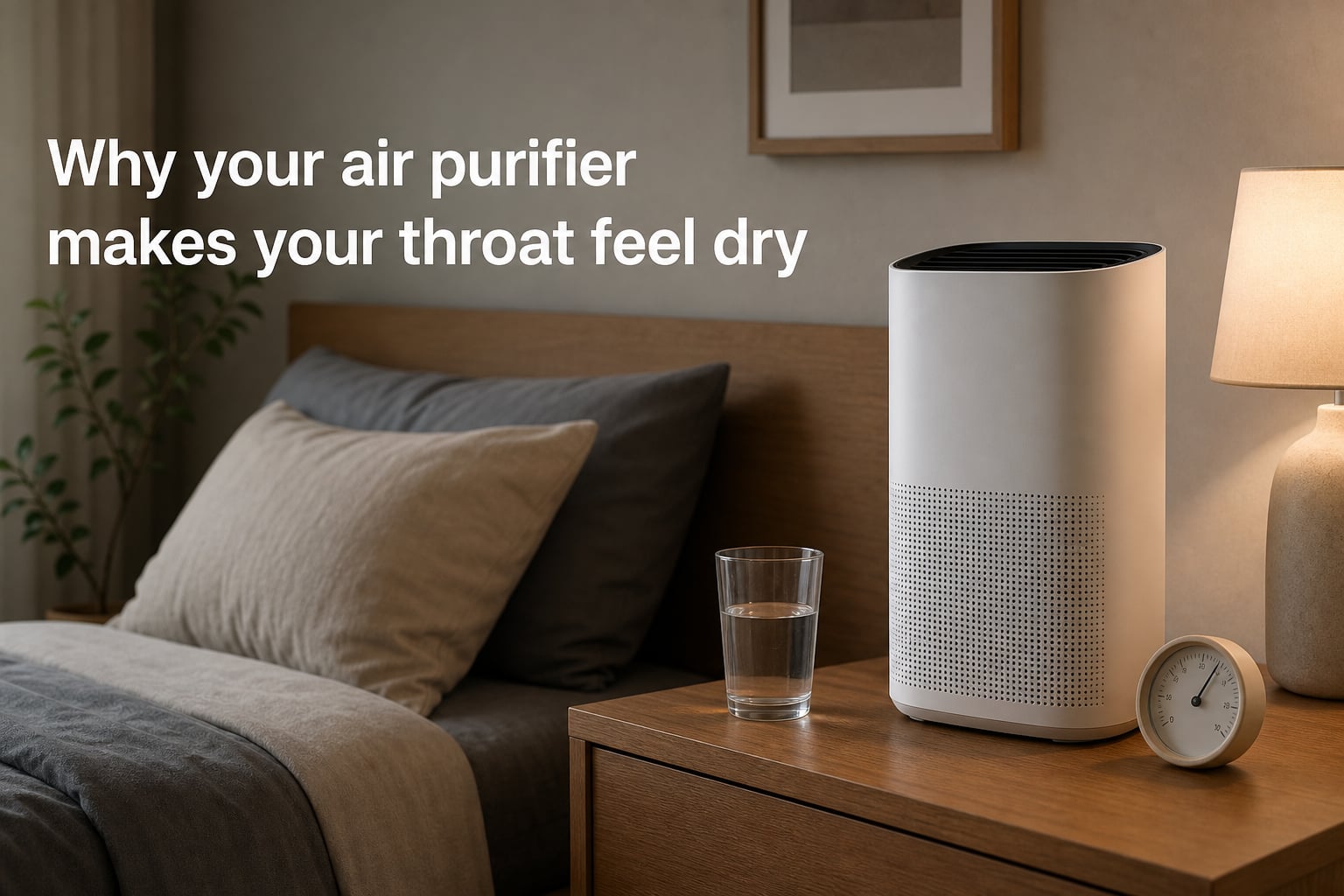
Yes, your air purifier can make your throat feel dry. The most common cause is reduced indoor humidity from constant air circulation, which pulls moisture from your mucous membranes. Ozone-emitting ionizers and high fan speeds make the effect worse, especially overnight when you cannot consciously rehydrate.
I first noticed this myself during a brutal winter two years ago. I had just unboxed a sleek new purifier for my bedroom, and within three nights I was waking up at 3 a.m. with a throat so dry it felt lined with sandpaper. One Reddit user described the exact same thing after running a Levoit Core 300 at the foot of the bed: “woke up thirstier than I have in a long time. My mouth, nose, skin, and throat all dry.”
That kind of overnight dryness is not in your head, and it is not a defect in your purifier. It is the predictable Aresult of how air-cleaning technology interacts with the delicate tissues of your respiratory tract. In this guide, I will walk you through the exact reasons why your air purifier makes your throat feel dry, the three purifier types responsible for the worst symptoms, and the practical changes our team uses to keep the air clean without wrecking our comfort.
You will learn the science of mucous membrane evaporation, how HEPA, ionic, and ozone purifiers differ in their drying effects, why mornings hit the hardest, and a step-by-step prevention plan you can set up tonight.
Table of Contents
How air purifiers work and why they affect your throat
Air purifiers do not add anything to the air. They move air through filters or charged plates to capture particles, allergens, smoke, and sometimes odors. A standard household unit pulls in room air, forces it through a HEPA or carbon filter, and pushes the cleaned air back out.
That constant circulation is the heart of the problem. Every cubic foot of air that brushes past your lips, nose, and throat carries a tiny amount of moisture away with it. Under normal conditions, your mucous membranes replace that moisture fast enough that you never feel it. Under continuous high-speed airflow, the balance tips.
The basic mechanism of air purification
Most home purifiers use one or more of these technologies. A mechanical HEPA filter traps particles down to 0.3 microns. An activated carbon layer absorbs gases and odors. Ionic and electrostatic models charge particles so they stick to a plate. Ozone generators deliberately produce O3 to neutralize odors. UV-C units attempt to kill biological contaminants with light.
None of those technologies remove water vapor from the air in any meaningful way. A HEPA filter, for example, cannot tell the difference between a dust particle and a water molecule. So if your throat is drying out, it is not because the purifier is sucking humidity out. It is because the purifier is accelerating evaporation from your tissues.
The connection between air circulation and moisture
Think of it this way. Wet laundry dries faster on a windy day than on a still one. The same physics applies to the wet surfaces inside your nose and throat. Air moving across those tissues carries moisture away, and your body has to keep refilling the supply.
If the surrounding air is already dry (below 30 percent relative humidity), your body has to work harder to keep up. If a purifier runs for eight hours straight at high speed, you can lose more fluid from your respiratory tract than you can easily replace, especially while you sleep and breathe through your mouth.
How ACH impacts the drying effect
ACH stands for Air Changes Per Hour, and it is the cleanest way to size a purifier to your room. One ACH means the purifier cycles the entire room volume once per hour. Five ACH means five full cycles, which is the standard recommended for allergy and asthma relief.
Higher ACH means more airflow, which means more evaporation from your tissues. A purifier running at five ACH in a small bedroom will dry the air around you much faster than a unit running at two ACH in a large living room. This is why placement and room size matter just as much as filter type.
The 3 main reasons your air purifier dries out your throat
When our team dug into forum posts, Reddit threads, and user reviews, the same three culprits kept surfacing. Sometimes they act alone, but more often they stack on top of each other. If your air purifier makes your throat feel dry, one of these is almost always involved.
1. Reduced indoor humidity
This is the biggest driver for most people. Indoor air in heated homes often sits between 10 and 30 percent relative humidity in winter, well below the 30 to 50 percent range that doctors consider comfortable. A purifier does not drop the humidity further, but it constantly bathes your airways in that already-dry air.
The mucous membranes in your throat and nose act like sponges, soaking up water from the air you breathe. When that air is too dry, the membranes slowly desiccate. After a few hours, you start to feel scratchy, then sore, then outright painful. Many users say the dryness hits hardest in the morning because they have been breathing low-humidity air for seven or eight hours straight.
2. Ozone emissions from ionizers and ozone generators
Ionizers and ozone generators produce trace amounts of ozone as a byproduct or as the primary cleaning agent. Ozone is a strong oxidant, and it directly irritates the tissues of your throat, lungs, and eyes.
The EPA has warned against ozone generators for indoor use because the gas inflames respiratory passages even at low concentrations. If your purifier has an “ionizer,” “plasma,” or “fresh air” mode, and your throat feels scratchy within minutes of turning it on, ozone is probably contributing.
3. Direct airflow and mucous membrane irritation
Where you place the purifier matters as much as what it does. Sit too close to the outlet, and you are essentially pointing a small fan at your face all night. That direct stream accelerates evaporation on one side of your mouth and nose while the rest of the room stays calmer.
Several users have described this sensation as similar to sleeping under a ceiling fan, only worse because the air from a purifier is colder and dryer. Moving the unit across the room, or angling the outlet toward a wall instead of your pillow, often clears the symptom up immediately.
HEPA vs ionic vs ozone air purifiers: which dries your throat most
Not all air purifiers dry your throat equally. The technology inside the box is the single biggest predictor of whether you will wake up uncomfortable. Here is how the main types stack up.
| Purifier type | How it cleans | Dry throat risk | Best for |
|---|---|---|---|
| HEPA-only | Mechanical filter traps particles | Low | Allergies, asthma, general use |
| HEPA + activated carbon | Adds odor and gas absorption | Low | Smoke, cooking smells, VOCs |
| Ionic / electrostatic | Charges particles to a plate | Medium (ozone byproduct) | Quiet operation, large rooms |
| Ozone generator | Produces O3 to neutralize odors | High | Not recommended for occupied spaces |
| UV-C light | Kills biological contaminants | Low to medium | Mold, bacteria concerns |
| Hybrid (HEPA + ionizer) | Combines both | Medium | Only if ionizer is optional and off |
HEPA filter purifiers
Pure HEPA purifiers are the safest choice if you want clean air without drying out your throat. They do not emit ozone, do not produce charged particles, and only move air. The drying you feel is purely the humidity effect, which is easier to manage with a humidifier or by adjusting fan speed.
Ionic and electrostatic purifiers
Ionic purifiers look appealing because they have no real filter to replace and run almost silently. The catch is that they produce small amounts of ozone as a byproduct, and they release charged particles into the room. If your throat stings within minutes of turning one on, that is the ozone doing its job on your tissues, not on the air.
Ozone-generating purifiers
These units are sold as “air fresheners” or “odor eliminators,” and they are the worst offenders for throat irritation. The California Air Resources Board has banned many of them, and the EPA advises against using them in any occupied space. If your purifier claims to remove smells by producing “activated oxygen” or “trioxygen,” unplug it.
UV-C and hybrid models
UV-C purifiers use light to neutralize bacteria and mold. They do not produce ozone, but some hybrid units combine UV-C with an ionizer. In those cases, the ionizer is the problem, not the UV-C. Look for models that let you switch the ionizer off independently.
Why dry throat hits hardest in the morning
Morning throat dryness is its own special misery, and almost no competitor covers it directly. If your air purifier makes your throat feel dry right when you wake up but feels fine during the day, the overnight cycle is the culprit.
Overnight dehydration cycle
You breathe roughly 12 to 20 times per minute while asleep, which adds up to thousands of breaths per night. Each one moves air across your throat tissues. If that air is dry and moving fast, you lose fluid faster than your body can replace it, especially in the second half of the night.
By the time your alarm goes off, you have lost a measurable amount of water through your respiratory tract alone. Add eight hours without drinking, and you wake up parched.
Bedroom placement and direct airflow
Bedrooms are small, so people often put the purifier on the nightstand or directly at the foot of the bed. Both placements aim the clean air output straight at your face. That concentrated stream is far more drying than the diffused air you would get in a larger room.
The fix is simple: move the unit at least six feet away and angle the outlet toward the center of the room or up toward the ceiling instead of across the bed.
Sleeping with your mouth open
Many people breathe through their mouth at night without realizing it, especially if they have allergies or a deviated septum. Mouth breathing bypasses your nose’s natural humidification system entirely, so the dry air from the purifier goes straight to your throat with no warming or moisturizing along the way.
If you snore or wake up with a dry mouth, try a chin strap, nasal dilator, or talk to a doctor about possible obstructive sleep apnea. The purifier is not the only thing drying you out at night.
Side effects beyond dry throat to watch for
A dry throat is rarely the only symptom. Our team has read dozens of forum threads where users describe a cluster of related effects. If your air purifier makes your throat feel dry, you may also notice some of these.
Sinus and nasal dryness
Your sinuses are lined with the same kind of mucous membrane as your throat. Dry air causes the same evaporation there, leading to a feeling of stuffiness, crusting around the nostrils, or even nosebleeds in extreme cases. Sinuses that are too dry also lose some of their ability to trap incoming particles, which partially defeats the purpose of running the purifier.
Skin and eye irritation
Several forum users report dry skin and itchy eyes alongside their throat symptoms. The cause is the same: low humidity pulling moisture from every exposed surface. If you notice your skin flaking or your eyes stinging after a night with the purifier on, humidity is almost certainly too low.
Dizziness and headaches
Some users report mild dizziness or headaches when running ionic or ozone-emitting purifiers. Ozone exposure is the most likely cause, since it can affect oxygen uptake at high concentrations. If you feel dizzy along with dry throat, turn the unit off for a day and see if symptoms improve.
How to stop your air purifier from drying out your throat
The good news is that almost every cause of air-purifier-induced dry throat has a simple fix. You do not have to stop using your purifier to feel better. You just have to give your environment what the purifier cannot: moisture, distance, and the right settings.
1. Monitor humidity with a hygrometer
Buy an inexpensive hygrometer and keep it in the same room as your purifier. Aim for 40 to 50 percent relative humidity during the day and 30 to 45 percent at night. If your humidity is already below 30 percent, the purifier is not the root cause; the heating system is. The purifier is just making the dry air more noticeable.
2. Add a humidifier to the room
A separate humidifier is the single most effective fix our team has found. You can run a cool-mist humidifier in the same room as the purifier to bring humidity back into the 30 to 50 percent comfort range. Just keep them at least a few feet apart so the purifier does not pull moisture out of the humidifier’s mist before it spreads.
3. Adjust fan speed and placement
Switch from high to medium or low fan speed overnight. Move the unit at least six feet from your head, and angle the outlet away from your pillow. These two changes alone resolve the issue for most users we have heard from.
4. Replace filters on schedule
A clogged filter makes the fan work harder, which means faster, drier airflow. Most HEPA filters need replacement every 6 to 12 months depending on use. A fresh filter actually reduces drying because the unit can move air more efficiently at a lower fan speed.
5. Run intermittently vs continuously
If you do not need continuous cleaning (for example, you do not have pets or severe allergies), try running the purifier on a timer. Two or three hours on, an hour off, lets your mucous membranes recover between cycles. Auto modes on modern units often do this for you based on air quality readings.
6. Switch off the ionizer or ozone mode
If your purifier has a separate ionizer, plasma, or “fresh air” button, turn it off and see if symptoms improve. Most modern HEPA units clean the air perfectly well without it, and the ozone byproduct is rarely worth the marginal odor benefit.
7. Choose a HEPA-only model if you are buying new
If you are shopping for a replacement, look for true HEPA filtration without an ionizer. Skip anything marketed as an “ozone air purifier” or “activated oxygen” device. The Asthma and Allergy Foundation of America maintains a list of certified asthma- and allergy-friendly models that follow these guidelines.
When to talk to a doctor about air purifier symptoms
Most dry throat symptoms from an air purifier are uncomfortable but not dangerous. However, some signs point to a larger issue worth discussing with a healthcare professional.
See a doctor if your dry throat lasts more than two weeks even after adjusting your purifier and adding humidity. Other reasons to seek help include persistent coughing, wheezing, shortness of breath, recurring sinus infections, or any throat pain that feels like it is getting worse rather than better.
People with asthma, COPD, or other respiratory conditions should be especially careful with ionic and ozone-emitting purifiers. If you fall into one of these groups and your air purifier makes your throat feel dry, switch to a HEPA-only unit and check in with your doctor about ongoing symptoms.
FAQs
Can an air purifier dry your throat out?
Yes. Air purifiers do not remove humidity directly, but they circulate dry air constantly across your throat and nose, which speeds up moisture loss from the mucous membranes. Low room humidity, ozone from ionizers, and direct airflow from a nearby purifier make the effect much worse, especially overnight.
How do I fix an insanely dry throat from my air purifier?
Start by measuring your room humidity with a hygrometer and aiming for 30 to 50 percent. Add a cool-mist humidifier if it is below 30 percent. Move the purifier at least six feet from your head, lower the fan speed, and turn off any ionizer or ozone mode. These four steps clear up the symptom for most people within a few days.
What are the side effects of using an air purifier?
The most common side effects are dry throat, dry sinuses, dry skin, itchy eyes, and in some cases mild dizziness or coughing. Side effects are usually linked to low humidity, high fan speed, or ozone from ionizer-style purifiers. HEPA-only models with proper humidity control rarely cause noticeable symptoms.
Is it okay to sleep with an air purifier on all night?
Yes, as long as it is a HEPA-only model and the room humidity stays between 30 and 50 percent. Place the unit several feet from your head, run it on low or medium fan speed, and consider pairing it with a humidifier in winter. Avoid ionic or ozone-emitting models for overnight use.
Can an air purifier dry out your sinuses?
Yes. The same evaporation process that dries your throat also affects the mucous lining in your sinuses. Symptoms include a stuffy feeling, crusting around the nostrils, and in severe cases nosebleeds. Adding humidity and switching to a HEPA-only purifier usually resolves sinus dryness within a week.
Do air purifiers take moisture out of the air?
No. Air purifiers move air through filters but do not extract water vapor. The dryness you feel comes from accelerated evaporation on your skin and mucous membranes, not from the purifier itself removing humidity. If your indoor humidity is low, the purifier simply makes the dry air more noticeable by blowing it around your face.
The bottom line on why your air purifier makes your throat feel dry
Your air purifier makes your throat feel dry because it accelerates moisture loss from the tissues of your respiratory tract, not because it pulls water out of the air. The biggest contributors are low indoor humidity, direct airflow from a poorly placed unit, and ozone emissions from ionizer-style purifiers.
You do not need to choose between clean air and a comfortable throat. Measure your humidity, add a humidifier if it is below 30 percent, move your purifier across the room, lower the fan speed, and turn off any ozone or ionizer modes. For most people, those five changes turn the purifier from a nightly nuisance into a quiet helper.
If symptoms persist for more than two weeks after making those adjustments, talk to a doctor. Dry throat that does not respond to environmental changes can occasionally signal something else, and your physician can help you rule it out.