
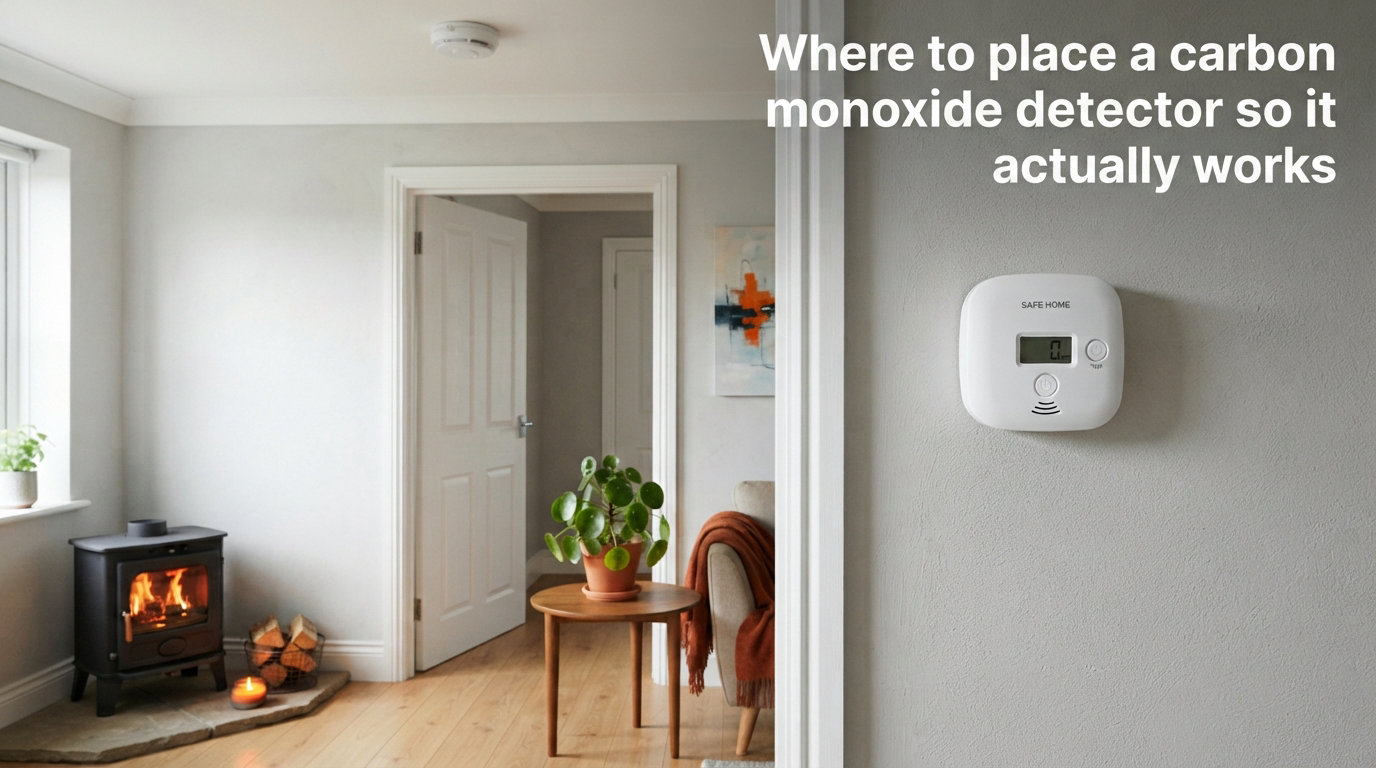
A carbon monoxide detector taped to the wrong wall gives you nothing but false confidence. Our team has looked into hundreds of placements in homes, apartments, and rentals, and the same mistakes show up over and over: detectors stuck behind furniture, mounted in dead-air corners, or shoved next to a window where drafts dilute the reading.
Correct carbon monoxide detector placement is the single biggest factor in whether the alarm actually wakes you up in time. The gas is colorless, odorless, and tasteless, so your nose cannot help you. The detector is your only warning system, and where you put it determines how fast it reacts.
This guide breaks down exactly where to install CO detectors, the right height, the spots to avoid, how many you need, and the maintenance that keeps them working. Everything here is based on NFPA 720 guidance, UL 2034 standards, and real-world reports from homeowners and firefighters.
Whether you just bought your first detector or you are auditing the ones already mounted in your home, these placement rules will help you get it right the first time.
Table of Contents
Why Carbon Monoxide Detector Placement Matters
Carbon monoxide is produced whenever a fuel burns incompletely. Furnaces, water heaters, gas stoves, fireplaces, wood stoves, attached vehicles, portable generators, and charcoal grills all generate CO as a byproduct.
The gas replaces oxygen in your bloodstream. Even moderate exposure causes headaches, dizziness, confusion, and nausea. High exposure leads to loss of consciousness, brain damage, and death, often within minutes. According to the CDC, more than 400 Americans die each year from unintentional CO poisoning, and thousands more visit emergency rooms.
Placement matters because CO disperses through your home based on air currents, temperature, and how the gas was released. A detector in the wrong spot may take 15 to 30 minutes longer to register dangerous levels. That delay can be fatal when someone is already asleep.
The goal of carbon monoxide detector placement is simple: position alarms so they sense rising CO levels as early as possible, then alert every sleeping person before concentrations become dangerous.
CO Exposure Levels and Health Effects
Understanding ppm (parts per million) helps you read what your detector is telling you. Standard UL 2034 detectors are designed to alarm at specific thresholds, but they do not alert you to low-level CO that builds up slowly over days.
Here is what different CO concentrations mean for your body:
9 to 35 ppm: Normal indoor background levels. No action needed in most cases.
35 to 50 ppm: Maximum allowable exposure for 8 hours in workplace settings. Investigate possible sources.
50 to 100 ppm: Headaches, fatigue, and shortness of breath after several hours. Open windows and check appliances.
100 to 200 ppm: Mild poisoning symptoms within 1 to 2 hours. Dangerously high for prolonged exposure.
200 to 400 ppm: Severe headache, nausea, confusion. Evacuate immediately.
400+ ppm: Life-threatening within 1 to 3 hours. Loss of consciousness and death possible.
Standard CO detectors do not sound the alarm until CO reaches roughly 70 ppm for 1 to 4 hours, or much higher for shorter periods. Low-level CO monitors exist for people who want earlier warnings, particularly those with infants, elderly family members, or anyone with heart or lung conditions.
Where to Place a Carbon Monoxide Detector (Required Locations)
The NFPA and most building codes agree on three minimum placement rules. Follow these and you cover the essentials that keep people alive.
1. Outside Each Sleeping Area
Place a CO detector in the hallway outside every bedroom or group of bedrooms. This is the single most important location because people are most vulnerable while sleeping.
If bedrooms are spread across different parts of the house, you need multiple detectors. A detector near the master bedroom does not help someone sleeping in a basement room on the other side of the house, especially with closed doors blocking sound travel.
Mount the detector close enough that the alarm will wake sleepers through a closed door. The general rule is within 10 to 15 feet of the bedroom door.
2. On Every Level of the Home
Every floor of your home needs at least one CO detector, including the basement and any habitable attic space. CO produced on the ground floor will eventually rise and spread upstairs, but a detector on each level catches the danger sooner.
This includes finished basements, even if nobody sleeps there. Basements often house the furnace and water heater, two of the most common CO sources in a home.
3. Near Fuel-Burning Appliances
Place a detector within 10 to 15 feet of any fuel-burning appliance, which includes furnaces, gas water heaters, gas stoves, fireplaces, and wood stoves. This gives you an early warning if an appliance starts backdrafting or malfunctioning.
Do not mount the detector directly above or right next to the appliance. Combustion gases and moisture from the appliance can trigger false alarms and damage the sensor over time. Stay at least 5 feet away from cooking and heating equipment.
4. Near an Attached Garage
If your home has an attached garage, put a detector in the room adjoining it. Cars produce large amounts of CO during the first few minutes after starting, and that gas can enter the living space through connecting doors.
Never place the detector inside the garage itself. Garages are considered non-living spaces, and vehicle exhaust, temperature swings, and dust will trigger constant false alarms and shorten sensor life.
5. In Hallways and Common Areas
Hallways connecting bedrooms, living rooms, and kitchens are prime detector locations. Air circulates through these spaces, making them reliable sampling points for CO levels throughout the house.
Living rooms and family rooms near fireplaces or gas logs also warrant their own detector if the layout makes sense.
The Height Question: Should a CO Detector Be High or Low?
This is the most debated question in carbon monoxide detector placement, and the confusion comes from a misunderstanding of how CO behaves in air.
Carbon monoxide has a molecular weight of 28, which is slightly lighter than air (average molecular weight around 29). This small difference is not what determines where CO collects in a room. In a real home, CO mixes evenly with the surrounding air within minutes due to air currents, convection, and the forced-air movement from HVAC systems.
The NFPA and most detector manufacturers now state that mounting height does not significantly affect how quickly a CO detector responds. You can place it on the wall, on the ceiling, or anywhere in between, and it will work.
The Practical Recommendation
Mount CO detectors at a height that is easy to reach for testing and battery changes. For most homes, that means chest height on the wall, roughly 5 feet off the floor.
This puts the detector in the breathing zone, makes the digital display readable, and keeps it out of the way of curious children and pets. Avoid placing it so high that you need a ladder every time the battery chirps.
Exceptions to the Height Rule
Follow the specific instructions in your detector manual, because some models are calibrated for a particular mounting orientation. Combination smoke and CO detectors usually need ceiling placement because smoke detectors require it.
In homes with vaulted ceilings or open lofts, dead-air spaces can form near the peak where air barely moves. Avoid mounting detectors in these stagnant zones, because the slow air exchange delays detection.
Where NOT to Place a Carbon Monoxide Detector
Putting a CO detector in the wrong location causes false alarms, missed warnings, and premature sensor failure. Here are the spots to avoid.
Inside the Garage
Vehicle exhaust contains concentrated CO and other pollutants that overwhelm the sensor. A detector in the garage will alarm every time a car starts, and constant exposure shortens the sensor life dramatically. Place it in the room next to the garage instead.
Near Windows, Doors, and Vents
Drafty areas dilute the air around the detector, which slows response time and can prevent the alarm from triggering at all. Keep detectors at least 5 feet away from windows, exterior doors, ceiling fans, supply registers, and kitchen exhaust vents.
In or Near the Kitchen
Cooking produces combustion gases and moisture that trigger false alarms. If you have a gas stove, place the detector at least 10 feet away, ideally in an adjoining hallway rather than the kitchen itself.
Directly Above or Beside Fuel-Burning Appliances
Combustion gases and humidity from furnaces, water heaters, and fireplaces can fool the sensor and degrade it faster. Maintain the 5 to 15 foot buffer recommended earlier.
In Bathrooms and Humid Rooms
Steam and high humidity interfere with the electrochemical sensor inside most CO detectors. Bathrooms, laundry rooms, and any space near a humidifier should be avoided.
In Dead-Air Spaces
Corners where two walls and the ceiling meet often have minimal air movement. CO reaching these spots takes longer to register. Stay at least 4 inches away from corners and avoid tight spaces behind furniture or curtains.
In Extreme Temperatures
Most CO detectors are rated for 40 to 100 degrees Fahrenheit. Unheated garages, sheds, porches, and attics with poor insulation fall outside this range and cause the sensor to malfunction. Check the temperature rating on your specific model.
How Many Carbon Monoxide Detectors Do You Need?
The minimum standard is one detector outside each sleeping area and one on every level of the home, including the basement. For most families, that works out to at least three to five detectors.
Here is a practical breakdown by home type:
Single-Story Home or Apartment
A typical one-story home needs a minimum of two detectors. Place one in the hallway outside the bedrooms and one near the living area or kitchen. If you have an attached garage or gas appliances, add a third near those sources.
Two-Story Home
Plan for at least three to four detectors. One outside the upstairs bedrooms, one in the downstairs hallway or living area, one near the furnace or water heater (often in the basement), and optionally one near an attached garage.
Large or Multi-Zone Homes
Bigger homes with separated sleeping wings, basement suites, or in-law quarters need additional detectors in each zone. The rule of thumb is simple: every sleeping area gets its own nearby detector, and no detector should be more than one floor away from any sleeping room.
Homes Without Fuel-Burning Appliances
Even all-electric homes should have at least one CO detector if they have an attached garage. Cars remain a CO source, and neighboring units in apartment buildings can share vents or connected spaces.
Special Placement Situations
Some home setups require extra attention. Here are the scenarios that catch people off guard.
Attached Garages
We have covered this, but it deserves emphasis. The connecting room between your garage and living space is a critical detector location. Car engines produce the highest CO output during the first one to two minutes after starting, before the catalytic converter warms up.
If you warm up your car in the garage, even with the door open, CO can seep into the house. A detector in the mudroom, laundry room, or entry hall adjacent to the garage catches this exposure early.
Basements With Furnaces and Water Heaters
Basement placement is non-negotiable if your furnace or water heater lives there. Mount the detector on the basement ceiling or wall, 10 to 15 feet from the appliance, in a spot where air from the utility area naturally flows toward it.
Avoid corners and areas blocked by storage shelving. The detector needs circulating air to sample accurately.
Fireplaces and Wood Stoves
Wood and gas fireplaces produce CO when combustion is incomplete, which happens with dirty chimneys, blocked flues, or poor draft. Place a detector in the same room as the fireplace, at least 5 feet from the opening.
For wood stoves, follow the same buffer rule. The detector should be close enough to catch a backdraft but far enough to avoid the heat and combustion gases right at the stove.
Portable Generators (Critical Safety Warning)
Generators are one of the deadliest CO sources during power outages. A single portable generator produces as much CO as hundreds of idling cars, and FEMA reports that most generator-related CO deaths happen when units are run indoors, in garages, or too close to the house.
Never operate a portable generator inside the home, in a garage, in a basement, in a crawl space, or within 20 feet of any window, door, or vent. If you use a generator during outages, make sure you have working CO detectors near the sleeping areas and in rooms that face the generator location.
If the alarm sounds during generator use, evacuate immediately and call 911. Do not assume the alarm is a false trigger.
Vaulted Ceilings and Open Lofts
Open floor plans and vaulted ceilings create large volumes of air that dilute CO and slow detector response. In these homes, consider placing detectors lower on the wall rather than at the peak, where dead-air spaces reduce effectiveness.
Combination Smoke and CO Detectors
Combination units must follow smoke detector placement rules, which usually means ceiling mounting. Check the manual for your specific model, because some combos are rated for wall mounting while others are not.
Combination detectors are convenient and reduce clutter, but keep in mind they expire as a unit. If either sensor fails, the whole device needs replacement.
Carbon Monoxide Detector Maintenance and Replacement
A detector only works if you maintain it. Dead batteries and expired sensors are the two most common reasons CO alarms fail when they are needed most.
Test Monthly
Press the test button on every detector once a month. The alarm should sound within a few seconds. If it does not, replace the battery and test again. If it still fails, replace the detector.
Replace Batteries on Schedule
For battery-powered detectors, replace the batteries at least once a year or whenever you hear the low-battery chirp. Many homeowners tie this to the daylight saving time clock change as a memory aid.
Hardwired detectors with battery backup also need fresh backup batteries. The backup is what keeps the alarm working during a power outage, which is exactly when generator use spikes.
Replace Detectors Every 5 to 10 Years
The electrochemical sensor inside a CO detector degrades over time. Most units carry a 5 to 7 year lifespan, though some premium models last up to 10 years. Check the manufacture date printed on the back of the unit, not the date you installed it.
When the sensor reaches end of life, the detector will typically chirp in a distinct pattern or display an end-of-life code. Do not ignore this signal. Replace the unit immediately.
Understand Alarm Patterns
A continuous loud alarm means CO has reached dangerous levels. Evacuate the home, move to fresh air, and call 911 or your local fire department.
A single chirp every 30 to 60 seconds means low battery. Replace the battery soon, but you do not need to evacuate.
A series of chirps in a distinct pattern, often paired with an error code on the digital display, indicates a sensor fault or end-of-life warning. Replace the detector.
Keep Sensors Clean
Dust, grease, and cobwebs can settle into the sensor opening and reduce sensitivity. Vacuum the outside of each detector every few months using a soft brush attachment. Never use cleaning sprays or water on a CO detector.
Quick Placement Checklist (Save This)
Use this checklist when installing or auditing CO detectors in your home. It covers the essentials without the deep explanation.
One detector outside every sleeping area, within 10 to 15 feet of bedroom doors.
One detector on every level, including the basement.
One detector within 10 to 15 feet of the furnace, water heater, or other fuel-burning appliances (but at least 5 feet away).
One detector in the room next to an attached garage.
Wall-mounted at roughly 5 feet high, in the breathing zone, unless your manual says otherwise.
At least 5 feet from windows, doors, vents, ceiling fans, and cooking appliances.
Out of kitchens, bathrooms, garages, corners, and humid or extreme-temperature spaces.
Tested monthly, batteries replaced yearly, full unit replaced every 5 to 10 years.
Interconnected if possible, so every alarm sounds throughout the house.
Digital display preferred, so you can read actual ppm levels and catch low-level exposure.
If your setup meets every item on this list, your carbon monoxide detector placement is doing its job. If anything is missing, fix it today rather than tomorrow.
FAQs
Should a carbon monoxide detector be placed high or low?
Carbon monoxide mixes evenly with air in a normal home, so mounting height does not significantly affect detection speed. Most manufacturers and the NFPA recommend placing CO detectors at roughly 5 feet off the floor, in the breathing zone, where they are easy to test and read. Ceiling mounting also works if you follow the instructions for your specific model. Combination smoke and CO detectors usually require ceiling placement.
Where is the best location to put a carbon monoxide detector?
The best locations are outside each sleeping area, on every level of the home including the basement, and within 10 to 15 feet of fuel-burning appliances like furnaces and water heaters. If you have an attached garage, add a detector in the connecting room. Prioritize the hallway near bedrooms first, because people are most vulnerable to CO poisoning while asleep.
Where not to put a carbon monoxide detector?
Avoid placing CO detectors inside garages, within 5 feet of windows and doors, in or near kitchens, directly above fuel-burning appliances, in bathrooms or humid rooms, in corners with poor air circulation, and in spaces with extreme temperatures outside the 40 to 100 degree Fahrenheit range. These locations cause false alarms, slow response times, and premature sensor failure.
Can a CO detector be near a window?
No, keep CO detectors at least 5 feet away from windows, exterior doors, and HVAC vents. Moving air from these openings dilutes the CO concentration around the sensor, which delays the alarm and can prevent it from triggering at dangerous levels. Choose a wall location with stable, representative air circulation instead.
How many carbon monoxide detectors do I need?
You need at least one detector outside each sleeping area and one on every level of the home, including the basement. For most homes that means a minimum of 3 to 5 detectors. Add more near fuel-burning appliances and attached garages. A single-story apartment may need only 2, while a large two-story home with a basement and garage typically needs 4 to 6.
How often should I replace a carbon monoxide detector?
Replace CO detectors every 5 to 10 years depending on the model, using the manufacture date printed on the back as your reference. Test the alarm monthly, replace batteries yearly, and replace the entire unit immediately if you hear an end-of-life chirp pattern or see an error code on the digital display. Most standard detectors last 5 to 7 years.
Conclusion
Getting carbon monoxide detector placement right is not complicated, but it does require following a few specific rules. Mount detectors outside every sleeping area, on every level, and near fuel-burning appliances. Keep them roughly 5 feet off the floor, away from drafts, kitchens, and garages, and replace the units before their sensors expire.
The single most important takeaway is this: a detector outside the bedrooms is non-negotiable. If you do nothing else after reading this guide, make sure that one placement is correct and tested monthly.
Carbon monoxide detector placement is the difference between an alarm that saves lives and one that fails silently. Audit your home today, fix any gaps, and sleep knowing your warning system will actually do its job.