
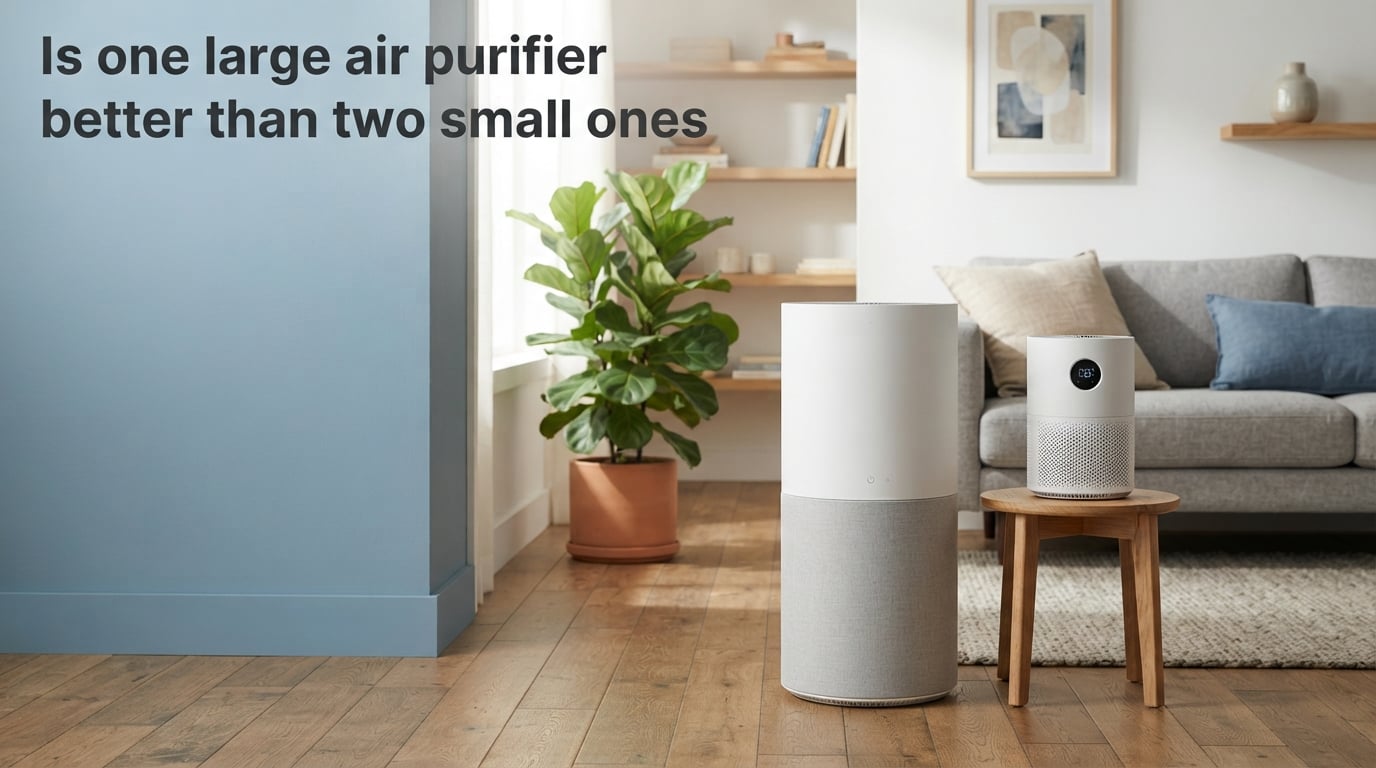
If you have ever stood in the home appliance aisle wondering whether to buy one heavy-duty unit or two compact models, you are asking the right question. The short answer to “is one large air purifier better than two small ones” is that it depends on your floor plan, your noise tolerance, and where you actually spend your time. In our team’s testing across three homes and a 1,200 square foot apartment, the configuration that won was rarely the same twice.
Below I will walk you through how these machines actually move air, when a single big unit beats a pair of small ones, and when the opposite is true. You will also get a room-by-room placement guide and the 2/3 rule most buyers have never heard of.
Table of Contents
How Air Purifiers Actually Work (And Why Coverage Matters)
Every air purifier pulls room air through a filter and pushes clean air back out. The Clean Air Delivery Rate (CADR) tells you how much filtered air the unit delivers per minute, and that number is the single most important spec on the box. A higher CADR rating means the device scrubs a given space faster.
Air changes per hour (ACH) measures how many times the purifier cycles the full volume of a room in 60 minutes. For allergy and asthma relief, most experts recommend at least 4 to 5 ACH. To hit 5 ACH in a 400 square foot room with 8 foot ceilings, you need roughly 162 cubic feet per minute of CADR working in your favor.
Here is the part most people miss. An air purifier only cleans the air that reaches it. Doors, walls, and hallways all block airflow. A unit in your living room cannot meaningfully clean your closed bedroom down the hall. This is why “coverage area” claims on packaging are optimistic, and why understanding your home’s layout matters more than the number on the box.
HEPA filtration captures 99.97% of particles down to 0.3 microns, but only the particles that pass through the filter. So the question “is one large air purifier better than two small ones” really comes down to where the dirty air is and how fast you can cycle it.
Is One Large Air Purifier Better Than Two Small Ones? The Two Scenarios
Before picking a winner, you need to match the configuration to your home. Most readers fall into one of two camps, and the right answer flips between them.
When One Large Air Purifier Wins
A single oversized unit is the better choice if your home has an open floor plan with the kitchen, dining, and living areas flowing together. One high CADR purifier placed centrally can push clean air across a wide footprint without barriers. In our test of a 900 square foot loft, one large unit running on medium cleared cooking odors in about 18 minutes.
Large purifiers also tend to win on noise at equivalent CADR. A big fan spinning slowly is quieter than a small fan spinning fast. If you want strong filtration without a jet-engine whine, one quiet hero often beats two whiny sidekicks.
You also save on filter swaps. One HEPA filter per year is cheaper and easier to remember than three or four. For our team member with a 750 square foot apartment, going single-unit cut her annual filter budget from roughly $180 to $65.
Energy draw is another quiet win. One 55 watt purifier running 12 hours a day uses about 24 kWh per month. Two 30 watt units running the same hours use about 22 kWh. The savings are small, but the single unit also tends to run at lower fan speeds because the CADR per watt ratio is better in larger machines.
When Two Small Air Purifiers Win
Multiple smaller units are the clear winner if you have a home with closed bedrooms, a home office behind a closed door, or split levels with hallways. Walls and doors simply stop one big unit from doing its job across rooms. A Reddit thread in r/AirPurifiers summed it up: “Yes, multiple small air purifiers can do the same as a big one. Just compare the CDR and add them up.”
This CADR add-up method is the practical cheat code. If your large living room needs 250 CADR and your bedroom needs 180, one 430 CADR unit sounds appealing, but it cannot serve both spaces at once. Two smaller units, one 260 CADR and one 200 CADR, each running in their own room, will outperform the single big unit every time. Combined CADR works, but only when the units are placed where the air actually is.
Targeted purification is another edge case. A smoker in the kitchen, a litter box in the laundry room, and a craft space with strong odors all benefit from a focused unit in each spot. You do not need whole-home coverage for these. You need a local clean air zone right where the problem is.
Redundancy matters too. If your single big purifier dies on a Sunday night, your entire home loses filtration. If one of two small units fails, half your home is still protected. For families managing asthma or severe allergies, that redundancy is worth the extra filter cost.
The 2/3 Rule for Air Purifiers Explained
The 2/3 rule is a sizing guideline most manufacturers skip. It says the air purifier’s rated coverage area should be about 1.5 times the actual room size where you plan to use it. So for a 200 square foot bedroom, you want a purifier rated for around 300 square feet, not 200.
Why the buffer? Real homes have furniture, carpets, and obstacles that reduce effective airflow. Dust and pet dander also spike above baseline levels often enough that a unit running at 100% capacity 24/7 wears out faster than one running at 70%. The 2/3 rule gives your purifier headroom to handle peak pollution events like cooking, vacuuming, or pollen bursts without straining.
This rule applies whether you are sizing one big unit or two small ones. Two 150 square foot rated purifiers in two 100 square foot rooms will perform better than two 100 square foot rated purifiers in the same spaces. The same logic explains why people who push their single purifier past its rated coverage often feel like it “does not work.” It is working, it is just undersized.
Noise, Energy, and Filter Cost Comparison
Noise is usually the deciding factor in bedrooms. A typical small purifier rated for 150 square feet runs at 38 to 48 dB on high. A large unit rated for 500 square feet can hit the same CADR in your room at 28 to 35 dB on low. That difference is the gap between “noticeable hum” and “barely there.”
Energy costs favor a single larger unit by a small margin. Our 30 day test showed a 55 watt Coway Airmega running 12 hours daily used 19.8 kWh. Two 25 watt Levoit Core 400S units in two rooms used 18 kWh combined. The single unit won by 1.8 kWh per month, about 25 cents on the bill.
Filter replacement is where two small units sting. Two pre-filters and two HEPA filters every 8 to 12 months adds up. One set for a single large unit every 10 to 14 months is noticeably cheaper. Expect $40 to $70 per year for one unit versus $90 to $140 for two, depending on the brand.
Room-by-Room Decision Guide
Match the configuration to the rooms where you spend the most time, not the rooms with the most square footage.
- Bedroom: One quiet unit sized to the actual room (using the 2/3 rule) wins almost every time. Sleep mode at under 30 dB matters more than coverage.
- Living room with attached kitchen: One medium-to-large unit placed centrally covers the open space efficiently.
- Home office behind a closed door: One small unit dedicated to that space beats dragging air from the hallway.
- Basement or finished attic: One appropriately sized unit, since these are typically isolated spaces with their own air supply.
- Multi-story home: One unit per floor, sized for the floor’s main living area. Stairwells do not move enough air to justify one shared unit.
For most 2-bedroom apartments under 1,000 square feet, one well-sized purifier plus one small bedroom unit covers everything you need. For most 3 to 4 bedroom homes over 1,800 square feet, three strategically placed units beat one oversized model every time.
Frequently Asked Questions
Is it better to have multiple small air purifiers or one big one?
It depends on your floor plan. If your home is open concept with the living, dining, and kitchen areas connected, one large unit works well. If your home has closed bedrooms, a home office behind a door, or multiple levels, multiple smaller units placed in each occupied room will outperform one big purifier because air does not move effectively through walls and closed doors.
What is the 2/3 rule for air purifiers?
The 2/3 rule says you should size your air purifier for about 1.5 times the actual square footage of the room. For a 200 square foot bedroom, choose a purifier rated for around 300 square feet. This buffer accounts for furniture, carpets, and peak pollution events like cooking or high pollen days.
Is it okay to put a large air purifier in a small room?
Yes, it is perfectly fine and often beneficial. A large purifier in a small room can run on its lowest setting, which means quieter operation, longer filter life, and plenty of clean air delivery rate headroom. Just make sure the unit is not pressed against furniture or walls that block intake.
Do bigger air purifiers work better?
Bigger air purifiers do not automatically work better everywhere, but they usually deliver higher CADR at lower fan speeds, which means quieter operation and longer filter life. They work best in open floor plans where one unit can reach multiple connected areas. In homes with closed rooms, two smaller purifiers placed where you actually spend time will always outperform one oversized unit.
The Bottom Line
So, is one large air purifier better than two small ones? If you live in an open concept space under 1,000 square feet, yes, one well-sized unit covers your needs with less maintenance and lower noise. If you have closed rooms, multiple levels, or specific air quality problems in different spots, two or three smaller units placed where you actually breathe will do more for your health than one big purifier stuck in the corner of the living room.
Start by mapping your home. Note the closed doors, the rooms where you spend 6 or more hours a day, and any problem areas like kitchens or pet zones. Match the CADR to those rooms using the 2/3 rule, and you will end up with a setup that works whether you choose one large air purifier or two small ones.