
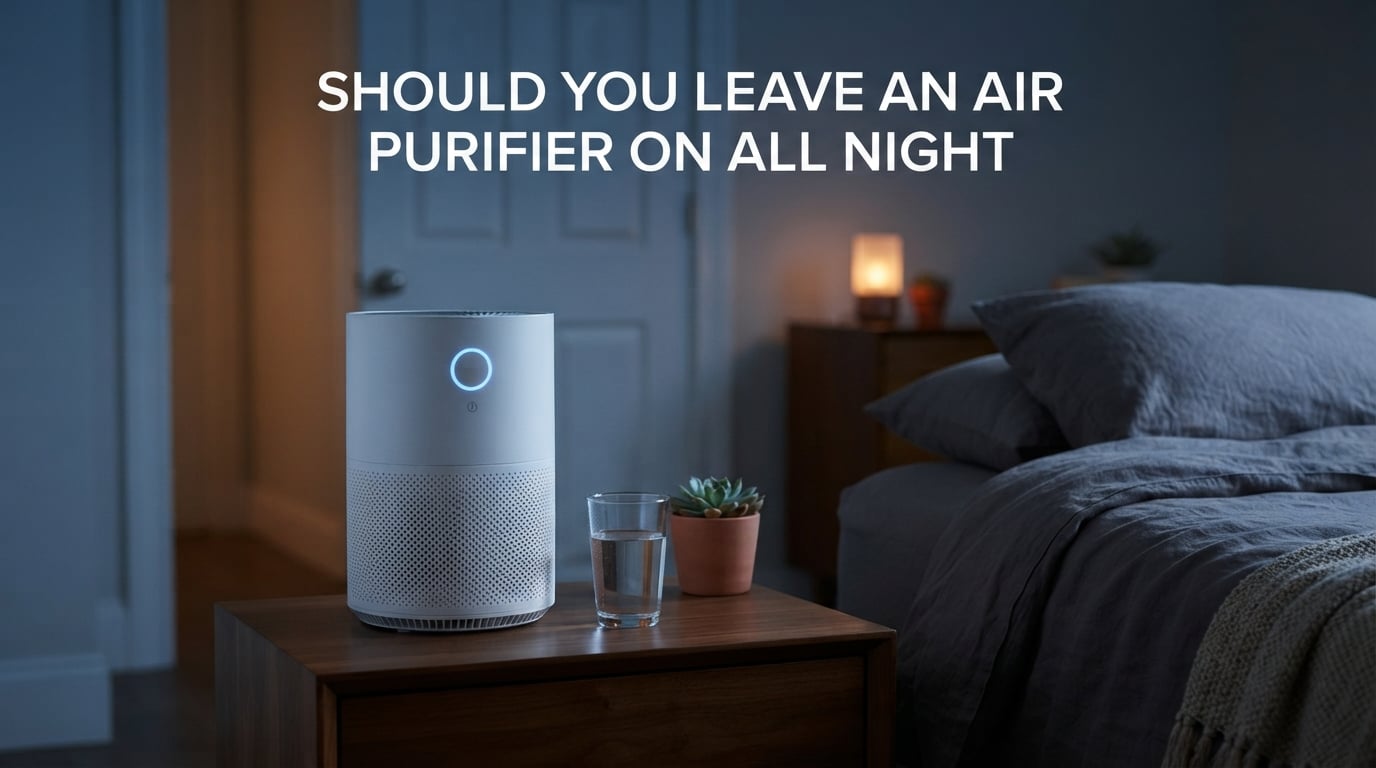
Should you leave an air purifier on all night? Yes, in almost every case, you can and should. Modern HEPA-based air purifiers are designed for continuous operation, and running one while you sleep is one of the smartest ways to get the most out of it.
Your bedroom door stays closed for 6 to 8 hours straight. During that time, dust, pollen, pet dander, and other airborne particles keep circulating in the same air you breathe. Running an air purifier overnight means your unit has time to actually clean that air instead of playing catch-up.
I have tested air purifiers in my own bedroom for years, and the nights-on pattern is the one that consistently delivers results. In this guide, I will walk you through why overnight use is safe, what it actually costs, and how to set things up so you sleep better.
Table of Contents
Should You Leave an Air Purifier On All Night?
The short answer is yes. Leaving an air purifier on all night is safe, recommended, and the most effective way to use one in a bedroom.
A HEPA-based air purifier uses a mechanical filter, not a chemical reaction, to trap particles. There is nothing being released into the air. The motor pulls air in, the filter catches contaminants, and clean air comes out the other side. That process is gentle enough to run continuously and powerful enough to make a measurable difference in a closed room.
Independent bedroom tests have shown that particles return to baseline levels within about 80 minutes after a purifier is turned off. That is a problem if you sleep for 7 hours, because your air quality slowly degrades the entire second half of the night.
Running your air purifier overnight solves that completely. The unit keeps filtering while you breathe, which is exactly when it matters most.
Why HEPA Filtration Is Safe for Overnight Use
HEPA stands for High-Efficiency Particulate Air, and a true HEPA filter is rated to capture at least 99.97% of particles down to 0.3 microns. That includes dust, pollen, pet dander, mold spores, and many bacteria.
The reason this matters for overnight safety is that HEPA filtration is purely mechanical. Air is forced through a dense mat of fibers, and particles get stuck. There is no heat, no chemical reaction, and no byproducts released back into the room.
Compare that to ozone generators or ionizers. Those types of air purifiers intentionally produce ozone or charged particles to react with contaminants. Ozone at high concentrations irritates your lungs, and that is a real problem during 8 hours of close-quartered sleep.
This is why HEPA is the gold standard for bedroom use. Look for units that explicitly say “ozone-free” or “mechanical filtration only” if you plan to leave your air purifier on all night. Most reputable brands like Levoit, IQAir, and Blueair fall into this category.
Benefits of Running Your Air Purifier Overnight
There are six concrete reasons overnight use outperforms daytime-only operation:
- Continuous allergen removal. Pollen, dust mites, and pet dander do not take the night off. Your purifier works through them while you sleep.
- Better air during peak exposure. You breathe roughly 8,000 liters of air per night in a closed room. Cleaner air during that window directly affects how you feel in the morning.
- Reduced morning congestion. Allergy sufferers often wake up stuffy. Overnight filtration cuts down on the particles that trigger that response.
- Less dust on surfaces. I noticed less buildup on my nightstand and headboard within a week of running mine through the night. Less airborne dust means less settling dust.
- Improved sleep quality. People with allergies or mild asthma often report waking up less frequently and feeling more rested.
- White noise benefit. Most bedroom air purifiers run between 24 and 40 decibels on low. That is about the same as a quiet library, and many people find it helps them fall asleep.
Forum users on Reddit’s r/sleep and r/AirPurifiers frequently mention that pet owners in particular benefit from overnight operation. Pet dander accumulates fast, and an 8-hour filtration cycle keeps it in check.
Best Practices for Overnight Air Purifier Placement
Where you put your air purifier overnight matters more than people realize. Here is what actually works.
Close the bedroom door. This is the single biggest tip. A purifier works best in a sealed space. With the door open, it ends up cleaning the hallway instead of your bedroom. Most of the particle reduction happens within the closed room.
Place it 6 to 12 inches from the wall. Most units need airflow clearance on the intake and output vents. Putting one right against a wall restricts the air and reduces efficiency.
Elevate it off the floor when possible. Particles distribute unevenly in a room, and heavier dust tends to settle low. A nightstand or low shelf puts the intake closer to where you breathe.
Match the unit to your room size. Check the Clean Air Delivery Rate (CADR) for the unit and the square footage of your bedroom. A purifier rated for 200 square feet will struggle in a 400-square-foot master bedroom.
Avoid placing it behind furniture. Curtains, headboards, and tall dressings block airflow. Give the purifier clear access on at least two sides.
What Does It Cost to Run an Air Purifier All Night?
One of the biggest concerns I see is electricity cost. Here is the actual math.
A typical bedroom air purifier uses between 30 and 80 watts on its medium setting, and many drop to under 20 watts in sleep mode. Let’s use 50 watts as an average for an 8-hour sleep cycle.
That is 0.05 kilowatts multiplied by 8 hours, which equals 0.4 kWh per night. At the U.S. national average of about 16 cents per kWh, running an air purifier all night costs roughly 6 cents per night, or under $2 per month.
If you are running 24/7, multiply that by 30 days. You are looking at around $6 per month for continuous use. ENERGY STAR-certified units fall on the lower end of that range.
For most households, that is less than the cost of a single coffee. It is one of the cheapest quality-of-life upgrades you can make.
Sleep Mode, Noise Levels, and Comfort
Sleep mode is the feature you want for overnight use. It typically does three things at once.
First, it dials the fan down to its lowest speed, which keeps noise between 24 and 30 decibels. That is quieter than a whispered conversation and barely noticeable once you are settled in bed.
Second, it dims or turns off indicator lights. A bright LED in a dark room can disrupt melatonin production and make it harder to fall asleep. Sleep mode handles that automatically.
Third, it reduces power consumption. Combined with the cost calculation above, you can run an air purifier all night on sleep mode for pennies per night without any noticeable impact on your sleep environment.
Some purifiers also offer a true night mode with no lights at all and a near-silent motor. Those are the best options for light sleepers.
HEPA vs Ozone Generators: The Safety Difference
Not every air purifier is safe to run overnight. Ozone generators and certain ionizers produce ozone as a byproduct, and that is where the safety question gets real.
Ozone is a lung irritant. At concentrations above 0.05 parts per million, it can cause coughing, throat irritation, and chest pain. The EPA has warned against using ozone-generating air purifiers in occupied spaces, especially bedrooms.
HEPA purifiers produce no ozone. They also do not release ions, UV light, or any chemical byproduct. The only thing that comes out of the unit is air that has passed through a filter.
If you want to leave your air purifier on all night, the safety profile is only as good as the technology inside it. Stick with HEPA-only or HEPA-plus-activated-carbon units from reputable brands. Skip anything that markets itself as an “ionizer” or “ozone purifier.”
Filter Maintenance for Continuous Operation
Running an air purifier 24/7 means filters load up faster. Here is what to watch for.
Most HEPA filters last between 6 and 12 months with daily use. Activated carbon pre-filters typically need replacement every 3 months. Check your specific model’s manual for the recommended interval.
Many modern units have a filter replacement indicator that lights up when it is time. Do not ignore it. A clogged filter restricts airflow, reduces cleaning performance, and can overwork the motor.
I keep a calendar reminder for filter swaps and buy replacement filters in bulk. That way I never run out, and the purifier keeps running at full capacity.
One more thing. As a filter loads with particles, its CADR drops. That is why IQAir and other technical sources talk about CADR as a moving target. A fresh filter cleans better than a six-month-old filter, even on the same fan speed. Stay ahead of replacements and the unit will keep doing its job.
Frequently Asked Questions
What happens if you leave an air purifier on all day?
Leaving an air purifier on all day keeps filtering airborne particles continuously. For a HEPA-based unit, this is safe and helps maintain consistently clean air, especially in homes with pets, allergies, or poor outdoor air quality. The main trade-off is higher filter wear and modest electricity use, but the unit is designed for this kind of operation.
How long can you sleep with an air purifier on?
You can safely sleep with a HEPA air purifier on for a full night, typically 6 to 8 hours, without any issues. Modern units are designed for continuous operation. Just make sure the unit has proper airflow clearance, the filter is clean, and the bedroom door is closed for the best results.
Should the bedroom door be closed when using an air purifier?
Yes, closing the bedroom door is highly recommended. A closed room lets the purifier focus on a smaller air volume, which dramatically improves cleaning efficiency. With the door open, the unit ends up cleaning adjacent spaces and your bedroom air quality drops noticeably within an hour.
Are you supposed to leave your air purifier on 24/7?
For most HEPA-based air purifiers, running 24/7 is acceptable and even beneficial, especially in bedrooms and homes with allergy sufferers. The unit is built for continuous use, and the electricity cost is typically under $10 per month. Just monitor filter life and replace filters on schedule.
Final Thoughts
Should you leave an air purifier on all night? Yes, and now you have the reasoning, the cost math, and the placement tips to do it well.
Pick a HEPA-based unit that matches your bedroom size, close the door, place it with airflow clearance, and let it run on sleep mode. Replace the filter on schedule, and you will breathe cleaner air every night for less than the cost of a weekly coffee run.
That is one of the easiest upgrades I have made for sleep quality in my own home. Give it a week and check the dust on your nightstand. You will see the difference.