
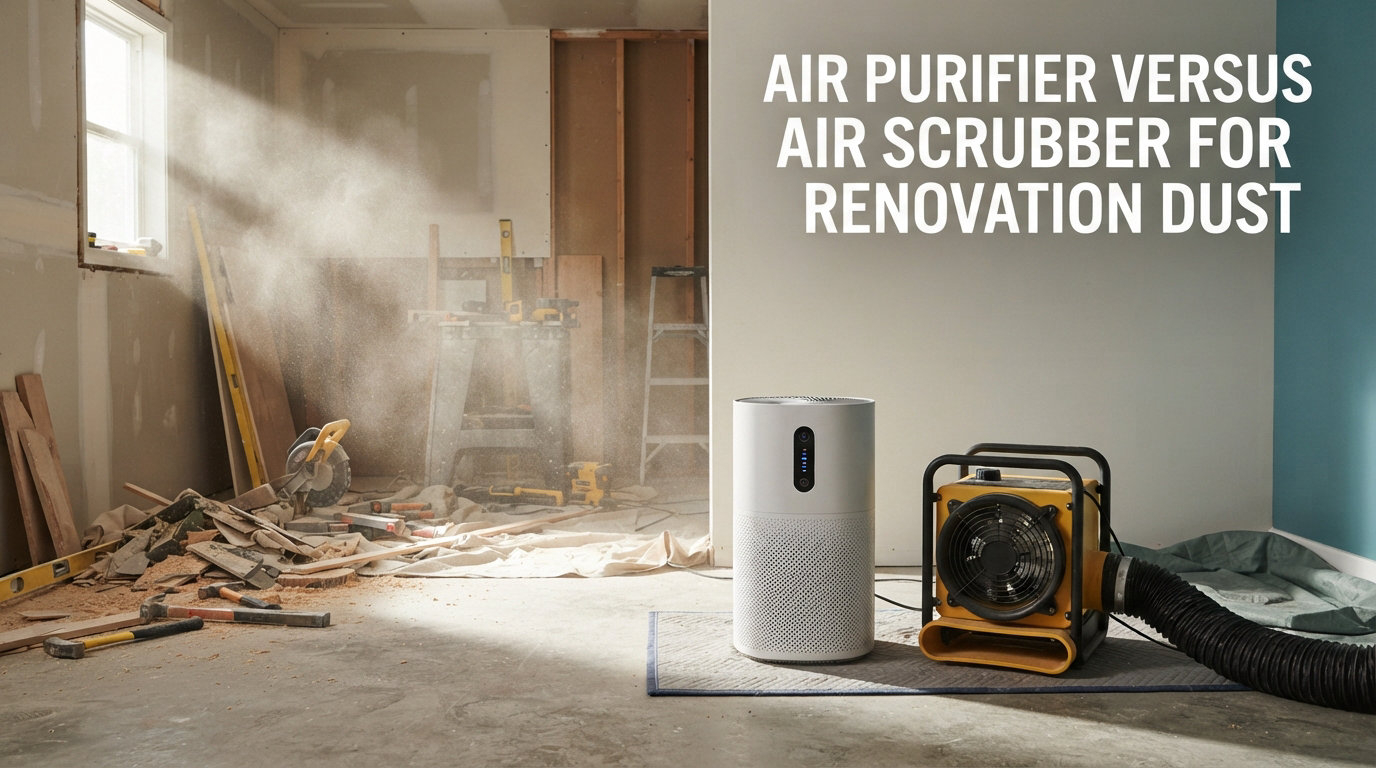
Renovation dust has a way of surprising homeowners. You start a “small” bathroom tile project, and within hours there is a fine white film on every surface in the house.
I have been in that exact situation, and the question that always comes up is whether a residential air purifier is enough or if you need to bring in commercial air scrubber equipment. The answer depends on the project size, whether you are living in the home, and what kind of dust you are generating.
In this guide to the air purifier versus air scrubber for renovation dust question, I will break down what each device does, how they compare on the specs that matter, and a simple decision framework you can use before your next project. By the end, you will know exactly which tool fits your job — and whether to rent, buy, or use what you already own.
Table of Contents
What Is an Air Purifier?
An air purifier is a residential (and sometimes light-commercial) device that runs continuously to clean indoor air. Most units pull room air through a pre-filter, an activated carbon layer for odors, and a HEPA filter rated to capture 99.97 percent of particles down to 0.3 microns.
Typical home air purifiers move between 100 and 600 CFM (cubic feet per minute) of air, run quietly enough to sit in a bedroom, and are built to be left on 24/7. The CADR (Clean Air Delivery Rate) rating tells you how quickly a unit cleans a given room size.
For renovation dust, an air purifier works well as a finishing tool once the heavy dust has settled, or for small projects like painting a single room, sanding a piece of furniture, or cutting a few pieces of trim.
What Is an Air Scrubber?
An air scrubber is a commercial-grade portable air cleaner built for restoration, remediation, and active construction sites. These units move a lot more air — typically 500 to 2,500 CFM — and almost always use a true HEPA filter as the primary stage.
Air scrubbers are also designed to be ducted. You can attach flex duct to the intake or exhaust and use the unit to create negative air pressure in the work zone, which keeps contaminated air from spreading into the rest of the house. That negative pressure setup is the same approach professional mold remediators use on every job.
The trade-off is noise, weight, and price. A typical scrubber weighs 45 to 80 pounds, sounds like a loud fan or shop vac, and costs several times what a residential air purifier does.
Air Purifier Versus Air Scrubber for Renovation Dust: Key Differences
The air purifier versus air scrubber for renovation dust comparison comes down to six core specs: airflow, noise, weight, filtration stages, runtime expectation, and ducting capability. Here is how they line up side by side.
Airflow (CFM): Air purifiers move roughly 100 to 600 CFM. Air scrubbers move 500 to 2,500+ CFM. A scrubber can cycle the air in a 200-square-foot room five to ten times faster than a typical residential unit.
Noise level: Residential purifiers typically run at 25 to 55 dBA — quiet enough for a bedroom. Air scrubbers sit between 60 and 75 dBA, which is comparable to a shop vac or loud bathroom fan running constantly.
Weight and portability: A HEPA air purifier weighs 10 to 30 pounds and rolls easily on small casters. A scrubber weighs 45 to 80 pounds but is built with handles, stackable cases, and sometimes built-in dollies for job-site mobility.
Filtration stages: Both can use HEPA, but scrubbers usually start with a heavy-duty washable pre-filter to catch large debris like drywall chunks and sawdust before it loads the expensive HEPA. Air purifiers rely on lighter pre-filters that clog fast when hit with heavy construction dust.
Runtime expectation: Air purifiers are designed to run 24/7 for years. Air scrubbers are rated for continuous use too, but most homeowners only run them for the duration of a project — days to a couple of weeks.
Ducting and negative pressure: This is the big differentiator. Air scrubbers can be ducted to exhaust outside or to create negative air pressure in a contained work zone. Air purifiers cannot. If you want to keep dust from spreading room to room during demolition, only a scrubber can do that.
Renovation Dust Types and How Each Device Handles Them
Not all renovation dust is the same, and the type of dust you generate matters more than most guides admit. Here are the three main culprits you will run into on a typical home project.
Drywall dust: Fine gypsum particles between 0.5 and 10 microns. It floats, it settles everywhere, and it loads filters fast. A scrubber with a washable pre-filter handles this far better than a residential purifier, which will choke on the volume within hours.
Wood dust: Particles from cutting, sanding, and routing range from 1 to 100 microns. Larger chips fall quickly, but the fine sanding dust stays airborne for a long time. Both devices capture it, but a scrubber’s higher airflow clears a room noticeably faster.
Silica dust: This is the one most articles skip. Cutting concrete, brick, tile, stone, or some joint compounds generates respirable crystalline silica particles smaller than 4 microns. Long-term inhalation is linked to silicosis, a serious and irreversible lung disease. For silica-generating work, I would not rely on a residential purifier alone — a HEPA air scrubber with proper source capture, plus wet-cutting methods, is the safer combination.
The takeaway: HEPA filtration captures all three dust types at the 0.3-micron level. The question is not whether the filter can catch the particle — it is whether the device can move enough air to keep up with the volume you are generating in real time.
When an Air Purifier Is Enough for Renovation Dust
For most DIY homeowners, an air purifier is the right call. You probably already own one, or you can buy a quality unit for under a few hundred dollars that will keep working for you long after the project wraps.
I would reach for an air purifier if any of these describe your project: painting a room or two, sanding and refinishing a small piece of furniture, installing trim or shelving, light drywall patching, or doing cleanup after a contractor has finished for the day. The same unit then keeps serving you year-round for allergies, wildfire smoke, and everyday household dust — which is the real value proposition.
A purifier with a CADR of 300 or higher in a closed room will knock down visible dust within an hour or two of finishing the work. Just remember to swap or vacuum the pre-filter after a dusty project, because loaded filters drop airflow dramatically and shorten HEPA life.
When You Actually Need an Air Scrubber
You need an air scrubber when the project out-paces what a residential unit can handle. The trigger points are pretty clear once you know what to look for.
Rent or buy a scrubber if you are doing whole-room or whole-house demolition, removing tile and thinset from floors, knocking down walls, doing mold remediation, handling water damage restoration, or living in the home during a major contractor-driven renovation where dust containment actually matters.
The negative air pressure setup is what makes the scrubber worth the money in these scenarios. By ducting the exhaust out a window and sealing the work zone with plastic sheeting, you keep the dust inside the containment area instead of letting it migrate through every HVAC return in the house. That is something no residential purifier can do.
Renting Versus Buying: What Makes Sense for Your Project
This is one of the most common questions I see on home improvement forums, and the math is more straightforward than people think once you line it up side by side.
Renting a HEPA air scrubber typically runs $40 to $80 per day from equipment rental yards, with weekly rates landing around $200 to $350. For a single bathroom renovation or a one-time flooring tear-out, renting almost always wins. You get the right tool for the job without storing an 80-pound machine the other 51 weeks of the year.
Buying a scrubber makes sense if you are a contractor, a serial house flipper, or planning a multi-phase renovation that will stretch across months. A quality 500 to 800 CFM HEPA scrubber runs $500 to $1,200 new. Once you cross roughly two to three weeks of cumulative rental cost, owning becomes the better financial play.
For air purifiers, the math flips. Buying is almost always the right move because the unit works for you year-round after the project ends. A $250 to $500 HEPA purifier handles most residential renovation scenarios and then transitions into everyday allergy and smoke duty without missing a beat.
One budget-friendly middle path I see recommended often on Reddit: build a DIY “box fan plus MERV-13 filter” rig for under $50 using a standard 20-inch box fan and a furnace filter taped to the back. It is loud and ugly, but it moves serious air for the duration of a project, and you can toss it or store it when you are done.
How to Choose: A 4-Step Decision Framework
If you want a simple way to work through the air purifier versus air scrubber for renovation dust question, run your project through these four steps. Most homeowners land on an answer within five minutes.
Step 1 — Estimate your dust volume. Light dust (painting, trim, small patches) points to an air purifier. Heavy dust (tile removal, drywall hanging, demolition, concrete cutting) points to a scrubber. Be honest with yourself here — people almost always underestimate dust volume.
Step 2 — Check whether the home is occupied. If you are living in the house during the work, noise and dust containment matter a lot. A scrubber with negative pressure is louder but keeps dust out of your living space. A purifier is quieter but will not contain anything.
Step 3 — Calculate the work zone size and air changes. Aim for 4 to 6 air changes per hour in the work zone. For a 200-square-foot room with 8-foot ceilings (1,600 cubic feet), you need roughly 640 CFM to hit 4 air changes per hour. That is firmly in scrubber territory.
Step 4 — Look at total project length. A weekend project leans toward renting a scrubber or using a strong purifier you already own. A multi-week renovation leans toward buying or renting a scrubber and pairing it with a purifier for after-hours cleanup and long-term air quality.
Most homeowners I talk through this end up surprised that the “right” answer is often both: a rented scrubber running during demolition week, then a residential purifier running 24/7 during the finishing phase and beyond. That combination covers heavy dust when you need raw airflow, and quiet continuous cleaning when the project winds down.
FAQs
Do air scrubbers work better than air purifiers?
Air scrubbers move significantly more air (500 to 2,500+ CFM versus 100 to 600 CFM for purifiers) and can be ducted to create negative air pressure, so they are better for heavy renovation dust, demolition, and mold remediation. For everyday indoor air quality and light DIY projects, an air purifier is the better and quieter choice.
Do air scrubbers work for construction dust?
Yes, air scrubbers are purpose-built for construction dust. Their high CFM, washable pre-filters, and true HEPA stages handle drywall dust, wood dust, and silica particles far better than residential purifiers. They can also be ducted to exhaust contaminated air outside or to maintain negative pressure in a contained work zone.
Will an air purifier help with renovation dust?
Yes, an air purifier with a true HEPA filter will capture renovation dust particles down to 0.3 microns. It works well for light DIY projects like painting, trim work, and small patches, and it is excellent for after-hours cleanup once heavy dust has settled. For major demolition or tile removal, a purifier alone will not keep up with the dust volume.
Do you need an air purifier if you have an air scrubber?
During active demolition you do not need both running in the same space, since the scrubber handles the heavy lifting. After the heavy work ends, an air purifier becomes useful because it runs quietly 24/7 and handles the fine residual dust plus everyday air quality concerns like allergens and smoke.
Conclusion
The air purifier versus air scrubber for renovation dust decision comes down to scale, occupancy, and how much dust you are willing to live with. A residential HEPA air purifier handles light DIY work and keeps serving you long after the project ends. A commercial HEPA air scrubber earns its keep on demolition, mold, and major contractor jobs where negative air pressure and high CFM actually matter.
Before your next project, estimate the dust, measure the room, and decide whether to rent, buy, or use what you already have. Your lungs — and your furniture — will thank you.