
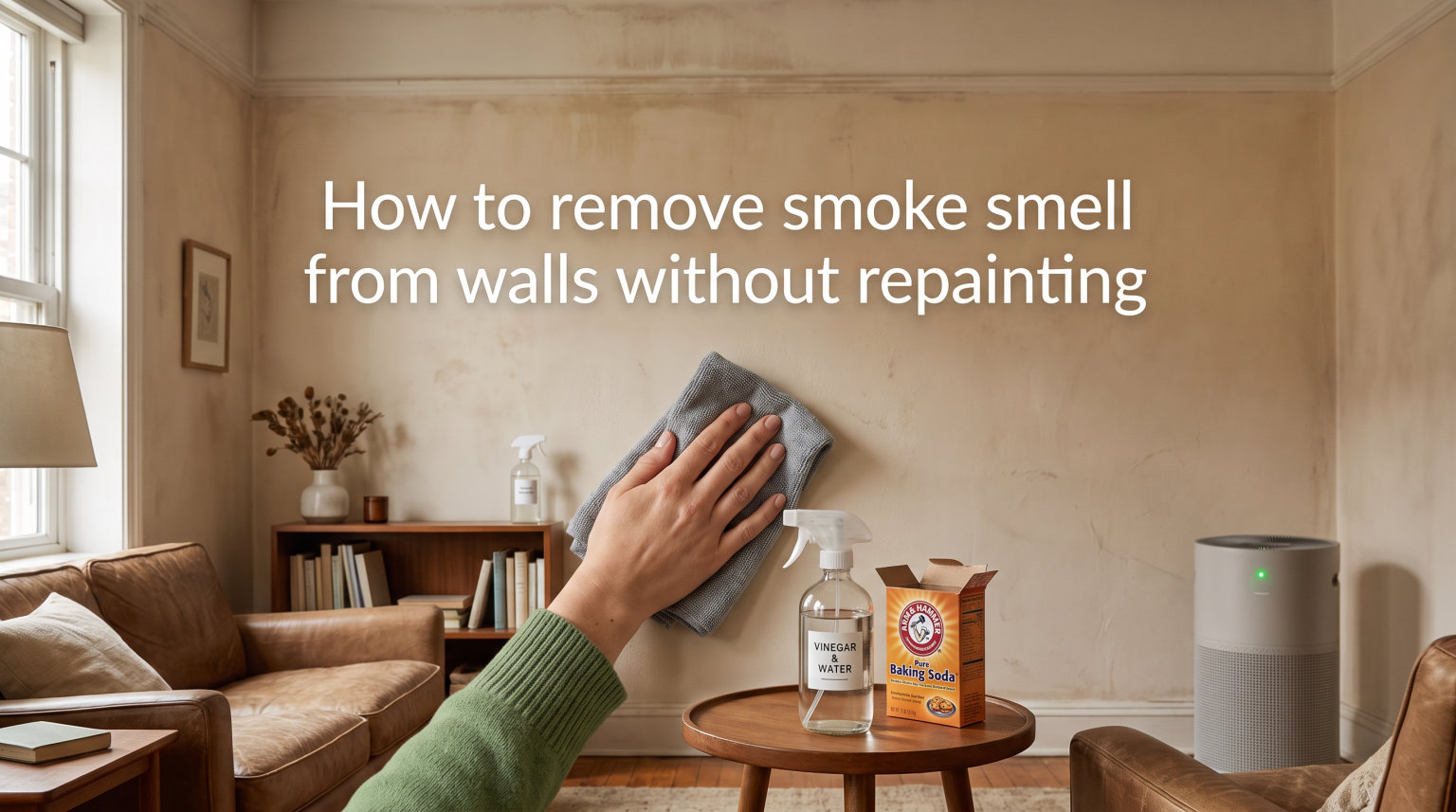
If you have ever walked into a home previously owned by a smoker, you know that cigarette smell does not just linger in the air. It coats every wall, ceiling, and surface with a sticky, yellowish film that can persist for years. The good news is that you can remove smoke smell from walls without repainting, and I am going to walk you through every method that actually works.
After researching advice from professional cleaners, restoration specialists, and homeowners who have tackled this exact problem on forums like Reddit’s r/CleaningTips and r/homeowners, I have compiled a complete guide. We will cover five proven cleaning methods, safety precautions, surface-specific guidance, and when to call in professionals.
Whether you are moving into a former smoker’s home, preparing a rental property for new tenants, or just want to freshen up your living space, these techniques will help you eliminate smoke odor at the source. No new paint job required.
Table of Contents
Why Smoke Smell Lingers on Walls
That persistent smoke smell comes from what researchers call third-hand smoke. This is the residue left behind after a cigarette burns, consisting of nicotine, tar, and hundreds of chemical compounds that settle onto surfaces and soak into porous materials.
Smoke particles are microscopic, measuring less than 2.5 microns in diameter. They penetrate deep into paint, drywall, wallpaper, and even bare wood. Over time, these trapped particles slowly release odor molecules back into the room, which is why the smell seems to return even after you have cleaned the surface.
Nicotine residue is particularly stubborn because it is sticky and water-resistant. As it builds up layer after layer from repeated smoking, it forms a yellow-brown film that bonds with wall paint. This is why simply wiping with soap and water often is not enough.
One critical point that comes up repeatedly in homeowner forums: painting over smoke-coated walls without cleaning them first will trap the odor underneath. The smoke residue will eventually bleed through the new paint, and you will smell it again within weeks. Professional painters on Reddit’s r/paint warn that primer alone applied over dirty walls will fail because the nicotine prevents proper adhesion.
Different wall surfaces absorb smoke at different rates. Flat paint is more porous and holds onto smoke more aggressively than semi-gloss or high-gloss finishes. Bare drywall is the worst case scenario because it has no protective barrier at all. Wallpaper traps smoke between the paper and the wall, creating a sealed odor pocket that requires removing the wallpaper to fully address.
Safety Precautions Before You Start Cleaning
Before you grab a scrub brush and start attacking those nicotine-stained walls, take time to protect yourself and your home. Smoke residue contains harmful chemicals that you do not want to inhale or absorb through your skin.
Here is the protective equipment you will need:
Nitrile or rubber gloves to protect your hands from harsh cleaning chemicals
An N95 or P100 respirator mask to filter out airborne particles dislodged during scrubbing
Safety goggles to prevent splashes from cleaning solutions
Long sleeves and pants to minimize skin exposure
Old shoes or boots you do not mind getting dirty
Open all windows in the room you are cleaning and set up a box fan pointing outward to pull fumes outside. If you are using chemical cleaners like ammonia or TSP, this ventilation is not optional. It is essential for your safety.
One rule that cannot be overstated: never mix ammonia and bleach. Combining these two chemicals produces chloramine gas, which can cause severe respiratory damage and even death. If you switch between ammonia-based and bleach-based cleaners, rinse the area thoroughly with water between applications.
Always test your cleaning solution on a small, inconspicuous area of the wall first. Apply a small amount, wait five minutes, then wipe it away and check for discoloration or damage to the paint finish. This quick test can save you from stripping paint off an entire wall.
How to Remove Smoke Smell From Walls Without Repainting: Method 1: White Vinegar Deep Clean
White vinegar is one of the most effective natural deodorizers available, and it is my first recommendation for mild to moderate smoke odor. Its acetic acid content helps break down nicotine residue while neutralizing odor molecules at the same time.
Here is the exact mixture ratio I recommend based on what professional house cleaners use:
1 part distilled white vinegar
1 part warm water
Optional: 1 tablespoon of dish soap per quart for extra grease-cutting power
Pour the solution into a spray bottle for easy application. Working in sections of about 3 by 3 feet, spray the wall generously and let it sit for 5 to 10 minutes. This dwell time allows the acid to penetrate and break down the nicotine film.
After letting it sit, scrub the area with a soft-bristled brush or a microfiber sponge. Use circular motions and moderate pressure. You will likely see a yellow-brown tint appear on your sponge as the nicotine transfers from the wall.
Rinse each section with clean warm water and a separate sponge. This step is important because leaving vinegar residue on the wall can create a sticky film that actually attracts more dirt and dust.
Dry the wall with a clean microfiber cloth. This prevents water from soaking into the paint and causing damage.
For best results, repeat this entire process a second time 24 hours later. The first pass removes surface-level residue, while the second pass addresses deeper penetration. You should notice a significant reduction in smoke odor after the second treatment.
The vinegar method works best on painted drywall with semi-gloss or satin finishes. It is less effective on flat paint because the porous surface holds onto smoke more tightly. For heavy smoke buildup, you will likely need to move on to TSP or ammonia.
One downside of vinegar is the smell itself. Your home will smell like a pickle factory for a day or two, but this dissipates quickly with ventilation. The trade-off is worth it because vinegar is safe, non-toxic, and inexpensive.
Method 2: Trisodium Phosphate (TSP) Treatment
When forum users on r/homeowners and r/DIY ask what actually removes heavy smoke deposits, one answer comes up more than any other: TSP. Trisodium phosphate is an industrial-strength cleaner that professional painters and restoration companies have relied on for decades.
One Reddit user who does this professionally put it bluntly: “TSP is the only cleaner that will really remove smoke deposits from the walls so the next coat of paint will stick.” That is a strong endorsement from someone who does this work for a living.
TSP works by chemically breaking down the grease and tar in smoke residue. It strips away the nicotine film at a molecular level, which is why it succeeds where gentler cleaners fail. However, this power means you need to use it carefully.
Here is how to mix and apply TSP for smoke removal:
Fill a bucket with 2 gallons of warm water
Add 1/4 cup of TSP powder and stir until dissolved
For extremely heavy smoke buildup, you can increase to 1/2 cup per 2 gallons
Wear gloves, goggles, and a mask throughout the process
Working in small sections, apply the TSP solution with a sponge or rag. Scrub firmly in circular motions, paying extra attention to corners and areas near ceilings where smoke tends to accumulate. The tar and nicotine will start dissolving on contact.
After scrubbing each section, rinse thoroughly with clean water. TSP leaves a film if not rinsed completely, and this film can interfere with any future paint application. Use a separate clean sponge and change your rinse water frequently.
Be aware that TSP can darken or discolor certain wall finishes. It may stain aluminum, discolor grout, and etch glass if left too long. If you have natural wood trim or special wall finishes, test a small hidden area first.
For environmentally sensitive situations, TSP-PF (phosphate-free) is available. It is slightly less aggressive but still effective for moderate smoke residue. Many hardware stores stock both versions side by side.
You can find TSP at any hardware store in the paint section, typically priced between $5 and $10 for a box. One box is enough to clean several rooms, making it one of the most cost-effective smoke removal options available.
Method 3: Ammonia Solution for Heavy Smoke Buildup
Ammonia is another powerful option that professional cleaners recommend for homes with severe smoke damage. It cuts through tar and grease with remarkable efficiency, and it evaporates quickly without leaving residue behind.
Based on advice from professional cleaners shared on cleaning forums, here is the recommended ammonia cleaning mixture:
1 gallon of hot water (as hot as you can comfortably handle with gloves)
1/2 cup of clear, non-sudsy ammonia
1 teaspoon of dish detergent to help the solution cling to vertical surfaces
The hot water is important here. Heat amplifies ammonia’s cleaning power and helps soften stubborn tar deposits that cold water cannot touch.
Apply the solution with a sponge, working from the bottom of the wall upward. This prevents streaking, which occurs when dirty solution runs down over already-cleaned areas. Scrub in firm circular motions and reapply as the solution becomes dirty.
One Reddit contributor who cleaned homes professionally stated: “Hot water and ammonia works well for heavy smoke buildup. I have seen it remove years of yellow staining in a single session.”
Rinse with clean warm water after scrubbing each wall. Then dry with clean cloths to prevent water spots and potential damage to the paint.
The critical safety rule bears repeating: never use ammonia in the same room where bleach products have been used or are being used. The combination produces toxic gas. If you have used bleach anywhere in the house, ventilate thoroughly and wait at least 24 hours before bringing ammonia into the space.
Ammonia works well on painted drywall, wood paneling, and metal surfaces. Avoid using it on natural stone, marble, or waxed wood finishes, as it can cause etching or stripping.
Method 4: Baking Soda and Activated Charcoal Absorption
After you have deep cleaned your walls with vinegar, TSP, or ammonia, residual odor molecules may still linger in the air and in porous materials. This is where passive odor absorbers come in.
Baking soda works through simple chemistry. It reacts with both acidic and alkaline odor compounds, neutralizing them rather than just masking the smell. Activated charcoal takes a different approach, using its highly porous structure to trap odor molecules within its microscopic pores.
To use baking soda on walls, make a paste by mixing equal parts baking soda and water. Apply a thin layer to the wall with a sponge, let it dry completely (usually 1 to 2 hours), then brush or vacuum it off. This draws out odor molecules that have penetrated the paint surface.
For whole-room odor absorption, place open containers of activated charcoal around the room. You can buy bulk activated charcoal online or at pet stores for about $15 to $20 per pound. Spread it in shallow trays and leave it for 3 to 5 days, replacing it once during that period.
This passive method will not remove heavy smoke residue on its own. Think of it as a finishing step after active cleaning. It catches what scrubbing misses and helps ensure the odor does not creep back over the following weeks.
Method 5: Ozone Generator Treatment
For stubborn smoke odors that resist every cleaning method, an ozone generator may be your best remaining option. These devices produce ozone gas (O3), which is a powerful oxidizer that neutralizes odor molecules at a chemical level.
One forum contributor described the effect well: “An ozone generator can neutralize odors on a molecular level, but it must be used when no one is present.” This is the key point about ozone treatment. It is highly effective but requires strict safety protocols.
Ozone is toxic to humans and pets. It can damage the respiratory system, so you must follow these rules:
Remove all people, pets, and plants from the home before treatment
Remove or cover rubber items, as ozone degrades rubber over time
Run the generator for 1 to 2 hours for a single room, or 4 to 8 hours for a whole house
Wait at least 2 hours after the generator turns off before re-entering
Open all windows and run fans for at least 1 hour to ventilate before occupying
You do not need to buy an ozone generator. Most equipment rental stores rent them for $30 to $50 per day. Some hardware stores also carry them for purchase in the $80 to $200 range.
Ozone treatment is best used as a final step after you have thoroughly cleaned all wall surfaces. It penetrates into cracks, crevices, and porous materials that liquid cleaners cannot reach, catching residual odor molecules that would otherwise slowly release over time.
If you are sensitive to chemicals or dealing with severe smoke damage throughout an entire home, ozone treatment is worth the effort. Just take the safety warnings seriously. Forum users repeatedly stress that this is not a step to rush or cut corners on.
Wall Surface-Specific Cleaning Guide
Not all walls are created equal when it comes to smoke removal. The material and finish of your walls determine which cleaning methods will work and which could cause damage.
Painted Drywall (Satin or Semi-Gloss Finish)
This is the easiest surface to clean because the paint creates a protective barrier between the smoke and the drywall underneath. Start with the vinegar method. If that does not fully remove the odor, escalate to TSP or ammonia. These tougher cleaners are safe on satin and semi-gloss paint as long as you rinse thoroughly.
Work in small sections and avoid oversaturating the wall. Drywall absorbs water through paint seams and joints, which can cause swelling and damage if you are too aggressive with liquid cleaners.
Painted Drywall (Flat Finish)
Flat paint is porous, which means smoke penetrates deeper and is harder to remove. Gentle cleaning with a barely damp sponge is your starting point. Avoid heavy scrubbing, which can burnish or remove flat paint.
If vinegar does not work, use TSP at half strength to reduce the risk of damaging the paint finish. Test in an inconspicuous spot first. For severe cases on flat paint, you may ultimately need to apply a stain-blocking primer followed by a fresh coat of paint, even if your goal was to avoid repainting.
Wallpaper
Wallpaper is the most challenging surface for smoke removal because the odor gets trapped between the paper and the wall. Surface cleaning with vinegar can help reduce odor on the paper itself, but deep-seated smoke smell usually requires removing the wallpaper entirely.
If you remove wallpaper and discover smoke-damaged drywall underneath, clean the bare drywall with TSP before applying any new wall covering. Skipping this step guarantees the odor will persist under the new surface.
Wood Paneling and Trim
Wood is porous and absorbs smoke readily. TSP or ammonia both work well on finished wood paneling. Use a soft cloth rather than a brush to avoid scratching the finish.
For unfinished wood, consider applying a coat of shellac-based primer after cleaning. Shellac naturally blocks odors and is the product restoration professionals use on fire-damaged wood.
How to Prevent Smoke Smell From Returning
Cleaning your walls is only half the battle. If you do not address the other sources of trapped smoke odor in your home, the smell will creep back within weeks.
Replace your HVAC air filters with HEPA-rated filters. Smoke particles circulate through your duct system and settle on every surface the air touches. A clean filter system prevents residual particles from redepositing on your freshly cleaned walls.
Consider having your ductwork professionally cleaned, especially if the previous occupant was a heavy smoker. Duct cleaning costs between $300 and $500 for an average home but makes a dramatic difference in overall air quality.
Treat carpets and upholstery in the same rooms where you cleaned the walls. Smoke settles into fabric even more aggressively than it settles on hard surfaces. Steam cleaning or professional carpet shampooing removes embedded odor that wall cleaning cannot address.
Run a HEPA air purifier in each treated room for at least two weeks after cleaning. This captures any remaining airborne particles and helps maintain the clean smell you have worked hard to achieve.
Keep windows open when weather permits for the first month after treatment. Fresh air circulation is one of the most effective long-term deodorizers available, and it costs nothing.
When to Call Professional Smoke Remediation
Sometimes DIY cleaning is not enough, and knowing when to call professionals can save you weeks of frustration. Here are the warning signs that your smoke problem may be beyond what home cleaning methods can handle.
If you have cleaned every wall surface with TSP or ammonia, run an ozone generator, replaced your air filters, and the smell still persists after two weeks, the smoke has likely penetrated into the drywall itself. At this point, professional remediation or wall replacement may be necessary.
Forum users on r/realestateinvesting share a common experience: properties occupied by heavy smokers for decades often require drywall replacement in the worst-affected rooms. If you squeeze a wall and it feels spongy or you can see a dark yellow stain through the paint from inside the wall cavity, you are dealing with deep structural contamination.
Professional smoke remediation services typically charge between $200 and $1,200 per room depending on severity. This includes industrial-grade cleaning, thermal fogging, and sometimes ozone treatment. For an entire home, expect costs in the range of $2,000 to $10,000.
For rental properties, check your local tenant laws before charging former tenants for smoke remediation. Some jurisdictions classify cigarette smoke damage as normal wear and tear, while others allow landlords to deduct cleaning costs from security deposits. Document the condition thoroughly with photos before beginning any work.
Here is a simple test to check if your cleaning has been effective: close all windows and doors in the room, leave it sealed for 48 hours, then walk in and take a deep breath. If you smell smoke, there is still residual contamination. If the air smells clean or slightly like your cleaning solution, you have successfully removed the odor
FAQs
What takes smoke smell out of walls?
The most effective cleaners for removing smoke smell from walls are trisodium phosphate (TSP), white vinegar diluted with water, and ammonia mixed with hot water. TSP is the professional standard for heavy smoke buildup, while vinegar works well for mild to moderate odor. Baking soda and activated charcoal provide additional odor absorption after active cleaning.
Can you get rid of smoke smell without painting?
Yes, you can remove smoke smell from walls without repainting by deep cleaning with TSP, vinegar, or ammonia solutions. For stubborn cases, an ozone generator treatment can neutralize odors that liquid cleaners cannot reach. However, if smoke has penetrated into bare drywall, repainting with a stain-blocking primer may eventually become necessary.
What do professionals use to clean cigarette smoke off walls?
Professional smoke remediation companies typically use trisodium phosphate (TSP) for surface cleaning, followed by thermal fogging and ozone generator treatment. They also use industrial degreasers and specialized odor-neutralizing agents. Many professionals on cleaning forums recommend hot water mixed with ammonia or TSP as their go-to solutions for residential smoke damage.
How to clean smoke off walls without removing paint?
To clean smoke off walls without removing paint, start with a 1:1 mixture of white vinegar and warm water. Spray it on, let it sit for 5 to 10 minutes, scrub gently with a soft sponge, and rinse with clean water. Avoid heavy scrubbing or abrasive brushes that could damage the finish. Test any cleaning solution on a hidden area first to make sure it does not strip the paint.
How long does it take to remove smoke smell from walls?
Removing smoke smell from walls typically takes 2 to 5 days for a single room using DIY methods. This includes 1 to 2 days for active cleaning with vinegar or TSP, 24 hours for the surface to fully dry, and 1 to 2 days for baking soda or activated charcoal to absorb residual odors. Severe cases involving ozone treatment may require an additional day for treatment and ventilation.
Final Thoughts on Smoke Odor Removal
Removing smoke smell from walls without repainting is absolutely possible when you use the right methods and have realistic expectations about the effort involved. Start with vinegar for mild cases, escalate to TSP or ammonia for moderate buildup, and reserve ozone treatment for the most stubborn odors.
The key to success is thoroughness. As one forum contributor put it, every surface has to be cleaned, and missing spots causes the smell to return. Take your time, work methodically room by room, and do not skip the rinse and dry steps.
If you follow this guide and the smell persists after two weeks, consider consulting a professional smoke remediation service. Sometimes the damage goes deeper than what DIY methods can address, and that is not a failure on your part. It is simply the reality of long-term smoke exposure in a home.