
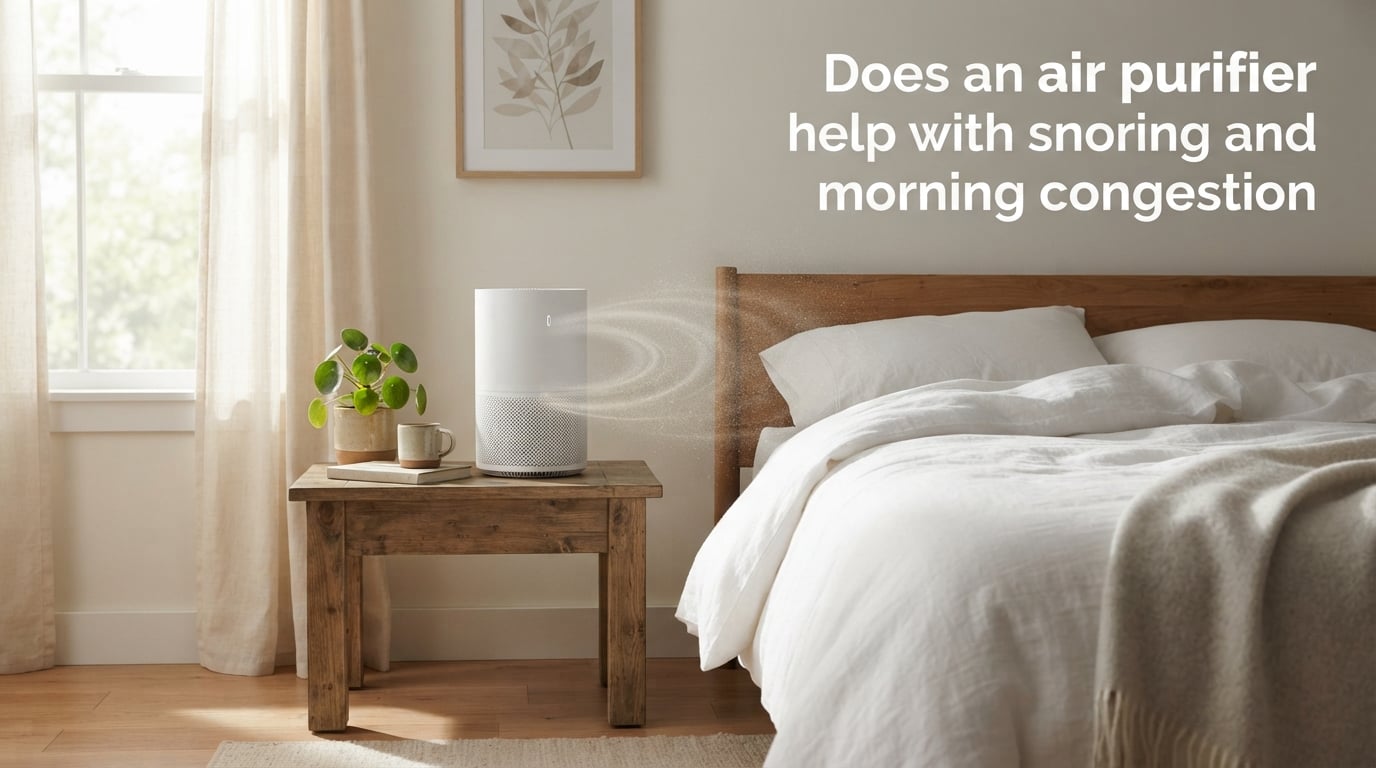
Yes, an air purifier can help with snoring and morning congestion, but with an important caveat. It works specifically when airborne irritants like dust mites, pet dander, pollen, or mold spores are contributing to your symptoms. By trapping these particles before they reach your nasal passages, a quality HEPA air purifier reduces airway inflammation and the congestion that makes you snore and wake up stuffed up.
Our team has spent months researching bedroom air quality and its connection to sleep. We dug through medical studies, Reddit threads from real snorers, and tested some of the most popular bedroom air purifiers on the market. What we found is that air purifiers are not a cure-all for every type of snoring, but for the large percentage of people whose nighttime congestion stems from indoor allergens, they can make a real, noticeable difference.
In this guide, we will walk you through exactly how an air purifier helps with snoring and morning congestion, which specific triggers it addresses, when it will not work, and how to choose the right one for your bedroom. We also break down three specific models worth considering and answer the questions people ask most often about air purifiers and sleep quality.
Table of Contents
Does an Air Purifier Help with Snoring and Morning Congestion?
The short answer is that an air purifier helps with snoring and morning congestion indirectly by removing the airborne particles that trigger nasal inflammation in the first place. Here is how that chain works.
When you breathe in allergens like dust mite debris, pet dander, or pollen throughout the night, your immune system reacts. That reaction causes the tissues inside your nasal passages to swell and produce excess mucus. The swelling narrows your airway, which forces air through a tighter space and makes the surrounding tissue vibrate. That vibration is what you hear as snoring.
A true HEPA filter captures 99.97% of particles as small as 0.1 to 0.3 microns. Dust mite allergen particles typically measure between 0.5 and 50 microns. Pet dander ranges from 2.5 to 10 microns. Pollen grains run between 10 and 100 microns. All of these fall well within the capture range of a quality HEPA filter, which means fewer irritants reach your airway while you sleep.
A study published in the National Center for Biotechnology Information found that air purifiers effectively reduced particulate matter levels in homes of patients with allergic rhinitis. Participants reported fewer symptoms and some were able to reduce their medication usage. This matters because allergic rhinitis is one of the most common underlying causes of nighttime nasal congestion and snoring.
On Reddit, users in the r/AirPurifiers community have shared similar experiences. One user reported that their sleep score hit 100% every night after adding an air purifier to their bedroom. Others noted they could breathe through their nose again within two hours of turning the unit on. These are not isolated incidents. The pattern is consistent enough that sleep clinics now frequently recommend air purifiers as part of a broader snoring management plan.
Common Airborne Triggers That Worsen Snoring
Not all snoring is triggered by air quality, but when it is, these are the usual suspects lurking in your bedroom.
Dust Mites
Dust mites are microscopic creatures that live in mattresses, pillows, carpets, and upholstery. Their waste particles are one of the most common indoor allergens in the world. When you roll around in bed at night, you stir these particles into the air and breathe them in for hours. This is a primary reason so many people wake up congested, and an air purifier running continuously in the bedroom can capture these particles before they settle back into your bedding.
Pet Dander
If your dog or cat sleeps in your bedroom or even just visits during the day, pet dander accumulates fast. Dander particles are incredibly light and can remain airborne for hours. For anyone with even a mild pet sensitivity, this constant exposure causes low-grade nasal inflammation that narrows the airway and promotes snoring night after night.
Pollen
During allergy season, pollen finds its way indoors through open windows, on clothing, and on shoes. Once inside, it circulates through your HVAC system and settles in your bedroom. Running an air purifier with a HEPA filter captures pollen before it can irritate your nasal passages overnight.
Mold Spores
Mold grows in damp areas like bathrooms, basements, and around windows. The spores it releases travel through the air and can cause significant respiratory irritation. If your morning congestion is worse during humid months or after rain, mold spores may be a hidden contributor.
VOCs and Smoke
Volatile organic compounds from cleaning products, paint, new furniture, and cooking can irritate your respiratory system. Wildfire smoke and cigarette smoke are even more aggressive irritants. An air purifier with an activated carbon layer alongside HEPA filtration addresses both the particles and the chemical gases that can inflame your airway.
Why Do I Wake Up Congested Most Mornings?
Morning congestion happens for several overlapping reasons, and understanding which one applies to you determines whether an air purifier will help.
The most common cause is continuous overnight exposure to indoor allergens. You spend roughly eight hours in the same room, breathing the same recycled air. Dust mite particles, pet dander, and mold spores build up in that enclosed space and your nasal passages react with inflammation and mucus production. When you wake up, you feel stuffed up because your body has been fighting allergens all night.
Another factor is gravity. When you lie flat, blood pressure increases in your head and nasal tissues. This causes the nasal passages to swell slightly even without allergens present. Add allergen-driven inflammation on top of that natural swelling, and you get the blocked-up feeling that millions of people experience every morning.
Dry air also plays a role for some people. In arid climates or during winter when heating systems dry out indoor air, your nasal passages overproduce mucus to compensate. This is why some users on Reddit report that air purifiers alone do not fully solve their congestion. In those cases, a humidifier used alongside the air purifier can address both the allergen load and the moisture level.
If your congestion clears up within 30 minutes of getting out of bed and moving around, airborne allergens are a likely contributor. An air purifier can make a significant difference in that scenario.
Air Purifier vs Humidifier for Snoring
People frequently confuse air purifiers and humidifiers or assume they do the same thing. They serve entirely different purposes, and understanding the difference helps you choose the right tool.
An air purifier removes particles and gases from the air. It tackles allergens, dust, smoke, and odors. If your snoring and congestion are caused by what is in the air, an air purifier is the right choice.
A humidifier adds moisture to dry air. It does not filter anything. If your congestion is caused by air that is too dry, particularly in winter or in arid climates, a humidifier addresses that root cause directly.
For many people, the best approach is using both. The air purifier keeps allergen levels low while the humidifier maintains comfortable moisture levels. Just be careful not to push humidity above 50%, because that encourages dust mite and mold growth, which brings you right back to the allergen problem.
One thing to watch for: some Reddit users report that running an air purifier alone dries out their sinuses and throat, especially in already dry environments. If you experience this, pairing your purifier with a humidifier solves the problem.
When Air Purifiers Won’t Help with Snoring
It is important to be honest about limitations. Air purifiers only help when airborne irritants are part of the problem. They will not fix snoring caused by structural or physiological factors.
If your snoring comes from excess weight around the neck, a deviated septum, nasal polyps, enlarged tonsils, or alcohol consumption before bed, cleaner air alone will not solve it. These are mechanical or anatomical issues that require different interventions.
Sleep apnea is a separate condition. While some users on r/SleepApnea report that air purifiers help them breathe more comfortably at night, an air purifier cannot treat or cure sleep apnea. If you suspect you have sleep apnea, characterized by pauses in breathing, gasping, or excessive daytime fatigue, talk to a doctor. A CPAP machine or oral appliance is the evidence-based treatment for that condition.
Think of an air purifier as one tool in a toolkit. It is most effective when your snoring has an allergic or environmental component, and it works best in combination with other strategies like washing bedding in hot water, using dust mite covers, and keeping pets out of the bedroom.
The 2-3 Rule for Air Purifier Sizing
This is one of the most asked questions about air purifiers, and almost no competitor covers it clearly. The 2-3 rule is a practical guideline for matching an air purifier to your room size.
The rule states that your air purifier should be able to clean the air in your room at least 2 to 3 times per hour. In healthcare settings, the recommendation is even higher at 4 to 6 air changes per hour. For a bedroom, aiming for 3 air changes per hour is a solid target.
Here is how to calculate it. Take your room’s square footage and multiply by ceiling height to get cubic feet. Then multiply by your desired air changes per hour (start with 3). That gives you the cubic feet per hour your purifier needs to handle. Divide by 60 to get the CFM, or cubic feet per minute, rating you should look for.
For a standard 12 by 12 foot bedroom with an 8 foot ceiling, that is 1,152 cubic feet. Multiply by 3 air changes per hour to get 3,456 cubic feet per hour. Divide by 60 and you need a CADR of approximately 58 CFM or higher. Most quality bedroom air purifiers exceed this easily, but it helps you avoid buying something underpowered.
3 Air Purifiers Worth Considering for Bedroom Use
Not every air purifier is suited for bedroom use. You need quiet operation, adequate coverage for your room size, and true HEPA filtration. After researching dozens of models and reading thousands of customer reviews, these three stand out for snoring and congestion relief.

LEVOIT Core 300-P Air Purifier
- True HEPA filtration
- Covers up to 1073 sq ft
- 24dB Sleep Mode
- AHAM VERIFIDE

GermGuardian AC4825E Tower
- True HEPA filter
- UV-C light option
- 22 inch tower design
- 3 speed settings

Clorox Small Room Air Purifier
- True HEPA filtration
- 23dB whisper quiet
- Covers up to 200 sq ft
- 360 degree intake
| Product | Specifications | Action |
|---|---|---|
| LEVOIT Core 300-P |
|
Check Latest Price |
| GermGuardian AC4825E |
|
Check Latest Price |
| Clorox Air Purifier |
|
Check Latest Price |
1. LEVOIT Core 300-P Air Purifier
Levoit Air Purifier for Home Pets Hair Allergens in Bedroom Quiet Purifiers
Covers up to 1073 sq ft
24dB Sleep Mode
3-in-1 HEPA filtration
AHAM VERIFIDE certified
Pros
- Whisper quiet at 24dB in Sleep Mode
- 99.97% filtration down to 0.1 microns
- Covers large bedrooms up to 1073 sq ft
- Display lights turn off for nighttime use
- Timer options for 2-8 hours
Cons
- Filter replacement needed for best performance
- 120V only for United States use
This is the model we recommend most often for snoring and morning congestion, and the reasons are straightforward. The LEVOIT Core 300-P checks every box that matters for bedroom air purification.
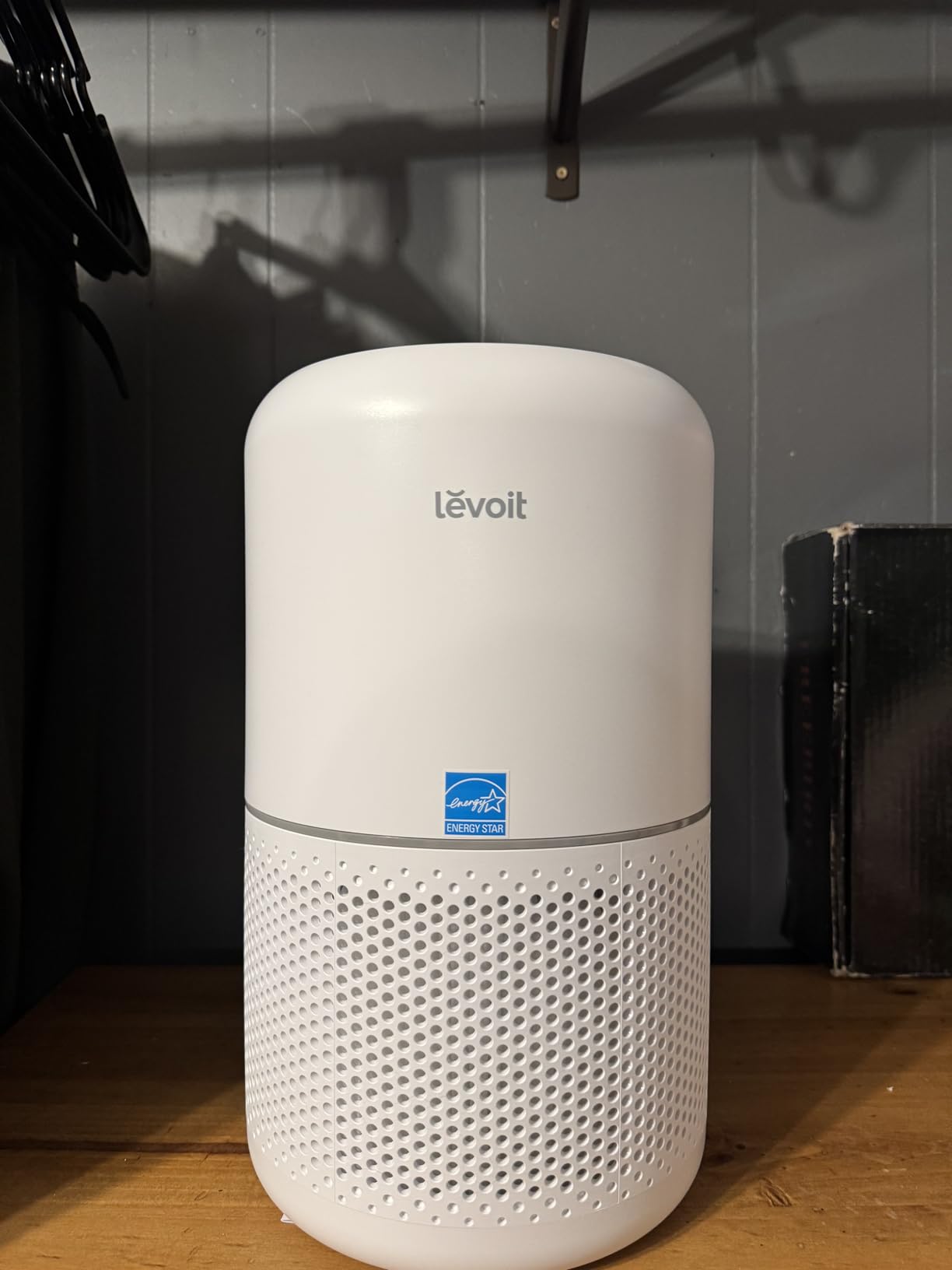
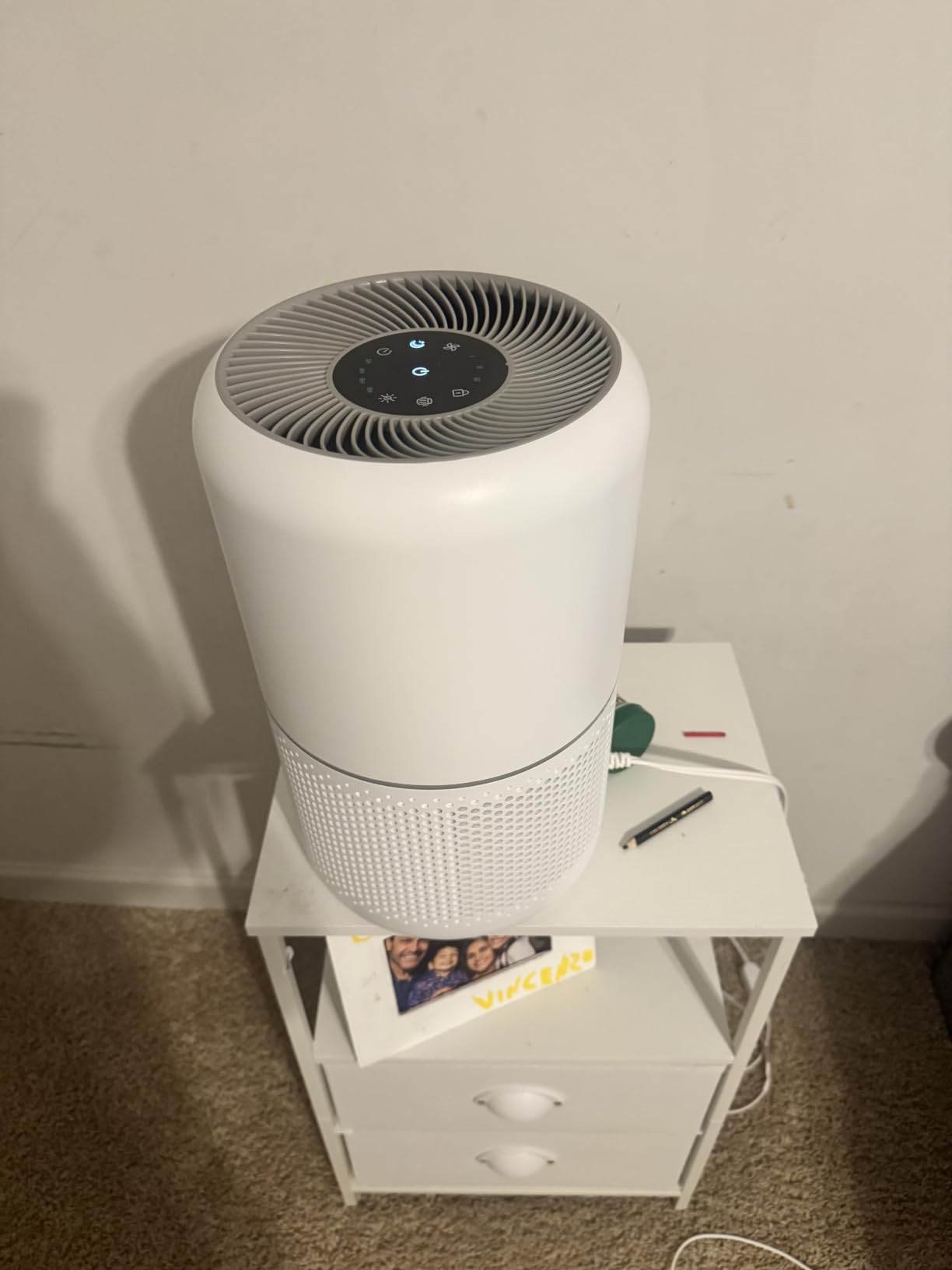
The Sleep Mode drops noise to just 24 decibels. For context, that is quieter than a whisper and quieter than most fans. Light sleepers who cannot tolerate background noise consistently praise this feature in reviews. The display lights also turn off completely, so there is no glow keeping you awake.
The 3-in-1 filtration system uses a pre-filter, an activated carbon layer, and a true HEPA-grade filter. This combination captures everything from large dust particles to microscopic allergens to odors and VOCs. With a CADR rating of 143 CFM for smoke, 153 for dust, and 167 for pollen, it has more than enough power for any standard bedroom.
With over 108,000 reviews and a 4.7 star average rating, this is one of the most tested and trusted air purifiers on the market. Users specifically mention waking up less congested, breathing through their nose at night, and noticing a reduction in dust accumulation. One reviewer wrote that their partner’s snoring noticeably decreased after two weeks of running this unit in their bedroom.
LEVOIT also offers specialized replacement filters for different needs. The Pet Allergy filter targets dander, the Toxin Absorber handles VOCs and smoke, and the Smoke Remover is designed for wildfire conditions. This flexibility lets you tailor the filtration to your specific triggers.
2. GermGuardian AC4825E 22-Inch Tower
GermGuardian HEPA Air Purifier – Large Room Air Purifier for Bedroom, Office, Dorm, and Home – Filters Pet Dander, Dust, Pollen, Smoke, Scents – AC4825E – 22″ Tower – Gray
True HEPA PURE filter
Optional UV-C light
22 inch tower design
Covers up to 743 sq ft
Pros
- True HEPA captures 99.97% of allergens down to 0.1 microns
- Optional UV-C light for airborne germ reduction
- Long lasting filter replaced approximately once per year
- 3 speed settings with quiet sleep mode
- Compact tower fits easily in bedroom corners
Cons
- UV-C light can be distracting at night if left on
- Does not remember settings after power outage
- Replacement filters and UV bulbs required periodically
The GermGuardian AC4825E has been a bedroom staple for years, and that longevity speaks volumes. This 22-inch tower combines true HEPA filtration with an optional UV-C light that reduces airborne bacteria and viruses. For people whose congestion is linked to both allergens and frequent colds or sinus infections, that dual approach is appealing.
The HEPA PURE filter captures 99.97% of particles as small as 0.1 microns, matching the filtration standard of more expensive units. It circulates and filters the air in a 153 square foot room every 12.5 minutes, which means it is hitting roughly 4.8 air changes per hour in a small bedroom. That comfortably exceeds the 2-3 rule we discussed earlier.
The 3 speed settings include a low speed suitable for sleeping. Some users note the UV-C light produces a faint blue glow that can bother sensitive sleepers. The good news is you can turn off the UV-C function independently while keeping the fan and filter running.
With over 63,000 reviews and a 4.6 star average, the user feedback is extensive. Reviewers with allergies and asthma consistently report fewer symptoms and better sleep. The long filter life, typically 6 to 8 months, keeps maintenance costs reasonable compared to units requiring monthly changes.
One practical tip from the review data: if you experience power outages, this unit resets to off rather than resuming its previous setting. For uninterrupted overnight use, a smart plug can automate the on-off cycle.
3. Clorox Air Purifier for Small Rooms
Clorox Small Room Air Purifiers for Bedroom Home, True HEPA Filter
True HEPA filter
Covers up to 200 sq ft
23dB whisper quiet
360 degree air intake
Pros
- Very quiet operation at 23 decibels
- Compact tabletop design for small bedrooms
- 360 degree air intake for efficient purification
- True HEPA captures 99.97% of particles down to 0.1 microns
- Adjustable night light with dimming options
- 3 year limited warranty
Cons
- Small coverage area limited to 200 sq ft
- No auto-on or memory feature
- No continuous run mode limited to 2-8 hour timer
- Replacement filters cost approximately $26
The Clorox Air Purifier is purpose-built for small spaces, and for anyone sleeping in a compact bedroom, dorm room, or studio apartment, it offers excellent value without compromising on filtration quality.
The true HEPA filter captures 99.97% of particles as small as 0.1 microns. The 360-degree air intake design pulls air from all directions, which is more efficient than single-direction units in small rooms. For an 80 square foot room, it cleans the air 5 times per hour, well above the recommended 2-3 air changes.
At 23 decibels on its lowest setting, it is among the quietest options available. The adjustable night light is a thoughtful touch, offering bright, dim, or off settings so you can customize your sleep environment. The compact 7.5 by 7.5 by 9.5 inch frame sits unobtrusively on a nightstand or dresser.
With over 1,200 reviews and an 80% five-star rate, users praise its effectiveness for allergy relief and mold reduction. Reviewers with asthma and dust sensitivities report waking up less congested. The main trade-off is coverage area. At 200 square feet maximum, it is not suited for large or open-plan bedrooms.
The timer offers 2, 4, or 8 hour options but lacks a continuous run mode. For all-night use, the 8-hour setting covers a standard sleep period. The 3-year warranty is notably longer than most competitors in this price range.
Tips for Maximum Effectiveness
Even the best air purifier underperforms if you do not use it correctly. These tips come from user experiences and sleep clinic recommendations.
Place the purifier within 3 to 6 feet of your bed for maximum benefit. The cleanest air concentrates closest to the unit. Avoid tucking it behind furniture or in a corner where airflow is restricted.
Run it all night. Most users who report improvement mention running their unit continuously while sleeping. The 2-hour window some Reddit users cite for noticing relief suggests that consistent overnight use is key.
Replace filters on schedule. A clogged filter stops capturing particles and can actually recirculate trapped allergens. Check your filter indicator monthly and replace according to the manufacturer schedule.
Keep windows closed while running the purifier. Opening a window introduces a fresh wave of pollen and dust that overwhelms the unit’s capacity.
Combine with good sleep hygiene. Wash bedding weekly in hot water, use dust mite pillow covers, and vacuum regularly. The air purifier is one piece of a comprehensive allergen reduction strategy.
FAQs
Will an air purifier help with morning congestion?
Yes, an air purifier can help with morning congestion when airborne allergens like dust mites, pet dander, pollen, or mold spores are the cause. A true HEPA filter captures these particles before they reach your nasal passages, reducing overnight inflammation and mucus buildup. If your congestion clears within 30 minutes of waking up, allergens are likely a contributor and an air purifier can make a noticeable difference.
Can an air purifier stop snoring?
An air purifier can reduce snoring but cannot stop it entirely unless airborne irritants are the primary cause. By removing dust, dander, and other allergens from bedroom air, it reduces nasal congestion and airway inflammation that contribute to snoring. If your snoring stems from structural issues like a deviated septum, excess weight, or sleep apnea, an air purifier alone will not solve the problem.
What is the 2-3 rule for air purifiers?
The 2-3 rule means your air purifier should filter all the air in your room at least 2 to 3 times per hour. To calculate this, multiply your room’s cubic footage by 2 or 3, then divide by 60 to find the minimum CFM rating you need. For a standard bedroom, most quality HEPA air purifiers exceed this threshold comfortably.
Does an air purifier dry out your sinuses?
Some users report that air purifiers dry out their sinuses and throat, particularly in already dry climates or during winter. Air purifiers do not add moisture to air, so in low-humidity environments the constant airflow can feel drying. If this happens, pairing your air purifier with a humidifier solves the problem while maintaining clean air quality.
Will an air purifier help with sleep apnea?
An air purifier cannot treat or cure sleep apnea. Sleep apnea is a condition involving physical airway obstruction or neurological signaling issues that require medical intervention such as a CPAP machine. However, some users with mild sleep apnea report that cleaner bedroom air helps them breathe more comfortably at night, which may complement their prescribed treatment plan.
Final Thoughts
So, does an air purifier help with snoring and morning congestion? For the significant percentage of people whose symptoms are driven by indoor allergens, the answer is a genuine yes. A quality HEPA air purifier removes the dust mite debris, pet dander, pollen, and mold spores that inflame your nasal passages night after night.
The key is matching the right unit to your room size using the 2-3 rule, running it consistently overnight, and replacing filters on schedule. If your congestion persists despite clean air, consider adding a humidifier or consulting a doctor to explore structural causes. Better sleep often starts with better air, and an air purifier is one of the simplest steps you can take toward quieter, more restful nights.