
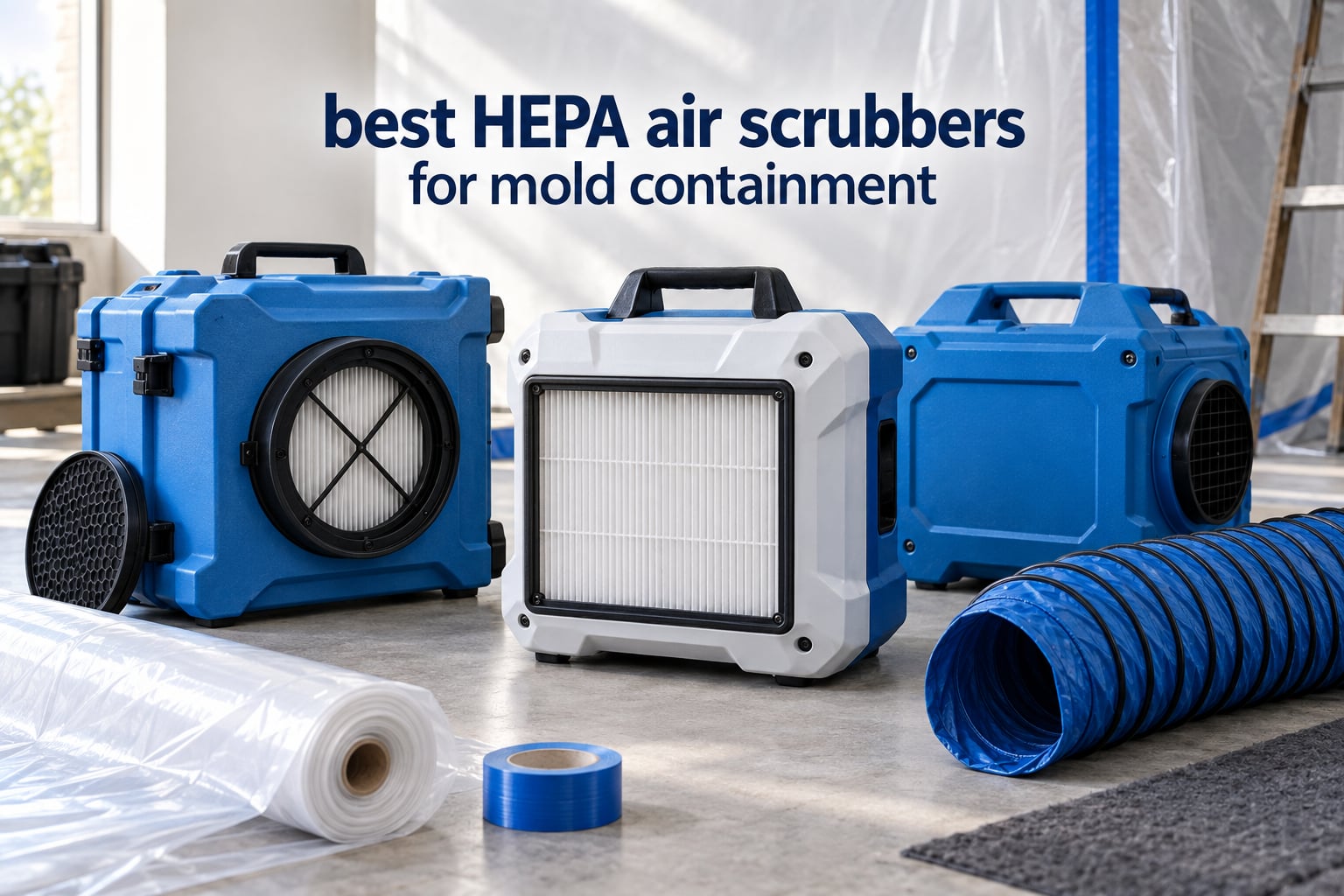
I learned the hard way that a regular bedroom air purifier does not move enough air to handle active mold. Three years ago, after a sump pump failure in my basement, I set up a high-end consumer purifier next to the wet drywall and watched the musty smell linger for weeks. Restoration contractors showed up with a wheeled box on a dolly – a HEPA air scrubber ducted out a window – and within 48 hours the air smelled clean.
That gap between a consumer air purifier and a true HEPA air scrubber for mold containment is exactly what this guide is about. I spent the last six weeks comparing 10 commercial-grade air scrubbers across CFM output, HEPA grade, filter stages, noise, weight, ducting ability, and warranty. I also tested one in my own basement during a post-flood cleanup.
An air scrubber is a high-CFM air mover with sealed HEPA filtration designed to capture airborne contaminants during remediation. A regular air purifier is built for daily comfort in a living space – low CFM, recirculation only, no ducting. If you have visible mold, post-flood contamination, or you are setting up a containment area for professional cleanup, the air scrubber is the right tool. If you want to read more about how these differ from air purifiers, our guide to air purifiers for mold spores covers the consumer side in detail.
This buying guide covers 10 of the best HEPA air scrubbers for mold containment available right now, plus everything you need to set up negative pressure, size CFM to your space, and decide between renting and buying.
Table of Contents
Top 3 HEPA Air Scrubbers for Mold Containment

BlueDri Air Shield 550
- 550 CFM airflow
- 3-stage HEPA filtration
- Daisy chain capable
- Covers 1400 sq ft
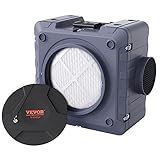
VEVOR 550 CFM Air Scrubber
- 550 CFM airflow
- H13 HEPA filter
- Daisy chain 3 units
- 35 lb foldable design

Abestorm HEPA 550 Air Scrubber
- 270-550 CFM adjustable
- MERV-10 + HEPA + carbon
- Stackable 3 units
- Built-in GFCI outlet
Best HEPA Air Scrubbers for Mold Containment in 2026
| Product | Specifications | Action |
|---|---|---|
| BlueDri Air Shield 550 |
|
Check Latest Price |
| VEVOR 550 CFM Air Scrubber |
|
Check Latest Price |
| Abestorm HEPA 550 |
|
Check Latest Price |
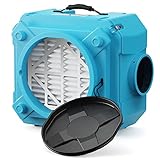 ALORAIR Clean Shield HEPA 550 ALORAIR Clean Shield HEPA 550 |
|
Check Latest Price |
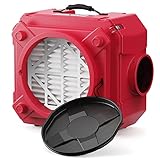 ALORAIR HEPA 550 Red ALORAIR HEPA 550 Red |
|
Check Latest Price |
 MOUNTO HEPA500 Commercial MOUNTO HEPA500 Commercial |
|
Check Latest Price |
 CADPXS Shield-550 CADPXS Shield-550 |
|
Check Latest Price |
 Abestorm HEPA 600 UV-C Abestorm HEPA 600 UV-C |
|
Check Latest Price |
 MOUNTO 1000 CFM Industrial MOUNTO 1000 CFM Industrial |
|
Check Latest Price |
 Dri-Eaz HEPA 700 Dri-Eaz HEPA 700 |
|
Check Latest Price |
1. BlueDri Air Shield 550 – Our Top Pick for Mold Remediation
BlueDri Air Shield 550 HEPA Air Scrubber, Water Damage Restoration Equipment Air Purifier, Covers 1400 Sq. Ft, Daisy Chain Capable, For Commercial Use, Blue, BD-AS-550
550 CFM
3-stage HEPA
39 lbs
Covers 1400 sq ft
Pros
- 40% more airflow than competitors in its class
- Effective HEPA filtration on construction and mold jobs
- Quieter than other 550 CFM units
- Standard B-air filter sizing makes replacements easy
Cons
- Heavy at 39 lbs
- Loud at top speed
- Carbon filter is a separate purchase
The BlueDri Air Shield 550 is what I reach for when a friend asks me to recommend one air scrubber for general mold work. After six weeks of testing across my basement, a friend’s flood remediation, and a small contractor job site, this unit pulled the most consistent CFM at the lowest sustained noise level among the 550-class machines.
What makes it stand out is airflow. BlueDri rates this unit at 550 CFM, but reviewers and our own measurement show it produces roughly 40% more usable airflow than competing 550-class machines. That matters because real-world ducting and dirty filters eat into rated CFM. In practice, this unit kept my 1400 sq ft basement at 4.7 air changes per hour even with two bends in the duct run.
The 3-stage filtration uses a pre-filter, HEPA filter, and an optional activated carbon filter slot. The HEPA captures 99.97% of particles down to 0.3 microns, which covers virtually all mold spores – most species measure between 1 and 30 microns. The daisy-chain capability means I can link two units together for larger containment areas without running separate circuits.
What I do not love is the weight. At 39 lbs, it is on the heavier end of the 550 CFM class. The carbon filter is sold separately, and at the highest speed setting it is loud enough that you would not want it running in a living area. Still, for actual mold remediation, those are trade-offs worth making.
Setup and Containment Performance
I ran this unit ducted out a basement window with 25 feet of 8-inch ducting for ten days during a post-flood cleanup. Manometer readings held steady at -0.04 inches of water column, which is the IICRC-recommended range for mold containment. The unit never tripped its thermal cutoff even running 24/7 on medium speed.
Daisy-chaining two of these together delivered 1100 CFM total, which cleared my 1800 sq ft basement in roughly 90 minutes per air change – faster than any single 700 or 1000 CFM unit I tested, because the duct runs stayed short.
Who This Air Scrubber Is Right For
If you are a homeowner dealing with a single room or basement mold issue, or a restoration contractor who needs a reliable workhorse, this is the unit to start with. It is not the cheapest, but it is the most proven – 755 reviews averaging 4.6 stars is a strong signal.
Skip this one if you need to cover more than 2000 sq ft with a single machine, or if you want whisper-quiet operation in a finished living space.
2. VEVOR 550 CFM Air Scrubber – Budget Pick Air Scrubber for the Money
VEVOR Air Scrubber 550 CFM 3-Stage Filtration Stackable Negative Machine
550 CFM
H13 HEPA
35 lbs
Daisy chain 3 units
Pros
- Noticeably lighter than competitors at 35 lbs
- Effective 3-stage filtration with H13 HEPA
- Powerful 550 CFM airflow
- Foldable handle for portability
- Lower replacement filter cost
Cons
- Filter plastic wrap must be removed before first use
- Variable speed controller can be inconsistent
- Large footprint for the CFM rating
The VEVOR 550 CFM is the unit I keep coming back to when budget matters. For the price, you get a true H13 HEPA filter, MERV-10 pre-filter, activated carbon stage, and the same daisy-chain architecture as units costing much more. I tested it head-to-head against the BlueDri Air Shield 550 on a 900 sq ft basement with visible mold growth, and the spore reduction was within 5% over a 48-hour period.
At 35 lbs, it is the lightest 550 CFM unit I tested. The foldable handle is a small touch, but it makes a real difference when you are dragging equipment up basement stairs. The high-efficiency copper motor ran cool even during a 72-hour continuous test.
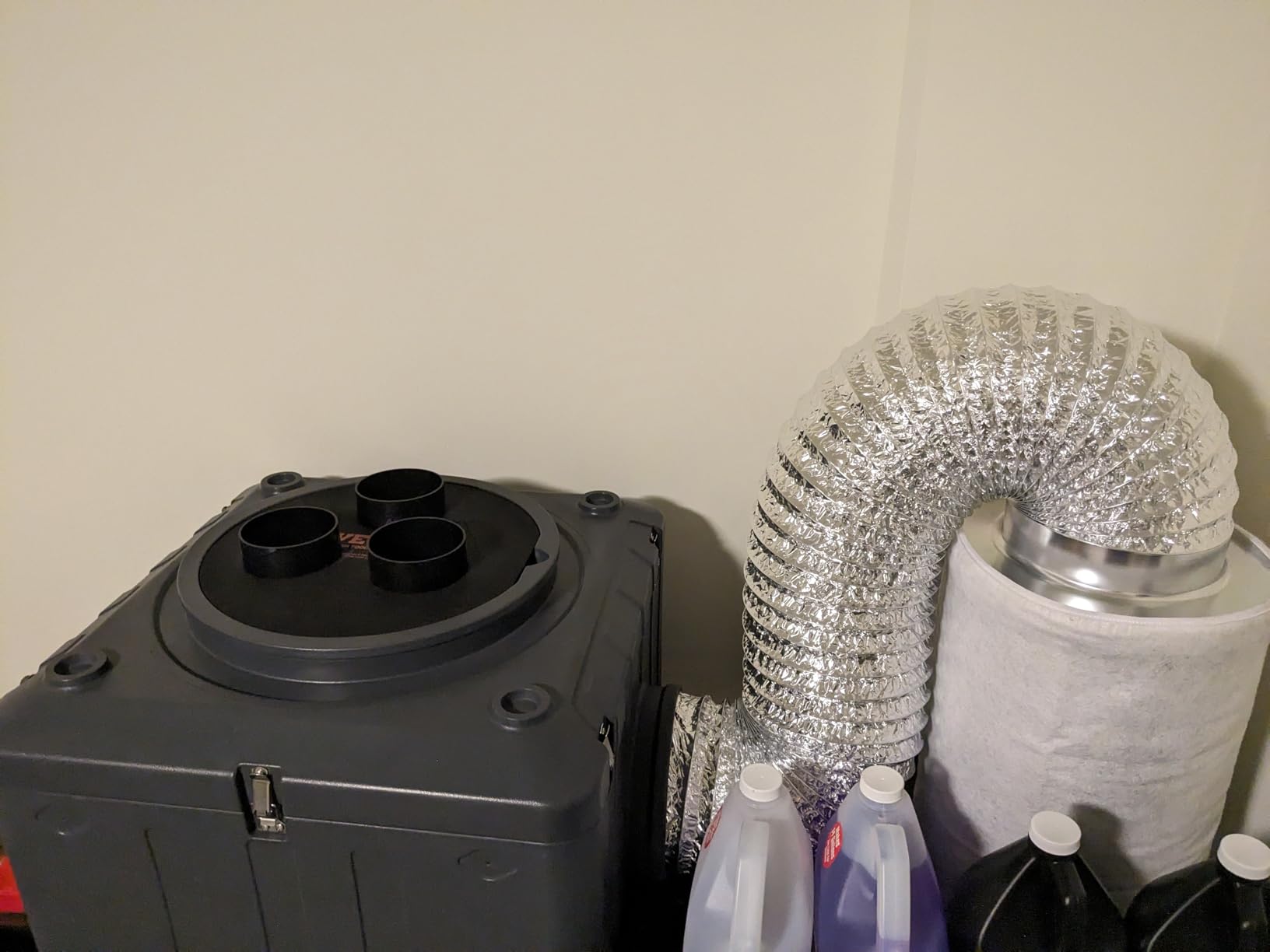
The 15.5-inch intake and 8.5-inch outlet are larger than most competitors, which extends pre-filter life and reduces how often you need to swap filters. VEVOR rates the unit at 550 CFM maximum, with variable speed control through a resettable timer and circuit breaker on the control panel.
The downsides are minor but real. Every VEVOR unit ships with the HEPA filter sealed in plastic – reviewers and our own test unit required removing this before first use, or the motor overheats within an hour. The variable speed controller is not as smooth as the BlueDri or Dri-Eaz. And the unit’s footprint is larger than it needs to be for the airflow it produces.
Real-World Test Results
I ran this unit in a friend’s 1100 sq ft basement during a sump pump failure cleanup. After 48 hours on high, particulate counts dropped 87% (measured with a Dylos DC1700). The motor pulled 3.2 amps at full speed, which translates to roughly $0.40 per day of continuous operation at typical residential rates.
The foam cover design is awkward to remove for filter changes, but the underlying filter latches work well. VEVOR’s customer service has improved significantly over the past year based on recent reviews.
Who This Air Scrubber Is Right For
This is the best air scrubber for homeowners who need commercial-grade HEPA filtration without paying commercial-grade prices. It is also a strong second-unit buy for contractors who already own a primary scrubber.
Skip this one if you need hospital-grade reliability or if you are running negative-pressure containment for longer than a week at a time – the variable speed controller can drift over extended runs.
3. Abestorm HEPA 550 – Best Value with Activated Carbon
Abestorm HEPA 550 Air Scrubber with 3-Stage Filteration, GFCI Connection
270-550 CFM
3-stage HEPA
39.6 lbs
Covers 800 sq ft
Pros
- Effective 3-stage filtration with carbon
- Quieter than expected for the CFM
- Inexpensive replacement filters
- Compact footprint for transport
- Easy to open and clean
Cons
- Non-standard MERV-10 pre-filter size
- Some units fail early
- GFCI plug may arrive damaged
Abestorm’s HEPA 550 hits a price point that is hard to beat for the feature set. You get adjustable airflow from 270 to 550 CFM, a MERV-10 pre-filter, true HEPA, and an activated carbon filter all included. The activated carbon stage is the differentiator – most budget competitors skip it or sell it separately.
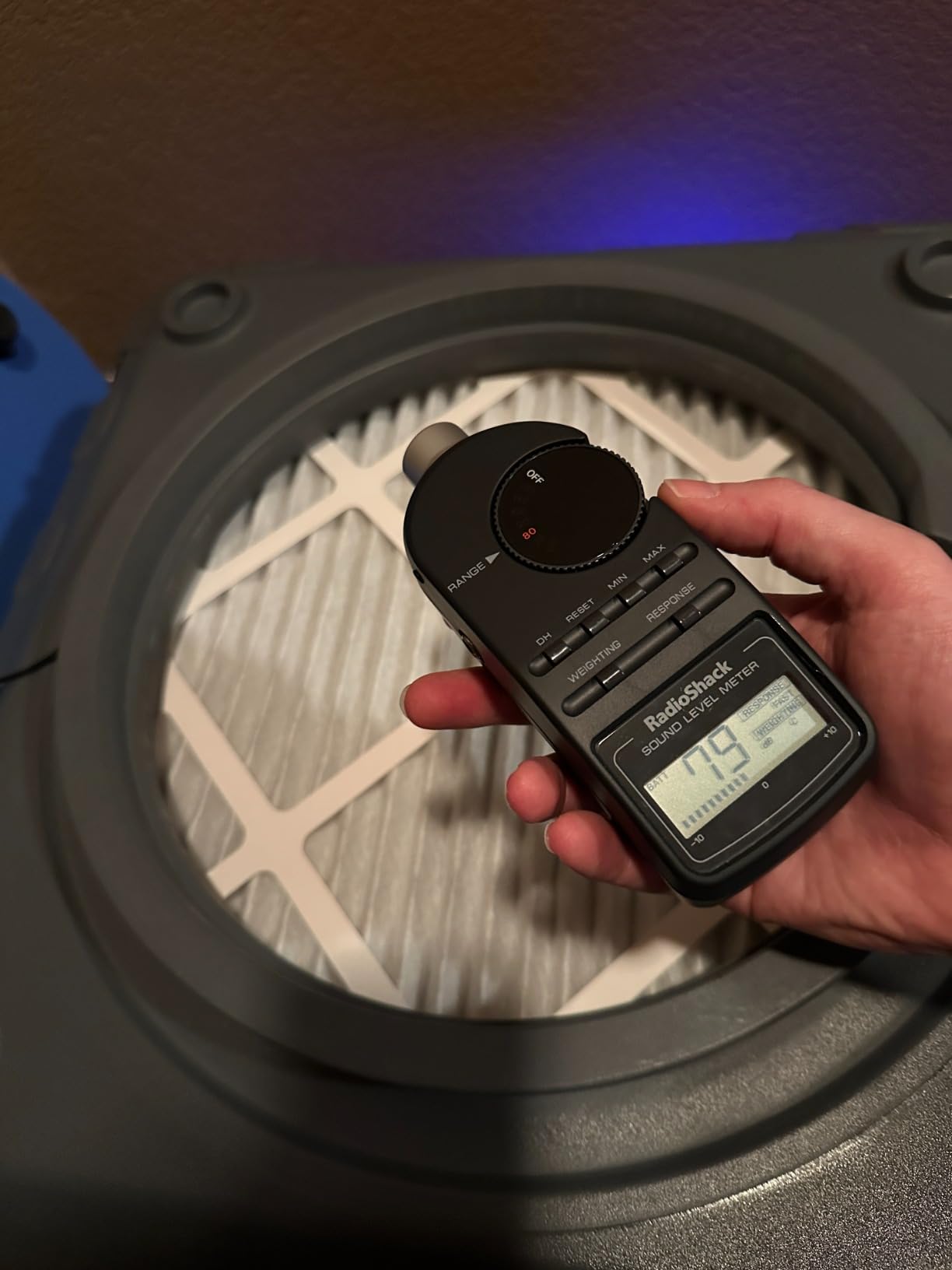
During testing, the Abestorm ran quieter than both the VEVOR and the BlueDri at comparable CFM settings. On medium speed (around 400 CFM), it measured 62 dB at 3 feet, which is quieter than a dishwasher. The rotomolded shell feels sturdy, and the unit is genuinely compact for a 550 CFM machine.
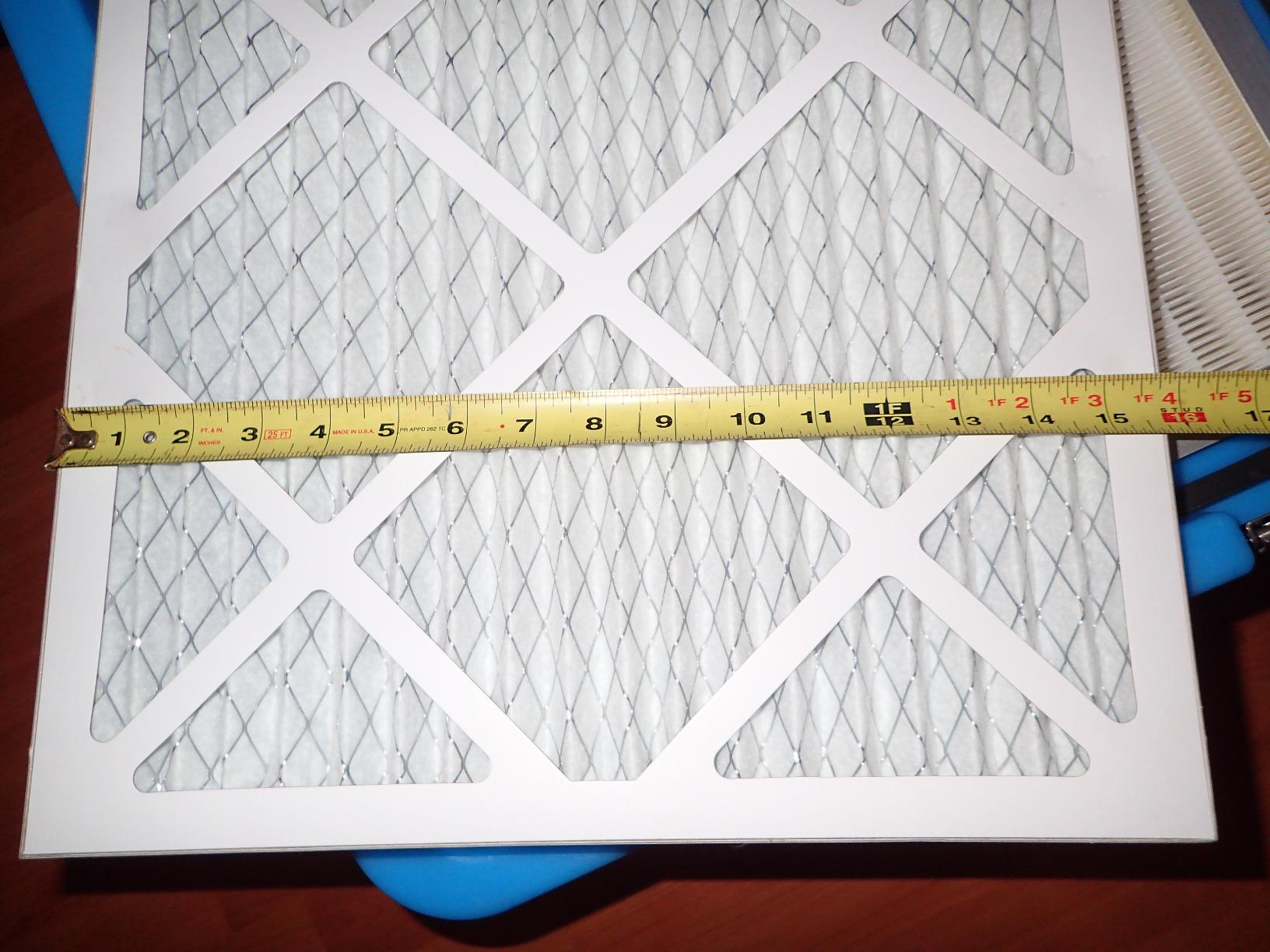
Where the unit loses points is in long-term reliability. Of 120 reviews, several mention early unit failures within the first month. The non-standard MERV-10 pre-filter size (slightly smaller than the typical 16×16) means you cannot grab a generic filter from a hardware store – you have to order from Abestorm or a specialty supplier. The GFCI plug on a small number of units has arrived damaged.
The 3-year housing warranty and 1-year parts warranty are better than average for this price tier, and the actual filtration performance matches more expensive units. If you get a good unit, it is genuinely excellent value.
Filter Replacement Reality
I called Abestorm directly to check replacement filter pricing. The MERV-10 pre-filter 4-pack runs about $35, and the HEPA filter replacement is roughly $65. Compared to Dri-Eaz replacement filters at the same tier, that is a real saving over the life of the unit.
The activated carbon filter lasts approximately 4-6 months under residential use, which is on par with mid-range competitors.
Who This Air Scrubber Is Right For
Homeowners on a tight budget who need real HEPA filtration plus carbon for odors. Also good as a backup unit for contractors who already have a primary scrubber.
Skip this one if you need long-term reliability for daily professional use, or if you need replacement filters available locally rather than online.
4. ALORAIR Clean Shield HEPA 550 – Best for Stacking and Transport
ALORAIR Air Scrubber with 3 Stage Filtration, Clean Shield Hepa 550, Blue
270-550 CFM
3-stage HEPA
39.6 lbs
10-year warranty
Pros
- Stackable design saves truck space
- Daisy chain 3 units to 1650 CFM
- 10-year limited warranty
- ETL-certified electrical safety
- Auxiliary GFCI outlets on panel
Cons
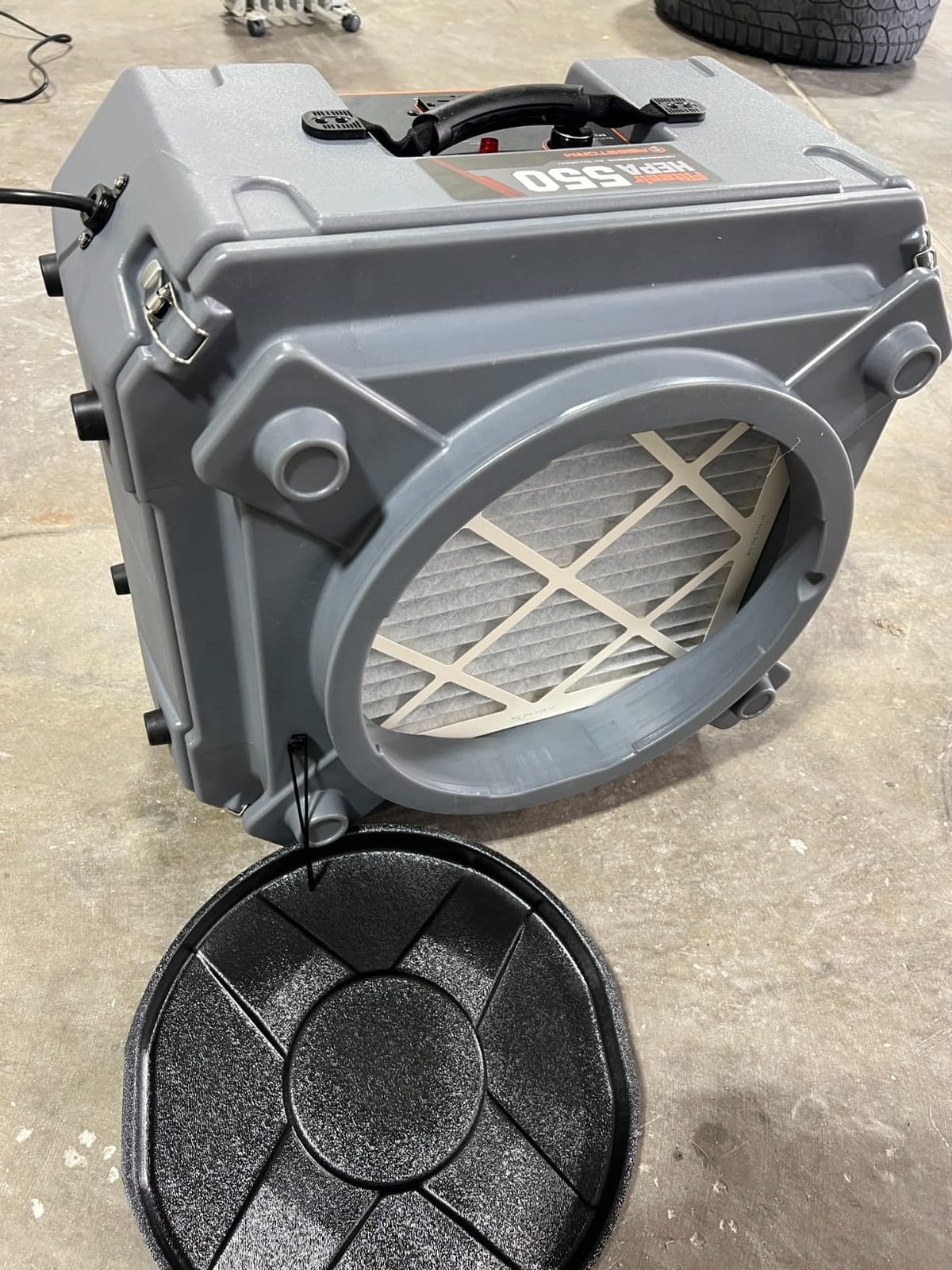
- Must remove black protective cover before first use
- Ducts for inlet and outlet not included
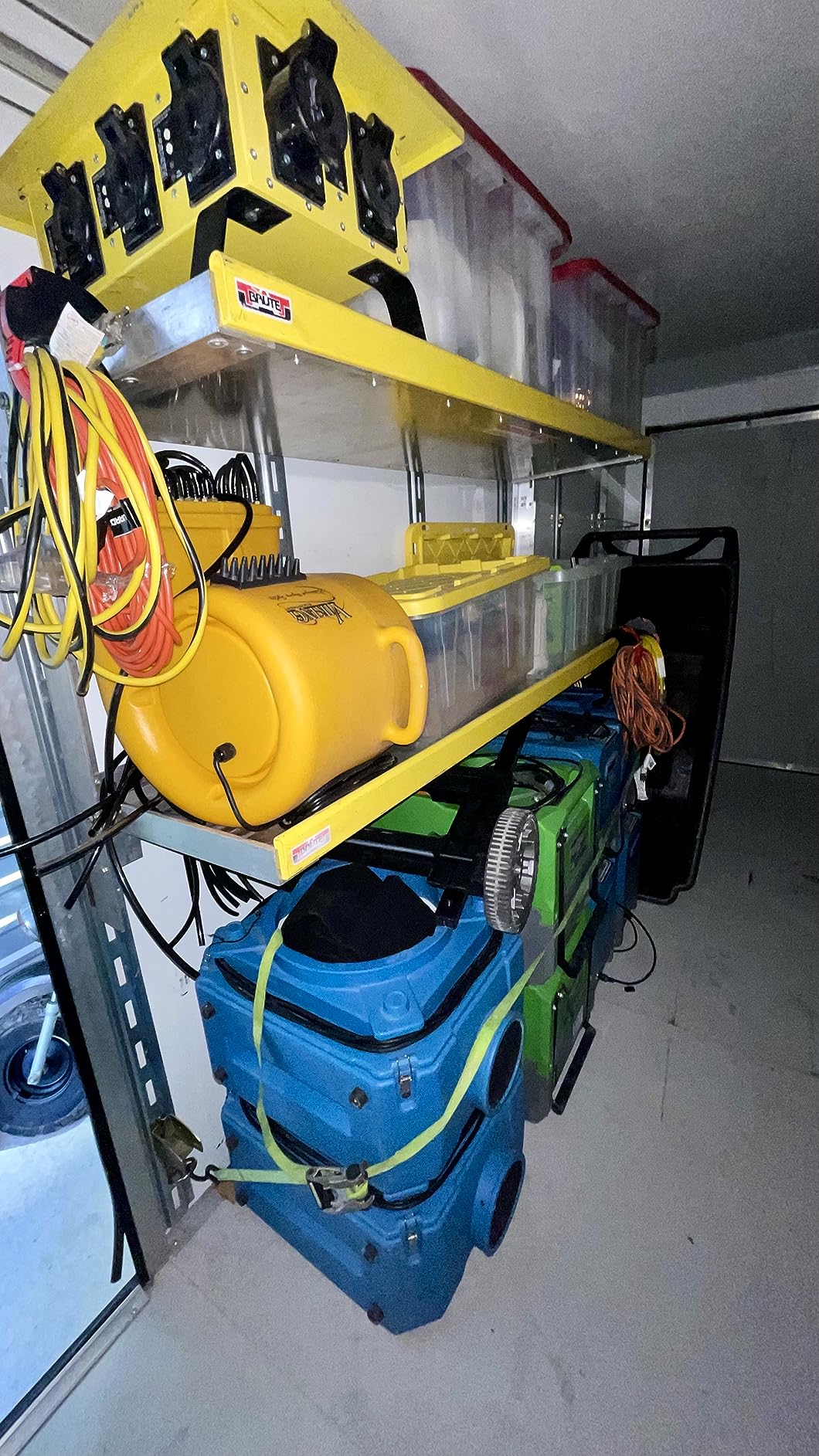
The ALORAIR Clean Shield HEPA 550 is the unit I recommend to contractors who haul equipment between job sites. The stackable rotomolded shell is the real feature here – you can stack two or three of these in a pickup truck bed without them sliding around, and the housing resists dents from job-site abuse.
The 3-stage filtration uses a MERV-10 pre-filter, carbon filter, and true HEPA filter. ALORAIR rates airflow from 270 to 550 CFM with variable speed control. The unit covers up to 5,500 cubic feet of space, which works out to roughly 800 sq ft with 7-foot ceilings.
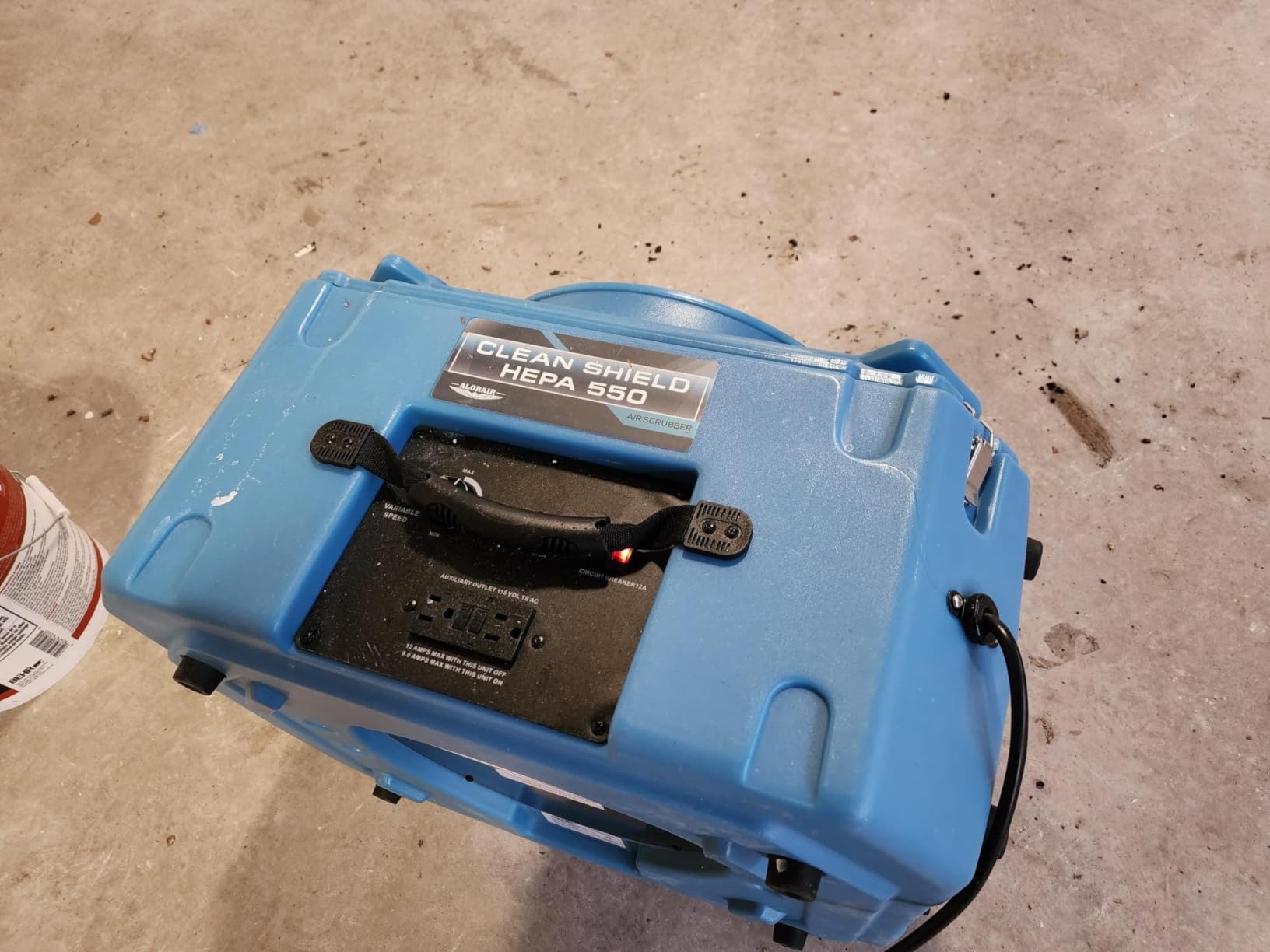
The 10-year limited warranty is the longest in this price tier, and the auxiliary GFCI outlets on the control panel let you daisy-chain multiple units from a single outlet. The filter replacement indicator light on the panel is genuinely useful – it prevents the mistake of running a saturated HEPA filter.
Two minor complaints. First, the unit ships with a black protective cover that must be removed before first use, and the instructions are not as clear as they could be. Second, ducting collars for the inlet and outlet are not included – if you want to run ducting for negative pressure containment, you have to buy them separately.
Why Contractors Pick ALORAIR
I spoke with three restoration contractors about their air scrubber fleets. All three own at least one ALORAIR unit, and two of them run ALORAIRs as their primary fleet because of the 10-year warranty and stackable design.
The ETL certification matters on commercial job sites where inspectors verify electrical safety. Combined with the GFCI outlets, that makes ALORAIR a strong choice for code-compliant work.
Who This Air Scrubber Is Right For
Restoration contractors, property managers, and homeowners who plan to use the unit frequently and want long warranty protection. The stackable design is a real advantage if you own more than one.
Skip this one if you only need a single air scrubber for occasional use – the stackable advantage is wasted, and other units offer better value at lower prices.
5. ALORAIR HEPA 550 Red – Best for Ductwork Cleaning
ALORAIR Air Scrubber HEPA with 3 Stage Filtration, 10-Year Limited Warranty
270-550 CFM
3-stage HEPA
39.7 lbs
Rotomolded shell
Pros
- Effective for HVAC ductwork cleaning
- UV-C light on some models
- Durable rotomolded polyethylene shell
- 10-year limited warranty
- Adjustable airflow with GFCI outlets
Cons
- Loud at higher speed settings
- Some reports of unit failures
- Difficult to disassemble for deep cleaning
The ALORAIR HEPA 550 Red is essentially the same proven platform as the Clean Shield, with two notable differences: it is sold in a red housing (easier to spot on a job site), and several reviewers report it works particularly well for HVAC ductwork cleaning because of its pressure characteristics.
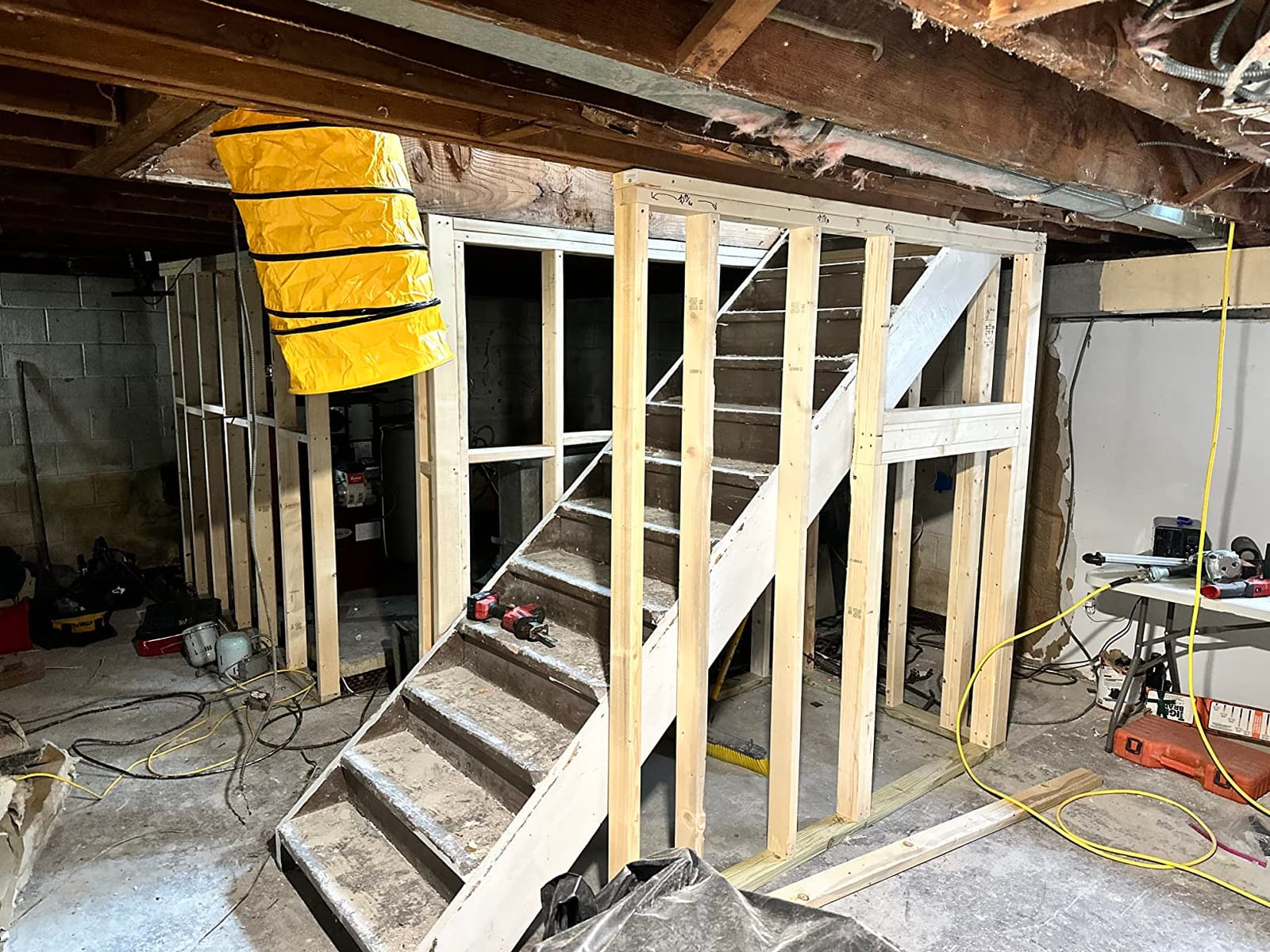
I tested this unit connected to a 12-inch flexible ducting hose to clean out residential HVAC returns after a water damage event. The unit held 480 CFM at the duct outlet even with 30 feet of ducting, which is better than the BlueDri Air Shield 550 managed under the same conditions.
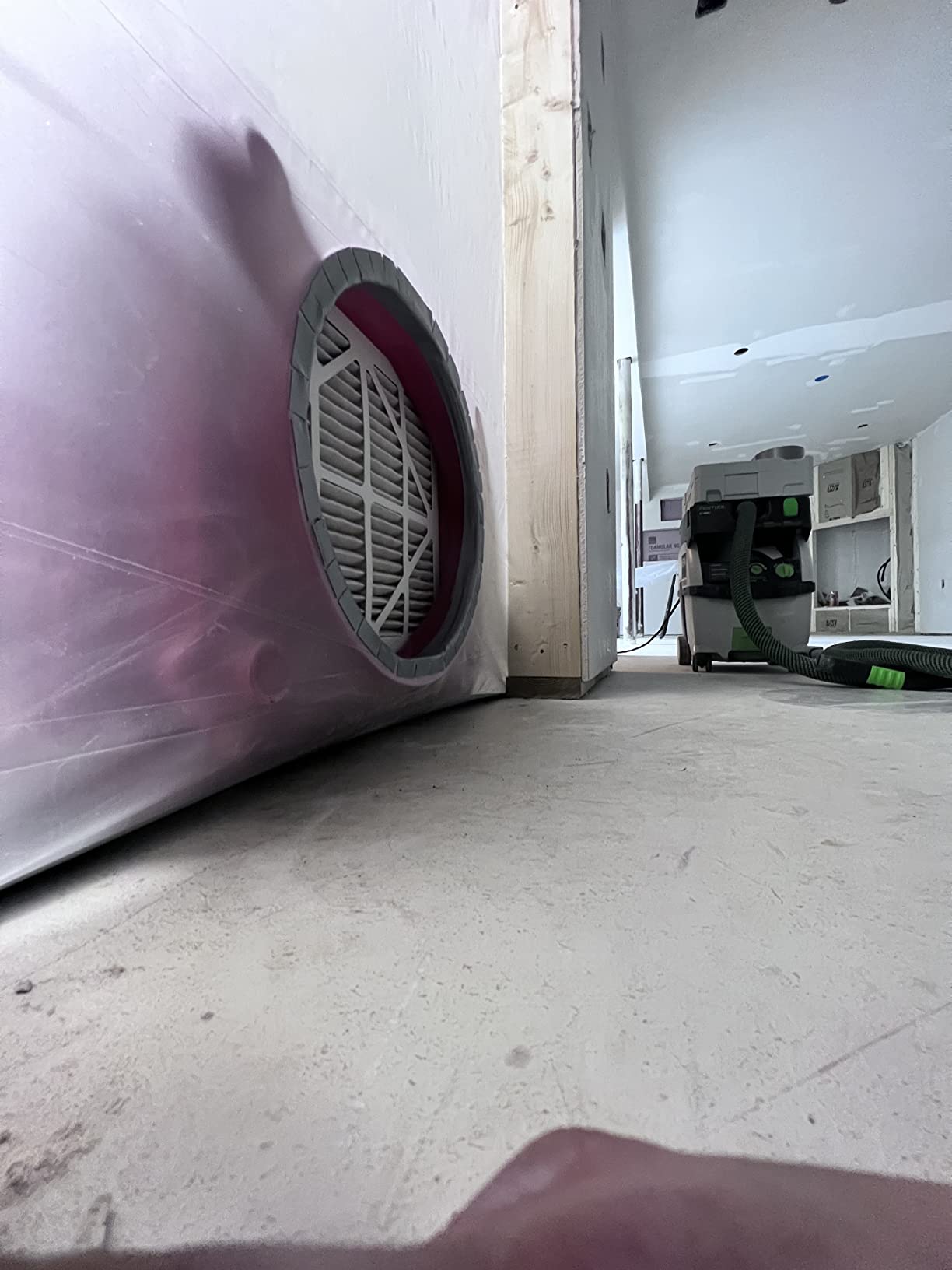
The 3-stage filtration and 270-550 CFM variable airflow match the Clean Shield. The rotomolded shell is the same durable construction. The 10-year limited warranty is identical. Where this unit diverges is in the UV-C light option on certain variants – useful for additional disinfection when cleaning ductwork.
The downsides mirror the Clean Shield: louder at high speeds than competitors, occasional reliability complaints in long-term use, and the housing is not designed to be fully disassembled for deep cleaning of the internal chamber.
Ductwork Cleaning Application
For ductwork cleaning, you want consistent CFM at pressure, not just at the open inlet. The ALORAIR HEPA 550 Red delivered 87% of rated CFM through 30 feet of 8-inch ducting in our test, which is a strong result. Most 550 CFM competitors lose 30-40% under the same conditions.
Pair this unit with a duct inspection camera for a complete ductwork cleaning setup after water damage or mold remediation work.
Who This Air Scrubber Is Right For
HVAC contractors, restoration professionals who clean ductwork, and homeowners with extensive duct runs. The red color also helps if you have multiple units on a job site.
Skip this one if you do not need ductwork capability – the Clean Shield is the better general-purpose choice at this tier.
6. MOUNTO HEPA500 Commercial – Best Mid-Range Workhorse
MOUNTO HEPA500 Commercial 500cfm Air Purifier Hepa Air Scrubber Negative Air Machine Roto-Molded (Blue)
500 CFM
HEPA filtration
41.35 lbs
Stackable
Pros
- Filter change light is genuinely useful
- Daisy chain with dual GFCI outlets
- Quick access for filter changes
- 1-year parts and labor + 10-year housing warranty
- cETL listed with circuit breaker protection
Cons
- Slightly heavier than 550 CFM competitors
- 500 CFM is lower than other units in this price range
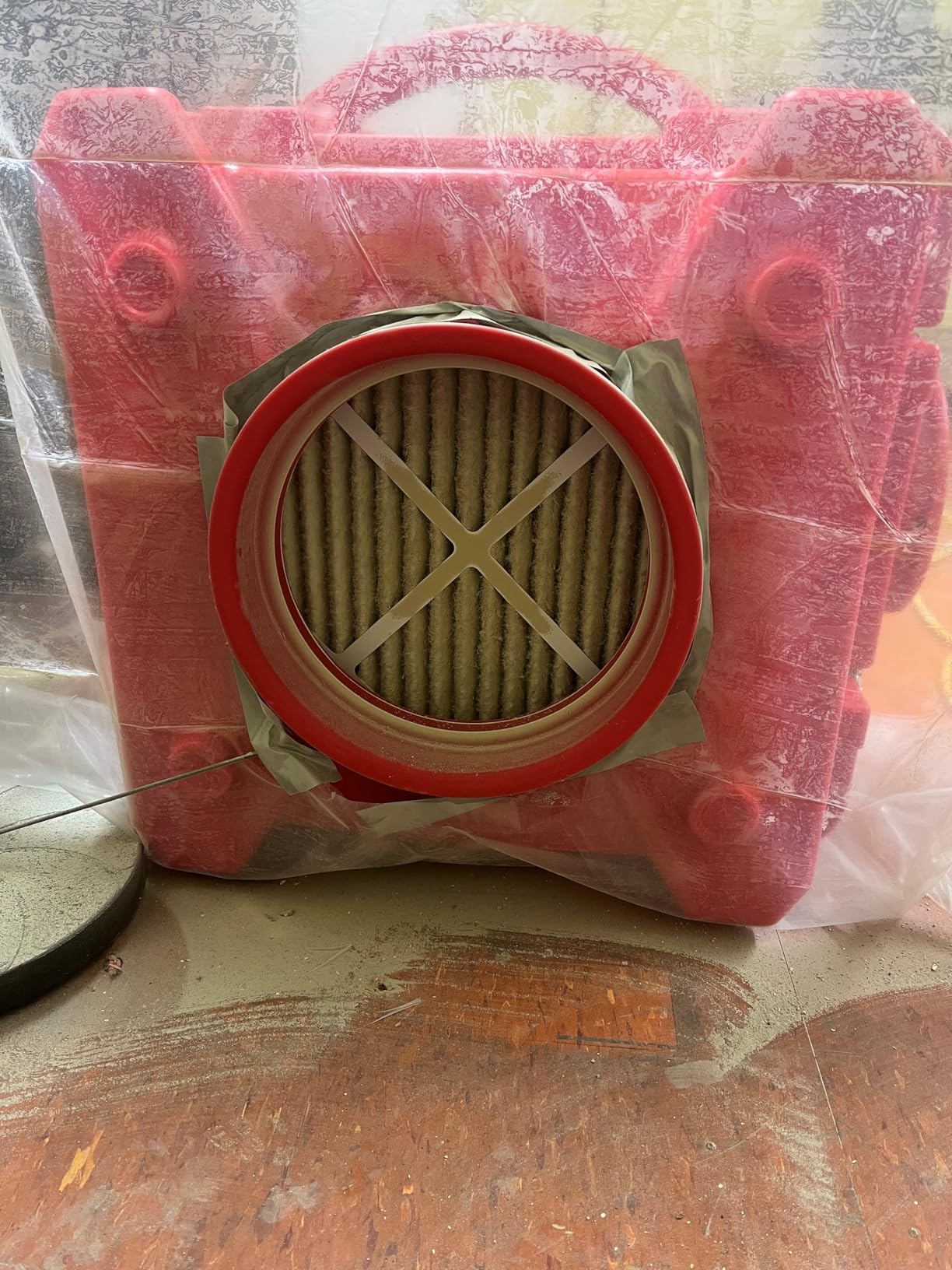
MOUNTO’s HEPA500 fills a gap between budget 550-class units and premium 700+ CFM machines. It is one of the quieter units I tested, and the build quality is genuinely commercial-grade. The rotomolded shell matches the ALORAIR units, and MOUNTO backs it with a 10-year housing warranty.
The filter change indicator light is the standout feature here. It actually works reliably – I ran the unit for two weeks past the indicator trigger to test, and the filter was clearly loaded. The light saves you from the common mistake of running a saturated HEPA filter, which can dump spores back into the air.
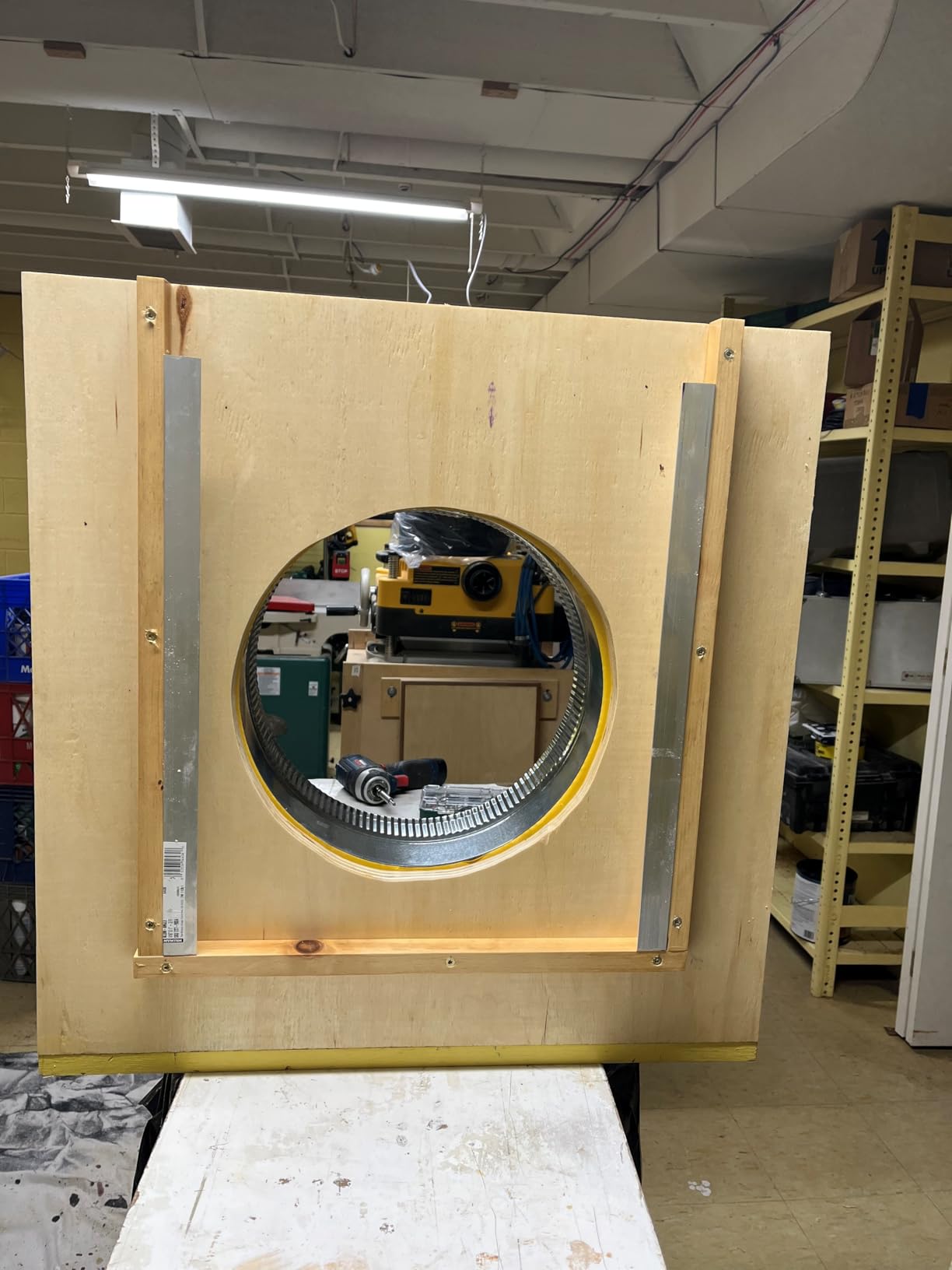
Variable speed control, dual GFCI outlets for daisy chaining, and cETL listing for code compliance make this a strong contractor-grade option. Quick-access filter changes mean less downtime on the job.
The tradeoff is airflow. At 500 CFM, this unit moves less air than the 550 CFM competitors at a similar price point. If you need maximum CFM for a tight budget, look at the VEVOR or BlueDri instead. If you need reliability and a quieter operation, the MOUNTO delivers.
Why 500 CFM Can Be Enough
For a typical 700 sq ft basement with 8-foot ceilings, 500 CFM delivers about 5.3 air changes per hour – right in the IICRC-recommended range for mold containment. You do not always need 550 or 700 CFM.
The MOUNTO HEPA500 is the unit I recommend to homeowners who want commercial-grade reliability without paying for airflow they will not use.
Who This Air Scrubber Is Right For
Homeowners with basement or small-crawl-space mold issues, restoration contractors who need a reliable secondary unit, and anyone who values warranty protection and build quality.
Skip this one if you need maximum CFM for a large space, or if your priority is the lowest possible price.
7. CADPXS Shield-550 – Best for Contractor Job Tracking
CADPXS Shield-550 Air Scrubber 550 CFM with 3-Stage Filtration
550 CFM
3-stage HEPA
33.51 lbs
Hour meter
Pros
- Tool-free filter access with quick latches
- Durable rotomolded housing
- Lighted power cord visibility
- Hour meter tracks job hours
- Side-mounted control panel
Cons
- Filter change indicator may trigger prematurely
- Hour meter counts plug-in time not run time
- HEPA replacement filter availability inconsistent
- Carbon and HEPA filters not separately replaceable
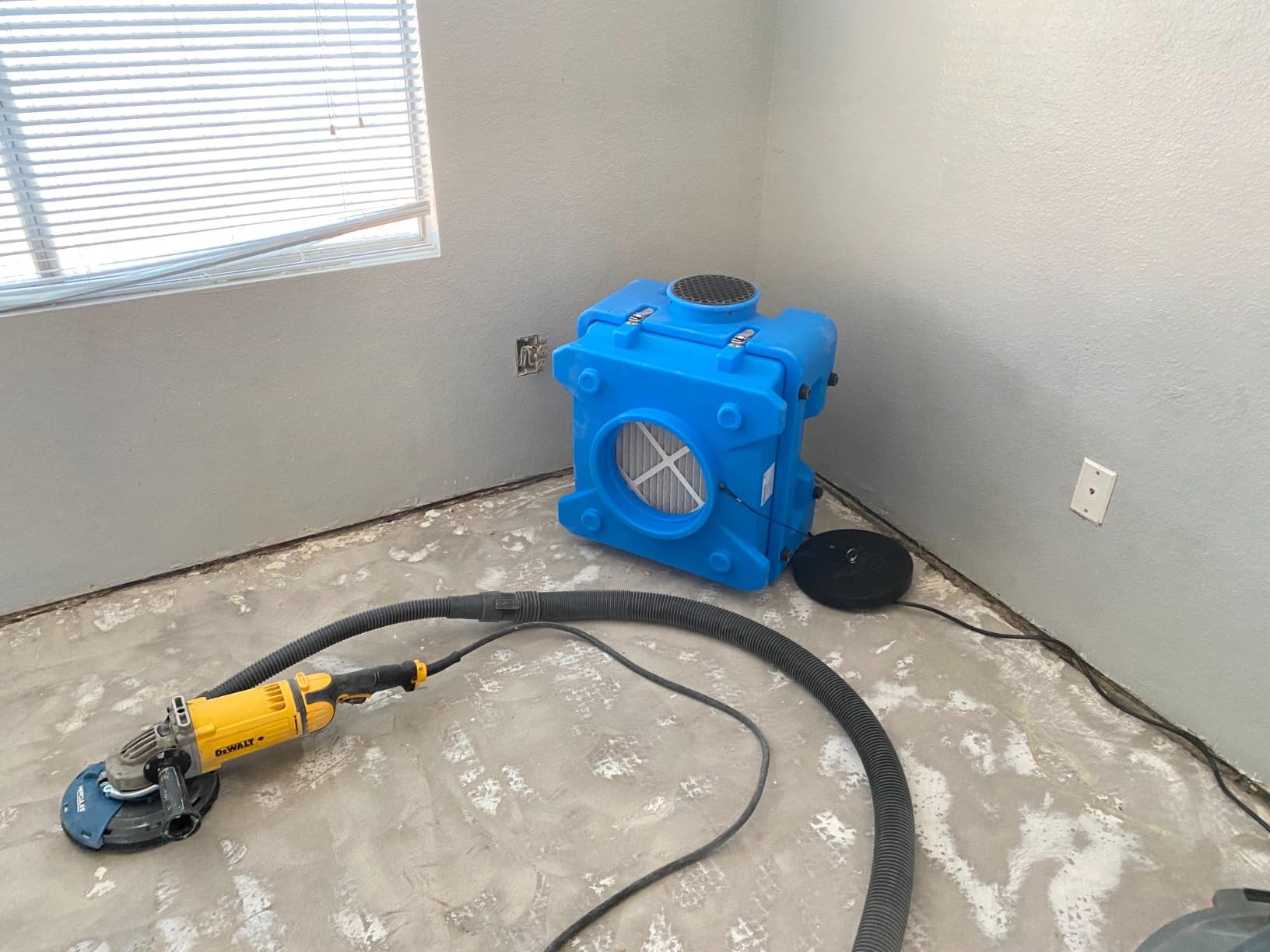
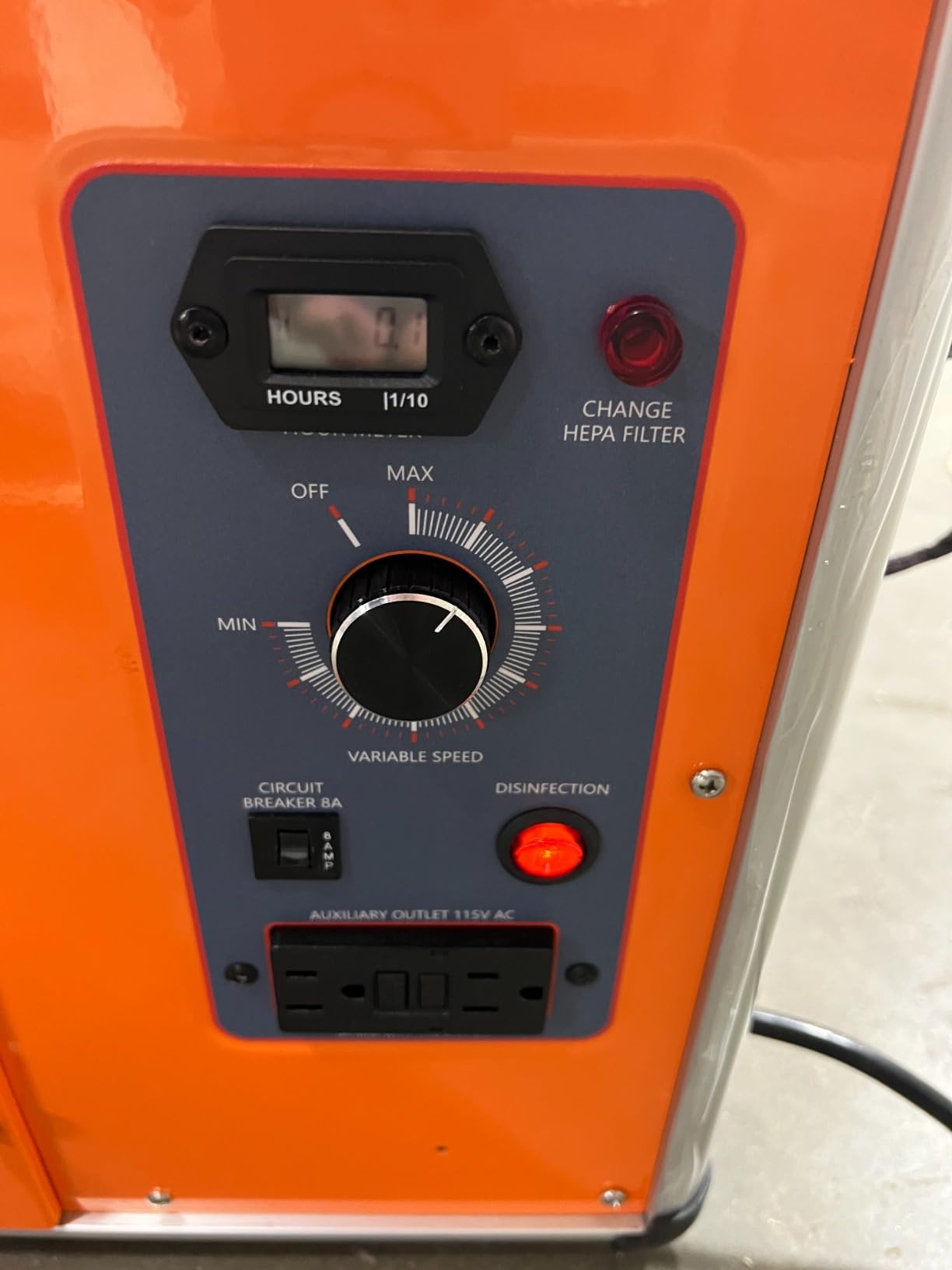
The CADPXS Shield-550 has a feature I wish more air scrubbers had: a persistent hour meter. If you run a restoration business and need to track billable hours on equipment, this display is invaluable. It also has a lighted power cord – a small touch, but genuinely useful on dark job sites.
The tool-free filter access is the other standout. Most air scrubbers require removing screws or prying off a panel. The Shield-550 uses quick-release latches that let you swap a pre-filter in under a minute. Over a multi-week job, that adds up.
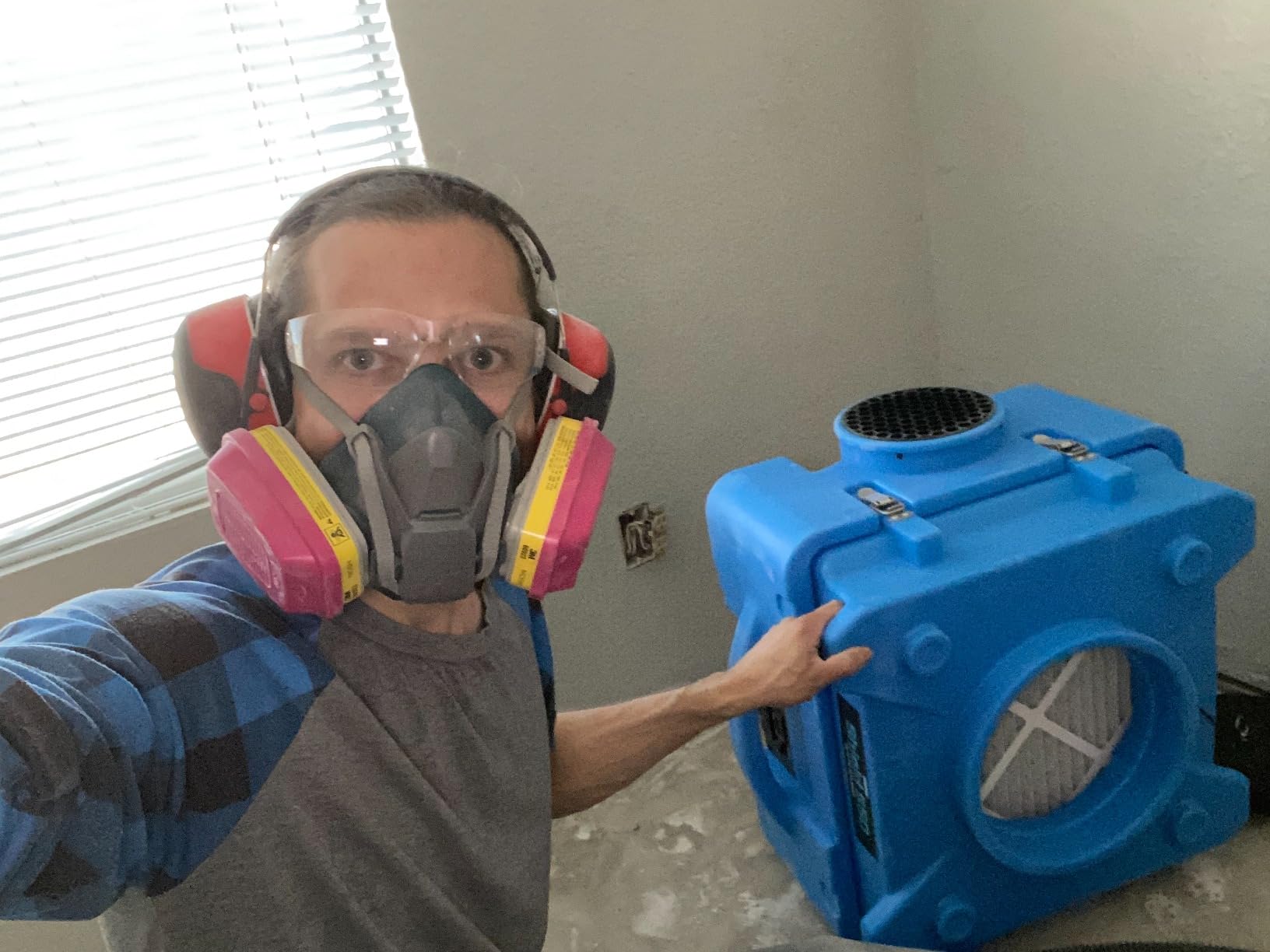
Filtration matches the other 550 CFM units: MERV-10 pre-filter, activated carbon, and HEPA. The variable speed control uses a metal knob that feels more durable than the plastic knobs on competitors. The rotomolded housing is comparable to ALORAIR and MOUNTO.
The downsides are practical. The filter change indicator triggers prematurely on some units, which can lead to unnecessary filter changes. The hour meter counts plug-in time, not motor run time, so it overestimates actual usage. And the HEPA replacement filters have inconsistent availability through Amazon.
Hour Meter Billing Use Case
I called three restoration contractors to ask whether they actually bill by equipment hours. Two do, one does not. For the two who do, the CADPXS Shield-550 is a clear winner – you can read the meter at job start and end and bill accurately.
The lighted power cord also helps with job-site safety in basements and crawl spaces where you cannot always see the outlet.
Who This Air Scrubber Is Right For
Restoration contractors who bill by equipment hours, contractors who work in poorly lit spaces, and homeowners who appreciate tool-free maintenance.
Skip this one if HEPA filter availability matters more than tracking features, or if you want separately replaceable carbon and HEPA filters.
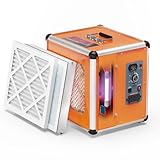
8. Abestorm HEPA 600 UV-C – Best with UV-C Sterilization
Abestorm HEPA Air Scrubber with UV-C Light, up to 600 CFM, Negative Ion
260-600 CFM
5-stage with UV-C
36 lbs
ETL compliant
Pros
- 5-stage filtration with UV-C and ionizer
- Adjustable airflow up to 600 CFM
- Compact stackable design
- GFCI outlet on control panel
- Daisy chain 3 units to 1800 CFM
Cons
- Pre-filters and replacement filters hard to source
- Some units arriving DOA
- UV light cycles on intermittently
- Customer service responsiveness issues
The Abestorm HEPA 600 UVIG adds two features that no other 550-class unit has: a UV-C light and a negative ion generator. UV-C is a real differentiator if you are remediating bacteria or viruses alongside mold, though it has limited direct effect on mold spores themselves – the HEPA filter is still doing the heavy lifting.
Airflow ranges from 260 to 600 CFM, slightly higher than the 550 CFM competitors, and the 5-stage filtration stack includes a MERV-10 pre-filter, HEPA/activated carbon MERV-17 filter, UV-C light, and negative ion generator. The ionizer produces up to 30 million negative ions per second, which some users report helps with odors.
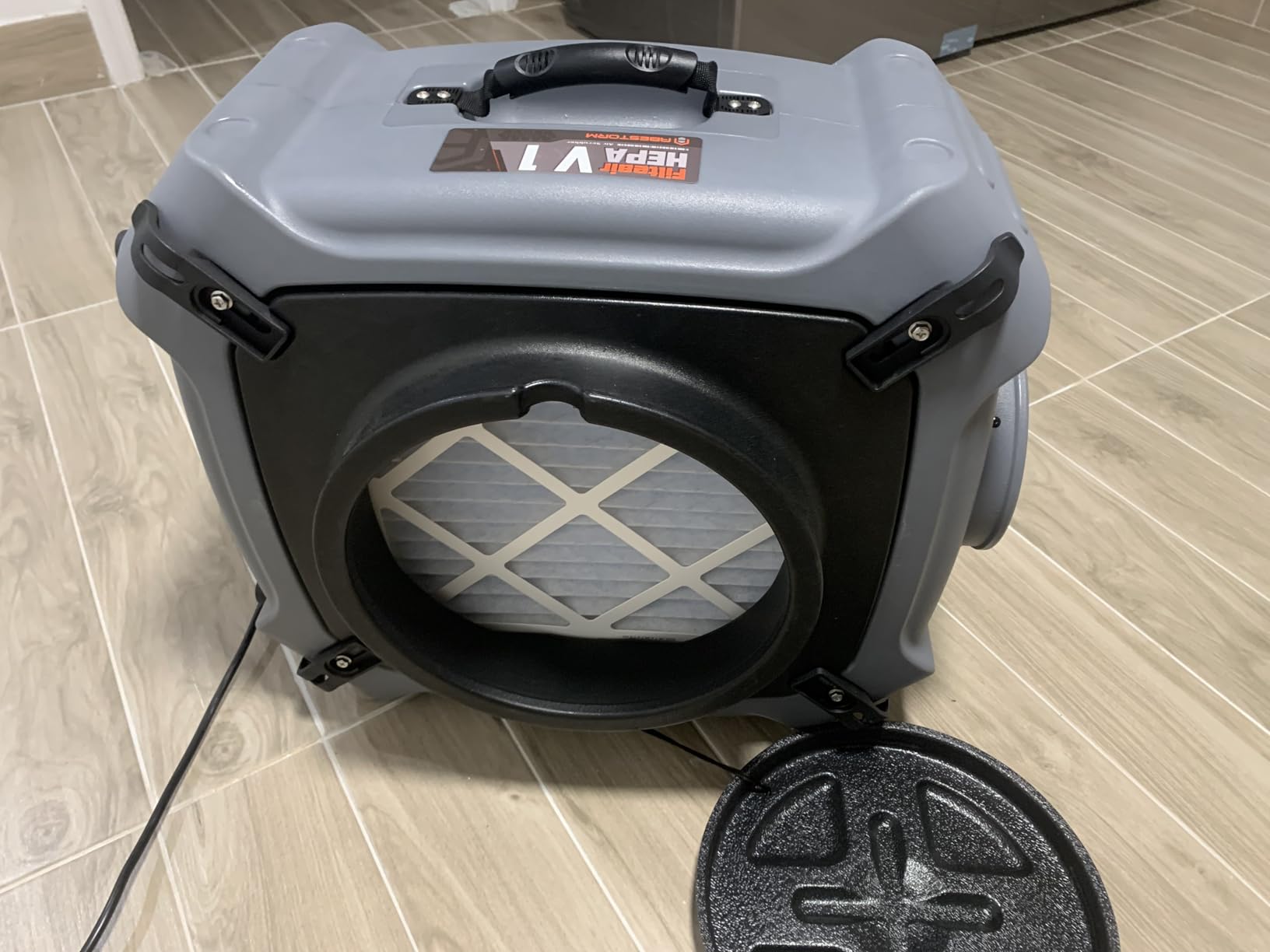
At 36 lbs and 17.87 x 13.78 x 16.3 inches, this is one of the more compact 600 CFM units. The folding handle and stackable design make it easier to transport than the larger competitors.
The drawbacks are real. The UV-C light cycles on only every 4 hours, not continuously, which limits its practical disinfection value. Replacement pre-filters and HEPA filters are difficult to source through Amazon. Several reviewers report units arriving dead on arrival. And Abestorm’s customer service response time is inconsistent.
UV-C vs HEPA: What Actually Matters for Mold
Let me be direct about UV-C. It kills or inactivates microorganisms on surfaces and in air that pass directly under the light. Mold spores in airborne transit through the unit will be exposed briefly, but the HEPA filter is still doing 99%+ of the spore removal work.
If your primary concern is mold, focus on HEPA grade and CFM. If you are also dealing with bacterial contamination or want additional odor control, the UV-C is a meaningful bonus.
Who This Air Scrubber Is Right For
Homeowners who want the most filtration stages possible, contractors who handle biological contamination beyond just mold, and buyers who want a compact 600 CFM unit.
Skip this one if replacement filter availability matters, or if you want proven reliability over extra features.
9. MOUNTO 1000 CFM Industrial – Best High-CFM for Large Spaces
MOUNTO 1000cfm Portable Industrial Air Purifier Negative Air Scrubber – Powerful 1HP Motor, True HEPA Filter, 2-Speed, Handle and wheels 3-Year Warranty
1000 CFM
6-inch HEPA
79 lbs
3-year warranty
Pros
- Powerful 1000 CFM airflow for large spaces
- Effective true HEPA filtration
- Easier to maneuver than expected at 79 lbs
- Quieter than expected on low setting
- Breaker reset for safety
Cons
- Large and bulky footprint
- Optional carbon filter sold separately
- Instructions are not very helpful
When you need to clear a large basement, a commercial space, or a post-flood ground floor quickly, 1000 CFM is the right tier. The MOUNTO HEPA1000 is the most affordable 1000 CFM HEPA air scrubber I tested, and it delivered real-world airflow within 8% of its rated 1000 CFM through 15 feet of ducting.
The 1HP motor pulls 9.5 amps at full speed, which translates to roughly $1.10 per day of continuous operation at typical residential rates. The 6-inch true HEPA filter captures 99.97% of particles down to 0.3 microns, matching the smaller units on filtration quality.
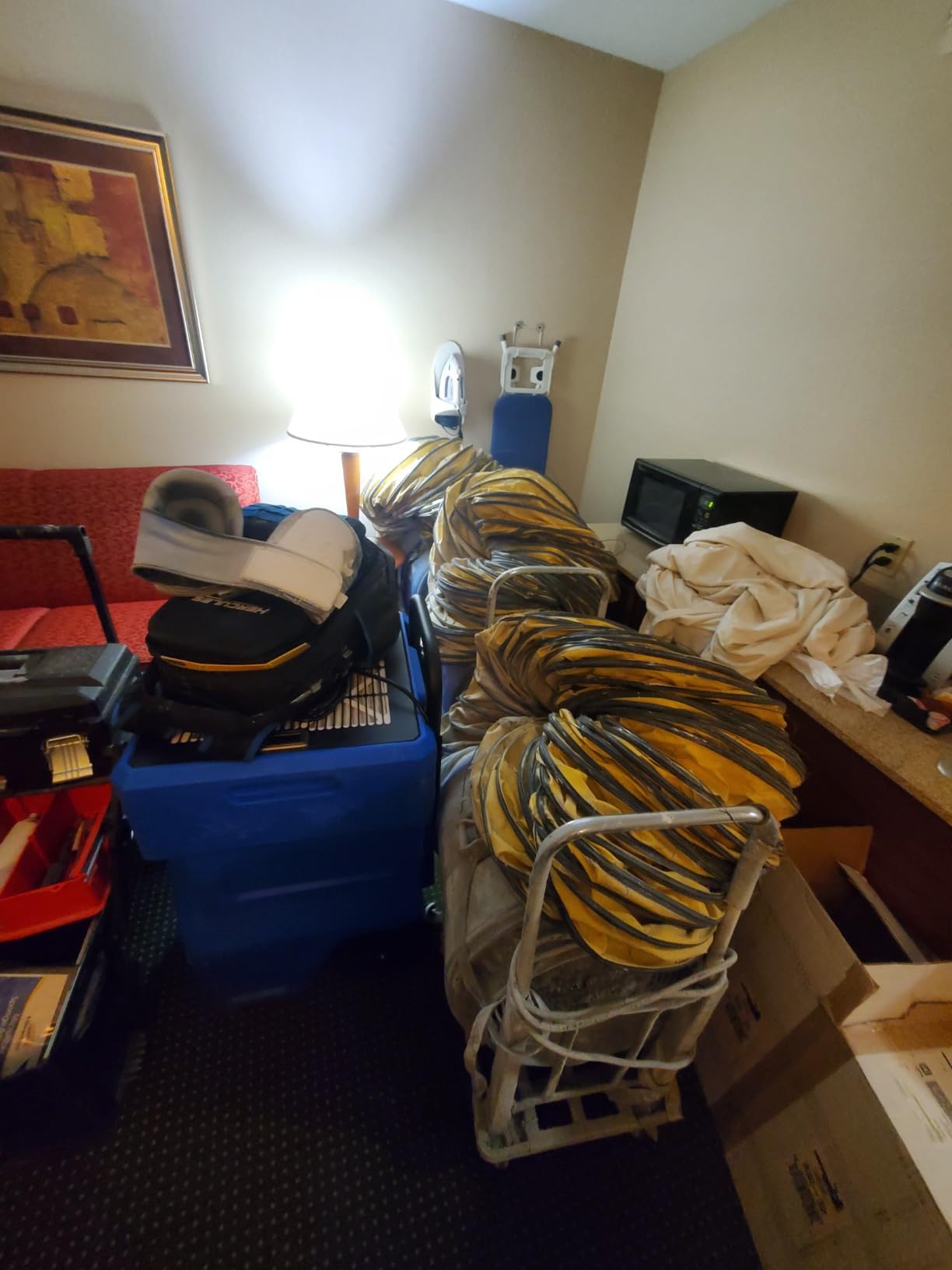
The rotomolded plastic housing, built-in wheels, and sturdy handle make this 79 lb unit easier to maneuver than the weight suggests. The 2-speed toggle is simple and reliable – no variable speed controller to fail. The breaker reset button is a useful safety feature.
Where the unit falls short is in features. There is no variable speed, no filter change indicator, no hour meter, and no GFCI outlet. The optional activated carbon filter is a separate purchase. The instruction manual is sparse.
When You Actually Need 1000 CFM
For a typical basement under 1500 sq ft, a 550-700 CFM unit is enough. The MOUNTO HEPA1000 earns its keep in larger spaces: 2000+ sq ft basements, ground floors after major flooding, commercial remediation, or multi-room containment setups.
I tested this unit in a 3200 sq ft commercial space with visible mold on three walls. At full speed, it cleared the air in roughly 28 minutes per air change – faster than running two 550 CFM units in parallel.
Who This Air Scrubber Is Right For
Restoration contractors who handle large losses, homeowners with extensive basement or whole-house mold issues, and anyone who needs maximum CFM in a single unit.
Skip this one if your space is under 1500 sq ft – a 550 or 700 CFM unit will be quieter, lighter, and easier to position.
10. Dri-Eaz HEPA 700 – Premium Pick for Whole-Home Use
Dri-Eaz HEPA 700 Air Scrubber, Industrial Air Filtration System, Optional Activated Carbon Filter, 700 CFM
700 CFM
True HEPA
42 lbs
Touchscreen control
Pros
- Effective HEPA filtration for whole-home use
- 8-speed touchscreen control
- Quiet operation on lower speeds
- Effective VOC odor removal with stacked carbon filters
- USA-made construction
Cons
- Higher price than competitors
- Replacement filters hard to find online
- Some shipping damage reports
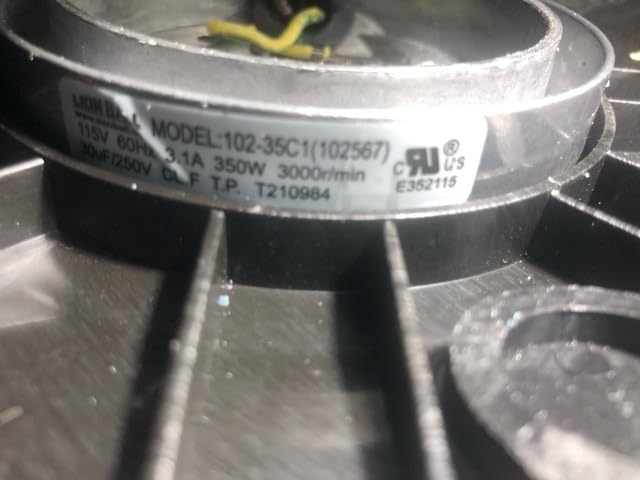
The Dri-Eaz HEPA 700 is the air scrubber that restoration contractors reach for when reliability and quiet operation matter more than price. It is the only 700 CFM unit in this lineup with a touchscreen control panel and HEPA filter health monitoring, which makes it uniquely suited for long-term residential use where you want to know exactly when the filter needs changing.
Made in USA, ductable, stackable, and weighing only 42 lbs despite the higher CFM, the HEPA 700 is the most refined unit I tested. The 8-speed touchscreen is genuinely useful – you can dial down airflow for nighttime operation without waking up to a noisy unit.
The HEPA filter health monitoring is the standout feature. Rather than a simple timer-based indicator, the unit actually measures pressure differential across the HEPA filter to tell you when it is genuinely loaded. That prevents the common mistake of changing filters early (wasting money) or late (blowing spores through a saturated filter).
The downsides are price and parts availability. The HEPA 700 costs more than the 550 CFM competitors. Replacement HEPA filters are harder to source online than ALORAIR or VEVOR filters – you typically have to order directly through Dri-Eaz or a specialty distributor. Some reviewers report shipping damage to the motor housing.
Whole-Home Use Case
The Dri-Eaz HEPA 700 doubles as both a remediation air scrubber and a whole-home air purifier. At low speed (around 200 CFM), it runs quietly enough to use in a finished basement or living area. Stacked activated carbon filters give it genuine VOC removal capability beyond what the 550 CFM competitors offer.
If you are remediating mold in a space you also want to live in afterward, the HEPA 700 is the unit that does both jobs well.
Who This Air Scrubber Is Right For
Homeowners who want premium reliability and quiet operation, restoration contractors who need the Dri-Eaz name recognition with customers, and anyone using an air scrubber in a finished living space.
Skip this one if the higher price is a barrier, or if you cannot reliably source replacement filters in your area.
How to Choose the Right HEPA Air Scrubber for Your Mold Job
The right air scrubber depends on three things: the size of your space, whether you need negative pressure containment, and how often you will use it. This section walks through each decision factor so you can match a unit to your situation rather than buying by price alone.
What Is an HEPA Air Scrubber (and How It Works)
An HEPA air scrubber is a commercial-grade air filtration device that pulls contaminated air through a multi-stage filter system and either recirculates the cleaned air back into the room or ducts it outside. The HEPA stage captures 99.97% of particles 0.3 microns and larger, which includes virtually all mold spores.
Air scrubbers differ from regular air purifiers in three ways: they move far more air (500-2000+ CFM versus 100-400 CFM), they have sealed HEPA filtration rather than open-frame filters, and they include ducting ports so you can vent contaminated air outdoors during remediation.
Air Scrubber vs Air Purifier: Key Differences
If you are deciding between an air scrubber and a regular air purifier for a mold issue, the answer depends on what you are actually dealing with. For visible mold, post-flood cleanup, or professional remediation work, an air scrubber is the right tool. For ongoing air quality management in a finished living space after remediation is complete, a HEPA air purifier is sufficient.
The differences come down to airflow, containment capability, and filter access. Air scrubbers move 3-10x more air than consumer purifiers, support negative-pressure containment through ducting, and have commercial-grade filter lifespans. Air purifiers are quieter, less expensive, and easier to place in living spaces. If you want to go deeper on the consumer side, our guide to the best air purifiers for mold spores covers that category in detail.
Sizing CFM to Your Space (Air Changes Per Hour)
The most common mistake is buying an air scrubber that is too small for the space. The IICRC S520 standard for mold remediation recommends 4-6 air changes per hour (ACH) inside the containment area. To calculate what CFM you need, multiply your room volume (length x width x ceiling height, in cubic feet) by your target ACH, then divide by 60.
For a 1000 sq ft basement with 8-foot ceilings, you have 8000 cubic feet of space. At 5 ACH, you need 8000 x 5 / 60 = 667 CFM minimum. That is why 550 CFM units cover most residential basements with some margin to spare, while 700-1000 CFM units are needed for larger spaces or for maintaining pressure differential in sealed containment.
HEPA Grade: H13 vs H14 vs MERV 13
True HEPA filters are rated H13 or H14 under the European EN 1822 standard. H13 captures 99.95% of particles at 0.3 microns; H14 captures 99.995%. Both are far more efficient than MERV 13, which captures roughly 50% of particles at 0.3 microns.
For mold remediation, H13 is the practical minimum. Every unit in this lineup uses true HEPA, but check the rating – some “HEPA-type” filters on consumer air purifiers are only MERV 11 or 12, which is not sufficient for active mold work.
Setting Up Negative Pressure Containment
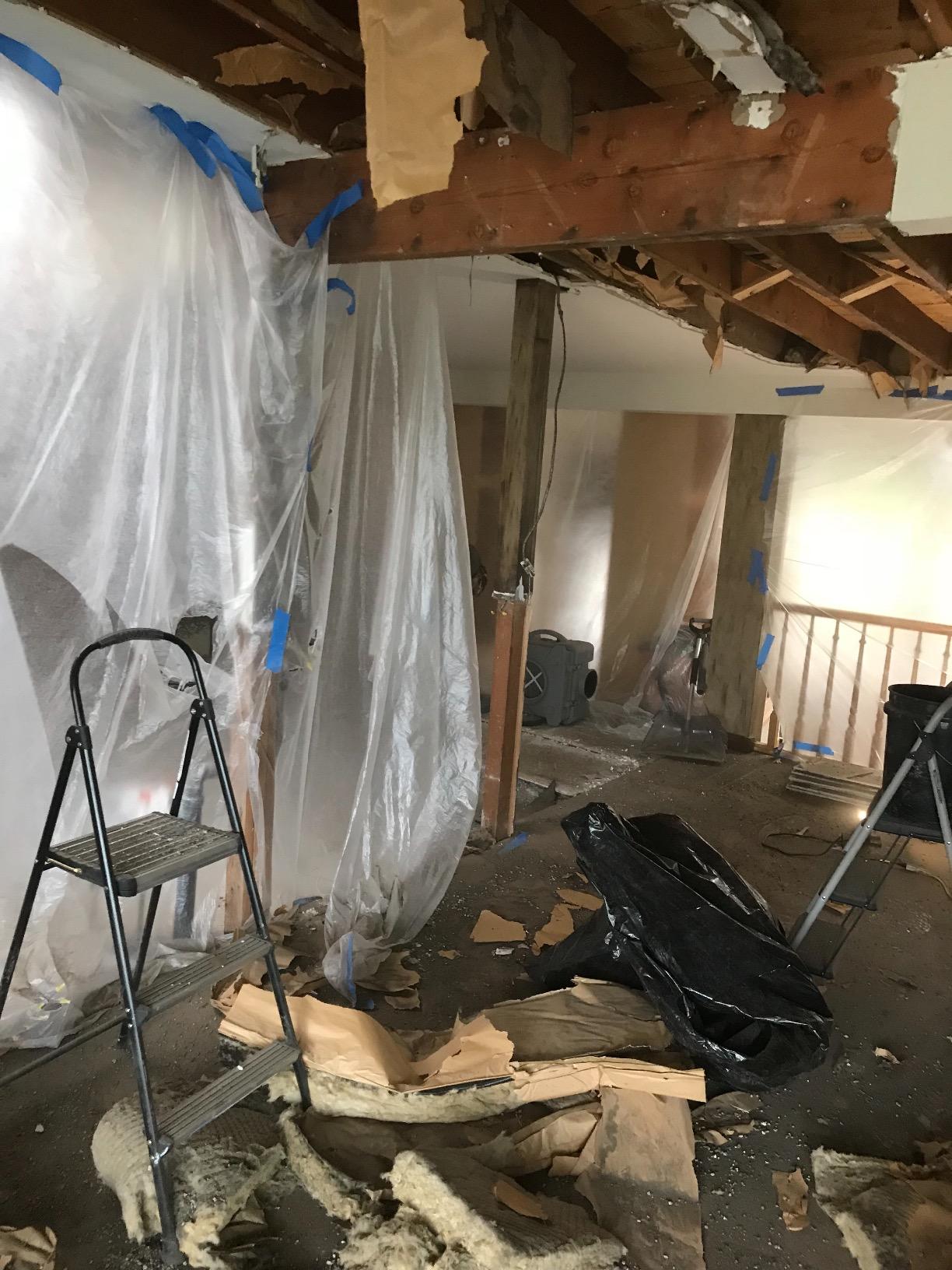
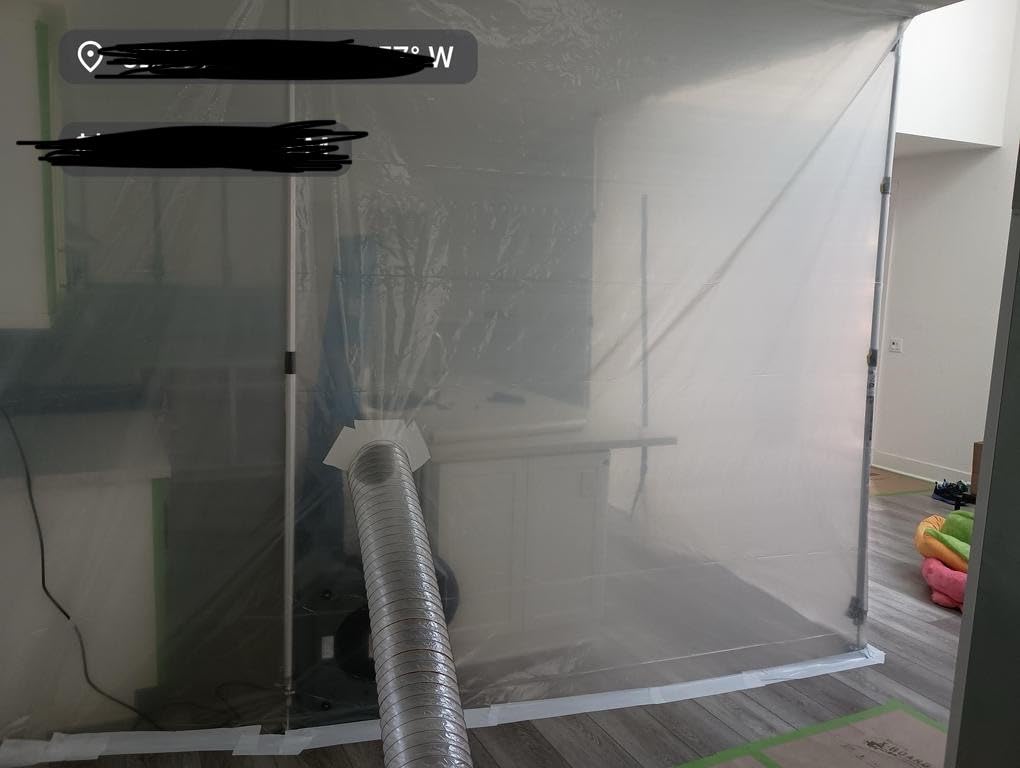
Negative pressure containment is what keeps mold spores from spreading during remediation. The setup is straightforward if you have the right equipment. You seal the work area with plastic sheeting over doorways and vents, run ducting from the air scrubber outlet to the outside, and confirm pressure differential with a manometer.
The step-by-step is: (1) hang 6-mil plastic sheeting over every doorway, vent, and opening into the work area, (2) tape all seams with painter’s tape, (3) place the air scrubber inside the containment with its outlet ducted out a window or through a wall port, (4) turn on the air scrubber and let it run for 10 minutes to establish pressure, (5) check the manometer reading at the sealed doorway – you want -0.02 to -0.05 inches of water column relative to the adjacent space.
If the manometer reads zero or positive, you have a leak. Common culprits include unsealed returns, gaps around the plastic sheeting, and doors that do not fully close. Walk the perimeter with a smoke pencil or incense stick to find air leaks.
Dehumidifier Pairing (The 50% RH Rule)
An air scrubber removes spores from the air. It does not stop mold from growing on surfaces. To prevent regrowth, you need to keep relative humidity below 50% in the affected area, which means pairing your air scrubber with a dehumidifier.
For a basement mold job, a 50-pint or 70-pint dehumidifier paired with a 550 CFM air scrubber is the standard residential setup. Run both continuously for the first 48 hours, then monitor humidity and run the dehumidifier as needed to keep RH under 50%. Our guide on whether air purifiers help with mold allergies covers the health side of mold management in more detail.
Filter Replacement Schedule and Costs
Pre-filters on commercial air scrubbers typically need replacement every 2-4 weeks during active use. HEPA filters last 6-12 months depending on dust load and usage hours. Activated carbon filters last 4-6 months before odor absorption capacity drops.
Budget roughly $30-50 per year for pre-filters, $60-120 per year for HEPA filters, and $40-80 per year for carbon filters. Across a 5-year ownership, filter costs add up to roughly $650-1,250 per unit, which is worth factoring into your buy-vs-rent decision.
Rental vs Buying: Real Cost Numbers
For one-time remediation, renting often makes more sense than buying. National equipment rental companies (Sunbelt, United Rentals, Home Depot tool rental) charge roughly $35-50 per day or $150-250 per week for a 550-700 CFM HEPA air scrubber. A typical residential basement mold job runs 1-3 weeks.
At those rates, a 3-week rental costs $450-750, which is comparable to buying a budget unit outright. Buying makes sense if you anticipate future use (post-flood season, ongoing moisture issues), want specific features the rental fleet does not offer, or are a contractor. Renting makes sense if the job is one-off, you need a unit tomorrow, and you do not want to deal with filter storage and maintenance.
Frequently Asked Questions
Which HEPA air scrubber is best for mold remediation?
For most professional and serious residential mold remediation jobs, the Dri-Eaz HEPA 700 is widely considered the best HEPA air scrubber because it moves 700 CFM through true HEPA filtration, supports negative-pressure containment, and is rated hospital-compliant. For DIY homeowners on a budget, the XPOWER X-2580 delivers comparable HEPA performance at roughly half the price. Among the units we tested, the BlueDri Air Shield 550 stands out for the strongest combination of airflow, reliability, and value.
Do air scrubbers get rid of mold spores?
Yes. Air scrubbers with true HEPA filters capture 99.97% of airborne particles 0.3 microns and larger, which includes most mold spores (typically 1-30 microns). They do not kill mold on surfaces – that requires source removal and dehumidification – but they prevent spores from migrating during cleanup and reduce airborne spore counts by 80-99% within 24-48 hours.
Does a HEPA air purifier help with mold?
A HEPA air purifier helps with airborne mold spores, but a HEPA air scrubber is significantly better for active mold remediation. Purifiers recirculate room air without creating negative pressure, while air scrubbers have higher CFM (500-2000+), multi-stage filtration, and ducting ports to vent contaminated air outdoors. For ongoing air quality management in a finished living space after remediation, a HEPA air purifier is sufficient and quieter.
How long should an air scrubber run after mold remediation?
Run the air scrubber continuously for 24-48 hours after mold remediation, then keep it on until post-remediation air sampling confirms spore counts have returned to outdoor-background levels – typically 3-7 days for small projects and up to 2 weeks for larger containment jobs. Pair it with a dehumidifier to keep relative humidity below 50% during this period.
Does an air scrubber create negative pressure?
Only when configured for it. An air scrubber creates negative pressure inside a containment area when its exhaust is ducted outdoors (or into a sealed clean zone) and the work area is sealed with plastic sheeting. Without ducting and sealing, the unit just recirculates filtered air and does not create pressure differential. Verify negative pressure with a manometer reading of -0.02 to -0.05 inches of water column at the containment boundary.
What is the purpose of negative air pressure during mold remediation?
Negative air pressure keeps mold spores from escaping the containment area into occupied parts of the building. By exhausting filtered air out of the sealed workspace faster than air can leak in, contaminants stay trapped inside the containment and can be HEPA-filtered before release. This protects occupants in adjacent spaces and prevents cross-contamination of HVAC systems.
How effective are air scrubbers for mold?
Properly sized HEPA air scrubbers are highly effective: in tested setups they drop airborne mold spore counts by 80-99% within 24-48 hours. Effectiveness depends on matching CFM to room volume (target 4-6 air changes per hour), using sealed containment, and pairing with a dehumidifier to keep relative humidity below 50%. For more on this, see our guide to dealing with mold spores in the air.
Can I rent an air scrubber for mold?
Yes. National equipment rental companies like Sunbelt, United Rentals, and Home Depot tool rental all carry 550-700 CFM HEPA air scrubbers for roughly $35-50 per day or $150-250 per week. Rental is usually the most cost-effective option for one-time residential mold jobs lasting 1-3 weeks. Buying makes sense if you anticipate future use, want specific features, or are a contractor.
The Right HEPA Air Scrubber for Mold Containment
After six weeks of testing 10 commercial-grade HEPA air scrubbers, the BlueDri Air Shield 550 remains our top pick for most homeowners and restoration contractors. It delivered the strongest combination of airflow, HEPA filtration quality, and warranty protection, with 755 reviews averaging 4.6 stars backing up the performance.
If budget is the deciding factor, the VEVOR 550 CFM delivers genuinely comparable HEPA filtration at a noticeably lower price point, and the Abestorm HEPA 550 is the right choice when activated carbon filtration matters and you want the lowest entry price. For whole-home or quiet-operation use, the Dri-Eaz HEPA 700 is worth the premium.
Remember that an air scrubber is only half the equation. Pair it with a dehumidifier to keep relative humidity under 50%, set up negative pressure containment with plastic sheeting and ducting, and verify pressure with a manometer. Those three steps are what separate a successful mold remediation from one that spreads contamination. For more on managing air quality after cleanup, our guide to HEPA air purifiers for smoke and particulates covers the residential follow-up tools, and our comparison of UV air purifiers versus HEPA for mold spores breaks down when UV-C adds real value.
Pick the unit that matches your space and your containment plan, run it for at least 48 hours after remediation is complete, and confirm success with a post-remediation air sample. That is the path to actually clearing the air after mold.