
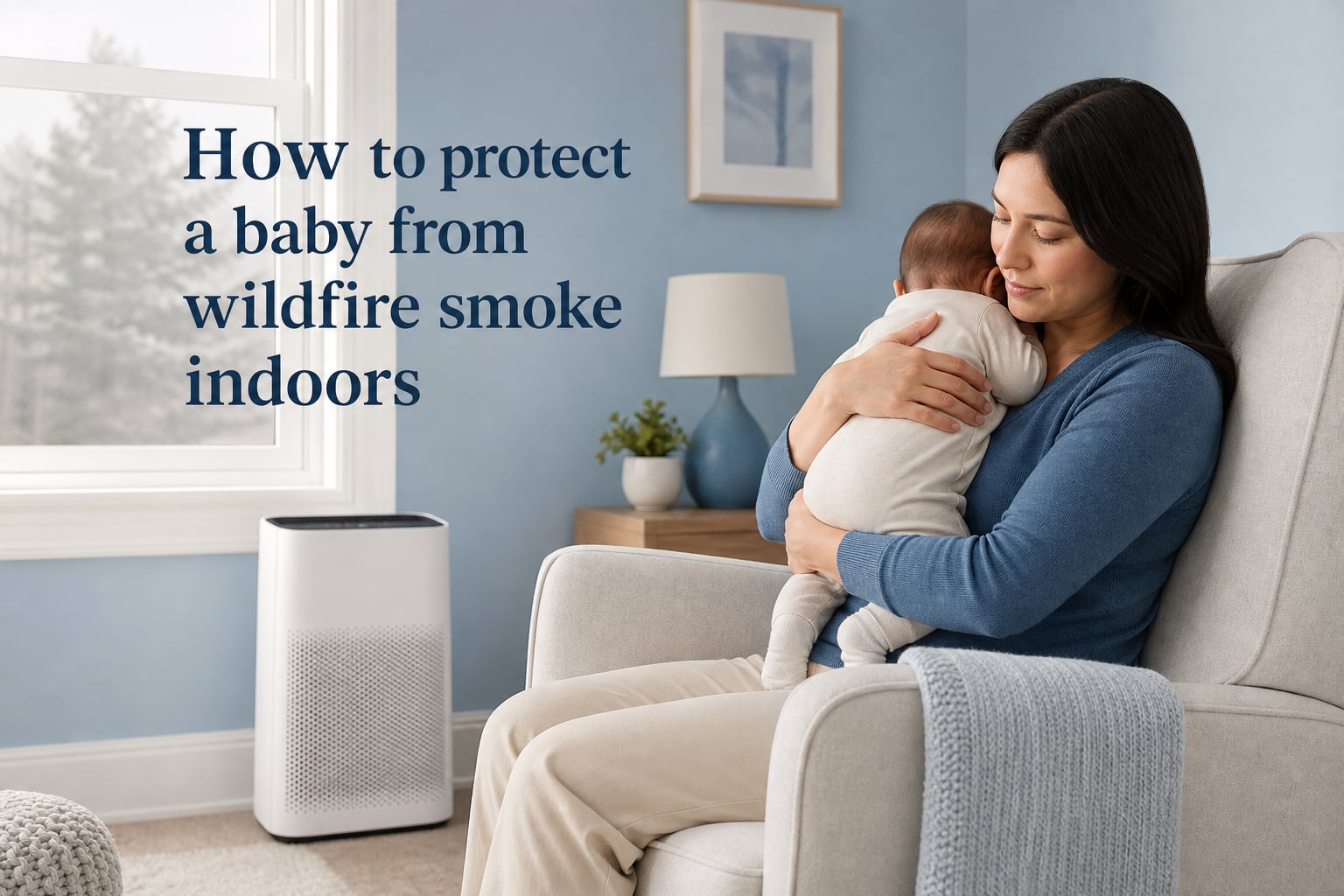
To protect a baby from wildfire smoke indoors, keep doors and windows shut, run filtered air in one closed room, use your cooling system on recirculate when available, and cut indoor sources of particles. Check the local Air Quality Index (AQI), keep outings short or skip them when air quality is poor, and get medical help quickly for breathing trouble.
Wildfire smoke can carry very small PM2.5 particles deep into the lungs. Babies are at higher risk because their lungs are still developing, they breathe faster than adults, and they cannot tell you when their chest feels tight or their throat hurts.
This guide focuses on practical infant wildfire smoke protection at home: what to set up before a smoke event, what to do when the sky turns hazy, and which symptoms should move you from watchful care to a call for help. It is not a substitute for your child’s clinician, especially if your baby was premature or has heart or lung disease.
Table of Contents
Protect your baby indoors with six immediate steps
- Close exterior windows and doors, then limit trips in and out.
- Choose one room where your baby sleeps or spends most of the day and keep its door closed as much as practical.
- Run a portable air cleaner with particle filtration in that room, or run central air with a compatible higher-efficiency filter.
- Set central air conditioning to recirculate rather than bringing in outdoor air, if your system offers that setting.
- Do not add particles indoors: skip smoking, candles, incense, aerosol sprays, frying, broiling, and vacuuming.
- Check AQI and your baby’s breathing often; leave for cleaner air or seek care if symptoms or heat cannot be managed safely.
Start here: A closed home is helpful but not airtight. The strongest approach is layered: block incoming smoke, filter the air that gets in, and lower the particles created inside.
Babies need extra protection because smoke reaches developing lungs
Wildfire smoke is a mix of gases and fine particles from burning vegetation and, at times, buildings or vehicles. PM2.5 is particulate matter small enough to travel far into the respiratory system; it is a main reason public-health advice focuses on staying inside during smoky periods.
For an infant, “inside” is a starting point rather than a complete solution. Smoke enters through open windows and doors, gaps around frames, leaky ducts, and air pulled in by ventilation equipment such as bathroom or kitchen exhaust fans.
Smoke can also linger indoors after outdoor conditions improve, particularly in a room with frequent door opening or weak filtration. The smell is a useful warning that something has entered the home, but smell alone does not measure the amount of PM2.5, and you may have particle pollution even when you cannot smell it.
Keep the nursery as clean as practical rather than aiming for perfection
A clean room is simply a room where you reduce pathways for smoke and run filtration continuously while conditions are bad. It does not need special construction, and it does not need to be the nursery if another room is cooler, quieter, or easier to keep closed.
Pick a room with few exterior doors or drafty windows, enough space for feeding and sleep, and a dependable electrical outlet. Bring diapers, medications, water for adults, a phone charger, feeding supplies, and a few quiet activities into it so you are not repeatedly crossing the house.
Parents in community discussions often mention wet towels under a drafty door. That may temporarily reduce a noticeable gap, but it should not block a required exit or substitute for closing openings and filtering the room air.
Prepare your home before the first smoky day arrives
Preparing during clear weather makes a stressful day much easier. Make a short family plan now, then adjust it with your pediatrician if your baby has asthma, chronic lung disease, heart disease, or a history of severe breathing problems.
Set up alerts and choose a clean room before smoke is present
- Track local AQI. Use AirNow and local public-health alerts, and check the forecast as well as the current reading. AQI can change quickly when wind shifts.
- Choose your room. Decide where baby will sleep and play during a smoke day, and close it off from the rest of the home when possible.
- Check windows and doors. Close and latch them; replace worn weather stripping or address clear gaps before the season begins.
- Plan filtration. Read the instructions for your portable air cleaner and locate replacement filters before a regional smoke event makes them harder to find.
- Check central air. Learn how to select recirculate and ask an HVAC professional what filter rating your system can safely handle. A MERV 13 filter can capture more fine particles than a basic filter when the system is designed for it.
- Prepare for heat. Identify a cleaner, air-conditioned place you could go if the home becomes too hot with windows closed.
- Pack for a quick departure. Keep infant medication, feeding supplies, diapers, a safe sleep item, medical contacts, and important documents together.
Do not wait to see smoke before reviewing your air conditioner. Some window units and portable units have different modes, and the wrong setting can draw outdoor air in; the manual or manufacturer can tell you how your unit handles ventilation.
Planning tip: Ask your baby’s clinician what symptoms matter most for your child and where to seek after-hours care. That conversation is especially useful for a newborn, a baby born early, or a child who already uses respiratory medicine.
Keep the room cool without opening the windows
Heat and smoke are a difficult combination because a closed room can become uncomfortable fast. Use air conditioning in recirculate mode if available, close blinds or curtains against direct sun, dress baby lightly, and offer normal feeds on schedule.
Fans can help with comfort and air mixing, but they do not remove PM2.5 by themselves. Point a fan so it does not blow directly and constantly onto a newborn, and do not use an open window as a cooling shortcut when outdoor smoke is heavy.
Keep smoke out and particles down during the event
When wildfire smoke arrives, simplify the day around the room where your baby spends the most time. The aim is to reduce exposure steadily, not to chase a perfect indoor number or panic at every faint odor.
Close outside openings and limit air exchange first
Keep windows and exterior doors closed. Ask everyone in the household to use one door when possible, make deliveries brief, and avoid leaving a door open while bringing in groceries or gear.
Turn off systems that deliberately pull outdoor air inside if you can do so safely. Bathroom fans, range hoods, clothes dryers, and whole-house ventilation can change air movement, so use them only when needed and follow the instructions for your home.
Never turn off equipment that you need for safety, and never cover vents or block a gas appliance. If you smell gas, suspect carbon monoxide, or have another household emergency, follow the relevant emergency guidance rather than trying to preserve the clean room.
Run particle filtration continuously in the room your baby uses
A portable air cleaner with HEPA filtration can reduce airborne particles in the room it is designed to cover. Place it on a stable surface where cords cannot be pulled, keep the air intake and outlet clear, and run it as continuously as the manufacturer directs during the smoke event.
Match the cleaner to the room rather than assuming a small unit can handle an open-plan home. Keep the room door shut as much as possible so the cleaner is working on a defined space, and do not put the unit in the crib, on soft bedding, or where it could tip.
Central HVAC can add another layer when it is set to recirculate and uses a compatible filter. Check filters according to the system instructions because smoky conditions can load them faster; a clogged filter can reduce airflow and make cooling harder.
A do-it-yourself box-fan air cleaner can be discussed in public-health guidance for smoke emergencies, but it requires careful fire and electrical safety. Keep it away from water and curious children, use an intact fan with a stable filter arrangement, do not leave it unsupervised, and choose a certified portable air cleaner if that is an option for your household.
Do not rely on these for smoke particles: Scented sprays, essential oils, odor absorbers, and ordinary fans may change how the room smells or feels, but they do not replace particle filtration. Avoid ozone-generating devices because ozone can irritate lungs.
Stop indoor activities that add to the particle load
During a smoke episode, do not smoke or vape indoors, and keep smoke from cooking outdoors from drifting in through doors or windows. Skip candles, incense, fireplaces, aerosol cleaners, spray deodorants, and hobby products with strong fumes.
Choose no-cook meals or lower-particle cooking methods when possible. Frying and broiling can add fine particles, and vigorous vacuuming can stir settled dust back into the air; save those jobs for later.
If you must cook, use the least smoky method you can and limit how long the kitchen exhaust runs if it brings in outdoor air. Clean a small spill with a damp cloth instead of dry sweeping, then wash hands before touching feeding gear.
Keep babies and toddlers occupied without adding exertion or pollutants
Parents often say the hardest part is not the purifier—it is keeping an active toddler inside for days. Set up a small rotation of board books, blocks, music at a low volume, water-free sensory play, puzzles, and pretend play in the clean room.
For babies, floor time on a clean mat, songs, books, supervised tummy time, and calm face-to-face play are enough. Keep the pace gentle when smoke is bad, particularly if your child has been coughing or seems more tired than usual.
Avoid indoor roughhousing that causes heavy breathing, scented craft materials, and projects that make dust. If your home has a clear indoor air monitor, use its trend as feedback, but do not let a single reading override obvious signs that your baby is struggling.
Follow safe feeding and sleep routines in the cleaner room
Continue breastmilk or formula feeding as usual unless your clinician gives different advice. Frequent feeds may be comforting, and normal wet diapers remain one useful sign that a baby is getting fluids, but do not force extra water on young infants without medical guidance.
Keep safe sleep unchanged: place baby on their back on a firm, flat sleep surface with no loose blankets, pillows, or soft items. Do not place a mask, damp cloth, or air-filter material near a sleeping baby’s face.
Smoke can disrupt naps, and a stuffy room can make everyone tense. A steady routine—feed, calm play, sleep, repeat—often works better than repeatedly moving baby between rooms to search for fresh air.
Use AQI and breathing changes to guide your next move
The Air Quality Index translates pollutant levels into an action scale. For wildfire smoke, AQI often reflects PM2.5, but it measures outdoor air at a monitoring location, not the exact air in your nursery.
Use AQI bands as a precaution scale for babies
AQI 0–50: Air quality is considered good. Keep an eye on local alerts if a fire is nearby, but ordinary indoor routines are generally reasonable.
AQI 51–100: Air quality is moderate. Sensitive babies may need fewer outdoor activities, so check the forecast, close windows if smoke is noticeable, and begin using your clean-room plan if conditions are worsening.
AQI 101–150: This range is unhealthy for sensitive groups. Babies and children belong in that group, so keep baby indoors, close doors and windows, run filtration, and avoid exertion outdoors.
AQI 151–200 or higher: Air is unhealthy for everyone. Keep baby in the clean room as much as practical, avoid outdoor time, and reassess whether your home can stay cool and reasonably clean.
AQI alone does not create a universal evacuation threshold for infants. Consider a cleaner place to stay if smoke is entering heavily despite your steps, indoor heat cannot be controlled, your baby has a medical condition, evacuation authorities direct you to leave, or your clinician advises it.
Watch infants for quiet signs as well as obvious coughs
Smoke symptoms in babies can look subtle. Watch for coughing, wheezing, faster breathing, a runny nose, irritated eyes, unusual fussiness, poor feeding, less interest in feeding, disrupted sleep, or less energy than usual.
Newborns cannot describe chest discomfort, so look at the work of breathing. Flaring nostrils, grunting, a head bob with breaths, skin pulling in between or below the ribs, or blue, gray, or pale lips or face are urgent signs rather than symptoms to monitor at home.
Toddlers may say their throat or eyes hurt, complain that it is hard to breathe, cough more with activity, or become unusually tired. A cough can have many causes, which is why a pattern of worsening breathing or behavior matters more than trying to diagnose smoke exposure from one symptom.
Get emergency help now for blue or gray coloring, severe trouble breathing, pauses in breathing, marked chest retractions, inability to feed because of breathing, unusual limpness, or a baby who is hard to wake. Call your pediatrician promptly for new wheezing, persistent cough, faster breathing, poor feeding, fewer wet diapers, fever in a young infant, or symptoms that concern you.
Use extra caution for newborns, chronic conditions, masks, heat, and evacuation
Newborn smoke exposure deserves a lower threshold for calling a clinician. Babies in the first months of life have smaller airways and less reserve, and fever or feeding changes can need prompt assessment even when smoke is not the only possible cause.
Protect babies with asthma or other health conditions with a clinician-led plan
If your baby has asthma, chronic lung disease, congenital heart disease, or a history of respiratory hospitalization, keep prescribed medicines available and follow the action plan provided by the medical team. Ask before smoke season how AQI should change your child’s routine and when the plan calls for urgent evaluation.
Do not start leftover medication, use someone else’s inhaler, or alter doses because the air smells smoky. A clinician can help separate a mild irritation from a flare that needs treatment.
Do not put a mask on an infant to filter smoke
Babies should not wear masks for wildfire smoke. They cannot get a reliable seal, cannot safely manage a face covering, and may have trouble signaling distress; a loose cloth mask does not filter fine smoke particles well in any case.
Older children may ask about respirators, but fit, tolerance, and medical context matter. For a baby or toddler, staying in filtered indoor air is the safer protection strategy.
Leave for cleaner air when the home cannot meet basic safety needs
Close windows to block smoke, but do not accept dangerous indoor heat in order to do it. If you do not have effective cooling, a public clean-air space, a friend or relative with filtered air, or another location outside the smoke area may be safer.
If you drive, keep windows closed and use the vehicle’s recirculate setting when feasible. Bring the baby’s car seat, supplies, medication, and a way to continue feeding, and follow local evacuation orders without delay.
Pregnant people in the household should also reduce smoke exposure by staying in filtered indoor air and avoiding exertion outside. The same clean-room routine supports the whole family, which can make feeding, rest, and caregiving more manageable.
Clean gradually after outdoor air improves
Wait for local conditions to improve before opening windows for fresh air, then do so only if the outdoor AQI supports it. Continue filtration for a while because indoor particles can remain after the visible haze has gone.
Use damp wiping and damp mopping for surfaces, and wash hands after cleaning. Replace or service HVAC and portable-cleaner filters according to their instructions, and do not dry sweep, dust aggressively, or vacuum with equipment that lacks good particle containment while baby is in the room.
Return to outdoor routines gradually as AQI improves and your baby is acting normally. If cough, wheeze, feeding trouble, or fast breathing continues after the smoke clears, contact the child’s clinician.
Get quick answers to common wildfire smoke questions
How do I protect my baby from wildfire smoke?
Keep your baby indoors with windows and doors closed, create one clean room, run a particle-filtering air cleaner or compatible central HVAC on recirculate, and avoid candles, frying, sprays, and other indoor particle sources. Check AQI and call a clinician for cough, wheeze, poor feeding, or any concerning breathing change.
What is a safe AQI level for babies?
AQI 0–50 is considered good. At AQI 101–150, which is unhealthy for sensitive groups, babies should stay indoors with filtration running; at AQI 151 or higher, avoid outdoor time and reassess whether the home is cool and clean enough. A baby with a health condition may need a more cautious plan from their clinician.
Is fire smoke smell bad for babies?
A smoke smell means smoke-related gases have reached the area, so it is a reason to close openings and improve filtration. Smell does not show the exact PM2.5 level, and fine particles can be present even when you cannot smell smoke. Use local AQI and your baby’s symptoms alongside what you smell.
How long does wildfire smoke stay in the air?
Outdoor smoke can last hours, days, or longer depending on fire activity and wind. Indoors, particles can remain after the outdoor air improves, especially if smoke entered through leaks or open doors. Keep filtration running and check local AQI before airing out the room.
Do air purifiers get rid of wildfire smoke?
A properly sized portable air cleaner with particle filtration can lower airborne smoke particles in a closed room, but it cannot make the room airtight or remove every gas in smoke. Pair it with closed windows and doors, recirculating HVAC when available, and less indoor particle production.
Does being inside protect you from wildfire smoke?
Yes, staying inside usually lowers exposure, but smoke can still enter through cracks, doors, windows, and ventilation. Indoor protection works best when you close openings, use filtration, limit indoor pollution, and move to a cleaner location if heat or heavy smoke infiltration cannot be controlled.
Protect your baby from wildfire smoke indoors by using layers
How to protect a baby from wildfire smoke indoors comes down to a repeatable sequence: close the home, filter one clean room, control heat, check AQI, and watch your child rather than the sky alone. Set up the room before you need it, and call your baby’s clinician early if breathing, feeding, or alertness changes.