
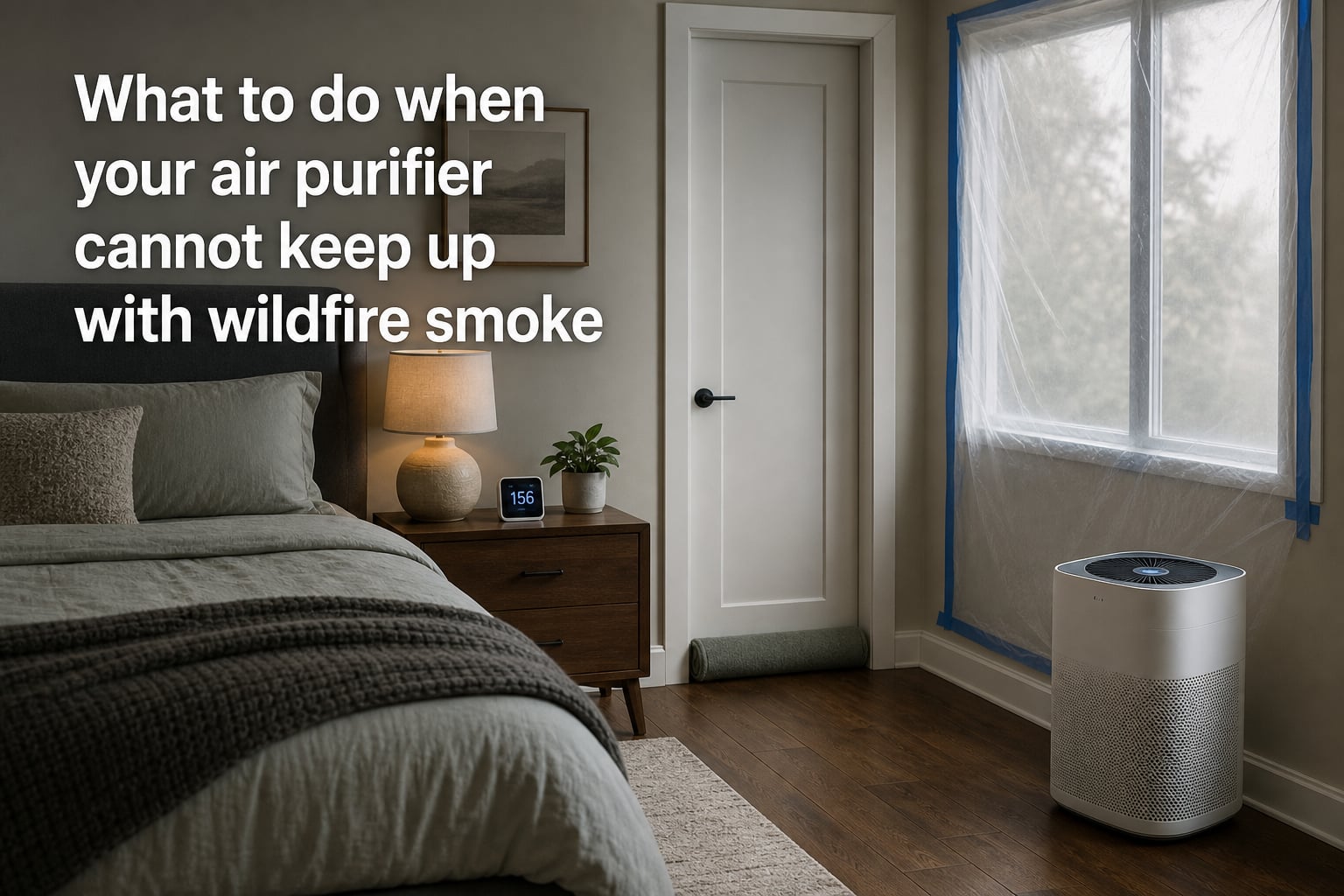
When your air purifier cannot keep up with wildfire smoke, the problem usually comes down to two things: smoke is pouring in faster than the unit can filter it, or the filter is already saturated. In my experience walking people through multi-week smoke events in California, British Columbia, and Alberta, the fix is rarely “buy a bigger machine.” It is almost always about sealing the room, dropping the infiltration rate, and checking whether the filter has given up.
This guide walks you through exactly what to do when your purifier is overwhelmed. You will learn the warning signs most people miss, the AQI thresholds that should change your behavior, how to seal a room properly, and when to add a second unit or build a Corsi-Rosenthal box as an emergency stopgap. I have pulled together what works in real homes during real smoke events, not just what sounds good in product brochures.
Wildfire smoke is not just an inconvenience. PM2.5 particles can stay suspended indoors for days, and they aggravate asthma, heart conditions, and pregnancy outcomes. If your purifier is losing the battle, the stakes are higher than comfort. In the past five years alone, wildfire smoke has been linked to thousands of premature deaths and tens of thousands of asthma exacerbations across North America. Let’s fix it.
Table of Contents
Why Your Air Purifier Cannot Keep Up with Wildfire Smoke
An air purifier is rated by its Clean Air Delivery Rate (CADR) for a specific room size. Wildfire smoke breaks that math because it does not respect room boundaries. Smoke leaks in through door gaps, electrical outlets, HVAC returns, bathroom exhaust fans, and tiny cracks you never noticed. When the infiltration rate exceeds the unit’s CADR, the purifier will run forever and never catch up.
There are three root causes, and they often stack on top of each other during a serious smoke event. I have seen households struggling with all three at the same time during the worst August events in the Pacific Northwest.
The room is too large for the unit. Most consumer purifiers are sized for 200 to 400 square feet at high speed. If you bought yours for a bedroom and you are now running it in a living room with vaulted ceilings, the CADR is mathematically insufficient. Heavy smoke demands 4 to 5 air changes per hour, which means a purifier rated for a 200 square foot room cannot deliver that in a 400 square foot room. A useful rule of thumb: multiply the manufacturer’s recommended room size by 0.7 to get the realistic coverage during wildfire conditions. Most ratings assume only 1.5 air changes per hour, which is not enough when infiltration is adding particulates faster than the filter can remove them.
The HEPA filter is doing fine, but the carbon filter is dead. HEPA captures particles. Activated carbon captures the gases and odors that make smoke smell like smoke. Carbon has a finite adsorption capacity, and that capacity fills up based on the volume of gases passing through, not just time. During heavy smoke, that capacity can exhaust in 4 to 8 weeks instead of the usual 6 to 12 months. Once carbon is saturated, the purifier still removes PM2.5, but the smell returns and the VOCs keep circulating. This is why some users on Reddit report their purifier working perfectly for particulates while still smelling smoke. The HEPA side is fine; the carbon side has given up.
You have the right unit, but infiltration is winning. This is the most common cause I see. Someone has a perfectly adequate purifier for their room, but they opened a window for ten minutes to cool the kitchen, ran the bathroom exhaust during a shower, or left the HVAC system pulling in outside air on a mild afternoon. A purifier can fight indoor pollution sources. It cannot fight your house breathing. I have measured indoor PM2.5 readings climb from 12 to over 100 in fifteen minutes after a window cracked open during an AQI 250 event.
Before you do anything else, figure out which of these three problems is yours. The fix is different for each, and chasing the wrong one wastes time and filters. If you do not own a PM2.5 monitor, buy one. Without measurements, you are guessing.
Warning Signs Your Purifier Is Losing the Battle
Most people wait until they can smell smoke again to realize the purifier is failing. By then, indoor PM2.5 has likely been elevated for hours and you have already breathed in the equivalent of several cigarettes’ worth of particulates. Here are the subtle warning signs I tell people to watch for, in the order they usually appear during a smoke event.
1. Your PM2.5 monitor climbs above 35 indoors. Outdoor air in clean conditions sits around 5 to 12. During heavy smoke it can hit 250 or higher. Your indoor reading should stay under 15 if the purifier is winning. Once it climbs past 35, the unit is falling behind even if you cannot smell smoke yet. Once it crosses 50, the unit has lost and you need to act.
2. The purifier runs for an hour and the smell is still there. A working purifier should knock down odor in 30 to 90 minutes in a sealed room. If the smoke smell is unchanged after two hours, either the carbon filter is saturated or infiltration is too high. This is the most common user complaint I see in smoke-prone regions, and it almost always traces to one of those two causes.
3. The air quality sensor on the purifier shows red or “poor” indefinitely. This is the unit itself telling you it is losing. Many modern purifiers have a built-in PM2.5 sensor with a colored indicator. If it reads above 100 for more than an hour on the highest setting, something is wrong. Either the room is too big, the filter is saturated, or smoke is leaking in faster than the unit can clear it.
4. Visible haze inside the room. Hold a flashlight or your phone light at an angle to the window. If you see beams cutting through the air, PM2.5 is elevated. Your eyes are a PM2.5 sensor. If they sting or water, the air is bad even before the smell becomes obvious. Eye irritation is one of the earliest symptoms and often appears at PM2.5 readings as low as 50.
5. Reduced airflow from the outlet grille. Walk up to your purifier and feel the output. If it is noticeably weaker than when the filter was new, the filter is loaded with particles and needs replacement. Hold a tissue near the output. If the tissue barely moves, airflow is restricted. If it flaps vigorously, the filter is fine.
6. The purifier smells stale or musty. A saturated HEPA filter can develop a smell of its own, especially if it has absorbed moisture along with particulates. If the purifier’s output smells different from room air in any unpleasant way, the filter has likely trapped contaminants it can no longer hold.
7. Worsening sleep quality or morning headaches. This is the slowest sign but one of the most reliable. If you and your household start waking up with headaches, scratchy throats, or grogginess despite running the purifier overnight, indoor air quality is poor. Your body is responding to particulates or VOCs the purifier is no longer removing.
If two or more of these are true at the same time, your purifier is losing. Move to the immediate actions below now. Do not wait for the smell to get worse or for symptoms to develop further.
AQI Thresholds: When to Act and What to Do
The Air Quality Index (AQI) tells you when to change behavior. Here is the reference I use with my own family during fire season, broken down by range.
| AQI Range | Category | What To Do |
|---|---|---|
| 0-50 | Good | Run purifier on auto or low. Windows open are fine. |
| 51-100 | Moderate | Run purifier on medium. Sensitive groups should stay indoors. |
| 101-150 | Unhealthy for Sensitive Groups | Run on high. Close windows. Begin sealing gaps. |
| 151-200 | Unhealthy | Stay in sealed clean room. Purifier on high. No outdoor exercise. |
| 201-300 | Very Unhealthy | Stay in sealed room. Add second purifier or DIY box if possible. Wear N95 if leaving home. |
| 301+ | Hazardous | Shelter in sealed room with maximum filtration. Avoid all outdoor exposure. Consider evacuation if event lasts more than 2-3 days. |
The key threshold is 151. Once outdoor AQI crosses 150, a single purifier in a normal home will struggle unless the room is sealed. At 200 and above, no consumer purifier keeps up without aggressive sealing, a small clean room, and possibly a second unit or Corsi-Rosenthal box.
At 300 and above, you should be treating the situation as a public health emergency. The smoke contains not just particulates but also carbon monoxide, benzene, formaldehyde, and other toxic gases that even a good purifier struggles to address. Anyone in a sensitive group (children, elderly, pregnant, asthmatic, heart conditions) should be in a sealed clean room with active filtration at all times. If the event is forecast to last more than three days, consider evacuation to an area with cleaner air.
Bookmark airnow.gov or download the AirNow app. Set alerts for AQI 100 in your zip code so you have time to act before the spike. The PurpleAir app and sensor network is also useful for hyperlocal readings, since smoke concentrations can vary dramatically within a single city or neighborhood.
Immediate Actions When Your Purifier Is Overwhelmed
If your purifier is failing right now, walk through these steps in order. They take 20 to 30 minutes total and will buy you a usable clean room. Each step is short on purpose. Do them in sequence.
Step 1: Close every window and exterior door. This is obvious but people forget the bathroom window, the back door, or the garage entry. Walk through the whole house. Close everything. Lock windows if they have locks, since locked windows seal slightly better than just-latched ones.
Step 2: Turn the purifier to its highest setting. Forget auto mode. You want maximum airflow right now. Noise is a fair trade for clean air. Many purifiers have a “turbo” or “max” setting that runs the fan at full speed indefinitely. Use it.
Step 3: Roll up a towel and place it at the base of the clean room door. This stops the biggest infiltration leak in most homes. The gap under a closed interior door is roughly 1 inch tall and runs the full width of the door. A towel seals it. For a tighter seal, fold a beach towel lengthwise and weight it down with a heavy book.
Step 4: Switch your HVAC system to “recirculate” or “fan only.” Most central systems have a setting that closes the outside air damper. If your thermostat has a fan mode option, use it. If your system only pulls fresh air, turn the fan off entirely for the duration of the smoke event. Running the HVAC system during heavy smoke without a MERV 13 filter just pumps outdoor smoke indoors.
Step 5: Pick your clean room and stay there. A clean room should be the smallest bedroom or office with the fewest windows and the best door seal. Run the purifier there. Do not move around the house. Every room you enter pulls smoke with you on your clothes and hair, and every door you open disrupts the seal of the clean room.
Step 6: Turn off bathroom and kitchen exhaust fans. These pull air out of the house and create negative pressure that sucks outdoor smoke in through every crack. Use them only when you must, and only briefly. Cover the grilles with plastic sheeting and painter’s tape if the smoke event will last more than a day.
Step 7: Run the purifier for 60 minutes undisturbed. After sealing the room, give the purifier a full hour to bring PM2.5 down. Resist the urge to keep checking or going in and out. Most quality purifiers will reduce particulates by 60 to 80 percent in the first hour in a sealed room. If your PM2.5 monitor still reads above 35 after 60 minutes, the filter or the unit size is the problem.
After these seven steps, your indoor PM2.5 should start dropping within an hour. If it does not, the filter is the problem. Skip to the filter assessment section.
How to Seal a Room for Wildfire Smoke
If AQI is above 150 and you expect the event to last more than a day, temporary sealing pays for itself in reduced headaches, better sleep, and less filter replacement. Here is the order I recommend, working from biggest leaks to smallest.
Start with the door gap. A rolled towel along the bottom of the clean room door blocks 80 percent of leakage under that door. A door snake or draft stopper from a hardware store works even better and can be reused for future events. For a multi-day event, you can also tape a piece of plastic sheeting across the entire door opening as a temporary airlock.
Move to windows. Painter’s tape (the blue kind, not masking tape) over window seams and the gap between the sash and frame is a quick fix. For multi-day events, plastic sheeting taped over the entire window frame with painter’s tape creates a real seal and removes easily later. Do not use duct tape on painted surfaces; it pulls off the finish. If you have curtains, leave them closed, as they provide an additional diffusion barrier against any remaining leakage.
Cover HVAC supply and return vents in the clean room. If your clean room has a forced-air vent, the system is blowing air in that may carry smoke if your filter is not MERV 13. You can leave these open if your HVAC filter is MERV 13 or higher. Otherwise, tape a piece of fiberglass furnace filter material over the vent grille. This is also a good moment to check your central HVAC filter. If it is not MERV 13, swap it now.
Block the bathroom and kitchen exhaust fans. Place a piece of rigid foam board or thick cardboard over the fan grille when not in use. Secure with painter’s tape. These fans create massive negative pressure that pulls smoke in through every other gap when running. During a smoke event, your dryer vent and range hood vent are also smoke entry points. Tape them off when not in use.
Cover electrical outlets and light switches on exterior walls. This is overkill for most events, but during a multi-day hazardous air event (AQI 300+), the gaps behind outlet covers on outside walls do pull smoke in. Childproof outlet plugs or removable painter’s tape over the cover plate work. Focus on the outlets on walls facing the wind direction, since those are under the highest pressure differential.
Seal the mail slot and pet door. A rolled towel in the mail slot. A blanket or fitted sheet clipped over the pet door with binder clips. These are larger leaks than people realize. A standard mail slot is roughly 1.5 by 9 inches, which is enough to pull significant smoke into a hallway.
Address the gap around the clean room ceiling. In multi-story homes, smoke rises and enters through recessed lights, attic hatches, and gaps around ceiling-mounted fixtures. Stuff a towel into any attic access in the clean room and consider taping plastic over recessed lights if smoke is severe.
You will not get your house airtight. You do not need to. The goal is to drop infiltration below the purifier’s CADR. In a 200 square foot room with a properly sized purifier, these steps usually do it.
Filter Condition Assessment: When to Replace
During heavy smoke, filters load faster than usual. A HEPA filter that lasts 12 months in normal conditions can be saturated in 6 to 8 weeks during a serious smoke event. Activated carbon can exhaust even faster. Here is how to tell which filter needs replacement.
Visual inspection. Pull the HEPA filter out (with the unit unplugged). Hold it up to a bright light. If you cannot see light through the media, the filter is fully loaded. A working HEPA filter should still allow diffuse light through even when used. If the filter looks gray or dark across the entire surface, replace it. Pay special attention to the side that faces the incoming air, since that is where particulates accumulate first.
Smell test. Stand near the purifier’s air output. If the exhaust smells faintly smoky or stale, the carbon layer is exhausted. A working carbon filter should make output air smell noticeably cleaner than room air. If the exhaust smells the same as the rest of the room, carbon is no longer doing its job.
Reduced airflow. A loaded filter restricts airflow. If your purifier’s output feels weaker than it did a month ago, the filter is the cause. Most units have a filter replacement indicator. During smoke season, ignore the indicator if your output is strong and your room smells clean. Trust the output, not the timer. Indicators are usually calibrated for normal use, not the heavy particulate loads of wildfire smoke.
Pressure drop. Some units get louder or higher-pitched when filters load, because the motor works harder to pull air through. If your purifier suddenly sounds strained, check the filter before assuming a motor problem. A strained motor with reduced output is almost always a filter issue, not a unit failure.
Replacement timeline during heavy smoke. Plan to replace HEPA filters every 6 to 8 weeks of continuous smoke exposure instead of the usual 6 to 12 months. Replace activated carbon pre-filters every 4 to 6 weeks. Stock spare filters before fire season starts. Running out of filters mid-event is a real problem, since most retailers sell out within hours of a regional smoke event being announced.
What about washable filters? Some purifiers use washable HEPA-type filters. These are convenient in normal conditions but a poor choice for wildfire smoke, because the fine PM2.5 clogs the filter media faster and washing does not always restore full airflow. If you have a washable unit, plan to swap in a disposable HEPA filter for the duration of the smoke season.
Adding a Second Unit or DIY Solution
If you have done all of the above and the room still smells smoky or your PM2.5 monitor stays above 50, you need more filtration capacity. You have three options, ranging from easiest to most effective.
Option 1: Add a second purifier. Two medium purifiers in the same room deliver more CADR than one large purifier at the same price point. Position them on opposite sides of the room, both on high. This is the cleanest solution if you have a second unit or can borrow one. Aim for one purifier per 200 square feet during heavy smoke, not the manufacturer-rated room size.
Option 2: Build a Corsi-Rosenthal box. This is the gold standard DIY emergency air cleaner, developed during the COVID pandemic and now widely used for wildfire smoke. It costs around $60 to $80 in materials and uses a 20-inch box fan, four or five MERV 13 furnace filters, and a cardboard box. Tape the filters to the box openings with the airflow arrows pointing toward the fan. Seal all seams with painter’s tape. The result is a high-CADR air cleaner that performs comparably to commercial units in the same price range. Build two or three before fire season if you live in a smoke-prone area. You can find detailed build instructions and videos from the EPA, university extension services, and clean-air advocacy groups.
Option 3: Quick box fan stopgap. If you do not have time to build a Corsi-Rosenthal box, tape a single MERV 13 furnace filter to the back of a 20-inch box fan. This is not as effective as a proper Corsi-Rosenthal box, but it pulls more particulates out of the air than nothing and uses parts available at any hardware store. Make sure the filter is oriented with airflow arrows pointing toward the fan intake. Run the fan on medium, not high, to avoid motor strain from the added resistance.
For large rooms or homes where you need to filter multiple rooms, a combination approach works best. Use your main purifier in the clean room, a Corsi-Rosenthal box in a second room, and keep the rest of the house sealed. If you have a forced-air HVAC system with a MERV 13 filter, your entire home benefits from central filtration as a baseline, with point-of-use purifiers in the rooms you actually use.
One important warning about box fans and DIY units: never use an ozone generator or an ionizer. These produce ozone, which is itself a respiratory irritant and is banned for indoor use in California. During wildfire smoke events, the last thing you want is to add another lung irritant to already-stressed air.
Pre-Season Preparation Checklist
If you have not yet entered the smoke season, the next 4 to 6 weeks are when to prepare. Most people wait until the first bad air day and find that every purifier in their area is sold out and replacement filters are backordered. Here is what I do for my own home every May.
Stock at least one spare HEPA filter for every purifier in the house. Two spares if you have storage space. Filters are cheaper before fire season and impossible to find during a serious event. Check your local hardware store and online retailers; both tend to sell out within days of a major regional fire.
Stock at least one spare activated carbon pre-filter. These are the cheapest filter and they exhaust fastest. Buy two or three. They are often overlooked, but they are what removes the smoke smell. Without a working carbon layer, your HEPA purifier will remove particulates but the air will still smell like a campfire.
Test each purifier at full speed. Run each unit on high for 30 minutes and feel the output. If the airflow is weak, replace the filter now. You do not want to discover a dead unit when AQI hits 250. While you are at it, clean the pre-filter grille and wipe down the air intake. Reduced airflow is sometimes just dust on the outside, not a saturated filter inside.
Upgrade your HVAC filter to MERV 13. A MERV 13 filter in your central system catches a meaningful percentage of PM2.5. Most modern HVAC systems accept MERV 13 without restricting airflow. Check your system manual first, and if you have an older system or high static pressure, consider MERV 11 to avoid motor strain. Either way, a real furnace filter is better than the cheap one-inch fiberglas filter that ships with most systems.
Identify your clean room in advance. Pick the smallest bedroom with the fewest windows and the best door. Move a purifier in there now, before you need it. Pre-position a towel for the door gap and a roll of painter’s tape by the window. When the smoke arrives, you will not want to be shopping for supplies.
Buy sealing supplies. Painter’s tape, plastic sheeting, door draft stoppers, and a spare MERV 13 furnace filter for a Corsi-Rosenthal box build. Get them now, before the rush. Hardware stores run out of painter’s tape surprisingly fast during regional smoke events.
Buy a PM2.5 monitor if you do not have one. A basic monitor costs $50 to $100 and tells you when to take action and whether your sealing is working. Without one, you are guessing based on smell alone, and smell is a lagging indicator. PM2.5 readings from a PurpleAir sensor or a dedicated indoor monitor give you real-time data and let you adjust sealing and filtration in the moment.
Save the EPA and AirNow websites on your phone. When AQI spikes, you want real-time data without searching. Add weather apps with air quality modules and sign up for local emergency alerts that include air quality notifications.
Talk to your family or housemates about the plan. Everyone in the home needs to know which room is the clean room, why doors stay closed, and what to do if the AQI spikes while you are at work. A purifier cannot keep up if someone leaves the front door open for twenty minutes to bring in groceries.
Consider an evacuation plan for extended events. If you live in a region that gets multi-week smoke events every summer, identify a friend or family member in a less affected area where you could stay if AQI stays above 300 for more than three days. Have a go-bag ready with N95 masks, medications, and pet supplies.
Do this work once and you will not be scrambling when the first smoke event of the season hits. The people who prepare in May sleep better in August.
FAQs
Do air purifiers work for wildfire smoke?
Yes, but only when properly sized, sealed, and maintained. A HEPA filter with activated carbon captures PM2.5 particles and absorbs the gases that cause smoke odor. The purifier cannot work if smoke is infiltrating faster than it can filter, which is why sealing the room matters as much as the unit itself.
Why is my air purifier not keeping up with smoke?
Three common reasons: the unit is too small for the room, the activated carbon filter is saturated, or smoke is leaking in faster than the purifier can remove it. Check your indoor PM2.5 reading with a monitor, inspect the filter visually, and seal obvious gaps around doors and windows to diagnose which problem you have.
How often should I replace filters during wildfire season?
During heavy smoke, replace HEPA filters every 6 to 8 weeks instead of the usual 6 to 12 months. Replace activated carbon pre-filters every 4 to 6 weeks. Stock spares before fire season starts, since filters become hard to find during active smoke events.
Is one air purifier enough for a whole house during a smoke event?
No. Consumer purifiers are rated for specific room sizes, not whole homes. During heavy smoke, designate one small room as a clean room, seal it, and run the purifier there on high. Trying to filter a whole house with one unit means the unit loses everywhere.
Can I use any HEPA air purifier for wildfire smoke?
A true HEPA filter captures particles effectively, but wildfire smoke also contains gases and VOCs that cause odor and respiratory irritation. For wildfire smoke, you need a HEPA filter combined with activated carbon. A HEPA-only unit will remove particles but the smell will remain.
How do I know if my air purifier is working during a wildfire?
Use a PM2.5 monitor. A working purifier in a sealed room should bring indoor PM2.5 below 15 within an hour on high. If readings stay above 35 after an hour, the filter is saturated, the room is not sealed, or the unit is undersized for the space.
The Bottom Line
When your air purifier cannot keep up with wildfire smoke, the fix is almost never “buy a bigger unit” as a first step. The fix is to seal the room, run the unit on high, check the filter, and stay in the smallest viable space until the air clears. Most failures come from infiltration, not from inadequate equipment.
If you do one thing today, buy a PM2.5 monitor and a spare set of filters. Those two purchases tell you when to act and keep you filtering when supply chains dry up. After that, pick your clean room, stock painter’s tape, and you will be ready when the next smoke event arrives. Wildfire season is now a fact of life for millions of North Americans. The homes that handle it best are the ones that prepared in spring, not the ones that react in panic when the AQI hits 300.