
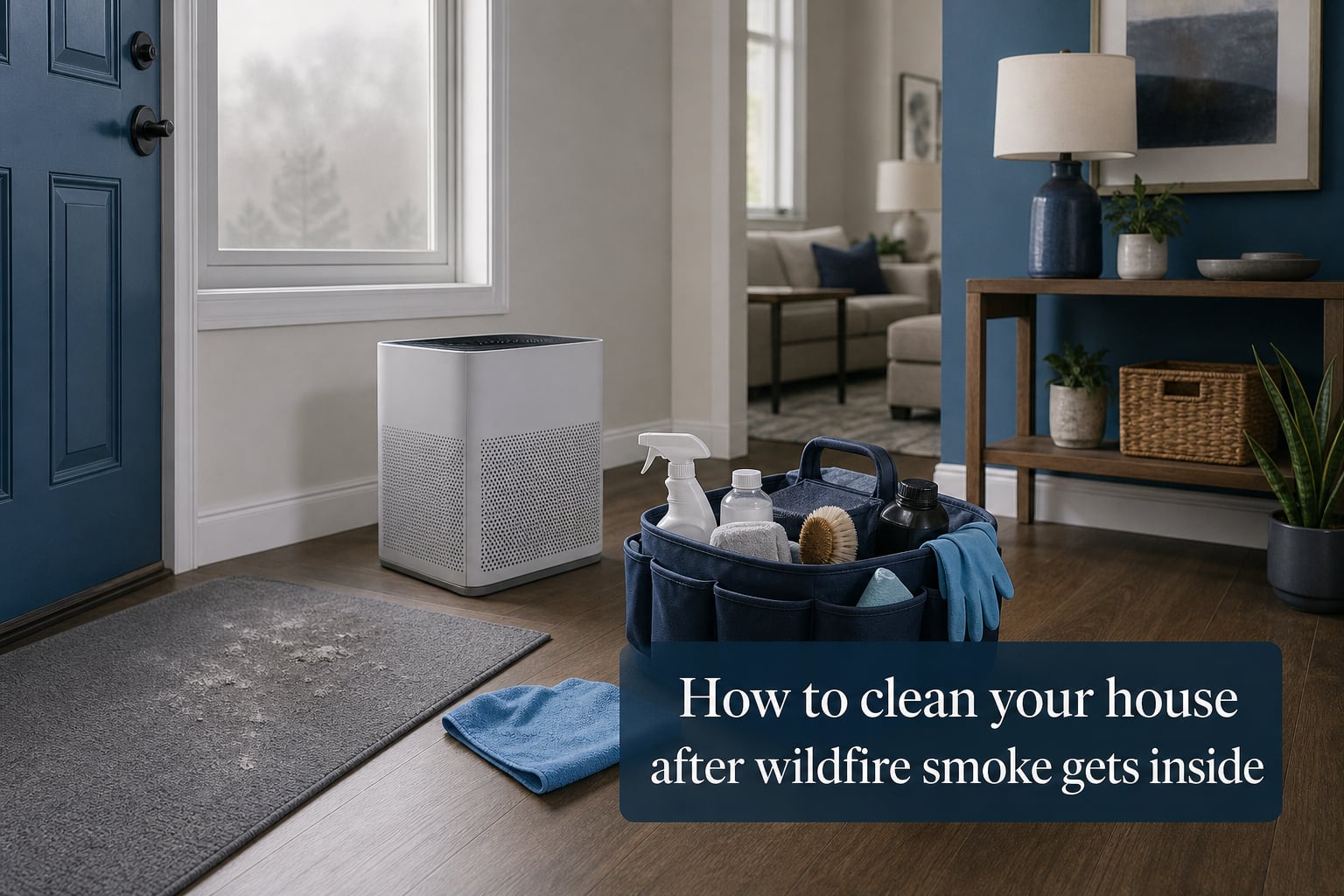
To clean your house after wildfire smoke gets inside, first stop more smoke from entering, protect yourself with gloves and a well-fitting N95 respirator, then remove settled ash with damp methods and filter the indoor air. Work from the cleanest rooms toward the dirtiest, and do not dry sweep, dust, or use a non-HEPA vacuum because those actions can put fine particles back into the air.
Wildfire smoke cleanup is more than getting rid of a campfire-like smell. Fine particles can settle on floors, walls, furniture, food packaging, and HVAC components, while gases and odor-causing compounds can cling to porous materials.
This guide explains how to clean your house after wildfire smoke gets inside without spreading ash through the rooms you just cleaned. It also spells out when a home cleanup is reasonable, when to discard an item, and when the job calls for a qualified smoke-remediation professional.
Quick answer: Keep windows and exterior doors closed while outdoor air is smoky. Once the outdoor air is clearly better, use controlled ventilation, run filtration, damp-wipe high-touch surfaces, wet-mop hard floors, launder washable fabrics, and repeat the air-cleaning cycle until odor and visible residue are gone.
Table of Contents
Start with safety, outdoor air, and a damage check before cleaning
Start cleanup only after local officials say it is safe to return and the immediate fire danger has passed. If smoke is still heavy outdoors, shut windows, exterior doors, fireplace dampers, and any HVAC fresh-air intake so you do not pull more particulate matter indoors.
Wear an N95 respirator that seals closely around your nose and mouth, disposable or washable gloves, long sleeves, long pants, and closed shoes. An N95 reduces what you breathe in; it does not remove gases, and a loose mask does not offer the same protection.
People with asthma, COPD, heart disease, severe allergies, pregnancy-related breathing concerns, or a recent respiratory illness should avoid the cleanup work when possible. Children and older adults should stay in the cleanest available room or elsewhere until the dusty work is complete.
Warning: Leave the house and contact emergency services if you smell gas, see smoldering material, find damaged electrical wiring, or have a carbon monoxide alarm. Do not enter an area with major structural damage, extensive soot, standing water, or suspected asbestos-containing material without professional direction.
Before moving anything, take photographs and make a simple room-by-room list of visible ash, soot streaks, odor, water damage, and affected belongings. This record can help with an insurance claim and keeps you from forgetting a closet, drawer, duct register, or storage area.
Wildfire ash is usually a light gray or black powder left after vegetation burns. Soot is a finer, often oily black residue that can smear into paint, fabric, and unfinished wood; if you see widespread soot or thick residue, get an assessment before scrubbing it deeper into surfaces.
Clean your house after wildfire smoke with a controlled six-step sequence
Clean smoke residue in a sequence that limits recontamination: control incoming air, remove loose particles, clean high surfaces before low ones, wash fabrics, filter the air, then check for remaining odor. One careful pass is safer than rushing through every room with dry tools.
- Step 1: Set up one cleaner room. Pick a room with the least odor and residue, close it off as much as practical, and run a properly sized portable air cleaner there. Put clean bedding, medicines, and items for sensitive household members in that room first.
- Step 2: Stop dry particle spread. Remove shoes at the door, place washable mats at entry points, and do not use a leaf blower, compressed air, or ordinary broom indoors. Those tools lift ash and soot into the breathing zone.
- Step 3: Capture loose dust carefully. Use a vacuum with true HEPA filtration only if the manufacturer directs it for fine dust, moving slowly over carpets, upholstered furniture, and crevices. If you do not have one, postpone vacuuming rather than using a machine that exhausts dust back into the room.
- Step 4: Wipe from high to low. With a slightly damp microfiber cloth or disposable damp cloth, wipe ceiling-adjacent trim, shelves, blinds, counters, furniture, and finally baseboards. Fold or change cloths often so you lift residue instead of redistributing it.
- Step 5: Wet-clean floors and washable items. Wet-mop sealed hard floors and wash removable fabrics according to their care labels. Clean a small test area before treating walls, painted surfaces, unfinished wood, leather, or delicate fabrics.
- Step 6: Run filtration and reassess. Continue air cleaning with doors and windows closed while the outdoor air remains poor. Once the outdoor air improves, air out the home briefly if conditions allow, then check rooms, filters, and fabrics for renewed odor or residue.
Work one room at a time and finish it before starting the next. Keep cleaned fabrics and supplies covered or outside the work area so ash from a later room does not land on them.
Tip: Think in phases rather than trying to finish in an afternoon. The first day is for safety, air control, and loose ash; the next phase is surfaces and laundry; the final phase is odor checks, filter changes, and decisions about items that remain smoky.
Keep cleaning solutions mild and match them to the surface
For most sealed hard surfaces, start with mild dish soap or household detergent in warm water and a damp cloth. Use enough moisture to capture residue, but do not soak drywall, raw wood, or upholstered padding.
A light vinegar-and-water solution may help with lingering odor on some washable, non-stone surfaces, but it does not replace particle removal. Test it in an inconspicuous spot first, because vinegar can damage natural stone and may dull some finishes.
Tri-sodium phosphate, often called TSP, is sometimes used for stubborn smoke residue on durable painted surfaces, yet it is a stronger cleaner that needs label directions, gloves, ventilation when outdoor air permits, and a rinse where directed. Never mix any cleaner with bleach, ammonia, or another chemical product.
Warning: Do not rely on fragrance sprays, scented candles, or incense to cover smoke odor. They add more material to indoor air and do not remove the particles or gases that caused the smell.
Remove smoke from indoor air with HEPA filtration and careful HVAC settings
Remove smoke particles from indoor air by running a portable air cleaner with a HEPA filter in the rooms you use most. HEPA filtration captures fine particles; an activated carbon filter can help with some gases and odor, though carbon does not replace a HEPA filter.
Place the cleaner where air can circulate around it, rather than behind a sofa or tight against a wall. Keep doors and windows closed during a smoke episode, and run the unit continuously or at a higher setting when the room is occupied.
Your central HVAC system can help only if the equipment and filter setup are appropriate. Set the system to recirculate when possible, close a fresh-air intake during outdoor smoke, and ask an HVAC professional whether the system can safely accommodate a MERV 13 filter before installing one.
A MERV rating describes how well an HVAC filter captures particles in specified size ranges. A higher-rated filter can increase resistance to airflow, so forcing a filter into a system not designed for it can reduce performance or strain the equipment.
Replace a loaded HVAC filter according to the system instructions and after a significant smoke event if it is visibly dirty. Record the replacement date and inspect the filter sooner than usual during recurring smoke periods.
Ventilate only when outdoor air is cleaner than indoor air
Ventilate after wildfire smoke only when outdoor conditions have improved enough that opening the home will not bring in another wave of particles. Check local air-quality reporting, then open windows on opposite sides of the home for a short period if the air is favorable and no one in the household is highly sensitive.
If outdoor air quality is still poor, mechanical ventilation that pulls in outside air can make indoor air worse. Use recirculation, seal obvious gaps around windows and doors temporarily, and keep bathroom or kitchen exhaust use limited to what is needed while outside smoke remains high.
A do-it-yourself box-fan filter setup is sometimes discussed for emergency particle control, but it needs a clean fan, a compatible MERV filter, stable placement, and manufacturer safety instructions. A commercially made, properly sized portable air cleaner is the simpler choice when available, and neither option replaces safe cleanup practices.
Clean walls, ceilings, floors, and furniture with damp methods
Clean smoke damage on walls and ceilings by removing loose residue gently before washing. Start at the top of the wall with a barely damp microfiber cloth, use overlapping passes, and replace the cloth or rinse it frequently so it stays clean.
Do not scrub hard at soot marks. The oily residue can smear, and aggressive rubbing can damage paint or force soot into textured surfaces.
For a painted wall with light residue, a mild detergent solution is usually the first approach. Wring the cloth out well, test a hidden patch, and dry the surface with a clean towel after wiping so moisture does not linger in drywall or seams.
Textured ceilings, acoustic ceiling tiles, unsealed brick, unfinished wood, and wallpaper can trap particles and react badly to water. If these materials hold visible soot, persistent odor, or staining after a careful test, stop and speak with a restoration specialist rather than escalating to harsher cleaners.
Clean kitchens by treating food-contact areas and porous supplies differently
Clean kitchen counters, appliance exteriors, cabinet fronts, and sealed shelves with detergent and water, followed by a clean-water wipe if the product directions call for it. Wash dishes, cookware, utensils, and reusable food containers before using them, especially if they were stored uncovered.
Discard food that was uncovered during heavy smoke exposure or that has an unusual odor, residue, or damaged packaging. A sealed metal can or intact glass jar can often be washed on the outside, but food in cardboard, paper, porous plastic, or opened packages is harder to judge safely.
Do not taste questionable food to decide whether it is safe. When a refrigerator or freezer was affected by smoke, power loss, or fire-suppression water, follow local public-health directions and use the safer discard choice when the history is unclear.
Clean bathrooms by wiping residue without mixing chemicals
Clean bathroom counters, sinks, fixtures, tubs, and sealed tile with one compatible household cleaner at a time. Rinse or wipe surfaces as directed, and wash bath mats, towels, and shower curtains that can be laundered.
Bleach is not a smoke-odor cure and should never be mixed with vinegar, ammonia, TSP, or any other cleaning product. If mold is present because water entered the home, that is a separate moisture problem that may need professional advice.
Clean carpets and upholstery by capturing particles before deodorizing
Clean carpets and upholstered furniture with a HEPA vacuum using slow, repeated passes in several directions. Empty or dispose of collected material according to the vacuum instructions while wearing your respirator and gloves, ideally away from the living area.
After particle removal, washable cushion covers and throws can go through the laundry if their labels allow it. Do not saturate cushions, mattresses, or rugs with deodorizer or water, because damp padding can trap odor and develop mold.
For fabrics that still smell after laundering and filtration, try a small, label-safe test or use a professional cleaner experienced with smoke damage. Strong odor in padding, foam, or a mattress after repeated cleaning is a practical sign that replacement or professional assessment may be more sensible.
Clean wood, books, papers, and electronics with restraint
Clean sealed wood furniture with a lightly damp cloth and a cleaner approved for the finish, then dry it promptly. Avoid soaking joints, veneer edges, unfinished wood, and antique finishes, which can swell, stain, or lose their protective coating.
Books, paper records, photographs, and artwork can absorb smoke odor quickly. Place lightly affected items in a clean, dry, well-filtered room, separate them from smoky objects, and seek a document or art conservator for important collections rather than applying household cleaners.
Keep electronics unplugged until they are dry and free from visible residue. Smoke particles can settle inside vents and circuitry, so a television, computer, appliance, or HVAC control with heavy soot should be inspected by a qualified technician instead of opened and cleaned at home.
Decide what to keep, discard, or send to a professional
Keep items that are nonporous, intact, and fully cleanable when their odor and visible residue clear after careful washing. Glass, metal, sealed plastic, washable dishes, and many sealed hard surfaces fit this group.
Discard items when smoke residue has penetrated food, medicine, cosmetics, infant supplies, heavily damaged paper goods, or porous materials that remain odorous after sensible cleaning. When an item directly touches your mouth, skin, food, or a baby and you cannot clean it confidently, replacement is the safer choice.
Send items out or request professional help when soot is widespread, odor returns after cleaning, walls or insulation may be affected, or the home suffered any direct fire damage. Restoration professionals can assess cavities, HVAC ducts, thermal fogging needs, and specialized textile or document cleaning.
- Usually washable: sealed dishes, glass, metal, washable clothing, hard plastic, sealed countertops, and finished floors.
- Use caution: upholstered furniture, rugs, mattresses, unfinished wood, books, paper files, leather, blinds, and children’s plush toys.
- Often discard or get advice first: exposed food, opened pantry goods, medicines with smoke residue, cosmetics, badly smoky foam, and any item affected by fire, melting, or contaminated water.
Insurance documentation matters even for items you throw away. Photograph the item, note why it could not be cleaned, and check the claim process before disposal unless it presents an immediate safety risk.
Protect your home from the next round of wildfire smoke
Protect the home before the next smoke episode by keeping a small supply of clean filters, microfiber cloths, gloves, and well-fitting N95 respirators. Assign a low-traffic room as a clean-air room, and keep its windows, doors, and gaps closed during poor outdoor air.
Check weather stripping around exterior doors, window seals, fireplace dampers, and obvious utility penetrations. Simple entry habits also help: remove shoes at the door, wash pets after outdoor exposure when practical, and damp-wipe tracked-in ash before it spreads.
Keep your HVAC maintenance current and ask a technician about a compatible MERV 13 filter before a smoke emergency. If you use a portable air cleaner, learn the filter-change instructions before the unit is needed and keep it clear of curtains and furniture.
Tip: A smoke smell that fades after two days of filtration can still warrant a final wipe-down and laundry cycle. Forum users often report fast improvement with filtration, but odor alone is not a reliable measure of particle levels or the cleanliness of porous materials.
Get direct answers to common wildfire smoke cleanup questions
How do you clean a house after wildfire smoke?
Close the home to more smoke, wear gloves and a well-fitting N95 respirator, run HEPA filtration, and use damp cloths and a wet mop to remove ash. Vacuum only with a true HEPA vacuum, clean from high surfaces to low ones, wash washable fabrics, and discard exposed food or porous items that remain smoky after careful cleaning.
How long does smoke from a fire stay in your house?
Smoke odor may improve within days when outdoor air is clean, HEPA filtration runs continuously, and surfaces and fabrics are cleaned. It can last weeks or longer when soot has settled in carpet padding, upholstery, wall cavities, insulation, or HVAC components; persistent or returning odor calls for a professional assessment.
How do you detox from wildfire smoke?
There is no household detox that removes wildfire smoke from the body. Reduce further exposure, move to cleaner air, rest, drink fluids as appropriate for your health, follow your clinician’s usual respiratory plan, and seek medical care for trouble breathing, chest pain, severe wheezing, confusion, or symptoms that worsen.
How toxic is smoke from a house fire?
Smoke from any fire can contain fine particles, irritating gases, and toxic chemicals, and smoke from a house fire may contain additional chemicals from burning furnishings and building materials. Do not treat it like ordinary dust: wear protective equipment, avoid dry cleanup methods, and get professional help for heavy soot, direct fire damage, or persistent contamination.
Can you use an ozone generator to remove wildfire smoke smell?
Do not run an ozone generator in an occupied home. Ozone can irritate the lungs and requires strict vacancy and safety procedures; it also does not replace removal of ash and soot. Start with source removal, HEPA filtration, activated carbon for odor support, and professional advice for persistent odor.
Finish wildfire smoke cleanup by removing residue first and judging odor second
How to clean your house after wildfire smoke gets inside comes down to a disciplined order: stop new smoke, protect your lungs, capture particles with damp methods and HEPA filtration, then wash fabrics and surfaces one room at a time. The smell may fade quickly, but do not use fragrance or ozone as a shortcut around real ash and soot removal.
If heavy soot, direct fire damage, or an odor that keeps returning is part of the picture, pause the do-it-yourself work and arrange a professional evaluation. For a light smoke intrusion, the same patient sequence gives your household the clearest path back to a cleaner indoor space.