
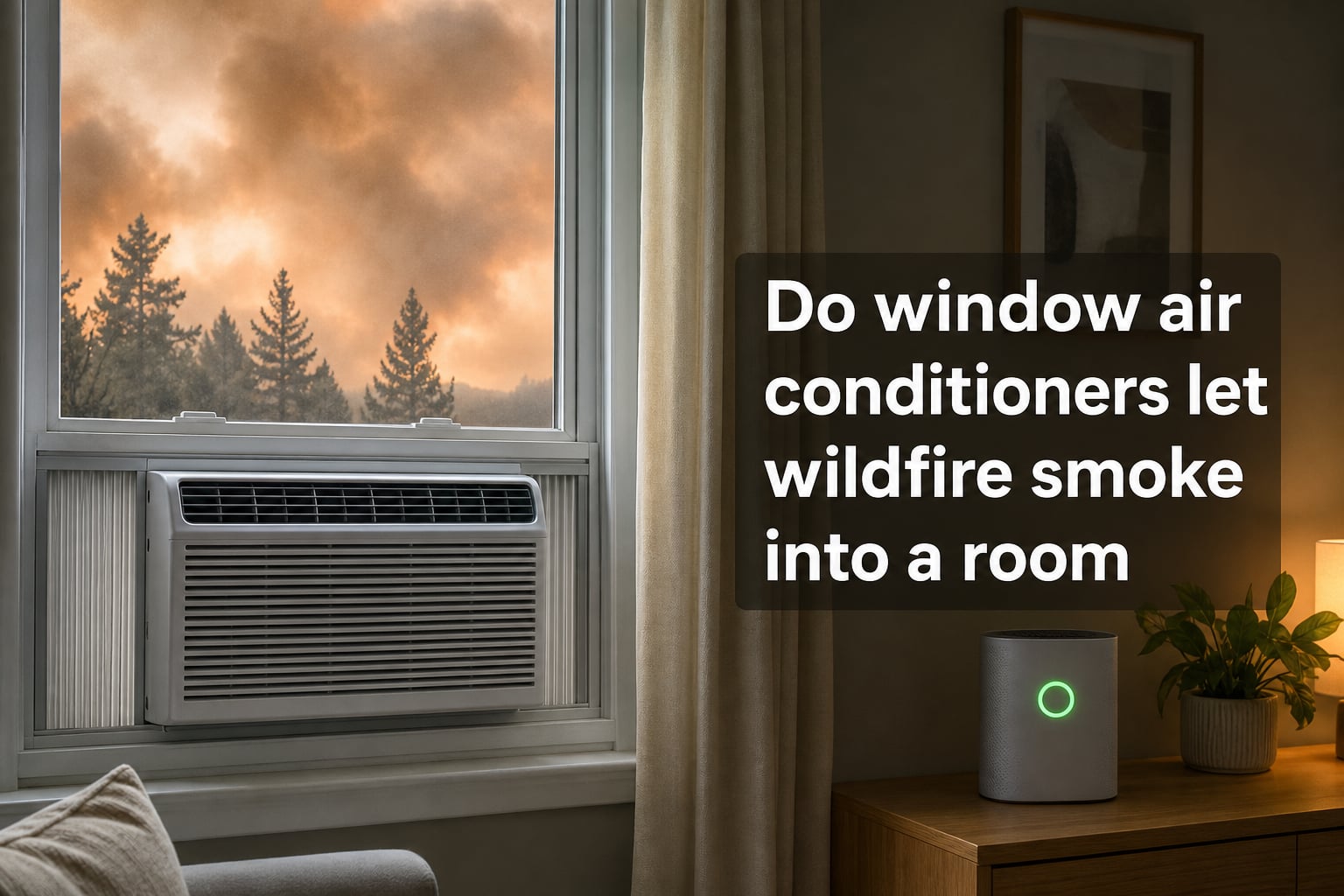
Yes, window air conditioners can let wildfire smoke into a room. The smoke gets in mostly through gaps around the unit and through doors and windows elsewhere in your home, not because the AC itself is actively pulling outdoor air. A standard window AC recirculates indoor air and offers almost no protection against fine PM2.5 particles from wildfire smoke.
I dug into EPA guidance, air quality research, and community discussions on Reddit and Houzz to put together this practical answer. By the end, you will understand exactly how your window AC handles wildfire smoke, why the filter is not doing what you think it does, and the specific steps that make a real difference during smoke events.
Table of Contents
How Do Window Air Conditioners Actually Work
A window air conditioner is a self-contained cooling system that pulls warm air from inside your room, removes heat and humidity, and pushes the cooled air back out. Critically, it does not need to bring in outdoor air to function. This recirculation design is the first thing to understand when figuring out what happens during a smoke event.
Recirculation vs Fresh Air Mode
In normal operation, a window AC takes room air, cools it over the evaporator coils, and returns it through the front grille. The outdoor side (the part sticking out the window) expels heat to the outside, but the indoor air loop stays sealed. This means your AC is not constantly sucking smoky air into your living space the way an open window would.
That said, many window units include a small fresh air vent or damper feature. When this vent is open, the unit draws a small amount of outdoor air into the recirculation stream. In smoky conditions, this feature becomes a direct pipeline for PM2.5 particles to enter your room.
The Fresh Air Damper Explained
The fresh air damper is usually a small slider, lever, or knob on the front or side of your AC unit, often near the control panel. Opening it lets outside air mix with the cooled air. Manufacturers include this for ventilation on pleasant days, but it works against you during wildfires.
On most models, the damper position is marked with icons (a house, arrows, or the words “vent” and “close”). If you cannot find it, check the manual or look for a small louvered section that opens when you slide a switch. I have found that many people never touch this feature and do not realize it is open by default on some units.
Can Wildfire Smoke Get Into a Room Through a Window AC
Yes, wildfire smoke can enter a room even when your window AC is running, but the AC itself is rarely the main culprit. The bigger problems are gaps around the unit, the fresh air damper being open, and doors or windows elsewhere in the home letting smoke seep in.
How Smoke Actually Enters a Building
The EPA’s research on wildfires and indoor air quality shows that outdoor air finds its way inside through any small opening. Window AC installations are rarely airtight. Side panels, foam seals, and the gap between the unit and window frame degrade over time, creating pathways for outdoor air to leak in.
According to EPA data, normal air exchange rates run around 0.4 air changes per hour on typical days, dropping to roughly 0.2 during wildfire events as buildings get buttoned up. Even at the lower rate, fine smoke particles still penetrate, just more slowly. The longer smoke hangs outside, the more finds its way in.
Common Infiltration Points Around Window AC Units
In my experience reviewing community posts on Reddit and Houzz, the most reported smoke entry points are the gaps where the accordion side panels meet the window frame, the seam between the AC chassis and the window sill, and any cracked or missing foam insulation. Homeowners in Portland and Seattle have described waking up to smoky-smelling rooms despite their AC running all night.
Doors opened for pets, bathroom exhaust fans, and even electrical outlets on exterior walls can all contribute. Your window AC is one pathway among many, which is why simply running the AC does not guarantee clean indoor air during a smoke event.
Why Standard Window AC Filters Cannot Catch Wildfire Smoke
The thin mesh or foam filter that came with your window AC is designed to catch dust and lint, not fine smoke particles. Wildfire smoke is dominated by PM2.5, particles 2.5 micrometers or smaller, which slip through standard filters almost completely.
Understanding MERV Ratings for Smoke
MERV (Minimum Efficiency Reporting Value) measures how well a filter captures particles of different sizes. A standard window AC filter typically rates between MERV 1 and MERV 4. These low ratings are good enough for visible dust and pet hair but capture very little of the fine particulate matter that makes wildfire smoke dangerous to breathe.
For meaningful smoke protection, you need MERV-13 or higher. A MERV-13 filter captures at least 50% of PM2.5 particles, while a MERV-16 filter captures over 75%. The problem is that most window AC units are not designed to accept high-MERV filters. The filter slot is too thin, and the blower motor cannot push air through denser media without straining.
What Filter Rating Actually Stops Smoke Particles
To put it simply: the filter in your window AC will not stop wildfire smoke. Even a MERV-8 filter, considered good for residential use, only captures around 20% of PM2.5. True protection from fine particles requires either a HEPA filter (which captures 99.97% of particles down to 0.3 micrometers) or a portable air purifier with HEPA filtration.
Communities dealing with repeated wildfire smoke, like those in California and the Pacific Northwest, have learned this the hard way. Reddit threads in r/Portland and r/Washington are filled with users reporting that despite running their AC with various filters, they could still smell smoke indoors.
How to Reduce Smoke Infiltration When Using a Window AC
You can take several concrete steps to reduce how much wildfire smoke enters your room through or around your window AC. None of these are complicated, and together they make a meaningful difference in indoor air quality during a smoke event.
Close the Fresh Air Damper
This is the single most important step. Locate the fresh air vent or damper on your AC unit and close it completely. On most window units, this is a small lever or slider that you push to the “closed” or “recirculate” position. Check your owner’s manual if you are unsure where it is.
Once closed, the unit will only recirculate indoor air, which is exactly what you want when outdoor air is hazardous. Some newer units have a dedicated “recirculate” button on the remote or control panel that does this automatically.
Seal Gaps Around the Unit
Inspect the perimeter of your window AC installation for gaps. Common culprits include the accordion side panels (which rarely seal tightly), the gap between the AC and the window sill, and any spaces where the unit meets the window frame. Use weather stripping, removable caulk, or foam tape to seal these openings.
I have seen homeowners use magnetic strips, foam insulation, and even rolled-up towels as temporary seals during peak smoke events. Anything that blocks airflow from outside helps. Just make sure you are not blocking the AC’s exhaust or creating a fire hazard.
Upgrade Your Filter If Possible
If your window AC has a filter slot that can accommodate a thicker filter, upgrade to the highest MERV rating that fits without restricting airflow. For most window units, this is MERV-8 at best, but even a modest upgrade from a MERV-2 to a MERV-8 filter helps.
Check your filter more frequently during smoke events. A clogged filter reduces airflow and lets more unfiltered air bypass the filter through gaps. Swap it out every few weeks when wildfire smoke is in the air, rather than the usual monthly schedule.
Run the Fan on Recirculate and Keep Doors Closed
Set your AC to recirculate mode (or close the fresh air damper) and keep interior doors closed to isolate the cleanest room in your home. Pick one room with the fewest windows and doors, ideally one where you spend most of your time, and make it your clean air shelter.
Run the AC fan continuously on a low setting to keep air circulating through the filter. This does not eliminate smoke but helps reduce particle concentration in your chosen room over time. Combined with a portable HEPA air purifier, this setup can keep one room breathable even when outdoor air quality is hazardous.
When to Be Concerned and When to Act Differently
If you can see haze indoors, smell smoke strongly, or notice eye or throat irritation, your indoor air quality is already compromised. These are signs that smoke is getting in faster than your AC filter can handle, and you need additional protection.
During heavy smoke events, consider investing in a portable air purifier with a true HEPA filter. These units are specifically designed to capture PM2.5 and can reduce indoor particle concentrations by 50% or more in a single room. Place it in your shelter room alongside the window AC running on recirculate.
For vulnerable groups, including children, elderly individuals, pregnant women, and people with asthma or heart conditions, even moderate smoke infiltration poses health risks. When AQI readings for PM2.5 exceed 150, public health agencies recommend staying in a filtered indoor environment and avoiding outdoor activity. Do not rely on your window AC alone during these conditions.
Frequently Asked Questions
Do window AC units filter out wildfire smoke?
No, standard window AC units do not effectively filter wildfire smoke. Their built-in filters are typically MERV 1 to MERV 4, which capture large dust particles and allow fine PM2.5 smoke particles to pass through almost completely. You need a MERV-13 or higher filter for meaningful smoke protection, and most window ACs cannot accommodate that rating.
Should you run AC with wildfire smoke outside?
Yes, you can run your window AC during wildfire smoke, but only on recirculate mode with the fresh air damper closed. Running it this way cools your room without pulling in additional outdoor air. For best results, pair it with a portable HEPA air purifier and seal any gaps around the unit.
Are window AC units a fire risk during wildfires?
Window AC units themselves are not a fire risk during wildfires, but they can become damaged if exposed to extreme heat or flying embers. More importantly, they do not filter smoke well, so running them during a smoke event does not protect your indoor air quality the way many people expect. Focus on sealing gaps and using a HEPA purifier instead.
What are the downsides of using a window AC during wildfire smoke?
The main downsides are that standard filters do not capture PM2.5 particles, gaps around the unit can let smoke seep in, and the fresh air damper can pull outdoor air into your room if left open. Window ACs also cannot match the filtration of a dedicated HEPA air purifier, so they offer limited protection during heavy smoke events.
Does wildfire smoke affect indoor air quality even with AC running?
Yes, wildfire smoke significantly affects indoor air quality even when your window AC is running. Studies show infiltration rates of roughly 0.2 air changes per hour during wildfire events, meaning outdoor particles still enter through gaps, doors, and ventilation. To maintain healthy indoor air, you need sealed windows, recirculate mode, and ideally a HEPA air purifier.
Final Thoughts on Window AC Units and Wildfire Smoke
Window air conditioners can let wildfire smoke into a room, mostly through gaps around the unit and the fresh air damper feature rather than the cooling process itself. The filters that come standard with most units are not designed to capture PM2.5 particles, so running your AC alone does not protect your indoor air quality the way you might hope.
Close the fresh air damper, seal any visible gaps, run the fan on recirculate, and consider adding a portable HEPA air purifier for the room where you spend the most time. These steps, combined with keeping doors and windows closed, will give you the best chance of staying comfortable and breathing cleaner air during wildfire season in 2026 and beyond.