
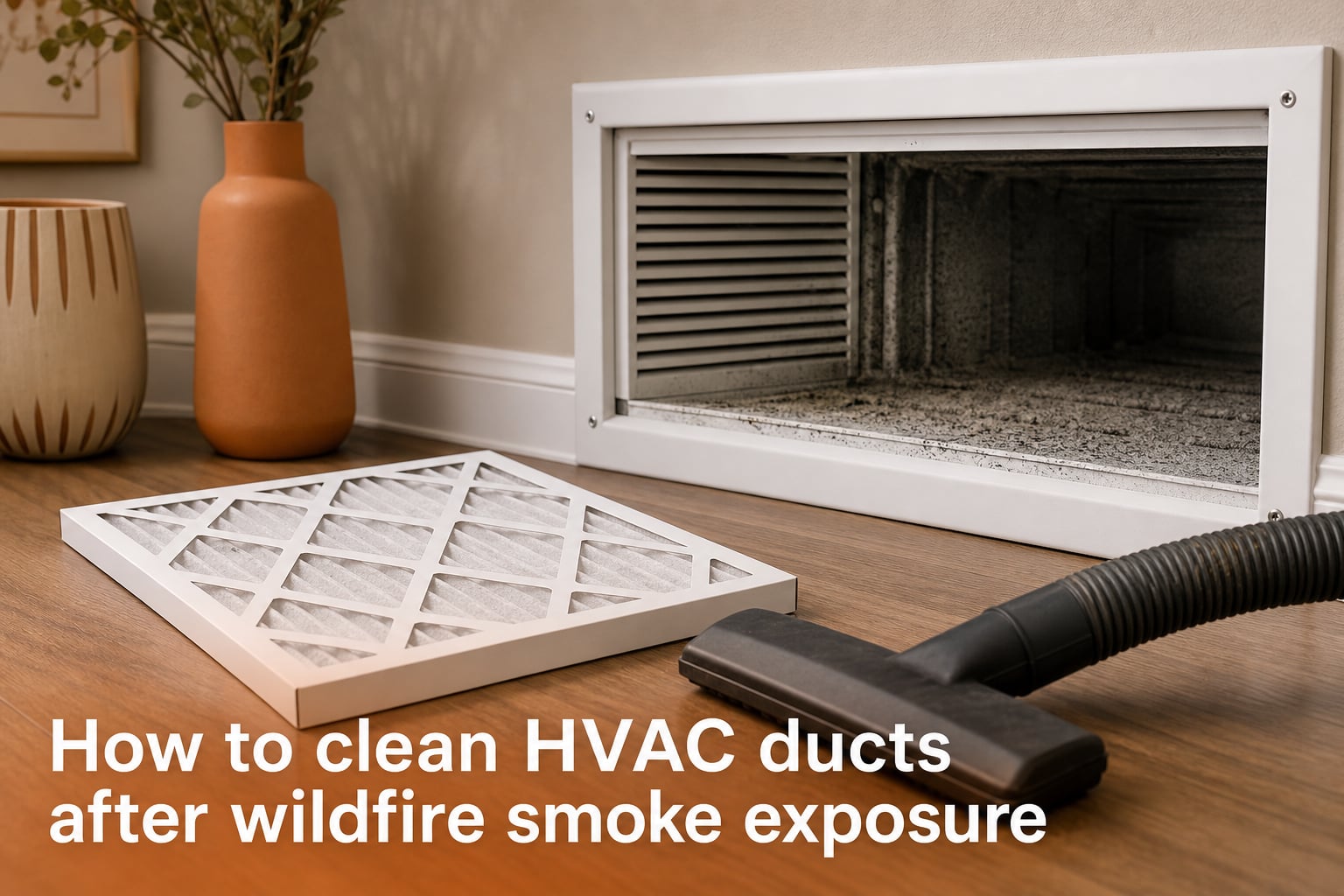
Learning how to clean HVAC ducts after wildfire smoke exposure starts with a boundary: you can safely clean the return grille, supply registers, filter area, and visible dust, but a contaminated duct system or furnace cabinet calls for trained help. Wildfire smoke carries ash, soot, and very small particles that can settle on a blower wheel, evaporator coil, drain pan, and duct surfaces before you notice a smell.
The first goal is not to perfume the system. It is to stop recirculation, remove loose residue without sending it back into the living space, replace loaded filtration, and check whether hidden components need smoke damage air duct cleaning.
Act sooner when smoke odor returns every time the fan starts, the filter blackens unusually fast, or grey residue appears around registers. If there was direct fire damage, visible heavy soot, water damage, or anyone in the home has breathing trouble, skip DIY duct cleaning and contact a qualified restoration or HVAC professional.
Quick answer: Shut the system down, photograph its condition, replace the filter, HEPA-vacuum accessible grilles and return areas, clean accessible cabinet surfaces, then have the ducts, blower, coil, and odor source assessed if residue or smell persists. Do not spray fragrances, bleach, or sealants into ductwork.
Table of Contents
How to clean HVAC ducts after wildfire smoke exposure: use this seven-step order
For light, indirect exposure, the sequence below keeps loose ash from being pulled deeper into the system. Plan on an initial inspection and accessible cleaning in one session, then judge the result after the system has run with a clean filter.
Step 1: Inspect the system before you disturb any residue
Turn the thermostat to off and note the date, the wildfire smoke conditions, the odor level, and any visible dust at every supply and return. Photograph the filter, grilles, accessible return box, and furnace or air-handler cabinet before cleaning; those records help a technician compare conditions and can support an insurance claim.
Remove one register cover only if it is easy to reach, use a flashlight, and look a short distance into the boot. A thin household dust film is different from black or grey soot, sticky residue, insulation debris, or damp material.
Check the filter first. If it is dark, clogged, bowed inward, wet, or carries a strong smoke odor, it has done its job and should be changed before the system runs again.
Warning: Do not open an electrical panel, disconnect blower wiring, scrape an evaporator coil, or enter a crawlspace or attic duct run without the right training and protective gear. Damage to a coil, flex duct, insulation, or condensate system can create a much larger repair problem.
Step 2: Shut down airflow and protect the work area
Keep heating and cooling off while you clean accessible parts. Running the blower while ash is loose can pull particles through returns and send them to other rooms.
Open windows only when outdoor air quality is acceptable. If the smoke event is still active or outdoor air smells smoky, keep windows closed and work in a contained area rather than trying to air out the house.
Wear gloves and a well-fitting particulate respirator when handling dusty registers or filters. Put a drop cloth below each grille so debris can be collected instead of ground into carpeting or tracked through the home.
Step 3: Replace the filter and clean the filter rack
Take the old filter straight to a bag, seal it, and discard it according to local instructions. Vacuum the filter rack, return grille, and the accessible metal around the opening with a HEPA-filtered vacuum using a soft brush attachment.
Wipe hard, non-electrical surfaces with a lightly damp microfiber cloth, changing cloths as they become dirty. Do not use a household vacuum that lacks HEPA filtration, because its exhaust may put fine particles back into the room.
Install a correctly sized filter with the airflow arrow facing the equipment. A filter that is too restrictive for the system can reduce airflow, so check the unit documentation or ask an HVAC technician before moving to a higher-efficiency option.
Step 4: Clean supply and return grilles without pushing debris inward
Remove washable metal grilles, if their screws and paint condition allow it, and clean them away from the opening with mild detergent and water. Let them dry completely before reinstalling; moisture left near a duct opening is not helpful.
With the grille off, use the HEPA vacuum at the opening and along the first reachable section of the register boot. Keep the nozzle moving slowly and avoid forcing a brush, rag, or flexible tool down the duct, because that can dislodge internal liner, tear flex duct, or leave a blockage.
For fixed ceiling registers, vacuum the face and perimeter instead of pulling hard on a painted cover. The aim at this stage is soot removal from ducts where you can actually see and reach it, not a claim that the entire duct run is clean.
Step 5: Clean only the accessible air-handler cabinet surfaces
After confirming power is off at the service switch or breaker, remove only the access panel that the manufacturer identifies as user-serviceable. HEPA-vacuum loose debris from the cabinet floor and wipe accessible painted metal, taking care not to bend fins, wet electrical parts, or disturb wiring.
The blower wheel, evaporator coil, and drain pan deserve special attention after wildfire smoke exposure because residue can hold odor and affect airflow or heat transfer. They are also easy to damage, so blower wheel cleaning smoke residue and evaporator coil cleaning wildfire residue are usually professional tasks.
A forum observation is especially useful here: people often report that duct cleaning did little because the odor was embedded in furnace-adjacent materials. That is why the cabinet, coil area, filter rack, and source of odor matter as much as the duct openings.
Step 6: Decide whether the ducts need professional negative-pressure cleaning
Professional wildfire smoke HVAC cleaning usually begins with an inspection camera and a system assessment. Technicians isolate the system, place it under negative air pressure with HEPA capture, then use air whips or rotary brushes to loosen loose particulate while it is collected.
A credible scope includes supply and return ducts, accessible trunks, registers, the air handler, and the components that actually hold residue. Ask what will be cleaned, what cannot be cleaned safely, how dust will be captured, and whether before-and-after photos will be provided.
NADCA duct cleaning standards are a useful screening point when comparing providers. For smoke restoration or direct fire impact, ask whether the company has the appropriate restoration experience and whether the work plan separates cleaning from any repair, insulation replacement, or odor treatment.
Step 7: Restart, monitor, and test the result
Reinstall dry grilles and a clean filter, then run the fan for a short period while someone checks each room for odor, visible discharge, rattling, or weak airflow. Do not mask a new smell with a fragrance; note where it appears and whether it starts only with heating, cooling, or fan-only operation.
Inspect the filter again after several days of normal operation. A fast buildup, repeated odor, dust streaking around registers, or worsened airflow means the system needs a deeper assessment rather than repeated surface wiping.
Keep the inspection photos, filter receipts, service reports, and any indoor-air findings together. This turns a vague smoke event into a useful maintenance record for 2026 and gives a restoration professional a clearer starting point.
HVAC ducts need cleaning after wildfire smoke when clear signs point to contamination
Not every home downwind of a wildfire needs full duct restoration. Distant smoke can still infiltrate overnight, though, and the deciding factor is what reached the system and whether it remains there after basic cleaning and filtration changes.
- Smoke odor starts with the blower: A smell that returns when fan-only mode runs suggests a system component or duct surface is involved.
- Filters load far faster than normal: Wildfire particles can clog filters quickly, especially during a long smoke episode.
- Visible ash or soot is present: Grey or black deposits at grilles, in the return, or inside accessible equipment merit prompt inspection.
- Airflow or comfort changed: Residue on a blower wheel or coil can contribute to poor airflow and reduced system performance.
- People have symptoms indoors: Eye irritation, coughing, headaches, or breathing symptoms should move health and air-quality advice ahead of cleaning chores.
Cleaning is more urgent when exposure was heavy, the home was open to smoky outdoor air, or the HVAC system operated continuously during the event. A direct fire, melted duct material, water from suppression, or thick soot is restoration work, not routine maintenance.
Health warning: Infants, older adults, pregnant people, and people with heart or lung conditions may be more sensitive to smoke particles. Follow local public-health guidance, seek medical advice for symptoms, and use a qualified HVAC or restoration provider when home conditions are uncertain.
Trained cleaners remove smoke residue with capture, agitation, and component care
The important word in HEPA vacuum duct cleaning is capture. A professional negative-air machine pulls loosened debris toward HEPA filtration instead of relying on a shop vacuum at a register opening.
Agitation tools such as air whips and rotary brushes can dislodge dry residue from suitable metal ducts. Their use has to match the duct material; aggressive tools are not appropriate for every flex duct, internally lined duct, or fragile connection.
Technicians may also inspect and clean the blower compartment, blower wheel, evaporator coil, and drain pan. A static-pressure check after reassembly can flag an airflow problem, while visual documentation makes it easier to judge whether the cleaning reached the stated areas.
Thermal fogging addresses remaining odor only after source removal
Thermal fogging HVAC treatment disperses a deodorizing product as a fine fog intended to reach odor-bearing areas. It is not a substitute for removing soot, ash, damaged insulation, or contaminated filters first.
Ask what product is proposed, why it fits the material involved, and what ventilation or re-entry instructions apply. Avoid anyone who promises that a fragrance, fog, or ozone treatment alone will solve a persistent smoke odor.
Ozone is not a casual odor-removal shortcut
Ozone can irritate the lungs and is not something to run in an occupied home as a DIY fix. If odor remains after cleaning, source investigation is the first move: check the filter rack, coil area, return path, insulation, and other smoke-affected household surfaces.
DIY cleaning is limited to accessible surfaces, while professionals handle hidden contamination
DIY work is reasonable when exposure was light and you can safely replace the filter, clean grilles, vacuum the first reachable boot section, and wipe accessible cabinet metal. It is also a useful first response while you arrange an inspection.
Professional service is the better choice when soot is visible inside the duct run, odor persists after a filter change, the system has poor airflow, or components such as the coil and blower wheel need cleaning. The same applies to direct fire damage, water exposure, rodent contamination, suspected mold, or damaged duct insulation.
When requesting service, describe the wildfire event, whether the HVAC ran, which rooms smell affected, how fast the filter loaded, and what you found. Request a written scope, the collection method, component access limits, documentation, and post-cleaning checks rather than a vague promise to sanitize everything.
Practical check: A duct-cleaning quote should describe the entire system, not just a count of vents. If a provider cannot explain containment, HEPA capture, and what happens at the air handler, keep looking.
Run AC during active wildfire smoke only when the system can limit outdoor air entry
The safest general approach during an active smoke event is to keep windows and exterior doors closed, set the HVAC to recirculate if the system has that option, and use a clean, compatible filter. Avoid settings that intentionally bring in outdoor air unless a building professional or local health authority says otherwise.
Central air conditioning does not create clean air by itself. It can, however, keep a home cooler while recirculating indoor air through a suitable filter, which may be preferable to opening windows during poor outdoor air conditions.
A MERV filter can help when it fits the system
MERV describes how effectively a filter captures particles across size ranges. For wildfire smoke filtration, many households look at MERV 11 to MERV 13, but the right choice depends on the equipment, filter thickness, and available airflow.
Forum discussions often favor a 4- to 5-inch filter with a MERV 12 or higher rating during wildfire season rather than a thin 1-inch filter. That can be sensible in a system designed for a deeper media filter, but it is not a universal upgrade; a restrictive filter can stress airflow in equipment that was not designed for it.
Check the manufacturer guidance or consult an HVAC technician, then inspect the filter more often while smoke conditions continue. A lower-rated clean filter can perform better for airflow than an over-restrictive filter left in place too long.
Portable air purifiers can reduce particles in the room where they run
A portable purifier with HEPA filtration can reduce airborne particles in a closed room when it is correctly sized and operated continuously. It does not clean duct interiors or repair a smoke-contaminated coil, but it can help improve air quality after wildfire while the home is closed up.
Place it in the room used most by sensitive household members, keep doors and windows closed during bad smoke, and replace filters according to the unit instructions. Activated carbon may help with odors, but a lingering smoke smell still calls for source control rather than scent masking.
Document the smoke event and prepare the HVAC system before the next one
Before discarding filters or wiping surfaces, take dated photos and keep a short log of the event, indoor odors, symptoms, and equipment behavior. Save communications, inspection reports, and receipts; insurance coverage varies, and your insurer can explain its documentation and claim requirements.
Do not wait for the next emergency to learn where the filter goes or which mode controls outdoor-air intake. A calm-season service visit is a good time to ask about compatible filter ratings, cabinet sealing, duct condition, and any needed repairs.
Prepare for wildfire smoke with this household checklist
- Keep the correct filter size and type on hand, plus a spare for heavy smoke periods.
- Learn how to turn the system off and how to select recirculation, if available.
- Check that return grilles and filter doors fit properly and are not bypassing unfiltered air.
- Maintain a portable HEPA purifier for the room where household members spend the most time.
- Photograph the air handler, filter, and accessible grilles before fire season for a clean baseline.
- Schedule ordinary maintenance before smoke conditions are expected, not during an active event.
These steps do not make a home smoke-proof. They give you a cleaner starting point, make filter changes faster, and help distinguish new smoke residue from ordinary household dust.
Common questions have clear answers about wildfire smoke and HVAC ducts
How do you clean ductwork after a fire?
Turn off the HVAC system, document visible residue, replace the filter, HEPA-vacuum accessible grilles and return areas, and clean only user-serviceable cabinet surfaces. Heavy soot, persistent odor, direct fire impact, or contamination beyond reachable openings needs professional negative-pressure cleaning and component inspection.
How long does soot stay in the air after a fire?
Airborne soot can settle quickly indoors, but very fine particles may remain suspended while air is moving and can be recirculated by an HVAC system. The practical concern is not only outdoor smoke duration but also residue left on filters, ducts, coils, and indoor surfaces after the event.
How do you clean a house after wildfire smoke?
Start by keeping smoky outdoor air out, using compatible filtration, and HEPA-vacuuming and damp-wiping hard surfaces from high to low. Launder washable fabrics, replace loaded filters, and address odor sources in the HVAC cabinet, ducts, insulation, and furnishings rather than relying on fragrance products.
Do air purifiers get rid of wildfire smoke?
A correctly sized portable purifier with HEPA filtration can reduce airborne particles in the closed room where it operates. It does not remove residue already inside HVAC ducts or on a coil, and odor reduction may require source cleaning and activated-carbon filtration.
How long does wildfire smoke stay in the air?
Outdoor smoke duration depends on the fire, weather, and local conditions, so follow local air-quality reports. Indoors, smoke can remain a problem after outdoor conditions improve if particles or odors settled on filters, HVAC components, and household surfaces.
Does the EPA recommend duct cleaning?
EPA guidance does not support routine duct cleaning for every home. It makes sense to investigate cleaning when there is visible contamination, vermin, mold concerns, or particles being released from supply registers; wildfire soot and persistent smoke odor are reasons to have the system assessed.
What time of year should you do duct cleaning?
Do ordinary HVAC maintenance before wildfire season or when outdoor air is clear and the system can be shut down comfortably. After a smoke event, arrange an assessment promptly if there is visible soot, strong recurring odor, fast filter loading, or airflow trouble.
Will my house smell better after air duct cleaning?
It can, if ducts or HVAC components are the odor source and the cleaning includes the affected system areas. A persistent smell may also be held in the filter rack, coil area, insulation, walls, fabrics, or furnishings, so duct cleaning alone cannot promise complete odor removal.
Cleaning HVAC ducts after wildfire smoke works best when source removal comes first
How to clean HVAC ducts after wildfire smoke exposure comes down to a safe sequence: stop recirculation, document what you find, replace the filter, clean only accessible surfaces with HEPA capture, and bring in qualified help for hidden soot, component cleaning, or lingering odor. That approach protects the equipment and gives your home a better chance at cleaner indoor air after wildfire conditions pass.
Start with the filter and a careful visual inspection today. If the odor comes back with the fan or residue is visible beyond the openings, arrange an HVAC or restoration assessment instead of trying to force a DIY tool through the ductwork.