
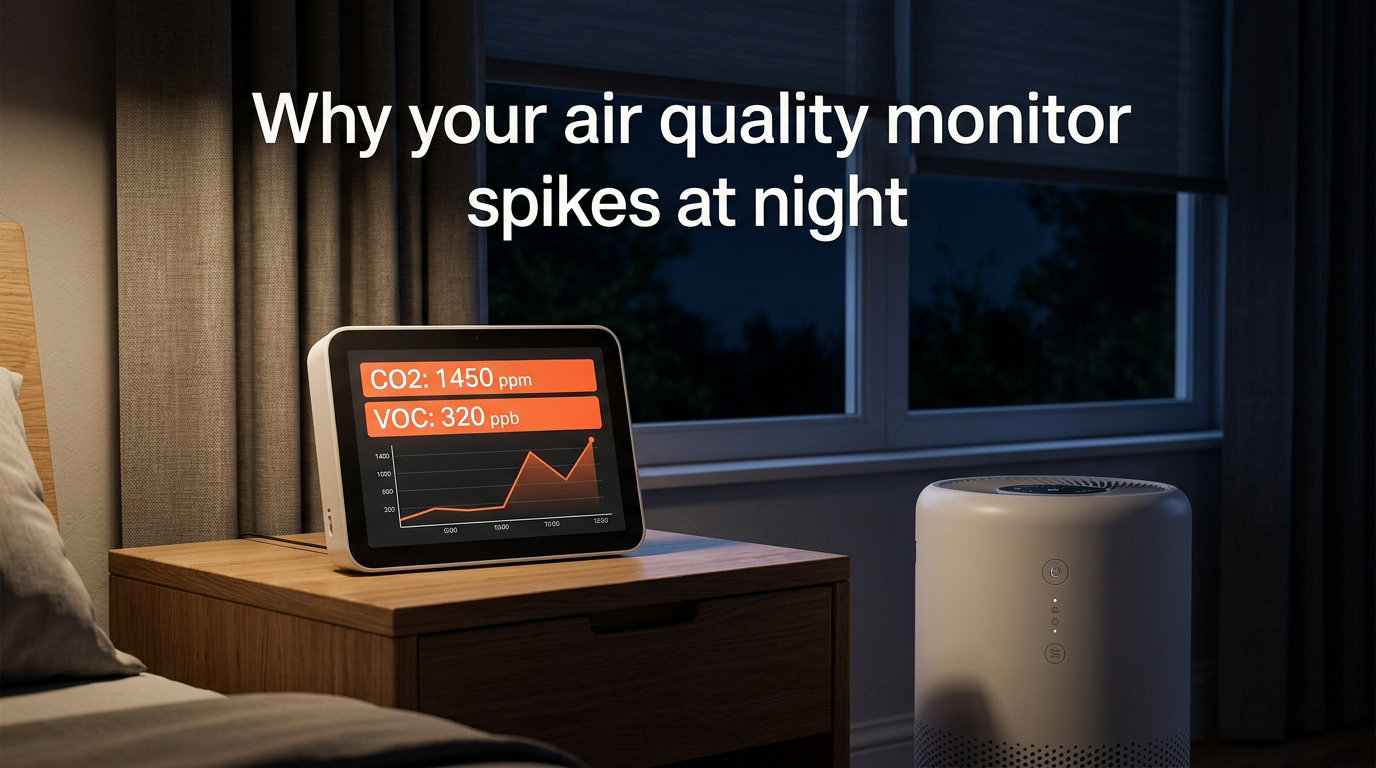
You check your air quality monitor first thing in the morning and there it is: another overnight spike. Your TVOC reading climbed from 80 ppb at bedtime to 600 ppb at 3 a.m., and the CO2 level looks like a slow-moving mountain.
Most people assume the sensor is broken or that something dangerous snuck in through the vents. Neither is usually true.
Your air quality monitor spikes at night because closed windows and doors cut off fresh air exchange, while your own body keeps breathing out CO2 and moisture. As the room cools overnight, VOCs absorbed into mattresses, bedding, and furniture re-emit back into the air.
When morning warmth arrives, rising vapor pressure accelerates that off-gassing, which is why the worst readings often appear right when you wake up.
This is not a glitch. It is a predictable, physics-driven pattern that almost every sealed bedroom repeats every night. Once you understand the mechanism chain, you can read those spikes like a diagnostic tool instead of a panic alarm.
In this guide I walk through why your air quality monitor spikes at night, what the most common culprits are, how to tell whether your numbers are normal or genuinely concerning, and which fixes actually move the needle. I have spent months comparing overnight logs from my own monitors and matching patterns to the underlying science.
The numbers and thresholds here come from real readings rather than generic advice.
Table of Contents
Why air quality gets worse at night: the three underlying forces
Almost every nighttime air quality spike traces back to three forces working in combination: reduced ventilation, a temperature inversion in the room, and the steady stream of CO2 plus moisture you exhale all night. Each one is harmless on its own.
Together, they create the conditions for VOCs and CO2 to accumulate to levels that look alarming on a graph.
Reduced ventilation when you close up for sleep
Ventilation is the single biggest factor in overnight air quality. The moment you shut the bedroom door and window, the room effectively becomes a sealed box with one slow-leaking vent: the gap under the door.
Studies of naturally ventilated bedrooms show CO2 climbing past 2,000 ppm within two to three hours once the door and window close. Outdoor air, by comparison, sits around 420 ppm.
A typical adult exhales enough CO2 overnight to push a closed bedroom well past 2,500 ppm, which is the threshold most indoor air guidelines flag as poor.
The same trapped-air problem concentrates VOCs. With no fresh air to dilute them, off-gassed compounds from your mattress, paint, and furniture build continuously through the night.
Temperature inversions trap pollutants near the ground
Outdoor temperature inversions get blamed for smog alerts, but a smaller version happens inside your bedroom. As walls cool toward morning, the air nearest the floor and the bed becomes cooler and denser than the air near the ceiling.
This stable layer resists mixing. Pollutants, moisture, and VOCs stay trapped in the breathing zone instead of dispersing. That is why monitors placed at nightstand height often record worse numbers than sensors mounted higher up.
The effect is stronger in winter, when window glass and exterior walls get much colder than room air. The bigger the temperature gap, the more sharply the inversion locks pollutants near the bed.
Your own breath adds CO2 and moisture all night
A sleeping adult exhales roughly 25 to 30 liters of CO2 per hour and about 40 grams of water vapor. In a sealed 1,000-cubic-foot bedroom, that is enough to swing both readings dramatically.
The CO2 climb is what most people notice first. But the moisture you add is just as important, because humidity interacts directly with VOC release, which I cover in detail below.
This is also why monitors in shared beds show bigger spikes than single-occupant rooms. Two adults exhale twice the CO2 and moisture, doubling the load on the same ventilation system.
What VOCs are and why they spike while you sleep
VOC stands for volatile organic compound, a broad family of carbon-based chemicals that evaporate easily at room temperature. Your monitor reports them as a single TVOC number, usually in parts per billion (ppb) or micrograms per cubic meter.
The reading is real, but it lumps together hundreds of different compounds, from formaldehyde to limonene.
VOCs 101: what your sensor is actually measuring
Most consumer monitors use a metal-oxide (MOX) sensor that heats a small element and measures resistance changes as VOCs land on it. The output is accurate as a trend, but it cannot tell you which specific VOC is spiking or how concentrated each one is.
That means a TVOC jump from 100 to 500 ppb does not mean your air became five times more toxic. It means the total load of whatever compounds are present is five times higher than the baseline the sensor learned when you first set it up.
This matters because it changes how you read the data. A consistent overnight pattern is more useful than a single scary number. Tracking what time the spike starts, when it peaks, and how it falls tells you far more about cause than the absolute reading does.
Why the bedroom is a VOC hot spot
Bedrooms concentrate VOC sources more than any other room. Mattresses, pillows, and bedding are large foam and textile products that off-gas for years. Dressers, closets full of clothing, and recently painted walls add their own inventory of compounds.
On top of source density, bedrooms tend to run warm. Heat accelerates off-gassing, so a 70-degree bedroom with closed doors becomes a slow-release chamber for everything in it.
Forum users on r/AirQuality and similar threads consistently report that the bedroom produces the largest, most repeatable spikes of any room in their home. My own logs match that pattern almost exactly.
The re-emission cycle explained
Here is the part most guides skip. Materials do not just emit VOCs at a steady rate. They also absorb VOCs from the air and release them later, a process called the re-emission cycle.
During the day, when your HVAC is running and windows open periodically, fabrics and dust soak up ambient VOCs. At night, as temperatures drop and air exchange slows, those materials begin releasing what they stored.
The result is a slow overnight climb that often peaks just before dawn.
Then the morning HVAC kicks in, the room warms, vapor pressure rises, and a second release happens. That is why so many people see a sharp morning VOC spike in addition to the overnight climb.
Common bedroom VOC sources you may not suspect
The biggest overnight VOC contributors are almost always hiding in plain sight. Mattresses lead the list, followed by composite furniture, then personal care products and cleaning residue.
None of these announce themselves as sources, which is why they go unblamed for so long.
Mattresses and memory foam off-gassing
Memory foam mattresses are the most frequent culprit behind a high VOC levels bedroom night reading. Polyurethane foam, fire retardants, and adhesives all release compounds for months after unboxing, and lower levels persist for years.
A bed-in-a-box mattress can take two to six months to reach a low baseline. Even older innerspring mattresses with foam comfort layers continue off-gassing at measurable rates.
If you bought a new mattress in the last year and your monitor started spiking shortly after, that is almost certainly your answer. Off-gassing is fastest in warm rooms, which is why summer readings often dwarf winter ones for the same mattress.
Particleboard furniture and new finishes
Particleboard and medium-density fiberboard (MDF) are held together with urea-formaldehyde resins that off-gas formaldehyde continuously. Dressers, nightstands, and bookshelves made from these materials are slow, constant VOC sources.
New paint is another underestimated source. Even low-VOC paint can take weeks to fully cure, and during that period it releases compounds at a much higher rate than after curing completes.
Watch for any furniture delivered or any room painted in the last three to six months. If your monitor was calm before and started spiking after a new addition, the cause is usually obvious in hindsight.
Cleaning products and personal care residue
Many surface cleaners, air fresheners, and personal care products contain limonene, pinene, and other terpenes that are themselves VOCs. They also react with ozone to form formaldehyde and ultrafine particles.
Scented candles, essential oil diffusers, and plug-in fragrance dispensers fall in the same category. They smell pleasant, but each one is a direct VOC source.
Even residue from perfume, hairspray, or lotion applied before bed adds to the overnight load. Multiple forum users report dramatic overnight improvement simply by moving the diffuser out of the bedroom.
How humidity amplifies overnight VOC release
Humidity is the multiplier most homeowners never think about. Higher relative humidity increases the rate at which materials release VOCs, sometimes by a factor of two or more.
Understanding this mechanism explains why some homes see much bigger spikes than others.
The hygroscopic VOC release mechanism
Many building materials and textiles are hygroscopic, meaning they absorb moisture from the air. When humidity rises, water molecules occupy sites on the material that would otherwise hold VOCs. The VOCs get pushed out into the air.
This is why a bedroom at 70 percent humidity can show TVOC readings twice as high as the same room at 40 percent, even with identical furniture and ventilation. The compounds are not multiplying. They are being displaced.
This interaction is well documented in indoor air research, yet it is barely mentioned in user forums. Once you understand it, the relationship between your humidity sensor and VOC sensor suddenly makes sense.
Summer vs winter patterns
Summer typically produces the highest overnight VOC spikes for two reasons. First, warmer air holds more moisture, so indoor humidity climbs. Second, warmer materials off-gas faster because higher temperature raises vapor pressure.
Winter often produces the highest CO2 readings because homes are sealed tightest against the cold. But winter VOC numbers tend to run lower than summer, simply because cooler, drier materials release less.
If your monitor shows big summer spikes and quieter winter ones, that pattern points toward material-driven off-gassing rather than an outdoor pollution source.
Why morning humidity rises compound the issue
As morning approaches, your body heat and exhaled moisture push bedroom humidity upward. That humidity rise triggers another wave of hygroscopic VOC release from the mattress and bedding, right on top of the temperature-driven release from the morning warm-up.
This double trigger is why morning VOC readings often exceed overnight readings. The two mechanisms stack, and your monitor captures the combined peak.
Lowering bedroom humidity overnight is one of the most effective ways to blunt this effect. I cover specific tactics in the solutions section below.
Normal vs problematic spike: a diagnostic framework
Most overnight spikes are normal. Some are not. The difference usually shows up in the pattern, the absolute numbers, and how you feel in the morning, not in any single reading.
Reading thresholds: what numbers matter
For TVOC, readings below 300 ppb are generally considered good, 300 to 500 ppb is acceptable but worth investigating, and anything consistently above 500 ppb during sleeping hours deserves attention.
Levels above 1,000 ppb sustained overnight suggest a strong source that should be identified.
For CO2, anything above 1,000 ppm is considered a sign of insufficient ventilation. Readings between 1,500 and 2,500 ppm are common in closed bedrooms overnight, and above 2,500 ppm indicates a serious fresh air deficit.
For PM2.5, look for readings below 12 micrograms per cubic meter. Indoor spikes here usually come from cooking drift, candle use, or outdoor pollution intrusion rather than the bedroom itself.
Pattern recognition: clockwork vs random spikes
A clockwork spike that happens the same way every night almost always points to a steady source and predictable ventilation conditions. Mattress off-gassing, HVAC schedules, and your own breathing all create this pattern.
Random spikes, especially ones that happen at different times or only on certain nights, often come from a discrete event. Cleaning, cooking, a candle, or a sensor glitch are the usual suspects.
Track your readings over two full weeks before drawing conclusions. A single bad night tells you almost nothing about the underlying cause.
When to be concerned about sensor accuracy
Consumer monitors are trend tools, not laboratory instruments. MOX VOC sensors drift over time, and high humidity alone can produce apparent VOC spikes because water vapor interferes with the sensor element.
If your readings spike wildly after a hot shower or when humidity jumps 30 percent, suspect sensor interference before blaming a source. Cross-checking with a second monitor in the same room is the fastest way to rule out a faulty unit.
Multiple forum users with two or more monitors report that family members see the same overnight pattern on different devices, which is strong evidence the readings are real rather than a malfunction.
What actually reduces overnight VOC spikes (and what does not)
Reducing overnight spikes comes down to source control, ventilation, and humidity management in roughly that order. Quick fixes like a single air purifier often underperform because they only address one of the three.
Ventilation strategies that work overnight
The fastest single change is keeping the bedroom door open or cracking a window. Either step alone can cut overnight CO2 and VOC readings by half or more by reintroducing fresh air exchange.
If privacy or noise rules that out, a small exhaust fan pulling air out of the bedroom, or a supply fan pushing filtered air in from a hallway, accomplishes the same thing mechanically. Even a slow ceiling fan on low helps mix the air and weaken the overnight temperature inversion.
Avoid the temptation to seal the room tighter to keep out noise or outdoor pollution. A sealed bedroom trades one air quality problem for a bigger one indoors.
Activated carbon and air purifiers
HEPA filters do almost nothing for VOCs because VOCs are gases, not particles. The filter media that actually captures VOCs is activated carbon, and it has limited capacity. A thin carbon pad in a cheap purifier will saturate within weeks.
A purifier with several pounds of pelletized carbon, run overnight, can meaningfully reduce overnight VOC load. The key is the carbon weight and the airflow rate, not the HEPA rating.
Expect the purifier to soften the spike, not eliminate it. If your mattress is the source, the purifier competes against a constant release all night long. The fastest improvement still comes from removing or airing out the source.
Humidity control and source removal
Bringing bedroom humidity down to between 40 and 50 percent blunts the hygroscopic release that drives overnight VOC accumulation. A small dehumidifier or a properly sized HVAC system handles this in most rooms.
Source removal is the most permanent fix. Air out new mattresses in a spare room or garage for several weeks before sleeping on them. Move diffusers, scented products, and cleaning supplies out of the bedroom entirely. Let new furniture and paint cure fully before sleeping in the same room.
In my own bedroom, the biggest single drop came from removing an essential oil diffuser and airing out a new mattress for three weeks before bringing it back inside. Overnight TVOC peaks fell from over 700 ppb to under 200 ppb within a week.
FAQs
Why does my air quality get worse at night?
Air quality gets worse at night because closing the bedroom door and window cuts off fresh air exchange, trapping CO2 and VOCs while your own breath adds more. Cooler overnight temperatures also create a temperature inversion near the bed that locks pollutants in the breathing zone.
What causes VOC spikes at night?
VOC spikes at night are caused by reduced ventilation trapping emissions from mattresses, particleboard furniture, paint, and personal care products. The re-emission cycle, where materials release previously absorbed VOCs as temperatures drop, plus humidity-driven hygroscopic release, pushes the overnight reading higher.
Why do my VOCs go up at night?
Your VOCs go up at night because the materials in your bedroom, mainly foam mattresses, composite furniture, and bedding, continuously off-gas volatile organic compounds. With the door and window closed, those compounds accumulate instead of being diluted by fresh air.
How long do VOCs stay in the air?
Individual VOCs typically stay airborne for hours to days depending on the compound and ventilation. The source materials themselves can keep emitting for months or years. A new mattress, for example, can off-gas at measurable levels for one to six months, and a formaldehyde resin in particleboard continues releasing for years.
What are the acceptable levels of VOCs in indoor air?
Acceptable indoor VOC levels depend on the standard. As a general guideline, TVOC below 300 ppb is considered good, 300 to 500 ppb is acceptable but worth investigating, and sustained readings above 500 ppb during sleeping hours warrant action. Levels above 1,000 ppb overnight suggest a strong source that should be identified.
Can VOCs disrupt sleep?
Yes, VOCs can disrupt sleep. High overnight exposure to compounds like formaldehyde has been linked to reduced sleep quality, morning headaches, and airway irritation. Many people report waking with a dry throat or stuffy nose on nights when their TVOC reading peaks, and symptoms often improve when the source is removed or ventilation is improved.
Wrapping up: making sense of your overnight air quality monitor spikes
Knowing why your air quality monitor spikes at night turns a graph of scary numbers into a diagnostic tool. The three forces behind almost every spike are reduced ventilation, trapped heat from a temperature inversion, and steady CO2 plus moisture from your own breath.
On top of those, bedroom VOC sources like mattresses, particleboard, and personal care products feed the re-emission cycle, and humidity multiplies the effect through hygroscopic release.
The fix is rarely a single gadget. The biggest improvements come from opening up ventilation, controlling bedroom humidity between 40 and 50 percent, and removing or airing out the strongest VOC sources.
An air purifier with real activated carbon weight can help, but it cannot outpace a constant emitter on its own.
Start by tracking your readings for two full weeks. Look at the pattern, the timing, and the absolute numbers. Once you can see the shape of your spike, the underlying cause usually becomes obvious, and so does the right fix.