
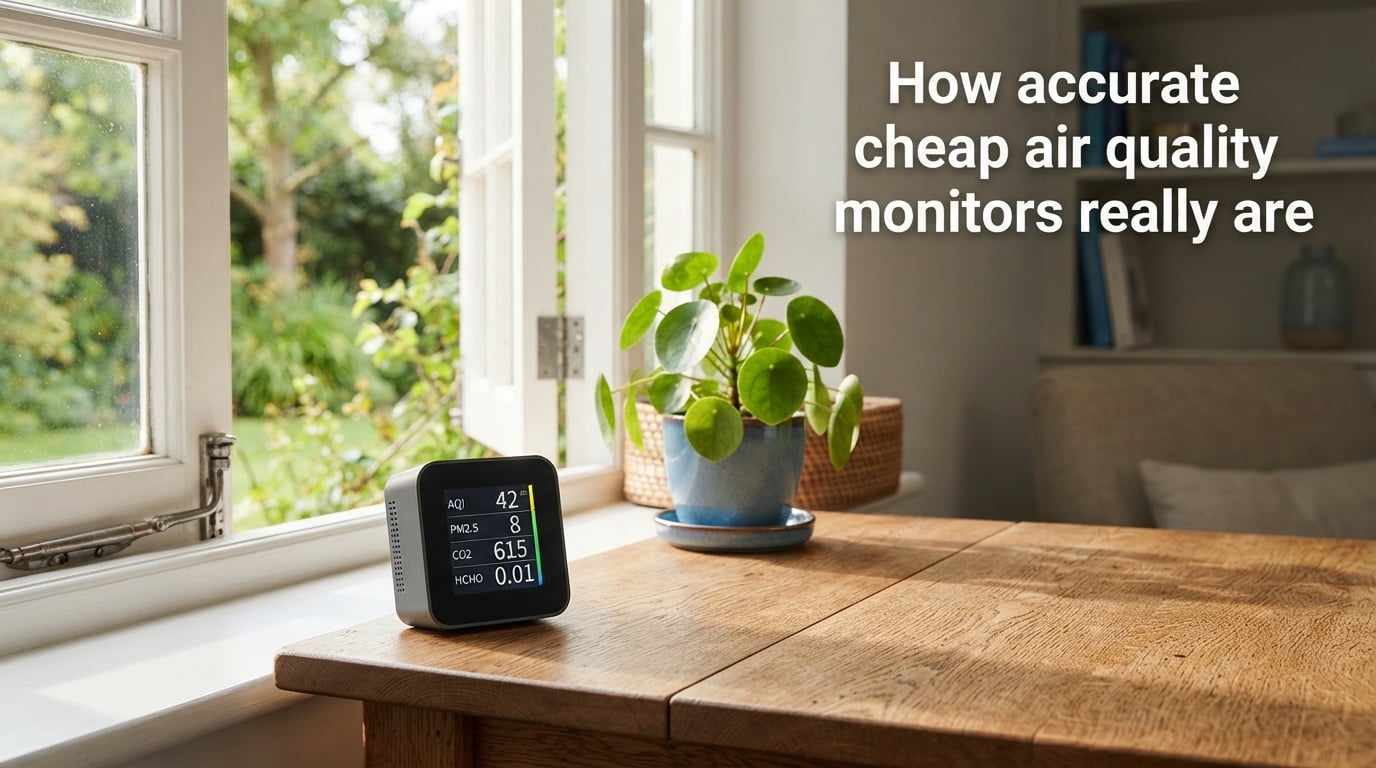
Cheap air quality monitors are more accurate than most people think for tracking particulate matter (PM2.5) and carbon dioxide (CO2), but they fall short on volatile organic compounds (TVOC) and formaldehyde. After digging through third-party test data from the South Coast Air Quality Management District (AQMD), EPA guidance, and dozens of community reports on Reddit and the AirGradient forum, I can tell you the answer is not a simple yes or no.
Here is the short version. Budget monitors under $200 that use laser scattering for PM2.5 and NDIR sensors for CO2 typically reach 80 to 95 percent accuracy when compared against reference-grade equipment. That is genuinely good. The problem is that TVOC sensors, even in expensive units, carry error rates around 20 percent and produce random false spikes that confuse almost everyone.
So when people ask how accurate cheap air quality monitors really are, my answer depends entirely on which pollutant you care about. PM2.5 tracking during wildfire smoke season? Cheap monitors do that job well. Catching trace formaldehyde off-gassing from new furniture? Save your money, because almost no consumer monitor handles that reliably.
In this guide I will break down what cheap air quality monitors accuracy actually looks like sensor by sensor, why price does not predict performance the way you might expect, and how you can validate any monitor’s readings at home with a few simple tests.
Table of Contents
What “cheap” actually means for air quality monitors in 2026
When I say “cheap” in the context of air quality monitors, I am talking about consumer-grade devices priced under $200. That single price point matters more than you might expect because it separates true budget sensors from the mid-tier units that start using better components.
The cheapest monitors on the market sit between $30 and $60. These are the no-name units you see flooding Amazon, often sold under rotating brand names. They typically measure PM2.5 and TVOC only, sometimes CO2 using an estimation method rather than a direct sensor.
The $60 to $150 range is where things get interesting. This is where you find monitors from established brands like Temtop, Qingping, and IKEA’s VINDSTYRKA. These units usually include a real NDIR sensor for CO2 and a decent laser particle counter for PM2.5.
The typical price ranges I see on the market
Here is how I mentally bucket the market when someone asks me for a recommendation. Under $50 gets you a basic trend tracker, good for relative changes but not absolute numbers. Between $50 and $150 you get monitors that can hold their own against equipment costing five times as much for PM2.5 and CO2 specifically.
Above $150 you start paying for connectivity features, better displays, multi-pollutant coverage, and brand reputation rather than raw sensor upgrades. The sensors themselves often do not change much beyond that threshold, which is a point most buyers completely miss.
Professional-grade reference monitors start around $5,000 and climb past $25,000. Those use Federal Reference Method (FRM) or Federal Equivalent Method (FEM) certified technology. No consumer monitor, regardless of price, reaches that level of certification.
How accuracy is measured in air quality monitors
Understanding how accuracy is measured changes everything about how you interpret a monitor’s readings. Manufacturers love throwing around accuracy claims, but unless you know what metric they are citing, those numbers mean almost nothing.
The gold standard for comparing consumer monitors against reference equipment is the R2 correlation coefficient, also called the coefficient of determination. Independent testing programs like the South Coast AQMD evaluation use this metric almost exclusively.
The R2 correlation coefficient explained
R2 measures how closely a budget monitor’s readings track a reference monitor over time. The value runs from 0 to 1, where 1 means a perfect match and 0 means no relationship at all. In practice, you will never see a perfect 1 from any consumer device.
Here is how I interpret R2 scores based on the AQMD testing methodology. An R2 above 0.85 means the monitor is reliable for tracking pollution trends and is solid for most home use cases. Between 0.70 and 0.85 it is decent but shows meaningful drift under certain conditions. Below 0.70, the monitor is really only useful as a rough indicator, not a serious measurement tool.
The Smart Air Filters analysis of AQMD data put monitors into three tiers. The best performers hit above 85 percent accuracy, the pretty good ones landed between 70 and 85 percent, and anything below 70 percent they labeled “not so good.” That three-tier framework is one I use constantly when evaluating new monitors.
Precision vs accuracy – they are not the same
This is the distinction that trips up almost everyone I talk to. Accuracy means how close a reading is to the true value. Precision means how consistently the sensor reports the same value when conditions stay the same.
A monitor can be precise but inaccurate. Imagine a bathroom scale that always reads exactly 8 pounds heavy. It is perfectly consistent, so it is precise, but every single reading is wrong, so it is inaccurate. I see this pattern constantly with cheap TVOC sensors, which report consistently but at values disconnected from reality.
The opposite also happens. A monitor might be accurate on average but imprecise, meaning its readings bounce around the true value wildly. This shows up in some budget PM2.5 sensors that detect pollution events correctly but overshoot or undershoot the actual concentration on any given reading.
When manufacturers cite an accuracy figure without context, they almost always mean precision. The more useful number for consumers is the R2 correlation from independent testing, which captures how well the monitor tracks reality over time.
Sensor technologies and their real accuracy limits
Every accuracy claim traces back to the sensor technology inside the device. The same pollutant measured by two different sensor types can produce wildly different results, and this is where cheap air quality monitors accuracy diverges most sharply from the expensive options.
PM2.5 sensors – laser scattering technology
Almost every consumer PM2.5 monitor, cheap or expensive, uses laser scattering. A laser beam hits particles in the air, and a photodetector measures the scattered light to estimate particle count and size. The technology has gotten cheap enough that even $40 monitors use reasonably good laser modules.
This is why PM2.5 is the one pollutant where budget monitors genuinely compete with expensive units. The South Coast AQMD tested 55 PM2.5 monitors and found several sub-$150 units achieving R2 values above 0.90 against reference equipment. That is excellent performance for the price.
The main limitation of laser scattering is humidity. When humidity climbs above 70 percent, water droplets can scatter light the same way particles do, causing false high readings. Good monitors include humidity compensation, but cheap ones often skip it.
CO2 sensors – NDIR vs estimation methods
Carbon dioxide measurement splits into two camps. The good monitors use NDIR (non-dispersive infrared) sensors, which directly measure CO2 absorption of infrared light. These are accurate to within plus or minus 50 parts per million even in budget devices.
The bad monitors estimate CO2 from TVOC readings using an algorithm. This is not real measurement. The EPA and most air quality professionals consider estimated CO2 values unreliable for any serious use.
If a cheap monitor advertises CO2 measurement and costs under $50, it almost certainly uses the estimation method. You can usually confirm this by checking whether the spec sheet mentions NDIR specifically. If it does not, assume the CO2 number is a rough guess.
NDIR sensors are the bright spot in budget monitoring. The technology has come down in price so dramatically that monitors in the $80 to $130 range now include genuine NDIR CO2 sensors with real accuracy.
TVOC sensors – the weak link in every price range
TVOC sensors are where I tell people to lower their expectations regardless of budget. Almost all consumer monitors use metal oxide semiconductor (MOS) sensors for VOCs, and these are notoriously unreliable.
Reddit users on r/AirQuality consistently report TVOC error rates around 20 percent. The sensors respond to a wide range of gases non-specifically, meaning they cannot tell you what chemical they are detecting. They also drift significantly with temperature and humidity changes.
This is not just a cheap monitor problem. I have seen $300-plus monitors produce the same random TVOC spikes as $40 units. The sensor technology itself is the limitation, not the price point. If you see a TVOC reading jump suddenly with no obvious source, treat it with skepticism.
Formaldehyde and specialty sensors
Formaldehyde sensors in consumer devices use electrochemical technology, and their accuracy is questionable at the low concentrations relevant to home air. I have not seen a single consumer-grade formaldehyde monitor that I would trust for absolute numbers.
Radon detection requires entirely different technology (alpha track or ionization chambers) and long measurement periods. No cheap multipollutant monitor includes reliable radon detection. Carbon monoxide detection is similarly specialized and should come from a dedicated UL-listed CO alarm, not an air quality monitor.
What cheap monitors can measure reliably
Despite the limitations, cheap monitors are genuinely useful for several measurements. Here is where I have confidence in budget device readings based on independent test data.
PM2.5 tracking is the strongest suit. During wildfire smoke events, even a $50 monitor will tell you whether your indoor air is getting worse and whether your air purifier is actually working. The relative trends matter more than absolute numbers for most home decisions, and budget monitors capture those trends well.
CO2 monitoring with NDIR sensors is the second reliable win. Tracking CO2 levels helps you know when to open a window or boost ventilation, especially in bedrooms, classrooms, and home offices. A reading that climbs past 1,000 parts per million is a clear signal regardless of minor sensor error.
Temperature and humidity readings are consistently accurate across all price points because the sensors for those are cheap and mature technology. You can trust those numbers on essentially any monitor.
Long-term trend tracking is where cheap monitors shine. Even if absolute accuracy is imperfect, watching whether your indoor PM2.5 averages improve after installing an air purifier gives you actionable information. Consistency matters more than precision for this use case.
What cheap monitors cannot measure accurately
Now for the honest part. There are several things I would never trust a cheap monitor to handle, and knowing these limits keeps you from making bad decisions based on bad data.
TVOC absolute values are unreliable across the board. The number on screen tells you something is in the air, but not what or how much. I treat TVOC readings as a binary “something changed” indicator rather than a measurement.
Formaldehyde readings from consumer monitors should be ignored for health decisions. The detection limits and cross-sensitivity issues make the numbers essentially meaningless at typical indoor concentrations.
Individual VOC identification is impossible with any consumer device. If you need to know whether a specific harmful chemical is present, you need laboratory analysis, not a $100 monitor.
Outdoor air quality comparisons are misleading if you rely on a single indoor monitor. Your indoor readings reflect indoor sources and filtered outdoor air, not the air quality outside your window. Use an outdoor sensor network or government station for outdoor data.
Low concentration pollutant events may fall below a cheap monitor’s detection threshold entirely. A monitor that works fine during heavy wildfire smoke might show nothing during a minor paint off-gassing event because the concentration is below its sensitivity floor.
The price vs accuracy myth – why expensive is not always better
This is the finding that surprised me most when I started researching cheap air quality monitors accuracy seriously. Price and accuracy do not correlate the way most people assume.
The South Coast AQMD testing found no clear relationship between price and PM2.5 accuracy across the 55 monitors tested. Some sub-$100 units outperformed monitors costing three or four times as much. The IKEA VINDSTYRKA, priced around $40, tested surprisingly well against units several times its cost.
Why does this happen? Because the core sensor components are commoditized. The same Plantower or Sensirion laser PM2.5 module shows up inside monitors at wildly different price points. When you pay more, you are usually buying better build quality, connectivity, brand support, and multi-pollutant coverage, not a fundamentally better particle sensor.
This creates a real trap for buyers. A $250 monitor with the same PM2.5 sensor as an $80 unit will perform nearly identically on particulate measurement. The extra $170 bought you a nicer screen and an app, not better accuracy.
Where expensive monitors do justify their cost is in sensor quality for the harder measurements. A $400 monitor with a true photoionization detector for VOCs will outperform a $40 MOS sensor unit on VOC accuracy. But that is a specific upgrade for a specific measurement, not a blanket quality difference.
The AirGradient ONE controversy illustrates this perfectly. It earned community praise for open-source design and good performance, then got slammed by WIRED in a review. The lesson I take from that saga is that reputation and real-world performance do not always align, and you should look at test data rather than brand buzz.
How to test your air quality monitor at home
You do not need a laboratory to sanity-check your monitor. I use three simple validation tests that anyone can run at home to confirm whether their device is actually detecting what it claims.
The incense test for PM2.5
Light a stick of incense or a match in the same room as your monitor, placed a few feet away. Within 30 to 60 seconds, a working PM2.5 sensor should show a clear spike upward. If the reading barely moves, either the sensor is dead or the monitor is using an estimation method instead of a real laser counter.
Blow the incense out and open a window or run an air purifier. You should see readings climb back down over the next 10 to 20 minutes. The speed and smoothness of that recovery tells you how responsive and accurate the sensor is.
The breathing test for CO2
If your monitor has a real NDIR CO2 sensor, exhale slowly toward it from about a foot away for 30 seconds. CO2 in exhaled breath is around 40,000 parts per million, so the reading should jump noticeably, often past 1,500 or 2,000 parts per million.
If the number barely changes, your monitor is likely estimating CO2 rather than measuring it directly. This is the fastest way I know to separate real NDIR sensors from fake ones without opening the device.
Spotting fake TVOC spikes
TVOC sensors respond to many things besides harmful pollutants. Alcohol hand sanitizer, perfume, cooking steam, and even a new plastic package can trigger a spike. The test I run is simple. Note the temperature and humidity when a TVOC spike happens.
If the TVOC reading jumps at the same time as a humidity or temperature change, the sensor is probably reacting to environmental conditions rather than actual VOCs. This cross-referencing helps you ignore false alarms and recognize when a reading is genuinely meaningful.
Which cheap air quality monitor should you actually buy
Since this guide is about accuracy rather than specific product picks, let me give you a decision framework instead of a shopping list. The right cheap monitor depends entirely on which pollutants you care about and what decisions you need the data to inform.
Look for these specific features
The single most important feature for accuracy is an NDIR sensor for CO2. If the spec sheet does not explicitly mention NDIR, assume the CO2 number is estimated and unreliable. This one detail separates trustworthy monitors from toys.
A real laser scattering PM2.5 sensor is the second must-have. Look for terms like “laser particle sensor” or a specific sensor model name like Plantower or Sensirion. Generic “dust sensor” language usually means a cheaper, less accurate component.
Data logging and trend display matter more than people realize. A monitor that only shows the current reading forces you to remember numbers. One that graphs the last 24 hours lets you spot patterns and confirm whether interventions like opening a window actually worked.
Humidity and temperature compensation features indicate a manufacturer took accuracy seriously. Budget monitors that include these tend to perform better in independent testing because they correct for the environmental factors that distort readings.
Brands that perform well in third-party tests
Based on AQMD data and community feedback, a few names come up repeatedly as accuracy leaders in the budget space. Temtop models consistently receive positive reports from Reddit users who compare them against more expensive equipment. Their laser particle counters track reference monitors well for PM2.5.
The IKEA VINDSTYRKA surprised everyone in the community by delivering solid PM2.5 accuracy for around $40. It is limited in scope but does what it measures well. For the price, it is hard to beat as a trend tracker.
AirGradient built its reputation on open-source design and transparent data. The AirGradient One includes a genuine NDIR CO2 sensor and has been validated by community testing against reference equipment, even after the WIRED controversy.
Qingping monitors show up in AQMD testing with respectable R2 values for PM2.5. They pair decent sensors with good app integration, which makes them popular for people who want both accuracy and convenience.
I avoid making absolute recommendations because individual units vary and sensor lots differ. The pattern I trust is consistent third-party validation across multiple sources, not a single positive review.
When you need to spend more
There are situations where a cheap monitor is genuinely not enough. If you have severe respiratory conditions like severe asthma or COPD and need precise PM2.5 data for medical decisions, invest in a higher-tier monitor with documented high R2 performance.
If you need to identify specific volatile organic compounds rather than just detect their presence, no consumer monitor handles that. You need either a professional PID monitor (starting around $500) or laboratory air sampling.
Commercial or regulatory compliance monitoring requires certified reference-grade equipment. No consumer device, at any price, qualifies for that use case.
For most home users tracking general indoor air quality, wildfire smoke, or ventilation effectiveness, a well-chosen cheap monitor is more than sufficient. The key is matching the monitor’s strengths to your actual needs rather than paying for capabilities you will never accurately use.
FAQs
Are cheap air quality monitors accurate?
Cheap air quality monitors are accurate for PM2.5 and CO2 tracking when they use laser scattering and NDIR sensors respectively, typically reaching 80 to 95 percent accuracy against reference equipment. They are not accurate for TVOC or formaldehyde measurement, where error rates around 20 percent are common across all price points.
How accurate are Temtop air quality monitors?
Temtop air quality monitors perform well in third-party testing and community comparisons, with their laser particle counters tracking reference monitors closely for PM2.5. Reddit users consistently report Temtop readings comparable to more expensive units, making them one of the stronger budget brand options for particulate measurement.
What is the best inexpensive air quality monitor?
The best inexpensive air quality monitors are those with genuine NDIR CO2 sensors and laser PM2.5 sensors, such as the IKEA VINDSTYRKA for basic PM2.5 tracking at around $40, Qingping models for app-connected monitoring, and AirGradient One for open-source transparency with real NDIR CO2 measurement.
Is it worth buying an air quality monitor?
Yes, buying an air quality monitor is worth it if you want to track PM2.5 during wildfire smoke, monitor CO2 for ventilation decisions, or measure whether your air purifier is working. A well-chosen budget monitor under $150 provides real value for these use cases, while expensive monitors rarely justify their cost for typical home needs.
How can I test my air quality monitor at home?
Test PM2.5 sensors by lighting incense nearby and watching for a spike within 60 seconds. Test CO2 sensors by exhaling toward the monitor and checking for a reading jump. Check TVOC sensors by noting whether spikes coincide with humidity or temperature changes, which indicates false readings rather than real pollutant detection.
The bottom line on cheap air quality monitor accuracy
Understanding how accurate cheap air quality monitors really are comes down to matching the right sensor technology to your needs. Budget monitors excel at PM2.5 and CO2 tracking with genuine laser and NDIR sensors, regularly hitting 80 to 95 percent accuracy. They fall short on TVOC and formaldehyde, where even expensive units struggle.
Price does not predict accuracy the way most buyers assume. A $40 monitor with the right sensors can outperform a $250 unit with the same components inside a fancier case. Buy based on sensor type and independent test data, not marketing claims, and you will get reliable air quality insights without overspending.