
That faint musty smell hits you the second you walk into the basement, and suddenly you are wondering what is floating in the air you breathe. Mold spores are invisible to the naked eye, yet they can trigger allergies, asthma attacks, and lingering respiratory problems in your own home. Learning how to test for mold in the air yourself lets you catch a problem early, before it spreads behind walls or into your HVAC system, and without paying $300 to $800 for a professional inspection on day one.
In this guide, our team walks through four practical DIY mold testing methods, the warning signs that mean you should test, the health effects of mold exposure, and exactly when to stop testing and call a pro. Whether you just moved into an older home, survived a water leak, or cannot shake a cough that started two weeks ago, you will leave knowing exactly what to do next.
Table of Contents
What Is Mold and Why Test for It
Mold is a type of fungus that grows indoors and outdoors wherever moisture and organic material meet. It reproduces by releasing microscopic spores into the air, and those spores drift through your home until they land on a damp surface and start a new colony. A single colony can release thousands of spores per minute, which means the air you breathe may carry far more mold than you can see.
Testing the air for mold matters because the spores themselves are the problem. You can scrub a visible patch off the bathroom ceiling and still breathe in airborne spores for weeks afterward. An air test tells you whether the cleanup worked, whether hidden mold is feeding spores into your living space, and whether a musty smell is actually mold or just a damp basement.
The CDC notes that no federal health-based standards exist for acceptable mold levels in indoor air, which is exactly why homeowners turn to relative testing. You compare a suspect room against an outdoor baseline, and a significantly higher indoor spore count tells you there is an active indoor source worth investigating. DIY testing gives you that comparison for a fraction of the cost of hiring a certified industrial hygienist.
Signs You May Have Mold in Your Air
Mold rarely announces itself with a single obvious clue. Instead, it leaves a trail of small signals that build over weeks or months. Watch for these warning signs before you ever open a test kit.
Persistent musty odor. That earthy, damp smell is the metabolic byproduct of active mold growth. If the odor strengthens when you close a room up for a day, mold is likely present even when nothing is visible.
Unexplained allergy or asthma symptoms. Sneezing, runny nose, itchy eyes, or wheezing that improves when you leave the house and returns when you come home is a classic pattern tied to indoor mold.
Visible growth or water stains. Black, green, brown, or white patches on drywall, grout, caulk, or wood are obvious signs, but discolored water stains on ceilings and walls often hide mold behind them.
Recent water damage. Any leak, flood, or condensation problem from the past 48 hours to several months can seed mold growth, especially in materials that stay damp.
Warped or bubbling surfaces. Buckling flooring, peeling paint, or bulging drywall often means moisture is trapped behind the surface, and trapped moisture almost always grows mold.
High indoor humidity. If your hygrometer reads above 60 percent relative humidity for days at a time, conditions are ripe for mold whether you can see it or not.
If two or more of these signs apply to your home, an air test is worth the effort. A single kit costs less than a dinner out, and it can confirm whether the air you breathe is actually a problem.
How to Test for Mold in the Air Yourself: 4 Methods
Learning how to test for mold in the air yourself means choosing a method that matches your budget and how detailed you want the answer to be. Here are the four most common DIY approaches, ranked roughly from cheapest to most thorough.
Method 1: Store-Bought Mold Test Kits
Brands like Mold Armor, Healthful Home, and Pro Lab sell kits in the $15 to $50 range at most hardware stores. Each kit includes a sterile petri dish filled with a microbial culture medium, and the idea is simple: open the dish, expose it to the air for a set time, seal it, and watch what grows.
Most kits ask you to expose the dish for one hour in a suspect room, then again outdoors for a baseline. After 48 to 96 hours of incubation at room temperature, you compare colony counts. Many kits also include a prepaid mailer so you can send the dish to a lab for species identification, usually for an additional fee of $30 to $50. The lab analysis is what turns a yes-or-no guessing game into a real identification of whether you are dealing with harmless Cladosporium or toxic Stachybotrys.
The tradeoff is that settling plates only catch spores that fall by gravity, so they undercount the lightest spores and overcount the heaviest ones. Use them as a screening tool, not a precise measurement.
Method 2: Petri Dish Settling Method (DIY Without a Kit)
If you want to test without spending money on a commercial kit, you can build a settling plate from items you already have. The method is the same one mycology hobbyists have used for decades to check air quality in grow rooms and labs.
Start by sterilizing a clean glass or plastic dish. Pour in a thin layer of potato dextrose agar or even plain unflavored gelatin mixed with a little sugar and a pinch of yeast nutrient, which gives mold something to eat. Let the medium solidify with the lid on. To run the test, set the open dish on a stable surface in the suspect room for one to two hours, then close it and let it sit at room temperature for five to seven days.
Compare the number and type of colonies against a dish you placed outdoors at the same time. More growth indoors than outdoors points to an indoor mold source. This method costs almost nothing, but it will not tell you the species unless you mail the dish to a lab, and it shares the same bias toward heavy spores as commercial kits.
Method 3: Tape Lift Sampling
Tape lift sampling does not measure airborne spores directly, but it is the fastest way to confirm that a suspicious stain on a wall, duct, or piece of furniture is actually mold. You press a strip of clear adhesive tape onto the surface, lift it off, and stick it to a clean glass slide or the card included in many test kits.
The sample then goes to a lab for direct microscopic examination. A technician can identify spore types, hyphae, and fruiting structures, which tells you both that mold is present and which genus you are dealing with. Tape lifts shine when you already see something suspect and want a fast, cheap answer without waiting days for a culture to grow.
The limitation is coverage. A tape lift only tells you about the square inch you sampled. If mold is hiding inside a wall cavity or ductwork, a tape lift on the outside surface will come back clean even when spores are circulating in the air.
Method 4: Air Sampling Pumps and Spore Traps
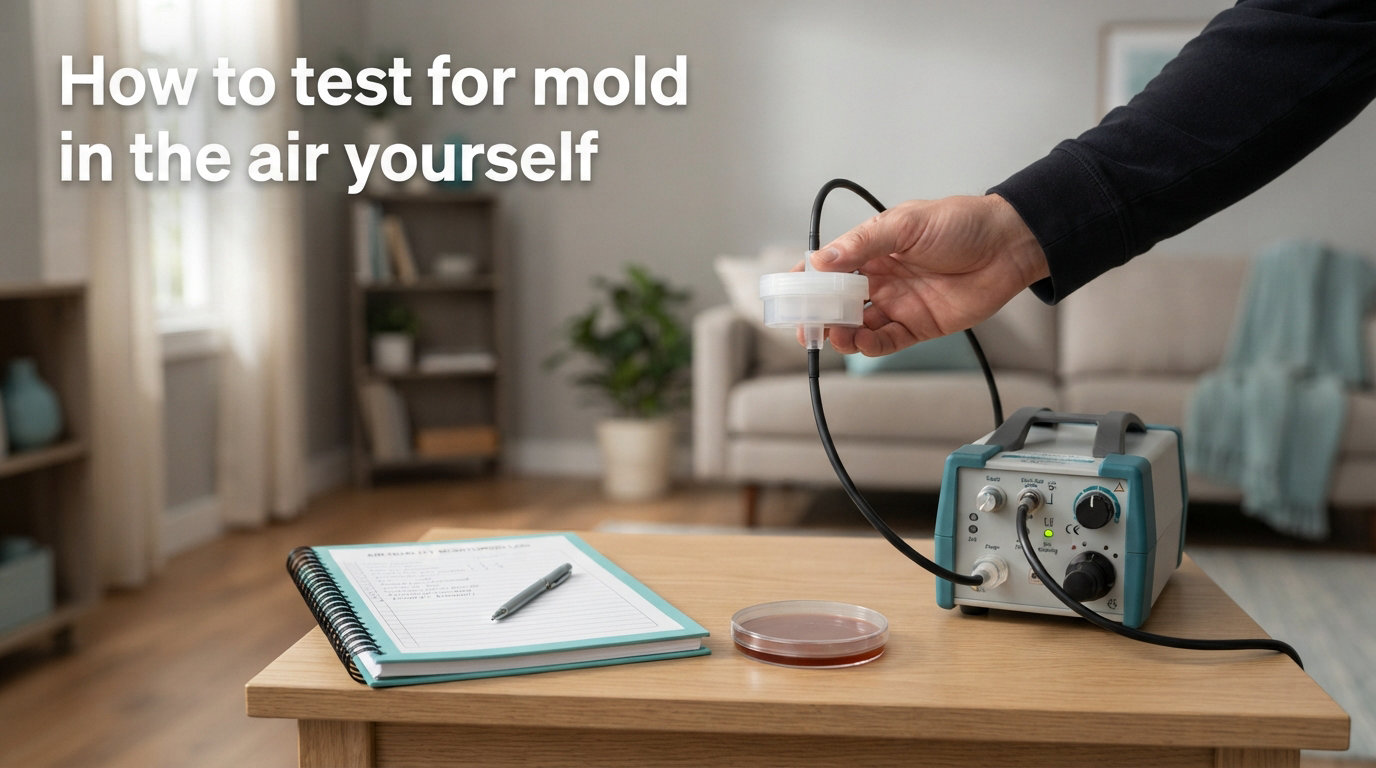
Air sampling pumps are the same devices professionals use, and a growing number of rental and consumer-grade units now put this method in reach. A small battery-powered pump pulls a known volume of air through a spore trap cassette over a set period, typically 5 to 10 minutes at 15 liters per minute. The cassette catches spores on a sticky slide inside.
You seal the cassette and mail it to a lab, where a microbiologist counts and identifies the spores under a microscope. Results come back as spores per cubic meter of air, broken down by species, which is the most accurate picture of what you are actually breathing.
This is the most expensive DIY route, often $100 to $150 for the cassette and lab fee, but it is also the most defensible. Forum users on r/Mold and r/homeowners consistently report that spore trap results matched what professional inspectors found in the same homes. If you are documenting a problem for a landlord, insurance claim, or real estate transaction, this is the method that holds up.
Step-by-Step: How to Do a Mold Air Test at Home
Once you pick a method, follow the same preparation and process to get results you can actually trust. Skipping prep is the number one reason DIY tests fail or return misleading numbers.
Close the room for 24 hours. Shut all doors, windows, and HVAC vents in the room you want to test at least a full day before sampling. This lets spores settle into a stable concentration instead of being diluted or boosted by airflow.
Turn off fans and purifiers. Ceiling fans, exhaust fans, portable heaters, and air purifiers all move air and change spore distribution. Let the room sit still for the final hour before you open your test device.
Run an outdoor baseline at the same time. Every test needs a comparison. Set up an identical dish, cassette, or tape sample outdoors while the indoor sample runs, so you can tell indoor mold apart from normal outdoor spores.
Place the sample at breathing height. Set the dish, cassette, or pump intake 3 to 5 feet off the floor, roughly where your nose sits, and away from corners where air stagnates.
Expose for the recommended time. Most settling plates run 1 to 2 hours. Spore trap cassettes run 5 to 10 minutes. Tape lifts take 2 seconds of contact per sample.
Seal and label everything. Close dishes, cap cassettes, and write the room name, date, and time on each sample so you do not mix up indoor and outdoor results.
Incubate or ship per instructions. Let settling plates sit at room temperature for the full incubation period, or mail cassettes and tape lifts to the lab within 24 hours.
Compare indoor results to your outdoor baseline. If the indoor sample shows significantly more growth or higher spore counts than outdoor, an indoor source is feeding spores into your air and you need to find it.
Test more than one room if you suspect a widespread problem. A single sample from one corner tells you about that corner. Running two or three kits across the basement, living area, and a suspect bedroom gives you a map of where the air is worst.
Health Effects of Mold Exposure
Mold exposure affects different people very differently, and that variability is part of why mold problems fly under the radar for so long. A healthy adult may feel nothing while a child, an elderly family member, or someone with asthma struggles for months.
The most common reactions are allergic. Sneezing, a runny or stuffy nose, red and itchy eyes, and skin irritation all fall in this bucket. These symptoms often improve within hours of leaving the affected building, which is a useful diagnostic clue on its own.
Mold also triggers and worsens respiratory problems. People with asthma can experience more frequent attacks, tighter chests, and coughing that does not respond to their usual medication. Long-term exposure to certain molds, particularly Aspergillus, can lead to chronic lung conditions in people with weakened immune systems.
The first signs of mold sickness, according to people who have gone through it, are usually a persistent cough that lingers for weeks, sinus congestion that never fully clears, fatigue that does not match your activity level, and headaches that concentrate in the front of the head. If those symptoms ease when you leave home for a few days and return when you come back, mold is a prime suspect worth testing for.
So-called toxic mold, especially Stachybotrys chartarum, gets a lot of attention for producing mycotoxins. Research on the health effects of mycotoxin inhalation is still developing, but the CDC and EPA both treat any visible indoor mold as a potential health hazard worth removing, regardless of species.
Common Types of Household Mold
Knowing which mold you are dealing with changes how urgently you act. Labs identify dozens of indoor species, but four genera dominate homes in 2026.
Cladosporium is the most common indoor mold and the least alarming. It grows on damp wood, textiles, and HVAC ducts, and usually shows up as olive-green to brown patches. It triggers allergies but is rarely dangerous to healthy adults.
Aspergillus appears as yellow-green to black powdery growth on walls, food, and paper. Some species produce mycotoxins, and the genus is a known lung pathogen for people with compromised immune systems.
Penicillium is the blue-green fuzzy mold famous for giving us antibiotics. Indoors it thrives on water-damaged materials, insulation, and wallpaper, and it spreads spores aggressively through the air.
Stachybotrys chartarum is the mold most people call black mold. It needs sustained moisture and grows on cellulose-rich materials like drywall, paper, and ceiling tiles. It is slimy when wet and sooty black when dry. Because it produces mycotoxins and is hard to fully remove, it is the one species most experts say warrants professional remediation rather than a DIY cleanup.
When to Call a Professional Mold Inspector
DIY testing answers the question of whether you have a mold problem. A professional answers where it is, how bad it is, and how to remove it safely. Knowing when to make that call saves you both money and health risks.
Bring in a certified mold inspector or industrial hygienist if your DIY test comes back positive for Stachybotrys or high levels of Aspergillus, if mold covers more than roughly 10 square feet, or if the source is hidden behind walls, under flooring, or inside ductwork you cannot reach. A pro is also the right call after major water damage from flooding or a burst pipe, since those events can seed mold throughout a building in ways a single-room test will miss.
Households with infants, elderly members, pregnant individuals, or anyone with a serious respiratory or immune condition should escalate sooner rather than later. The cost of a professional inspection, typically $300 to $800, is small compared to the medical bills and remediation costs of letting a serious infestation run for months.
For real estate transactions, landlord disputes, or insurance claims, professional documentation is often required. A DIY petri dish photo will not hold up the way a lab report from a certified inspector will.
Mold Prevention and Natural Solutions
The cheapest mold test is the one you never need to run. Mold cannot grow without moisture, so every prevention strategy comes back to controlling water and humidity in your home.
Keep indoor relative humidity between 30 and 50 percent using a hygrometer to monitor and a dehumidifier to correct. Run exhaust fans in bathrooms and kitchens for at least 20 minutes after showering or cooking. Fix leaks within 24 to 48 hours, dry wet materials immediately, and never carpet bathrooms, basements, or other naturally damp spaces.
If you already have a small patch of surface mold, several natural solutions kill it without harsh bleach fumes. White vinegar undiluted in a spray bottle kills about 82 percent of mold species and penetrates porous surfaces better than bleach. Tea tree oil, at one teaspoon per cup of water, is a potent fungicide that works on most household molds. Hydrogen peroxide at 3 percent concentration lightens stains and kills mold on hard surfaces. Baking soda, dissolved in water and sprayed on, raises surface pH enough to inhibit regrowth and deodorizes at the same time.
None of these natural killers will solve a deep or hidden infestation. They are for surface cleaning, not for mold that has colonized wall cavities, insulation, or HVAC systems. For those situations, removal of the contaminated material is the only reliable fix.
Air purifiers with a true HEPA filter capture 99.97 percent of particles down to 0.3 microns, which includes most mold spores. They reduce airborne spore counts in a single room, which eases symptoms while you address the source. They do not detect mold, they do not kill mold, and they cannot substitute for finding and removing the colony that is producing the spores.
FAQs
What naturally kills mold in the air?
Nothing kills mold spores that are already airborne in any meaningful way. The fix is removing the source colony, then ventilating and running a true HEPA air purifier to capture spores down to 0.3 microns. Natural surface killers like undiluted white vinegar, tea tree oil in water, and 3 percent hydrogen peroxide work on visible growth but do not sterilize the air itself.
What are the first signs of mold sickness?
The earliest signs are usually a persistent cough, sinus congestion that never fully clears, itchy or watery eyes, sneezing, skin irritation, unexplained fatigue, and headaches concentrated in the front of the head. A telltale clue is that these symptoms improve within hours of leaving home and return when you come back. People with asthma may notice more frequent attacks that do not respond to their usual medication.
How to tell if there’s mold in your air?
The clearest signs are a persistent musty or earthy odor that intensifies in closed rooms, allergy symptoms that ease when you leave the house, visible growth on damp surfaces, recent water damage, and indoor humidity above 60 percent. An air test using a settling plate kit or spore trap cassette, compared against an outdoor baseline sample, confirms whether airborne spore counts are elevated indoors.
Do air purifiers detect mold spores?
No. Air purifiers capture mold spores but they do not detect or identify them. A true HEPA air purifier removes about 99.97 percent of particles down to 0.3 microns from the air that passes through it, which reduces airborne spore levels in a single room. To actually detect and measure mold spores you need a settling plate, tape lift, or spore trap cassette analyzed by a lab.
Can I test for mold in the air myself?
Yes. Store-bought mold test kits from brands like Mold Armor, Healthful Home, and Pro Lab cost $15 to $50 and let you collect airborne spores in a petri dish at home. You expose the dish for one to two hours, seal it, and incubate it for several days. Many kits include a mailer so a lab can identify the mold species for an additional fee, giving you a DIY test with near-professional accuracy.
How do I test myself for mold exposure?
You cannot accurately diagnose mold exposure at home. If you suspect mold is making you sick, the steps are to test your home for mold, remove the source, and see a doctor for an evaluation. A physician can order blood tests for mold antibodies, allergy skin prick tests, or sputum cultures to check for fungal colonization, and they can assess whether your respiratory or neurological symptoms match mold exposure.
Conclusion
Testing your own air for mold is one of those home skills that pays for itself the first time you use it. A $20 kit can confirm a problem, rule out a fear, or catch a hidden colony before it spreads into an expensive remediation project. The methods range from a free DIY settling plate to a lab-analyzed spore trap, so there is an option for every budget and every level of concern.
Pick the method that fits your situation, follow the preparation steps carefully, and always run an outdoor sample at the same time so your results mean something. Knowing how to test for mold in the air yourself gives you the first real answer in a process that, done right, leads to cleaner air and a healthier home. If your results point to Stachybotrys, a large infestation, or mold you cannot locate, hand the next step to a professional and breathe easier knowing you caught it early.