
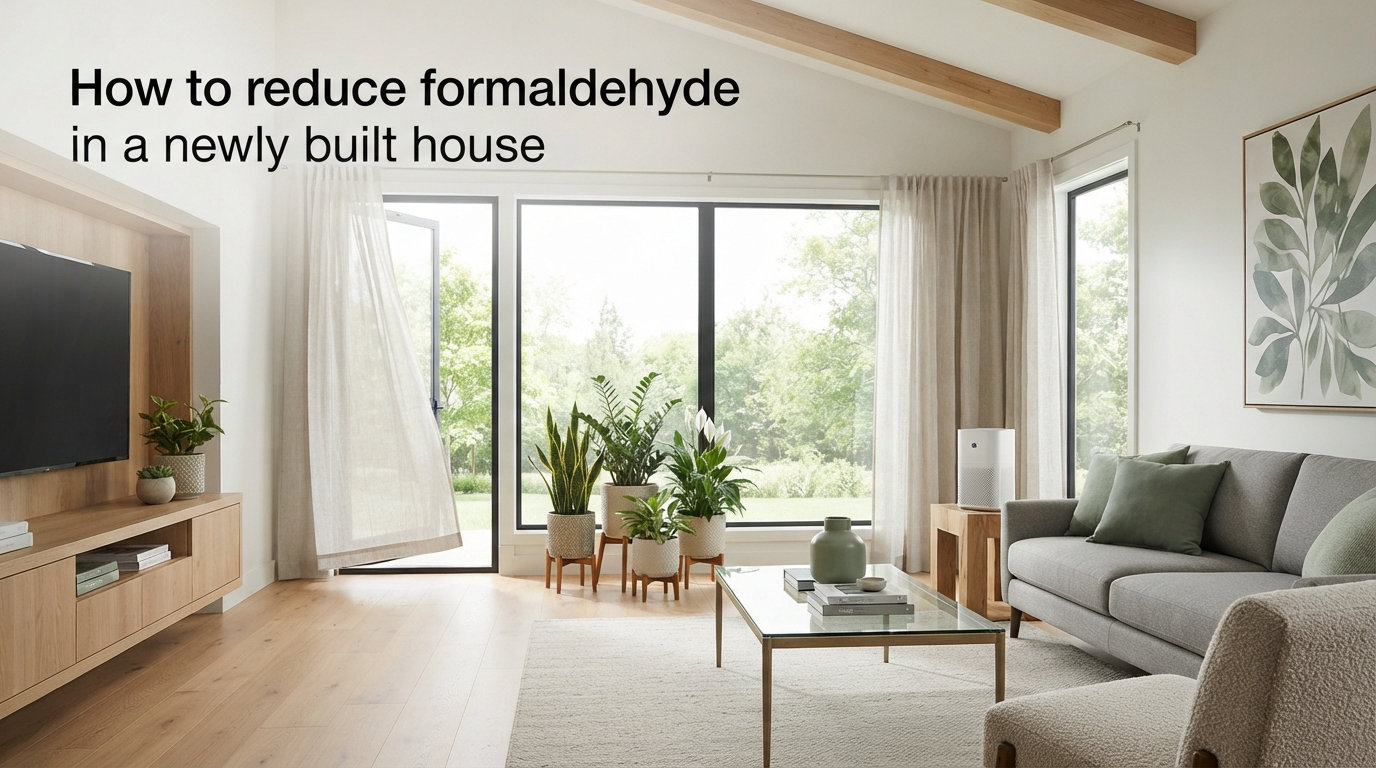
That sharp, chemical smell hitting you the moment you walk into a brand-new home is not your imagination. It is likely formaldehyde, a volatile organic compound (VOC) that off-gasses from the building materials, adhesives, and finishes used throughout modern construction. Learning how to reduce formaldehyde in a newly built house is one of the most important things you can do for your family’s health after moving in.
I have spent months researching this topic across scientific sources, government health agencies, and real homeowner experiences from forums like Reddit’s r/Home and r/AirQuality. What I found is that most guides give surface-level advice without addressing the real questions people ask: How long will this last? What actually works versus what is a waste of money? When should I start worrying?
This guide covers everything you need to know. We will walk through what formaldehyde is, where it hides in new construction, the health risks it poses, how to test for it, and seven proven methods to bring levels down. I will also share a month-by-month off-gassing timeline, mythbust common home remedies that do not work, and give you a practical action plan you can follow from day one.
Table of Contents
What Is Formaldehyde and Why It Matters in New Homes
Formaldehyde is a colorless, strong-smelling gas classified as a volatile organic compound (VOC). It is used extensively in manufacturing because it acts as a powerful binder and preservative. Resins made from formaldehyde hold together the pressed wood products, flooring, cabinetry, and insulation found in nearly every new home built today.
The problem is that these materials do not lock the formaldehyde away forever. Instead, they slowly release it into your indoor air through a process called off-gassing. This continuous release means that formaldehyde levels inside a newly constructed home can be significantly higher than outdoor levels. Some studies have found indoor concentrations reaching 200 times higher than what you would breathe outside.
This matters because formaldehyde is classified as a Group 1 carcinogen by the International Agency for Research on Cancer (IARC), meaning there is sufficient evidence it causes cancer in humans. Even at lower exposure levels, it triggers a range of uncomfortable and potentially serious health symptoms. The EPA and CDC both flag formaldehyde as a priority indoor air pollutant, especially in new construction and manufactured housing where pressed wood products are concentrated.
Understanding Off-Gassing
Off-gassing is the process by which manufactured products release trapped VOCs into the surrounding air over time. Think of it like a sponge slowly wringing itself out. The resins and adhesives in building materials contain formaldehyde that gradually works its way to the surface and evaporates.
This process is not quick. Formaldehyde off-gassing can continue for months and sometimes years after installation. The rate of release depends heavily on temperature, humidity, and the specific type of material involved. Warmer, more humid conditions accelerate the process, which is why levels often spike during summer months.
One important distinction: not all formaldehyde sources behave the same way. Urea-formaldehyde resins, commonly found in interior-grade particleboard and medium-density fiberboard (MDF), release formaldehyde more readily and for longer periods. Phenol-formaldehyde resins, used in exterior-grade plywood, emit far less. Understanding which materials are in your home helps you predict how long the off-gassing will last.
Primary Sources of Formaldehyde in New Construction
The biggest contributors to formaldehyde in a new home are pressed wood products and the adhesives used throughout the building. If you want to reduce levels effectively, you need to know where the gas is coming from. Here are the primary sources ranked by how much they typically contribute to indoor concentrations.
Pressed wood products top the list. Particleboard, MDF, and hardwood plywood are used in cabinets, shelving, subfloors, and furniture. These materials use urea-formaldehyde resins as binders, and they are the single largest source of indoor formaldehyde in most new homes. Medium-density fiberboard is particularly notorious because it contains the highest ratio of resin to wood.
New cabinetry and furniture are major offenders. Kitchen cabinets, bathroom vanities, and ready-to-assemble furniture are almost always made from pressed wood components. Forum users on Reddit frequently report that new cabinets and flat-pack furniture are the sources that push their air quality monitor readings into the danger zone.
Flooring materials contribute significantly. Laminate flooring, engineered hardwood, and certain vinyl products all contain formaldehyde-based adhesives. The controversial Lumber Liquidators case in 2015 brought national attention to this issue, but the underlying problem persists in many products sold today.
Insulation can be a source, particularly urea-formaldehyde foam insulation (UFFI) that was installed in older homes. While UFFI is rarely used in new construction today, some modern insulation products still contain trace amounts of formaldehyde-based binders.
Paints, varnishes, and finishes release formaldehyde and other VOCs during application and for weeks afterward. Even paints labeled as low-VOC can contribute measurable amounts of formaldehyde to indoor air, especially when applied across large surface areas in a short timeframe.
Glues, adhesives, and caulks used during construction are another hidden source. The adhesives under your flooring, behind your tiles, and around your windows often contain formaldehyde. These products are sealed behind other materials, which means they off-gas slowly over a long period.
Permanent-press fabrics and textiles deserve mention too. New carpets, curtains, upholstery, and even bedding are often treated with formaldehyde-based finishes to reduce wrinkling. These textiles can contribute to overall levels, especially in the first few weeks after installation.
Health Risks and Symptoms of Formaldehyde Exposure
Formaldehyde exposure causes a range of health effects that vary based on concentration and individual sensitivity. Short-term exposure to elevated levels typically causes irritation of the eyes, nose, and throat. Many people describe a burning sensation, watery eyes, and persistent coughing when they enter a home with high formaldehyde levels.
Common symptoms include headaches, dizziness, nausea, and skin irritation. Some individuals develop allergic contact dermatitis from direct contact with formaldehyde-containing materials. If you notice these symptoms improving when you leave the house and returning when you come back, formaldehyde is a likely culprit.
Long-term exposure is where the serious concerns lie. The IARC classification as a Group 1 carcinogen means chronic exposure is linked to nasopharyngeal cancer and leukemia. While these outcomes require sustained high-level exposure, the risk is real enough that health agencies recommend minimizing contact whenever possible.
Certain groups face higher risks. Children, whose respiratory systems are still developing, are more vulnerable to VOC exposure. Pregnant women, elderly individuals, and anyone with asthma, allergies, or chemical sensitivities may experience symptoms at lower concentrations than the general population.
What makes formaldehyde tricky is that you cannot always smell it at dangerous levels. The odor threshold for formaldehyde varies by person, but some individuals cannot detect it until concentrations are well above what health agencies consider safe. This is why testing matters even if your new home does not have an obvious chemical smell.
How to Test Formaldehyde Levels in Your Home
Testing is the only reliable way to know your actual formaldehyde levels. Guessing based on smell or symptoms is unreliable, and you cannot manage what you cannot measure. There are three main approaches, each with different price points and accuracy levels.
Passive air samplers are the most affordable option for homeowners. These small badges or tubes absorb formaldehyde from the air over a set period, usually 24 hours to 7 days. You then mail them to a laboratory for analysis. Results are accurate and give you a formaldehyde concentration in parts per million (ppm) or micrograms per cubic meter. These kits typically cost between $30 and $80 and are available from companies specializing in indoor air quality testing.
Real-time VOC monitors give you instant readings and track trends over time. These devices measure total VOCs rather than formaldehyde specifically, but they are excellent for tracking whether your reduction efforts are working. Many homeowners on Reddit’s r/AirQuality and r/Home forums use these monitors to watch levels drop over weeks and months. The ability to see before-and-after numbers is incredibly motivating and helps you identify which interventions make the biggest difference.
Professional air quality testing is the gold standard for accuracy. A certified indoor air quality professional comes to your home with calibrated equipment, takes samples from multiple rooms, and provides a detailed report. This option costs several hundred dollars but gives you room-by-room breakdowns and professional interpretation of the results.
When interpreting results, the CDC recommends keeping indoor formaldehyde levels below 0.1 ppm (100 ppb). The California Office of Environmental Health Hazard Assessment sets an even stricter guideline of 0.002 ppm for chronic exposure. If your readings exceed 0.1 ppm, you should take active steps to reduce levels before spending extended time in the home.
How to Reduce Formaldehyde in a Newly Built House: 7 Proven Methods
Reducing formaldehyde requires a multi-layered approach because no single method eliminates the problem entirely. The most effective strategy combines several techniques working together. Here are seven proven methods ranked by effectiveness, starting with the most impactful.
Method 1: Maximize ventilation. Opening windows and doors creates cross-ventilation that flushes formaldehyde-laden air out and replaces it with cleaner outdoor air. This is the single fastest way to lower indoor concentrations. Aim for at least 15 to 20 minutes of full ventilation, twice daily, during the first few months after moving in. Running exhaust fans in kitchens and bathrooms adds to this effect. The CDC specifically recommends this approach as a primary reduction strategy.
Keep in mind that ventilation dilutes formaldehyde but does not stop the source from emitting. You are treating the symptom, not the cause. This means you need to ventilate consistently for as long as off-gassing continues, which can be several months.
Method 2: Run air purifiers with activated carbon filters. Standard HEPA filters capture particles but cannot trap gases like formaldehyde. You need an air purifier specifically equipped with a thick activated carbon filter, which adsorbs VOC molecules from the air. Look for units with several pounds of activated carbon rather than thin carbon-impregnated sheets. The Clean Air Delivery Rate (CADR) for smoke and the carbon weight are the two specs that matter most for formaldehyde removal.
One thing competitors often gloss over: activated carbon filters eventually saturate and stop working. You need to replace them every 3 to 6 months in a high-formaldehyde environment, which adds to the ongoing cost. Forum users report that running a quality carbon-filtered purifier 24 hours a day made visible differences on their air quality monitors within days.
Method 3: Control temperature and humidity. Formaldehyde off-gassing accelerates dramatically in warm, humid conditions. While you cannot eliminate this effect, managing your indoor climate helps regulate emission rates. Keeping your home cooler and less humid during the initial off-gassing period slows the release, giving your ventilation and purification systems a better chance of keeping up.
Alternatively, some homeowners deliberately raise heat and humidity to speed up off-gassing before moving in. This strategy, called bake-out, involves heating the home to 85 to 90 degrees Fahrenheit with high humidity for several days while ventilating afterward. Research on its effectiveness is mixed, and it can temporarily spike formaldehyde levels to dangerous heights, so proceed with caution and never occupy the space during a bake-out.
Method 4: Seal pressed wood surfaces. Applying a VOC-blocking sealer to exposed pressed wood surfaces creates a barrier that traps formaldehyde inside the material. Products labeled as formaldehyde sealers or vapor barrier coatings can reduce emissions by 80 to 90 percent when applied correctly. Focus on the surfaces that are not already covered by laminate, paint, or veneer, such as the unfinished backs and undersides of cabinets and shelving.
This method takes effort but addresses the source directly rather than just filtering the air. It is one of the most cost-effective interventions for homeowners dealing with high-emission cabinetry or furniture.
Method 5: Air out new furniture before bringing it inside. New furniture is a concentrated source of formaldehyde. Whenever possible, unpack new items in a garage, covered patio, or spare room with open windows for at least a week before placing them in your living space. Forum users on Reddit consistently report that leaving new furniture outside in warm sunlight dramatically speeds up the initial off-gassing burst.
If you cannot air items outside, at least remove all plastic wrap and packaging immediately. Leaving furniture wrapped traps emissions and slows the off-gassing process.
Method 6: Choose low-formaldehyde replacements when renovating. If you are still in the planning or renovation phase, selecting building materials certified to low-emission standards prevents the problem at its source. Look for products certified by GREENGUARD Gold, which tests for formaldehyde and other VOCs under strict conditions. Solid wood furniture, exterior-grade plywood (which uses phenol-formaldehyde resins that emit far less), and formaldehyde-free insulation are all smart choices.
The California Air Resources Board (CARB) Phase 2 standard is another benchmark. Products meeting CARB Phase 2 have some of the lowest formaldehyde emission rates available. Specifying these materials during construction or renovation is the most effective long-term strategy, though it requires planning ahead.
Method 7: Wash textiles and fabrics before use. New carpets, curtains, and upholstery carry formaldehyde residues from manufacturing finishes. Washing machine-safe items like curtains and bedding benefit from a thorough wash before use. For carpets and upholstery that cannot be washed, professional steam cleaning can help extract some of the surface chemicals, though it will not eliminate deep-embedded formaldehyde.
This method provides modest reductions compared to ventilation and purification, but every layer of reduction adds up when you are dealing with a whole-house formaldehyde load.
Understanding Off-Gassing Timelines: What to Expect Month by Month
One of the most common questions from new homeowners is how long formaldehyde will remain a problem. The honest answer is that it depends on the materials in your home, the climate, and how aggressively you work to reduce levels. But general patterns emerge from both research and real homeowner experiences.
Weeks 1 to 4: Formaldehyde levels are typically at their absolute highest immediately after construction is complete. Every surface, from paint to flooring to cabinetry, is actively off-gassing at peak rates. During this period, levels can easily exceed 0.3 ppm or higher in poorly ventilated spaces. If possible, delay moving in during the first two to four weeks and instead focus on aggressive ventilation.
Months 1 to 3: Emission rates begin to decline noticeably but remain elevated. Air quality monitors that showed danger-level readings in week one typically show improvement during this window. However, levels often still exceed the 0.1 ppm safety threshold. Continued ventilation, air purification, and source control remain essential.
Months 3 to 6: Most surface-level emissions from paints, finishes, and adhesives have largely dissipated. The ongoing formaldehyde load now comes primarily from pressed wood products like cabinetry, subflooring, and furniture. These materials off-gas slowly but persistently. Levels should be approaching or below the 0.1 ppm threshold with proper mitigation in place.
Months 6 to 12: Formaldehyde levels continue a gradual decline. A user on Reddit’s r/AirQuality reported that their formaldehyde readings finally dropped into the acceptable range around 8 months post-renovation with consistent air purifier use and regular ventilation. This timeline matches what many other homeowners describe.
Years 1 to 3: Emissions from pressed wood products continue at very low levels but are generally not a health concern under normal conditions. The exception is homes with large quantities of MDF or particleboard, where measurable off-gassing can persist beyond two years. Ongoing monitoring helps confirm levels stay within safe ranges.
These timelines assume you are actively working to reduce levels. Homes left closed up with no ventilation or purification will maintain elevated concentrations far longer.
How Temperature and Humidity Affect Formaldehyde Emissions
Temperature and humidity are the two environmental factors that most directly control how fast formaldehyde off-gasses from building materials. Understanding this relationship helps you manage emissions strategically rather than fighting against physics.
Formaldehyde release roughly doubles for every 18-degree Fahrenheit increase in temperature. This means a home at 80 degrees emits significantly more formaldehyde than the same home at 68 degrees. During summer, indoor concentrations naturally rise even without any change in your building materials.
Humidity has an equally strong effect. High humidity increases the moisture content in pressed wood products, which accelerates the chemical breakdown of formaldehyde resins. At 70 percent relative humidity, emission rates can be 40 percent higher than at 30 percent humidity. This is why formaldehyde problems often feel worse during humid summer months and in naturally damp climates.
The practical takeaway is that keeping your new home cooler and drier during the initial months slows off-gassing to a rate your ventilation and purification systems can handle. Set your thermostat to 68 to 72 degrees and use a dehumidifier to maintain relative humidity below 50 percent. This will not stop off-gassing, but it reduces the peak concentration your air has to deal with at any given moment.
The flip side is the bake-out strategy mentioned earlier. By deliberately raising temperature and humidity, you force materials to off-gas faster, theoretically shortening the total timeline. However, this approach temporarily creates hazardous air quality and requires vacating the home. Research on whether bake-outs actually reduce total long-term emissions is inconclusive, so treat this method as experimental rather than proven.
What Does Not Work: Mythbusting Common Formaldehyde Remedies
The internet is full of advice about natural formaldehyde remedies that sound appealing but have limited scientific backing. Spending time and money on methods that do not work delays real progress and leaves your family exposed longer. Let us separate fact from fiction.
Houseplants are not the solution you have been told. The famous 1989 NASA study suggested that certain houseplants remove VOCs from indoor air. While technically true, the effect is negligible in real-world conditions. You would need roughly one plant per square foot of floor space to match the formaldehyde reduction you get from opening a single window for 15 minutes. Plants are wonderful for aesthetics and general well-being, but they are not a functional air purification strategy.
Activated charcoal bags and bamboo charcoal have become popular Amazon purchases for VOC removal. These products do adsorb some formaldehyde, but their capacity is tiny compared to a purpose-built air purifier with several pounds of activated carbon. A small linen bag of bamboo charcoal might weigh a few ounces, while an effective carbon filter contains pounds of material. The charcoal bags make a negligible difference in rooms with active off-gassing.
Baking soda, coffee grounds, and vinegar bowls are frequently recommended home remedies. None of these substances have meaningful capacity to adsorb formaldehyde from the air at the scale needed in a new home. They may mask odors, but masking a smell does not mean you have reduced the chemical concentration. Your air quality monitor will confirm that these remedies make zero measurable difference.
Onions, salt water, and tea leaves appear in some advice columns, particularly from sources translated from Chinese home remedy traditions. There is no scientific evidence that these materials reduce airborne formaldehyde in any meaningful way. Save your onions for cooking.
Formaldehyde removal sprays marketed online claim to neutralize VOCs on contact. While some chemical neutralizers exist for industrial applications, consumer sprays are generally untested and unregulated. Applying unknown chemicals to your home surfaces may introduce new VOCs rather than removing existing ones.
The methods that actually work are ventilation, activated carbon filtration, source sealing, and material selection. Everything else is either marginally helpful or a complete waste of resources.
Step-by-Step Action Plan for New Homeowners
Having a structured plan helps you stay on track rather than feeling overwhelmed by the formaldehyde problem. Here is a practical week-by-week and month-by-month action plan based on proven methods and real homeowner experiences.
Before move-in (weeks 1 to 2): Do not rush to occupy your new home if possible. During this window, keep windows open as much as weather allows. Set up air purifiers with activated carbon filters in the rooms with the most pressed wood, typically the kitchen and living areas. Run exhaust fans continuously. If you have flexibility, consider a controlled bake-out by raising the heat to 85 degrees for 3 to 5 days followed by thorough ventilation.
Week 1 after move-in: Establish a twice-daily ventilation routine. Open windows and exterior doors for 15 to 20 minutes in the morning and evening. Keep your thermostat between 68 and 72 degrees and run a dehumidifier if humidity exceeds 50 percent. Place air purifiers in bedrooms and main living spaces, running them 24 hours a day on the highest tolerable setting.
Weeks 2 to 4: Conduct your first formaldehyde test using a passive air sampler to get baseline numbers. This gives you a reference point to measure progress against. Begin sealing any exposed pressed wood surfaces, focusing on cabinet backs, shelving undersides, and unfinished furniture. Continue daily ventilation and round-the-clock air purification.
Months 1 to 3: Retest formaldehyde levels monthly to track the decline. Adjust your strategy based on the numbers. If levels remain above 0.1 ppm after three months, consider adding a second air purifier or increasing ventilation frequency. Replace activated carbon filters every 3 to 4 months in high-emission environments, as saturated carbon becomes useless.
Months 3 to 6: Transition from aggressive to maintenance mode. Reduce ventilation to once daily unless levels remain elevated. Continue running air purifiers but potentially at lower settings. Conduct a follow-up test to confirm levels are trending toward safe thresholds.
Month 6 and beyond: By this point, most homes with active mitigation should see formaldehyde levels at or near safe ranges. Continue periodic testing every 6 months for the first two years. Keep one air purifier running in the room with the highest pressed wood concentration as ongoing protection.
This plan costs between $200 and $600 depending on how many air purifiers and tests you invest in. The most cost-effective approach for budget-conscious homeowners is aggressive ventilation combined with a single quality air purifier and one baseline test. Homeowners with higher budgets can add source sealing, multiple purifiers, and professional testing for faster results.
FAQs
How long does it take for a new house to offgas?
A new house typically off-gasses at high levels for 3 to 6 months, with the most intense emissions in the first 4 weeks. Pressed wood products like cabinetry and furniture can continue releasing low levels of formaldehyde for 1 to 3 years. Most homes reach acceptable indoor air quality within 6 to 12 months with active ventilation and air purification.
How to speed up formaldehyde off-gassing?
To speed up formaldehyde off-gassing, increase temperature and humidity to accelerate emission rates, then ventilate aggressively to remove the released gas. This bake-out method involves heating the home to 85 to 90 degrees for several days followed by thorough ventilation. Airing out new furniture in direct sunlight before bringing it indoors also accelerates the initial off-gassing burst.
What cancels out formaldehyde?
Activated carbon is the most effective material for adsorbing formaldehyde from indoor air. Ventilation flushes formaldehyde out by replacing contaminated air with fresh outdoor air. No chemical or household substance truly cancels out formaldehyde at the source; only activated carbon filtration, ventilation, and sealing pressed wood surfaces meaningfully reduce airborne concentrations.
Do new houses have formaldehyde?
Yes, nearly all newly built houses contain formaldehyde from pressed wood products, adhesives, paints, finishes, and insulation. Formaldehyde is used extensively in construction materials as a binding resin. Indoor formaldehyde levels in new homes are typically highest in the first few months after construction and can reach concentrations significantly above safe health guidelines.
How to get rid of formaldehyde in a new home?
The most effective ways to get rid of formaldehyde in a new home are: 1) ventilate by opening windows twice daily for 15 to 20 minutes, 2) run air purifiers with thick activated carbon filters, 3) seal exposed pressed wood surfaces with VOC-blocking coatings, 4) control temperature and humidity to manage emission rates, and 5) air out new furniture before bringing it indoors.
How long does formaldehyde off-gassing last?
Formaldehyde off-gassing from building materials typically lasts 6 months to 3 years depending on the material type. Paints and finishes off-gas within a few weeks, while pressed wood products like particleboard and MDF can emit formaldehyde for years. Urea-formaldehyde resins release more and for longer than phenol-formaldehyde resins used in exterior-grade plywood.
Conclusion
Reducing formaldehyde in a newly built house is entirely achievable when you combine the right methods and stay consistent over the first 6 to 12 months. Ventilation, activated carbon air purification, source sealing, and climate control form the core of an effective strategy. Testing gives you the data to know whether your efforts are working, and a structured action plan keeps you on track.
The biggest mistake new homeowners make is relying on myths like houseplants and charcoal bags while skipping the methods that actually move the needle. Do not waste time or money on remedies that have no scientific backing. Focus your energy on proven techniques and track your progress with real measurements.
If you remember nothing else, remember this: learning how to reduce formaldehyde in a newly built house is an investment in your family’s long-term health. The effort you put in during the first year pays dividends in cleaner air for years to come. Start with a baseline test, build your ventilation and purification routine, and let time do the rest.