
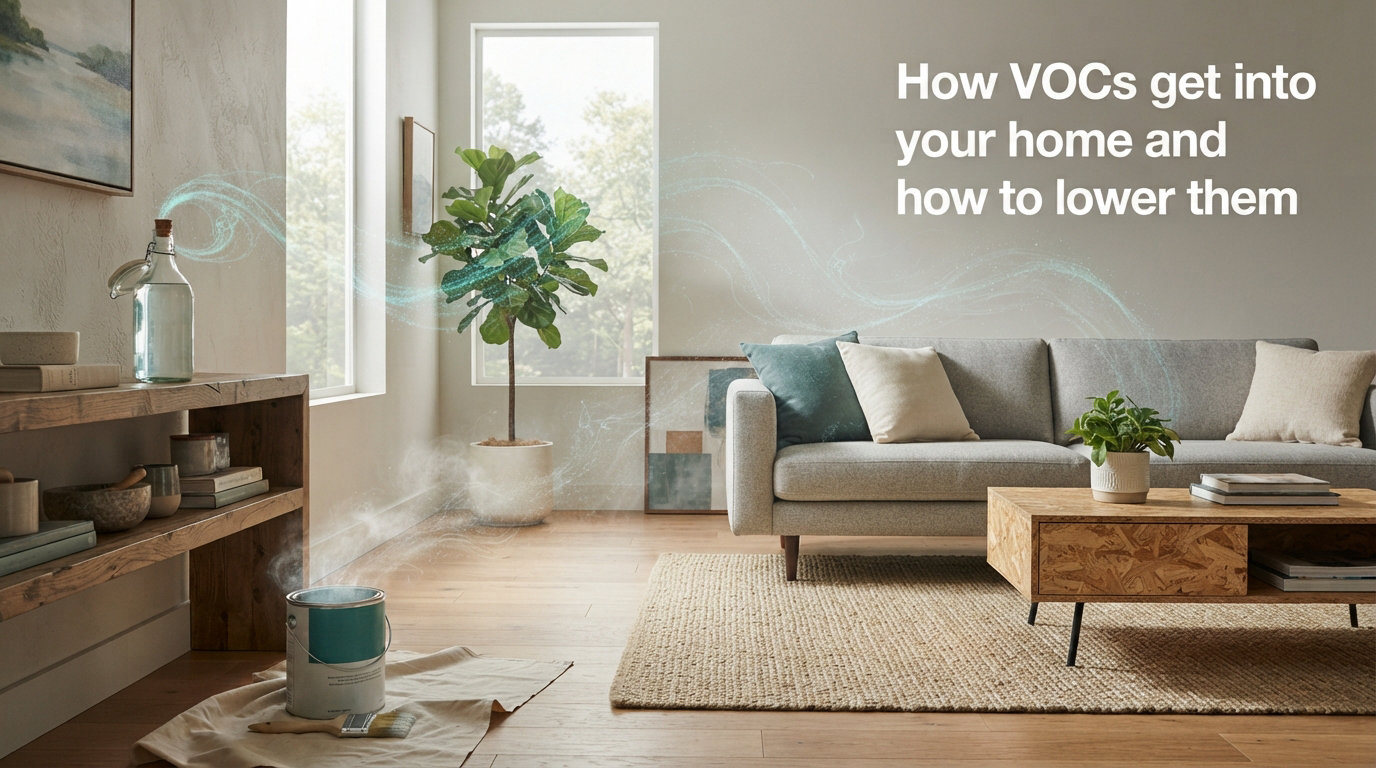
If you want to know how VOCs get into your home and how to lower them, the short answer is this: VOCs enter through everyday products like paint, furniture, cleaners, and carpets, and you lower them by removing sources, ventilating with fresh air, and filtering what remains with activated carbon.
That three-step approach (source control, ventilation, filtration) is the backbone of every reputable indoor air quality strategy. I have used it in my own home after a renovation, and the difference an open window and a carbon filter can make in a single afternoon is striking.
Volatile organic compounds, or VOCs, are gases released by thousands of common household items. Indoor VOC levels run 2 to 5 times higher than outdoor levels on average, and in some cases up to 10 times higher, according to the EPA. Since most of us spend roughly 90% of our time indoors, those numbers matter.
In this guide, our team breaks down exactly where VOCs come from, how they slip into your living space, what they do to your body, and the most effective ways to bring your levels down. We pulled from EPA guidance, American Lung Association research, and real homeowner experiences shared in air quality forums to build a plan that actually works.
Here is what we cover, so you can jump to what you need:
What VOCs actually are (and the specific chemicals to watch)
How VOCs get into your home in the first place
Short-term and long-term health effects
The top sources hiding in plain sight
Step-by-step methods to lower VOC levels
A room-by-room action plan
Answers to the most-searched questions
Quick action cheat sheet: If you only do five things today, do these:
Open windows on opposite sides of your home for 15 to 30 minutes to cross-ventilate
Run kitchen and bathroom exhaust fans while cooking or cleaning
Pull strong-smelling cleaners, paints, and solvents out of living areas and into a vented garage or shed
Keep indoor humidity between 30% and 50%
Add an air purifier with an activated carbon filter in the room where you spend the most time
Do those five things and you have already cut your exposure significantly. Now let’s get into the details so you understand exactly why each step matters.
Table of Contents
What Are VOCs (Volatile Organic Compounds)?
VOCs are carbon-based chemicals that evaporate easily at room temperature, which is exactly why they end up in the air you breathe. The “volatile” part of the name refers to how readily they vaporize, and that vaporization is what we call off-gassing.
Think of the smell of fresh paint, a new car, or a just-opened mattress. That distinct odor is VOCs leaving a product and entering the air. Some VOCs have a strong scent, but others have no smell at all, so your nose is not a reliable detector.
There are thousands of different VOCs. The ones that show up most often in homes include formaldehyde, benzene, toluene, xylene, and a group called phthalates. Each comes from different sources, and each affects the body differently.
Formaldehyde: The Most Common Indoor VOC
Formaldehyde is the single most abundant VOC in most homes. It is a colorless gas with a sharp, pickling smell, and it is used heavily in pressed wood products like particle board, plywood, and medium-density fiberboard (MDF).
If you own anything from a flat-pack furniture store, chances are it is releasing formaldehyde right now. The release rate is highest when the product is new and slowly declines over months or years, but it never truly hits zero.
Benzene, Toluene, and Xylene
These three solvents show up in paints, varnishes, adhesives, and gasoline. Benzene is a known carcinogen, meaning long-term exposure is linked to cancer. Toluene and xylene are neurological irritants that can cause dizziness, headaches, and fatigue.
Even the fumes from a gas stove include benzene. If you cook with gas, ventilation during and after cooking is not optional, it is essential.
Phthalates and Fragrance Chemicals
Phthalates are a class of VOCs used to make plastics flexible and to make scents last longer. They hide in vinyl flooring, shower curtains, air fresheners, scented candles, and anything labeled “fragrance.”
That “fragrance” word on a label can legally represent dozens of undisclosed chemicals, many of which are VOCs. This is one of the most overlooked sources in most homes.
Why Indoor VOC Levels Are So Much Higher Than Outdoor
Outdoors, wind disperses VOCs quickly. Indoors, there is nowhere for them to go. They accumulate in enclosed spaces, especially in well-sealed, energy-efficient homes that trap air inside.
The same insulation and weather-stripping that lowers your heating bill also traps VOCs. This is why ventilation is not a nice-to-have, it is the trade-off for an airtight home.
Now that you know what VOCs are, the next question is how they actually get inside.
How VOCs Get Into Your Home
VOCs enter your home through four main pathways: products you bring inside and use, materials that slowly off-gas over time, combustion activities that release them on the spot, and even your water supply.
Understanding these entry points is the first step to shutting them down. Here is how each pathway works.
1. Products You Use Regularly
Cleaning sprays, disinfectants, paint, nail polish remover, hobby glues, and even printer ink all release VOCs the moment you open them. Anything with a strong chemical smell is likely off-gassing VOCs.
The release is heaviest during use, but residual vapors linger for hours or days afterward in an unventilated room.
2. Materials That Off-Gas for Months or Years
Furniture, flooring, cabinets, mattresses, and carpets do not stop releasing VOCs after the new smell fades. Pressed wood products continue off-gassing formaldehyde for years, though at declining rates.
New carpet backing, vinyl flooring, and the adhesives used in installation are all long-term VOC sources. This is why people often notice headaches or irritation right after moving into a newly renovated space.
3. Combustion and Cooking
Burning anything releases VOCs. Gas stoves, wood-burning fireplaces, candles, tobacco smoke, and even space heaters that use combustion all contribute. Cooking with gas is one of the biggest and most under-recognized indoor VOC sources.
A Stanford study found that gas stoves can release benzene at levels comparable to secondhand smoke. If you cook with gas, your kitchen exhaust fan is your best friend.
4. Waterborne VOCs (The Source Most People Miss)
VOCs do not just come through the air, they can enter through your tap water. Trihalomethanes form when chlorine used to disinfect water reacts with organic matter. Tetrachloroethylene can leach in from industrial contamination. Pesticides and solvents also show up in some water supplies.
When you run a hot shower, those waterborne VOCs vaporize into the air through a process called stripping. This means your morning shower could be a measurable indoor air source.
A point-of-use water filter or a whole-home carbon filtration system can dramatically cut this pathway. This is a step almost no mainstream guide mentions, and it matters more than most people realize.
Health Effects of VOC Exposure
VOC exposure affects people differently depending on the chemical, the concentration, and how long you are exposed. Some effects show up within minutes, while others build silently over years.
Here is what the research and real-world reports tell us.
Short-Term Effects (Hours to Days)
The most common immediate reactions are irritation of the eyes, nose, and throat. Headaches, dizziness, nausea, and fatigue are also frequently reported, especially after exposure to fresh paint or new furniture.
People with asthma or chemical sensitivities often notice symptoms first. If you feel fine outside but develop a headache or scratchy throat within an hour of being home, VOCs are a prime suspect.
Long-Term Effects (Months to Years)
Chronic exposure to certain VOCs is linked to serious health outcomes. Benzene is a known cause of leukemia. Formaldehyde is classified as a human carcinogen. Long-term exposure has also been associated with liver damage, kidney damage, and damage to the central nervous system.
The risk is highest for people who live or work in poorly ventilated spaces with continuous VOC sources, such as a basement bedroom with new carpet and pressed-wood furniture.
Who Is Most at Risk
Children breathe more air per pound of body weight than adults, so they take in proportionally more VOCs. Older adults, pregnant women, and anyone with asthma, COPD, or a compromised immune system are also more vulnerable.
If anyone in your household falls into one of these groups, taking VOC reduction seriously is not an overreaction, it is sensible prevention.
Common Sources of VOCs in the Home
The biggest sources of VOCs in most homes are paint and coatings, pressed wood furniture, cleaning products, carpets and rugs, dry-cleaned clothing, scented products, and tap water. Here is a closer look at each.
1. Paint, Varnish, and Solvents
Fresh paint is the single most concentrated VOC source most people encounter. Conventional latex paint releases VOCs for several days after application, with the highest emissions in the first 24 hours. Oil-based paints and varnishes off-gas even longer.
The fix is straightforward: choose low-VOC or zero-VOC paint. Low-VOC paint contains fewer than 50 grams of VOCs per liter, while zero-VOC paint contains fewer than 5 grams per liter. Both dramatically cut emissions without sacrificing performance.
Even with low-VOC paint, ventilate thoroughly during and after painting. Open windows and run fans for at least 48 to 72 hours.
2. Pressed Wood and New Furniture
Particle board, plywood, and MDF are held together with formaldehyde-based resins. These resins release formaldehyde gas continuously, with the highest output in the first six months after manufacture.
Solid wood, metal, and glass furniture avoid this problem entirely. If you buy pressed wood products, look for those labeled CARB Phase 2 compliant or TSCA Title VI compliant, which meet the strictest formaldehyde emission standards.
3. Cleaning Products and Disinfectants
Many conventional cleaners rely on VOCs as solvents and propellants. Glass cleaners, all-purpose sprays, oven cleaners, and disinfectants are common offenders. The pine or lemon scent in some cleaners comes from VOC-releasing fragrance chemicals.
Switching to simple alternatives like vinegar, baking soda, and unscented castile soap eliminates most of these emissions. If you need a stronger product, use it with windows open and the exhaust fan running.
4. Carpets, Rugs, and Flooring
New carpet releases VOCs from the fibers, the backing, and the adhesives used in installation. The “new carpet smell” is literally VOCs entering your air. Vinyl flooring and the glue beneath it are also significant sources.
If you are installing new flooring, ask for low-emission products and request that the carpet be unrolled and aired out at the warehouse for 24 hours before delivery. After installation, ventilate aggressively for at least 72 hours.
5. Dry Cleaning
Dry-cleaned clothing off-gasses tetrachloroethylene, a solvent classified as a likely human carcinogen. The chemical clings to fabrics and releases slowly over days.
If you use dry cleaning, remove the plastic bag at home and hang the garments in a well-ventilated area, ideally outdoors or in a garage, for at least 24 hours before bringing them into your closet. Better yet, look for a cleaner that uses wet cleaning or liquid CO2 methods.
6. Scented Products and Air Fresheners
Air fresheners, scented candles, plug-ins, and essential oil diffusers all release VOCs. The word “fragrance” on a label can hide dozens of chemicals, and these products are designed specifically to fill the air.
This is one of the easiest sources to eliminate. Open a window instead of using an air freshener, choose unscented personal care products, and skip scented candles in favor of beeswax or unscented options.
7. Your Tap Water
As mentioned earlier, chlorinated tap water can contain trihalomethanes, and contaminated supplies may carry solvents or pesticides. A hot shower vaporizes these into your air.
A carbon-based shower filter or a whole-home water filtration system addresses this. If you are on municipal water, request your utility’s annual water quality report to see what is in your supply.
How to Lower VOCs in Your Home
The most effective way to lower VOCs is a layered approach: remove the sources you can, ventilate to dilute what remains, and filter the air to capture the rest. Here is the full method, in order of impact.
Step 1: Remove or Replace the Biggest Sources
Source control is always more effective than trying to clean up a problem after the fact. Move paints, solvents, and strong cleaners to a detached garage or shed. Replace conventional cleaning products with simple, unscented alternatives. Choose low-VOC or zero-VOC paint for your next project.
When it is time to replace furniture, opt for solid wood, glass, or metal over pressed wood. Every source you remove permanently lowers your baseline exposure.
Step 2: Ventilate Aggressively
Ventilation is the single fastest way to dilute VOCs. Open windows on opposite sides of your home to create cross-ventilation for 15 to 30 minutes, even in winter. Fresh outdoor air replaces VOC-laden indoor air almost immediately.
Run kitchen and bathroom exhaust fans whenever you cook, clean, or shower. Make sure your fans actually vent to the outside, not just into an attic or wall cavity. If your home is very airtight, consider installing a heat recovery ventilator (HRV) or energy recovery ventilator (ERV), which brings in fresh air while preserving your heating and cooling efficiency.
Step 3: Filter With Activated Carbon
Standard HEPA filters capture particles, not gases. VOCs are gases, so you need an activated carbon filter, which adsorbs VOC molecules onto its porous surface.
Look for an air purifier with a thick, heavy carbon bed, not just a thin carbon sheet sprinkled on a HEPA filter. The more carbon, the more VOCs it can hold before it needs replacement. Place the purifier in the room where VOC sources are highest or where you spend the most time, like a bedroom.
Replace the carbon filter on the manufacturer’s recommended schedule, since a saturated filter stops adsorbing and can even re-release captured VOCs.
Step 4: Control Temperature and Humidity
VOCs off-gas faster at higher temperatures and humidity levels. Keeping your home cooler and drier slows the release rate from furniture, flooring, and building materials.
The EPA and most indoor air quality experts recommend maintaining indoor humidity between 30% and 50%. Use a dehumidifier in damp basements and run air conditioning during humid months. This single step reduces both VOC emissions and mold growth.
Step 5: HEPA-Vacuum Dust and Surfaces
Here is a step most guides miss: VOCs settle onto household dust. Phthalates, flame retardants, and other semi-volatile compounds cling to dust particles that you then inhale or ingest.
A vacuum with a true HEPA filter captures these dust-bound chemicals instead of blowing them back into the air. Vacuum frequently, especially on carpets and upholstered furniture, and dust with a damp cloth rather than a dry one. This does not remove gas-phase VOCs, but it does cut your total chemical exposure meaningfully.
Step 6: Air Out New Products Before They Come Inside
Whenever possible, unbox new furniture, mattresses, or electronics in a garage or well-ventilated room for a few days before bringing them into your living space. The first few days of off-gassing are the most intense, so letting that initial burst happen elsewhere makes a real difference.
For new clothes or dry cleaning, the same logic applies. Air them out before they go in your closet or bedroom.
Step 7: Test and Monitor
You cannot manage what you cannot measure. An affordable indoor air quality monitor that tracks total VOCs (TVOCs) gives you real-time feedback. When levels spike, you will know immediately to open a window or run a fan.
Look for a monitor that displays TVOC readings in parts per billion (ppb) rather than a vague color-coded indicator. Numbers let you track whether your changes are actually working over time.
Realistic Timeline for VOC Reduction
One of the most common questions in air quality forums is “how long until my VOC levels go down?” The answer depends on the source and what you do about it.
If you ventilate well, an acute spike from painting or cleaning clears in 48 to 72 hours. New furniture off-gasses most heavily for the first 2 to 6 months, with declining emissions for up to two years. Permanent building materials like pressed-wood cabinets continue at low levels for years.
Forums users report that running windows open and a carbon air purifier continuously can bring a freshly renovated room from “high” to “acceptable” on a monitor within 1 to 2 weeks. Patience plus consistent ventilation is the formula.
Room-by-Room VOC Guide
Different rooms have different VOC profiles. Here is where to focus your attention in each space.
Kitchen
Your kitchen is likely the highest-VOC room if you cook with gas. Run the range hood every time you use the stove or oven, and make sure it vents outside. Store cleaning products in a cabinet with the door closed, and switch to unscented, simple cleaners where you can.
If you have pressed-wood cabinets, do not panic, but do ventilate. Keeping a window slightly open while cooking helps a great deal.
Bedroom
Bedrooms concentrate VOCs from mattresses, pressed-wood bed frames, and new clothing or dry cleaning. Since you spend roughly a third of your life here, this room deserves priority.
Air out a new mattress in a spare room or garage for several days before sleeping on it. Avoid storing paint, craft supplies, or chemicals in bedroom closets. Run a carbon air purifier overnight if your monitor shows elevated levels.
Bathroom
Bathrooms combine two VOC sources: hot showers that vaporize waterborne chemicals, and scented personal care products. A quality exhaust fan handles both, as long as it runs during and for 20 minutes after your shower.
Skip the plug-in air freshener and the heavily scented candles. A simple vinegar-and-water spray cleans effectively without adding VOCs.
Garage and Attached Spaces
Attached garages are a major, overlooked VOC source. Gasoline, motor oil, paint cans, and lawn equipment all off-gas, and those fumes travel into your home through shared walls and doors.
Store chemicals in sealed containers, never run a car or generator in the garage, and weather-strip the door between your garage and living space. If your garage connects to a mudroom or hallway, keep that interior door closed.
FAQs
How to get VOCs out of your house?
Remove or reduce VOC sources first (paints, strong cleaners, air fresheners), then ventilate by opening windows on opposite sides of your home for 15 to 30 minutes to cross-ventilate. Run kitchen and bathroom exhaust fans, and use an air purifier with a thick activated carbon filter to capture VOC gases that ventilation leaves behind.
What are 5 common sources of VOCs?
The five most common indoor VOC sources are paint and solvents, pressed-wood furniture and cabinets, cleaning and disinfecting products, new carpets and flooring with adhesives, and scented products like air fresheners and candles. Dry-cleaned clothing and chlorinated tap water are also significant but less obvious sources.
How do you flush out VOCs?
To flush out VOCs fast, open windows on opposite sides of your home to create cross-ventilation for at least 15 to 30 minutes. Run exhaust fans in the kitchen and bathroom, set up a box fan pointing out one window to push stale air outside, and run an activated carbon air purifier continuously until levels drop.
How long do VOCs stay in the air?
Acute VOC spikes from painting or cleaning clear within 48 to 72 hours with good ventilation. New furniture off-gasses most heavily for 2 to 6 months, with declining emissions for up to two years. Permanent pressed-wood materials continue releasing low levels for years. Continuous ventilation and carbon filtration speed up every timeline.
What level of VOC is dangerous?
There is no single safe threshold for all VOCs because each chemical has different toxicity. As a general guide, total VOC (TVOC) levels below 300 to 500 parts per billion (ppb) are considered acceptable for most homes. Levels above 1,000 ppb warrant immediate source control and ventilation, and anyone experiencing headaches, dizziness, or breathing irritation should ventilate right away and consider professional help.
Conclusion
Understanding how VOCs get into your home and how to lower them comes down to a simple framework: identify the sources, control what you can, ventilate to dilute the rest, and filter with activated carbon. The five-minute cheat sheet at the top of this guide is enough to get you started today.
Our team has seen that the biggest gains come from the least glamorous changes. Moving paint cans to the garage, switching to unscented cleaners, and running the kitchen fan every time you cook matter more than any single expensive gadget.
Pick one source from the list above and address it this week. Then add another next week. Within a month, your indoor air will be measurably cleaner, and your lungs will thank you for it.