
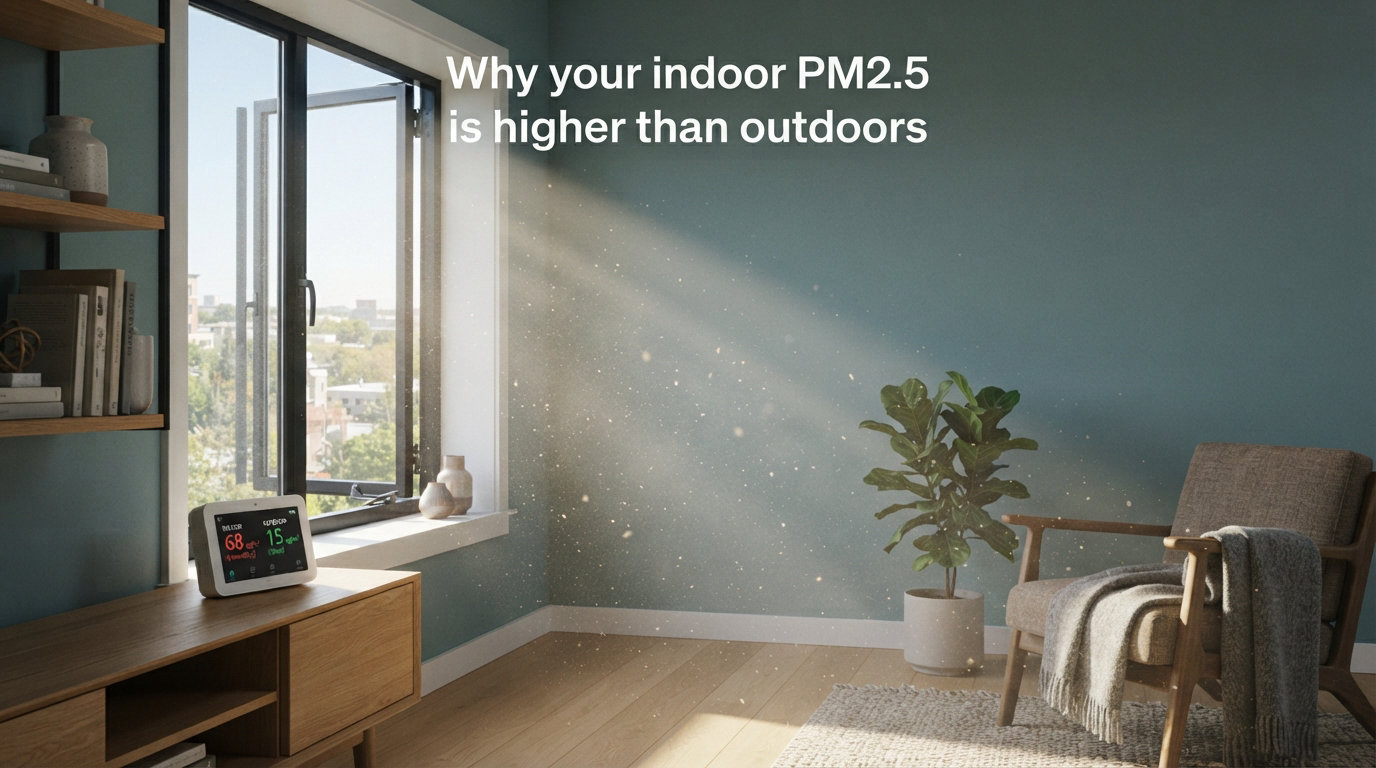
You bought an air quality monitor, checked it against the outdoor reading on your weather app, and now you are staring at numbers that make no sense. Your living room PM2.5 is showing 35 micrograms per cubic meter while the outdoor station two miles away says 12. Your bedroom is somehow worse at 45. You keep the windows closed, you do not smoke, and you vacuum regularly. So why is your indoor PM2.5 higher than outdoors?
You are not imagining things, and your monitor is probably not broken. The American Lung Association reports that indoor air is typically 2 to 5 times more polluted than outdoor air, and in some cases can reach 100 times the pollution level outside. The EPA has found that Americans spend roughly 87% of their time indoors, which means most of your particulate exposure happens inside your own four walls, not at the bus stop or the park.
The reason comes down to a simple principle. Outdoors, wind, rain, and open space constantly dilute and disperse fine particles. Indoors, there is nowhere for them to go. Every time you cook, light a candle, vacuum the rug, or even walk across the floor, you generate particles that accumulate in a sealed box called your home. Outdoor pollution seeps in through cracks and vents, then adds to the load instead of replacing it.
This guide breaks down exactly why your indoor PM2.5 is higher than outdoors, what is generating those particles, and what you can actually do about it. We pulled data from the EPA, the American Lung Association, air quality researchers, and real-world discussions from air quality forums where people have wrestled with the same confusing readings you are seeing right now.
Table of Contents
The Short Answer: Why Indoor PM2.5 Often Beats Outdoor Levels
Indoor PM2.5 is frequently higher than outdoor PM2.5 because homes accumulate particles from both indoor sources and infiltrated outdoor air, with no wind or rain to disperse them. Cooking, combustion, dust resuspension, and biological activity all generate fine particles continuously, while the building envelope traps them. The result is a slow buildup that often pushes indoor concentrations past outdoor levels even on relatively clean days.
Think of your home as a low-speed blender. Particles enter through every gap, vent, and open door, and then you add your own contributions every time you fry an egg or shake out a blanket. Without active filtration or ventilation to flush them out, those particles stay suspended for hours and stack on top of each other.
The main causes of indoor PM2.5 exceeding outdoor levels include:
Cooking emissions – Frying, broiling, and gas combustion can spike PM2.5 to several hundred micrograms per cubic meter within minutes.
Outdoor infiltration – Up to 100% of outdoor PM2.5 can enter through cracks, windows, doors, and HVAC intakes, then accumulate.
Combustion sources – Candles, fireplaces, gas stoves, space heaters, and incense all produce fine particles.
Dust resuspension – Walking, vacuuming, and cleaning kick settled dust back into the air.
Limited dilution – Without wind or active ventilation, particles have nowhere to go and build up over time.
Once you understand these five forces, almost every weird reading on your monitor starts to make sense.
How Outdoor PM2.5 Gets Inside Your Home
Outdoor air and indoor air are never fully separated. The EPA notes that outdoor and indoor air are constantly mixing together, so some outdoor air is always coming into your home, carrying particulate matter with it. This happens even when every window and door is shut tight.
Air infiltrates through three main pathways. First, structural gaps: cracks around windows and doors, gaps in siding, and penetrations for plumbing and electrical lines. Second, mechanical systems: HVAC intakes, exhaust fans, and dryer vents that pull outside air in to balance the air being pushed out. Third, intentional ventilation: open windows, screen doors, and vents designed to bring fresh air inside.
The rate at which outdoor air replaces indoor air is called the air change rate, measured in air changes per hour (ACH). Older, draftier homes might see 1.0 to 1.5 ACH naturally. Newer energy-efficient homes can drop to 0.2 or 0.3 ACH, meaning the air inside barely turns over. IQAir reports that anywhere from 10% to 100% of indoor particle pollution can originate outdoors depending on conditions, with wildfire smoke and heavy traffic pollution pushing that figure toward the top of the range.
This is the part that surprises most people. Closing your windows does not seal out outdoor PM2.5. It just slows it down. Fine particles are small enough, at 2.5 micrometers or less, to slip through tiny gaps you cannot even see. Once inside, they have nowhere to go, so they add to whatever you are generating indoors.
Negative pressure makes this worse. When you run a bathroom fan, range hood, or clothes dryer without balanced makeup air, the house goes under slight negative pressure. That vacuum pulls outdoor air in faster through every available crack, accelerating infiltration of whatever pollution is outside. This is why many people see indoor PM2.5 climb on bad outdoor air days even with everything buttoned up.
The Major Indoor Sources of PM2.5
If outdoor infiltration were the whole story, indoor levels would usually track below outdoor levels. The reason they do not is that you and your household activities generate particles constantly. Here is where those particles actually come from.
Cooking: The Hidden Pollutant Factory
Cooking is the single biggest contributor to indoor PM2.5 in most homes, and it is not even close. Atmotube and EPA data both show that cooking can produce short-term PM2.5 peaks many times background levels. Frying, broiling, and charring create the biggest spikes, with readings of 200 to 400 micrograms per cubic meter commonly reported during a single cooking session.
Gas stoves make things worse because combustion itself produces fine particles along with nitrogen dioxide. Even electric stoves generate substantial PM2.5 from the food being cooked: oils atomized at high heat, water vapor carrying dissolved particles, and charred organic matter all contribute. The fats and proteins hitting a hot pan create aerosols that your monitor picks up instantly.
Forum users on r/AirQuality consistently confirm this. People report watching their PM2.5 readings jump from single digits to 150 or higher the moment they start cooking dinner, then slowly decline over the next two to three hours. Range hoods help, but only if they actually vent outside and you remember to turn them on before the burner does.
Combustion Sources Inside Your Home
Anything that burns inside your home produces PM2.5. The list includes candles, incense, fireplaces, wood stoves, gas space heaters, tobacco, and even that decorative match you light for ambiance. A single scented candle can push PM2.5 to 30 to 50 micrograms per cubic meter in a closed room within an hour.
Wood-burning fireplaces are particularly potent. They generate large quantities of fine particles that can linger in living spaces long after the fire goes out, especially if the chimney draft is weak or the house is under negative pressure. Gas fireplaces and vent-free heaters produce less visible smoke but still emit combustion byproducts that register on a quality monitor.
Secondhand and thirdhand tobacco smoke is another major source. Smoke particles settle into carpets, walls, and furniture, then resuspend over time with normal household activity. This is why former smoker homes can still show elevated PM2.5 long after the last cigarette.
Dust, Resuspension, and Everyday Activity
Settled dust is not inert. Every time you walk across a room, sit on a couch, shake out a blanket, or run the vacuum, you resuspend particles that had previously settled. This is why your monitor often spikes when you start cleaning, not after. The act of cleaning lifts dust back into the breathable zone.
Vacuuming without a HEPA exhaust filter is especially counterproductive for PM2.5. The machine picks up dust from the floor, then exhausts the finest particles back into the air through a less efficient filter. You end up with cleaner floors but dirtier air for the next hour or two.
Pets add their own contribution through dander, skin cells, and tracked-in material. Dogs and cats shedding skin flakes produce biological particles small enough to register as PM2.5, and their movement through the house keeps those particles airborne longer than they would stay on their own.
Biological Contaminants and Allergens
Mold spores, pollen, pet dander, dust mite debris, and bacteria all fall into the PM2.5 range or close to it. High humidity accelerates mold growth, which then releases spores into the air. Pollen that enters through open windows or rides in on clothing breaks down into smaller fragments that stay suspended longer than intact grains.
The EPA groups these together as biological contaminants, and they are a particular problem for people with asthma and allergies. Unlike cooking particles that dissipate in a few hours, biological particles can persist for days and trigger ongoing respiratory symptoms even when the rest of your readings look fine.
Consumer products add another layer. Hairsprays, cleaning sprays, air fresheners, and even printer toner can generate fine particles through aerosolization and chemical reactions. The EPA specifically calls out printers and copiers as indoor PM sources in office settings, and the same chemistry applies to home offices.
The Airtight Home Paradox
Here is where most guides stop short, and it is the single most misunderstood part of indoor air quality. Newer, more energy-efficient homes often have worse indoor PM2.5 than older drafty ones. IQAir is one of the few authoritative sources to highlight this, and it is worth understanding in detail.
Building codes have pushed homes toward tighter envelopes over the past two decades. Better insulation, sealed windows, house wraps, and caulked penetrations all reduce the amount of air that leaks in and out. That is great for energy bills but terrible for indoor air quality, because the same tightness that keeps conditioned air inside also traps pollutants inside.
In a drafty older home with 1.5 ACH, indoor air gets replaced roughly every 40 minutes even with windows closed. In a tight new home with 0.3 ACH, that replacement takes over three hours. Everything you generate indoors, from cooking particles to candle smoke to pet dander, has three times longer to accumulate before any of it leaves.
This is the airtight home paradox. The harder you seal your home against the outdoors, the more you concentrate whatever you produce indoors. People who move from an old apartment to a brand-new energy-efficient unit often see their PM2.5 readings go up, not down, even though the outdoor air quality is identical. The building changed, not the air.
The solution is not to make your home drafty again. It is to combine a tight envelope with controlled mechanical ventilation, such as an energy recovery ventilator or a balanced supply-and-exhaust system, so you bring in filtered outdoor air on your terms rather than relying on random leaks.
The One-Room Spike Phenomenon
One of the most common questions on air quality forums is why one specific room shows dramatically higher PM2.5 than the rest of the house, often for no obvious reason. Someone will report their bedroom sitting at 80 micrograms per cubic meter while the hallway reads 12. Another user sees their kitchen spike to 300 every evening and then slowly settle back overnight.
There are usually three explanations. First, proximity to the source. If the high room is closest to the kitchen or the room where candles are burned, particles travel through shared air before settling. Second, poor air mixing. Closed doors and furniture arrangements create dead zones where particles accumulate without being diluted by airflow from the rest of the house.
Third, localized sources. A bedroom with a dusty carpet, a closet full of stored items, an attached bathroom with mold, or a pet bed can all generate particles in that one space. The room becomes its own micro-environment with higher PM2.5 than the open areas around it.
Forum users have found a useful diagnostic trick. If you move an air purifier into the spike room and the reading drops to near zero within an hour, the source is inside that room. If the reading stays elevated, the particles are migrating in from elsewhere and you need to track down the larger source. This simple test has saved many people from chasing the wrong problem.
Health Effects of Indoor PM2.5 Exposure
PM2.5 is the particle size range that matters most for health because the particles are small enough to bypass your body’s natural filters. At 2.5 micrometers or smaller, they travel deep into the lungs and can cross into the bloodstream. The WHO and EPA both classify PM2.5 as one of the most harmful common air pollutants.
Short-term exposure to elevated PM2.5 triggers asthma attacks, worsens COPD symptoms, causes coughing and wheezing, and irritates eyes and throat. Long-term exposure is linked to reduced lung function, cardiovascular disease, and premature death. The American Lung Association emphasizes that children, the elderly, pregnant people, and anyone with existing heart or lung disease faces the highest risk.
What makes indoor exposure particularly dangerous is duration. You might spend 30 minutes outdoors on a bad air day, but you spend 12 to 16 hours breathing indoor air in your home, often while sleeping. A bedroom with PM2.5 of 40 micrograms per cubic meter all night delivers more total particle dose than a quick walk through smoggy outdoor air.
So what is a safe level of PM2.5 indoors? The WHO guideline is an annual mean of 5 micrograms per cubic meter and a 24-hour mean of 15. The EPA’s National Ambient Air Quality Standard is 12 micrograms per cubic meter annually. In practice, most homes sit somewhere between 5 and 25 in normal conditions, with spikes well above 100 during cooking or cleaning. If your steady-state indoor reading is above 15 for extended periods, you are above the WHO threshold and should investigate sources and filtration.
How to Lower Your Indoor PM2.5
Knowing why your indoor PM2.5 is higher than outdoors only matters if you can do something about it. The good news is that the same five forces causing the buildup, sources, infiltration, combustion, resuspension, and poor dilution, can each be addressed directly. Here is what actually works.
Smart Ventilation: When to Open and Close Windows
Window timing matters more than most people think. The goal is to flush indoor particles out without replacing them with a bigger load from outside. As a general rule, open windows when outdoor PM2.5 is clearly lower than your indoor reading, and keep them closed when outdoor air is worse.
During normal conditions, early morning hours often have the cleanest outdoor air, especially in urban areas where traffic and industrial activity pick up later in the day. During wildfire season, keep windows closed and rely on filtration instead, because outdoor PM2.5 can exceed 200 and overwhelm any benefit from fresh air.
A quick test: check your monitor’s indoor reading, then check a local outdoor station or air quality app. If outdoor is half or less of your indoor level, a 15-minute cross-ventilation with windows on opposite sides of the house can cut indoor PM2.5 significantly. If outdoor is higher, button up and run your purifiers.
Upgrading Your HVAC Filtration
Your HVAC system moves every cubic foot of air in your home multiple times per day. If the filter in that system is a cheap fiberglass panel, it is doing almost nothing for PM2.5. The EPA specifically recommends upgrading to MERV 13 filters where your system can handle the airflow resistance.
Here is how MERV ratings break down for particle filtration:
MERV 1 to 4 – Catches pollen and dust lint. Useless for PM2.5.
MERV 8 – Captures larger fine dust and mold spores. Minimal PM2.5 removal.
MERV 11 – Starts catching a meaningful share of fine particles. A decent baseline.
MERV 13 – Removes over 80% of particles in the 0.3 to 1.0 micron range. The EPA’s recommended minimum for PM2.5 control.
MERV 14 to 16 – Higher efficiency, but check that your blower motor can handle the static pressure.
One important note: a higher MERV rating increases airflow resistance, which can stress older HVAC blowers and reduce heating and cooling performance. Check your system’s documentation or ask an HVAC technician before jumping straight to MERV 16. For most homes, MERV 13 strikes the right balance between PM2.5 capture and system compatibility.
Change the filter on schedule. A loaded filter stops capturing particles and can actually become a source itself as trapped material breaks loose. Most MERV 13 filters need replacement every 3 months in normal use, more often during wildfire season or in homes with pets.
Air Purifiers and HEPA Filtration
A standalone air purifier with a true HEPA filter is the most effective tool for dropping PM2.5 in specific rooms. True HEPA captures at least 99.97% of particles 0.3 micrometers and larger, which covers the entire PM2.5 range and most ultrafine particles as well.
The metric that matters most is the Clean Air Delivery Rate, or CADR. It tells you how many cubic feet of cleaned air the unit delivers per minute for smoke, dust, and pollen. For PM2.5, look at the smoke CADR, since smoke particles are in the same size range. A rule of thumb is to choose a unit with a smoke CADR at least two-thirds of the room’s square footage. For a 300-square-foot bedroom, that means a smoke CADR of 200 or higher.
Placement matters too. Forum users consistently report that putting the purifier inside the room where readings are highest drops PM2.5 fastest. Moving it just outside the room can let particles from the rest of the house keep feeding in. Run it on a higher speed during and after cooking, then drop to a quieter speed for steady-state maintenance.
Keep the filters changed. A HEPA filter loaded with months of captured particles loses airflow and efficiency. Most manufacturers recommend 6 to 12 month replacement intervals depending on usage and how dirty your air is. During wildfire season, check more often.
Source Control at Home
The cheapest way to reduce indoor PM2.5 is to generate less of it in the first place. Some of the highest-impact changes cost nothing.
Always use a vented range hood when cooking, especially on gas stoves. Turn it on before the burner and leave it running for 10 to 15 minutes after you finish.
Skip the candles and incense, or switch to electric alternatives. A single candle can undo an hour of purifier runtime.
Upgrade to a HEPA vacuum and vacuum slowly to give the head time to pull particles out of the carpet rather than resuspending them.
Control humidity between 30% and 50% to limit mold growth and dust mite activity.
Take shoes off at the door to stop tracked-in particles from becoming airborne indoors.
Avoid smoking indoors entirely. Thirdhand smoke resuspends particles for months.
Seal gaps and weatherstrip around windows and doors, but pair that with mechanical ventilation so you do not create the airtight home trap.
Source control multiplies the effect of every other strategy. A house where cooking is always vented, candles are off, and humidity is controlled will stay in the single digits far more easily than a house relying on filtration alone to catch the mess.
FAQs
Why is my indoor PM 2.5 so high?
Indoor PM2.5 runs high because homes trap particles from cooking, combustion, dust resuspension, and outdoor infiltration without wind or rain to disperse them. Cooking alone can spike readings to several hundred micrograms per cubic meter within minutes, and without active filtration or ventilation those particles stay suspended for hours and accumulate on top of each other.
Why is indoor air quality worse than outdoor?
Indoor air quality is often worse than outdoor because the building envelope traps particles and gases that have nowhere to go. Outdoors, wind, rain, and open space constantly dilute pollution. Indoors, every activity from cooking to vacuuming adds to a closed volume of air, and newer airtight homes can concentrate those pollutants up to 2 to 5 times higher than outdoor levels, sometimes reaching 100 times worse during events like cooking or wildfire smoke.
What is a safe level of PM 2.5 indoors?
The WHO recommends keeping indoor PM2.5 below 5 micrograms per cubic meter as an annual average and below 15 as a 24-hour average. The EPA standard is 12 micrograms per cubic meter annually. In practice, most homes sit between 5 and 25 in normal conditions with spikes during cooking or cleaning. If your steady-state reading stays above 15 for long stretches, you should investigate sources and add filtration.
Should I stay indoors when air quality is bad?
Staying indoors helps when outdoor PM2.5 is high, but only if your indoor air is actually cleaner. Keep windows closed, run air purifiers with HEPA filters, and upgrade your HVAC filter to MERV 13. If your home has strong indoor sources like gas cooking or candles, indoor air can still exceed outdoor levels on a bad day, so monitor both and ventilate only during windows when outdoor air drops below your indoor reading.
Conclusion
The reason your indoor PM2.5 is higher than outdoors comes down to accumulation. Particles from cooking, combustion, dust, outdoor infiltration, and everyday activity all enter a closed volume of air with no wind to disperse them, and newer airtight homes make the concentration problem worse, not better. Once you know that, the path forward is straightforward.
Vent your range hood every time you cook, upgrade to a MERV 13 HVAC filter, add a HEPA air purifier in the rooms where you spend the most time, and time your window ventilation for when outdoor air is actually cleaner than indoor air. Monitor both readings so you are making decisions based on real numbers, not assumptions.
You do not need to live with PM2.5 readings in the double or triple digits. The combination of source control, filtration, and smart ventilation can pull most homes back down into single digits within days. Start with whatever step is easiest for you, measure the result, and build from there.