
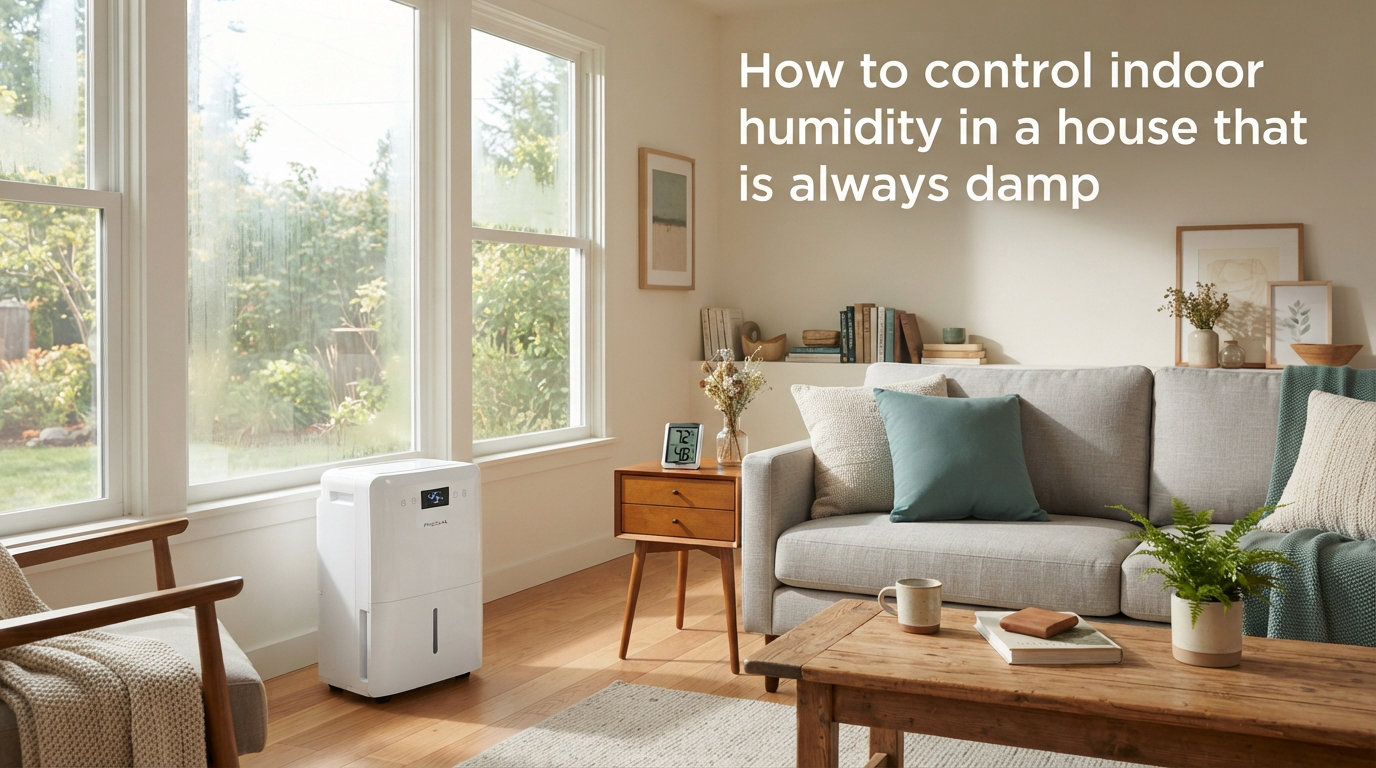
If your windows fog up, your air feels sticky, and a musty smell keeps coming back no matter how much you clean, you are probably living in a chronically damp house. Learning how to control indoor humidity in a house that is always damp starts with one rule: get your indoor relative humidity between 30% and 50%, which is the range the EPA links to better health and a longer-lasting home. I have spent years talking with homeowners on forums like r/HomeMaintenance and r/HomeImprovement, and the same questions come up again and again — why does humidity bounce right back after opening windows, what works when you cannot afford a dehumidifier, and how do you fix a house that feels wet even on dry days.
This guide breaks the problem into layers so you can fix what you can afford today and plan for the bigger fixes later. You will learn what healthy humidity actually looks like, the hidden sources pumping moisture into your air, and a step-by-step method that combines exhaust fans, dehumidifiers, HVAC tuning, source control, and low-cost DIY absorbers. By the end, you should have a clear path from “my house always feels damp” to “my hygrometer finally reads 45%.”
Everything here is updated for 2026, and it is built around the real pain points renters and owners share online — including high-humidity climates, old houses with dirt crawl spaces, and the frustration of watching a 70% reading climb back up within an hour of ventilating. Let us start with why this even matters.
Table of Contents
Why Indoor Humidity Matters: Health Risks and Home Damage
Indoor humidity above 60% relative humidity turns your home into an incubator for mold, dust mites, bacteria, and wood-destroying fungi. The EPA, CDC, and most building science groups agree that sustained dampness is one of the top indoor environmental risks a homeowner can face. Living in it long enough raises your odds of asthma flare-ups, allergic reactions, and chronic sinus problems — especially in kids, older adults, and anyone with a weakened immune system.
The damage to the house itself can be even more expensive than the health effects. Mold begins growing on drywall, grout, and trim within 24 to 48 hours of a moisture spike. Wood floors cup, joists rot, paint peels, and insulation loses its R-value when it gets soaked. One Georgia renter I corresponded with described daily humidity readings between 65% and 82% even after ventilating — exactly the kind of environment where structural damage quietly accelerates behind walls.
High humidity also drives up your energy bills. When the air is loaded with moisture, 75 degrees feels like 82, so you crank the AC lower and run it longer. A damp house forces your HVAC system to work overtime removing water vapor before it can even begin to cool the air. Fixing humidity is one of the few home upgrades that pays for itself in lower utility costs.
What Is the Ideal Indoor Humidity Level?
The EPA recommends keeping indoor relative humidity between 30% and 50%, with an upper limit of 60% that you should never exceed. That range balances comfort, health, and building durability in most homes. Below 30% you get dry skin, static shocks, and cracked woodwork; above 60% you invite mold, dust mites, and condensation problems.
The sweet spot shifts slightly with the season. In summer, aim for 40% to 50% to keep mold at bay without overworking your AC. In winter, drop to 30% to 40% so cold windows and exterior walls do not condense water — this is when indoor condensation on glass is usually a sign you are running a humidifier you do not need. In cold northern climates, even 25% to 30% may be right during deep freezes to stop window condensation from rotting your sills.
If you remember nothing else from this guide, remember the 30 to 50 rule. It is the single number most cited by the EPA, Energy Star, ASHRAE, and every reputable HVAC resource on indoor humidity control.
Signs Your House Has Too Much Humidity
Most damp-home problems announce themselves long before mold takes hold. The clearest signs are persistent condensation on windows, mirrors, and toilet tanks, a sticky or heavy feeling in the air, and a musty odor that returns within days of cleaning. If you notice paint bubbling on exterior walls, wallpaper peeling at the seams, or dark spots forming in grout lines and along baseboards, your humidity is almost certainly above 60%.
Other warning signs are more physical. Warped or cupped wood floors, doors that stick and then fit again as seasons change, and a damp smell in closets or laundry rooms all point to chronic moisture. So do allergic reactions that improve when you leave the house and come back when you return — a classic sign of dust mite or mold sensitivity triggered by indoor humidity.
Forum users in r/HomeImprovement often report humidity readings of 65% to 75% in basements and first-floor rooms with no obvious leaks, even after running fans. If you suspect a problem but cannot see one, a fifteen-dollar hygrometer will confirm it within hours. The number does not lie, and it lets you track whether your fixes are actually working.
Major Sources of Moisture in Homes
You cannot fix humidity until you know where the water is coming from. Indoor activities are the biggest daily contributors: a single hot shower adds about a pint of water vapor to your air, cooking a family meal can add two to three pints, and line-drying laundry indoors dumps gallons per load. Four people breathing and sweating in a sealed home can introduce six to twelve pints of moisture per day on their own.
Outdoor air is the next major source, especially in humid climates. Every time you open windows or doors in a place like Florida, Georgia, or the Gulf Coast, you let in air that may already carry 70% to 90% relative humidity. One Reddit user in the San Francisco Bay Area described a 1915 home with a dirt crawl space sitting at 55% to 70% RH year-round — the moisture came up through the floor invisibly.
Hidden problems round out the list. Plumbing leaks inside walls, roof leaks around chimneys and skylights, groundwater seeping through foundation cracks, and unventilated crawl spaces all add steady moisture you cannot see. If your house is always damp despite fans and ventilation, one of these silent sources is almost certainly the culprit.
How to Control Indoor Humidity in a House That Is Always Damp
Learning how to control indoor humidity in a house that is always damp means combining measurement, mechanical help, ventilation, and source control into one layered plan. No single fix works on its own for a truly chronic case. Work through these six steps in order.
Step 1: Measure With a Hygrometer and Find Your Baseline
Buy a digital hygrometer and place it in the dampest room of your house, away from windows, vents, and direct sunlight. Record the reading morning and night for one week. That baseline number tells you how aggressive your solution needs to be and gives you a way to verify each fix actually worked.
For multi-level homes, place a second hygrometer upstairs. Basements almost always run 5% to 15% higher than upper floors, so a normal reading on the main level can hide a serious problem below. Smart thermostats with built-in humidistats are a worthwhile upgrade because they log trends automatically and let you check readings from your phone.
Step 2: Run Exhaust Fans in Bathrooms, Kitchen, and Laundry
Exhaust fans are your first and cheapest line of defense, but only if you actually use them. Run the bathroom fan during every shower and for at least twenty minutes afterward — this is the single most common gap I see in damp homes. In the kitchen, switch on the range hood any time you boil water, run the dishwasher, or cook on the stovetop. Vent the clothes dryer directly outside, never into a garage or attic.
If your fans feel weak, check the ductwork. Many older homes have fans vented into the attic or through a long, flexible duct that has collapsed or filled with lint. A fan rated for at least 50 CFM in each bathroom, properly ducted to a wall or roof cap, will outperform almost any other low-cost change you can make.
Step 3: Add a Properly Sized Dehumidifier
A dehumidifier is the most effective tool for a chronically damp house, but only if it is sized correctly. Manufacturers rate units in pints per day: a 30-pint dehumidifier handles a moderately damp 500-square-foot room, while a 50- to 70-pint unit is right for a 1,000- to 2,500-square-foot basement in a perpetually wet climate. Undersizing the unit is the most common mistake homeowners make.
Look for a model with a built-in humidistat, continuous drainage option, and Energy Star certification. Set the target between 45% and 50% RH, empty the reservoir or route the hose to a drain, and clean the filter monthly. A whole-house dehumidifier tied into your HVAC system is the right call if multiple rooms stay damp at once.
Step 4: Optimize Your HVAC and Air Conditioner Settings
Air conditioners naturally dehumidify as they cool, but only if they run long enough to pull water from the air. An oversized AC short-cycles, cooling the room too fast to remove meaningful moisture — a problem so common it has its own name: short-cycling. If your house feels cool and clammy at the same time, your AC is probably too big for the space.
Set your fan to AUTO, not ON. Leaving the fan running constantly re-evaporates the moisture sitting on the cold coil and pushes it right back into your rooms. If you have a variable-speed blower, ask an HVAC tech to dial it to the slower settings designed for latent heat removal. These settings run longer cycles at lower speeds, which strips far more water out of the air per hour of operation.
Step 5: Improve Whole-Home Ventilation
Ventilation only works when the air outside is drier than the air inside. In dry climates, opening windows in the morning and evening can drop humidity quickly. In humid climates, that same move pulls wet air in faster than your AC can dry it — which is exactly why forum users in Georgia and Florida complain about humidity climbing right back up after closing windows.
The fix is mechanical ventilation that filters and conditions incoming air. A balanced system like an ERV or HRV exchanges stale indoor air for fresh outdoor air while recovering heat and managing moisture. A whole-house fan works well in dry climates by flushing hot, humid indoor air into the attic at night. Match the ventilation method to your climate, not to what worked for a friend across the country.
Step 6: Stop Moisture at the Source
Source control is the most permanent layer of humidity management because it eliminates water before it can enter your air. Fix plumbing leaks the day you find them. Seal foundation cracks with hydraulic cement, slope soil away from your foundation so rain does not pool against walls, and clean your gutters every fall so overflow does not soak the basement.
In crawl spaces and basements, lay a heavy polyethylene vapor barrier over exposed soil, tape the seams, and run it up the walls six to twelve inches. Add insulation to cold pipes, exterior walls, and rim joists to stop condensation from forming on cool surfaces. Caulk and weatherstrip around windows and doors to slow humid outdoor air infiltration. These fixes cost more than a fan, but they are what stop a damp house for good.
How to Lower Humidity Without a Dehumidifier
Not everyone can drop two hundred dollars on a dehumidifier today. The good news is that simple desiccants and household ingredients can absorb meaningful amounts of moisture from small spaces, and small daily changes compound quickly. Forum users in r/DIYUK and r/howto consistently recommend these methods when budgets are tight.
Calcium chloride crystals, sold in refillable moisture absorber tubs, are the most effective over-the-counter option. They pull water from the air through a chemical reaction and trap it in a lower reservoir you empty every few weeks. Baking soda, rock salt, and activated charcoal also absorb moisture more slowly and double as odor fighters in closets, pantries, and small bathrooms. DampRid-style products work the same way and last about thirty to sixty days per refill.
For a true DIY absorber, try the two-bucket trick several weather hobbyists recommend. Drill holes in the bottom of one bucket, fill it with rock salt or water-softener pellets, and nest it inside a second empty bucket. Set the assembly in a damp room; moisture from the air condenses on the salt and drips into the lower bucket. Empty the collected water weekly and refill the salt as needed.
Daily activity changes add up fast. Take shorter, cooler showers. Cover pots while cooking, run the dishwasher only when full, and never line-dry clothes indoors. Move houseplants to a single well-ventilated room — they transpire surprising amounts of water — and consider drying firewood outside. None of these alone will rescue a 75% RH basement, but combined they can drop your readings several percentage points within a week.
Climate-Specific Humidity Control
Humidity control is not one-size-fits-all. What works in Phoenix will backfire in Mobile, and winter in Minnesota demands a completely different playbook than summer in Houston. Treat the advice below as the filter you apply to every other tip in this guide.
Humid Climates (Southeast, Gulf Coast, Florida)
In persistently humid climates, the outdoor air is your enemy, not your friend. Keep windows and doors closed during the day, run a dedicated dehumidifier, and rely on your AC for moisture removal rather than ventilation. One Georgia renter I spoke with sees 65% to 82% indoor humidity even after ventilating — opening windows there simply imports the swamp-like outside air. Set your thermostat a degree or two warmer and let the AC run longer cycles at lower fan speeds to pull more water out per hour.
Winter Humidity Management
Cold-weather humidity reverses the problem. Outdoor air is dry, so heating it inside pushes relative humidity down sharply. If you run a humidifier in winter, keep it below 40% RH and watch your windows closely. The moment condensation forms on cold glass, your indoor humidity is too high for that outdoor temperature, and you should dial the humidifier back. In well-insulated homes, you may not need a humidifier at all.
Old Homes and Dirt Crawl Spaces
Pre-1950 homes with dirt-floor crawl spaces are notorious for chronic dampness. The soil constantly evaporates water into the air below your floor, which then migrates up through floorboards and around plumbing penetrations. The fix is a properly sealed crawl space: heavy vapor barrier on the floor, sealed and insulated walls, conditioned air supplied from the HVAC system, and a dehumidifier sized for the volume. This single project drops upstairs humidity by ten percentage points or more in many older homes.
Quick Fixes for Immediate Relief
When you need to drop humidity this weekend, these tactics deliver the fastest results without major investment. Stack as many as possible for compound effect.
- Open windows only when outdoor humidity is below 50% — usually early morning in dry climates, never midday in humid ones.
- Set your thermostat fan to AUTO and lower the temperature two degrees so the AC runs longer and pulls more moisture.
- Run bathroom and kitchen fans for at least twenty minutes after every shower and every stovetop meal.
- Take cooler, shorter showers and avoid long baths that steam up the bathroom for hours.
- Move houseplants into one well-ventilated room and stop line-drying laundry indoors.
- Place calcium chloride absorbers in the dampest closets, bathrooms, and corners.
- Boil less water on the stovetop and use a lid whenever possible to trap steam.
Track your hygrometer readings morning and night. You should see a measurable drop within two to three days if you commit to all of the above.
Choosing Your Approach: A Decision Guide
Not every solution fits every home or budget. The right plan depends on how damp your house is, what is causing it, and how much you can spend. Use this tiered framework to match the fix to your situation.
For mild cases — readings between 50% and 60% RH with occasional window condensation — start with the cheap and easy layer. Add a hygrometer, run your exhaust fans religiously, set the AC fan to AUTO, and place a few desiccant tubs in problem rooms. Total investment is under fifty dollars and most homeowners see results within a week.
For moderate cases — sustained 60% to 70% RH, visible mold in one room, musty smells across the first floor — you will need a mid-range layer. Buy a properly sized portable dehumidifier for the worst room, have an HVAC technician check your AC sizing and fan speed, and add vapor barriers to any exposed crawl space soil. Expect to spend between two hundred and eight hundred dollars depending on the dehumidifier size and any duct repairs.
For severe cases — readings above 70% RH, mold returning after cleaning, multiple damp rooms, an old home with a dirt crawl space — you need long-term fixes. Encapsulate the crawl space with sealed vapor barriers and conditioned air, install a whole-house dehumidifier tied into your HVAC, replace oversized AC equipment with correctly sized variable-speed units, and address any foundation or roof leaks. This tier can run several thousand dollars but is what finally breaks the cycle in chronically damp homes.
Most damp-home cases do not need the top tier. The mistake I see most often is jumping straight to a portable dehumidifier without first running exhaust fans, fixing the AC fan setting, and addressing obvious source problems. Solve those first, measure your progress, and only escalate when the numbers demand it.
When to Call a Professional
Some humidity problems are too big or too hidden for a DIY approach. Call a professional if you see mold covering more than ten square feet, if mold returns within days of cleaning, if you suspect a hidden plumbing leak inside a wall, or if your readings stay above 70% RH despite a dehumidifier and source control. These are signs of structural moisture problems that need specialized equipment to diagnose.
The right pro depends on the problem. A licensed plumber handles hidden leaks; an HVAC contractor evaluates AC sizing, ductwork, and whole-house dehumidifier options; a crawl space or basement specialist encapsulates dirt floors and installs perimeter drainage; a mold remediation contractor removes contaminated materials safely. Start with a home energy auditor or building science inspector if you are not sure where the moisture originates — their report will steer you to the right specialist.
Frequently Asked Questions
Why is my house so damp and humid?
A house feels damp and humid when moisture enters faster than ventilation, dehumidification, or absorption can remove it. The most common sources are daily activities like showering, cooking, and line-drying laundry; hidden plumbing or roof leaks; humid outdoor air infiltrating through gaps; and exposed soil in basements or dirt crawl spaces evaporating water into the air continuously.
How to get rid of too much humidity in the house?
Reduce indoor humidity by running bathroom and kitchen exhaust fans, adding a properly sized dehumidifier, setting your AC fan to AUTO, sealing leaks and crawl spaces with vapor barriers, and limiting indoor moisture from showers and cooking. Open windows only when outdoor humidity is below 50%, and never in persistently humid climates.
Is 70% humidity in your house too high?
Yes. The EPA recommends keeping indoor humidity between 30% and 50%, with 60% as the absolute upper limit. A reading of 70% relative humidity creates ideal conditions for mold growth, dust mites, wood rot, and condensation damage, and it should be lowered as soon as possible using dehumidification and source control.
What absorbs moisture in a house?
Calcium chloride crystals (sold as refillable moisture absorbers and DampRid products) are the most effective household moisture absorber. Baking soda, rock salt, activated charcoal, and silica gel packets also pull water from the air more slowly and work well in small enclosed spaces like closets and cabinets.
How quickly can I lower indoor humidity?
You can drop indoor humidity by several percentage points within 24 to 48 hours using a combination of exhaust fans, a properly sized dehumidifier, and limiting showers and cooking. A portable dehumidifier set to 45% RH can pull measurable water from a room within hours, though fully drying out walls and floors in a chronically damp house takes weeks.
Can a dirty crawl space cause high humidity upstairs?
Yes. An unsealed crawl space with exposed soil constantly evaporates gallons of water per day into the air below your floor, and that moisture migrates upward through floorboards, plumbing penetrations, and ductwork. Encapsulating the crawl space with a heavy vapor barrier and conditioning the air below is often the single biggest humidity fix for older homes.
Conclusion
Controlling humidity in a chronically damp house is a layered project, not a one-time purchase. Start by measuring your relative humidity with a cheap hygrometer, work through exhaust fans, HVAC settings, and a properly sized dehumidifier, then tackle source control with vapor barriers, insulation, and leak repairs. Knowing how to control indoor humidity in a house that is always damp means combining these layers until your readings hold steady between 30% and 50% RH — and stay there.
Begin with the cheap layer this weekend and track your numbers for a week. If your readings drop, you have your answer; if not, move up a tier and tackle the next source. The first step is always the same: get a hygrometer, find your baseline, and let the numbers guide every fix you make.