
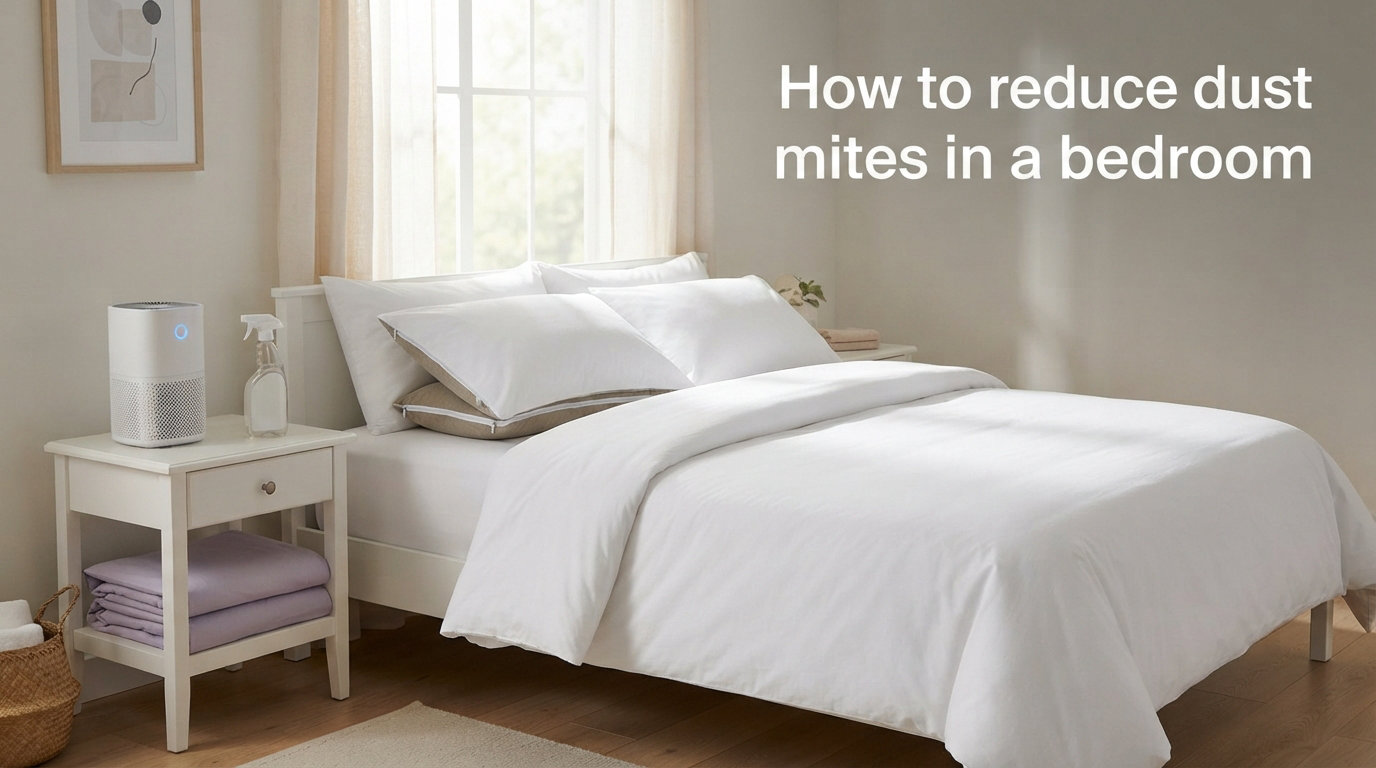
Dust mites are the uninvited guests you can’t see but definitely feel. If you wake up congested, sneeze through the morning, or notice your eczema flaring after sleep, these microscopic creatures are likely part of the problem. Learning how to reduce dust mites in a bedroom can cut allergy symptoms dramatically — often within just a couple of weeks of consistent effort.
We’ve tested these methods in our own homes and cross-checked every claim against research from the American Lung Association, Mayo Clinic, and peer-reviewed studies. The result is a step-by-step plan that targets the root causes rather than just cleaning the surface.
Our team focused on what actually works based on data, not marketing promises. You’ll find specific numbers throughout: 130°F water temperatures, 50% humidity ceilings, 10-micron pore sizes, and weekly washing schedules. No vague advice.
By the end of this guide, you’ll have a clear plan to lower the allergen load in your bedroom, breathe easier at night, and understand which steps give you the biggest payoff for the least effort. Let’s start with what dust mites actually are — because you can’t fight what you don’t understand.
Table of Contents
What Are Dust Mites? (The Science Behind the Pest)
Dust mites are microscopic arachnids — close relatives of spiders and ticks — that measure about 0.3 millimeters long. You can’t see them without magnification. They feed on the dead skin cells (dander) that humans shed every night, which is why they congregate in mattresses, pillows, and bedding.
The allergen itself isn’t the mite. It’s a protein called Der p 1, found in dust mite feces and decaying body parts. When inhaled, Der p 1 triggers immune responses in sensitive people — runny nose, itchy eyes, asthma flare-ups, eczema patches on the skin.
Dust mites absorb moisture from the air rather than drinking water. That’s why humidity control matters so much — they literally can’t survive in dry environments. Below 50% relative humidity, they stop reproducing and eventually die off.
A typical mattress that’s a few years old can house anywhere from 100,000 to 1 million dust mites. They’re not a sign of poor hygiene — even spotless homes have them. What matters is how well you manage the allergen load.
One key distinction: dust mites are not bed bugs. They don’t bite. They don’t carry disease. But their waste is one of the most common indoor allergens worldwide, and reducing exposure is the most reliable way to bring symptoms under control.
Signs You Have Dust Mites in Your Bedroom
Dust mites themselves are invisible, but the symptoms they cause are loud and clear. If you notice these patterns, your bedroom is likely a hotspot worth addressing.
Morning congestion that clears within an hour of leaving the bedroom is the classic sign. You wake up stuffy, sneeze a few times, then feel fine once you’re at work or out of the house. That’s not a coincidence — it’s an allergic response triggered by overnight exposure.
Other dust mite allergy symptoms to watch for include:
Runny or itchy nose, especially first thing in the morning
Itchy, watery, or red eyes after waking
Postnasal drip that lingers through the day
Coughing or wheezing at night or upon waking
Eczema flare-ups on the face, neck, or arms
Dark circles under the eyes, sometimes called “allergic shiners”
Restless, unrefreshing sleep even after a full night
If these symptoms worsen at night or first thing in the morning, dust mites are a prime suspect. The pattern is distinctive — symptoms flare during exposure (in bed) and fade when you leave the room.
How to know for sure: get a skin-prick test or specific IgE blood test from an allergist. The test can confirm whether your immune system reacts to the Der p 1 protein. Without testing, you’re guessing.
One quick home experiment worth trying: spend a week sleeping in another room or a hotel. If your symptoms vanish, dust mites (or another bedroom allergen like mold or pet dander) are almost certainly involved.
How to Reduce Dust Mites in a Bedroom (8-Step Plan)
Reducing dust mites means hitting them on every front: their food supply, their water source, and their hiding spots. These eight steps work together — and the order matters because each step builds on the previous one.
We recommend doing all of them for full effect. But if you only have time for three, prioritize hot-water washing, allergen-proof encasements, and humidity control. Those three deliver roughly 80% of the benefit on their own.
Step 1: Wash Bedding Weekly in Hot Water (130°F or Higher)
Hot water is your single most effective weapon against dust mites. Mites die at temperatures of 130°F (54°C) and above. Cool or warm water doesn’t kill them — it just removes some of the loose allergen.
Here’s the protocol our team follows:
Strip all bedding: sheets, pillowcases, blankets, duvet covers, mattress pads
Wash in water that hits at least 130°F (54°C). Check your water heater setting if you’re unsure.
Use regular detergent as usual. The mechanical action and heat do the killing, not special chemicals.
Dry on high heat for at least 20 to 30 minutes. The dryer heat kills any survivors.
If your washing machine can’t reach 130°F, use a sanitizing cycle if it has one. Some newer machines have specific allergen cycles that boost both temperature and agitation.
For items that can’t handle hot water (delicates, wool, certain quilts), tumble-dry on high heat for 15 minutes first, then wash warm and dry again. The dryer heat is what actually kills the mites.
Wash frequency matters: every 7 to 10 days minimum. During peak allergy season or humid summer months, every 5 to 7 days is better. Set a recurring reminder so you don’t fall behind.
Step 2: Encase Your Mattress, Box Spring, and Pillows
Encasements are zippered covers that seal your mattress, box spring, and pillows in a tightly woven fabric. They trap existing mites inside (where they eventually die) and block new ones from colonizing the bedding.
Look for covers labeled “dust mite proof” or “allergen-proof” with a pore size of 10 microns or smaller. Anything larger lets Der p 1 particles escape back into your breathing zone. Independent certification from the Asthma and Allergy Foundation of America (AAFA) is a reliable sign of quality.
Encasements work because they address the source. Your mattress is the single biggest dust mite habitat in your entire home. Sealing it cuts the allergen load more than any other single action you can take.
Cover these three items completely:
Mattress (top and all sides, fully sealed)
Box spring (often overlooked — mites live here too)
Pillows (every pillow on the bed, not just your favorites)
Leave encasements on for at least 12 months before removing them to wash. The mites trapped inside need to die and decompose fully. When you do wash them, follow the same 130°F rule you use for regular bedding.
Step 3: Keep Bedroom Humidity Below 50%
This is the step most people skip, and it’s a costly mistake. Dust mites absorb moisture straight from the air — they can’t drink water. Below 50% relative humidity, they stop reproducing and start dying off within days.
Buy a hygrometer (a simple humidity gauge) and place it in your bedroom. Check it morning and evening for a week to get a baseline reading before making changes.
If your bedroom runs above 50%, here’s how to bring it down:
Run a dehumidifier set to 40 to 45% during humid months
Run the air conditioner — AC naturally dehumidifies as it cools
Crack a window on dry, breezy days
Skip the bedroom humidifier unless you live in a desert climate
Run bathroom exhaust fans during and after showers to keep moisture out
The sweet spot is 40 to 50% humidity. Below 40% can dry out your sinuses and skin, so don’t go too aggressive and create new problems.
Reddit users in the r/Allergies and r/CleaningTips communities consistently call the dehumidifier the single most effective change they made. Several report waking symptom-free for the first time in years after adding one to the bedroom.
Step 4: Vacuum Weekly with a HEPA-Filter Vacuum
A HEPA (high-efficiency particulate air) filter traps 99.97% of particles 0.3 microns and larger, which includes most dust mite allergen. Regular vacuums suck up dust mites — then blow the smallest particles right back out the exhaust.
Use a vacuum with a sealed HEPA system, not just a “HEPA-style” or “HEPA-type” filter. Sealed systems prevent air leaks around the filter that would let allergens escape back into the room.
Our vacuuming protocol:
Vacuum bedroom carpets at least twice a week during allergy season
Vacuum the mattress surface monthly (with encasement in place)
Use the upholstery attachment on fabric headboards and curtains
Empty the canister or change the bag outdoors
Wear an N95 mask while vacuuming if you’re highly sensitive
Hard floors need vacuuming too — it picks up fine particles that sweeping just stirs up into the air. Follow vacuuming with a damp mop on hard flooring for the cleanest result.
Step 5: Reduce Clutter and Dust Catchers
Dust is where dust mites live and feed. Less dust means fewer mites — and less allergen to breathe in. The bedroom often collects items that hold dust but rarely get cleaned properly.
Walk through your bedroom and address these common hotspots:
Books and magazines on the nightstand — move them to a bookshelf outside the bedroom
Decorative pillows and throw blankets — minimize or remove entirely
Knickknacks and picture frames — store them in closed cabinets
Stuffed animals — keep them off the bed (more on this below)
Open shelving — replace with closed cabinets where possible
Window blinds — switch to washable roller shades if you can
Ceiling fan blades — wipe them weekly with a damp cloth
Dust with a damp cloth or microfiber duster, never a dry one. Dry dusting just launches particles back into the air. A damp cloth physically traps them so you can wash them down the drain.
Step 6: Rethink Carpets and Flooring
Carpet is a dust mite paradise. The fibers trap dead skin cells, hold moisture, and provide endless hiding spots that even the best vacuum can’t fully reach. If you have wall-to-wall carpet in your bedroom, removing it is one of the most effective long-term moves you can make.
Hard flooring options that resist dust mites include hardwood, tile, luxury vinyl plank, and laminate. All of these can be damp-mopped regularly to remove allergen completely.
If removing carpet isn’t an option right now:
Vacuum at least twice weekly with a sealed HEPA vacuum
Have carpets professionally cleaned with hot water extraction every 6 to 12 months
Avoid shag or high-pile carpets — they trap significantly more dust
Consider washable area rugs instead of wall-to-wall carpeting
Underneath the bed is a major dust trap that’s easy to forget. Either keep the space completely empty or use sealed storage containers — never open boxes or bins that collect dust and pet dander.
Step 7: Manage Stuffed Animals and Soft Toys
Stuffed animals are dust mite magnets. The fabric holds skin cells, the stuffing traps moisture, and kids sleep with their faces pressed against them for hours each night.
The freezer trick works for items that can’t survive hot-water washing: place stuffed animals in a sealed plastic bag and freeze for 24 hours. The cold kills the mites. Then wash on hot or tumble dry on high to remove the dead mites and the allergen they leave behind.
For children’s bedrooms specifically:
Limit stuffed animals on the bed to one or two washable favorites
Wash those favorites weekly along with the bedding
Freeze them monthly as a backup measure
Store the rest in a sealed plastic bin away from the bed
Adult bedrooms aren’t exempt — decorative throw pillows, weighted blanket covers, and even fabric laundry hampers can harbor mites. Treat them with the same washing and freezing rules.
Step 8: Consider an Air Purifier (With Realistic Expectations)
Air purifiers help with airborne allergens but can’t touch dust mites living inside your mattress. They’re a complement to the steps above, not a replacement for them.
If you add one to your bedroom, look for these features:
True HEPA filter (not “HEPA-type” or “HEPA-style” — those aren’t certified)
CADR (clean air delivery rate) rated for your bedroom’s square footage
AHAM verified certification for independent performance testing
Place the purifier near the bed and run it on the highest tolerable setting while you sleep. Replace filters per the manufacturer’s schedule — usually every 6 to 12 months depending on usage and air quality.
Air purifiers capture the Der p 1 particles that get stirred up when you make the bed, change sheets, or walk across carpet. They don’t reduce mite populations directly. Set realistic expectations and treat them as the final layer, not the foundation.
Seasonal Considerations — When Dust Mites Are Worst
Dust mites thrive in heat and humidity, so they peak in late summer and early fall. July through September is typically the worst stretch across most of the United States, when warm indoor temperatures and humid air create ideal breeding conditions.
Winter brings relief in cold climates — heating systems dry out indoor air, which suppresses mite populations naturally. But in humid southern states, Gulf Coast areas, and coastal regions, dust mites can persist year-round regardless of season.
If you notice your symptoms worsening each summer, that’s a strong clue. Step up washing frequency, run the dehumidifier harder, and consider over-the-counter allergy medication during peak months.
Spring is tricky because tree and grass pollen overlaps with rising humidity. Track your symptoms in a journal to figure out which allergen is driving them — the treatment approach differs depending on the trigger.
Common Myths About Dust Mites — Debunked
Misinformation about dust mites is everywhere online. Let’s clear up the most common myths our team encounters in forums and social media.
Myth: Lysol and disinfectant sprays kill dust mites. Reality: They kill some surface mites on direct contact but don’t penetrate into mattresses or fabric layers. They also don’t neutralize the Der p 1 allergen that’s already present. Skip them entirely.
Myth: Essential oils like eucalyptus, tea tree, or clove kill dust mites. Reality: A handful of lab studies show some effect at high concentrations in petri dishes, but real-world use in homes is unproven. They might smell nice. They won’t solve the underlying problem.
Myth: Sunlight kills dust mites. Reality: UV rays do kill surface mites, but only with direct, prolonged exposure. Hanging bedding outside helps dry it out (mites hate dry conditions), so there’s a partial benefit — but sunlight alone isn’t a primary control method.
Myth: Baking soda kills dust mites. Reality: No credible scientific evidence supports this claim. Baking soda may deodorize fabrics, but it doesn’t kill mites or neutralize allergens. Save your money for encasements and a dehumidifier.
Myth: If you can’t see them, they’re not there. Reality: Dust mites are microscopic — every home has them. The real question is how many you’re hosting, and how well you’re managing the allergen load they produce.
When to See a Doctor About Dust Mite Allergy
If cleaning and environmental controls don’t bring relief within 4 to 6 weeks of consistent effort, see an allergist. The problem may be more complex than dust mites alone.
An allergist can do several things you can’t do at home:
Confirm dust mite allergy with skin-prick or specific IgE blood testing
Identify other triggers like pollen, pet dander, or mold you might also be reacting to
Prescribe medications such as antihistamines, nasal corticosteroid sprays, or leukotriene modifiers
Discuss immunotherapy — allergy shots (SCIT) or under-the-tongue tablets (SLIT) that build long-term tolerance
Immunotherapy is the only treatment that modifies the immune response rather than just managing symptoms. It typically takes 3 to 5 years of consistent treatment but can provide lasting relief long after you stop.
Don’t rely on self-diagnosis. Many conditions mimic dust mite allergy — chronic sinusitis, non-allergic rhinitis, vasomotor rhinitis, even acid reflux. A proper medical workup can save you years of frustration and wasted effort.
FAQs
What kills dust mites in the bedroom?
Hot water at 130°F (54°C) or higher kills dust mites on bedding and washable fabrics. Allergen-proof encasements trap mites inside mattresses and pillows until they die. Humidity below 50% stops them from reproducing. Tumble drying on high heat for at least 20 minutes also kills mites on items that can’t be washed in hot water.
How to tell if your bedroom has dust mites?
The classic sign is morning congestion that clears within an hour of leaving the bedroom. Other symptoms include itchy or watery eyes on waking, postnasal drip, nighttime coughing, eczema flare-ups on the face or neck, dark circles under the eyes, and unrefreshing sleep. A skin-prick test or specific IgE blood test from an allergist can confirm dust mite allergy.
What smell does dust mite hate?
There is no strong scientific evidence that any particular smell repels dust mites effectively in real-world conditions. Essential oils like eucalyptus, clove, and tea tree show limited effect in lab studies but don’t control mites in homes. Humidity control below 50%, hot-water washing, and allergen-proof encasements are far more reliable than scents.
What time of year is worse for dust mites?
Dust mites peak in late summer and early fall, typically July through September in the United States, when heat and humidity are highest. Winter brings relief in cold climates because heating dries indoor air. In humid southern and coastal regions, dust mites can persist year-round regardless of season.
Can you see dust mites with the naked eye?
No. Dust mites measure about 0.3 millimeters long and are invisible without magnification. Even a mattress containing hundreds of thousands of mites looks perfectly clean. You detect their presence through allergy symptoms and air-quality testing, not by seeing them.
Does baking soda kill dust mites?
No. There is no credible scientific evidence that baking soda kills dust mites or neutralizes the Der p 1 allergen they produce. Baking soda may deodorize fabrics but won’t reduce mite populations. Hot water at 130°F, allergen-proof encasements, and humidity control are the proven methods.
Are dust mite covers worth it?
Yes. Allergen-proof encasements with a pore size of 10 microns or smaller are one of the highest-impact steps you can take. They trap existing mites inside your mattress and pillows (where they die) and block new ones from colonizing. A single set typically lasts several years and addresses the biggest dust mite habitat in your home.
How often should I wash my bedding to control dust mites?
Wash sheets, pillowcases, and blankets every 7 to 10 days in water that reaches at least 130°F. During humid summer months or peak allergy season, increase frequency to every 5 to 7 days. Dry everything on high heat for at least 20 to 30 minutes after washing to kill any surviving mites.
Conclusion: How to Reduce Dust Mites in a Bedroom
Learning how to reduce dust mites in a bedroom is a multi-step process — but a small handful of changes deliver most of the benefit. Hot water washing at 130°F, allergen-proof encasements on your mattress and pillows, and humidity kept below 50% are the big three. Get those right and you’ve handled roughly 80% of the problem.
Add HEPA vacuuming, clutter reduction, smart flooring choices, and stuffed animal management to lock in your gains. Layer in an air purifier as the final piece if you want extra protection against airborne allergen particles.
Most people notice improvement within 2 to 4 weeks of consistent effort. If symptoms persist despite your best work, an allergist can help you identify the full picture and explore medical options like prescription medication or immunotherapy.
Your bedroom should be where you recover, not where your body fights off allergens all night. Take these steps, stick with the routine, and you’ll likely breathe easier by morning.