
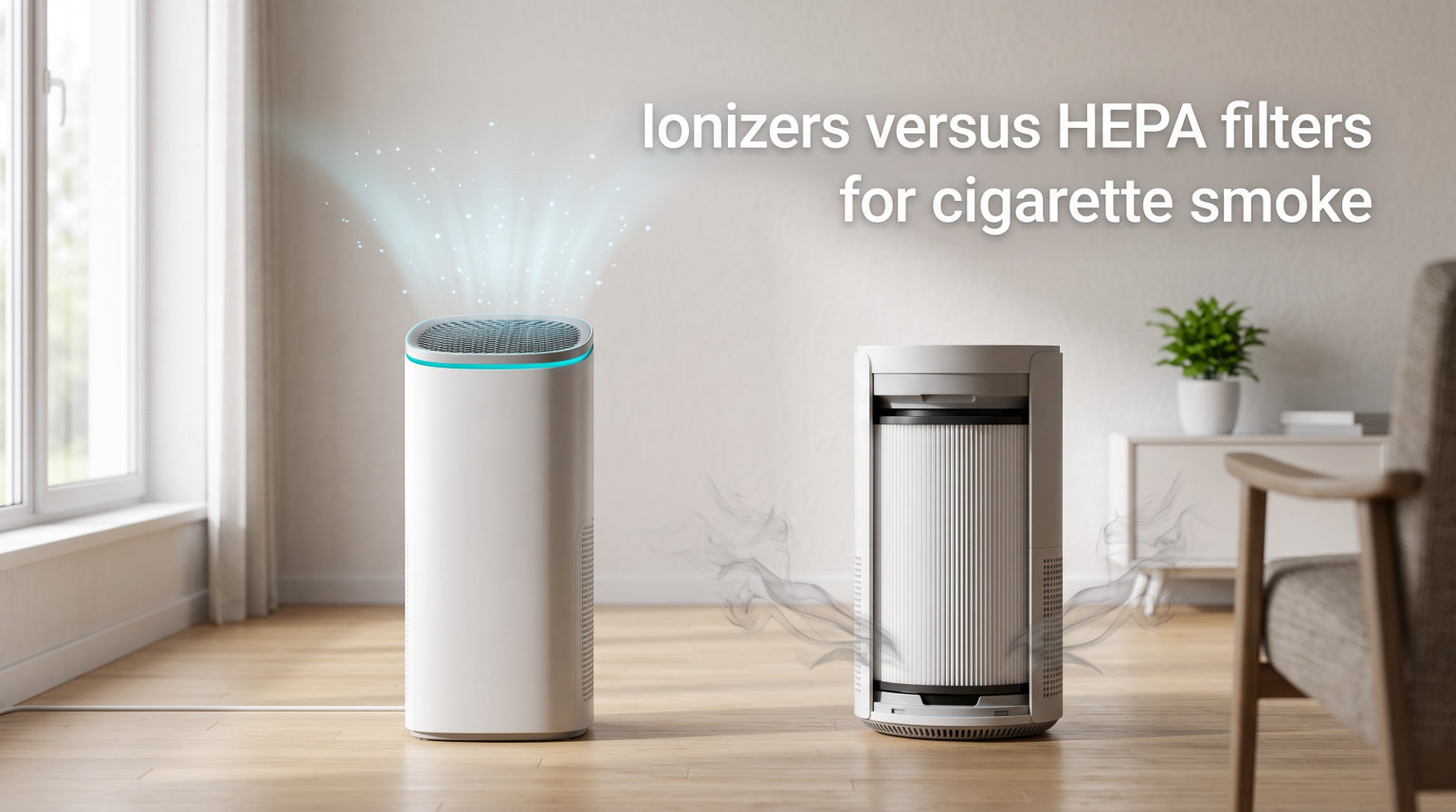
When my neighbor started smoking on the balcony, I figured any air purifier would solve the problem. I bought a cheap ionizer first, then a HEPA unit with a carbon filter, and spent three months testing both. What I learned is that the ionizers versus HEPA filters for cigarette smoke debate isn’t really a tie. The two technologies handle smoke in completely different ways, and choosing the wrong one means breathing polluted air while thinking you’re protected.
Cigarette smoke is unusual because it’s not just particles. It’s a mix of fine particulate matter, volatile organic compounds (VOCs), and gases like formaldehyde and acrolein. That mix is why a single filter technology often falls short. In this guide, I’ll walk through how HEPA filters and ionizers each work, what the EPA and California regulators say about ozone, and what real users on Reddit and cigar forums have actually experienced. By the end, you’ll know which technology fits your situation and which combination most experts quietly recommend.
Table of Contents
How HEPA Filters Work to Capture Cigarette Smoke
A HEPA filter is a mechanical filter, which means it physically traps particles as air is forced through a dense mat of fibers. True HEPA filters capture at least 99.97% of particles at 0.3 microns, which is the hardest size to trap because it sits between where fibers catch larger particles and where diffusion catches smaller ones.
Cigarette smoke particles are tiny. Most of the visible smoke is actually liquid droplets in the 0.1 to 1 micron range, with some ultra-fine particles below that. A HEPA filter handles these efficiently, which is why the EPA and most respiratory doctors point to HEPA as the standard for smoke removal.
Here’s the catch that catches most buyers: HEPA filters capture particles, not odors. The smell of cigarette smoke is mostly gaseous VOCs, and those pass straight through a HEPA filter. That’s why every serious smoke purifier pairs HEPA with an activated carbon layer. The carbon adsorbs gases, while the HEPA layer catches the particles. Without carbon, your room will look clearer but still smell like an ashtray.
What HEPA does well
HEPA filters are predictable and well-regulated. The 0.3 micron standard is enforced by the U.S. Department of Energy, and independent labs verify it. For households with someone who has asthma or COPD, this kind of certainty matters. You’re not relying on chemistry or electrostatic attraction, you’re relying on a physical barrier.
HEPA filters also don’t introduce anything new into the air. There’s no ionization, no ozone byproduct, no charged particles settling on your electronics. You get clean air and nothing else. That alone is a major reason pediatricians and allergists tend to recommend HEPA over ionizers for bedrooms and nurseries.
Where HEPA falls short
Replacement costs are real. A quality HEPA filter runs $40 to $120 depending on the unit, and most need changing every 12 months. Activated carbon pre-filters often need swapping every 3 to 6 months if you’re dealing with heavy smoke. Over five years, I’ve spent close to $400 on filters for one medium-sized room.
HEPA filters also create back pressure. As the filter loads with particles, the fan has to work harder and noise goes up. If you forget to change the filter, performance drops sharply. I learned this the hard way when a year-old filter let visible haze back into the room during a heavy cooking event.
How Ionizers Work to Remove Cigarette Smoke
Ionizers take a completely different approach. Instead of pulling air through a filter, they release negatively charged ions into the room. Those ions attach to smoke particles, dust, and other airborne pollutants, giving them a negative charge.
Once charged, the particles behave differently. They stick to nearby surfaces like walls, furniture, floors, and TV screens. Some ionizers include a positively charged collection plate that pulls the particles out of the air faster. This process is called electrostatic precipitation, and it works without a physical filter.
Bi-polar ionizers are a newer variant. They release both positive and negative ions, which the manufacturers claim creates a more balanced reaction in the air. Some also claim the ions break down VOCs at a molecular level. The science on that last claim is mixed and often comes from manufacturer-funded studies.
What ionizers do well
Ionizers are quiet and filter-less. There’s no fan pushing air through a dense mat, no motor noise, no replacement filters to buy. Some tower-style ionizers run silent or nearly silent, which makes them appealing for bedrooms and offices.
Theoretically, ionizers can capture ultra-fine particles below 0.1 microns that even HEPA filters struggle with. Cigarette smoke contains particles in this range, and ionizer marketing leans heavily on that fact. In a controlled lab, ionizers can reduce airborne particle counts substantially.
Where ionizers fall short
The biggest complaint I see on forums and in my own apartment is dust. Ionizers don’t remove particles, they relocate them. After two weeks with my ionizer running, my black TV screen was visibly gray with charged dust. Wipe a white wall near the unit and you’ll see the same thing. You’re trading air pollution for surface pollution.
Performance also drops as collection plates get dirty. Most ionizer plates are washable, but if you forget to clean them monthly, effectiveness plummets. Several Reddit users in r/AirPurifiers reported their ionizer “stopped working” only to find the plate caked with residue.
Then there’s ozone, which I’ll cover in detail below. It’s the single biggest reason most public health agencies warn against ionizers in occupied spaces.
Which Is Better for Cigarette Smoke: HEPA or Ionizer?
For capturing the particles in cigarette smoke, HEPA filters win. The 99.97% capture rate at 0.3 microns is verified and consistent, and HEPA doesn’t depend on ions finding their way to a plate or surface. If your main concern is removing the visible smoke and the fine particulate that gets deep into lungs, HEPA is the more reliable tool.
For odor removal, neither technology works alone. HEPA filters don’t touch gases, and ionizers only weakly affect VOCs through electrostatic attraction. The only thing that consistently removes cigarette smell is activated carbon, ideally paired with HEPA. A standalone ionizer will leave your room smelling smoky indefinitely.
For asthma and respiratory conditions, HEPA is the safer choice. The American Lung Association, the EPA, and most allergists recommend HEPA-based purifiers for people with asthma, COPD, or other lung issues. Ionizers introduce charged particles and ozone into the breathing zone, both of which can irritate airways.
For quiet operation and low maintenance, ionizers have an edge. If you’re not dealing with a smoker in the home but want to reduce dust and mild odors in a home office, an ionizer can be a reasonable choice, especially if you commit to cleaning the plates and accepting the dust on nearby surfaces.
For heavy smoke situations, like a smoker in the household, frequent cigar smoking, or apartment smoke drift, the answer is a HEPA + activated carbon system. The combination handles both the particles and the gases. Adding an ionizer to such a system is optional and most experts say skip it.
Ozone Safety: Why Ionizers Raise Health Concerns
Ozone is a lung irritant. The EPA is clear on this: ozone can worsen asthma, trigger chest pain, and reduce lung function even at low concentrations. The agency explicitly warns against using ozone-generating devices, including many ionizers, in occupied spaces.
The ozone concern is the main reason ionizers have fallen out of favor since the Sharper Image Ionic Breeze fad in the early 2000s. Consumer Reports eventually found that some ionic air purifiers produced ozone above California’s 0.05 ppm limit, leading to a California Air Resources Board (CARB) certification requirement for any air purifier sold in the state.
California’s Prop 65 also lists ozone as a chemical known to cause respiratory harm, which means products exceeding the limit must carry warning labels. If you live outside California and buy a non-CARB-certified ionizer, you may be inhaling more ozone than you realize. There’s no federal ozone limit for indoor air purifiers in the U.S., which is a gap many public health advocates have flagged.
For people with asthma, allergies, or COPD, even small amounts of ozone can cause symptoms. If anyone in your household has a respiratory condition, I’d skip ionizers entirely and go with a HEPA + carbon system. The risk isn’t worth the marginal gain in capturing sub-0.1 micron particles.
Pros and Cons of HEPA Filters and Ionizers
Here’s a side-by-side look at how the two technologies stack up for cigarette smoke specifically.
HEPA filters with activated carbon
- Pros: Captures 99.97% of particles at 0.3 microns, removes smoke odor when paired with carbon, no ozone or byproducts, recommended by EPA and lung associations, predictable performance.
- Cons: Replacement filters cost $40 to $120 yearly, fan noise on most units, performance drops if filters aren’t changed, doesn’t address ultra-fine particles below 0.1 microns as efficiently.
Ionizers (standalone)
- Pros: Filter-less design, very quiet operation, can capture ultra-fine particles, no recurring filter costs, simple to maintain.
- Cons: Produces ozone in many models, relocates particles to surfaces instead of removing them, plates need regular cleaning, ineffective for cigarette odor without carbon, not recommended for people with respiratory conditions.
For most readers dealing with cigarette smoke, the HEPA side of this list wins on every count that matters: effectiveness, safety, and third-party validation.
Thirdhand Smoke: The Hidden Risk Most Purifiers Miss
Thirdhand smoke is the residue that clings to walls, furniture, curtains, and clothing long after a cigarette is extinguished. It contains nicotine and other chemicals that react with indoor air to form new carcinogens. A 2010 study in Pediatrics showed that thirdhand smoke accumulates on surfaces and gets re-released into the air over time.
Here’s where the ionizers versus HEPA filters for cigarette smoke question gets interesting. Neither technology addresses thirdhand smoke effectively on its own. HEPA filters can’t grab particles stuck to surfaces, and ionizers actually make it worse by depositing more charged particles onto the same surfaces.
The practical fix for thirdhand smoke is washing fabrics, repainting walls in severe cases, and running an air purifier with a strong carbon layer to capture the gases as they off-gas from surfaces. If you’re moving into a former smoker’s apartment, no air purifier alone will solve the problem. You need surface cleaning first, then continuous HEPA + carbon filtration.
What Real Users Say About Ionizers and HEPA Filters
I spent time reading through Reddit’s r/AirPurifiers, r/HVAC, and cigar forums like Cigarpass to see what actual owners experienced. A few patterns came up again and again.
HEPA + carbon combinations are the most recommended setup. When someone posts about cigarette smoke in their apartment, the top reply is almost always to get a purifier with both a HEPA filter and an activated carbon layer. Rabbit Air, Coway, and Austin Air models get frequent mentions. Standalone HEPA filters without carbon are called out as ineffective for odor.
Ionizers make surfaces dusty. Multiple users complained about a visible film on electronics, walls, and furniture within days of running an ionizer. For people with allergies, this can actually worsen symptoms because the dust still contains allergens, just on a different surface.
Ozone smell is a dealbreaker for many. Several users reported a sharp “clean” or metallic smell when running ionizers, which is actually ozone. People with asthma said it triggered headaches or chest tightness. A few users who initially liked their ionizer eventually replaced it with a HEPA unit after these symptoms appeared.
Filter costs add up over time. Long-term owners of HEPA units mentioned spending $50 to $100 per year on filters, with premium brands like IQ Air climbing higher. This is a real budget factor over 5 to 10 years of ownership, though most agreed the cost was worth it for clean air.
Choosing the Right Air Purifier for Cigarette Smoke
If you smoke inside the home, choose a purifier with a true HEPA filter, a thick activated carbon layer (at least 2 to 3 pounds of carbon for medium rooms), and a high CADR rating for smoke. Look for AHAM certification, which verifies the Clean Air Delivery Rate. For a 200 square foot room, you want a smoke CADR of at least 150.
If you’re dealing with neighbor smoke drift in an apartment, the same HEPA + carbon approach applies, but size up the unit. Go one or two sizes larger than the room’s square footage to handle the constant incoming particles. Place the purifier near the source of the drift, like a shared wall or vent, for best results.
If you have asthma or respiratory issues, skip ionizers entirely. Stick with HEPA + carbon and look for units with sealed filter designs so nothing leaks back into the air. Brands like Austin Air and IQ Air specialize in this category and are widely recommended by allergists.
If you want quiet operation in a bedroom, look for HEPA units with sleep modes that drop below 30 decibels. Most modern Coway, Honeywell, and Blueair models offer this. Ionizers are quieter still, but the ozone trade-off isn’t worth it for overnight use in my view.
If budget is the main concern, a basic HEPA + carbon unit from Coway or Levoit runs $150 to $250, with annual filter costs around $50. That’s the floor I’d recommend. Anything cheaper usually cuts the carbon layer, which means the smoke smell lingers no matter how good the HEPA filter is.
One last tip: avoid “air purifier” products marketed as HEPA-type or HEPA-style. True HEPA must meet the 99.97% standard. HEPA-type filters can be anything, and many capture far less. Look for the words “true HEPA” or “HEPA H13/H14” in the specifications.
Frequently Asked Questions
What is the best filter to remove cigarette smoke?
A combination of a true HEPA filter and a thick activated carbon layer is the best filter setup for cigarette smoke. HEPA captures 99.97% of particles at 0.3 microns, while activated carbon adsorbs the odor-causing gases and VOCs that HEPA alone cannot remove.
Does an ionizer help with cigarette smoke?
Ionizers can reduce airborne smoke particles by attaching negative ions to them and causing them to fall onto surfaces. However, they do not remove cigarette odor effectively and they often produce ozone, which the EPA warns against for occupied spaces. For most situations, a HEPA + carbon system is the safer and more complete solution.
Which is better, a HEPA filter or an ionizer?
For cigarette smoke specifically, HEPA filters are the better choice. They reliably capture smoke particles, pair with activated carbon for odor removal, and produce no ozone. Ionizers relocate particles to surfaces, struggle with smoke odor, and carry ozone-related health risks that make them unsuitable for people with respiratory conditions.
Will a HEPA filter remove cigarette smoke?
A HEPA filter will remove the particles in cigarette smoke, including the fine particulate that reaches deep into lungs. It will not remove the smell on its own, which is why every effective smoke purifier pairs HEPA with activated carbon. Without carbon, the air looks cleaner but still carries the odor and many of the harmful gases.
Final Verdict on Ionizers versus HEPA Filters for Cigarette Smoke
If you take one thing from this guide, let it be this: for cigarette smoke, a true HEPA filter paired with a serious activated carbon layer is the right answer in almost every case. Ionizers have theoretical advantages on ultra-fine particles, but they introduce ozone, relocate rather than remove pollutants, and leave odor largely untouched.
Start with a properly sized HEPA + carbon purifier from a brand like Coway, Austin Air, Rabbit Air, or IQ Air. Match the unit to your room size, change the carbon pre-filter every 3 to 6 months, and replace the HEPA filter annually. Your indoor air quality will improve dramatically, and you’ll breathe easier knowing the technology is backed by the EPA, the American Lung Association, and decades of independent testing.