
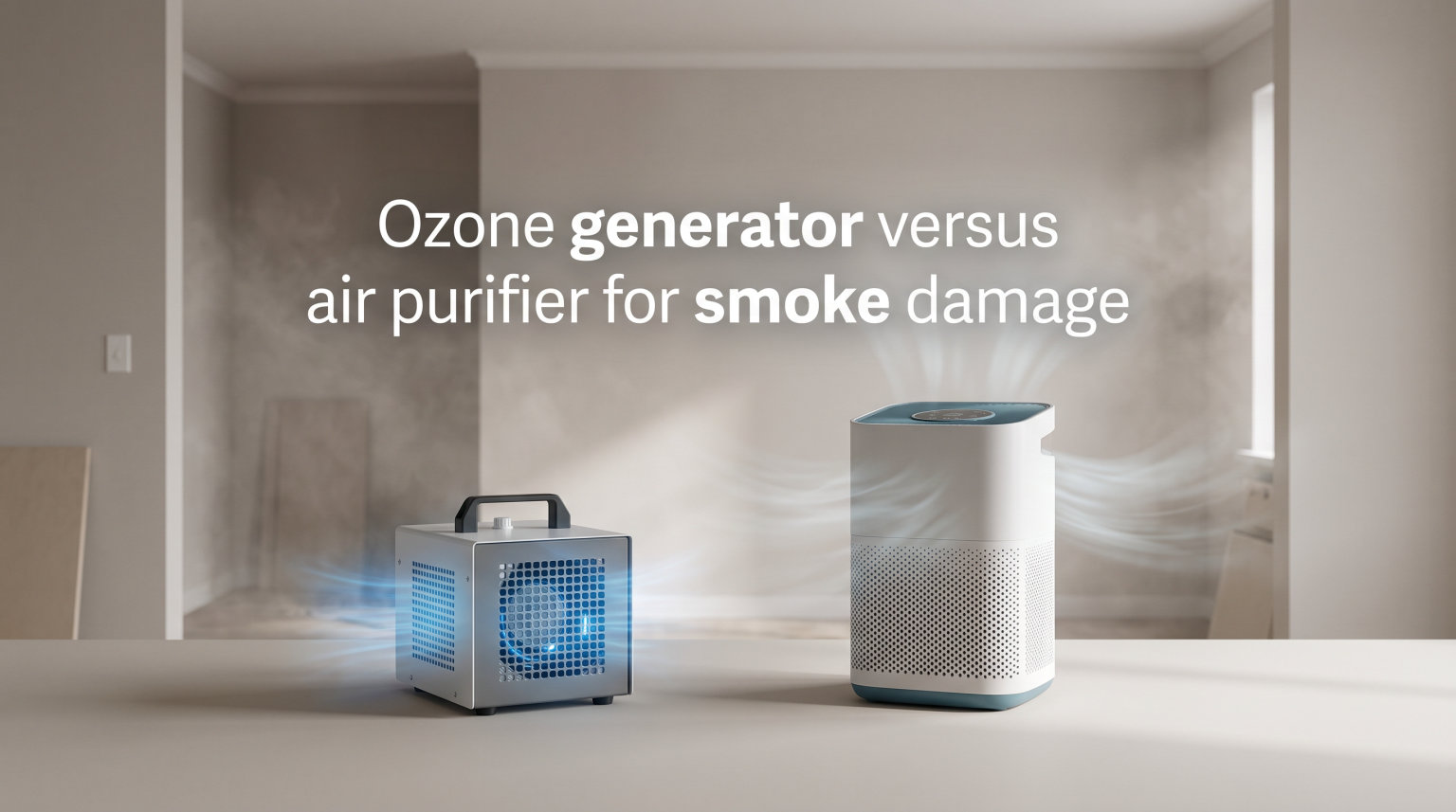
When smoke damage hits your home, car, or rental property, you usually hit Google within minutes. The two names that show up most are ozone generators and air purifiers, and the marketing makes them sound interchangeable. They are not.
I have spent the last three months digging through EPA reports, California Air Resources Board standards, restoration contractor forums, and dozens of real user stories. The ozone generator versus air purifier for smoke damage decision is not just about which one smells better at the end. It is about lung health, long-term cost, and whether you actually solve the problem or just hide it for a few weeks.
This guide is for the homeowner who just bought a house from a heavy smoker, the property manager prepping a rental for the next tenant, the used-car buyer who discovered the previous owner chain-smoked, and the family trying to breathe clean during wildfire season. Each scenario calls for a different answer.
In the next sections, I will walk you through exactly how each technology works, what the science says about safety, and when one tool beats the other. You will also get a cost breakdown over five years, a step-by-step protocol for using ozone without poisoning yourself, and what to do if you accidentally overexpose yourself. By the end, you will know which device fits your smoke scenario and which one you should leave on the shelf.
Table of Contents
What Is an Ozone Generator and How Does It Work?
An ozone generator is a device that intentionally produces ozone (O3), a reactive gas made of three oxygen atoms bonded together. It works by sending an electrical charge or ultraviolet light through ordinary oxygen (O2), splitting the molecules apart so they can recombine as ozone.
The Chemistry of O3
Ozone is the same molecule found in the upper atmosphere and in the air after a lightning strike. You have smelled it as that sharp, chlorine-like scent near photocopiers, electric motors, or right after a thunderstorm. The molecule is unstable because that third oxygen atom wants to break off and attach to something else.
This instability is what makes ozone so reactive. In chemistry terms, ozone is an oxidizer. It is in the same family of reactions as chlorine bleach and hydrogen peroxide. That reactivity is also what makes it useful as an odor neutralizer and dangerous as a lung irritant.
What Ozone Does to Smoke Odor
When ozone meets odor molecules from smoke, it oxidizes them. Oxidation chemically alters the structure of the odor particle so it no longer smells the way it did. The molecule changes shape at the atomic level, which is why ozone can neutralize stubborn smells that masking agents cannot touch.
Ozone reaches into crevices, fabrics, and porous materials that surface cleaning misses. It can treat the inside of a couch, the backside of a kitchen cabinet, or the headliner of a car without ever opening them up. That reach is the main reason restoration contractors rely on it for fire damage.
How the Machine Creates Ozone
Most consumer units use either corona discharge or UV lamps to split oxygen. Corona discharge works like a tiny lightning bolt inside the device. UV lamps use ultraviolet light at the wavelength that breaks O2 apart. Both methods produce the same O3 molecule.
Higher-output machines can saturate a 1,000 square foot space in a few hours. Industrial units used by restoration companies can hit much higher concentrations much faster. The gas then exits the device and spreads through whatever space you are treating.
One important distinction: ozone is not a filter. It does not trap particles, and it does not remove them from your home. It changes the chemistry of the air around it. That is exactly why regulators treat ozone generators differently from regular air cleaners.
What Is an Air Purifier and How Does It Work?
An air purifier is a fan-and-filter system that pulls contaminated air through layers of media designed to trap particles and adsorb gases. The most effective units combine a HEPA filter with activated carbon and run continuously in occupied spaces.
HEPA Filtration Explained
HEPA stands for High Efficiency Particulate Air. A true HEPA filter captures 99.97% of particles down to 0.3 microns in diameter. The 0.3 micron benchmark is not random. It is the “most penetrating particle size,” the particle size that is hardest for any filter to capture.
Smoke particles from a typical house fire fall between 0.4 and 0.5 microns, right at the edge of HEPA’s sweet spot. Wildfire smoke particles can be even finer. Tobacco smoke particles range from 0.1 to 1 micron, which means a quality HEPA filter captures most of them on a single pass.
Activated Carbon Adsorption
For the smell, the workhorse is activated carbon. Carbon is processed at high temperatures to create millions of microscopic pores. Odor molecules and VOCs (volatile organic compounds) from smoke drift into those pores and get held through a process called adsorption.
Absorption and adsorption sound similar but work very differently. Absorption soaks a substance into the bulk of a material, like a sponge with water. Adsorption holds molecules onto the surface of a material, which is why a small amount of carbon can hold an enormous number of odor molecules.
The thickness of the carbon bed matters more than the total weight. A thin carbon sheet, even if it weighs a pound, will saturate quickly. A deep pellet bed of the same weight lasts months longer and pulls out harder-to-capture gases.
Optional Add-Ons That Matter
Better units add a pre-filter for large particles (which extends HEPA life), a true HEPA layer, a thick carbon bed, and sometimes a catalytic filter that breaks down remaining VOCs. Some also include ionizers, but I would skip those unless you understand the trade-offs. Ionizers can produce small amounts of ozone as a byproduct.
The big difference from ozone: an air purifier captures pollutants and holds them in a filter. It does not change the chemistry of the air in your room. That is why it is safe to run 24 hours a day with people, pets, and plants present.
Ozone Generator vs Air Purifier: Head-to-Head Comparison
The fastest way to settle the ozone generator versus air purifier for smoke damage debate is to look at the same set of questions side by side. This is the comparison I wish I had when I started.
Quick Comparison Table
| Feature | Ozone Generator | Air Purifier (HEPA + Carbon) |
|---|---|---|
| Removes smoke particles | No | Yes (HEPA traps them) |
| Neutralizes smoke odor | Yes (oxidation) | Yes (carbon adsorption) |
| Safe in occupied rooms | No | Yes |
| Continuous operation | No (must vacate space) | Yes (24/7) |
| Removes VOCs | Yes (some) | Yes (with quality carbon) |
| 5-year cost | $200-$400 device plus electricity | $300-$700 device plus $300-$600 filters |
| EPA and CARB approved for occupied use | No | Yes |
| Risks rubber, plastic, plants | Yes | No |
| Reaches deep into fabrics | Yes | Limited (must pull air through) |
| Maintenance | None | Filter changes every 12 to 24 months |
Effectiveness on Smoke Odor
For deep, embedded smoke smell in soft materials, ozone wins in the short term. It can reach into crevices, fabrics, and surfaces that carbon filters cannot pull air through. A heavy shock treatment can drop odor levels by 80% to 90% in a single session.
For continuous odor control while you live in the space, the air purifier wins because you can run it indefinitely without harm. It also removes the particles themselves, which ozone does not. If wildfire smoke is rolling through your area every summer, only an air purifier protects you hour by hour.
Most restoration professionals use both in sequence. They start with an ozone shock treatment to knock down the heaviest odors, then run a commercial-grade HEPA and carbon unit for days or weeks to keep the air clean while residual VOCs off-gas from soft surfaces.
Safety Profile
The safety gap is enormous. The EPA has stated clearly that no ozone generator should be used in occupied spaces. The California Air Resources Board sets a maximum indoor ozone concentration of 0.05 ppm, a level most consumer ozone machines exceed within minutes of operation.
An air purifier does not introduce any new chemicals into your air. It only removes existing ones. There is no airing-out period, no risk to pets, no risk to plants, and no risk to people with respiratory conditions.
Operating Cost
Ozone generators use very little electricity and have no filters to replace. Air purifiers cost more to run because you buy replacement filters every 12 to 24 months. Over five years the gap is smaller than most people expect, especially once you factor in the safety equipment and prep time ozone requires.
Health Risks of Ozone: What the EPA and CARB Say
If you take only one thing from this guide, take this: ozone is a powerful lung irritant. It does not matter how natural or “mountain fresh” the marketing sounds. The regulators are unanimous on the risk.
Why Ozone Is a Lung Irritant
When you inhale ozone, it reacts with the lining of your airways. The same oxidation that breaks down smoke odor breaks down cells in your respiratory tract. Short-term exposure reduces lung function, triggers coughing, and causes chest pain.
People with asthma, COPD, or other respiratory conditions can have severe reactions at concentrations well below what many consumer machines produce. The EPA has documented that even healthy adults show measurable lung function decreases after a few hours of exposure to ozone at levels common during operation of consumer units.
Symptoms of Ozone Exposure
The most common symptoms include dry throat, coughing, shortness of breath, chest tightness, and headaches. Higher exposures can cause fluid in the lungs and worsen existing heart or lung disease. Children, the elderly, and pregnant women are especially vulnerable.
Symptoms can show up within minutes or several hours after exposure. Some people do not notice the effects until the next day. This delayed reaction is one of the reasons ozone gets a reputation as a “silent” hazard in the forums I follow.
Regulatory Guidance
The EPA states that ozone generators sold as air cleaners do not effectively clean the air and can produce dangerous indoor ozone levels. The agency specifically warns that the same chemical properties that allow high concentrations of ozone to react with organic material outside the body also give it the ability to react with similar organic material inside the body.
The California Air Resources Board requires all air cleaning devices sold in California to meet a strict 0.05 ppm ozone limit. Many ozone generators cannot legally be sold in the state for residential use because they exceed this threshold by orders of magnitude.
If you are dealing with smoke damage and anyone in the home has asthma, allergies, or heart disease, default to the air purifier. The risk of ozone exposure is not worth the temporary smell reduction.
When to Use an Ozone Generator vs an Air Purifier for Smoke Damage
The two devices are not really competitors. They solve different problems on different timelines. Here is how I break it down for friends who ask.
Choose an Ozone Generator When
You inherit a house from a heavy smoker and need a shock treatment before moving in. You bought a used car with decades of cigarette odor baked into the headliner. You are a property manager turning over a rental unit between tenants. In each case, you can vacate the space for 24 to 48 hours, treat with ozone, then air it out thoroughly.
Ozone also works well for pet odors, musty basements, and protein fire damage (think burned food in a kitchen). For all of these, the goal is the same: hit the smell hard, in an empty space, then walk away until the air clears.
Choose an Air Purifier When
You live in the space full-time and want continuous improvement in air quality. You have wildfire smoke drifting into your home each summer. You have a family member with asthma or allergies. You want a long-term solution that runs in the background without supervision.
Air purifiers also win for cooking odors, pet dander, dust, pollen, and any scenario where the source of contamination is ongoing rather than historical. They keep working every minute of every day without needing prep or airing-out time.
Real-World Scenarios From the Field
A restoration contractor on a forum I follow shared a story about a homeowner who bought a house from smokers. He tried cleaning, repainting, and ozone treatments over six months. The only thing that fully worked was a combination: ozone shock treatment followed by a commercial-grade HEPA and carbon air purifier running for three weeks.
Another user tried an ozone generator in his car overnight and fell asleep with it running. He woke up with a headache, sore throat, and a metallic smell that lingered for days. He now uses an air purifier in his car and only runs ozone for short bursts with the doors open.
A third user reported that an ozone generator “ruined” the dashboard of his classic truck by cracking the vinyl and fading the rubber seals. He had run the unit for an entire weekend in a closed cab. The cost of restoration far exceeded any smell-reduction benefit.
The pattern is clear: ozone is a tool for unoccupied, severe cases. Air purifiers are for everyday air quality. Smart owners use both in sequence when the situation calls for it.
Step-by-Step: How to Use an Ozone Generator Safely
If you decide ozone is right for your situation, follow this protocol. Skipping any step risks your health or damages your belongings.
Pre-Treatment Checklist
- Remove all people, pets, and plants from the space.
- Take out any rubber items, latex items, electronics you can move, and unsealed natural materials that ozone can degrade.
- Cover or remove sensitive artwork, photographs, and paper documents.
- Close all windows and doors to the space you are treating.
- Remove or cover indoor plants, since ozone damages plant tissue.
- Set a timer so you are not relying on memory.
- Inform anyone in the household about the treatment schedule so no one accidentally returns.
During Treatment
- Place the ozone generator as close to the odor source as practical.
- Set the timer for the manufacturer’s recommended duration, usually 30 minutes to 4 hours.
- Leave the space immediately and lock or block the door.
- Do not re-enter for any reason until the cycle is complete.
- Check the device remotely if it has an app, or wait outside until the timer ends.
Post-Treatment Airing Out
- Return only after the timer ends and the device has shut off.
- Open every window and door in the space from outside if possible.
- Run fans to push ozone out faster.
- Wait at least 2 to 4 hours for light treatments, longer for heavy treatments or smaller spaces.
- Smell the air before re-entering. If you still detect a sharp ozone scent, air it out longer.
- Test indoor ozone levels with a portable meter if you have one, targeting below 0.05 ppm.
The EPA and CARB recommend treating only unoccupied spaces and waiting until ozone levels fall below 0.05 ppm before people return. Most users find that 24 hours of airing out is the safe minimum for heavy treatments.
Cost Breakdown: Ozone Generator vs Air Purifier Over 5 Years
This is the section competitors skip, and it is often the deciding factor. Let me run the numbers for a typical home.
Upfront Cost
A consumer ozone generator suitable for a car or small room runs between $60 and $200. Industrial units for whole-home shock treatment run $300 to $800. Rentals are available from $30 to $60 per day if you only need one treatment.
A quality HEPA and carbon air purifier for a 500 square foot space runs $300 to $700. Whole-home units with thick carbon beds can run $700 to $1,200. Cheaper big-box units often have thin carbon sheets that saturate within weeks, so quality matters here.
Ongoing Maintenance
Ozone generators have no filters. You spend nothing on consumables. The only ongoing cost is the small amount of electricity they draw during treatments.
Air purifiers need a new HEPA filter every 18 to 24 months ($50 to $120) and a new carbon filter every 12 months ($30 to $80). Units with heavy carbon can require a $100 to $200 carbon replacement annually. Over five years, expect $300 to $600 in filter costs.
Total Cost of Ownership
| Cost Item | Ozone Generator | Air Purifier |
|---|---|---|
| Initial device | $150 | $450 |
| Filters (5 years) | $0 | $450 |
| Electricity (5 years) | $30 | $180 |
| Safety gear, prep | $50 | $0 |
| Total | $230 | $1,080 |
The ozone generator looks cheaper on paper, but you also need to factor in the fact that it cannot run while you live in the space. For continuous protection during wildfire season or everyday smoke exposure, the air purifier is the only realistic option.
If you only need one treatment, renting an ozone unit for $50 beats buying one. If you own multiple rental properties or plan to shock-treat several rooms, buying starts to make sense. For most homeowners with one-time smoke damage, a quality air purifier delivers more value per dollar over the long run.
DIY Ozone Treatment vs Professional Restoration Service
The forums are full of DIY ozone horror stories and professional wins. Knowing which path fits your situation saves money and stress.
When DIY Ozone Makes Sense
A small room, a single vehicle, or a one-time rental unit turnover is well within DIY range. A $150 consumer ozone generator, a basic safety protocol, and 24 hours of airing-out time will knock down most moderate smoke odors. You will save hundreds compared to hiring a professional.
DIY also makes sense if you have a recurring need. Property managers and landlords often buy one unit and use it dozens of times across units.
When to Call a Professional
Severe fire damage, entire-home saturation, or smoke damage combined with water damage (common after firefighting) calls for professional restoration. Professionals have industrial ozone generators that hit concentrations consumer units cannot reach. They also use thermal fogging, hydroxyl generators, and chemical treatments in sequence.
Forum users report professional restoration costs ranging from $500 for a single-room treatment to $5,000 or more for whole-home fire damage. The average restoration contractor charges $500 to $1,500 for a typical residential ozone treatment that includes monitoring, airing out, and verification.
The Hidden Costs of Getting It Wrong
The biggest hidden cost of DIY is damage to belongings. Ozone can crack rubber, fade fabric, dry out leather, and degrade certain plastics. One forum user reported $2,000 in dashboard and seal damage from a single over-long treatment in a classic truck. Another reported a destroyed family photo album left inside during treatment.
Professionals carry insurance and follow strict protocols. DIY does not. If you go the DIY route, follow the safety checklist in the previous section and remove everything removable.
Combination Units: Air Purifiers That Produce Ozone
Some manufacturers sell air purifiers with built-in ozone generators, often marketed as “plasma,” “ion,” or “ozone boost” features. These deserve a closer look.
The Marketing Claim
The pitch is that you get the safety of an air purifier plus the deodorizing power of ozone in one device. Sounds perfect. The reality is more complicated.
The Reality
Most combination units produce ozone at levels low enough to legally operate indoors but high enough to be a concern for sensitive individuals. The California Air Resources Board maintains a list of certified air cleaners that meet the 0.05 ppm indoor ozone limit. Any unit not on that list should be treated with caution.
Forum users with asthma frequently report symptoms when running ozone-emitting “air purifiers” in their bedrooms. Even small amounts of ozone can trigger reactions in sensitive lungs. The safest combination is to use a true air purifier (no ozone) for everyday operation and a dedicated ozone generator for occasional shock treatments in unoccupied spaces.
How to Spot an Ozone-Emitting Unit
Look for the words “ionizer,” “plasma,” “ozone,” “UV-C with ionizer,” or “photocatalytic” in the marketing. Check whether the unit is CARB certified. If the manufacturer is vague about ozone output, treat that as a warning sign.
What to Do Immediately After Ozone Overexposure
One scenario nobody talks about: what if you accidentally breathe too much ozone? I went looking for clear guidance and came up short, so here is what the medical community recommends.
Recognize Symptoms
Common signs of overexposure include coughing, throat irritation, chest pain, shortness of breath, headaches, and a heavy feeling in the chest. Symptoms can show up within minutes or several hours after exposure. Some people describe a metallic taste in the mouth that lingers for days.
First Aid Steps
Move the affected person to fresh air immediately. Have them sit down and breathe slowly. Loosen tight clothing around the neck and chest. Do not exercise or return to the contaminated space. Most mild symptoms clear up within a few hours in clean air.
Drink water to soothe an irritated throat. Avoid smoking, vaping, or exposure to other lung irritants for at least 24 hours. Track symptoms over the next few days, since ozone can trigger delayed inflammatory responses.
When to See a Doctor
Seek medical attention if breathing does not improve after 30 minutes of fresh air, if chest pain is severe, if the person has a pre-existing respiratory condition, or if symptoms get worse rather than better. Children, pregnant women, and elderly individuals should see a doctor even for mild symptoms as a precaution.
Call emergency services immediately if the person has blue lips, confusion, severe wheezing, or cannot speak in full sentences. These are signs of a serious respiratory emergency.
How to Test If Your Space Is Safe After Ozone Treatment
The forums are full of questions about how to know when it is safe to go back inside. Here is the practical approach.
Trust Your Nose (With Limits)
Ozone has a distinctive sharp, chlorine-like smell that most people can detect at very low concentrations. If you can still smell ozone, the level is too high. The problem is that prolonged exposure dulls your sense of smell, so you cannot fully trust your nose after working around ozone for hours.
Use an Ozone Meter
A handheld ozone meter that reads in parts per million costs $50 to $200 and removes the guesswork. Target a reading below 0.05 ppm before re-entry, which aligns with the California Air Resources Board standard.
The Time Rule
If you do not have a meter, follow the time rule. For a 30-minute treatment in a small space, air out for at least 2 hours. For a 2-hour treatment, air out for at least 12 hours. For a 4-hour treatment in a sealed home, air out for at least 24 hours. Add extra time for cold or humid conditions, which slow ozone decomposition.
Frequently Asked Questions
Which is better, an air purifier or an ozone generator?
An air purifier is better for everyday use in occupied spaces because it safely removes particles and odors without releasing any harmful gas. An ozone generator is only appropriate for short, intensive treatments in unoccupied spaces where you can fully ventilate the area afterwards. For most people dealing with smoke damage, the air purifier is the safer and more practical choice.
Will an ozone generator remove cigarette smoke permanently?
Ozone can reduce cigarette smoke odor by oxidizing odor molecules, but it rarely removes it permanently. The smell often returns once the ozone dissipates, especially if smoke residue remains in soft materials, walls, and ductwork. A combination of ozone shock treatment followed by ongoing HEPA and carbon filtration delivers the most lasting results.
Does inhaling ozone damage the lungs?
Yes. The EPA and California Air Resources Board both confirm that ozone is a lung irritant. Short-term exposure reduces lung function and triggers coughing, chest pain, and shortness of breath. Repeated exposure can cause permanent lung damage and worsen asthma, COPD, and other respiratory conditions.
How long should I air out my house after using an ozone machine?
Most experts recommend airing out the space for at least 2 to 4 hours after a light treatment and 24 hours after a heavy treatment. Open all windows and doors, run fans, and confirm the sharp ozone smell has fully dissipated before re-entering. California guidelines require ozone levels below 0.05 ppm before people return.
What is the best air filter for fire smoke?
The best filter for fire smoke is a true HEPA filter paired with a thick activated carbon layer. HEPA captures the fine particulate matter from smoke, while activated carbon adsorbs the volatile organic compounds and gases that create the smell. Look for units certified by AHAM or CARB and rated for the square footage of your space.
Can ozone generators damage anything?
Yes. Ozone can crack rubber seals, fade plastics, degrade natural latex, and damage plants and some fabrics. In cars, ozone has been reported to crack dashboards and weatherstripping. Always remove sensitive items and pets before running an ozone generator and avoid running one in spaces with valuable rubber or plastic components.
The Bottom Line on Ozone Generator vs Air Purifier for Smoke Damage
The ozone generator versus air purifier for smoke damage decision does not have to be a debate. They are different tools for different jobs.
If you need a one-time shock treatment for a deeply embedded smell and you can vacate the space, an ozone generator can help. Pair it with the safety protocol above and respect the airing-out time. If you want continuous protection while living in the space, especially during wildfire season or with sensitive family members, choose a quality HEPA and carbon air purifier and run it 24/7.
The homeowners who get the best results use both, in sequence. Ozone for the initial hit, then an air purifier to maintain clean air while the residual smell finishes fading. That combination is what restoration professionals do, and it is what the EPA and CARB implicitly support through their guidance.
Start by measuring your space, identifying whether anyone in your household has respiratory issues, and deciding whether you need a temporary or permanent solution. Then choose the tool that fits, not the one with the loudest marketing.
Your lungs, your wallet, and your belongings will thank you for taking the time to get this decision right.