
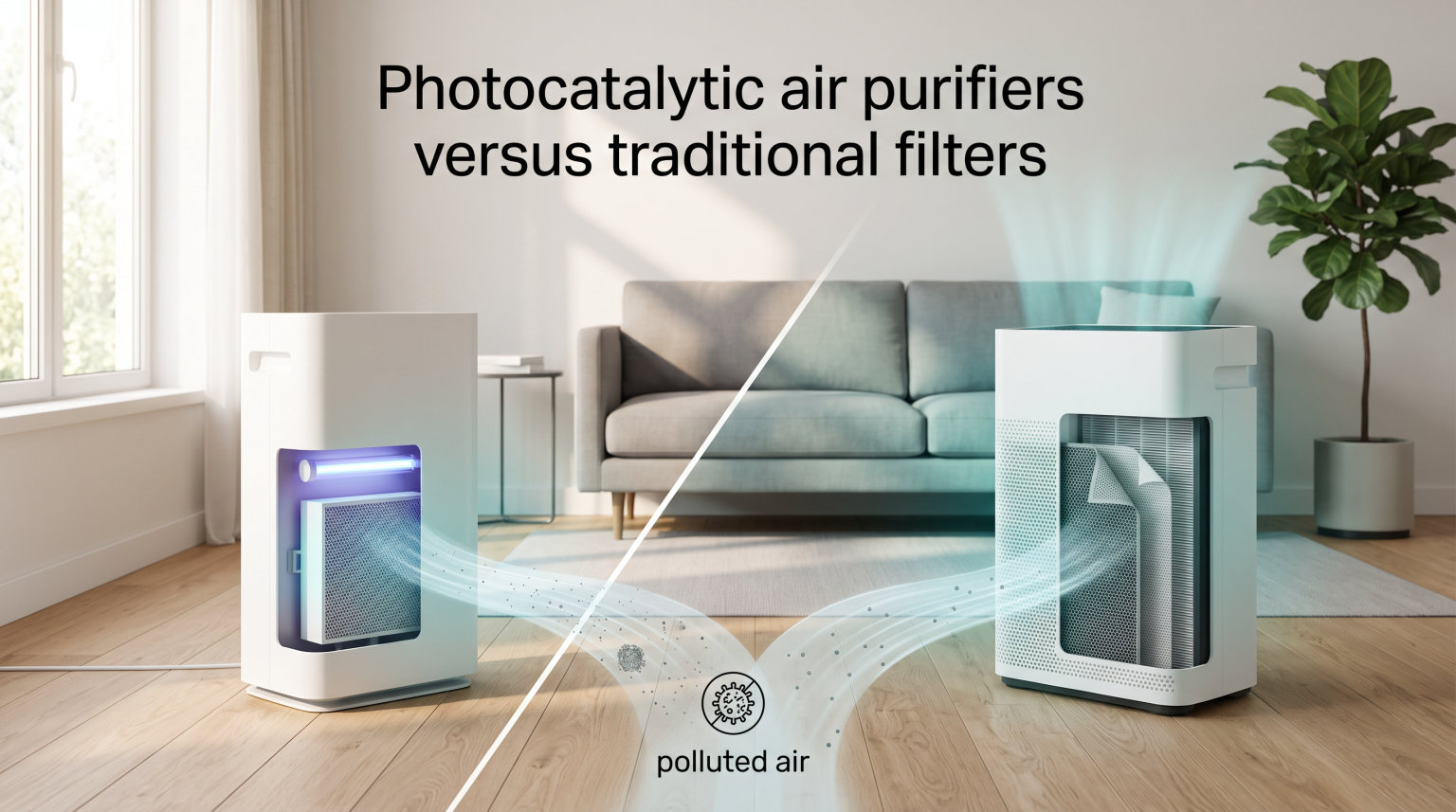
If you have ever stood in an appliance aisle staring at two very different air purifiers and wondering which one actually cleans the air better, you are not alone. The photocatalytic air purifiers versus traditional filters debate has picked up serious steam in 2026, and for good reason. One technology destroys pollutants at the molecular level, while the other physically traps them in dense filter material.
Our team has spent the last several months digging into peer-reviewed research from the NIH, reading through hundreds of Reddit threads on r/AirPurifiers and r/AirQuality, and comparing real-world user experiences. What we found is that most comparison guides skip the actual science, gloss over safety concerns like ozone production, and never give you a clear decision framework.
This guide fixes that. We break down exactly how photocatalytic oxidation works, how HEPA and carbon filters do their job, where each technology shines, and where each one falls short. By the end, you will have a confident answer for your specific room, budget, and air quality situation.
One quick note before we start: there is no universal winner here. The best choice depends on what you are trying to remove from your air, how much maintenance you are willing to do, and whether you are comfortable with UV-based technology. We will walk you through every variable so you can make the call yourself.
We will also address the questions Reddit users ask most often, including whether PCO units are actually effective for real-world home use, whether you should combine PCO with HEPA, and what the long-term cost picture looks like over five or more years of ownership.
Table of Contents
How Photocatalytic Air Purifiers Actually Work
Photocatalytic air purifiers use a combination of ultraviolet light and a catalyst to break down pollutants at the molecular level. The technology is called photocatalytic oxidation, or PCO, and it has roots in research that goes back decades, including work originally developed for space station air purification by NASA.
Here is the simple version of the process, step by step.
Step 1. A UV light source, usually in the UVA spectrum, shines onto a coated surface inside the purifier. That surface is typically titanium dioxide, often written as TiO2, which acts as the photocatalyst.
Step 2. The UV light energizes electrons inside the titanium dioxide. Those energized electrons leave behind what scientists call electron holes, and the whole surface becomes chemically reactive.
Step 3. When moisture in the air hits that activated surface, the reaction splits water molecules into hydroxyl radicals. These radicals are among the most reactive substances you can safely generate indoors.
Step 4. The hydroxyl radicals attack airborne pollutants. They oxidize volatile organic compounds, bacteria, viruses, mold spores, and odor molecules, breaking them apart into simpler, safer substances like trace amounts of water and carbon dioxide.
Step 5. The catalyst itself is never consumed in the reaction. That is the defining feature of any catalyst. It keeps working as long as the UV light is on and air is flowing through the chamber.
The key thing to understand is that PCO does not trap anything. It destroys pollutants chemically rather than capturing them physically. This is why photocatalytic purifiers are often marketed as filter-free or maintenance-free. There is no dense filter material to clog up.
That also means PCO units have a real advantage when it comes to volatile organic compounds and gaseous pollutants. VOCs include things like formaldehyde, benzene, cooking odors, paint fumes, and tobacco smoke residue. These are molecules, not particles, and they slip right through a standard HEPA filter. PCO is one of the few technologies that actually breaks them down rather than just absorbing them temporarily.
A common question we see on Reddit is whether the UV light itself is doing the purification. The answer is no. The UV light is the activator. The real work is done by the hydroxyl radicals generated on the catalyst surface. Without the catalyst, a bare UV bulb would do very little for air quality.
It is also worth noting that the effectiveness of PCO depends heavily on contact time. Air needs to spend enough time in the reaction chamber for the hydroxyl radicals to do their work. Cheap units with small catalyst surfaces and high air flow rates may pass pollutants through too quickly for meaningful breakdown. Quality units are designed with longer contact chambers or denser catalyst honeycombs.
What Is a Photocatalytic Filter?
A photocatalytic filter is the coated surface inside a PCO purifier where the reaction happens. It is usually a honeycomb or mesh structure coated with titanium dioxide nanoparticles. The honeycomb design maximizes surface area so more air makes contact with the catalyst.
Unlike a HEPA filter, a photocatalytic filter does not need regular replacement under normal use. The titanium dioxide coating stays active for years. Some manufacturers rate their catalysts for 5 to 10 years of continuous operation before any degradation shows up.
That said, the catalyst surface can become less effective if it gets coated in dust, grease, or other contaminants. Most PCO units include a basic pre-filter or recommend occasional gentle cleaning of the catalyst chamber to keep performance high.
How Traditional HEPA and Carbon Filters Work
Traditional air purifiers rely on mechanical filtration. They pull air through a series of physical filters, and each filter captures different types of pollutants based on how it is constructed. This is the technology most people picture when they hear the words air purifier.
A typical traditional unit stacks three layers of filtration, each handling a different category of contaminant.
The pre-filter is a coarse mesh that catches large particles like hair, lint, and visible dust. Its job is to protect the more expensive filters downstream from loading up too quickly. Pre-filters are usually washable or replaceable for a few dollars.
The HEPA filter is the heart of the system. True HEPA filters are rated to capture at least 99.97 percent of particles that are 0.3 microns in diameter. That size matters because 0.3 microns is what engineers call the most penetrating particle size. Particles larger or smaller than that are actually captured at even higher rates.
HEPA filters work through a combination of three mechanisms. Large particles slam directly into the filter fibers and stick. Medium particles get caught as the air stream bends around fibers. The smallest particles, including many viruses and fine combustion particles, move randomly due to Brownian motion and eventually collide with a fiber.
The activated carbon layer handles gases and odors that the HEPA material cannot stop. Activated carbon is carbon that has been treated to create a massive network of microscopic pores. Those pores adsorb, meaning they trap on their surface, molecules like VOCs, smoke compounds, and chemical fumes.
One important limitation: activated carbon has a finite capacity. Once the pores fill up, the carbon stops adsorbing. In a home with heavy cooking, smoking, or new furniture off-gassing, a carbon filter can saturate in a few months. In a cleaner environment, it might last six to twelve months.
There is also a difference between cheap carbon sheets and real pellet-based carbon filters. A thin carbon-impregnated foam sheet might contain only a few ounces of activated carbon and saturate within weeks. A proper pellet filter with several pounds of carbon can last significantly longer and adsorb a wider range of compounds.
The Visible Proof HEPA Filters Work
One thing Reddit users on r/BuyItForLife love to share is the dust weight test. After six months of use, they pull out their HEPA filter and weigh it. A heavily used filter can weigh a pound or more above its starting weight, all of it trapped dust, pollen, pet dander, and particulate matter.
That visible accumulation is the strongest argument for HEPA. You can see exactly what the filter kept out of your lungs. Photocatalytic purifiers cannot give you that same visual satisfaction because they destroy pollutants rather than collecting them.
For allergy sufferers, that visible dust is also a measurable health benefit. Less particulate matter in the air means fewer triggers for sneezing, congestion, and asthma flare-ups. The proof is not just on the filter. It is in how you feel at the end of pollen season.
Photocatalytic Air Purifiers Versus Traditional Filters: Side-by-Side Comparison
Now we get to the core comparison. Below is a breakdown of how the two technologies stack up across the factors that actually matter when you are trying to choose.
Particle removal. HEPA wins this category decisively. True HEPA captures 99.97 percent of particles at 0.3 microns and does even better on larger allergens like pollen, dust mites, and pet dander. PCO was never designed for particle capture. Some PCO units include a small pre-filter, but for serious particulate removal, HEPA is the proven standard.
Gas and odor removal. PCO has the edge here. Photocatalytic oxidation actively breaks down VOCs, smoke compounds, and odor molecules rather than just trapping them on a carbon surface that eventually saturates. Activated carbon works well when fresh, but PCO keeps operating as long as the catalyst and UV light are functioning.
Microbe and virus handling. Both technologies address biological contaminants, but in different ways. HEPA captures bacteria and virus-carrying droplets physically. PCO destroys microbes by oxidizing their cell structures. Research published in PMC suggests PCO can be highly effective against certain bacteria and viruses under controlled conditions, though real-world performance depends heavily on contact time and air flow design.
Maintenance requirements. This is where the two technologies diverge sharply. A traditional HEPA system needs filter replacements every 6 to 12 months for the HEPA element and every 3 to 6 months for the carbon layer. Over five years, those replacement filters add up to a significant ongoing cost. PCO units need their UV bulb replaced every 1 to 2 years, and the catalyst coating itself can last 5 to 10 years.
Upfront cost. Traditional HEPA purifiers are widely available at a range of price points, including budget options under $100. Standalone PCO units tend to sit in the mid to premium range because the UV light assembly and catalyst coating cost more to manufacture.
Energy consumption. Both technologies use comparable amounts of electricity for the fan. PCO units add a small additional draw for the UV bulb, typically 5 to 15 watts. The difference on your electricity bill is minimal over the course of a year.
Noise level. This depends more on fan design than filtration technology. However, HEPA systems often need to push air through dense filter material, which can require a more powerful fan. PCO chambers offer less air resistance, which in theory allows for quieter operation at comparable air flow rates.
Lifespan and durability. A well-built HEPA purifier can run for a decade or more if the motor holds up, with only filter swaps needed along the way. PCO units have fewer consumable parts but rely on a UV bulb that degrades over time. When the bulb dies, the entire PCO function stops until you replace it.
Environmental impact. PCO generates less physical waste because there are no large filter cartridges to throw away every few months. HEPA systems contribute a steady stream of used filters to landfill, though some manufacturers offer recycling programs for spent cartridges.
Quick Comparison Summary
For readers who want the short version: choose HEPA if your main concern is dust, pollen, pet allergens, and visible particulate pollution. Choose PCO if you are fighting VOCs, chemical odors, smoke, or microbial contaminants and you want filter-free operation. Choose a hybrid system if you want comprehensive coverage and do not mind maintaining both technologies.
Key Advantages of Each Technology
Where Photocatalytic Purifiers Excel
PCO shines in scenarios where traditional filters struggle. The biggest advantage is filter-free operation. There is no dense HEPA media to replace, no carbon to refresh, and no ongoing consumable cost beyond the occasional UV bulb swap.
Photocatalytic oxidation is also one of the few technologies that actively destroys pollutants rather than relocating them. A HEPA filter full of captured mold spores is still a HEPA filter full of mold spores. PCO breaks those spores down into harmless molecular fragments.
VOC removal is another major strength. If you have recently renovated, brought home new furniture, or live in a space with paint fumes, cleaning products, or cooking odors, PCO addresses those gaseous pollutants directly. Activated carbon only adsorbs them temporarily.
PCO units tend to be more compact because they do not need room for thick filter stacks. That makes them appealing for small apartments, offices, vehicles, and other tight spaces where a full-size HEPA tower would not fit.
Continuous purification is a real selling point. Because there is no filter to clog, performance does not degrade over weeks of use the way a HEPA filter slowly loses efficiency as it loads up with particles. The output stays consistent month after month.
Long-term cost savings add up. If you would otherwise spend $80 to $150 per year on HEPA and carbon replacements, a PCO unit that runs for five years on its original catalyst and a couple of UV bulb swaps can save you several hundred dollars over its useful life.
Where Traditional HEPA Filters Excel
HEPA is the gold standard for particulate removal, and that title is well earned. Decades of testing in hospitals, cleanrooms, and laboratories have proven that True HEPA captures the particles that matter most for allergy and asthma sufferers.
The visible results are a powerful trust signal. When you pull out a grey, heavy HEPA filter after six months, you know exactly what it did. That tangible proof is something PCO cannot match.
HEPA is also predictable. There is no chemical reaction to worry about, no UV bulb to fail unexpectedly, and no question about byproducts. The filter either captures particles or it does not, and the capture rate is independently certified by standardized testing.
Cost flexibility is another advantage. You can find a capable HEPA purifier at almost any budget. Replacement filters are widely available, standardized, and competitively priced. The ecosystem is mature and well-supported by dozens of manufacturers.
Finally, HEPA is silent on the safety front. There is no ozone discussion, no UV exposure concern, and no question about chemical byproducts. For households with babies, people with respiratory sensitivities, or anyone cautious about new technologies, HEPA is the conservative, proven choice.
Limitations, Drawbacks, and Safety Concerns
Photocatalytic Limitations and Ozone Concerns
We promised an honest discussion of safety, so here it is. The single most common concern with PCO technology is ozone production. When UV light interacts with oxygen in the air, it can generate small amounts of ozone as a byproduct.
Not all PCO units produce problematic ozone levels. Quality units use UVA bulbs that operate below the ozone-generating threshold, and many include additional catalyst layers specifically designed to break down any ozone that forms. But cheaper or poorly designed units can produce enough ozone to irritate lungs, especially in small unventilated rooms.
Are photocatalytic air purifiers safe? For most healthy adults in a properly sized space, yes. If you have asthma, COPD, or other respiratory conditions, or if you are using a unit in a small bedroom with the door closed, look specifically for units certified to produce less than 0.05 parts per million of ozone. The California Air Resources Board maintains a list of certified air cleaning devices that meet this standard.
The second concern is incomplete oxidation. Under real-world conditions, PCO reactions do not always break pollutants down fully into water and carbon dioxide. Some studies have detected trace amounts of intermediate byproducts like formaldehyde or acetaldehyde in the output of certain PCO units. The risk depends heavily on the specific pollutant mix, the catalyst design, and the contact time inside the reaction chamber.
A third practical limitation is that PCO was never designed for particle removal. If dust, pollen, and pet dander are your main concerns, a standalone PCO unit will underperform compared to even a basic HEPA purifier. Some users on Reddit report disappointment when they buy a PCO unit expecting dust reduction and see no visible improvement.
UV bulb reliability is another factor. The bulb is the single most critical component in a PCO system, and when it fails, the entire photocatalytic function stops. Quality bulbs last 9,000 to 12,000 hours of continuous use, which translates to roughly 1 to 2 years of always-on operation. Replacements are usually affordable but need to be sourced from the manufacturer.
Traditional Filter Limitations
HEPA filters are not perfect either. The biggest ongoing cost is filter replacement. Depending on the unit and your air quality, you might spend $60 to $200 per year on replacement HEPA and carbon filters. Over five years, that adds up to several hundred dollars in consumables alone.
HEPA filters also do nothing for gases and VOCs on their own. The carbon layer helps, but activated carbon saturates and stops working. Most people do not realize their carbon filter has stopped adsorbing until they notice odors returning, at which point they have been breathing unfiltered VOCs for weeks.
There is also a filter disposal question. Used HEPA filters are full of captured contaminants and cannot be recycled in standard municipal streams. They go to landfill, which is an environmental cost that adds up across millions of households.
Performance degradation is real. A HEPA filter that is 6 months into its life is less effective than one that is fresh, especially as the filter loads up near the end of its replacement cycle. PCO maintains more consistent output over time because there is no accumulating load.
Finally, dense HEPA media creates air resistance. That means more fan power, which means more noise and more electricity compared to the same air flow through an open PCO chamber. Some HEPA purifiers are noticeably loud on their higher settings, which can be a dealbreaker for bedroom use.
Practical Applications and Which to Choose
Let us translate all of this into actual buying decisions. Here is how to think about your specific situation.
For allergies and asthma. Choose HEPA. The evidence for HEPA in reducing exposure to pollen, dust mites, pet dander, and other particulate allergens is overwhelming. If allergies are your primary concern, PCO alone is not the right tool.
For VOCs, smoke, and chemical odors. Choose PCO, or a unit that combines PCO with carbon. New furniture, renovation off-gassing, cooking odors, tobacco smoke, and household chemical fumes are all molecular pollutants that HEPA cannot touch.
For mold and microbial concerns. A hybrid approach works well. HEPA captures mold spores before they settle, and PCO can address the mycotoxins and microbial fragments that pass through filter media.
For low-maintenance convenience. PCO is the clear winner. If you do not want to remember filter replacement schedules or budget for consumables, a quality PCO unit with a long-life UV bulb is about as hands-off as air purification gets.
For budget-conscious buyers. HEPA offers the best cost-to-performance ratio upfront. You can get effective particulate filtration at a fraction of what a comparable PCO unit costs.
For large open spaces. HEPA typically wins here too, because high-CADR HEPA units are widely available and proven for whole-room particulate clearing. PCO units with sufficient catalyst surface area for large rooms exist but are less common and more expensive.
For bedrooms and quiet spaces. Look at the noise ratings on both types. Many users find that PCO chambers, with their lower air resistance, can deliver comparable air cleaning at lower fan speeds. But modern HEPA units with brushless motors and aerodynamic fan designs have closed much of that gap.
The 2/3 Rule for Air Purifier Sizing
One question that comes up frequently is how to size an air purifier correctly. The commonly cited guideline is the 2/3 rule, also known as the two-thirds rule. The idea is that your air purifier should be rated to clean a room at least two-thirds the size of your actual room, with the goal of cycling all the air through the unit at least twice per hour, and ideally three times per hour for allergy sufferers.
In practice, this means looking at the Clean Air Delivery Rate, or CADR, and matching it to your room volume. A higher CADR rating lets you cover a larger room or achieve more air changes per hour in a smaller space. Both PCO and HEPA units publish CADR ratings, though the metric is more standardized for particulate removal than for gas phase cleaning.
For rooms with high ceilings, open doorways, or significant pollution sources like kitchens and smoking areas, size up beyond the 2/3 baseline. Undersized purifiers are the most common reason people feel disappointed with their air quality results.
Should You Combine Both Technologies?
This is one of the most common questions on Reddit, and the consensus among experienced users is that combining PCO with HEPA gives you the best of both worlds. Several premium purifiers now ship with a HEPA filter, an activated carbon layer, and a PCO stage in the same unit.
The tradeoff is cost and complexity. A hybrid unit costs more upfront, and you still need to replace the HEPA and carbon components on schedule. But you get comprehensive coverage across particles, gases, and microbes without needing two separate devices.
For most homes, a hybrid is the most pragmatic choice if budget allows. For specific targeted needs, a single-technology unit may be simpler and more cost-effective. The right answer depends on what is actually in your air and how much you are willing to spend to address it.
FAQs
Are photocatalytic air purifiers safe?
Photocatalytic air purifiers are generally safe for healthy adults in properly ventilated rooms, but they can produce trace amounts of ozone as a byproduct. Look for units certified by the California Air Resources Board to produce less than 0.05 ppm of ozone, and avoid using uncertified PCO units in small closed bedrooms if you have asthma or other respiratory conditions.
What is the most effective type of air purifier?
There is no single most effective type. HEPA filters are the most effective technology for removing particulate pollution like dust, pollen, and pet dander. Photocatalytic oxidation is more effective for gases, VOCs, and chemical odors. For comprehensive coverage, a hybrid unit combining HEPA, activated carbon, and PCO is the most effective overall solution.
What is a photocatalytic filter?
A photocatalytic filter is a coated surface, usually titanium dioxide on a honeycomb or mesh substrate, where ultraviolet light triggers a reaction that generates hydroxyl radicals. These radicals oxidize and break down airborne pollutants like VOCs, bacteria, and odors into harmless substances such as water vapor and trace carbon dioxide.
What is the 2/3 rule for air purifiers?
The 2/3 rule suggests choosing an air purifier rated for at least two-thirds of your room size so the unit can cycle all the air through at least twice per hour, or ideally three times per hour for allergy sufferers. Match the Clean Air Delivery Rate (CADR) to your room volume to achieve the recommended number of air changes.
Do photocatalytic air purifiers remove dust?
Photocatalytic purifiers are not designed for dust removal. They destroy gaseous and molecular pollutants but do not capture particulate matter like dust, pollen, or pet dander. For dust control, a True HEPA filter is the proven solution, capturing 99.97 percent of particles at 0.3 microns.
Do HEPA filters remove VOCs?
HEPA filters alone do not remove VOCs because VOCs are gaseous molecules that pass through the filter media. Most HEPA purifiers include an activated carbon layer to adsorb VOCs, but carbon saturates over time. Photocatalytic oxidation is more effective for long-term VOC breakdown because it destroys molecules rather than trapping them.
Can you combine PCO and HEPA in the same room?
Yes, combining PCO and HEPA is a popular and effective approach. Many Reddit users run both technologies together to get particulate capture from HEPA and gas phase destruction from PCO. Several manufacturers also sell hybrid units that stack HEPA, activated carbon, and PCO stages in a single device.
Final Verdict on Photocatalytic Air Purifiers Versus Traditional Filters
The photocatalytic air purifiers versus traditional filters question does not have a single right answer because the two technologies solve different problems. HEPA wins for particles, PCO wins for gases and odors, and a hybrid unit wins for comprehensive coverage.
Our recommendation for most readers in 2026 is to start by identifying your primary air quality concern. If it is dust, pollen, or pet allergens, get a quality HEPA purifier and commit to a filter replacement schedule. If it is VOCs, smoke, or chemical odors, look for a PCO unit with documented low ozone output. If you want maximum coverage and budget allows, choose a hybrid that does both.
Whichever path you take, the most important step is actually placing the unit correctly and running it consistently. The best air purifier technology in the world does nothing if it sits in the wrong room or runs only when you remember to turn it on.