
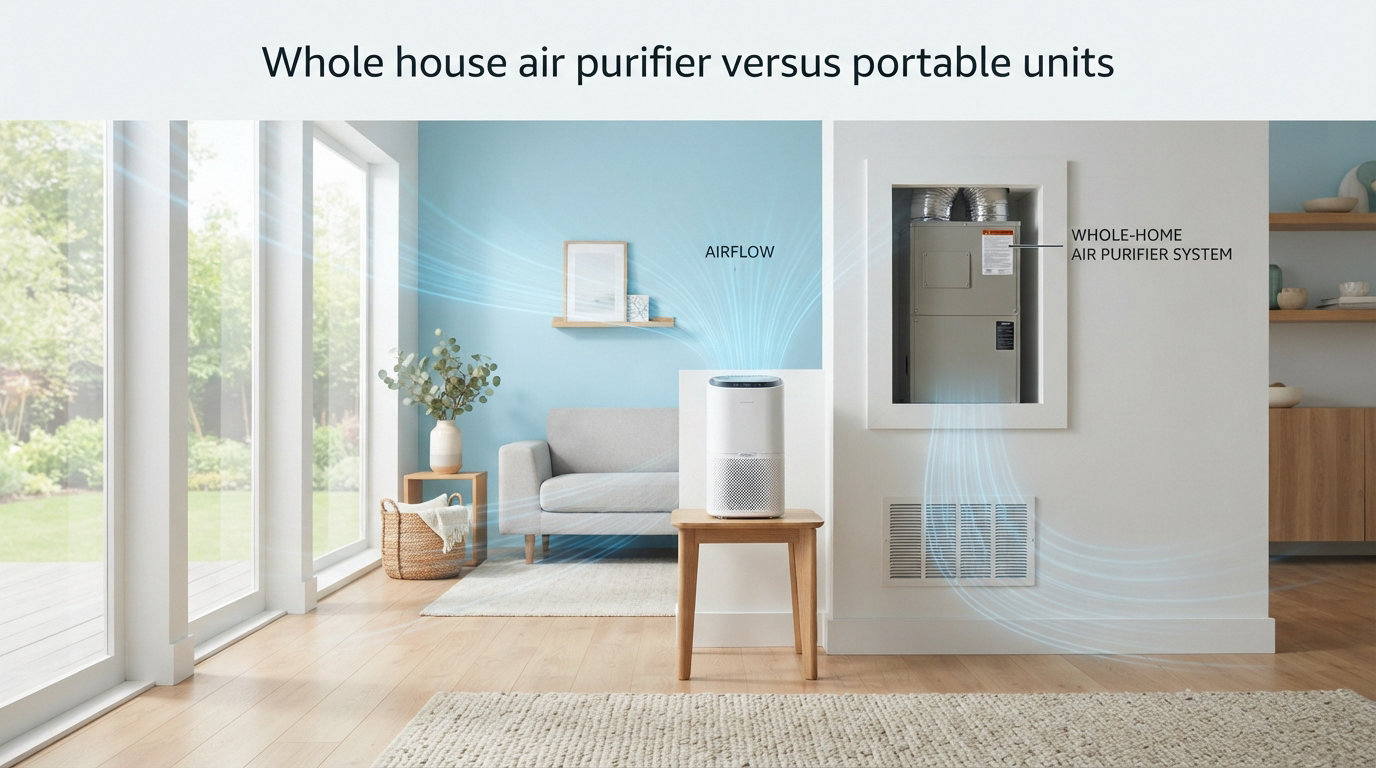
If you want clean air in every room without cluttering your home with multiple machines, a whole house air purifier versus portable units debate matters more than most buyers realize. A whole-house system ties into your HVAC to filter air across your entire home, while a portable air purifier is a standalone unit that cleans a single room at a time. The right choice comes down to coverage, cost, ownership status, and how much control you want over your indoor air quality.
After digging through forum threads from allergy sufferers, HVAC technician insights, and technical breakdowns from installers, I noticed most comparison guides skip the details people actually care about. They repeat marketing claims without explaining why whole-house systems often underperform in real homes. They also ignore the 2/3 rule for air purifiers, a sizing principle that directly answers whether one unit can clean an entire house.
This guide breaks down how each system works, where whole-house units fall short, and exactly which option fits your situation. Whether you own a 3,000 square foot home or rent a studio, you will leave with a clear answer. Let us start with the basics.
Table of Contents
What Is a Portable Air Purifier?
A portable air purifier is a standalone device you plug into a wall outlet and place in a single room. It pulls air through a series of internal filters, captures particles, and pushes clean air back out. Most models use a pre-filter for large dust, a HEPA filter for fine particles down to 0.3 microns, and an activated carbon layer for odors and gases.
These units are measured by their Clean Air Delivery Rate, or CADR rating, which tells you how fast they clean a specific room size. A higher CADR means faster filtration for that space. Coverage typically ranges from 100 square feet for compact bedroom units up to 1,000 or more square feet for large-room models.
The biggest advantage is simplicity, because you buy one, set it down, and turn it on with no installation, no HVAC technician, and no ductwork. Renters love them because they move with you from apartment to apartment.
The tradeoff is that you need separate units for each room if you want whole-home coverage. That means multiple purchases, multiple power outlets, and multiple filters to track over time.
What Is a Whole House Air Purifier?
A whole house air purifier is an integrated filtration system installed directly into your home’s HVAC ductwork. Instead of cleaning one room, it filters air as it circulates through your central heating and cooling system. Every time your blower fan runs, air passes through a large media filter or electronic air cleaner before reaching your vents.
These systems come in a few configurations. A bypass unit diverts a portion of return air through a high-efficiency filter and feeds it back into the system, while a non-bypass or inline unit filters all the air moving through the main return duct. Some also add UV light technology to neutralize bacteria, viruses, and mold spores at the coil.
The appeal is obvious because one system handles your entire home with no visible boxes sitting in your living room. The filters are much larger than portable units, so they hold more debris and need replacing less often. The catch is that performance depends entirely on how your HVAC system was designed and how often it actually runs.
Whole House Air Purifier Versus Portable Units: Head-to-Head Comparison
The core difference between a whole house air purifier versus portable units comes down to how air reaches the filter. A whole-house system only cleans air when your HVAC blower is running, and it relies on a return air path that may not pull from every room equally. A portable unit sits directly in the space you occupy, cleaning that air continuously regardless of what your furnace or AC is doing.
Here is how the two compare across the categories that matter most.
| Factor | Portable Air Purifier | Whole House System |
|---|---|---|
| Coverage area | Single room (100 to 1,000+ sq ft) | Entire home (limited by HVAC design) |
| Initial cost | Low to moderate | High, plus professional installation |
| Ongoing cost | Filter replacements every 6 to 12 months | Large media filter every 6 to 12 months |
| Filtration level | True HEPA captures 99.97% at 0.3 microns | Typically MERV 11 to 16, rarely true HEPA |
| Operating noise | Noticeable on high settings, quiet on low | Silent in living space, noise at HVAC unit |
| When it cleans | Continuous, whenever powered on | Only when HVAC blower runs |
| Installation | Plug and play | Requires HVAC technician and ductwork |
| Renter friendly | Yes | No |
Notice the filtration level row, because it reveals the biggest technical gap between the two. Most whole-house systems use MERV-rated media filters, which are excellent for capturing dust and pollen but do not match true HEPA standards.
A true HEPA filter captures 99.97 percent of particles at 0.3 microns. Most residential HVAC systems cannot push air through a dense HEPA filter without straining the blower motor, which is why installers rarely recommend them for whole-home use.
Portable units win on filtration purity, while whole-house systems win on convenience and whole-home reach. That last part assumes your ductwork actually delivers air evenly, which is where things get interesting.
Why Whole House Systems Underperform: HVAC Limitations Explained
Whole house air purifiers sound perfect on paper, but their real-world effectiveness depends on three HVAC factors that manufacturers rarely mention. Understanding these limitations is the single most important thing you can do before spending thousands on an integrated system.
Your HVAC Only Runs When Heating or Cooling Is Needed
A whole-house filter only cleans air while the blower fan is running, which is a problem in mild weather when your system may sit idle for hours or days at a time. During spring and fall, when pollen counts peak, your furnace and AC might barely run. That means no air is moving through the filter during the exact seasons you need it most.
Some homeowners solve this by switching the fan to run continuously, but that increases energy costs and wear on the blower motor. Portable units have no such limitation because they run whenever you press the power button.
Ductwork Rarely Creates a Balanced Return Air Path
Most homes have a single large return air grille, often in a central hallway. Bedrooms and distant rooms rely on air flowing under doors or through transfer grilles to make it back to that return. The result is uneven airflow, where rooms far from the return vent get filtered poorly while rooms near it get cleaned repeatedly.
A portable unit placed in your bedroom cleans that room’s air directly. It does not depend on air traveling down a hall, under a door, and through ductwork to reach a filter. For allergy sufferers who spend eight hours a night in one room, this matters enormously.
Blower Fans Are Not Designed for Dense Filters
Your HVAC blower was sized to move air through a standard MERV 8 filter. Upgrading to a dense MERV 16 or true HEPA media increases static pressure, which forces the motor to work harder. In some homes, this reduces airflow enough to cause coil freezing in summer or overheating in winter.
A competent HVAC technician will measure static pressure before recommending a high-efficiency whole-house filter, but many skip this step entirely. This is why forum users on Reddit communities like r/AirPurifiers and r/hvacadvice repeatedly report that adding a whole-house filter did not noticeably improve their allergy symptoms. The air simply was not moving through the filter often enough or evenly enough to matter.
Pros and Cons of Each System
Let us lay out the honest strengths and weaknesses of each approach so you can weigh them against your own situation.
Portable Air Purifier Pros
Portable units are affordable and require zero installation, so you can buy one today and breathe cleaner air tonight. They offer true HEPA filtration, which captures particles as small as 0.3 microns with 99.97 percent efficiency. They run continuously regardless of your HVAC status, so they clean during shoulder seasons when whole-house systems sit idle.
You can move them from room to room or take them when you relocate. They are ideal for renters and anyone who cannot modify their ductwork. Most models also include activated carbon for removing odors, smoke, and volatile organic compounds that whole-house media filters often miss.
Portable Air Purifier Cons
You need multiple units for whole-home coverage, which adds up in cost and floor space. They are visible in your living areas and produce noticeable fan noise on higher speeds. Filter replacements for several units can cost more annually than one large whole-house media filter.
Whole House Air Purifier Pros
A whole-house system is invisible and silent in your living space, using large filter media that lasts longer and captures more total debris before needing replacement. It cleans every room your ductwork reaches, which means no hauling units around. For large homes where running multiple portables is impractical, an integrated system is the only realistic path to whole-home filtration.
It also protects your HVAC equipment by capturing dust before it reaches the coil and blower. Over years, this can reduce maintenance costs and extend equipment life.
Whole House Air Purifier Cons
Upfront cost is high, including the unit itself and professional installation. Performance depends entirely on how often your blower runs and how well your ductwork distributes air. Most systems cannot use true HEPA filters without overloading the blower motor.
You cannot take it with you if you move. And if you rent, this option is off the table entirely.
Which Air Purifier Is Right for You?
Choosing between a whole house air purifier versus portable units comes down to four questions. Answer them honestly and the right path becomes obvious.
Do You Own Your Home and Have Central HVAC?
If you rent or live in a home without ductwork, portable is your only practical option. Whole-house systems require permanent modification to HVAC equipment. If you own a home with central air and want whole-home coverage with minimal visible equipment, a whole-house system earns consideration.
How Large Is Your Home?
For studios and one-bedroom apartments, a single portable unit handles the space easily. For homes under 1,500 square feet, two well-placed portable units typically outperform a whole-house system because they run continuously and clean air directly. For homes over 2,500 square feet, the math shifts toward a whole-house system supplemented by a portable in the bedroom.
What Are You Trying to Filter?
If wildfire smoke, severe allergies, or asthma are your concern, true HEPA filtration matters and portable units deliver this reliably. Whole-house systems rarely achieve HEPA-level filtration due to blower pressure limits. For general dust and pollen reduction across a large home, a MERV 13 or 16 whole-house media filter does a solid job.
What Is Your Budget?
Portable units keep upfront costs low and spread spending over time as you add units. Whole-house systems require a larger initial investment but offer lower ongoing maintenance per square foot filtered. If cash flow matters more than total coverage, start with portables and expand as needed.
What Is the 2/3 Rule for Air Purifiers?
The 2/3 rule is a sizing guideline that says your air purifier’s Clean Air Delivery Rate should equal at least two-thirds of the room’s area in square feet. For a room that is 300 square feet, you need a unit with a CADR of at least 200. This rule guarantees the purifier can cycle all the air in the room roughly every 15 minutes, which is the minimum exchange rate for effective particle removal.
The rule also explains why one portable unit cannot clean an entire house. No single unit has a CADR high enough to satisfy the 2/3 threshold for a whole home. That is why whole-home coverage requires either multiple portables or an HVAC-integrated system.
Long-Term Costs: Filters, Energy, and Maintenance Over Time
Most comparison guides stop at purchase price, but long-term costs tell the real story. Filter replacements and energy consumption add up over years, and the math differs sharply between the two approaches.
A portable HEPA unit typically needs a new filter every 6 to 12 months, with replacements costing between 30 and 80 dollars per unit depending on brand and size. If you run three portables across a home, that adds up to 90 to 240 dollars annually just in filters. Energy draw is modest, usually between 30 and 80 watts on average settings, which translates to a few dollars per month on your electric bill.
Whole-house media filters are larger and last longer, often 6 to 12 months depending on household dust load and pet count. A replacement media filter for a system like an AprilAire or Carrier unit typically runs 40 to 120 dollars, but you only buy one per year. The tradeoff is that running your HVAC blower continuously to keep air moving through that filter can add 20 to 50 dollars per month to your energy bill during shoulder seasons.
Over a five-year span, the costs tend to converge. Three portable units with annual filter changes might total 600 to 1,200 dollars in consumables and power. A whole-house system with continuous fan operation might total 400 to 1,000 dollars over the same period, so base your choice on performance and fit rather than long-term cost alone.
Frequently Asked Questions
Is a whole house air purifier better than a portable air purifier?
A whole house air purifier is better for whole-home convenience and protecting HVAC equipment, but a portable air purifier is better for targeted HEPA-level cleaning in the rooms where you spend the most time. Most allergy sufferers get the best results from a whole-house system for general dust reduction plus a portable unit in the bedroom.
What is the 2 3 rule for air purifiers?
The 2/3 rule states that your air purifier’s CADR rating should be at least two-thirds of your room’s square footage. A 300 square foot room needs a CADR of 200 or higher. This guarantees the air cycles through the filter every 12 to 15 minutes for effective particle removal.
Is a whole home air purification system worth it?
A whole home air purification system is worth it if you own a large home with central HVAC, want invisible whole-home filtration, and have the budget for installation. It is not worth it if you rent, have a small home, or need true HEPA filtration for severe allergies, since portable units deliver HEPA performance at a lower cost.
Can one air purifier clean an entire house?
No single air purifier can effectively clean an entire house. Air purifiers work best in enclosed single rooms because they rely on pulling nearby air through the filter. For whole-home coverage you need either a whole-house HVAC-integrated system or multiple portable units placed in each room where you spend time.
Conclusion: Making the Right Choice for Your Air
The whole house air purifier versus portable units decision is not about which is objectively better, but which fits your home, budget, and health needs. Whole-house systems deliver invisible whole-home coverage for large homes with central HVAC, but their effectiveness hinges on blower runtime and ductwork design that most homes do not optimize well. Portable units deliver true HEPA filtration exactly where you need it, run continuously, and work for renters and homeowners alike.
For most people, the smartest approach is hybrid. Install a whole-house media filter for general dust reduction and equipment protection, then add a portable HEPA unit in the bedroom where you spend a third of your life. That combination addresses both the broad coverage and the targeted filtration that neither system achieves alone. Use the 2/3 rule to size your portable correctly, and you will notice the difference within days.