
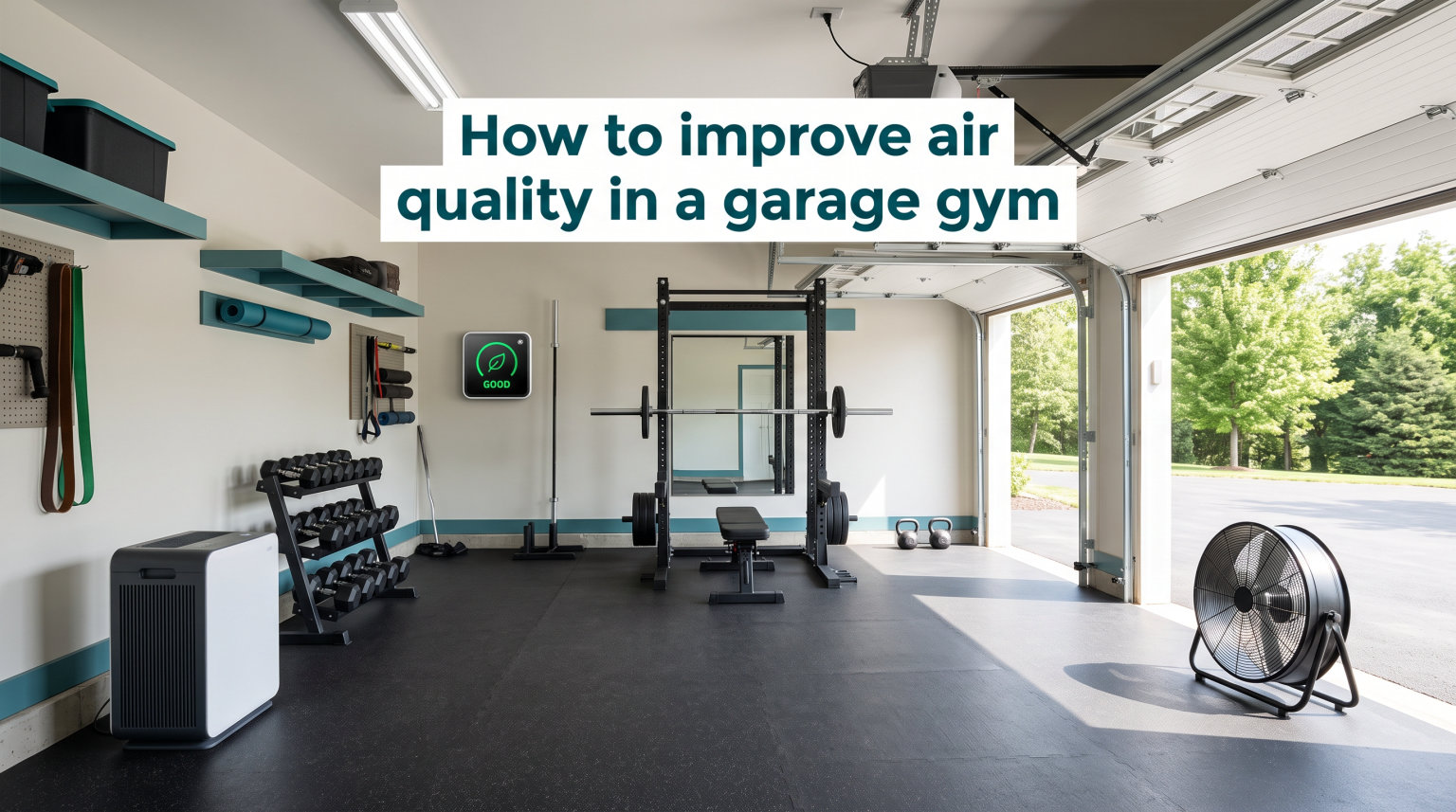
When you train hard in a garage gym, your breathing rate jumps to as much as 10 times your resting level. That means you are inhaling a massive volume of whatever is floating in the air around you, from rubber mat fumes to mold spores to invisible carbon monoxide. If you have been wondering how to improve air quality in a garage gym, you are asking the right question, because the stuff you cannot see can quietly undermine your gains, your energy, and your health.
I have spent years training in a converted garage, and I learned the hard way that a stuffy, smelly workout space is not just annoying. It is a real health hazard. The good news is that cleaning up your garage gym air is entirely doable with a mix of ventilation, filtration, humidity control, and some smart habits. This guide walks through every major cause of poor garage gym air and gives you practical, tested solutions for each one.
Whether you are dealing with musty odors, headaches after lifting, wildfire smoke, or freezing winter dryness, the strategies below will help you build a healthier place to train. Let us break down exactly what is in your air and how to fix it.
Table of Contents
Why Garage Gym Air Quality Is a Bigger Deal Than You Think
Poor air quality in a garage gym matters more than in a normal room because of one simple fact: you breathe harder when you work out. During intense sets, you pull in far more air per minute than you do sitting at a desk. That higher volume means your lungs absorb a bigger dose of whatever pollutants are present.
Garages are also uniquely problematic spaces. They are often attached to homes with vehicles inside, they tend to be poorly sealed against moisture, and they are loaded with materials that off-gas chemicals. Rubber flooring, stored chemicals, old insulation, and concrete that wicks groundwater all contribute to a cocktail of contaminants.
People with asthma, allergies, or other respiratory conditions feel the effects fastest, but even perfectly healthy lifters can experience headaches, fatigue, dizziness, and reduced performance from breathing polluted air session after session.
7 Ways to Improve Air Quality in a Garage Gym
Here is the quick overview of the most effective strategies, and we will break down each one in detail below.
Identify and remove the source of pollution (mold, VOCs, fumes, dust).
Ventilate by bringing in fresh outdoor air through doors, windows, and fans.
Add an air purifier with a true HEPA filter and activated carbon.
Control humidity with a dehumidifier or humidifier depending on the season.
Use DIY filtration hacks like a box fan and furnace filter combo.
Monitor your air with an air quality monitor, radon test, and carbon monoxide detector.
Clean regularly to keep dust, sweat, and odors under control.
These seven steps form a complete system. Skip any one of them and you leave a gap that pollutants will exploit. Now let us look at what is actually polluting your gym so you know what you are fighting.
Identify What Is Polluting Your Garage Gym Air
You cannot fix air quality problems until you know what is causing them. Garages collect a unique mix of pollutants that you would not find in a bedroom or living room. Here are the five biggest culprits and how to recognize each one.
Mold and Moisture Buildup
Mold is the number one air quality complaint in garage and basement gyms. It thrives in damp, poorly ventilated spaces, and concrete garage floors are notorious for wicking up groundwater from the soil below. If your gym smells musty, earthy, or sour, mold is almost certainly the cause.
You might not see visible mold growth and still have a problem. Mold spores travel through the air and can colonize behind walls, under mats, and inside insulation. Black spots on concrete, peeling paint, or a persistent damp smell are all warning signs.
Breathing mold spores during exercise can trigger allergic reactions, asthma attacks, sinus congestion, and lingering respiratory infections. If you notice your throat feeling scratchy or your nose running every time you train, mold is a prime suspect.
VOCs from Rubber Mats and Equipment
Volatile organic compounds, or VOCs, are chemicals that evaporate into the air at room temperature. In a garage gym, the biggest source of VOCs is almost always your rubber flooring. Horse stall mats, puzzle mats, and rubber-encased dumbbells all release gases as they age and warm up.
That distinctive rubber smell is literally chemical off-gassing. New mats are the worst offenders, but even older equipment can continue releasing VOCs for months or years, especially in a warm garage. The problem intensifies during summer when heat speeds up the off-gassing process.
VOC exposure can cause headaches, dizziness, nausea, and eye or throat irritation. Several members of the home gym community on Reddit report getting headaches after training in freshly matted garages, which is a classic VOC symptom. Letting new mats air out outdoors for several days before installation dramatically reduces this problem.
Dust and Allergens
Garages are dusty by nature. Concrete floors shed fine particles, garage doors let in pollen and outdoor dust every time they open, and chalk used for lifting adds to the airborne particulate load. If you can see dust floating in a beam of sunlight, you are looking at the problem.
During exercise, those particles travel deep into your lungs with every breath. For allergy sufferers, pollen and dust mites in a garage gym can turn a workout into a sneezing, watery-eyed ordeal. Even if you do not have allergies, fine dust can irritate your airways over time.
Regular sweeping is not enough because it just stirs dust back into the air. A vacuum with a HEPA filter, combined with an air purifier, is the effective way to keep particulate levels down.
Gasoline and Vehicle Exhaust Fumes
This is the danger that most garage gym guides gloss over, and it is a serious one. If you park your car in the same garage where you work out, you are sharing air space with gasoline vapors, exhaust residue, and potentially carbon monoxide.
Even a cold engine that has been sitting overnight can release fumes. Gasoline vapors contain benzene and other compounds linked to serious health problems with repeated exposure. Carbon monoxide is odorless, invisible, and potentially lethal at high concentrations.
One Reddit user shared a harrowing story about feeling dizzy and nauseous after training in a garage where a vehicle had recently been running. If your garage doubles as a parking spot, never start the car with the gym door open to the house, install a carbon monoxide detector, and ventilate thoroughly before every session.
Radon Gas in Attached Garages
Radon is a naturally occurring radioactive gas that seeps up from the ground through cracks in concrete floors and foundations. It is invisible, odorless, and the second leading cause of lung cancer after smoking. Many garages sit directly on concrete slabs with no vapor barrier, making them prime entry points for radon.
Almost no garage gym guides talk about radon, but it is a real and measurable threat depending on where you live. Certain regions of the United States have naturally high radon levels in the soil. You can buy a radon test kit for around 15 to 20 dollars, and every home gym owner in an attached garage or basement should run one.
Testing takes a few days to a few months depending on the kit type. If your results come back above 4 picocuries per liter, the EPA recommends installing a radon mitigation system, which typically involves a vent pipe and fan that pulls gas out from under the slab.
How to Ventilate a Garage Gym Properly
Ventilation is the single most important step in improving garage gym air quality because it addresses the root problem: stale, polluted indoor air. No filter or purifier can fully compensate for a sealed room with no fresh air exchange. Here is how to get air moving the right way.
The simplest approach is natural ventilation. Open the garage door, any side doors, and windows at least 15 to 30 minutes before your workout to flush out accumulated pollutants. If outdoor air quality is good, keep some airflow going during your session by cracking the main door a few feet.
For mechanical ventilation, an exhaust fan is your best friend. A wall-mounted exhaust fan pulls stale air out of the garage, which creates negative pressure that draws fresh air in through other openings. Look for a fan rated for your garage’s cubic footage, and aim for enough airflow to replace the air in your gym every 15 to 20 minutes.
Wall-mounted oscillating fans help circulate air within the space but do not replace air, so they are a supplement rather than a solution. For maximum effect, pair an exhaust fan pulling air out with an intake vent or cracked door letting fresh air in. This creates a continuous flow that keeps pollutants from building up.
Avoid the common mistake of only opening the garage door during workouts without any cross-ventilation. Without a second opening for air to flow through, you get minimal exchange. Open both ends of the garage whenever possible to create a wind-tunnel effect.
Choosing an Air Purifier for Your Garage Gym
An air purifier is the workhorse of garage gym air quality because it actively filters contaminants out of the air. Ventilation brings in fresh air, but a purifier captures the particles and gases that remain. Not all purifiers are equal, though, so here is what to look for.
First, insist on a true HEPA filter. True HEPA captures 99.97 percent of particles down to 0.3 microns, which covers dust, pollen, mold spores, and even some bacteria. Avoid products labeled HEPA-type or HEPA-style, because those terms are not held to the same standard and let far more particles through.
Second, you need activated carbon for gases and odors. HEPA filters do not capture VOCs, rubber fumes, or gasoline vapors. Activated carbon adsorbs these gaseous pollutants through its porous structure. For a garage gym with rubber mats or vehicle proximity, a thick carbon filter is just as important as the HEPA layer.
Third, check the Clean Air Delivery Rate, or CADR. This number tells you how quickly the purifier cleans a given volume of air. For a typical two-car garage of about 400 square feet, look for a purifier with a smoke CADR of at least 300. Undersized purifiers will run constantly without ever catching up to the pollution load.
Finally, consider noise level and filter replacement cost. A purifier running during a workout needs to be tolerable, and replacing filters every 6 to 12 months is an ongoing expense. Factor both into your decision rather than just looking at the upfront price.
Controlling Humidity in Your Garage Gym
Humidity control is the bridge between air quality and comfort. Too much moisture feeds mold growth and makes the air feel heavy and hard to breathe. Too little moisture dries out your throat and nasal passages, making you more susceptible to irritation. The sweet spot for a garage gym is between 30 and 50 percent relative humidity.
In most garages, the problem is excess moisture, especially in humid climates or during summer. A dehumidifier pulls water out of the air and collects it in a tank or drains it through a hose. For a standard garage gym, look for a dehumidifier rated for at least 50 pints per day. Run it during and after workouts, and check the collection tank regularly.
Condensation on windows, concrete, or metal equipment is a sign your humidity is too high. Musty smells almost always point to moisture problems as well. If you live in a humid region, a dehumidifier is not optional, it is essential equipment for your gym.
In dry winter climates, the opposite problem occurs. Heating a garage with a space heater drives humidity down further, which can leave your throat raw and your skin dry after workouts. In that case, a humidifier adds moisture back to the air. Monitor humidity with a cheap hygrometer and adjust based on actual readings rather than guessing.
Budget DIY Air Quality Hacks
You do not need to spend hundreds of dollars to start improving your garage gym air. Some of the most effective solutions are cheap, simple, and surprisingly powerful.
The box fan and furnace filter trick is a favorite in the home gym community. Take a standard 20-inch box fan and tape a MERV 11 or MERV 13 furnace filter to the back of it. When you turn the fan on, it pulls air through the filter and captures dust, pollen, and mold spores for a fraction of what a commercial purifier costs. Total cost is typically under 40 dollars.
For around 100 dollars, you can build a more powerful DIY filter using a Corsi-Rosenthal box design, which uses multiple furnace filters arranged around a box fan. These setups have been tested by researchers and can match or exceed the performance of expensive commercial units.
Houseplants offer a modest natural boost to air quality. Peace lilies, spider plants, and snake plants are commonly recommended for filtering indoor air. While research shows that plants alone cannot clean a polluted garage, they do help with minor odor and humidity regulation when combined with other strategies.
Sealing gaps around your garage door with weather stripping prevents outdoor dust, pollen, and humidity from constantly entering your space. This is a 20-dollar fix that pays dividends all year, especially during allergy season and wildfire smoke events.
Seasonal Garage Gym Air Quality Checklist
Air quality needs change with the seasons, and what works in July will not cut it in January. Here is how to adjust your approach throughout the year.
In summer, heat and humidity are your main enemies. High temperatures speed up VOC off-gassing from rubber mats and create ideal conditions for mold. Run a dehumidifier, schedule workouts for early morning or evening when temps are lower, and ventilate aggressively. Keep your air purifier running on its highest setting during and after sessions.
In winter, the challenge shifts to dry air and lack of ventilation. You will naturally want to keep the garage closed to retain heat, but that traps pollutants. Crack a door or window for at least 10 minutes during your warmup to exchange air, even on cold days. If humidity drops below 30 percent, add a humidifier to protect your airways.
During wildfire season, the rules change entirely. Outdoor air may be more dangerous than indoor air, so you must reverse your strategy. Keep all doors and windows tightly sealed, run your air purifier continuously on its highest CADR setting, and consider upgrading to a higher MERV filter. An N95 mask during low-intensity workouts is a reasonable precaution when air quality index readings are in the unhealthy range.
How to Test and Monitor Air Quality in Your Garage Gym
You cannot manage what you cannot measure. Investing in a few monitoring tools takes the guesswork out of air quality and tells you whether your fixes are actually working.
A dedicated air quality monitor is the best starting point. Look for one that measures PM2.5 (fine particulate matter), VOC levels, humidity, and temperature. These devices cost 50 to 150 dollars and give you real-time feedback on what is in your air. Many users on the home gym subreddit report being shocked at how high their particulate readings spike during chalk-heavy lifting sessions.
For radon, buy a short-term test kit from a hardware store or online. These kits sit in your gym for a few days and then get mailed to a lab for analysis. If results are elevated, follow up with a long-term test to confirm before investing in mitigation.
A carbon monoxide detector is non-negotiable if your garage shares space with a vehicle or if you use any combustion heater. Carbon monoxide is odorless and deadly, and a 20-dollar detector is the cheapest insurance you will ever buy. Place it at breathing height near your training area.
How to Keep a Garage Gym Clean and Smelling Fresh
Cleaning is the foundation that makes every other air quality strategy more effective. Dust, sweat, and chalk build up fast in a garage gym, and without regular maintenance, your purifier and ventilation system are fighting an uphill battle.
Vacuum your floors weekly with a HEPA-filtered vacuum rather than sweeping, which just launches dust back into the air. Wipe down equipment after every session to prevent sweat buildup that feeds bacteria and odors. A spray bottle with a mild vinegar solution works well for daily cleaning without adding chemical fumes.
To eliminate persistent odors, wash your rubber mats with a mixture of dish soap and warm water, then let them dry completely. For extra odor fighting, sprinkle baking soda on mats overnight and vacuum it up the next morning. Activated charcoal bags placed around the gym also absorb lingering smells passively.
Wash your gym towels, wraps, and belts regularly, because fabric that absorbs sweat becomes a breeding ground for odor-causing bacteria. Keep a small fan running after workouts to dry out the space, since lingering moisture is the fastest path to mold and mustiness.
FAQs
How to ventilate a garage gym?
Open the garage door and any side doors or windows at least 15 to 30 minutes before your workout to flush out stale air. For continuous airflow, install a wall-mounted exhaust fan that pulls polluted air out while fresh air enters through a cracked door or vent. Always create cross-ventilation by opening two openings so air flows through rather than stagnating.
How to improve air quality in garage?
Start by removing pollution sources like mold, stored chemicals, and excess moisture. Add natural ventilation through doors and windows, run an air purifier with a true HEPA filter and activated carbon, and control humidity between 30 and 50 percent with a dehumidifier. Test for radon and install a carbon monoxide detector if vehicles share the space.
How to make a garage gym smell better?
Air out new rubber mats outdoors for several days before installation to reduce VOC off-gassing. Run an air purifier with activated carbon to adsorb odor molecules, wash mats with dish soap and water, and place baking soda or activated charcoal bags around the gym. Keep humidity controlled, because dampness is the leading cause of musty gym smells.
How to keep a garage gym clean?
Vacuum floors weekly with a HEPA-filtered vacuum instead of sweeping to avoid launching dust into the air. Wipe down all equipment after each session with a mild cleaner, wash towels and wraps regularly, and run a fan after workouts to dry the space. Clean rubber mats with soap and water monthly to prevent sweat and bacteria buildup.
Wrapping Up
Learning how to improve air quality in a garage gym comes down to a simple framework: identify your pollutants, ventilate with fresh air, filter with HEPA and carbon, control humidity, and maintain the space with regular cleaning. None of these steps is complicated, but together they transform a dangerous training environment into a healthy one.
Start with the basics today. Open your garage door and let fresh air in, pick up a radon test kit and a carbon monoxide detector, and consider a budget-friendly box fan filter hack while you research a full air purifier. Your lungs will thank you, and your workouts will feel noticeably better once the air around you is clean.