
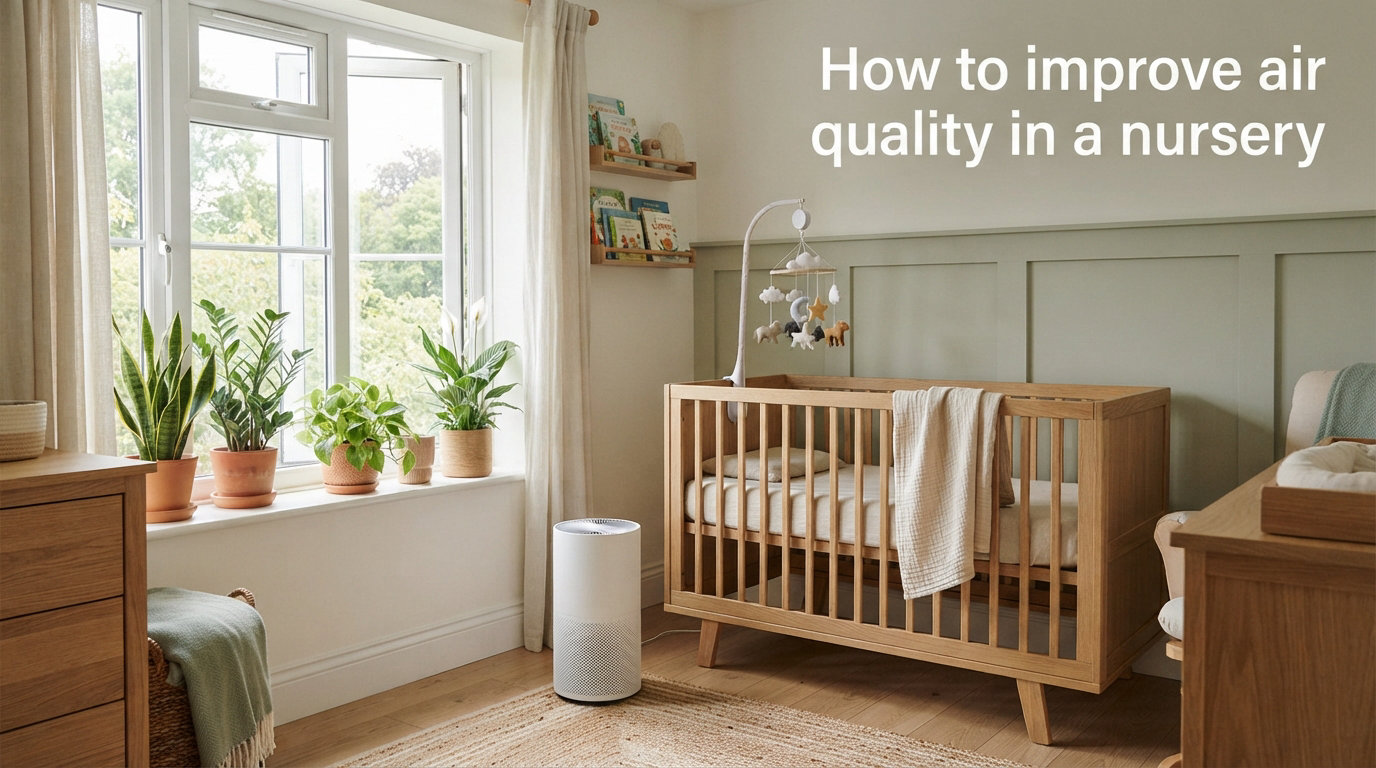
When we set up our baby’s nursery, the décor was the easy part. The harder question was the air itself. A newborn breathes around 40 times per minute — roughly twice the rate of an adult — and their lungs are still developing well past the toddler years.
Learning how to improve air quality in a nursery means thinking about what you cannot see: fine particulates drifting off new furniture, formaldehyde off-gassing from pressed-wood cribs, humidity swings that feed dust mites and mold, and CO2 that quietly climbs overnight in a closed room.
In this guide, I’ll walk through the same checklist we used, including the steps that actually moved the needle on our air quality monitor — and a few mistakes we made along the way (like that new dresser that sent our PM2.5 readings soaring for two weeks).
You’ll find specific humidity targets, HEPA filter guidance, wildfire smoke protocols, and a section on CO2 monitoring that most nursery guides skip entirely. Everything here is current for 2026 and based on what actually showed up on a real monitor.
Table of Contents
Why Nursery Air Quality Matters More Than You Think
Babies are uniquely vulnerable to indoor air pollution. Their lungs continue developing through age 8, their airways are narrower than ours, and they inhale more air per pound of body weight than adults do.
That means the same pollutant load hits a 10-pound infant far harder than it hits you. Poor nursery air quality is linked to higher rates of wheezing, asthma, allergies, eczema flare-ups, and disrupted sleep.
Research also points to a connection between indoor air pollution and Sudden Infant Death Syndrome (SIDS). A meta-analysis in the journal Pediatrics found infants exposed to higher levels of particulate matter had elevated SIDS risk. Cleaner air is not a SIDS guarantee, but it is one of the few risk factors you can actually control.
One more reason to care: outdoor PM2.5 can be 2 to 5 times lower indoors — or far higher, depending on what is in the room. You cannot guess. You have to measure.
How to Improve Air Quality in a Nursery: 10 Steps That Work
1. Control Humidity (Target 35 to 50%)
Humidity is the single most under-discussed factor in nursery air. Too dry (below 30%) irritates tiny airways and worsens eczema. Too humid (above 50%) fuels dust mites, mold, and bacterial growth.
The sweet spot is 35 to 50% relative humidity, and you cannot hit it by guessing. Buy a digital hygrometer — they cost under $15 — and place it near the crib at roughly the same height your baby sleeps.
If readings dip low in winter, add a cool-mist humidifier (warm-mist units pose a burn risk and are not recommended for nurseries). If you live in a humid climate or have a basement nursery, run a dehumidifier instead. We sized ours to the room’s square footage and dump the reservoir daily to prevent biofilm.
Clean humidifier tanks weekly with white vinegar. A dirty humidifier aerosolizes bacteria straight into the air your baby breathes.
2. Run a True HEPA Air Purifier
A True HEPA filter captures 99.97% of particles 0.3 microns and larger — including dust, pollen, pet dander, and most smoke particles. Look for the words “True HEPA” specifically, since “HEPA-type” or “HEPA-style” filters have no enforced standard.
Size the purifier to your room using the CADR (Clean Air Delivery Rate) rating. A simple rule of thumb: aim for a CADR at least two-thirds of the room’s square footage.
Run it 24/7 on a low, quiet setting rather than on high intermittently. Continuous low-speed filtration moves more air over a full day than periodic blasts. Replace the filter on schedule — usually every 6 to 12 months — because a saturated filter stops capturing new particles and can actually release trapped ones back into the room.
3. Reduce VOCs and Formaldehyde at the Source
Volatile Organic Compounds (VOCs) are gases emitted by paints, adhesives, pressed-wood furniture, mattresses, and even new clothing. Formaldehyde is one of the most common — and one of the most concerning — since it is a known respiratory irritant and probable carcinogen.
New nursery furniture is the largest single source. Our brand-new dresser pushed VOC levels above 600 ppb for nearly two weeks before settling. To avoid this, look for solid wood construction, low-VOC finishes, and ideally GREENGUARD Gold certification.
If you cannot avoid new pressed-wood items, unpack them outside, let them air out for at least 72 hours before bringing them into the nursery, and run the air purifier on high for the first two weeks.
Use only zero-VOC or low-VOC paint, and finish painting at least four weeks before the due date. Skip scented candles, plug-in air fresheners, and aerosol sprays entirely.
4. Ventilate the Room Every Day
Filtration alone cannot remove CO2 or fully refresh stale air. The only way to clear a stuffy nursery is to exchange indoor air with outdoor air.
Open the windows for 10 to 15 minutes each morning, even in winter (just dress the baby warmer during the airing-out). Cross-ventilate with a window on the opposite wall if possible.
Avoid opening windows during high-pollution days, heavy traffic hours, or active wildfire smoke events. Check your local AQI first — keep windows closed when outdoor AQI exceeds 100.
5. Maintain Your HVAC Filters
If your home has forced-air heating or cooling, every room is connected to the same duct system. A dirty filter means dirty air in the nursery.
Upgrade to a MERV 13 filter if your HVAC system can handle it. MERV 13 captures particles down to 0.3 microns — comparable to a basic HEPA — and traps most bacteria and fine smoke particles. Check your system manual first, since some older units struggle with the airflow resistance.
Replace filters every 60 to 90 days, or more often if you have pets, allergies, or wildfire exposure. Smart filters like the Filtrete Smart line send phone alerts when replacement is due, which helps during newborn-sleep-deprived weeks.
6. Choose Non-Toxic Furniture with GREENGUARD Gold Certification
GREENGUARD Gold is the strictest third-party certification for chemical emissions in furniture. Products carrying it have been tested for over 10,000 chemicals and meet safety thresholds even for sensitive environments like schools and healthcare facilities.
When shopping for a crib, dresser, and glider, prioritize GREENGUARD Gold, solid wood, and water-based finishes. Avoid inexpensive particleboard when possible, or air it out thoroughly before use.
Older or secondhand solid wood furniture can actually be safer than brand-new pressed-wood pieces — most have already finished off-gassing.
7. Use a HEPA Vacuum and Damp-Dust Weekly
Dust is a reservoir for allergens, flame retardants, and settled particulate matter. Standard vacuums stir fine dust back into the air instead of capturing it.
A HEPA vacuum (look for sealed-system construction, not just a HEPA exhaust filter) traps particles at the same 0.3-micron standard. Vacuum the nursery floor, crib skirt, and any rugs at least weekly.
Follow up with damp dusting using a microfiber cloth and water. Dry dusting just launches particles back into the air.
8. Monitor CO2 and Track PM2.5 in Real Time
This is the step most nursery guides skip — and the one Reddit parents ask about most often. A small indoor air quality monitor (under $100) tracks PM2.5, CO2, VOCs, temperature, and humidity in real time.
CO2 above 1,000 ppm causes drowsiness and indicates the room needs fresh air. Above 2,000 ppm is genuinely unhealthy. In a closed nursery overnight with a humidifier running, levels can climb surprisingly fast.
PM2.5 readings let you see immediately whether a new piece of furniture, a candle in another room, or a cooking session is affecting the nursery air. Once you can see the numbers, you can fix the source.
9. Protect the Nursery During Wildfire Smoke Events
Wildfire smoke is a growing threat in much of the country, and it is not something to wait out unprepared. Even distant fires can push PM2.5 to hazardous levels indoors if windows leak and HVAC filters are weak.
During smoke events, seal windows with weather-stripping or painter’s tape, upgrade to MERV 13 filters, and run the air purifier on high 24/7. Avoid vacuuming (it stirs settled ash) and avoid cooking with gas or frying foods, both of which add to the indoor PM load.
If outdoor AQI exceeds 150, consider a DIY box-fan filter (a MERV 13 filter taped to a standard 20-inch box fan) as a backup unit. They are loud but effective, and they cost under $40 to build.
10. Add Plants for Supplementary Filtration
Plants are a polarizing topic. The famous 1989 NASA study suggested houseplants scrub VOCs, but newer research shows the effect in a real home is small — you would need roughly one plant per square foot to match an air purifier.
That said, plants are harmless, add humidity, and look great in a nursery. Spider plants, peace lilies, and Boston ferns are non-toxic to children and pets.
Treat plants as a complement to filtration, not a replacement. Skip them if your baby has a known mold allergy, since moist potting soil can harbor spores.
What to Avoid in the Nursery
Some products are net negatives for nursery air quality, full stop.
Scented candles and plug-in air fresheners release VOCs, phthalates, and ultrafine particles. Even “natural” fragrances are unregulated and can irritate developing airways.
Smoking or vaping of any kind — even in another room — leaves thirdhand residue on fabrics and surfaces. There is no safe exposure level for infants.
Thick pile carpeting traps dust, allergens, and moisture. If the nursery already has it, vacuum twice weekly with a HEPA vacuum and consider a low-pile rug you can wash.
Gas space heaters produce combustion byproducts including nitrogen dioxide, which has no place in a baby’s room.
Quick Nursery Air Quality Checklist
Short on time? Here is the version I keep on my own phone:
- Hygrometer in the room — target 35 to 50%
- True HEPA purifier sized to the room, running 24/7
- Windows open 10 minutes daily (when AQI is below 100)
- Zero-VOC paint, finished 4+ weeks before baby arrives
- GREENGUARD Gold crib and key furniture
- HEPA vacuum weekly, damp-dust weekly
- Replace HVAC filter every 60 to 90 days (MERV 13 if possible)
- Air quality monitor for PM2.5, CO2, and VOCs
- No candles, plug-ins, smoking, or aerosol sprays
- Smoke-event plan: seal windows, run purifier on high
If you only do five of these, prioritize the air purifier, humidity control, the no-fragrance rule, source reduction (furniture and paint), and HVAC filter upgrades. Those five cover most of the risk.
Frequently Asked Questions
What are 5 ways to improve air quality in a nursery?
The five highest-impact steps are: run a True HEPA air purifier sized to the room, keep humidity between 35 and 50 percent with a hygrometer, swap your HVAC filter for a MERV 13 rated filter every 60 to 90 days, ventilate by opening windows for 10 minutes daily when outdoor AQI is below 100, and remove pollutant sources by choosing GREENGUARD Gold furniture and zero-VOC paint.
Should you put an air purifier in a nursery?
Yes. A True HEPA air purifier is one of the single most effective ways to remove fine particulates, allergens, and smoke particles from nursery air. Size it correctly to the room using the CADR rating, run it continuously on a low setting, and replace the filter every 6 to 12 months.
How to improve air quality in baby room?
To improve baby room air quality, control humidity to 35 to 50 percent, run a True HEPA purifier 24/7, ventilate daily, use low-VOC or zero-VOC paint and GREENGUARD Gold furniture, replace HVAC filters with MERV 13 rated filters, vacuum weekly with a HEPA vacuum, and avoid candles, air fresheners, and smoking entirely.
What AQI is safe for babies?
For infants, an outdoor AQI below 50 is ideal and below 100 is generally acceptable for outdoor time. Indoors, aim for PM2.5 readings under 12 micrograms per cubic meter on your air quality monitor. When outdoor AQI exceeds 100, keep nursery windows closed and run the air purifier on high.
How to improve air quality in home with plants?
Plants provide a small supplementary filtration benefit by absorbing some VOCs and releasing humidity, but research shows you would need roughly one plant per square foot to match a single HEPA air purifier. Use spider plants, peace lilies, or Boston ferns as complements to filtration, not replacements.
Final Thoughts
Improving nursery air quality is one of those projects that feels overwhelming until you break it down. Once you have the purifier running, the hygrometer in place, and a no-fragrance rule in the home, the rest is mostly maintenance.
Start with the five highest-impact steps in the checklist above, then add more as time and budget allow. Knowing how to improve air quality in a nursery is the first step — doing it one piece at a time is what actually protects your baby.