
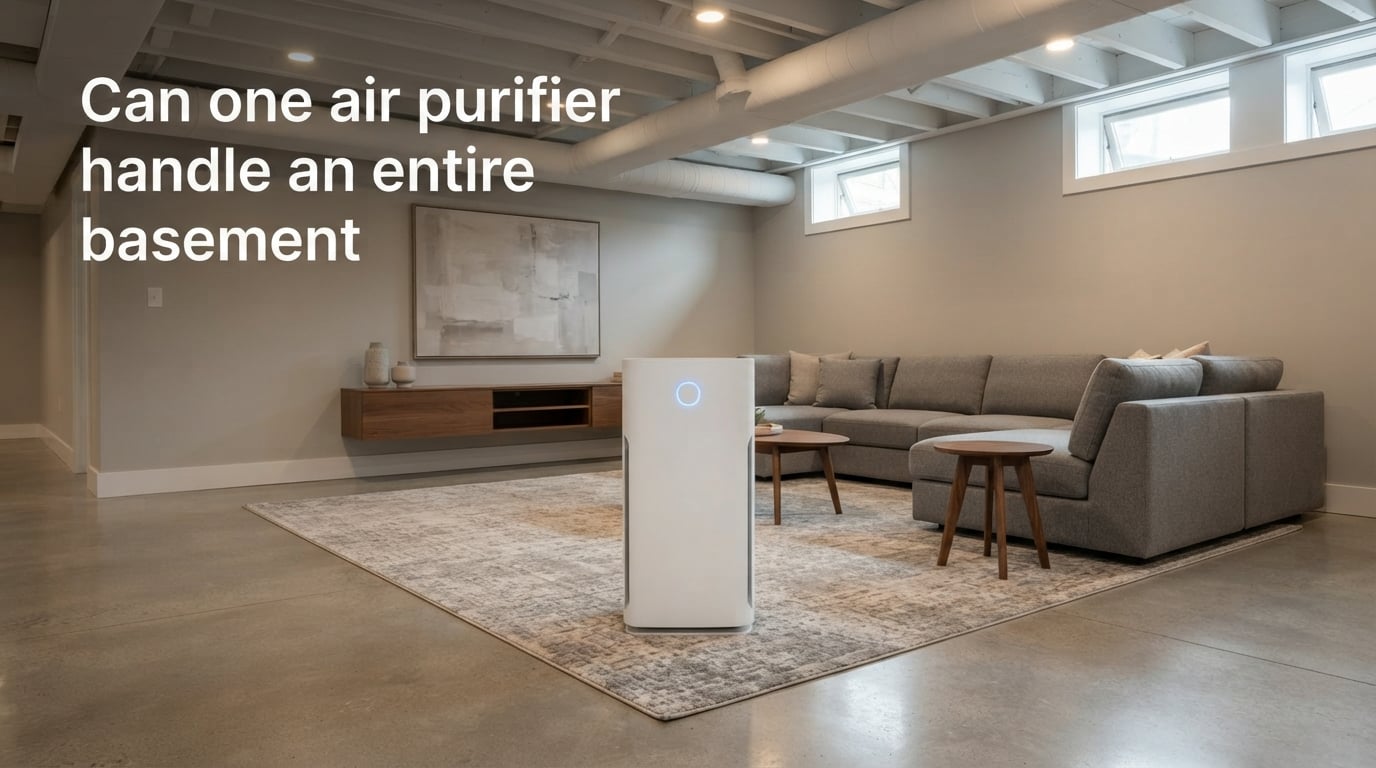
Yes, one air purifier can handle an entire basement, but only if it is properly sized for the space. A finished or unfinished basement ranging from 500 to 1,500 square feet typically needs a single unit rated for at least two-thirds more square footage than the room itself. Most basements between 500 and 1,000 square feet can be served by one well-matched unit with a CADR of 300 or higher.
The catch is that basement air is harder to clean than air upstairs. Below-grade spaces trap moisture, harbor mold spores, accumulate dust from concrete and insulation, and sometimes pull in radon gas through the foundation. An air purifier for basement use has to fight all of these issues while dealing with limited airflow from closed doors and partitioned rooms.
In this guide, our team breaks down exactly when one unit is enough, how to size it correctly, where to place it, and how to confirm it is actually doing its job. We also cover the often-misunderstood 2/3 rule and why pairing your purifier with a dehumidifier matters more than most people think.
Table of Contents
Can One Air Purifier Handle an Entire Basement?
One air purifier can handle an entire basement when three conditions are met: the unit is sized to the room’s true square footage, the basement is mostly open rather than chopped into small closed-off rooms, and the purifier runs long enough each day to cycle the air several times. If any of these conditions are missing, you will likely need a second unit or a more powerful model.
The biggest mistake we see is trusting the square footage number printed on the box. Manufacturers test coverage under ideal conditions in an open room with no obstacles. A basement with a finished family room, a closed-off utility area, and a bedroom in the corner does not behave like an open test chamber. Walls, doors, and staircases all block airflow and reduce the effective coverage.
A useful rule from Reddit users and HVAC pros alike: assume the real-world coverage is about two-thirds of what the box claims. If your basement is 900 square feet, you want a unit rated for at least 1,350 square feet. This buffer compensates for layout obstacles, ceiling height, and the slower air mixing in below-grade spaces.
For a single open basement of 500 to 800 square feet, one strong unit usually does the job. For basements over 1,000 square feet or ones divided into separate rooms, expect to need either one very large unit or two mid-sized units placed strategically. Our team has seen real-world setups where one large purifier in a central location outperformed two smaller units simply because it moved more total air.
Why Basements Are Different From Upstairs Rooms
Basements face air quality challenges that upstairs rooms rarely deal with. Understanding these differences is what separates a working basement air purifier setup from a disappointing purchase.
Moisture and Humidity Buildup
Basements sit below grade, which means surrounding soil constantly pushes moisture through the foundation walls and floor. Even a dry-looking basement can hold relative humidity above 60 percent, which is the threshold where mold spores begin to germinate. An air purifier captures airborne mold spores, but it cannot remove the moisture that feeds them.
This is why almost every experienced basement owner pairs their air purifier with a dehumidifier. The dehumidifier controls the source of the moisture problem, while the purifier handles the airborne contaminants that result from it.
Limited Natural Ventilation
Most basements have zero operable windows or just a few small hopper windows near the ceiling. There is no natural air exchange to dilute pollutants, which means anything released into the basement air stays there until something removes it. This is why a basement air purifier needs to run more hours per day than a unit you would use in a living room.
Without fresh air coming in, dust, VOCs from stored chemicals, pet dander, and cooking odors that drift down the stairs all accumulate. A purifier rated for the square footage but run only two hours a day will not keep up.
Mold Spores and Musty Odors
Musty basement smell is a direct sign of microbial volatile organic compounds, or MVOCs. These are gases produced by actively growing mold and bacteria. A standard HEPA filter catches the spores themselves, but only an activated carbon filter neutralizes the smell.
If your basement has that persistent earthy odor, a purifier with both True HEPA and a thick activated carbon layer is the right call. Thin carbon sheets, which are common on budget models, saturate within weeks and stop absorbing odors.
Radon Gas and Soil Gases
Radon is a naturally occurring radioactive gas that seeps up from soil through foundation cracks and pores in the concrete. It cannot be filtered by any air purifier because it is an elemental gas, not a particle. However, an air purifier can capture radon decay products, which are the tiny radioactive particles that radon leaves behind as it breaks down.
If you have not tested your basement for radon, do that first with a cheap test kit before buying any air quality equipment. High radon levels require a mitigation system with sub-slab depressurization, not an air purifier.
How to Size an Air Purifier for Your Basement
Sizing an air purifier for basement use comes down to two numbers: square footage and CADR. Get both right and one unit will handle the space. Get either wrong and you will end up with stale air and a unit that runs nonstop without making a visible difference.
Step 1: Measure Your Basement Square Footage
Multiply the length by the width of the area you want to cover. If your basement has multiple connected rooms, measure each one and add them together. For basements with ceilings higher than 8 feet, add roughly 10 percent to the total for each extra foot of ceiling height.
A 30-by-30-foot basement is 900 square feet at standard ceiling height. The same space with a 10-foot ceiling behaves more like 1,080 square feet of air volume. Volume matters because the purifier has to cycle that entire body of air.
Step 2: Apply the 2/3 Rule
The 2/3 rule for air purifiers says you should buy a unit rated for at least two-thirds more square footage than the room you are treating. In other words, multiply your measured square footage by 1.5 to find the minimum coverage rating you should shop for.
For a 900-square-foot basement, that means shopping for a unit rated for at least 1,350 square feet. This buffer accounts for real-world obstacles like furniture, doorways, ceiling fans, and the fact that manufacturer ratings are tested in ideal open rooms.
The rule comes from the observation that advertised coverage usually reflects only two air changes per hour under perfect conditions. Most indoor air quality experts recommend four to five air changes per hour in a basement, which means you need a more powerful unit than the label suggests.
Step 3: Match CADR to Room Size
CADR stands for Clean Air Delivery Rate, and it tells you how many cubic feet of cleaned air the unit delivers per minute. AHAM, the Association of Home Appliance Manufacturers, recommends a CADR equal to at least two-thirds of the room’s square footage for adequate cleaning.
For a 900-square-foot basement, you want a smoke or dust CADR of at least 600. For 1,200 square feet, look for a CADR of 800 or higher. High-CADR units are typically larger and louder, so check the decibel ratings on the highest fan speed if noise matters.
Step 4: Account for Air Changes Per Hour
Air changes per hour, or ACH, tells you how many times the purifier cycles the full room volume in 60 minutes. Bedrooms typically need two ACH, but basements benefit from four to five ACH because the air is more polluted and there is less natural ventilation.
You can calculate ACH yourself. Multiply the CADR by 60 to get cubic feet per hour, then divide by the room volume in cubic feet. If the result is below 4 for a basement, you either need a bigger unit, a second unit, or longer run times.
When One Air Purifier Is Enough (and When It Is Not)
One air purifier is enough for most finished basements up to about 1,000 square feet if the space is open and the unit is correctly sized. Beyond that point, or if the basement has a complex layout, you start running into diminishing returns.
One Unit Works Best When
Your basement is one large open room or has wide openings between areas. The total square footage is under 1,000. The ceiling height is 8 feet or less. The unit is rated for 1.5 times the actual square footage, and it can run 12 or more hours per day.
Open-concept finished basements with a TV area, a small bar, and maybe a half-bath in the corner usually work fine with a single strong unit placed centrally. The purifier can pull air from all directions and push clean air back out without walls blocking it.
You Probably Need Two Units When
Your basement is split into separate closed rooms, like a bedroom, an office, and a utility room. The total square footage exceeds 1,200. There are doorways that stay closed most of the day. Or one area has a specific problem, like a laundry room with lint and humidity.
Air does not move freely through closed doors. A single purifier in the main room will not effectively clean the air in a closed-off bedroom down the hall. In that scenario, a smaller second unit in the bedroom outperforms trying to push one large unit harder.
Cost Comparison: One Large vs Two Medium Units
A single large unit rated for 1,500 square feet typically costs about the same as two medium units rated for 700 square feet each. The single unit uses less total electricity and requires fewer filter replacements. However, the two-unit setup provides better coverage for partitioned basements and gives you redundancy if one fails.
For most homeowners with a typical 600 to 900 square foot basement, one properly sized unit is the more practical and economical choice. If your basement is bigger or split up, plan for a second smaller unit rather than oversizing the main one.
Where to Place an Air Purifier in a Basement
Placement affects performance as much as sizing. A perfectly matched unit shoved against a wall behind a couch will underperform a smaller unit placed correctly in the open.
Best Placement Spots
The ideal location is near the center of the basement, at least 1 to 2 feet away from any wall, with clear airflow in all directions. If a central spot is not possible, place the unit along the longest wall facing into the room. Avoid corners, which create dead zones where air does not circulate.
For basements with a known problem area, like a damp corner or a utility room, place the purifier between that area and the rest of the basement. This way it catches contaminants before they spread.
Where You Should Not Put an Air Purifier
Avoid placing an air purifier in a closed closet, directly behind furniture, under a low overhang, or right next to a dehumidifier or dryer vent. Heat sources and humidity generators confuse the airflow and can saturate carbon filters faster.
Also avoid corners, cramped utility shelves, behind a basement door that swings open, and any spot within 3 feet of a sump pump pit. Sump pits release moisture and occasional odors that the purifier will try to fight constantly.
Height and Clearance
If your unit pulls air in from the sides, keep at least 1 foot of clearance on all sides. Floor units work fine in basements with standard ceilings. Tower units placed on a low table can improve air mixing in rooms with ceiling heights above 9 feet, but this is usually unnecessary in standard basements.
Pairing an Air Purifier With a Dehumidifier
A dehumidifier and an air purifier do different jobs, but in a basement they work best as a team. The dehumidifier pulls excess moisture out of the air to starve mold and dust mites. The purifier captures the airborne spores, dust, and odors that remain.
Run the dehumidifier first to bring relative humidity down to 40-50 percent, which is the sweet spot for basement comfort and mold prevention. Once humidity is under control, the air purifier has a much easier job because it is no longer fighting a constant source of new contaminants.
Place the two units at least 5 feet apart so they do not fight each other for air. The dehumidifier exhaust is warm and slightly humid, which is fine on its own but should not blow directly into the purifier’s intake. Some users run the dehumidifier on a humidity-based setting and the purifier continuously, which is a good default schedule.
One common question is whether combo dehumidifier-air purifier units are worth it. These exist, but they typically compromise on both functions. A standalone dehumidifier will always outperform a combo unit at moisture removal, and a dedicated air purifier will move more air through better filters. Our team recommends separate units unless floor space is extremely tight.
How to Tell If Your Air Purifier Is Actually Working
Without a particle counter, it is hard to know whether your air purifier is doing anything. The good news is you do not need expensive lab equipment to confirm it is working. There are several practical ways to measure results.
Use an Affordable Air Quality Monitor
A PM2.5 sensor costs under 50 dollars and measures fine particle levels in real time. Place it across the room from the purifier, not right next to it. Check readings before you turn the purifier on, then again after 30 minutes of running. A working setup should drop PM2.5 readings by 50 percent or more in a typical basement.
For more thorough testing, log readings over a full week with the purifier running and another week with it off. The difference is usually obvious on the data, even if you cannot feel it walking in.
Watch for These Subjective Signs
If the musty smell fades within a week of installation, the unit is doing its job. Less dust settling on surfaces, fewer allergy symptoms when spending time in the basement, and reduced morning stuffiness are all good indicators. None of these are scientific, but together they tell a reliable story.
Track Filter Condition
If the pre-filter is visibly dirty after two weeks in a basement, the unit is pulling real contaminants out of the air. A filter that stays clean after months of use is a warning sign that either the unit is undersized or it is placed somewhere with poor airflow. Replace HEPA filters on the manufacturer schedule or sooner if the basement is unusually dusty.
One important note: air purifiers do not produce ozone by design, but some ionizing models do. Ozone has a sharp, chlorine-like smell and can irritate lungs. If you smell something sharp near an ionizing purifier, switch to a non-ozone-producing model.
FAQs
Are air purifiers worth it for basements?
Yes, air purifiers are worth it for basements because below-grade spaces trap moisture, mold spores, dust, and VOCs with little natural ventilation. A properly sized unit with True HEPA and activated carbon reduces musty odors, captures allergens, and improves air quality that would otherwise stay stale. The investment pays off especially if anyone in the household has allergies, asthma, or sensitivity to mold.
Will one air purifier do the whole house?
No, one air purifier will not effectively clean an entire house. Airflow is blocked by walls, doors, staircases, and closed-off rooms, so a single unit only cleans the area immediately around it. Whole-house purification requires an in-duct HVAC system or multiple portable units placed in the rooms you actually use.
What is the 2/3 rule for air purifiers?
The 2/3 rule for air purifiers says you should buy a unit rated for at least two-thirds more square footage than the room you are treating. Multiply your room’s square footage by 1.5 to get the minimum coverage rating you should shop for. This buffer compensates for furniture, ceiling height, and the fact that manufacturer ratings are tested under ideal open-room conditions.
How long should I run an air purifier in a basement?
Run a basement air purifier at least 12 hours per day, and ideally 24/7 on a low or medium speed. Basements lack natural ventilation, so pollutants accumulate faster than they do upstairs. Running the unit continuously keeps air changes per hour high and prevents buildup of mold spores, dust, and odors.
Where should you not put an air purifier?
Do not place an air purifier in a corner, behind furniture, inside a closet, under a low overhang, next to a heat source, or within 3 feet of a sump pump pit. Corners create dead zones with no airflow, and obstacles block intake and exhaust. Keep at least 1 foot of clearance on all sides for proper operation.
The Bottom Line on One Air Purifier for a Basement
One air purifier can handle an entire basement when it is sized correctly using the 2/3 rule, placed centrally with good clearance, and run long enough each day to maintain at least four air changes per hour. For most finished basements between 500 and 1,000 square feet, a single strong unit with a CADR above 300 is more than enough.
If your basement is split into separate closed rooms, exceeds 1,200 square feet, or has a specific problem area like a laundry corner, plan for a second smaller unit rather than oversizing the main one. Pair any purifier with a dehumidifier set to 40-50 percent relative humidity to address the moisture source rather than just the symptoms.
Test the air with a cheap PM2.5 monitor before and after a few days of running the unit. The numbers will tell you quickly whether your single-unit setup is working or whether you need to upgrade. Once you dial in the right size and placement, an air purifier for basement use is one of the highest-impact improvements you can make for below-grade air quality in 2026.