
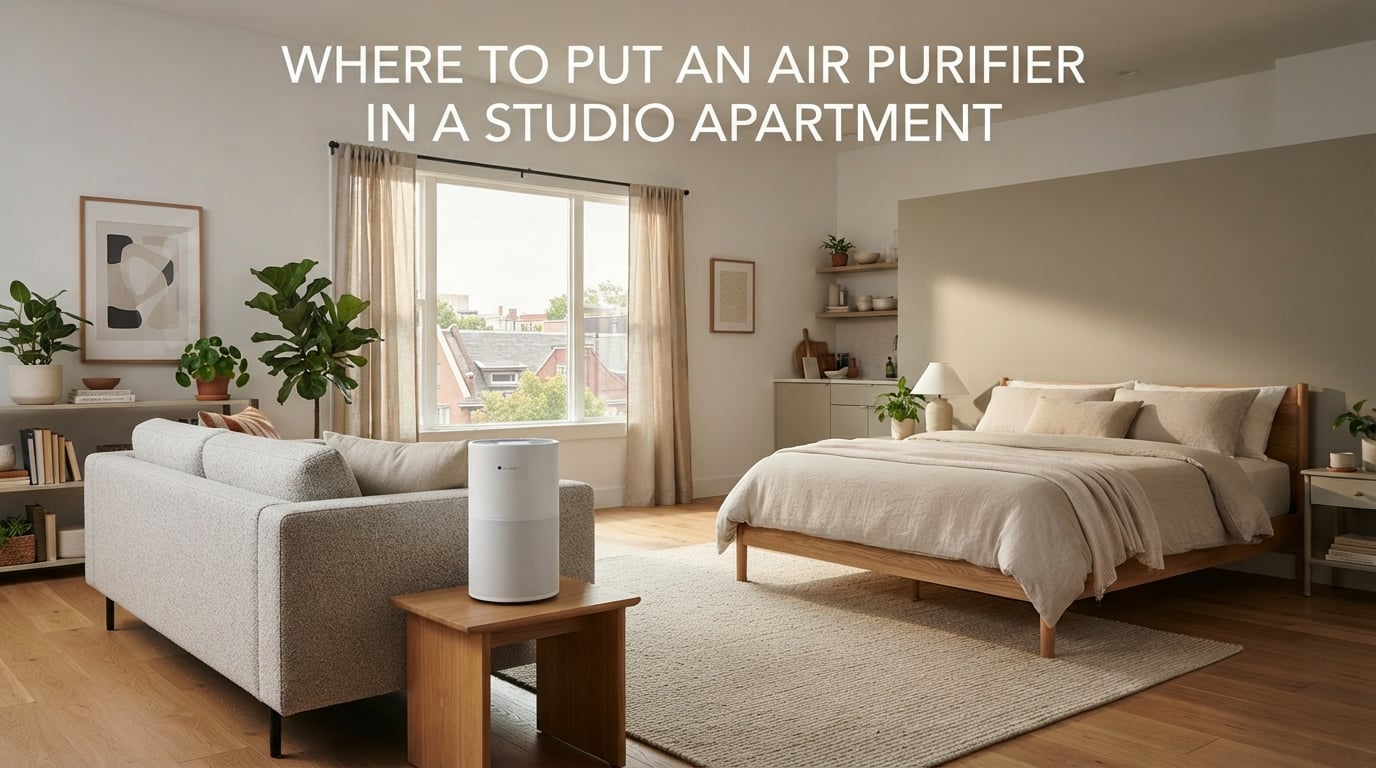
Figuring out where to put an air purifier in a studio apartment is trickier than it sounds. You have one open room that doubles as your bedroom, living room, and kitchen, which means a single unit has to do the work of three. I’ve helped friends set up their studios for years, and the placement choice almost always matters more than the model itself.
The short answer: place your purifier on the boundary between your sleeping and living zones, at breathing height (about 3 to 5 feet off the floor), with at least 1 to 3 feet of clearance from any wall or large furniture. That’s the sweet spot our team keeps coming back to in real studio layouts.
Below I’ll walk through the five best spots, the clearance rules, the floor versus elevated debate, and the placements you should actively avoid. Everything is based on how air purifiers actually move air, plus what I have seen work in real 300 to 500 square foot studios.
Table of Contents
Why Placement Matters More in a Studio Apartment
In a multi-room home, a poorly placed purifier only affects one room. In a studio, a bad spot affects your entire living space because there are no doors or hallways to contain airflow. One unit, one open floor plan, one decision.
Most purifiers pull air in from the sides (or in a 360-degree pattern) and push clean air out the top or back. If you shove one into a corner, behind a curtain, or under a desk, you choke the intake and the unit ends up cleaning a small pocket of air instead of the whole room. That is why placement matters more than CADR rating in a small space.
The core principle is simple: put it where the air actually circulates around you. In a studio, that usually means the most open area you can find, away from walls and corners, and ideally between the spots where you spend the most time.
The 5 Best Spots to Put an Air Purifier in a Studio Apartment
Here are the five placements that consistently work best in studio layouts, ranked by how often they solve the most common problems. Each one includes the specific measurements you need.
1. The Boundary Between Your Sleeping and Living Zones
This is the top recommendation for almost every studio. Place the purifier roughly halfway between your bed and your sofa or desk, in the open walkway between the two. That single position lets the unit clean air for both zones without you having to move it.
Why it works: in a studio, the “bedroom” and “living room” are not separate rooms, they are overlapping air zones. A central boundary placement means the clean air reaches your head while you sleep and your face while you relax, with the same airflow path covering both activities.
2. Within 3 to 6 Feet of the Head of Your Bed
If your main concern is sleep quality, allergies, or nighttime breathing, place the purifier 3 to 6 feet from the head of your bed. This is the breathing zone where you actually inhale during the night.
Two extra rules here: do not aim the outflow directly at your face (the cold or warm airstream wakes some people up), and avoid placing it on a nightstand directly next to your pillow. A few feet of distance solves both problems.
3. Elevated on a Stable Shelf or Nightstand (3 to 5 Feet High)
Breathing height is roughly 3 to 5 feet off the ground for most adults sitting or standing. Placing the purifier at that height puts the outflow right where you breathe, which is more efficient than floor placement in a studio.
A sturdy nightstand, a low bookshelf, or a small side table works well. Just make sure the surface can handle the weight, the unit is not near the edge, and the surface itself does not block the intake vents.
4. In a Central Open Area, Away From Corners
Corners are the worst spot for an air purifier. Air stagnates there, intake gets blocked by two walls at once, and the purifier has to fight the room’s geometry. A central open area, even if it is just a few feet away from the walls, dramatically improves airflow.
If you cannot avoid being near a wall, give yourself at least 1 to 3 feet of clearance on the intake side so air can reach the unit freely.
5. Between the Kitchen and Sleeping Zone
Cooking releases particulate matter, VOCs, and odors that drift across a studio fast. If your kitchen is on one end of the room and your bed is on the other, placing the purifier somewhere along that path catches pollutants before they reach your pillow.
This placement pairs well with an activated carbon pre-filter, which handles odors better than a HEPA-only unit. Run it on a higher setting while cooking and lower it overnight.
Clearance Rules: How Far Should an Air Purifier Be From the Wall?
The general rule from every manufacturer I have checked: keep at least 1 to 3 feet of clearance on all intake sides. Some models with 360-degree intakes need a full 3 feet in every direction. Others with a single intake panel can work with 1 foot, but more is always better.
Why this matters: air needs to flow freely into the unit. When the intake is too close to a wall, the purifier pulls from a much smaller volume of air, which forces it to work harder and clean less of your actual room. In a studio, that small efficiency loss compounds because every cubic foot matters.
Avoid placing it behind curtains, under shelves that hang low, or directly against bookshelves. If the intake is on the back of the unit, leave 1 to 3 feet behind it. If the intake is on the sides, leave that clearance on the sides instead.
Should an Air Purifier Be on the Floor or Elevated?
Elevated placement is almost always better in a studio, and here is why. Most purifiers are designed to push clean air outward at roughly chest or head height for a seated adult. On the floor, that clean air has to travel up past furniture, bedding, and your legs before it reaches your breathing zone.
The ideal height is 3 to 5 feet off the ground, which matches the breathing zone for both sitting and sleeping positions. That usually means a side table, nightstand, low dresser, or sturdy shelf. Floor placement is still acceptable if you cannot elevate safely, but expect to give it more runtime to compensate.
One exception: if your purifier has a top-mounted outlet and you want the air to mix above head height before drifting down, a low table near the room’s center can work well. This is more common with cylindrical or tower units.
Where You Should Never Put an Air Purifier
Equally important is knowing what to avoid. These placements either block airflow, damage the unit, or actively make your air worse.
- Corners: Two walls restrict intake from both sides at once. Air stagnates in corners and the purifier cannot pull effectively.
- Behind curtains or drapes: Fabric blocks the intake and traps dust right where the purifier cannot reach it.
- In direct sunlight: Heat can warp plastic housings and damage HEPA filter media over time.
- Next to heat sources: Radiators, space heaters, or heating vents can degrade filters and warp the unit.
- Inside or near a bathroom: Humidity damages filter media and encourages mold growth inside the purifier itself.
- Behind furniture: Sofas, bookcases, and beds all block the intake from at least one direction.
- Where it can be knocked over: In a small studio, foot traffic is high. A purifier on a wobbly surface is a hazard.
Understanding the 2/3 Rule for Air Purifiers
The 2/3 rule is a community shorthand that says your air purifier’s recommended room coverage should be at least two-thirds of your actual room size. For example, a purifier rated for 300 square feet works well in a studio up to about 200 square feet.
The extra headroom matters because real rooms have furniture, walls that do not move air, and pollution sources that concentrate particles. A unit sized to 2/3 of the room handles those inefficiencies without running at max speed 24/7, which also extends filter life and reduces noise.
In a studio, this rule is even more important. If your unit is sized exactly to your square footage, you will likely notice uneven cleaning near corners and closets. Oversizing slightly (by 30 to 50 percent) makes the placement more forgiving.
Studio Apartment Specific Challenges and Solutions
Studios have unique problems that bigger homes avoid. Here is how I would tackle the most common ones.
Multiple pollution sources in one space: Cooking, sleeping, electronics, and pets all dump different pollutants into the same air. Run the purifier on medium or high while cooking, then drop it to low overnight. That pattern handles both the bursts and the steady-state cleaning.
Power outlet accessibility: In older studios, outlets are often near the floor and tucked into corners. If your only outlet is in a bad spot, use a sturdy extension cord rather than compromising placement. A good spot with a cord beats a bad spot without one.
Noise near the bed: Most modern purifiers run under 30 decibels on low. If yours is louder, move it 5 to 6 feet from your head and run it on the lowest setting at night. The air still circulates across the bed even if the unit is across the room.
Moving between zones by time of day: Some studio dwellers rotate the unit between the kitchen during the day and the bedroom at night. This works, but expect to lose 30 to 60 minutes of effective cleaning each time you move it. If you can find a central spot that covers both, static placement is more efficient.
Open windows and doorways: If your studio opens onto a balcony or has a window you crack open, place the purifier away from the opening. Otherwise it ends up cleaning outdoor air instead of the room’s air, which defeats the point.
Quick Studio Apartment Placement Checklist
Before you commit to a spot, run through this checklist. It is the same one our team uses when setting up small spaces.
- At least 1 to 3 feet of clearance on every intake side
- 3 to 5 feet off the floor when possible
- Not in a corner, behind curtains, or under low furniture
- Within 3 to 6 feet of your head while sleeping
- On the path between your bed and your most-used daytime area
- Away from direct sunlight and heat sources
- Close enough to a power outlet that you do not need a long cord trail
- Stable surface that cannot be knocked over
Frequently Asked Questions
Where should you not place an air purifier?
Avoid corners, behind curtains or furniture, in direct sunlight, near heat sources, inside bathrooms, and anywhere with less than 1 to 3 feet of intake clearance. These spots block airflow, damage filter media, or restrict the unit’s ability to pull air from the full room.
What is the 2/3 rule for air purifiers?
The 2/3 rule means your purifier’s recommended room coverage should be at least two-thirds of your actual room size. For a 300 square foot studio, choose a purifier rated for at least 450 square feet. The extra headroom accounts for furniture, walls, and concentrated pollution sources that reduce real-world efficiency.
Should the bedroom door be closed when using an air purifier?
In a studio apartment, the door is usually already open because the room is one open space. If your bedroom is enclosed, close the door to contain clean air in the smaller volume and let the purifier work more efficiently. Opening the door forces the unit to clean the entire home, which can overwhelm it.
Should air purifiers be on the floor or up high?
Elevated placement at 3 to 5 feet off the floor is better because that matches your breathing zone for both sitting and sleeping positions. Floor placement still works but the clean air has to travel up past furniture before reaching you. Use a sturdy nightstand, shelf, or side table when possible.
Where should I place my air purifier for best results?
Place it in the most open central area of your studio, ideally on the boundary between your sleeping and living zones, with 1 to 3 feet of wall clearance and at 3 to 5 feet off the floor. This single position lets the unit cover your bed, your couch, and your workspace with the same airflow path.
Final Thoughts on Studio Apartment Air Purifier Placement
Where to put an air purifier in a studio apartment comes down to three numbers: 1 to 3 feet of wall clearance, 3 to 5 feet of breathing height, and a central spot between your bed and your living area. Hit those three and your purifier will outperform a more expensive model placed in a corner.
If you remember nothing else, remember this: in a studio, the worst spot is a corner and the best spot is the most open space you can find between the places you actually spend time.