
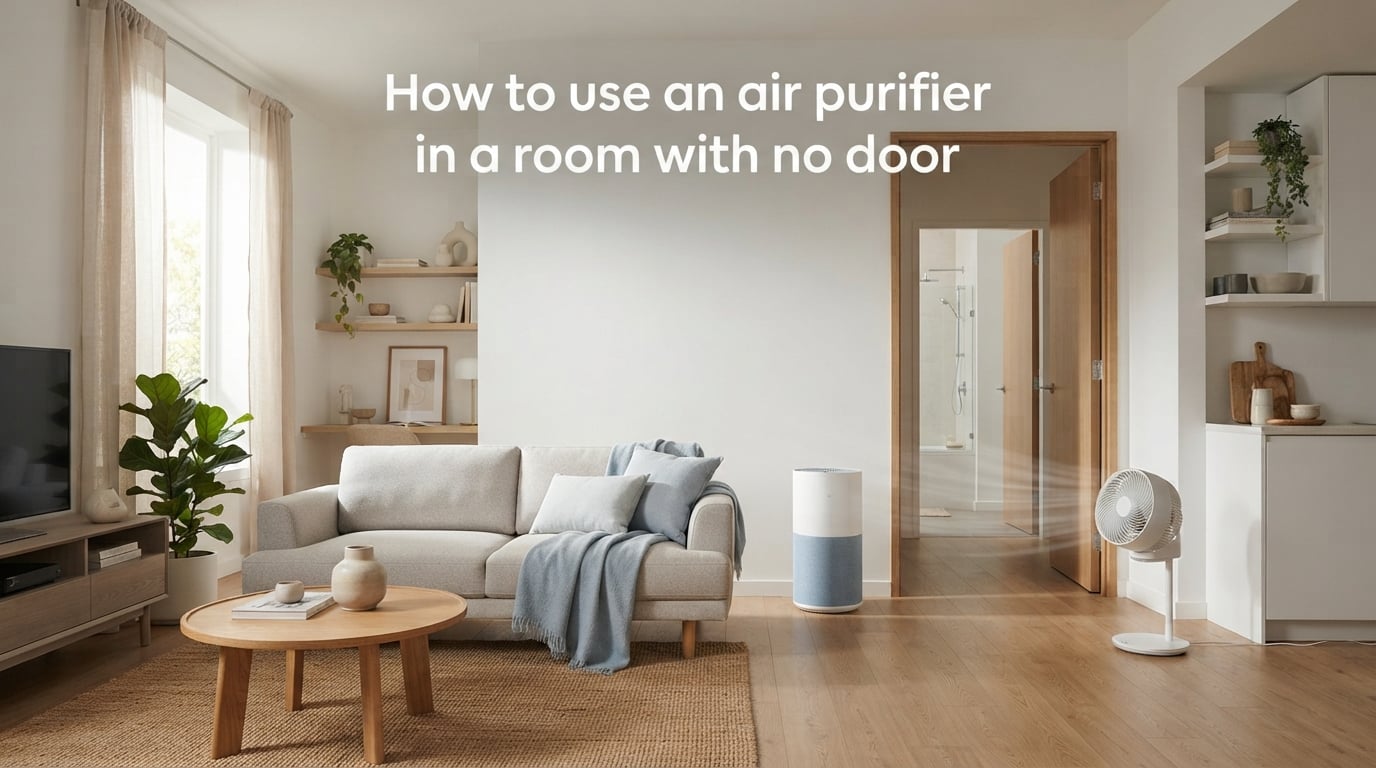
Yes, you can use an air purifier in a room with no door, but it takes a different approach than a closed-room setup. An air purifier in a room with no door still filters particles from the air that passes through it, but the cleaned air keeps drifting out through the open doorway instead of staying put. That means you need a bigger unit, smarter placement, and a few airflow tricks to get results you can actually feel.
Our team has tested air purifiers in studios, open-concept apartments, and doorless basement rooms, and the rules change fast once walls stop doing the work for you. In this guide I will walk you through exactly how to use an air purifier in a room with no door, where to place it, how to size it, and how to pair it with fans or curtains so the clean air stays where you need it.
By the end you will understand doorway airflow dynamics, CADR matching for connected spaces, and the small mistakes (like parking the unit in a corner) that quietly kill performance in open layouts.
Table of Contents
Does an Air Purifier Work in a Room With No Door?
Yes, an air purifier still works in a room with no door, but it works differently than it does in a sealed room. The HEPA filter still captures dust, pollen, smoke particles, and pet dander from every cubic foot of air pulled through it. What changes is how long that cleaned air stays in the room you care about.
In a closed room, the purifier recirculates the same air over and over. After three to four full air exchanges, particle counts drop noticeably. In a room with no door, some of that freshly cleaned air escapes into the hallway or adjoining space every time someone walks by or a draft pushes through. New, unfiltered air replaces it. The purifier keeps working, but it is cleaning a moving target.
Think of it like trying to fill a bucket with a hole near the rim. You can still fill it, you just need a faster hose. For an air purifier, that faster hose means a higher CADR rating and a longer runtime.
Forum users on r/AirPurifiers describe running a purifier with the door open as “fighting a losing battle,” and they are half right. A small unit sized for one bedroom will struggle in an open doorway setup. A properly sized unit, run correctly, still delivers real improvements in allergen levels, odors, and dust settling. The key is treating the connected space as one larger zone rather than one isolated room.
How to Use an Air Purifier in a Room With No Door (Step by Step)
Follow these five steps to get measurable results from an air purifier in any open-doorway or doorless room.
Step 1: Size the Unit to the Connected Space, Not Just the Room
The single biggest mistake in a no-door setup is buying a purifier rated only for the room it sits in. Open doorways mean the unit is effectively cleaning part of the adjoining hallway, bedroom, or living area too.
Take the square footage of the room the purifier will live in, then add the square footage of the connected space within about 15 feet of the doorway. If your bedroom is 120 square feet and it opens into a 200-square-foot hallway, plan for roughly 320 square feet of effective coverage.
Match that number to the unit’s Clean Air Delivery Rate (CADR). A good rule: choose a CADR that is at least two-thirds of the connected square footage. For 320 square feet, look for a smoke CADR around 210 or higher. Going oversized is not a waste in a doorless room, it is the only way to keep up with the constant air exchange through the open doorway.
Step 2: Place the Purifier Along the Airflow Path
Where you put the unit matters more in a doorless room than anywhere else. Aim to set up a loop: air leaves the purifier, travels across the room, and returns to the intake after sweeping through the space.
The best spot is usually along the wall opposite the open doorway, angled so the clean-air outlet points back toward the doorway. This pushes cleaned air across the room and creates a gentle circulation pattern that keeps new drafts moving through the filter instead of settling.
Avoid corners and tight alcoves. A unit needs at least 12 to 18 inches of clearance on every intake side to pull air freely. Pushed against two walls, even a powerful purifier chokes its own airflow.
Also avoid blocking the outlet with furniture, curtains, or a bed frame. If the cleaned air has nowhere to go, the unit just recirculates the same pocket of air around itself.
Step 3: Build a Directional Airflow Circuit With a Fan
In a doorless room, a small fan is your best friend. Used wrong, a fan spreads contaminants around. Used right, it turns the whole room into a slow conveyor belt that keeps feeding the purifier.
Place an oscillating fan near the open doorway, pointing into the room at a low speed. This creates gentle pressure that nudges air toward the purifier on the opposite wall. The purifier pulls it in, cleans it, and pushes it back out, completing the loop.
Keep the fan on low. High speeds stir up settled dust and overpower the purifier’s intake, sending particles past the filter before they can be captured. Slow, steady airflow always beats a strong breeze when you are trying to filter air.
If you have two fans, the second can go in the adjoining space pointing toward the doorway. This creates a mild cross-ventilation circuit that draws air through the room instead of letting it pool.
Step 4: Run It Longer Than You Think You Need To
In a sealed room, most purifiers hit peak cleanliness after about an hour on high. In a doorless room, that timeline stretches because the air you clean keeps leaving.
Plan to run the purifier at least four to six hours on high to get an initially clean baseline, then keep it on a medium or auto setting whenever the room is occupied. Many users I have talked with set their unit on a smart plug or use the manufacturer app to schedule it for an hour before bed and through the night.
For allergy sufferers, continuous low-speed operation often beats sporadic high-speed bursts. A unit running constantly at 30 percent power cleans more total air over a day than one that cranks up for 20 minutes every few hours.
Step 5: Slow the Air Escape With a Soft Barrier
You do not need to install a door to slow air exchange. A heavy curtain on a tension rod across the doorway can cut air leakage by 40 to 60 percent without changing the look of the space. A folding screen or tall bookshelf placed perpendicular to the opening has a similar effect.
Even a soft barrier creates enough resistance that the purifier has time to do multiple passes on the same air. The cleaner the air stays in the room, the less work the filter has to do overall.
For studio apartments, a partially closed closet door or a half-open folding partition can mimic the effect of a wall without killing the open feel. Every bit of air resistance helps the purifier keep up.
Where to Place an Air Purifier When There Is No Door
Placement in a doorless room follows one rule: work with the natural airflow, not against it.
Identify which way air usually moves through the room. In most homes, air drifts from warmer areas to cooler ones and follows the path of least resistance through doorways. Watch a thread of incense smoke or a tissue held near the doorway to see the direction.
Once you know the prevailing drift, set the purifier downstream of it. If air tends to flow from the hallway into your bedroom, the purifier belongs near the far wall so it can capture that incoming air on its way through.
In a studio apartment with an open kitchen and living area, place the purifier between the cooking zone and where you sleep or sit. Cooking generates some of the highest particle counts in any home, and a HEPA unit positioned in the airflow path between kitchen and living space catches a lot of it before it spreads.
In an open-concept space without walls at all, think in zones. One large purifier near the center of the room will underperform because it has no circulation pattern to lean on. Two smaller units placed at opposite ends of the space, both pointing toward each other, create a continuous exchange that covers far more area than one unit could alone.
For hallways and doorless entry areas, the ideal spot is against a side wall, not blocking the walking path. A unit tucked beside a console table keeps the intake clear and uses the wall to bounce cleaned air back into the flow.
Combining Your Air Purifier With Other Ventilation Methods
An air purifier alone will not solve a doorless room problem. Pairing it with other ventilation strategies makes a much bigger difference than any single upgrade.
Use Exhaust Fans to Pull Stale Air Out
If your room has a bathroom or kitchen nearby, run the exhaust fan for 10 to 15 minutes after cooking or showering. Exhaust fans create negative pressure that draws fresh air in through the doorway and pushes humid, particle-heavy air out through the vent. This gives your purifier cleaner air to work with in the first place.
Lean on Your HVAC System
Forced-air HVAC systems already move air between rooms. If your furnace or AC runs regularly, set the fan to “on” rather than “auto” so it circulates air even when heating or cooling is not active. A good MERV 11 or MERV 13 filter in the HVAC return works as a whole-house pre-filter, taking some load off the portable unit in your doorless room.
Add a Dehumidifier in Damp Spaces
High humidity makes airborne particles stick around longer and lets mold spores thrive. In a damp basement or doorless bathroom-adjacent room, a dehumidifier pulling moisture out of the air helps the purifier do its job with less competition.
Cross-Ventilate on Good Air Days
When outdoor air quality is better than indoor air, open a window in an adjoining room for 10 minutes to flush out stale air. Close it again and let the purifier reclaim the space. Avoid leaving windows open while the purifier runs full-time, since you are basically paying to clean outdoor air instead of indoor air.
Plants Help, but Only a Little
Houseplants do remove trace amounts of certain VOCs, but the effect is small compared to a HEPA purifier. Use them as a complement, not a substitute. A few peace lilies or snake plants near the doorway will not meaningfully reduce dust or pollen, but they do not hurt and they look good.
Common Mistakes to Avoid
Most doorless-room air purifier problems trace back to a handful of avoidable mistakes. Here are the ones our team sees most often.
Buying a Unit Sized Only for the Visible Room
This is the number one issue. The square footage on the box assumes a closed room. Always add the connected space when sizing a unit for an open doorway setup.
Parking the Purifier in a Corner or Closet
Corners cut off intake from two sides and trap cleaned air in a small pocket. The unit ends up recirculating the same cubic feet over and over while the rest of the room stays dirty.
Running It on a Timer for Just an Hour a Day
In a closed room, an hour a day might be enough. In a doorless room, that hour barely dents the steady inflow of new particles. Plan for continuous operation on low or medium.
Fighting a Cross-Breeze With the Unit Aimed Wrong
If your purifier’s clean-air outlet points toward the open doorway, you are blowing cleaned air into the next room instead of into your space. Angle it back into the room so the airflow loops.
Forgetting to Replace the Filter
HEPA filters clog faster in doorless rooms because they pull in more dust and pet hair from connected areas. Check the filter every three months instead of every six, and replace it when light no longer shines through it cleanly.
Expecting One Unit to Fix an Entire Open Floor Plan
Reddit users on r/homeowners consistently report that one purifier in a large open layout produces underwhelming results. If you live in a true open-concept home, budget for two or three smaller units placed in different zones rather than one oversize unit fighting the entire floor plan.
FAQs
Can you use an air purifier in a closed room?
Yes, air purifiers actually work best in closed rooms because the same air recirculates through the filter multiple times. After three to four full air exchanges, particle counts drop sharply and the cleaned air stays put rather than drifting into other spaces.
How do you ventilate a room without windows?
Use a combination of an exhaust fan, an HVAC supply vent, a doorway fan for cross-ventilation, and an air purifier to keep filtered air moving. Adding a dehumidifier in damp windowless rooms also reduces stuffy air and prevents mold growth.
Do air purifiers work in rooms without ventilation?
Yes. Air purifiers do not need outside ventilation because they recirculate and filter the existing indoor air. They reduce dust, allergens, odors, and some VOCs without bringing in fresh air, which makes them ideal for windowless or poorly ventilated rooms.
What happens if you run an air purifier with the door open?
The purifier still filters the air that passes through it, but cleaned air escapes through the doorway faster than the unit can replace it. Particle counts drop more slowly and the unit has to work harder, so you typically need a higher CADR rating and longer runtime to see the same results as in a closed room.
How many air changes per hour does an air purifier need in an open room?
For a room with an open doorway, aim for at least 4 to 5 air changes per hour, which usually means a CADR around two-thirds of the connected square footage. Sealed rooms can get by with 2 to 3 changes per hour, but open layouts need more cleaning power to keep up with constant air exchange.
Conclusion
Learning how to use an air purifier in a room with no door really comes down to treating the connected space as one zone instead of two. Size your unit to the full airflow area, place it along the natural circulation path, run it longer than you would in a closed room, and add a fan or soft barrier to slow the air escape.
None of these steps cost much on their own, and together they turn an underperforming setup into one you can actually feel when you walk into the room. If your space is especially open, do not be afraid to add a second purifier rather than chasing one oversize unit that has no airflow to lean on.
Start by measuring the connected square footage, then match a CADR to it. That single step fixes more doorless-room problems than every other tweak combined.