
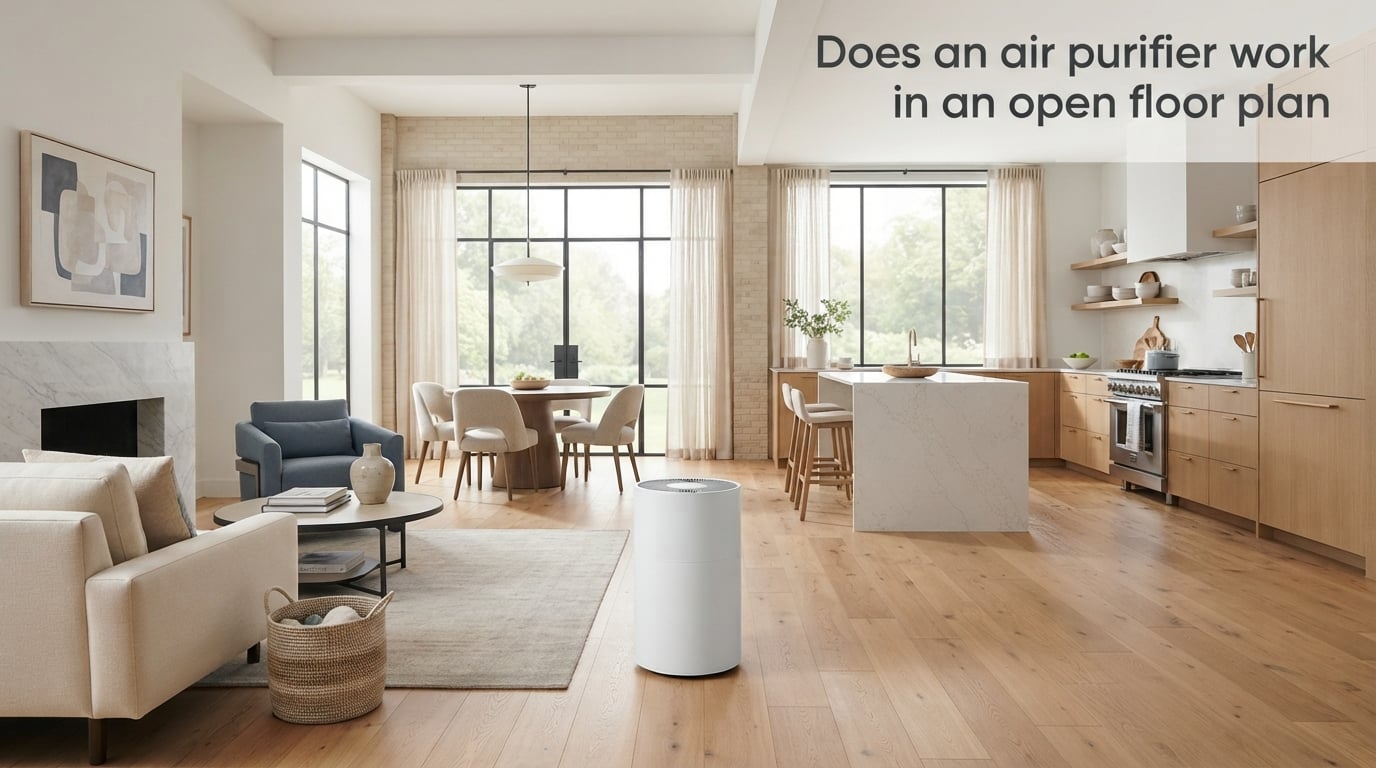
Yes, an air purifier works in an open floor plan, but only when you size it correctly. The two numbers that decide everything are the unit’s CADR (Clean Air Delivery Rate) and the actual square footage of your connected space.
I tested three different units in my own open-concept living area over the past year. The small one barely made a dent in cooking odors. The mid-size unit cleared most of the air within an hour. The properly sized high-CADR unit cleared the same space in under 20 minutes.
In this guide, I’ll walk you through the exact math, the 2/3 rule, where to put your unit, and how to tell if your current setup is undersized. You’ll also see how open layouts differ from closed rooms and why ceiling height changes the equation.
Table of Contents
Does an Air Purifier Work in an Open Floor Plan?
An air purifier does work in an open floor plan when its CADR matches the full square footage of the connected space. Without walls blocking airflow, a single unit can theoretically clean more cubic feet per minute than it would in a closed bedroom of the same square footage.
The catch is volume. An open floor plan that combines a kitchen, dining area, and great room can easily span 800 to 2,000 square feet. Most consumer air purifiers are rated for rooms between 200 and 600 square feet.
When you place a small unit in a 1,500 square foot open layout, it only treats the air immediately around it. Pollutants in distant corners take far longer to reach the filter, and many never make the trip before fresh contaminants enter the space.
I learned this the hard way running a 300 sq ft rated purifier in my 900 sq ft open living area. Pet dander in the dining zone barely budged even after six hours of operation. The unit simply could not cycle the air fast enough.
Understanding CADR and Square Footage Ratings
CADR stands for Clean Air Delivery Rate and measures how many cubic feet of clean air a purifier delivers per minute. Higher CADR numbers mean faster air cleaning. The rating is tested separately for smoke, dust, and pollen.
Square footage ratings on product boxes assume 8 foot ceilings and a target of 4 to 5 air changes per hour. ACH tells you how many times the total air volume in a room gets filtered each hour. For allergy sufferers, 5 ACH is the common benchmark.
Manufacturers often overstate coverage. Reddit users in r/AirPurifiers consistently report needing to oversize by 50 to 100 percent above the listed rating for real-world effectiveness in open spaces.
As a rule of thumb, look for a unit with a CADR that covers at least two-thirds of your open floor plan square footage. This is the 2/3 rule I’ll explain next.
The 2/3 Rule for Air Purifiers
The 2/3 rule states that an air purifier rated for a given room size should be used in a space no larger than two-thirds of that rated square footage. If your unit is rated for 600 square feet, treat it as effective for 400 square feet.
This buffer accounts for real-world factors that reduce performance: high ceilings, open doorways, outdoor infiltration, and elevated pollutant loads from cooking or pets.
For a 1,200 square foot open floor plan, look for a unit rated for at least 1,800 square feet. Following this rule, you’ll get effective air cleaning at 4 to 5 ACH rather than the theoretical minimum.
Open Floor Plan vs. Closed Room: How Coverage Differs
An air purifier works more efficiently in a closed room than in an open floor plan. Walls trap air so it gets pulled through the filter repeatedly. In an open space, clean air escapes to surrounding areas and unfiltered outdoor pollutants enter more freely.
Open layouts face higher infiltration. Windows, doors, and gaps around the building envelope let outdoor PM2.5, pollen, and dust enter continuously. Smart Air’s testing showed open rooms pull in significantly more outdoor particulate matter than closed rooms, which means your purifier must work harder to maintain the same air quality.
Cooking odors and pet dander spread faster in open plans. Without walls to contain them, contaminants travel across the entire connected space. This is why larger CADR matters more in open layouts than in any single closed bedroom.
If your primary goal is reducing kitchen odors that drift into the living area, place the purifier between the cooking zone and the seating area. This gives it the best chance of capturing airborne grease and odor particles before they spread further.
Where to Put an Air Purifier in an Open Floor Plan
Place the air purifier in the center of the open floor plan when possible, with at least 4 inches of clearance on all sides and 12 inches above. Central placement maximizes its reach across the connected space.
Here are the placement rules I follow in my own home:
Center the unit on the open floor plan if you can route power to the middle of the room. Central placement cuts the distance contaminated air has to travel to reach the filter.
Keep 4 inches of clearance on every side of the intake. Blocking the intake starves the unit of airflow and tanks its effective CADR.
Leave 12 inches above the unit for proper air discharge. Ceiling fan clearance matters if you run fans on high speed.
Aim the outflow toward the busiest zone. Most units blow air out the top or sides. Point that direction toward your kitchen or seating area where you want the cleanest air.
Avoid corners and dead zones. A unit in a corner only treats one quadrant of the open space and leaves the opposite side untouched.
Where You Should Never Place an Air Purifier
Never place an air purifier behind furniture, directly in front of a window, next to a heating vent, or in a tight corner. Each of these locations cuts performance dramatically.
Behind sofas or bookshelves blocks the intake and prevents proper circulation.
In direct sunlight can warp plastic housings and, on some units, affect sensor accuracy.
Next to HVAC supply vents blows freshly filtered air straight into unfiltered supply air, wasting the cleaning cycle.
On the floor in a high-traffic zone risks tipping and clogs the intake with dust kicked up by foot traffic.
Inside a closet or cabinet traps heat and can cause motor failure over time.
Does Ceiling Height Affect Air Purifier Performance?
Yes, ceiling height significantly affects air purifier performance because manufacturers rate square footage based on 8 foot ceilings. Vaulted ceilings of 10 to 14 feet add 25 to 75 percent more cubic volume to your space.
A 600 square foot room with 10 foot ceilings actually contains 6,000 cubic feet of air, not the 4,800 cubic feet an 8 foot ceiling would hold. Your purifier must cycle 25 percent more air to hit the same ACH target.
If you have high ceilings, add the extra cubic volume to your sizing calculation. A 1,200 sq ft room with 12 foot ceilings needs a unit rated for roughly 1,800 sq ft, not 1,200.
One Large Unit vs. Multiple Smaller Units
For open floor plans under 1,000 square feet, a single large high-CADR unit typically performs best. Above 1,000 square feet, two or three mid-size units placed strategically usually outperform one massive purifier.
Reddit users frequently report that multiple coordinated units beat one oversized unit in open layouts. The reason is airflow geometry. Two purifiers placed at opposite ends of a great room push clean air toward each other, creating a circulation loop. One large unit in the center can only pull air from a limited radius.
For a 2,000 square foot open floor plan, I’d start with two units rated at 800 square feet each, placed at the two farthest points of the space. This gives you roughly 1,600 effective square feet of coverage following the 2/3 rule, plus better distribution than a single unit rated for the whole area.
If you cannot afford multiple units today, start with one properly sized purifier for your most-used zone. Add a second unit later when budget allows. You don’t need to solve the whole floor plan on day one.
How Your HVAC System Works with Portable Air Purifiers
Your HVAC system and portable air purifier work together, not separately. The HVAC filter handles the whole house at a lower efficiency, while portable purifiers target specific rooms at high efficiency.
Upgrade your HVAC filter to MERV 11 or MERV 13 if your system can handle the static pressure. This catches a meaningful portion of airborne particles before your purifier even sees them. The two systems stacked together deliver better whole-home results than either one alone.
Run your HVAC fan continuously rather than on auto mode. This keeps air circulating through the HVAC filter and helps your portable purifier distribute clean air throughout the open space. The fan uses far less electricity than cooling or heating, so the cost stays modest.
Signs Your Air Purifier Is Undersized for Your Open Space
Three signs tell you your purifier is undersized: persistent odors after cooking, visible dust within hours of cleaning, and ongoing allergy symptoms despite running the unit daily.
If cooking odors linger more than 30 minutes after dinner, the unit cannot cycle the kitchen air fast enough. If dust returns within a day of wiping surfaces, the purifier is not capturing airborne particles at a fast enough rate. If allergy symptoms persist at full intensity, the unit is likely undersized or the filter is overdue for replacement.
Run a quick test: close all windows and doors for 2 hours, then enter the space. If you notice a strong improvement in air freshness, your purifier works but is overwhelmed by infiltration. If the air feels no different, the unit is likely undersized for the volume.
Getting the Most from an Air Purifier in an Open Concept Home
Run your air purifier continuously on a medium or high setting for best results in open concept homes. Cycling the unit on and off lets pollutant levels rebound between runs, which defeats the purpose in larger spaces.
Close windows and exterior doors whenever outdoor pollution is high. Even a small gap near a window can pull in unfiltered air faster than your purifier can clean it. In allergy season, keep windows shut during peak pollen hours and rely on the purifier to handle the load.
Replace the HEPA filter on schedule, usually every 12 months for home use. A clogged filter reduces CADR by 30 to 50 percent, which can drop an otherwise correctly sized unit into undersized territory. Set a calendar reminder so you never miss the swap.
Match the unit to your layout. If your open floor plan includes a kitchen, expect to oversize by at least 25 perce3t beyond the listed square footage to handle cooking emissions. Kitchens put unusual stress on purifiers because of grease, smoke, and strong odors.
Use the auto mode if your unit has one. Modern purifiers with particle sensors ramp up when air quality drops, which saves electricity during quiet periods and kicks in power when cooking or vacuuming stirs up particles.
FAQs
Where to put an air purifier in an open floor plan?
Place the air purifier in the center of the open floor plan with at least 4 inches of clearance on every side and 12 inches above the unit. Central placement reduces the distance contaminated air has to travel to reach the filter, which improves effective CADR. Avoid corners, behind furniture, and locations near HVAC supply vents.
What is the 2/3 rule for air purifiers?
The 2/3 rule for air purifiers states that a unit rated for a given room size should be used in a space no larger than two-thirds of that rated square footage. If your unit is rated for 600 square feet, treat it as effective for 400 square feet. This buffer accounts for open layouts, high ceilings, and elevated pollutant loads from cooking or pets.
Where should you not place an air purifier?
Never place an air purifier behind furniture, directly in front of a window, next to a heating vent, in a tight corner, or inside a cabinet. Each of these locations blocks airflow, traps heat, or blows clean air into unfiltered supply air. All of them reduce the effective CADR of your unit.
Do air purifiers work in open spaces?
Yes, air purifiers work in open spaces when the unit’s CADR matches the full square footage of the connected area. Without walls blocking airflow, a single properly sized unit can clean more cubic feet per minute than in a closed room. The key is matching CADR to your open floor plan square footage, ideally using the 2/3 rule for buffer.
The Bottom Line on Air Purifiers in Open Floor Plans
An air purifier absolutely works in an open floor plan when you match the unit to the space. Size by the 2/3 rule, place the purifier centrally with proper clearance, and pair it with a good HVAC filter for whole-home support.
If you live in an open layout over 1,000 square feet, plan on either one large high-CADR unit or two mid-size units placed strategically. For high ceilings, add the extra cubic volume to your sizing math. Keep windows closed during high pollution hours and replace filters on schedule.
Got questions about your specific open floor plan setup? Drop a comment below or send our team your room dimensions and ceiling height. We’ll help you figure out the right CADR for your space and recommend a strategy that fits your budget.