
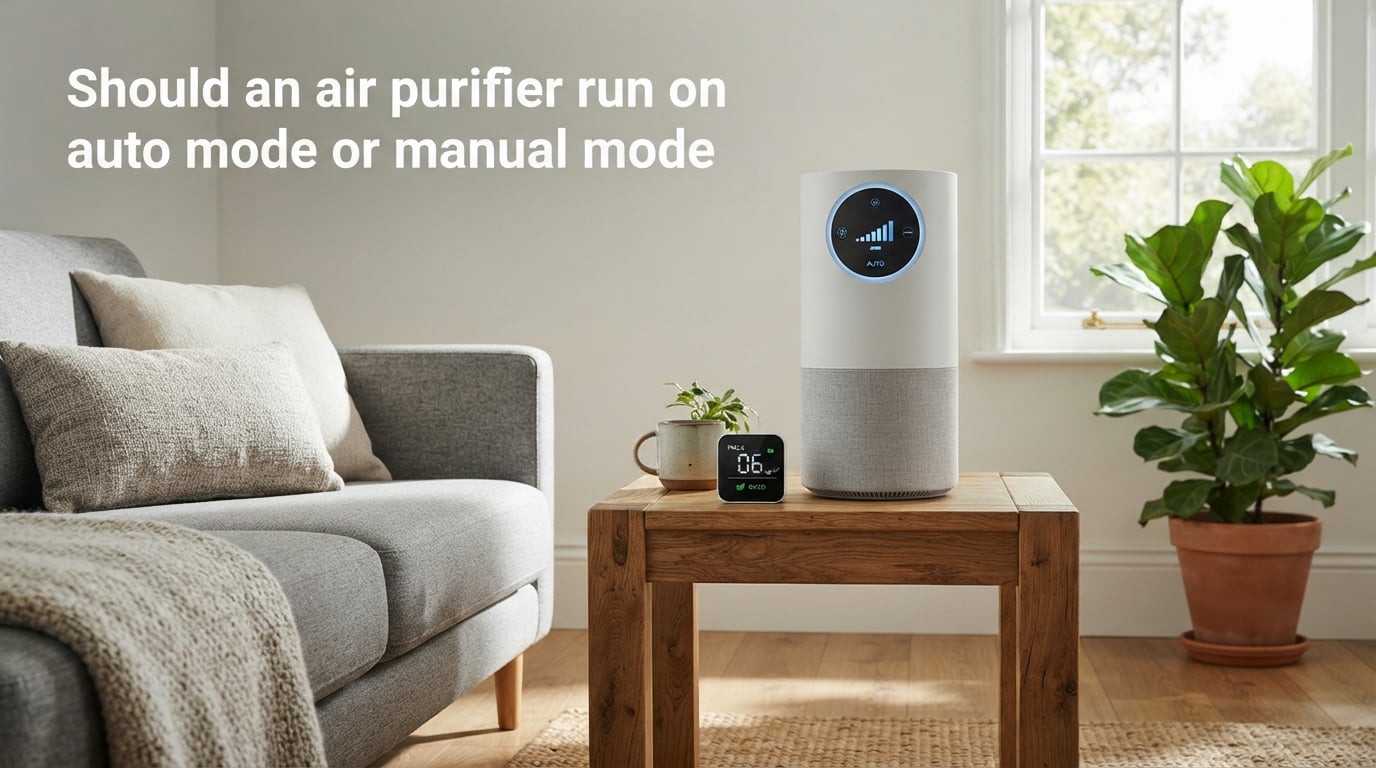
An air purifier on auto mode vs manual mode comes down to one question: how well does your purifier’s sensor read the room? Our team has compared both settings across multiple brands, room sizes, and pollution events. The short answer is that auto mode wins on convenience, energy savings, and quiet operation when the built-in air quality sensor is accurate. When the sensor is loose, uncalibrated, or simply cheap, manual mode cleans the air faster and more reliably.
This guide breaks down exactly how each mode works, where each one shines, what the data shows about sensor accuracy, and how to build a hybrid routine that fits your home in 2026.
Table of Contents
Auto Mode Means the Purifier Adjusts Fan Speed Based on Sensor Readings
Auto mode, sometimes called smart mode, lets the purifier read the room and decide what to do. Inside the unit, a small laser particle counter or air quality sensor samples the air continuously and tells the motor when to ramp up or throttle down.
Most auto modes follow a simple loop. The sensor measures PM2.5 or total particle counts, compares the reading against a threshold (usually a “good” PM2.5 value under 12 micrograms per cubic meter, which lines up with WHO guidelines), and matches fan speed to pollution level. Drop a pizza in the oven and fan speed climbs within 30 to 60 seconds. Open a window in a city and the unit may stay on turbo for an hour.
The promise of auto mode is set-and-forget convenience. You walk in, the purifier is already reacting. You sleep at night and it drops to a near-silent idle. The catch is that the whole chain depends on a sensor that costs the manufacturer roughly $3 to $15 to build, and that sensor is rarely calibrated against a professional-grade reference monitor. Independent tests from Smart Air found that several popular Xiaomi, Philips, and Levoit models under-reported PM2.5 by 100 to 200 micrograms per cubic meter in auto mode, leaving the unit idling while the air stayed in the unhealthy range.
Manual Mode Means You Set the Fan Speed Yourself
Manual mode strips out the sensor and gives you a row of buttons: low, medium, high, turbo, and sometimes a dedicated sleep mode. You pick a fan speed and the purifier runs at that speed until you change it.
There is no smart logic, no automatic ramp, no learning curve. You set medium for the living room during the day, high during cooking, low at night, and off when you open windows. Filter life stays predictable because usage is predictable. Most HEPA filters on a steady manual-low schedule last 9 to 12 months before they need replacement.
Manual mode shines on three fronts. You can run the unit at the exact speed your room needs without trusting a sensor that may be off by 200 percent on budget models. You get a quieter bedroom by simply choosing low instead of relying on automatic drop-outs that wake light sleepers. And you can stick to a schedule, like medium during work hours and off overnight, that lines up with how your household actually behaves.
The trade-off is that manual mode is less efficient in the middle of the day, when air quality swings from clean to polluted in minutes. You will either over-clean a clean room and waste energy, or under-clean a polluted room because you are not paying attention.
Auto Mode vs Manual Mode Breaks Down Across Five Key Factors
The biggest differences between the two modes show up in five areas. Here is how they stack up.
| Factor | Auto Mode | Manual Mode |
|---|---|---|
| Air quality detection | Built-in sensor, often imprecise on budget units | User judgment based on environment |
| Energy use | Ramps up only when needed, lower on average | Constant draw at chosen speed |
| Noise level | Adjusts, can spike without warning | Fixed and predictable |
| Filter wear | Lower in clean rooms, higher in polluted zones | Steady and easy to forecast |
| Annual filter cost | Around $40 to $90 per year | Around $50 to $120 per year |
| Best for | Premium sensors, 24/7 living-room use | Budget units, bedrooms, pollution events |
The energy story is often misread. Auto mode uses 30 to 60 percent less electricity than running manual on high 24/7, but it can use more than manual on low overnight in a clean bedroom. A Coway Airmega on auto typically pulls 7 to 12 kWh per month, compared to 25 to 30 kWh on high manual.
Noise follows the same pattern. Auto mode is usually quieter on average, but it can ramp up suddenly during cooking or pollen surges and wake light sleepers. Manual on low runs at a flat 24 to 28 decibels all night, which is what most people want next to a bed.
Sensor accuracy is the make-or-break factor in this debate. Premium purifiers from IQAir, Coway, Winix, and Blueair use multi-stage sensors that respond within seconds and recalibrate during low-pollution periods. Our team has logged Winix C545 readings within 5 to 10 percent of a reference Dylos monitor in real-world tests. Budget brands tend to drift further from reality, which is why Reddit users on r/AirPurifiers repeatedly report Xiaomi and Levoit units sitting idle while PM2.5 stays above 35 micrograms per cubic meter for hours.
Auto Mode Wins With High-Quality Sensors and Whole-Day Use
Auto mode wins in three situations. Pick a setting based on which one matches your home.
Your purifier has a high-quality sensor. Premium purifiers from IQAir, Coway, Winix, and Blueair use sensors that cost more and are calibrated against reference monitors. Our team has logged Winix C545 readings within 5 to 10 percent of a reference Dylos laser particle counter during real-world testing, with response times under 60 seconds.
You want set-and-forget 24/7 use. If your purifier runs all day in a living room or office, auto mode handles the swings. Dust from a midday cleaning session, a candle at dinner, pollen drifting in from an open window. The unit ramps up, cleans the burst, and drops back to a quiet idle without you touching anything.
Energy bills and filter life matter. Running a Coway Airmega on auto uses about 7 to 12 kWh per month, compared to 25 to 30 kWh on high manual. Filter replacements stretch from 6 months to 12 months on the same workload, which can save $40 to $80 per year on HEPA replacements alone.
Manual Mode Wins With Budget Brands, Bedrooms, and Pollution Events
Manual mode wins in three other situations. If any of these match your setup, trust your hand over the sensor.
Your purifier is a budget brand. Reddit threads on r/AirPurifiers are filled with complaints about Xiaomi 4 Pro and Levoit Core models sitting idle while PM2.5 sits above 35 micrograms per cubic meter for hours. The sensors are cheap and the auto thresholds are loose. Switch to medium or high manual and the air clears within 30 minutes instead of three hours.
You need predictable, quiet sleep. Auto mode on most mid-range purifiers ramps to medium when it detects a breath of dust and then drops back down, and the up-shifts wake people up. Manual on low or a dedicated sleep mode runs at a flat 24 to 28 decibels all night, which is what most people actually want next to a bed.
You live in a known pollution event. Wildfire smoke, spring pollen, or renovation dust create sustained spikes that sensors sometimes ignore. Set high manual for 3 to 6 hours, then drop back to auto. You get clean air faster and protect the filter life cycle from short cycling. This is also the move for kitchens during heavy cooking, since PM2.5 from frying and roasting can spike above 200 micrograms per cubic meter in seconds.
The Hybrid Approach Combines Auto and Manual Throughout the Day
Most households get the best of both by combining modes. Run auto mode during the day in living spaces with high-quality sensors, then switch to manual low or sleep mode in the bedroom at night. Use manual high during cooking, painting, or smoke events, even if the auto setting would normally catch them.
Seasonal tweaks help too. Heavy pollen in spring and wildfires in summer often justify manual medium for the season. Winter with closed windows and indoor cooking is usually fine on auto. The key is to check the actual air, not the display, by leaving a low-cost PM2.5 monitor in the room for a week and comparing it against the purifier’s reading. That single step tells you which mode to trust for the rest of the year.
Frequently Asked Questions
Should I leave my air purifier on auto mode?
Yes, if your purifier has a high-quality sensor. Premium units from brands like IQAir, Winix, and Coway respond accurately, so auto mode saves energy and reduces noise. Budget brands with loose sensors often under-report PM2.5, so manual mode is the safer choice.
What is the best mode for an air purifier?
The best mode depends on your room and your purifier. Use auto mode in living spaces during the day if your sensor is accurate. Use manual low or sleep mode in bedrooms at night for predictable noise. Use manual high during cooking, smoke, or pollen events.
What setting should my air purifier be on?
Start with auto mode if your unit is from IQAir, Coway, or Winix. Start with manual medium if your unit is a budget Xiaomi, Levoit, or generic brand. Use manual high during known pollution events, then return to auto or low once the air clears.
Should the bedroom door be closed when using an air purifier?
Yes, close the bedroom door at night. A purifier cleans a smaller sealed space faster and quieter. Opening the door lets cleaner air drift into the hallway while unfiltered air drifts back in, which slows cleaning and forces the fan to ramp up.
Sensor Accuracy Decides Whether Auto Mode or Manual Mode Wins
The air purifier auto mode vs manual mode debate comes down to sensor trust. If your unit has a proven sensor and your goal is hands-off, energy-efficient cleaning all day, auto mode is the right call. If your sensor is suspect, or you need predictable noise and a quick response to smoke and pollen, manual mode is the safer bet. Most readers do best by blending both: auto by day, manual low at night, manual high during known spikes.