
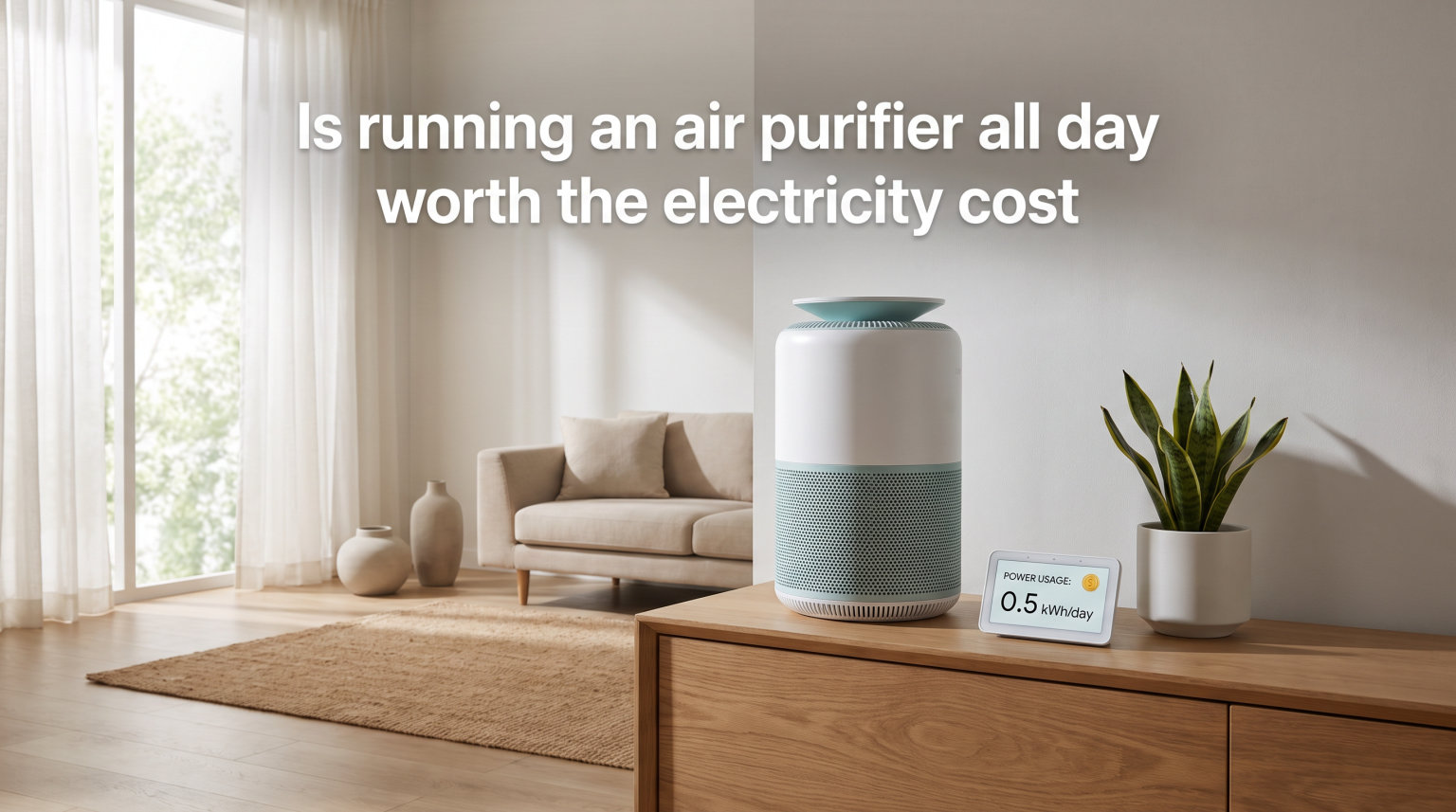
If you have been staring at your air purifier wondering whether leaving it on all day is quietly draining your wallet, you are in good company. It is one of the most common questions homeowners ask before committing to 24/7 operation. The good news is that the numbers are far less alarming than most people expect.
Running an air purifier all day electricity cost typically adds between $4 and $11 per month to your electric bill, depending on the unit’s wattage, your local electricity rate, and the fan speed you choose. For context, that is roughly the same as leaving a single incandescent light bulb burning around the clock. Most households spend more on a single takeout meal than they do running a purifier for an entire month.
I have spent the last few months digging into wattage specs, electricity rate tables, and real user reports from communities like Reddit’s r/AirPurifiers and r/Frugal to separate fact from fear. What I found is that the fear of high air purifier electricity usage is mostly unfounded. People expect a big spike and end up seeing almost nothing change on their bill.
In this guide, I will walk you through exactly how much power an air purifier draws, how to calculate your personal monthly cost down to the penny, how it compares to every other appliance in your home, and whether the health benefits justify the modest expense. By the end, you will know precisely what that little machine is costing you and whether it is worth keeping on.
Table of Contents
The Quick Answer: What Does an Air Purifier Actually Cost to Run?
Most air purifiers cost between $4 and $11 per month to run continuously, 24 hours a day. That works out to roughly $48 to $132 per year. The exact figure depends on three things: your unit’s wattage, your local electricity rate per kilowatt-hour, and how many hours per day you leave it switched on.
A small bedroom unit drawing around 30 watts in a region with average electricity rates will add about $3 to $4 per month. A larger whole-home unit running on high speed at 100 watts in a state with expensive electricity might push closer to $10 or $11 per month. Either way, we are talking about pocket change compared to what your air conditioner, water heater, or refrigerator consume.
The short version: yes, running an air purifier all day electricity cost is real, but it is small. For the vast majority of households, the improvement in indoor air quality, allergy relief, and odor control easily outweighs the few extra dollars on the monthly bill.
Understanding Air Purifier Power Consumption
Before you can calculate costs, it helps to understand how air purifiers actually use electricity. The key metric is wattage, which measures how much power the device draws while running. Think of watts as the speed at which your purifier consumes energy.
Most residential air purifiers fall into a fairly narrow power range. Compact desk and bedroom units typically draw between 20 and 40 watts. Mid-size units designed for living rooms and larger bedrooms usually sit in the 40 to 70 watt range. Heavy-duty whole-house models and units running on their highest turbo setting can pull 80 to 100 watts or more.
That wattage figure matters because your electric company does not bill you in watts. They bill you in kilowatt-hours, or kWh. One kilowatt-hour equals 1,000 watts used for one hour. So if your purifier draws 50 watts and runs for 20 hours, it has consumed 1 kilowatt-hour of electricity. Understanding this conversion is the foundation of every cost calculation that follows.
Here is where it gets interesting. A 50-watt air purifier running 24 hours a day uses 1.2 kWh daily. Over a full month, that is about 36 kWh. At the United States average electricity rate of roughly 16 to 17 cents per kWh, you are looking at around $6 per month. That is the entire cost of clean, filtered air circulating through your home every single day.
Compare that to a single 60-watt incandescent light bulb left on 24 hours a day. It would consume about 43 kWh per month and cost nearly the same amount. The air purifier is doing dramatically more work, moving and filtering hundreds of cubic feet of air per minute, for roughly the price of a light bulb.
How Much Does It Cost to Run an Air Purifier 24 Hours a Day
Let us get specific. If you want to know exactly what running an air purifier all day electricity cost looks like for your situation, here is the simple three-step formula I use.
Step 1: Find your purifier’s wattage. Check the label on the back, the user manual, or the manufacturer’s website. If only the amperage is listed, multiply amps by 120 (the standard US household voltage) to get watts.
Step 2: Convert watts to kilowatt-hours. Multiply the wattage by the number of hours you run it per day, then divide by 1,000. For example, a 50-watt unit running 24 hours: 50 x 24 = 1,200 watts per day. Divide by 1,000 and you get 1.2 kWh per day.
Step 3: Multiply daily kWh by your electricity rate. You can find your exact rate on your electric bill, usually expressed in cents per kWh. The US average sits around 16 cents, but rates vary widely from about 11 cents in states like Washington to over 30 cents in Hawaii and parts of California.
Let us run the numbers for a few common scenarios so you can see the real range. A 30-watt bedroom purifier running 24 hours a day at 16 cents per kWh costs about $3.46 per month. A 60-watt mid-size unit under the same conditions runs about $6.91 per month. A 100-watt unit on high speed costs roughly $11.52 per month.
What about annual costs? Multiply that monthly figure by 12. The bedroom unit costs about $42 per year. The mid-size unit runs about $83 annually. Even the power-hungry 100-watt model only reaches around $138 per year, which is less than what many people spend on streaming subscriptions.
One thing I always point out is that these calculations assume constant operation at a single speed. In reality, most modern purifiers feature auto mode, which automatically adjusts fan speed based on real-time air quality readings. When the air is clean, the fan drops to its lowest setting, sometimes drawing as little as 5 to 10 watts. This can cut your actual cost by 30 to 50 percent compared to running on medium or high all the time.
Air Purifier vs Other Household Appliances
Numbers in isolation can be hard to judge, so let us put air purifier energy consumption into perspective by comparing it to the other appliances running in your home. This is where most people have their aha moment and realize just how little power these devices actually use.
A central air conditioner is the heavyweight champion of household energy use. A typical central AC unit draws between 3,000 and 5,000 watts while running. That means your air conditioner uses roughly 50 to 100 times more electricity than your air purifier. Running AC for just one hour costs more than running a purifier for two full days.
Your refrigerator runs nearly 24 hours a day and draws between 150 and 400 watts on average, depending on size and age. That means your fridge costs two to four times more to operate than your air purifier, and nobody questions whether the fridge is worth running. A clothes dryer pulls 3,000 to 5,000 watts per load, meaning a single hour of drying laundry costs more than a week of air purification.
Even a standard ceiling fan on high speed draws 50 to 75 watts, putting it in the same range as a mid-size air purifier. A desktop computer running for several hours a day, a gaming console, or a space heater used for just 30 minutes will all cost you more than your purifier running around the clock.
The takeaway here is simple. When people ask whether an air purifier will run up their electric bill, the honest answer is that it barely registers alongside the appliances they already use without a second thought.
Factors That Affect Air Purifier Energy Consumption
Not all air purifiers and not all situations are created equal. Several variables influence how much electricity your unit actually consumes, and understanding them helps you predict and control your costs.
Fan speed is the biggest factor. Most purifiers have three to five speed settings, and power consumption scales roughly linearly with speed. A unit that draws 30 watts on low might pull 70 watts on medium and 100 watts on turbo. Running on low or auto mode instead of high can cut your cost in half or more.
Room size and CADR matter too. Clean Air Delivery Rate, or CADR, measures how quickly a purifier can clean a room of a specific size. A unit properly matched to its room will reach clean air faster and can then drop to a lower maintenance speed. An undersized unit fighting to clean a large space will run harder, longer, and use more electricity while delivering worse results.
Filter condition plays a surprising role. A clogged, dirty HEPA filter forces the motor to work harder to push air through, which increases power draw. I have seen reports of wattage increasing 20 to 30 percent on neglected filters. Replacing or cleaning your filter on schedule is one of the easiest ways to keep energy costs down.
Smart sensors and auto mode can dramatically reduce consumption. When a purifier detects clean air, it throttles back to its lowest setting automatically. Over the course of a month, this intelligent cycling can save several dollars compared to a manual unit locked on medium speed. Many Energy Star certified models include these features standard.
Your local electricity rate is the final multiplier on every calculation. Someone paying 11 cents per kWh in Idaho will spend half as much as someone paying 22 cents in Massachusetts for the exact same purifier running the exact same hours. Always check your actual rate rather than relying on national averages.
What Happens If You Leave an Air Purifier On All Day
This is one of the most searched questions on the topic, and the answer should put your mind at ease. Leaving an air purifier on all day is not just safe, it is actually how these devices are designed to operate.
Air purifiers are built for continuous operation. The motors, fans, and electronics inside are rated for thousands of hours of use. Think of it like your refrigerator, which runs day and night for years without issue. Quality units from reputable brands are engineered to handle 24/7 duty cycles without overheating or wearing out prematurely.
The mechanical reality is that stopping and starting a fan motor actually causes more wear than steady continuous operation. Each startup draws a surge of current and places stress on the bearings. From a pure longevity standpoint, running your purifier at a steady low speed all day is gentler on the hardware than switching it on and off repeatedly.
The one trade-off to be aware of is filter lifespan. Running your purifier 24 hours a day means the filter is processing more air and will need replacement sooner. Most HEPA filters are rated for 6 to 12 months of typical use. If you run continuously, expect to replace closer to the 6-month mark. Factor roughly $30 to $80 per replacement filter into your annual cost of ownership alongside the electricity.
That said, continuous operation delivers the best air quality results. Pollutants, allergens, dust, and odors enter your home constantly. The only way to keep up is to filter the air constantly. Running your purifier for just a few hours and then turning it off allows contaminants to accumulate again, which means you are always starting from a dirty baseline.
From the forum discussions I reviewed, users who run their purifiers all day consistently report the best allergy relief and odor control. One Reddit user with three Winix units running around the clock noted a small bump in their electric bill but called it absolutely worth it for the air quality improvement, especially with a neighbor who smoked nearby.
How to Reduce Air Purifier Electricity Costs
Even though air purifier energy costs are already low, there are several practical ways to bring them down further. None of these require buying new equipment, and most will pay for themselves in comfort and savings.
Use auto mode whenever possible. This is the single most effective strategy. Auto mode uses a built-in particle sensor to detect air quality and adjust fan speed automatically. When the air is clean, the fan drops to its quietest, lowest-wattage setting. Over a month, this can reduce consumption by 30 to 50 percent compared to a fixed medium or high setting.
Match the purifier to the room size. An oversized unit in a small room wastes energy by running harder than necessary. An undersized unit in a large room runs constantly at high speed without ever catching up. Check the recommended room size on the box and choose accordingly. A properly sized unit works smarter, not harder.
Replace filters on schedule. A dirty filter restricts airflow and forces the motor to draw more power to maintain the same output. Check your filter monthly and replace or clean it according to the manufacturer’s timeline. This small maintenance task keeps your unit running at peak electrical efficiency.
Position the purifier smartly. Place it in an open area away from walls, furniture, and curtains that block airflow. A unit that can breathe freely does not have to work as hard. Also, keep doors and windows closed while it runs so it is not endlessly fighting new incoming pollutants.
Use scheduling features if available. Some smart purifiers let you set schedules. You might run on a higher setting when you are home and active, then drop to low or sleep mode during work hours or overnight. This targeted approach ensures you are spending energy dollars only when the benefit is highest.
Run on low speed for background cleaning. Unless you are dealing with active smoke, cooking odors, or visible dust, a low or medium setting is usually sufficient for maintaining clean air. Turbo and high speeds are for quick response to pollution events, not steady-state operation.
Forum users consistently emphasize that the health benefits of clean air far outweigh the small electricity costs. The goal is not to eliminate the cost but to optimize it so you get maximum air quality benefit for minimum energy spend.
How to Choose an Energy-Efficient Air Purifier
If you are shopping for a new unit or replacing an old one, paying attention to energy efficiency upfront can save you money for years. Here is what to look for.
Look for the Energy Star label first. Energy Star certified air purifiers are tested and verified to use 20 to 40 percent less energy than standard models. Over the life of the unit, this certification alone can save you $30 to $60 or more in electricity compared to a non-certified equivalent.
Check the CADR rating relative to the room size. A higher CADR means the unit cleans air faster, which means it spends less time running at high speed. Match the CADR to your room square footage using the rule of thumb that you want at least two-thirds of your room’s square footage in CADR for dust and pollen.
Prioritize models with auto mode and air quality sensors. These features are the biggest energy savers available because they prevent the unit from running harder than necessary. A smart purifier that throttles itself based on real-time conditions will almost always cost less to operate than a dumb unit on a fixed setting.
Compare wattage specs across models before buying. Manufacturers list power consumption in the specifications. A unit drawing 40 watts on high is going to cost half as much to run as one drawing 80 watts on high, assuming similar cleaning performance. Do not assume bigger wattage means better performance, either. Good design can deliver high CADR at lower power draw.
Is Running an Air Purifier All Day Worth the Electricity Cost?
After running the numbers and reviewing real user experiences, my verdict is a confident yes. Running an air purifier all day electricity cost is one of the best value propositions in home appliances. You are paying $4 to $11 per month for continuously filtered air that removes allergens, dust, smoke, pet dander, mold spores, and volatile organic compounds from the air you breathe every day.
To put that in perspective, $8 per month is less than most people spend on coffee in a single week. It is less than a single co-pay for an allergy doctor visit. For households with allergy sufferers, asthma, pets, or neighbors who smoke, the health and comfort returns dwarf the modest energy investment many times over.
Users across the forums I reviewed overwhelmingly agree. Even those who noticed a slight bump in their electric bill considered it money well spent. The consensus is that you barely notice the cost, but you definitely notice the improvement in air quality, sleep, and allergy symptoms.
The only scenario where I would hesitate is if you are running multiple large units simultaneously in a region with very high electricity rates. Three 100-watt purifiers running 24 hours a day at 30 cents per kWh could add $65 or more per month. In that case, auto mode, scheduling, and right-sizing become essential rather than optional.
For the average household with one or two reasonably sized units, the math is overwhelmingly favorable. Clean air is cheap. Run your purifier with confidence.
FAQs
Will an air purifier make my electric bill go up?
Yes, but only slightly. Most air purifiers add between $4 and $11 per month to your electric bill when run 24 hours a day. The increase is comparable to leaving a single light bulb on continuously and is far smaller than what your refrigerator, air conditioner, or water heater already cost you. Most people do not even notice the change on their bill.
How much does it cost to run an air purifier 24 hours a day?
Running an air purifier 24 hours a day typically costs between $4 and $11 per month, or roughly $48 to $132 per year. A 30-watt bedroom unit at average US electricity rates costs about $3.46 per month. A 100-watt unit on high speed costs about $11.52 per month. Your exact cost depends on the unit’s wattage and your local electricity rate per kilowatt-hour.
What happens if you leave an air purifier on all day?
Leaving an air purifier on all day is completely safe and is how these devices are designed to operate. The motors and fans are rated for continuous use, and steady operation actually causes less wear than frequent starting and stopping. The main trade-off is that your filter will need replacement sooner, typically every 6 months instead of 12 with continuous use. Continuous operation also delivers the best air quality results.
What runs your electric bill up the most?
Heating and cooling systems are by far the biggest energy consumers in most homes. A central air conditioner draws 3,000 to 5,000 watts, which is 50 to 100 times more than an air purifier. Water heaters, clothes dryers, refrigerators, and ovens also consume far more electricity than an air purifier. Air purifiers rank among the lowest-cost appliances to operate in your entire home.
Final Thoughts on Air Purifier Electricity Costs
The fear of high electricity bills keeps too many people from running their air purifiers as often as they should. Now that you have the real numbers, that fear should be put to rest. Running an air purifier all day electricity cost averages just $4 to $11 per month, making it one of the cheapest appliances to operate in your entire home.
You pay less for a month of clean, filtered air than you do for a single lunch out. In return, you get continuous removal of allergens, dust, pet dander, smoke particles, and odors from the air your family breathes every day. For allergy sufferers, pet owners, and anyone dealing with poor indoor air quality, that is an extraordinary value.
Run your unit on auto mode, keep the filter clean, and let it do its job around the clock. The electricity cost is a rounding error compared to the health and comfort benefits. Your lungs will thank you, and your wallet will barely notice.