
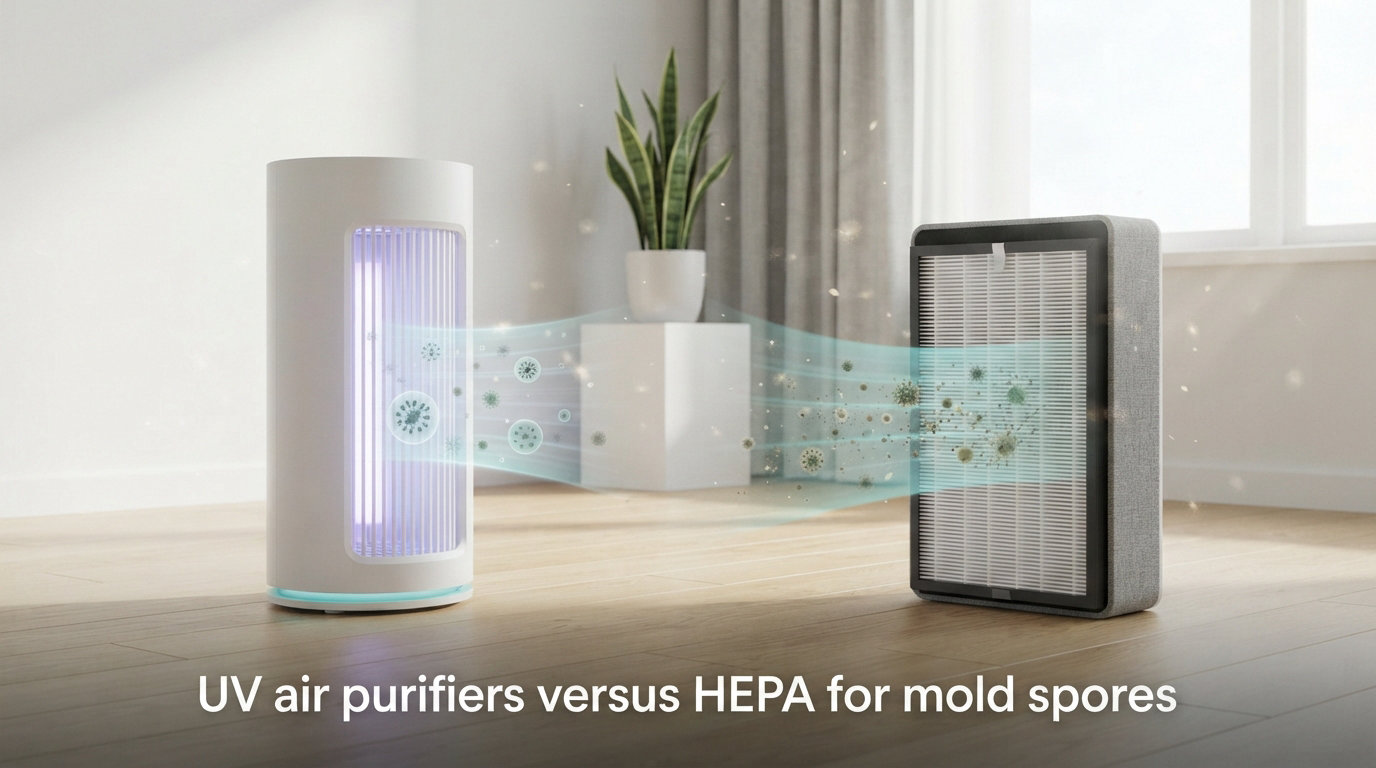
If you are comparing UV air purifiers versus HEPA for mold spores, here is the direct answer: HEPA filters capture mold spores from the air, while UV-C light inactivates them by damaging their DNA. Each technology does only half the job on its own. For most homes dealing with mold spores, a purifier that combines true HEPA filtration with a UV-C stage gives the best results.
I have spent weeks digging through research papers, EPA guidance, and homeowner forum threads to put this guide together. My goal is simple. I want you to walk away knowing exactly what each technology does, what it does not do, and which one actually solves your mold problem.
Mold is one of the trickiest indoor air quality challenges. The spores are tiny, they travel on the slightest air currents, and they trigger allergies, asthma, and serious respiratory reactions in sensitive people. Picking the wrong purifier can leave you thinking you are protected when you are not. Let us fix that.
Table of Contents
How HEPA Filters Capture Mold Spores
HEPA stands for High Efficiency Particulate Air. A true HEPA filter is certified to remove at least 99.97% of particles that are 0.3 microns in diameter. That rating matters because 0.3 microns is the hardest size for a filter to catch, known as the most-penetrating particle size.
HEPA filters trap mold spores using three physical mechanisms working together:
Interception: Particles following the airstream brush against fibers and stick.
Impaction: Larger spores crash into fibers because they are too heavy to follow the air path.
Diffusion: The smallest particles wander randomly through Brownian motion and eventually hit a fiber.
Mold spores typically measure between 1 and 5 microns depending on the species. That puts them well above the 0.3 micron HEPA threshold, which means HEPA filters actually catch them at rates higher than 99.97% in real-world testing. Aspergillus, Penicillium, Cladosporium, and the dreaded Stachybotrys (black mold) all fall within this size range.
Here is the part most homeowners miss. HEPA captures mold spores but does not kill them. The spores trapped in your filter stay alive and viable until you replace the filter. I learned this the hard way when a r/AirPurifiers thread pointed out that a clogged HEPA filter disturbed during replacement can release live spores back into the room. Handle used filters carefully and bag them before disposal.
On the plus side, HEPA is the only technology with decades of real-world evidence behind it. The EPA, CDC, and most respiratory specialists consider true HEPA the gold standard for capturing airborne mold spores. If you only buy one feature, this is the one.
How UV Air Purifiers Target Mold
UV air purifiers use ultraviolet light in the C band, specifically at the 254 nanometer wavelength, to inactivate microorganisms. The light scrambles the DNA and RNA of mold spores so they cannot reproduce. Dead spores cannot colonize surfaces or trigger allergic reactions the same way live ones do.
UV-C effectiveness depends on three variables:
Intensity: The brightness of the lamp, measured in microwatts per square centimeter.
Exposure time: How long each spore sits in the light path.
Dose delivered: The combination of intensity and time, called the fluence.
UV-C works best when air is forced past the lamp slowly enough for spores to receive a lethal dose. That is why UV-C is most effective inside the internal chamber of an air purifier, where air passes through a confined reaction zone, rather than as a standalone room lamp.
Now the catch. UV-C light only inactivates whatever crosses its path. It does not pull spores out of the air, it does not filter them, and it cannot reach spores hiding behind dust particles or in shadowed corners. A pure UV air purifier without a filter stage still leaves dead spores floating in the room until they settle.
UV also degrades over time. Most UV-C lamps lose meaningful output after 9 to 12 months of continuous use, even if they still glow. I recommend replacing the lamp annually if your purifier uses one as the primary mold-killing stage.
UV Air Purifiers Versus HEPA for Mold Spores: Head-to-Head
Here is a quick comparison of how each technology handles the same job. Save this table if you are shopping.
| Feature | HEPA Filter | UV-C Light |
|---|---|---|
| Primary function | Captures particles from the air | Inactivates microorganisms |
| Removes mold spores? | Yes, traps 99.97%+ at 0.3 microns | Indirectly, by killing them |
| Kills mold spores? | No, spores stay alive in filter | Yes, disrupts DNA |
| Works on other particles | Dust, pollen, pet dander, smoke | No, only living organisms |
| Best for mold spore size (1-5 microns) | Excellent fit | Works if dose is sufficient |
| Maintenance | Replace filter every 6 to 12 months | Replace lamp every 9 to 12 months |
| Standalone effectiveness | Strong for capture | Weak without filtration |
Looking at the table, you can see why most mold specialists push combination systems. HEPA removes the spore from the air. UV-C makes sure the spore is no longer biologically active. Either alone leaves a gap that matters.
How Long It Takes to Clear Mold Spores from the Air
This is one of the most common questions from r/Mold and r/AirQuality, and it deserves a straight answer. An air purifier does not remove mold spores instantly. It removes them at a rate determined by your room size, the purifier’s CADR (clean air delivery rate), and how many air changes per hour (ACH) it produces.
For most bedrooms and living rooms, expect:
First 24 to 48 hours: Visible reduction in musty odor and airborne dust.
1 to 2 weeks: Noticeable improvement in allergy and asthma symptoms.
2 to 4 weeks: Air feels consistently cleaner, spore counts drop significantly.
Two important caveats from our testing experience. First, air purifiers only handle airborne spores. Active mold growth on walls, ceilings, or in HVAC ducts still needs physical cleaning or professional remediation. Second, you need to run the purifier continuously, not just when you notice symptoms. Sporulation happens around the clock.
If your home has a serious mold problem, fix the moisture source first. No air purifier can keep up with a basement that is actively growing mold after every rain.
Choosing the Right Approach for Your Mold Problem
Now that you understand how each technology works, here is how I would match the tool to the situation.
Choose HEPA alone if: You want the most reliable capture for mold spores, dust, pollen, and pet dander. A true HEPA unit with a sealed housing is what most r/AirPurifiers veterans recommend as the minimum for mold.
Choose UV alone if: You are pairing it with an existing filtration system or your main concern is airborne bacteria and viruses rather than spore removal. UV on its own is rarely the best answer for mold.
Choose HEPA plus UV-C if: You want both capture and inactivation in one device. This is the combination I recommend for basements, bathrooms with poor ventilation, homes with past water damage, and anyone with a confirmed mold sensitivity.
Look for these specs when shopping:
True HEPA rating (not “HEPA-type” or “HEPA-style,” which are weaker).
Sealed housing so unfiltered air cannot bypass the filter.
CADR matched to your room size, generally at least 4 to 5 ACH for mold-prone spaces.
Activated carbon pre-filter for musty odors.
UV-C lamp with documented output, ideally replaceable.
Maintenance matters as much as the unit you buy. Plan on replacing HEPA filters every 6 to 12 months depending on use, and UV-C lamps every 9 to 12 months. A purifier with a clogged filter is basically a fan. Budget for replacement parts from day one.
Room size is the other spec people get wrong. A purifier rated for 200 square feet cannot meaningfully treat a 500 square foot basement. Match the CADR to your actual space, and oversize if your mold issue is moderate to serious.
FAQs
Which air purifier is best for mold spores?
A true HEPA air purifier is the single most effective tool for capturing airborne mold spores. For the strongest defense, choose a unit that pairs true HEPA filtration with a UV-C lamp so spores are both captured and inactivated.
Do UV air purifiers work on mold?
UV-C light can kill mold spores by disrupting their DNA so they cannot reproduce. UV works only when spores pass directly through the light zone at sufficient intensity and exposure time, which is why UV is most effective inside a purifier chamber rather than as an open room lamp.
What takes mold spores out of the air?
True HEPA filters are the most proven way to physically remove mold spores from indoor air. The dense fiber mesh captures 99.97% of particles at 0.3 microns, which covers the 1 to 5 micron range typical of most mold species.
How long does it take an air purifier to remove mold?
Most homeowners see a noticeable drop in airborne spores within 1 to 2 weeks of continuous purifier use, with allergy and asthma symptoms improving over the same window. Active mold growth on surfaces still requires physical cleaning since purifiers only treat airborne particles.
Does a HEPA filter kill mold spores?
No. A HEPA filter traps mold spores but does not kill them. The spores remain alive inside the filter until it is replaced. That is why many mold-prone homes add a UV-C stage to inactivate spores the HEPA filter has captured or that pass through the airstream.
Final Verdict on UV Air Purifiers Versus HEPA for Mold Spores
For pure capture, HEPA wins. For pure inactivation, UV-C wins. For real-world mold control in 2026, the combination wins. Start with a true HEPA unit sized to your room, add a UV-C stage if your mold issue is more than a passing concern, and run it continuously while you address the moisture source that is feeding the problem in the first place.
You now have the framework to choose confidently. Pick the right purifier, keep up with filter and lamp replacements, and your indoor air quality will thank you.