
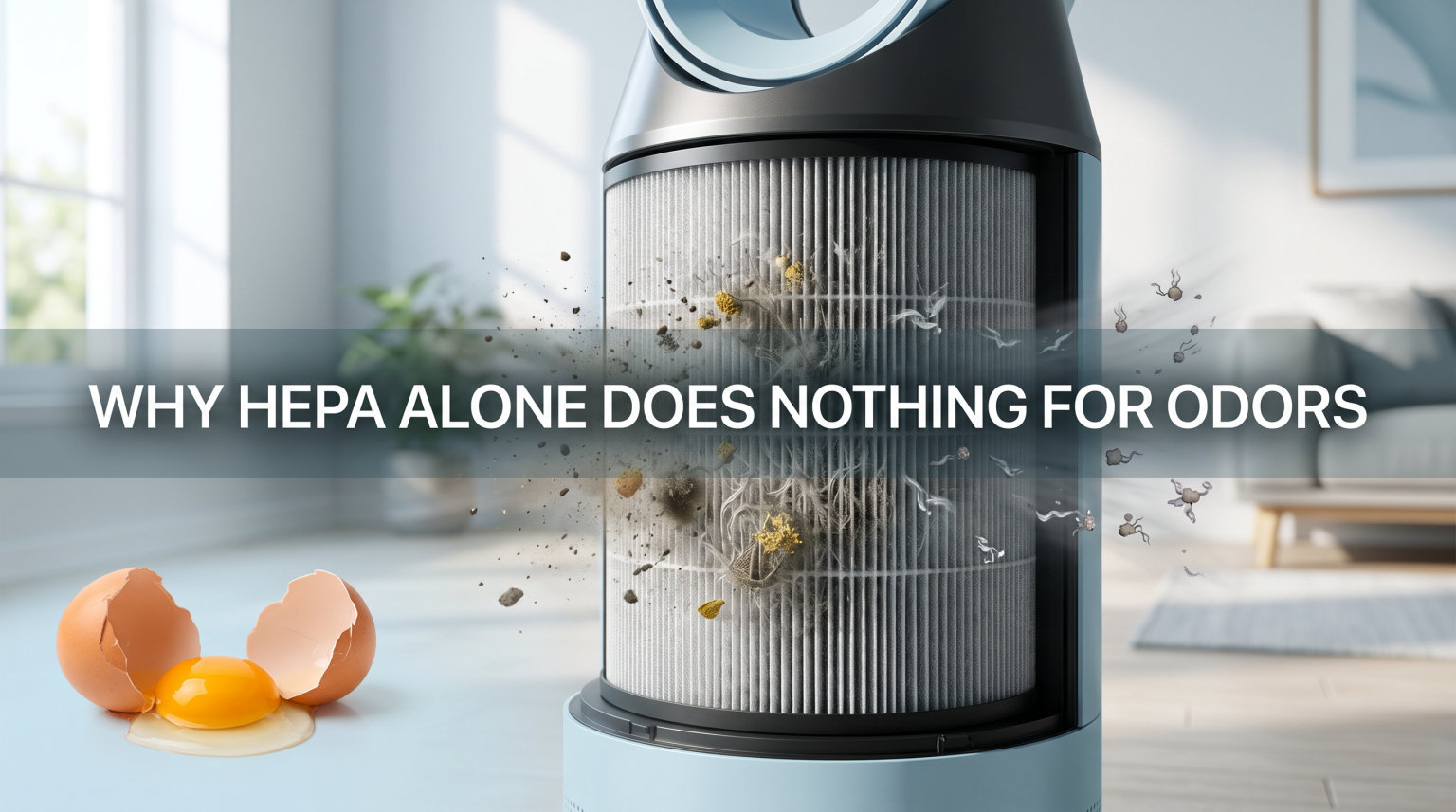
HEPA filter odors won’t go away because HEPA filters only capture solid particles, not gases. Odor molecules exist as gases that pass straight through the dense HEPA mesh. To actually remove smells, your purifier needs activated carbon, which traps odor molecules through a process called adsorption.
I learned this the hard way. Last year I dropped real money on a top-rated purifier with “true HEPA” filtration, ran it for 30 days in a small room with a litter box, and the smell never faded. The dust on the shelf was gone, sure, but the air still carried that unmistakable cat smell. I started digging into the science and realized HEPA filters have a fundamental blind spot that no amount of marketing talk can fix.
This guide breaks down exactly why HEPA filter odors remain a problem, what the science actually says, and what you need to do about it. I’ll cover the particle size gap that breaks HEPA for odors, how activated carbon actually works, and how to shop for a purifier that genuinely handles smells.
Table of Contents
What HEPA filters actually capture (and why that isn’t enough)
HEPA stands for High-Efficiency Particulate Air. It is a mechanical filter, meaning it physically traps particles as air is forced through a dense mat of randomly arranged fibers. There is no chemical reaction involved. It is pure physics.
A “true HEPA” filter must capture at least 99.97% of particles at 0.3 microns in diameter. That 0.3 micron size is known as the most penetrating particle size, or MPPS, which is the worst-case scenario for mechanical filtration. Particles at this exact size are the hardest for HEPA to catch.
Here is where it gets interesting. Particles larger than 0.3 microns are actually easier to capture, not harder. They get caught by a process called impaction, where their momentum carries them into the fibers. Particles much smaller than 0.3 microns also get caught, but through diffusion, where they bounce around randomly due to air currents and eventually stick.
So what does HEPA capture well? Dust, pollen, pet dander, mold spores, smoke particles (the solid soot portion, not the gas), bacteria, many viruses that travel on droplets, and a wide range of common airborne allergens. If you can see it under a microscope and it is a particle, HEPA is excellent at catching it.
What it does not capture is anything in a gaseous state. And this is exactly where the confusion about HEPA filter odors starts. Many people assume a filter that catches 99.97% of airborne particles should also catch smells. The two problems are completely different.
Why HEPA filters fail at odor removal
Odors are not particles. They are gas molecules small enough to slip between the fibers of a HEPA filter without ever making contact. The filter literally cannot see them.
Think of HEPA as a tight window screen. It blocks leaves, bugs, and even dust clumps. It does absolutely nothing to stop wind, because air passes through every gap. Gaseous odor molecules behave the same way with HEPA. They are the wind, and HEPA is the screen.
The mechanism behind HEPA filtration relies on physical collision. A particle has to actually strike a fiber to get trapped, or get close enough that electrostatic or diffusion forces pull it in. Gas molecules are so small and so light that they drift between the fibers without ever getting close enough for those forces to matter.
This is why air purifier odor removal requires more than just HEPA. You need a different filtration stage built specifically for gases, and that stage is activated carbon.
For a concrete size reference, common odor-causing molecules include formaldehyde (around 0.0003 microns), benzene (around 0.0005 microns), ammonia (around 0.0002 microns), and hydrogen sulfide, the rotten egg compound (around 0.0002 microns). All of these are roughly a thousand times smaller than the 0.3 micron HEPA threshold.
To put it in perspective, HEPA is built to catch objects the size of basketballs. Odor molecules are the size of grains of sand. No matter how tightly you pack the basketballs, the sand slips right through.
The size difference that breaks HEPA for odors
The size comparison is the part that makes the whole issue click. Picture a single HEPA fiber. Now think about what can physically fit through the gaps between fibers.
A human hair is roughly 70 microns wide. A HEPA filter can stop things about 230 times thinner than that, which is impressive. But that 0.3 micron threshold only addresses solid particles.
An odor molecule like hydrogen sulfide is about 0.0002 microns. That is roughly 1,500 times smaller than what HEPA is rated to capture. For formaldehyde, the gap is even wider.
This is the core reason HEPA filter odors persist no matter how long you run the purifier or how new the filter is. The filter is doing its job exactly as designed. It was never designed to capture gases. Running it harder, longer, or with a fresh filter does not change the physics.
This is also why people get frustrated and assume their purifier is broken. The marketing promised “odor removal,” the box said “true HEPA,” and the room still smells. The purifier is not broken. The problem is that HEPA filter doesn’t remove odors by design, and the brand did not include enough carbon to fill the gap.
How activated carbon actually removes odors
Activated carbon works through a process called adsorption. Pay attention to that “d” because adsorption is fundamentally different from absorption.
Absorption is what a sponge does. Liquid gets soaked into the bulk of the material, filling it from the inside. Adsorption is what happens at the surface. Gas molecules stick to the exterior and the internal pore surfaces of the carbon granules without penetrating the material itself.
Activated carbon is special because of its enormous surface area. A single gram of quality activated carbon can have a surface area of 500 to 1,500 square meters. That is roughly the size of a football field packed into something smaller than your thumb.
When gaseous odor molecules pass over that surface, they bond with the carbon through weak intermolecular forces called Van der Waals forces. Once bonded, they stay trapped. This is how chemical filtration works for gases, and it is the only practical, safe way to remove odors from indoor air without producing ozone.
The key variable is how much carbon the purifier contains. This is where things get tricky for shoppers. A thin carbon pre-filter sheet will only adsorb a small amount of odor before it gets saturated, often within weeks. For serious odor problems, several pounds of high-quality activated carbon are needed. This is one of the trust signals we keep seeing from real users in forums like r/AirPurifiers, where experienced owners consistently recommend purifiers with multiple pounds of carbon for smell issues.
Another factor is carbon type. Coconut shell carbon is common and effective for general odors. Impregnated carbons, which are treated with chemicals, can target specific gases like formaldehyde or ammonia. For most home users, a general-purpose activated carbon blend is enough.
Common odors HEPA cannot touch
Not all smells behave the same way, but almost all of them fall into the gas-phase category HEPA cannot address. Here is the breakdown of what to expect with common household odor sources.
Cigarette and cigar smoke smells come from volatile organic compounds and other gases that linger on fabrics, walls, and soft furnishings long after the visible smoke clears. HEPA catches the solid soot particles but does nothing for the smell itself. Thirdhand smoke is especially stubborn because the compounds soak into materials and off-gas over time.
Pet odors are a mix. The smell comes from compounds in urine, dander bacteria, anal gland secretions, and oils in pet fur. Most of the actual smell is gaseous. HEPA will catch pet hair and dander, which helps reduce allergens, but the smell stays.
Cooking smells include volatile compounds released from frying, baking, and especially strong spices like garlic, curry, and fish. These are gas-phase molecules that HEPA cannot address. Anyone who has tried to clear a curry smell with a HEPA-only purifier knows exactly how this plays out.
New furniture, paint, and flooring off-gas VOCs like formaldehyde and benzene. This is a common complaint in newer homes or after renovations, and it is purely a gas-phase problem. Some of these compounds are also health concerns, not just nuisance smells.
Mold mustiness comes from microbial volatile organic compounds, or MVOCs, that certain molds produce as they grow. HEPA catches mold spores, which helps prevent spread, but does not touch the musty smell.
Garbage, diaper pails, and bathroom smells are all gas-phase issues. None of them get touched by HEPA filter odors remain unaffected regardless of how powerful the fan is.
How to choose a purifier that handles both particles and odors
If your goal is real air purifier odor removal, you cannot rely on HEPA alone. Here is what to look for when shopping so you do not waste money on a unit that will not actually handle smells.
First, confirm the unit has a substantial activated carbon stage, not just a thin carbon pre-filter. Many purifiers advertise “carbon filtration” but only include a thin mesh sheet impregnated with a few grams of carbon. That handles minimal odor for a short time. Look for purifiers that list the carbon weight in pounds or grams. Anything under half a pound is essentially decorative for serious odor problems.
Second, check the placement of the carbon stage. Carbon filters placed before the HEPA stage can get overloaded quickly because they also have to deal with larger particles. Carbon placed after HEPA tends to last longer because particles are removed first. Some premium units use a separate carbon canister specifically for gas filtration.
Third, watch out for misleading marketing. “HEPA-type” and “HEPA-style” are not the same as “true HEPA” and usually refer to lower-grade filters that may only capture 85% to 90% of particles. Some brands also use carbon as a marketing term while only including a few grams of it. Real activated carbon has weight and substance.
Fourth, plan for replacement. Activated carbon gets saturated over time, usually within 6 to 12 months depending on use and odor load. Once saturated, it stops adsorbing and may even start re-releasing trapped compounds. If your purifier starts letting smells back through, the carbon stage is likely due for replacement. HEPA filters typically last 12 to 18 months, so the carbon stage will need replacing more often.
Fifth, consider room size. A purifier rated for a 200-square-foot room will struggle with odors in a 500-square-foot open plan. Match the unit to your space using the CADR rating, which tells you how many cubic feet of clean air the unit delivers per minute for specific pollutant types.
Sixth, avoid ozone generators and ionizers marketed as “odor removers.” These devices produce ozone, which is a known lung irritant and is banned for residential use in California. They can also damage rubber, plastic, and electronics over time. CARB-certified purifiers are the safer choice.
Finally, consider hybrid approaches. Running a quality HEPA plus carbon purifier alongside source control (cleaning, ventilation, removing the actual odor source) will always outperform relying on filtration alone. No purifier can keep up with a permanently smelly environment.
If you only care about particles (allergies, dust, pollen), HEPA alone is excellent and worth every penny. If you care about HEPA filter odors from any of the categories above, you need activated carbon as a real part of the system, not as a marketing afterthought.
Frequently Asked Questions
Why do HEPA filters not get rid of smells?
HEPA filters only capture solid particles down to 0.3 microns. Odor molecules are gases that are often a thousand times smaller than that, so they pass straight through the filter fibers without ever being trapped.
Do air purifiers really remove odors?
Only if they include an activated carbon stage. Purifiers with HEPA alone will not remove gaseous odors from smoke, pets, cooking, or VOCs. Look for purifiers with several pounds of activated carbon for noticeable odor reduction.
Which air purifier is best for odor?
The best air purifiers for odor have a substantial activated carbon filter (several pounds), a true HEPA stage, and are sized correctly for your room. Avoid ozone generators and ‘HEPA-type’ filters without genuine carbon media.
What are the two disadvantages of HEPA filters?
First, HEPA filters cannot capture gases, odors, or VOCs because odor molecules are far smaller than 0.3 microns. Second, HEPA filters are dense, which restricts airflow and requires more energy to push air through compared to less efficient filters.
The bottom line on HEPA filter odors
HEPA is one of the best filtration technologies ever developed for particles. It is just the wrong tool for odors. If you want HEPA filter odors to actually disappear, your purifier needs a real activated carbon stage with enough carbon to do the job. Check the carbon weight, replace it on schedule, and skip anything marketed as “HEPA-type” without genuine carbon filtration.
For 2026 and beyond, the smartest move is matching the filter to the problem. HEPA handles allergens and dust. Activated carbon handles smells. Together, they handle both. Without carbon, you will keep wondering why the room still smells after weeks of running your purifier.