
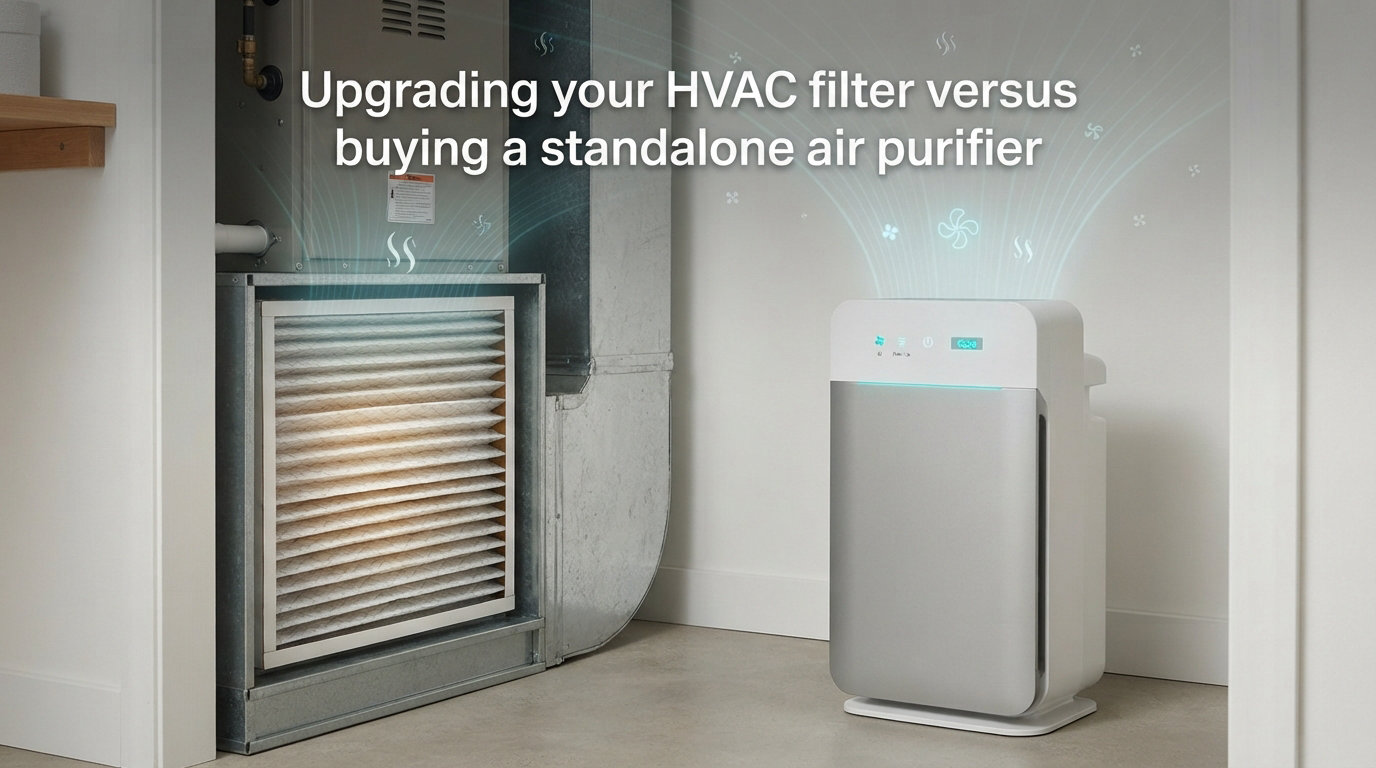
If you have been sneezing more indoors, noticing a fine layer of dust on every surface, or wondering why your allergies act up the moment you walk through the front door, you are probably weighing one common question. Should you upgrade your HVAC filter, or is it time to buy a standalone air purifier?
This is one of the most asked questions in home improvement forums, and for good reason. Indoor air can be 2 to 5 times more polluted than outdoor air, according to the EPA. The filtration choices you make affect everything from allergy symptoms to how hard your heating and cooling system works.
In this guide, I break down the HVAC filter vs air purifier debate so you can make a confident decision for your home. I cover how each option works, what MERV and HEPA ratings actually mean, the real cost differences, and when it makes sense to use both together. I also pull in real experiences from homeowners who have tested these options firsthand.
By the end, you will know exactly which path fits your space, your budget, and your air quality goals.
Table of Contents
What Is an HVAC Filter and How Does It Work
An HVAC filter is a replaceable screen installed in your ductwork, usually at the return air vent or inside the air handler. Its primary job is protecting your heating and cooling equipment from dust and debris that would otherwise coat the internal components.
Every time your furnace or air conditioner runs, the blower pulls household air through the filter before sending it back through your vents. This means filtration only happens while the system is actively heating or cooling. During mild weather when the system sits idle, your filter does nothing.
Most standard filters are made of spun fiberglass or pleated synthetic material. The pleated versions capture significantly more particles because the folds increase the surface area. Filters come in common sizes like 20x20x1 or 16x25x1, and they slide into a designated slot in your system.
The key thing to understand is that an HVAC filter works passively. It does not have its own motor or fan. It relies entirely on the airflow generated by your HVAC equipment, which is a critical distinction when comparing it to a standalone air purifier.
MERV Ratings Explained: What Each Level Actually Captures
MERV stands for Minimum Efficiency Reporting Value, and it is the standard rating system for HVAC filter performance. The scale runs from 1 to 20, but residential systems typically use filters rated between MERV 8 and MERV 13.
Here is a practical breakdown of the ratings most homeowners encounter:
MERV 8: Captures dust, lint, and pollen. This is the baseline filter found in many homes. It does a decent job of protecting equipment but misses finer particles.
MERV 11: Captures everything from MERV 8 plus finer dust, mold spores, and pet dander. A solid middle-ground upgrade for most households.
MERV 13: Captures bacteria, smoke, and particles as small as 0.3 microns. This is the highest rating most residential HVAC systems can handle without modification.
For context, a true HEPA filter captures 99.97 percent of particles down to 0.3 microns. The best residential HVAC filters max out around 62 to 95 percent at that size. This gap is one of the biggest reasons people consider adding a standalone purifier.
There is an important catch with high-MERV filters that many homeowners overlook. Denser filter media creates more airflow resistance. I have seen numerous forum posts from people who upgraded to MERV 13 and immediately noticed weak airflow from their vents.
If your return air ductwork is undersized or your blower motor is older, a thick pleated filter can strain the system. In homes with well-designed ductwork, upgraded filtration works beautifully. In older homes with smaller returns, you may need professional guidance before jumping to MERV 13.
What Is a Standalone Air Purifier
A standalone air purifier is an independent device with its own fan and motor that actively pulls room air through one or more filtration stages. Unlike an HVAC filter, it does not depend on your heating or cooling system running.
Most quality air purifiers use a multi-stage filtration process. The first stage is typically a pre-filter that catches large particles like pet hair and lint. The second stage is the HEPA filter, which is where the serious particle capture happens.
A true HEPA filter traps 99.97 percent of particles down to 0.3 microns, including fine dust, pollen, mold spores, bacteria, and smoke. Many models add an activated carbon layer that absorbs gases, odors, and volatile organic compounds, which mechanical filters cannot capture.
When shopping for a purifier, you will see a rating called CADR, or Clean Air Delivery Rate. This number tells you how quickly the unit cleans air in a given room size. A higher CADR means faster purification. The Association of Home Appliance Manufacturers certifies these ratings, and experienced buyers use them to match a purifier to their room dimensions.
The trade-off is coverage. A standalone unit cleans the air in one room, not your entire house. You would need multiple units for whole-home coverage, which adds up quickly in both purchase cost and ongoing maintenance.
HVAC Filter vs Air Purifier: Key Differences
The core difference in the HVAC filter vs air purifier comparison comes down to passive versus active filtration. An HVAC filter only works when your heating or cooling system runs. An air purifier runs on its own schedule, cleaning air continuously whether your HVAC is on or off.
Here are the key distinctions that matter most when deciding between the two:
Coverage area: An HVAC filter treats all the air that circulates through your ductwork, which means whole-home coverage in theory. A standalone purifier handles a single room, usually between 300 and 600 square feet depending on the model.
Filtration power: Even the best MERV 13 HVAC filter captures roughly 62 to 95 percent of fine particles. A true HEPA purifier captures 99.97 percent. If you need maximum particle removal, especially for smoke or allergens, a purifier wins on raw efficiency.
System role: An HVAC filter protects your equipment first and cleans air second. A standalone purifier exists purely to clean the air you breathe. They serve overlapping but different purposes.
Cost structure: Upgrading an HVAC filter costs a few dollars more per filter and requires periodic replacement. A standalone purifier requires an upfront purchase plus ongoing electricity and replacement filter costs.
Flexibility: You can move a standalone purifier from room to room or take it with you when you move. An HVAC filter upgrade stays with the house.
When to Upgrade Your HVAC Filter
Upgrading your HVAC filter is the right move when you want whole-home improvement without buying new equipment. If everyone in your household deals with mild allergies or you simply want less dust settling on surfaces, stepping up from MERV 8 to MERV 11 or MERV 13 can make a noticeable difference.
This approach works especially well if your HVAC system runs frequently. Homes in climates with long heating or cooling seasons get more benefit from upgraded filtration because air circulates through the filter more often.
Homeowners with well-designed ductwork report significant improvements. In one popular Reddit thread on r/HomeImprovement, multiple users shared that upgrading to MERV 13 in a newer home with properly sized returns noticeably reduced dust and allergy symptoms within weeks.
However, I want to flag a real concern that comes up repeatedly in HVAC forums. If you live in an older home, your return air system may not handle dense pleated filters well. A high-MERV filter in undersized ductwork can reduce airflow, cause your system to work harder, and even lead to frozen coils or premature blower motor wear.
The safest approach is to start with MERV 11 if you are currently using a basic fiberglass filter. Check your airflow after installation. If everything feels normal and your system runs quietly, you can consider stepping up to MERV 13 on the next replacement cycle.
Replace upgraded filters every 60 to 90 days rather than the standard 90-day interval, because denser media clogs faster. A clogged high-MERV filter actually performs worse than a clean standard filter.
When a Standalone Air Purifier Makes More Sense
A standalone air purifier is the better choice when you need targeted, high-efficiency cleaning in a specific space. Bedrooms, home offices, and nurseries are the most common rooms where people want maximum air quality.
If you suffer from asthma or severe allergies, a HEPA purifier running beside your bed can dramatically reduce nighttime symptoms. Forum users with chronic respiratory conditions frequently describe standalone HEPA units as life-changing, especially in older homes where HVAC filtration is limited.
Pet owners benefit from purifiers in a way HVAC filters cannot match. An activated carbon layer absorbs pet odors and the gases from litter boxes, which mechanical filtration simply passes through. If your main complaint is smell rather than dust, a purifier with a thick carbon filter addresses that directly.
Anyone dealing with wildfire smoke should seriously consider a standalone unit. HEPA filters capture the fine particulate matter in smoke that even MERV 13 HVAC filters miss. During smoke season, running a purifier in your main living space provides protection that a whole-home filter cannot fully deliver.
Renters also benefit from this option. You cannot modify an HVAC system in a rental property, but you can plug in a purifier anywhere. It travels with you and requires no installation.
Can You Use Both Together
Yes, and many indoor air quality experts recommend it. Using an upgraded HVAC filter and a standalone air purifier together creates a layered filtration strategy that covers your entire home.
Think of it this way. Your HVAC filter acts as the first line of defense, capturing larger particles and protecting your equipment across the whole house. Your standalone purifier acts as the precision tool, delivering HEPA-level cleaning exactly where you spend the most time.
This combined approach is what experienced homeowners on r/AirQuality often recommend. The consensus is that a MERV 11 HVAC filter paired with a HEPA purifier in the bedroom gives you the best of both worlds without overloading your HVAC system.
You do not need to go overboard. A single purifier in the room where you sleep, combined with a reasonably upgraded HVAC filter, covers most households better than either option alone.
Cost Comparison: Filter Upgrades vs Air Purifiers
Understanding the long-term cost helps you make a smart financial decision. Here is how the two options compare over a typical year.
HVAC filter upgrade costs: Stepping up from a basic fiberglass filter to MERV 11 or MERV 13 typically adds a few dollars per filter. If you replace filters every 60 to 90 days, your annual increase is modest. There is no new equipment to buy, no electricity cost beyond what your HVAC already uses, and no maintenance beyond swapping the filter.
The hidden cost is potential strain on your system. If a high-MERV filter restricts airflow in an older system, you could face higher energy bills or premature wear on components. This is why checking airflow after upgrading matters.
Standalone purifier costs: A quality HEPA purifier for a mid-sized room runs anywhere from moderately priced to several hundred dollars depending on features and coverage. You also pay for electricity to run it continuously and replacement filters every 6 to 12 months.
The ongoing filter replacement cost is the expense that surprises people. Some models use proprietary filters that cost significantly more than standard replacements. Check filter prices before you buy a unit, not after.
Value comparison: If your goal is whole-home dust reduction at minimal cost, upgrading your HVAC filter wins. If your goal is maximum air cleaning in one or two priority rooms, a standalone purifier delivers better results per dollar spent in that space.
Common Mistakes and Misconceptions
Several myths circulate in online discussions about air filtration. Let me clear up the most common ones I see.
Myth: Higher MERV is always better. This is false and potentially damaging. A MERV 13 filter in a system designed for MERV 8 can choke airflow and cause real problems. Match your filter rating to your system’s capacity.
Myth: A standalone purifier replaces your HVAC filter. It does not. Your HVAC filter protects your equipment. Running a system with no filter or a clogged filter allows dust to coat internal components, reducing efficiency and shortening equipment life. You always need a basic filter in place.
Myth: If you have not changed your filter in years, it still works fine. A filter that has not been changed in two years is likely so packed with debris that air barely passes through. This forces your blower motor to work overtime, raises energy bills, and can lead to system failure. One Reddit user described finding a filter so clogged it had actually started to collapse into the ductwork.
Myth: HEPA filters in HVAC systems are easy to add. True HEPA filtration requires significantly more air pressure than standard HVAC systems deliver. Whole-house HEPA systems exist but typically need professional installation, dedicated ductwork, and a stronger blower. This is why standalone HEPA purifiers remain popular for actual HEPA performance.
How to Choose the Right Option for Your Home
Use this framework to decide between upgrading your HVAC filter, buying a standalone purifier, or doing both.
Choose an HVAC filter upgrade if: You own your home, your system runs frequently, you want whole-home improvement, and your ductwork can handle denser filters. This is the lowest-cost path to better overall air quality.
Choose a standalone air purifier if: You rent, you need targeted cleaning in a bedroom or specific room, you deal with odors or smoke, or you have severe allergies that demand HEPA-level filtration.
Choose both if: You want comprehensive coverage. Upgrade your HVAC filter to MERV 11 for whole-home baseline protection, then add a HEPA purifier in your bedroom for maximum cleaning where you spend the most time.
Before upgrading your filter, check your current filter size and inspect your return air vents. If you are unsure whether your system can handle a higher MERV rating, ask an HVAC technician to assess your ductwork and blower capacity. A quick professional check costs far less than replacing a burned-out motor.
FAQs
Is an air purifier better than a HVAC filter?
Neither is universally better. A standalone air purifier with a HEPA filter captures 99.97 percent of particles down to 0.3 microns, which outperforms even the best residential HVAC filters. However, an HVAC filter provides whole-home coverage and protects your equipment, while a purifier only cleans one room. Most homeowners benefit from using both rather than choosing one over the other.
Are upgraded air filters worth it?
Yes, for most homeowners. Upgrading from a basic fiberglass filter to MERV 11 or MERV 13 captures significantly more dust, pollen, mold spores, and pet dander. The cost increase per filter is modest. The one caveat is that high-MERV filters can restrict airflow in older systems with undersized ductwork, so check your system capacity before upgrading to MERV 13.
Is an air purifier attached to the HVAC worth it?
Whole-house air purifiers that integrate with your HVAC system can be worth it if you want whole-home HEPA-level filtration and have the budget for professional installation. These systems cost significantly more than standalone units and may require ductwork modifications. For many households, upgrading the HVAC filter and adding a standalone purifier in key rooms delivers similar benefits at a lower total cost.
What happens if you haven’t changed your air filter in 2 years?
A filter left unchanged for two years becomes severely clogged, which restricts airflow and forces your blower motor to work much harder. This raises energy bills, reduces comfort, and can cause the evaporator coil to freeze or the motor to burn out. You may also notice more dust in your home and poorer indoor air quality. Replace the filter immediately and have your system inspected if you notice weak airflow or unusual sounds.
Can air purifiers replace HVAC filters?
No. A standalone air purifier cannot replace your HVAC filter because the HVAC filter serves a different purpose. It protects your heating and cooling equipment from dust and debris that would coat internal components and reduce efficiency. Even with a purifier running, you still need a functioning filter in your HVAC system, replaced every 60 to 90 days.
Making Your Final Decision on HVAC Filter vs Air Purifier
The HVAC filter vs air purifier question does not have a single right answer, but it has a clear framework. Your HVAC filter is your whole-home baseline, protecting your equipment and reducing dust across every room. A standalone air purifier is your precision tool, delivering HEPA-level cleaning exactly where you need it most.
If I had to give one recommendation, it would be this. Start by upgrading your HVAC filter to MERV 11, check your airflow, and add a standalone HEPA purifier in the room where you sleep. That combination delivers the best results for the lowest total investment, and it is the setup most experienced homeowners settle on after trying both options separately.
Assess your own situation. Consider your home size, your system age, your specific air quality concerns, and your budget. The right choice is the one that fits your life, not a one-size-fits-all answer from a product page.