
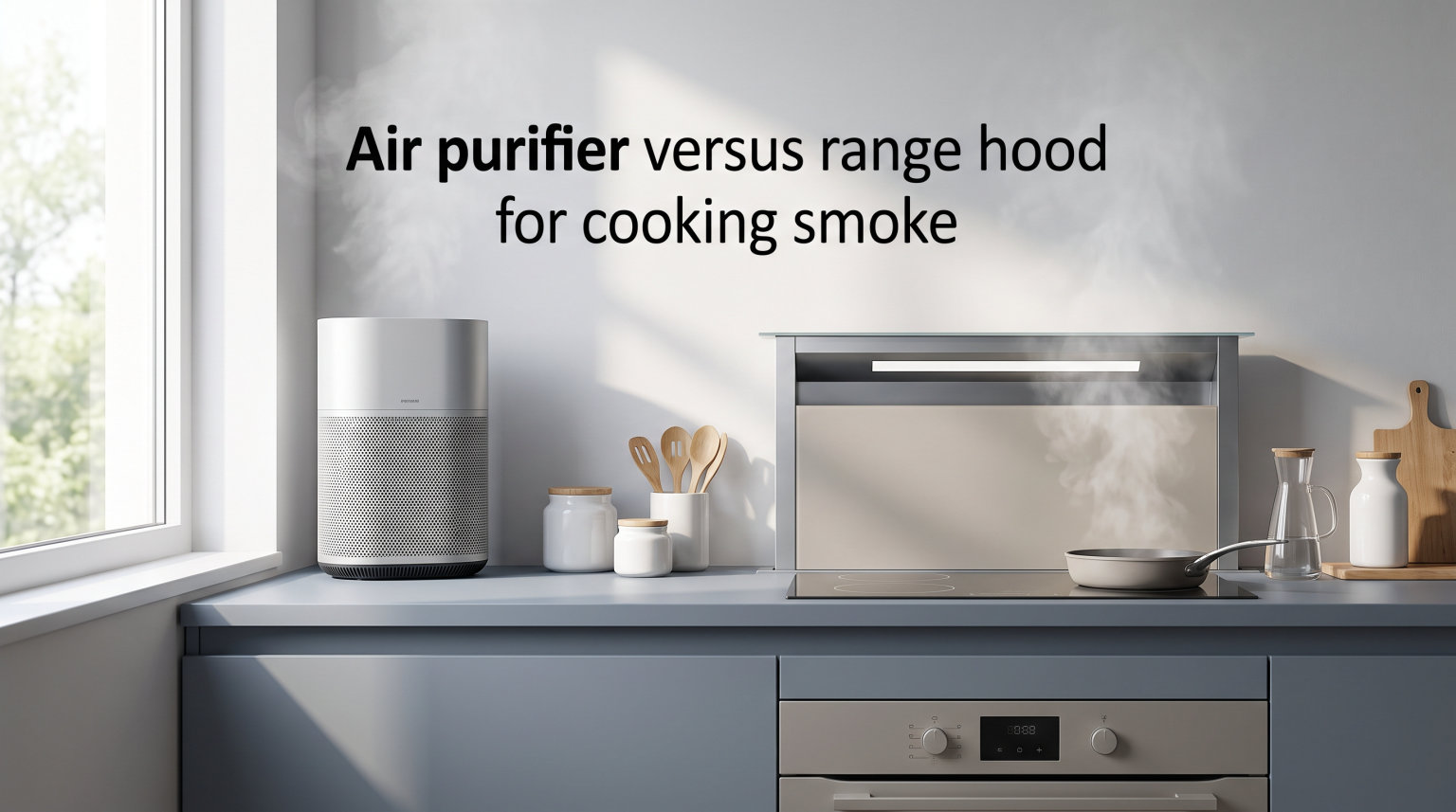
If you have ever set off the smoke alarm while searing a steak or watched a cloud of oil mist drift through your kitchen, you already know that cooking creates pollution. The question I hear most from readers is whether an air purifier can handle that pollution or if a range hood is the only real answer. This guide breaks down the air purifier versus range hood for cooking smoke debate so you can make a confident decision for your kitchen.
Both devices improve indoor air quality, but they work in completely different ways. A range hood captures smoke, grease, and gases at the source and either vents them outside or filters them through internal barriers. An air purifier sits in the room and pulls existing air through a series of filters to strip out particles and odors over time.
I have spent months researching kitchen air quality studies, reading hundreds of forum threads from real homeowners, and comparing the technical specifications of both solutions. What I found is that this is not a simple either-or question. The right answer depends on your stove type, kitchen layout, whether you can vent to the outside, and what you actually cook.
By the end of this article, you will understand exactly how each device works, what each one can and cannot do, and which solution fits your specific situation. I will also cover the safety considerations that matter most, especially if you cook with gas.
Table of Contents
Why Kitchen Ventilation Actually Matters
Cooking is one of the largest sources of indoor air pollution in most homes. When you heat oil, char meat, or boil liquids, you release a mix of fine particles, gases, and volatile organic compounds into the air you breathe.
Studies from institutions including the Lawrence Berkeley National Laboratory have shown that cooking on a gas stove can produce nitrogen dioxide levels that exceed outdoor air quality standards within minutes. The same research found that a single pan-fried meal can spike fine particulate matter (PM2.5) to levels that rival a smoggy city street.
These pollutants are not just a nuisance. Long-term exposure to cooking-related nitrogen dioxide has been linked to respiratory problems, especially in children and people with asthma. Fine particles from high-heat cooking can penetrate deep into the lungs and enter the bloodstream.
Even electric stoves create pollution. The act of heating food, vaporizing oils, and burning sugars generates ultrafine particles regardless of your heat source. A study referenced by IQAir found that cooking activities can produce particle concentrations up to ten times higher than background indoor levels.
Volatile organic compounds add another layer of concern. When fats and oils hit a hot pan, they release acrolein and other VOCs that irritate the eyes, throat, and lungs. These same compounds are what give cooking its characteristic smell, both pleasant and overwhelming.
Grease is the visible part of the problem. That sticky film that builds up on cabinets and walls near your stove comes from aerosolized cooking oil. Without capture at the source, it spreads throughout your home and becomes a cleaning nightmare.
This is why having a real plan for kitchen ventilation matters. It is not just about comfort or odor control. It is about protecting the air your family breathes every single day.
How Range Hoods Work
A range hood is a mechanical ventilation system mounted directly above your cooktop. Its job is to capture smoke, steam, grease, and combustion gases at the source before they can spread through your kitchen.
The basic mechanism is simple but effective. A motorized fan creates upward airflow that pulls cooking emissions into a canopy or hood. From there, the air takes one of two paths depending on the type of range hood you have.
A ducted range hood pulls contaminated air through metal grease filters and then pushes it through ductwork to the exterior of your home. This is the most effective design because it physically removes pollutants from your living space. The grease filters catch oil droplets before they enter the ductwork, and the rest of the smoke and gases go outside.
A ductless, or recirculating, range hood pulls air through grease filters and then through charcoal or carbon filters before releasing it back into the kitchen. These units trap some odors and grease but cannot remove combustion gases like carbon monoxide or nitrogen dioxide. Forum users widely consider ductless hoods inadequate for serious cooking, and the science backs them up.
The power of a range hood is measured in CFM, or cubic feet per minute. This number tells you how much air the fan can move. As a general rule, you want at least 100 CFM for every 10,000 BTUs of your cooktop output. A typical gas range producing 40,000 BTUs would need a hood rated for at least 400 CFM.
Research from Missouri University of Science and Technology showed that even a properly functioning range hood only captures about half of the pollutants from back burners and even less from front burners. That means a range hood helps significantly but does not solve the problem entirely on its own.
Range hoods also excel at grease capture. The metal baffle or mesh filters trap oil particles that would otherwise coat your kitchen surfaces. These filters are typically dishwasher-safe and reusable, which makes maintenance straightforward.
How Air Purifiers Handle Cooking Smoke
An air purifier is a standalone filtration device that sits in your kitchen and cleans the air already in the room. Instead of capturing smoke at the source like a range hood, it processes room air through multiple filter stages.
A quality kitchen air purifier uses at least three filtration stages. The first is a washable pre-filter that catches large particles like hair and dust. The second is a true HEPA filter, which captures 99.97 percent of particles as small as 0.3 microns. The third is an activated carbon filter, which adsorbs gases and odors.
The HEPA filter is what handles the visible smoke and fine particulate matter from cooking. It traps the PM2.5 particles that a range hood might miss, especially if those particles have already spread beyond the immediate cooking zone.
The activated carbon filter is what handles odors and gases. This is the component that many people overlook. A HEPA filter alone cannot remove cooking smells or volatile organic compounds because those are gaseous pollutants, not particles. Without a substantial carbon filter, your air purifier will not touch that lingering bacon smell.
Air purifier power is measured by CADR, or Clean Air Delivery Rate. This number tells you how quickly the unit can clean a specific volume of air. For kitchen use, you want a CADR of at least 300 for smoke particles. Higher is always better, especially if you cook frequently or at high heat.
The key limitation of an air purifier is that it reacts to pollution rather than preventing it. By the time smoke reaches the unit across the room, it has already spread through your kitchen and possibly into adjacent living spaces. The purifier will clean the air eventually, but the process takes time.
Another limitation is coverage. Air purifiers are rated for specific room sizes. If your open-concept kitchen flows into a living area, you need a unit sized for the total combined square footage, not just the kitchen footprint.
Despite these limitations, forum users consistently report that a good air purifier with a carbon filter makes a noticeable difference in cooking odors and air clarity. The trick is running it during and for at least 30 minutes after cooking.
Air Purifier Versus Range Hood: Direct Comparison
The core difference between these two solutions comes down to source capture versus room filtration. A range hood intercepts pollution at the stove before it spreads. An air purifier cleans air that has already escaped into the room.
For raw smoke and grease, the range hood wins. Because it sits inches above the cooktop, it can capture emissions before they disperse. Its grease filters catch oil that an air purifier was never designed to handle. No air purifier will prevent that sticky film from building up on your cabinets.
For fine particles that escape the range hood, the air purifier picks up the slack. A true HEPA filter captures particles down to 0.3 microns, which covers the ultrafine pollution generated by high-heat cooking. If your range hood only catches half the particles, a good purifier can help with the rest.
For odors and gases, the comparison gets more interesting. A ducted range hood physically removes odorous air from your home, which is the most effective approach. An air purifier with a thick activated carbon filter can adsorb many of the same odor molecules, but the process is slower and the carbon filter eventually saturates.
For combustion safety, there is no comparison. A ducted range hood removes carbon monoxide and nitrogen dioxide from your home. An air purifier cannot remove these gases in meaningful quantities because standard activated carbon is not designed for continuous CO or NO2 removal under real kitchen conditions.
For flexibility, the air purifier wins easily. You can place it anywhere, move it between rooms, and take it with you when you move. A range hood is a permanent installation that requires ductwork, electrical work, and sometimes building modifications.
For apartments and rentals, the air purifier is often the only viable option. You cannot install a ducted range hood without major renovations, and most landlords will not allow it.
Here is a quick side-by-side summary of how the two compare across the factors that matter most:
Pollutant removal method: Range hood captures at source and vents outside; air purifier filters room air through internal filters.
Grease capture: Range hood excels with metal filters; air purifier does not handle grease.
Odor control: Ducted range hood removes odors completely; air purifier adsorbs odors with carbon filter.
Combustion gas safety: Ducted range hood vents CO and NO2 outside; air purifier cannot address these gases effectively.
Installation: Range hood requires permanent installation and ductwork; air purifier plugs into any outlet.
Flexibility: Range hood is fixed above the stove; air purifier is portable and repositionable.
Filter maintenance: Range hood grease filters are washable and reusable; air purifier needs periodic HEPA and carbon filter replacements.
Cost: Range hood plus installation runs higher upfront; air purifier has a lower entry cost but ongoing filter costs.
Safety Considerations: Carbon Monoxide and Gas Stoves
If you cook with gas, safety changes the entire conversation. Gas combustion produces carbon monoxide, nitrogen dioxide, and other harmful byproducts that go far beyond cooking smoke and odors.
Nitrogen dioxide is the most immediate concern. The EPA has set outdoor NO2 standards at 100 parts per billion over one hour, and cooking with gas can push your kitchen well past that threshold. Research shows that homes with gas stoves consistently have higher NO2 levels than homes with electric stoves, sometimes by a factor of two or three.
Carbon monoxide is the silent danger. While normal gas cooking produces relatively small amounts of CO, any malfunctioning burner or poor ventilation can cause levels to climb. A ducted range hood provides real protection by venting combustion gases outside before they accumulate.
This is why I cannot recommend relying on an air purifier as your primary safety measure for a gas stove. Activated carbon can adsorb some NO2 under laboratory conditions, but the volume and flow rate of a typical home air purifier cannot keep up with the output of a gas burner in real-world use. No consumer air purifier is certified for CO removal.
If you have a gas stove and no ducted range hood, install a carbon monoxide detector in or near your kitchen immediately. This is a non-negotiable safety step that costs under $30 and could save your life.
I also recommend a nitrogen dioxide monitor if you can find one, especially if anyone in your household has asthma or other respiratory conditions. Knowing your actual exposure levels helps you make informed decisions about when to open windows, run additional fans, or adjust your cooking methods.
For electric and induction stoves, the safety picture is different. You do not have combustion gases to worry about, so an air purifier becomes a much more viable standalone solution for handling cooking particles and odors.
Can You Replace a Range Hood with an Air Purifier?
The short answer is no, not completely. An air purifier can reduce cooking smoke and odors, but it cannot fully replicate what a ducted range hood does, especially for gas stove safety.
The longer answer depends on your situation. For electric and induction cooktops in well-ventilated spaces, a high-quality air purifier with HEPA and thick activated carbon filtration can handle most cooking smoke and odor problems. Many forum users in apartments report satisfaction with this approach.
For gas stoves, I strongly advise against relying on an air purifier alone. The combustion gases produced by gas cooking require active ventilation to the exterior. This is a safety issue, not just a comfort issue.
For homes where a ducted range hood is impossible, the best approach is a combination strategy. Use a ductless range hood for grease capture, an air purifier with carbon filtration for particles and odors, and always keep a window cracked during heavy cooking sessions.
Real users on Reddit and home improvement forums consistently report that combining multiple solutions produces the best results. Those who rely on a single device are almost always disappointed, regardless of which device they chose.
When to Choose Each Solution
Your ideal setup depends on your kitchen, your stove, and your cooking habits. Let me walk through the most common scenarios I see from readers and forum discussions.
Choose a ducted range hood if you are renovating or building new. If you have the opportunity to run ductwork to the exterior, take it. A properly sized ducted hood is the single most effective tool for kitchen air quality. This is especially important if you cook with gas or do a lot of high-heat cooking like stir-frying or searing.
Choose an air purifier if you rent or cannot install ductwork. Apartments, condos, and homes with kitchens on interior walls often have no path for exterior venting. In these cases, a powerful air purifier with both HEPA and activated carbon filters is your best available option for managing cooking smoke and odors.
Choose both if you want maximum air quality. This is what I recommend to most readers who ask. A ducted range hood handles source capture, grease, and combustion gases. An air purifier placed nearby handles the particles and odors that escape the hood. Together, they provide layered defense that no single device can match.
Choose a ductless range hood only if you need grease capture. If ductwork is impossible but you still want to trap grease at the source, a recirculating hood with washable metal filters and replaceable charcoal pads can help. Just understand that it will not remove combustion gases, and the charcoal filters need frequent replacement to remain effective.
Consider a portable extraction hood if you have no permanent option. Products like countertop or portable extraction hoods have gained attention as a compromise. They sit near the stove and pull smoke through internal filters. User reviews are mixed, but some apartment dwellers find them helpful as a supplement rather than a primary solution.
Prioritize ventilation for frequent or high-heat cooking. If you cook every day, use high heat regularly, or prepare dishes that generate heavy smoke like grilled meats or deep-fried foods, you need strong ventilation. A small air purifier will not keep up with that volume of pollution, no matter how good its filters are.
Best Practices for Cleaner Kitchen Air
Whichever solution you choose, how you use it matters as much as what you buy. These practices come from research, manufacturer guidelines, and real user experience.
Run your range hood on the right burners. Use back burners whenever possible because they sit directly under the hood canopy. Research shows range hoods capture roughly twice as much pollution from back burners compared to front burners. If you must use a front burner, turn the fan to its highest setting.
Start the fan before you start cooking. Turn on your range hood or air purifier before you heat the pan. This creates airflow and capture momentum before the first puff of smoke appears. Many users make the mistake of waiting until smoke is visible, which means pollutants have already spread.
Keep the fan running after cooking. Run your range hood for 10 to 15 minutes after you finish cooking to clear residual particles and gases. If you are using an air purifier, let it run for at least 30 minutes post-cooking to process the air thoroughly.
Size your air purifier correctly. Check the CADR rating and match it to your room size. A unit with a smoke CADR of 300 can effectively clean a room of about 300 square feet. For open-concept kitchens that flow into living areas, you need to account for the total connected space, not just the cooking zone.
Place the air purifier near the stove but not on top of it. Positioning the unit 3 to 6 feet from the cooktop gives it access to cooking emissions without exposing it to direct heat or grease splatter. Avoid placing it directly on the counter next to a burner where oil could damage the unit.
Replace filters on a kitchen-specific schedule. Kitchen air purifiers work harder than units in other rooms. Plan to replace the carbon filter every 3 to 6 months instead of the standard 6 to 12 months. HEPA filters may need annual replacement instead of every 2 to 3 years, depending on how often you cook.
Clean range hood grease filters monthly. Metal baffle and mesh filters can be washed in the dishwasher or soaked in hot soapy water. A clogged filter reduces airflow and capture efficiency dramatically, so stay on top of this maintenance task.
Open a window when possible. Even a cracked window provides fresh air dilution that no mechanical system can replicate. If weather and outdoor air quality allow, create cross-ventilation by opening a window near the kitchen and another on the opposite side of your home.
Back up gas stove safety with a CO detector. Place a carbon monoxide detector in or just outside your kitchen. Test it monthly and replace the batteries twice a year. This is your safety net if ventilation fails or a burner malfunctions.
Consider upgrading to induction if possible. If you are replacing your stove anyway, induction cooktops eliminate combustion gases entirely. This removes the most dangerous category of kitchen pollution and makes an air purifier a much more complete standalone solution.
FAQs
Will an air purifier help with cooking smoke?
Yes, an air purifier with a true HEPA filter will reduce cooking smoke by capturing fine particles down to 0.3 microns. For best results, choose a unit with a high smoke CADR rating and a thick activated carbon filter for odor removal. Run it during cooking and for at least 30 minutes afterward.
Do range hoods remove smoke?
Yes, range hoods are designed to capture smoke, steam, and grease at the source above your cooktop. Ducted range hoods that vent outside are the most effective at removing smoke completely, while ductless models filter and recirculate the air back into the kitchen.
Can I use an air purifier instead of a range hood?
An air purifier can reduce cooking smoke and odors but cannot fully replace a ducted range hood, especially if you cook with gas. Gas stoves produce carbon monoxide and nitrogen dioxide that require exterior ventilation. For electric stoves, a quality air purifier is a more viable standalone option.
Is it safe to use a gas stove without a range hood?
Using a gas stove without ventilation is not recommended because gas combustion produces nitrogen dioxide and carbon monoxide that can reach unsafe levels. If no range hood is possible, install a carbon monoxide detector, open windows while cooking, and use additional fans to move air out of the kitchen.
Will an air purifier remove cooking smells?
Yes, but only if the air purifier has a substantial activated carbon filter. HEPA filters capture particles but cannot remove odors because smells are gaseous. The carbon filter adsorbs odor molecules, though it will need replacement every 3 to 6 months in a kitchen environment to stay effective.
Conclusion
The air purifier versus range hood for cooking smoke comparison does not have a single winner because the two devices serve different purposes. A ducted range hood captures pollution at the source and is essential for gas stove safety. An air purifier cleans existing room air and excels at particle and odor removal where ductwork is impossible.
For the best kitchen air quality, combine both. Use a ducted range hood for source capture and combustion gas removal, then add a HEPA plus carbon air purifier to clean what escapes. If you can only choose one, match the solution to your stove type, kitchen layout, and installation constraints.