
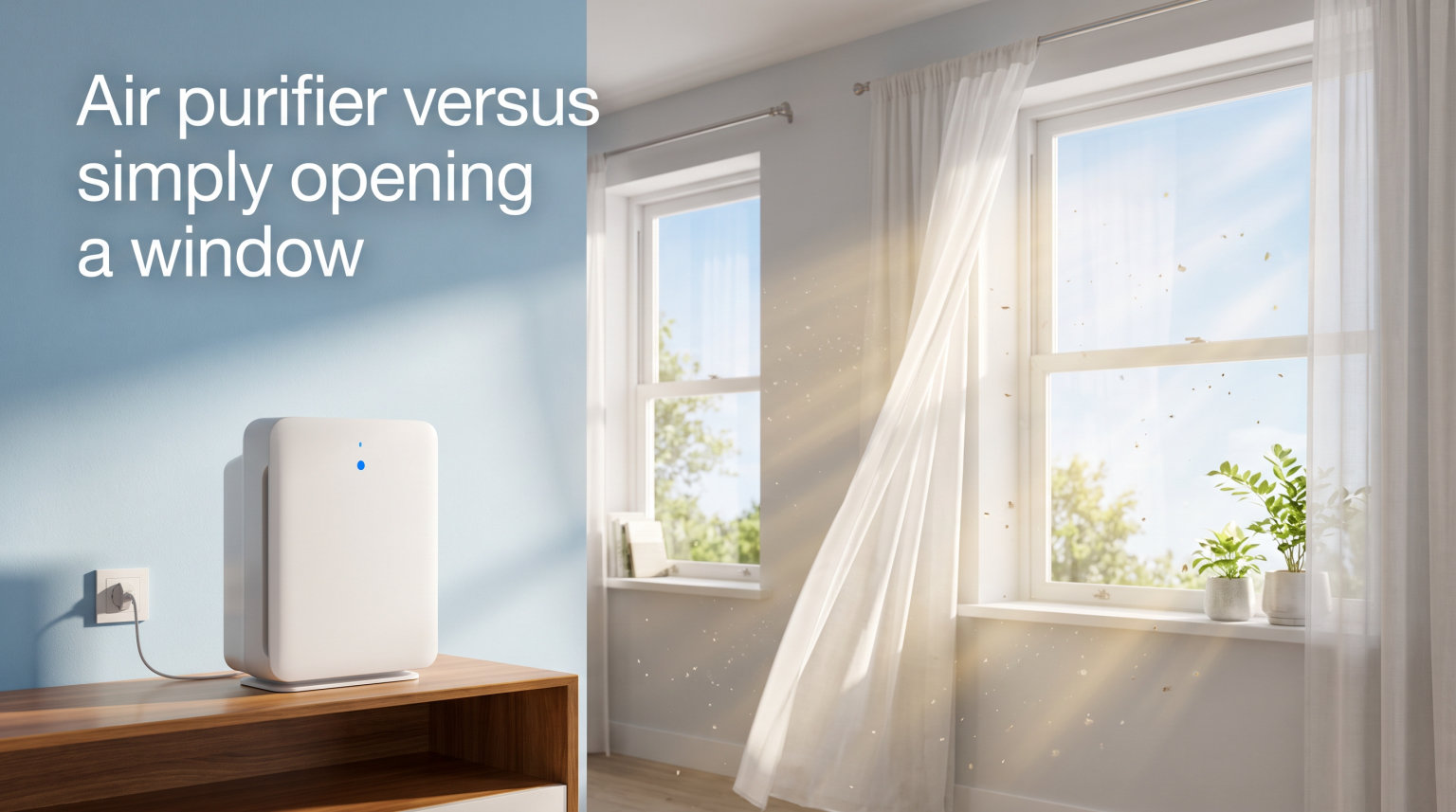
I get this question all the time from readers: should I just crack a window, or is an air purifier actually worth the money? After spending weeks testing both approaches in my own home, and digging into the science behind each, I’ll walk you through the real tradeoffs of the air purifier versus simply opening a window debate.
In this guide, you’ll learn how each method actually works, when one beats the other, and how to combine them for the cleanest indoor air. We’ll cover HEPA filtration, CO2 buildup, the popular 2-3 rule, and a practical decision framework you can use today.
Table of Contents
How Air Purifiers Actually Work (HEPA Filtration Explained)
An air purifier is a sealed electrical device that pulls indoor air through multiple filtration stages and pushes the cleaned air back into the room. Understanding the stages helps you decide whether you need one in the first place.
A typical purifier has three filters working in sequence. The pre-filter catches large particles like pet hair and visible dust. The HEPA filter traps 99.97% of particles down to 0.3 microns, including pollen, mold spores, and fine dust. The activated carbon layer absorbs gases, VOCs, cooking smells, and odors.
This is what people mean when they reference the 2-3 rule for air purifiers. For every 100 square feet of room space, you need an air purifier with at least 2 to 3 air changes per hour (ACH) to keep the air noticeably cleaner. A small bedroom (150 sq ft) needs a purifier rated for at least 300 to 450 sq ft equivalent coverage.
CADR (Clean Air Delivery Rate) is the number that matters when shopping. It tells you how many cubic feet of clean air the purifier delivers per minute for smoke, dust, and pollen. Higher CADR equals faster cleaning, especially in larger rooms or during allergy season.
Modern purifiers also add extras: UV-C light for biological contaminants, smart sensors that auto-adjust fan speed, and air quality displays that show real-time PM2.5 readings. These features are helpful, but the HEPA stage does the heavy lifting on its own.
What Opening a Window Does to Your Indoor Air
Opening a window creates natural ventilation. Stale indoor air flows out while fresh outdoor air flows in, balancing pressure and refreshing the room without any electricity.
The big benefit is oxygen and CO2 regulation. In a tightly sealed modern home, CO2 can climb above 1,000 ppm within a few hours, especially with multiple people working or sleeping in the same room. Outdoor air sits around 400 to 420 ppm. A cracked window drops indoor CO2 back to comfortable levels within 10 to 15 minutes.
Fresh air also reduces humidity buildup, removes lingering cooking odors, and prevents that “stuffy” feeling that triggers headaches and brain fog. Many of my readers report better focus on video calls simply from opening a window an hour beforehand.
The problem is what’s coming in alongside the fresh air. Outdoor PM2.5, pollen, vehicle exhaust, wildfire smoke, and industrial pollutants flow in freely. If you live near a busy road or in a city with poor AQI, those pollutants can spike your indoor levels well above what an air purifier would ever allow.
Window ventilation also loses heat in winter and cool air in summer, raising your energy bills. In some climates, the cost of conditioning that outdoor air can be significant over a year.
Air Purifier vs Open Window: A Direct Comparison
Here’s a side-by-side look at how each approach performs across the factors that actually matter for indoor air quality.
| Factor | Air Purifier | Open Window |
|---|---|---|
| PM2.5 removal | Reduces by 50-70% in 30 minutes | Brings outdoor levels inside |
| Pollen capture | Removes 99.97% via HEPA | Increases indoor pollen dramatically |
| CO2 regulation | No effect on CO2 | Drops CO2 to outdoor baseline |
| Allergen control | Strong for indoor allergens | Can worsen outdoor allergens |
| Energy cost | Runs continuously, modest wattage | Heating/cooling losses |
| Noise level | 20-55 dB depending on fan speed | Traffic, weather, insects |
| Odor handling | Carbon filter absorbs VOCs | Dilutes odors with fresh air |
| Best scenario | High AQI days, allergy season, bedrooms | Low AQI days, post-cooking, quick refresh |
Studies show that air purifiers can reduce particulate matter by up to 60% in just 20 minutes, even with windows open. The catch is they work much harder in that scenario, so filters wear out faster and energy use climbs.
If you prioritize health and consistency, an air purifier gives you predictable results regardless of outdoor conditions. If you prioritize freshness and low cost, a window wins every time the air outside is genuinely clean.
The honest answer to “is it better to open a window or run an air purifier” is neither wins universally. They solve different problems. The purifier filters what is already in your air. The window dilutes and refreshes the air with new oxygen and lower CO2.
When to Use Each Method: Practical Scenarios
Real life rarely fits a single rule, so here is how I break down the decision based on common situations my readers face.
High AQI or Wildfire Smoke Days
Close the windows and run the air purifier on high. Outdoor PM2.5 readings above 100 AQI mean opening a window is actively harmful. Your purifier’s HEPA filter will trap the particles already inside and keep indoor levels far below outdoor levels.
Allergy Season (Spring and Fall)
Keep windows closed during peak pollen hours (early morning and windy afternoons). Run the purifier in the bedroom overnight so you wake up without congestion. Save window-opening for after a rain, when pollen counts drop.
Cooking and Strong Odors
Open the window for 15 to 20 minutes right after cooking. The purifier alone cannot remove cooking smoke fast enough, and the activated carbon filter will saturate quickly. Ventilation handles the bulk of the odor; the purifier handles the fine particles afterward.
Sleep Quality and Bedrooms
Run the air purifier with the bedroom door closed. The closed door keeps the purifier’s cleaned air from leaking into the hallway, where it would do nothing for you. Studies show bedroom air quality directly affects sleep cycles, restless leg symptoms, and morning congestion.
Home Office and Focus Work
Crack a window for CO2 control during long video calls. CO2 above 800 ppm measurably reduces decision-making performance. A small window opening (2 inches) combined with a low-speed purifier gives you the best of both: fresh oxygen and clean particulates.
Winter and Heating Season
Lean on the air purifier and limit window opening to 5-minute bursts. The energy cost of conditioning very cold outdoor air outweighs the air quality benefit for most homes. Use the bathroom exhaust fan during showers to manage humidity instead.
So can you leave a window open with an air purifier running? Yes, but expect reduced efficiency. The purifier works hardest to keep up with the incoming outdoor air. Filters clog faster, fan noise increases, and electricity use rises. It is not wasteful in an absolute sense, but it is not optimal either.
The Strategic Hybrid Approach: Combining Both
The smartest setup uses both methods in sequence rather than choosing one. Here is the framework I recommend after testing in my own home across all four seasons.
Step 1: Check the Outdoor Air Quality First
Open your weather app or a free AQI tracker before opening any window. If AQI is below 50, ventilation is safe and helpful. Above 100, keep the windows sealed and let the purifier do its job.
Step 2: Ventilate Strategically, Not Constantly
Open windows for 15 to 30 minutes in the morning when outdoor AQI is typically lowest. Close them before traffic, pollen, or temperature peaks. This scheduled exchange refreshes CO2 and prevents the stuffy feeling without sustained pollutant exposure.
Step 3: Run the Purifier in a Sealed Room
Keep the bedroom door closed when running the air purifier. The purifier can only clean the air it can access. A closed room gives it a defined space to filter effectively. Open doors let cleaned air escape into hallways where it dilutes uselessly.
Step 4: Match Purifier Size to Room Dimensions
Apply the 2-3 rule: pick a purifier rated for at least 2x the square footage of the room. A 200 sq ft bedroom needs a purifier rated for 400+ sq ft coverage. Undersized purifiers run constantly on high and still struggle to keep up.
Step 5: Maintain Filters on Schedule
Running a purifier with an open window clogs pre-filters in weeks instead of months. Check filters monthly during heavy-use seasons and replace when visibly gray. A clogged filter strains the motor and reduces cleaning effectiveness dramatically.
Step 6: Use Exhaust Fans in Kitchens and Bathrooms
Range hoods and bathroom fans remove moisture, cooking particles, and odors at the source. This targeted ventilation is more efficient than opening a window and complements the air purifier’s whole-room work.
The hybrid approach takes a little more planning than just cracking a window, but it gives you consistently clean air with proper oxygen levels. You do not have to choose between fresh air and filtered air; you just have to use each at the right time.
Frequently Asked Questions
Is it better to open a window or run an air purifier?
Neither method wins universally. Opening a window refreshes oxygen and drops CO2 levels but brings in outdoor pollutants like PM2.5 and pollen. An air purifier filters existing indoor air with HEPA but does nothing for CO2 buildup. The best results come from using both strategically: open windows when outdoor AQI is below 50, and run the purifier in a sealed room when outdoor air is polluted or during allergy season.
What is the 2-3 rule for air purifiers?
The 2-3 rule means matching your air purifier size to your room: for every 100 square feet of floor space, choose a purifier that delivers 2 to 3 full air changes per hour (ACH). A 200 square foot bedroom needs a purifier rated for at least 400-600 sq ft equivalent coverage. This ensures the purifier can actually clean the air in your space rather than running constantly on high.
Can I leave my window open with an air purifier?
Yes, you can leave a window open while running an air purifier, but efficiency drops significantly. The purifier must work harder to filter incoming outdoor air, which shortens filter life, increases energy use, and raises noise levels. For best results, close windows during high-pollen or high-AQI periods and only ventilate when outdoor air quality is genuinely clean.
Should the bedroom door be closed when using an air purifier?
Yes, close the bedroom door when running an air purifier for sleep. A closed door contains the cleaned air within the room where you are breathing, instead of letting it escape into hallways. The purifier can only filter the air it has access to, so a sealed room gives it a defined space to work effectively throughout the night.
Should doors and windows be closed when using an air purifier?
Close both doors and windows for maximum air purifier effectiveness. Sealing the room lets the HEPA filter cycle through the full air volume multiple times per hour, removing 99.97% of particles down to 0.3 microns. If you need fresh air, ventilate first, then close up and run the purifier to clean what came in. This sequence beats running the purifier with everything open.
Is it wasteful to run an air purifier with windows open?
It is not wasteful in absolute terms, but it is inefficient. The purifier still filters particles, just at a much lower rate because outdoor air constantly reintroduces new contaminants. Filters wear out faster, electricity costs climb, and you get worse air quality than sealing the room would provide. Ventilate separately, then run the purifier in a closed room for best results.
Final Verdict
The air purifier versus simply opening a window question comes down to what you are trying to fix. If outdoor air is dirty, pollen is high, or you need consistent particle removal, close the windows and run the purifier in a sealed room. If you need fresh oxygen, lower CO2, or quick odor relief on a clean-air day, open the window.
For most of my readers, the winning strategy is the hybrid approach: ventilate briefly when outdoor AQI is low, then seal the room and let the purifier maintain clean air. Check your local AQI, apply the 2-3 rule for sizing, and keep your bedroom door closed at night. That combination delivers the cleanest, freshest indoor air without choosing one method over the other.