
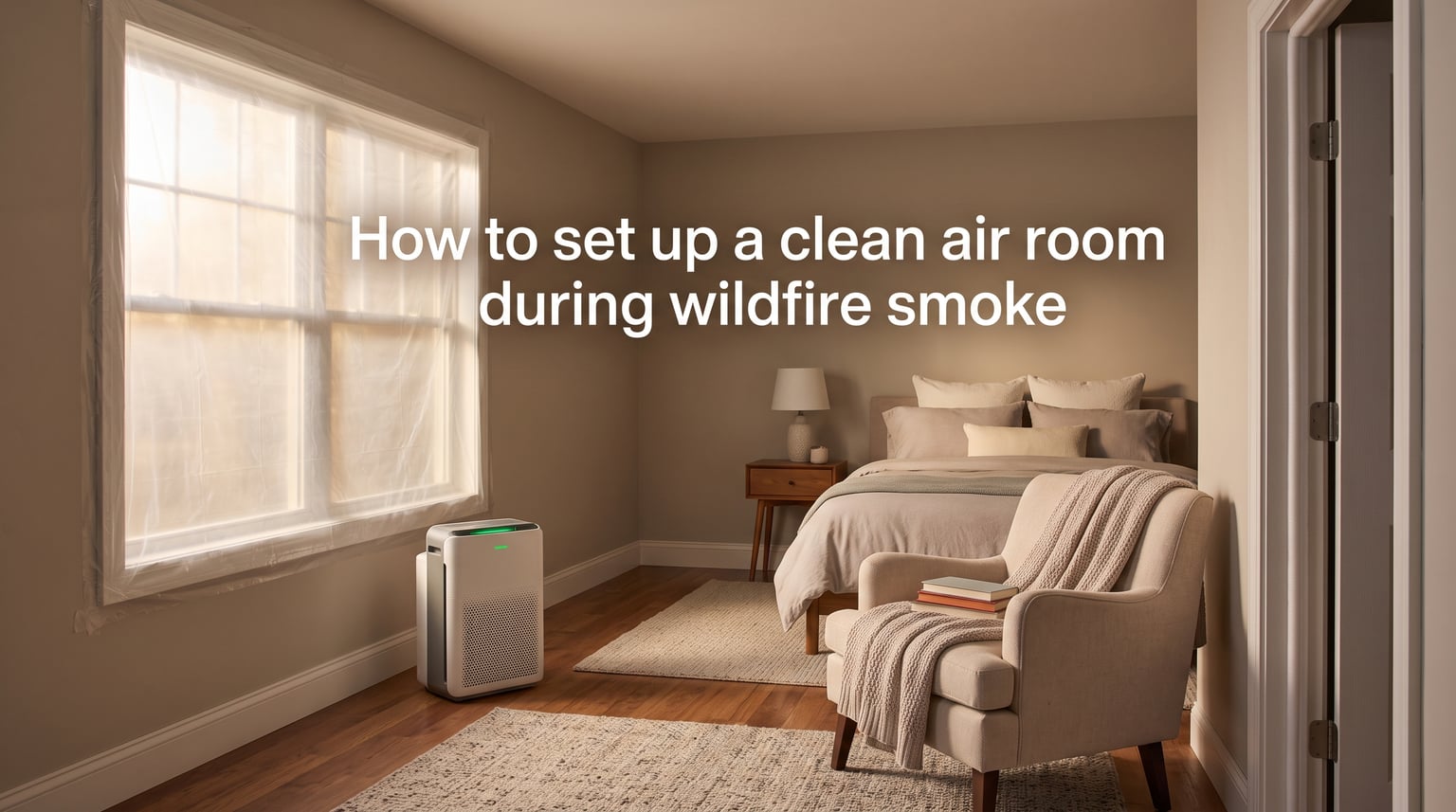
When wildfire smoke fills the air outside, your home becomes your first line of defense. Learning how to set up a clean air room during wildfire smoke can significantly reduce your exposure to harmful particles and protect your family’s health. A clean air room acts as a sanctuary where you can breathe easier when outdoor air quality reaches dangerous levels.
I’ve helped families prepare for wildfire season for years, and one thing remains consistent: those who have a plan feel more confident when smoke arrives. The good news is that setting up a clean room doesn’t require expensive equipment or complex renovations. You can create effective protection with items you likely already have at home.
This guide walks you through the exact steps to transform any room into a clean air space. You’ll learn how to choose the right room, seal out smoke, filter the air effectively, and maintain comfortable conditions. I’ll also cover budget-friendly DIY solutions and what to do if the power goes out.
Table of Contents
What Is a Clean Air Room?
A clean air room is a designated space in your home specifically set up to maintain the lowest possible levels of smoke particles and other pollutants during wildfire smoke events. You create this protected environment by sealing the room from outside air, running continuous air filtration, and avoiding any activities that generate indoor pollution.
Unlike normal rooms in your home, a clean air room functions as a refuge. While smoke may infiltrate other areas of your house through cracks and gaps, your clean room stays significantly cleaner. Research from the EPA shows that properly set up clean rooms can reduce indoor particle concentrations by 80% or more compared to outdoor levels during heavy smoke events.
Think of it like this: your entire home is a ship, and the clean air room is the sealed compartment that stays dry while water rises around it. The concept comes from clean room technology used in laboratories and manufacturing, but adapted for residential use during emergency air quality events.
Why You Need a Clean Air Room During Wildfire Smoke
Wildfire smoke contains a complex mixture of gases and fine particles that can penetrate deep into your lungs and even enter your bloodstream. The most dangerous component is PM2.5—particles smaller than 2.5 micrometers that bypass your body’s natural filtering systems. During severe wildfire events, PM2.5 concentrations can reach levels 10 to 20 times higher than what the EPA considers safe.
Breathing this air, even for short periods, can trigger immediate symptoms like coughing, wheezing, chest tightness, and shortness of breath. Longer exposure increases the risk of serious health problems, including respiratory infections, heart attacks, and stroke. Children, older adults, and people with existing heart or lung conditions face the greatest danger.
Indoor air quality during wildfire smoke events can vary dramatically. Without a clean room setup, smoke particles infiltrate homes through windows, doors, vents, and small cracks. Studies show that indoor PM2.5 levels can reach 50% to 70% of outdoor levels in homes without special preparation. A properly maintained clean air room keeps indoor concentrations far lower, giving your lungs a break from constant particle exposure.
Who Benefits Most From a Clean Air Room
Anyone can benefit from breathing cleaner air during smoke events, but certain groups need this protection more urgently. Children breathe more air relative to their body weight and their lungs are still developing. Older adults often have reduced lung function and existing health conditions. Pregnant women need to protect both themselves and their developing babies from particle exposure.
People with asthma, chronic obstructive pulmonary disease (COPD), heart disease, or diabetes face heightened risks during smoke events. Even moderate smoke exposure can trigger serious health episodes in these individuals. Having a clean air room available can mean the difference between managing symptoms at home and requiring emergency medical care.
Don’t forget about your pets. Dogs, cats, and other companion animals breathe the same air you do. They can experience respiratory distress, eye irritation, and fatigue from smoke exposure. Birds are especially sensitive to air quality and can show symptoms at lower particle concentrations. Include your pets in your clean room planning—bring their beds, food, and water into the protected space.
How to Set Up a Clean Air Room During Wildfire Smoke: Step by Step
Follow these six steps to transform any room into an effective clean air space. Each step builds on the previous one, so work through them in order for best results.
Step 1: Choose the Right Room
Select a room that will be easiest to seal and maintain. The ideal clean air room has few windows, no fireplace or wood stove, and enough space for everyone who needs protection. A bedroom with an attached bathroom works exceptionally well because it allows extended stays without leaving the protected space.
Consider room size carefully. Smaller rooms are easier to filter effectively because there’s less air volume to clean. However, you need enough space for comfortable extended occupation. A 10×12 foot bedroom can typically accommodate a family of four with an air purifier running continuously.
Avoid rooms connected to kitchens, garages, or spaces where pollutants might enter. Rooms on higher floors sometimes have slightly better air quality during wildfire events because smoke settles closer to ground level. If you have central air conditioning, choose a room where you can close the supply vent to prevent contaminated air from entering through the ductwork.
Step 2: Seal Windows and Doors
Smoke particles are tiny and will find any opening to enter your clean room. Seal every possible gap before smoke arrives. Start with windows and window frames. Apply painter’s tape or masking tape around the entire perimeter of each window frame. For extra protection, cover the entire window opening with plastic sheeting secured with tape.
Weather stripping provides a more permanent solution for frequently used doors. Foam weather stripping is inexpensive and easy to install. For emergency sealing, duct tape works well around door frames. Pay special attention to the gap at the bottom of doors—install a door sweep or roll up a towel to block this opening.
Check for less obvious entry points too. Electrical outlets on exterior walls can leak air. Outlet covers with foam gaskets are inexpensive and quick to install. Bathroom and kitchen exhaust fans can pull smoke inside. Disable these fans during heavy smoke events and cover the openings with plastic. Don’t forget about holes where pipes enter under sinks—these often connect to wall cavities that extend outside.
Step 3: Filter the Air
Effective air filtration is the heart of your clean air room setup. You have three main options: portable air cleaners with HEPA filters, upgraded HVAC filters, and DIY filtration systems.
Portable air cleaners: Look for units with true HEPA filters certified to capture 99.97% of particles 0.3 micrometers and larger. Check the Clean Air Delivery Rate (CADR) rating on the packaging—the higher the number for tobacco smoke, the more effective the unit will be for wildfire particles. For a typical bedroom, you want a CADR of at least 150 for smoke. Run the purifier continuously on its highest comfortable setting.
Central HVAC systems: If your home has forced air heating or cooling, upgrade the filter to MERV 13 or higher. Standard fiberglass filters capture only large particles. MERV 13 filters catch particles down to 0.3 micrometers—similar to HEPA performance. Set your system to run the fan continuously rather than cycling on and off. This constant airflow keeps filtering particles even when the system isn’t actively heating or cooling.
DIY air cleaners: If commercial air purifiers aren’t available or don’t fit your budget, you can build an effective filtration unit using a box fan and furnace filters. I’ll cover this in detail in the next section.
Place your air cleaning equipment near likely entry points for smoke—close to windows and doors. This positioning captures particles as they try to enter. Run filtration continuously throughout the smoke event, not just when you notice odors or visible haze.
Step 4: Keep the Room Cool
Sealing a room during hot weather creates a new problem: heat. You need to maintain comfortable temperatures without bringing in contaminated outside air. Start by closing blinds and curtains during the hottest part of the day to reduce solar heating. Use light-colored sheets over windows for additional reflection.
If you have a window air conditioner in your clean room, set it to recirculate mode. This setting cools the air inside without drawing in outside air. If your unit doesn’t have a recirculate option, there’s typically a vent or damper that can be closed manually—check your owner’s manual for instructions.
Portable air conditioners with dual-hose designs are safer than single-hose models during smoke events. Single-hose units draw air from inside your home to cool their condensers, creating negative pressure that can pull smoke in through cracks. Dual-hose models circulate air within the room without affecting indoor pressure.
Fans help circulate air and promote evaporative cooling from your skin. They don’t cool the room itself, but they make higher temperatures more tolerable. Place fans to create a gentle breeze across your seating and sleeping areas. Avoid pointing fans directly at your air purifier’s intake, which can disrupt its airflow pattern.
Step 5: Avoid Indoor Pollutants
Creating clean air means not just filtering out smoke but also avoiding activities that generate particles indoors. Many common household activities release the same size particles you’re trying to remove.
Don’t cook with gas appliances. Gas stoves release nitrogen dioxide and ultrafine particles. If you must cook, use electric appliances like microwaves, toaster ovens, or electric kettles. Better yet, prepare cold foods like sandwiches and salads that require no cooking at all.
Avoid vacuuming. Vacuum cleaners stir up settled dust and particles that were trapped in carpets. These become airborne again, adding to the particle load your purifier must handle. Wait until after the smoke event to vacuum, or use a vacuum with a HEPA exhaust filter if cleaning is essential.
Don’t burn anything. Candles, incense, cigarettes, and wood fireplaces all release combustion particles. Even scented candles produce fine particles and volatile organic compounds. If you need light, use LED or battery-powered lighting rather than candles.
Limit cleaning products. Many sprays and cleaning chemicals release volatile organic compounds that degrade indoor air quality. Use damp cloths for dusting and skip spray products until smoke clears.
Step 6: Spend Time in Your Clean Air Room
Your clean air room only protects you when you’re inside it. Plan to spend as much time as possible in this space during heavy smoke events. Sleep there at night when smoke concentrations often peak. Set up comfortable seating, entertainment, and if possible, work or study space.
If your clean room includes an attached bathroom, you can stay inside for extended periods. Bring in everything you need: medications, water, snacks, phone chargers, books, and entertainment devices. The less often you open the door to the rest of your home, the cleaner your air will remain.
Keep doors to other parts of your home closed. Tape door edges if the gap seems significant. When you must leave, close the door quickly and minimize how long it stays open. Plan your trips—gather everything you need before opening the door rather than making multiple trips.
Building a DIY Air Cleaner on a Budget
Commercial air purifiers can cost hundreds of dollars and sell out quickly during wildfire emergencies. The good news is you can build an effective air cleaner yourself for under $100 using materials available at hardware stores. This design, known as a Corsi-Rosenthal box, has been tested by researchers and performs comparably to expensive commercial units.
Materials Needed
You’ll need four to five 20×20 inch furnace filters rated MERV 13 or higher, a 20-inch box fan, a utility knife, and duct tape. Avoid the cheapest cardboard-frame filters—they’re flimsy and won’t create good seals. Look for filters with rigid frames and MERV 13, MERV 14, or MERV 16 ratings.
Assembly Instructions
Start by taping four filters together at their edges to form a cube. The filter material should face inward toward the center of the cube. Use plenty of duct tape to create airtight seams—any gaps will reduce effectiveness. Tape all outside seams as well as inside seams.
Place the box fan on top of the cube with the fan blowing outward (away from the filters). Some people build a five-sided cube with filters on all sides except the top, where the fan sits. Others use the fan as the fifth side. Both approaches work.
Secure the fan to the filters with duct tape, sealing all gaps around the edges. The fan should pull air through the filters and exhaust clean air out the top. Run the fan on its highest setting for maximum air cleaning.
Important Safety Warnings
Only use newer box fans with a fused plug and safety certification from UL, ETL, or CSA. Older fans from the 1990s and early 2000s pose fire risks when used with filters that restrict airflow. Look for fans that clearly state they meet current safety standards.
Check your DIY unit regularly during operation. If the fan motor becomes hot to the touch or you notice any burning smell, turn it off immediately. Never leave a DIY air cleaner running unattended, especially overnight while you sleep.
Replace filters when they become visibly discolored or when airflow noticeably decreases. During heavy smoke events, filters may need replacement every one to two weeks. Keep spare filters on hand before wildfire season begins.
Maintaining Your Clean Air Room and Knowing When to Leave
Setting up your clean air room is just the beginning. Ongoing maintenance and monitoring ensure continued protection throughout the smoke event.
Monitor Air Quality
Stay informed about outdoor conditions by checking the Air Quality Index (AQI) regularly. AirNow.gov provides real-time AQI readings for most locations in the United States. Many weather apps include AQI information. For indoor monitoring, consider a portable air quality sensor that measures PM2.5 levels.
When outdoor AQI exceeds 150 (considered unhealthy for everyone), minimize all outdoor activity and stay in your clean room as much as possible. At AQI above 200 (very unhealthy), remain indoors entirely unless you have no choice.
Replace Filters Regularly
Wildfire smoke loads filters much faster than normal household dust. Check your air purifier filter weekly during active smoke events. If the filter appears gray or black rather than its original color, replace it. Some purifiers have filter life indicators—pay attention to these warnings.
Keep replacement filters on hand before you need them. Supply chain issues during major wildfire events can make filters difficult to find. If you rely on HVAC filtration, buy extra MERV 13 filters at the start of wildfire season.
Plan for Power Outages
Wildfires and power outages often occur together. Your air purifier won’t work without electricity. Prepare a backup plan before you need it.
If you have a generator, ensure it’s properly installed and never operate it indoors or in enclosed spaces where carbon monoxide can accumulate. Know how to safely power your essential equipment, including at least one air purifier.
Battery-powered portable fans can provide some air circulation, though they won’t filter particles. Stay in your sealed room during outages—the seal will continue providing some protection even without active filtration. Limit movement and physical activity to reduce your respiration rate.
Consider staying elsewhere if an extended power outage coincides with severe smoke. Public buildings like libraries, shopping malls, and community centers often have backup power and air filtration. Check with local emergency management for designated clean air shelters.
Know When to Seek Alternative Shelter
Despite your best efforts, conditions may become too dangerous to stay home. Seek alternative shelter if you experience any of these situations:
Your indoor PM2.5 readings remain above 150 micrograms per cubic meter despite running air purifiers. You or family members develop severe symptoms like difficulty breathing, chest pain, or confusion. Your power fails during extreme smoke conditions and you lack backup power. Temperatures in your sealed room reach dangerous levels without air conditioning. Local officials issue evacuation orders for your area.
Public shelters, hotels with good air filtration, or staying with friends or family outside the affected area are all options during severe events. Plan evacuation routes and destinations before you need them.
Recognize Smoke Exposure Symptoms
Even in your clean air room, pay attention to how you feel. Seek medical attention if you experience severe coughing that won’t stop, difficulty breathing or shortness of breath, chest pain or tightness, wheezing or unusual breathing sounds, dizziness or confusion, or rapid heartbeat that persists.
These symptoms indicate your respiratory or cardiovascular system is struggling. People with existing heart and lung conditions are especially vulnerable. When in doubt, err on the side of seeking medical care.
FAQs
How to purify air from wildfire smoke?
Run a portable air cleaner with a HEPA filter continuously in your sealed room. For whole-house filtration, upgrade your HVAC filter to MERV 13 or higher and set the fan to run constantly. DIY air cleaners made from box fans and furnace filters also work effectively. Keep windows and doors sealed to prevent new smoke from entering.
How to improve your indoor air quality during wildfire season?
Seal windows and doors with tape and plastic sheeting. Run air filtration continuously rather than intermittently. Avoid cooking with gas, vacuuming, burning candles, and using chemical sprays. Monitor AQI and stay indoors when levels exceed 150. Replace filters more frequently during smoke events.
What air purifier is best for wildfire smoke?
Look for air purifiers with true HEPA filters and a high Clean Air Delivery Rate (CADR) specifically rated for smoke. Units with CADR ratings above 150 for smoke work well in typical bedrooms. Avoid ozone-generating purifiers, which can worsen indoor air quality. Run purifiers on high settings during peak smoke periods.
How do I keep my house cool during wildfire smoke without letting smoke in?
Set window air conditioners to recirculate mode so they cool inside air without drawing in outside air. Use portable fans to circulate air across your skin. Close blinds and curtains during the hottest hours to reduce solar heating. Consider a dual-hose portable air conditioner for sealed rooms, as these don’t create negative pressure.
Final Thoughts on Clean Air Rooms
Knowing how to set up a clean air room during wildfire smoke gives you control when conditions feel overwhelming. The six steps—choose a room, seal openings, filter the air, keep it cool, avoid pollutants, and stay inside—create real protection for your family during dangerous air quality events.
Don’t wait until smoke fills the sky to prepare. Gather your supplies before wildfire season: tape, plastic sheeting, weather stripping, MERV 13 filters, and backup filter replacements. Build your DIY air cleaner and test it. Identify your clean room and practice sealing it. A few hours of preparation now can save you stress and protect your health when smoke arrives.
Wildfire seasons are getting longer and more intense across many regions. Making clean air room preparation part of your annual routine—like checking smoke detectors—is a smart investment in your family’s wellbeing. Your future self will thank you when the next smoke event arrives.