
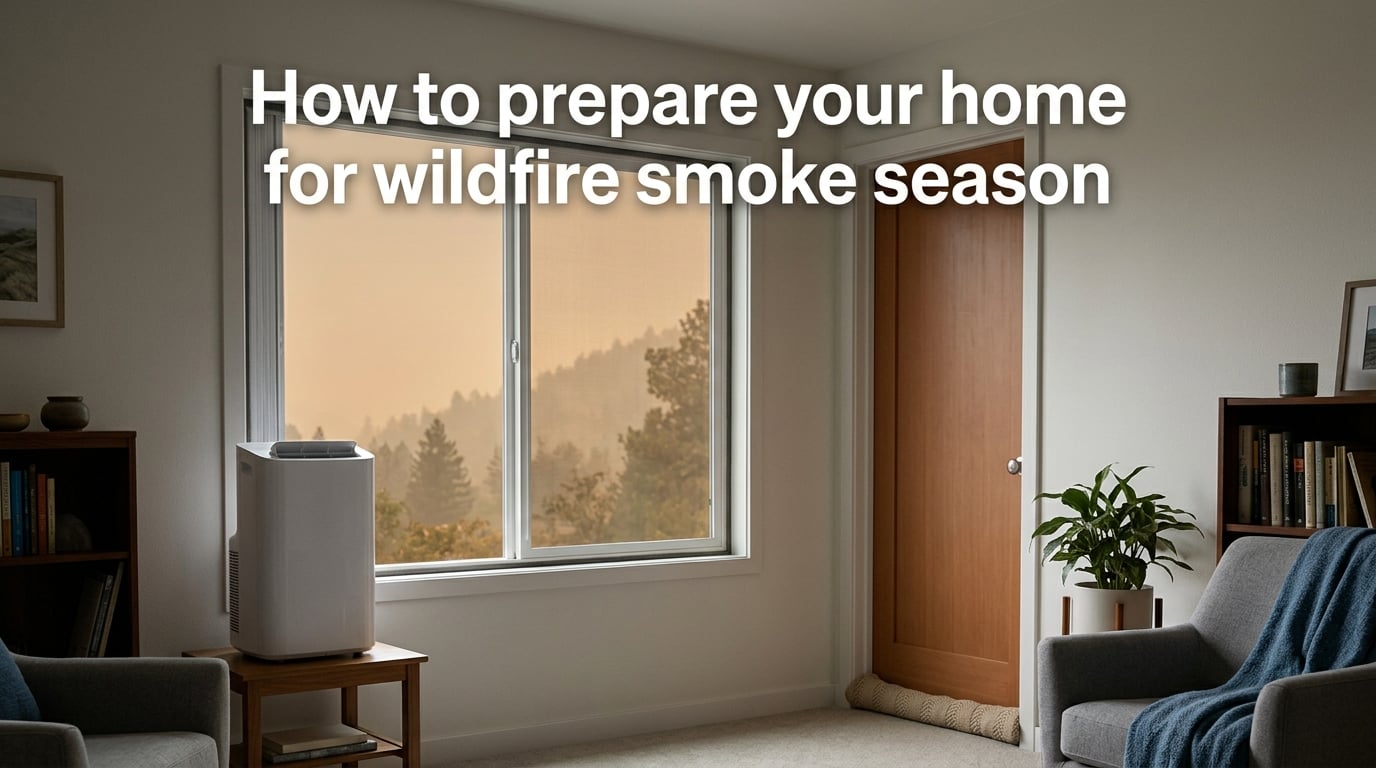
To prepare your home for wildfire smoke season, close and seal the gaps that admit outdoor air, set up effective particle filtration, and choose one room as a clean-air refuge before the first smoky day. This order matters because wildfire smoke can enter through tiny openings even when windows look closed, and a last-minute scramble may leave a household without the supplies or routine it needs.
Wildfire smoke is a mixture of gases and fine particles from burning trees and materials. The fine-particle fraction, called PM2.5, is small enough to get deep into the lungs, so indoor air can still affect breathing, sleep, headaches, and day-to-day comfort when outdoor smoke is heavy.
This guide explains how to prepare your home for wildfire smoke season without treating it as the same problem as a nearby fire. Smoke preparation helps reduce exposure while you remain at home; an evacuation order or an immediate fire threat calls for leaving according to local authorities, not for improving a seal around the house.
Start before the season rather than waiting for the air to smell smoky. People who have lived through severe smoke events commonly report that the odor gets in through overlooked gaps, while air purifiers and replacement filters can be hard to find once an event starts.
Table of Contents
Prepare your home for wildfire smoke season by following this readiness checklist
The most useful smoke plan is short enough to use under stress. Work through these steps on a clear day, then keep the list where everyone in the household can see it.
- Inspect entry points. Check each window, exterior door, window-mounted unit, pet door, fireplace opening, and obvious wall or utility gap for drafts.
- Gather temporary sealing materials. Keep weather stripping, a door sweep or draft stopper, removable painter’s tape, and plastic sheeting only for openings that cannot close tightly.
- Set up filtration. Confirm that a portable air cleaner uses particle filtration such as a true HEPA filter, and learn the room size it is intended to serve.
- Pick a clean air room. Choose a small, easy-to-close room where household members can rest, sleep, or work during bad air days.
- Check your cooling system. Learn whether your HVAC system can run with a suitable filter and whether it has an outdoor-air intake that should be closed or set to recirculate when appropriate.
- Follow local alerts. Know where your area posts official AQI, smoke forecasts, evacuation warnings, and cooling-center information.
- Prepare people and pets. Refill prescribed medicines, identify a low-smoke place to go if needed, and put carriers, documents, water, and basic supplies within reach.
Wildfire smoke is dangerous because PM2.5 reaches deep into lungs
PM2.5 means particulate matter that is 2.5 micrometers or smaller. These particles are far smaller than the ash that settles on a car, which is why a home can look clean while the air inside still has a meaningful particle load.
Smoke can irritate eyes, nose, and throat and can make breathing harder. It matters most for children, older adults, pregnant people, people with heart or lung conditions, people who have asthma, and pets, but a smoky indoor space is not healthy for anyone.
PM2.5 is the particle measurement that matters most indoors
Odor is a warning that smoke-related gases or particles have arrived, but it is not a precise measure of the particle concentration. A smoke smell may remain after particle levels have fallen, and dangerous fine particles may be present even when the odor seems mild.
That is why a particle-focused filter and an official outdoor AQI report are more useful than judging conditions by smell alone. If you use a home monitor, treat it as one piece of information and compare its trend with official reports rather than relying on a single number.
The Air Quality Index turns pollution data into action categories
The AQI is a public reporting scale that translates pollution measurements into categories ranging from good to hazardous. During a wildfire event, look at the pollutant being reported and the local forecast, then make more conservative choices when wildfire smoke is driving the score upward.
There is no universal indoor AQI target that a household can promise, because buildings, monitors, weather, and outdoor smoke change. The practical goal is to make indoor particle levels clearly lower than outdoors and keep the clean air room as low-smoke as possible.
Seal windows, doors, and openings before smoke arrives
Smoke enters a home through the same routes that allow drafts: poorly fitting sashes, door gaps, unsealed penetrations, vents, and damaged weather stripping. A careful walk-through is more productive than assuming one closed window protects an entire room.
Step 1: Find leaks with a simple room-by-room inspection
On a calm day, inspect the perimeter of every exterior window and door. Look for cracked caulk, flattened weather stripping, daylight around a door, loose screens, gaps where pipes or cables pass through a wall, and air conditioner panels that do not sit tightly in the opening.
Move slowly around the room, including closets beside exterior walls. If a curtain moves with a draft or a piece of lightweight tissue shifts near a closed window, mark the spot for repair; do not use an open flame to look for air movement.
Step 2: Repair the permanent gaps that belong to the property
For homeowners, replace worn weather stripping around doors and windows, fit a door sweep where daylight shows beneath an exterior door, and repair failed exterior caulk when conditions and product directions allow. These repairs reduce smoke entry and can also reduce ordinary drafts.
Take care not to seal required combustion-air openings or permanently block a system that needs ventilation. When a home has gas appliances, a fireplace, an unfamiliar vent, or a whole-house ventilation system, follow the equipment guidance or ask a qualified professional before changing the opening.
Step 3: Use renter-safe temporary measures on smoky days
Renters can often improve a room without altering the building. A removable draft stopper at the bottom of a door, removable weather stripping approved for the surface, or painter’s tape over a small obvious gap may help while the smoke event lasts.
Tell the landlord or property manager about broken seals, damaged windows, and gaps that need repair. Temporary measures are not a substitute for a window that will not latch or an exterior door that has a visible gap around its frame.
Step 4: Treat window air conditioners and portable units as special cases
A window-mounted air conditioner can leave gaps around side panels and the frame. Close the outdoor-air vent if the unit has one, set it to recirculate if that setting is available, and inspect the installation instructions before applying any temporary material.
A portable air conditioner usually vents through a window kit, which can also leak. Improve the fit of the supplied panel according to the manufacturer instructions, but never obstruct the exhaust hose or seal the unit in a way that causes overheating or backflow.
Step 5: Close openings without making the home unsafe or unbearably hot
Keep windows and exterior doors closed as much as practical when smoke is elevated outside. Avoid frequent trips in and out, and ask family members to use the least-leaky entrance when they return home.
Heat changes the decision. If closing the house creates dangerous indoor temperatures, use air conditioning on recirculation when available, seek a public cooling space with cleaner air, or go to a friend or relative whose home can stay cooler and lower in smoke.
HEPA filtration lowers particles in the room you occupy
A portable air cleaner can reduce airborne particles in a room when it has effective particle filtration and enough airflow for the room size. A true HEPA filter is designed to capture fine particles; avoid assuming that a device marketed for odor, ionization, UV treatment, or a vague “air cleaning” claim will provide the same particle reduction.
A right-sized air cleaner has enough clean-air delivery for the room
Look for a stated room-size recommendation or clean-air delivery information that matches the room where people will actually spend time. A large open living area needs more airflow than a closed bedroom, and a single portable unit should not be expected to clean an entire multi-room home through closed doors.
Air changes per hour describe how often the cleaner can process a room’s air volume. More clean-air delivery and a smaller, better-sealed room generally mean faster particle reduction, so placing the unit in the clean air room is usually more realistic than chasing whole-house coverage.
Run the air cleaner continuously when smoke is high
Set the unit in an open spot with room for air to enter and leave it. Keep it away from curtains, furniture, and walls that restrict intake or exhaust, and do not hide it in a corner simply to reduce noise.
During high-smoke periods, run the cleaner continuously and raise the fan speed if the noise is manageable. People in wildfire-prone communities frequently report better results after increasing fan speed during the worst periods, which fits the simple principle that more filtered airflow cleans a room faster.
HVAC filtration can help when the system is compatible
Central heating and cooling can circulate and filter indoor air if the system is operating and the filter is appropriate for it. A higher MERV rating can capture more fine particles, but a filter that is too restrictive for a particular system can reduce airflow or create equipment problems.
Check the equipment manual or ask an HVAC professional about the highest MERV rating your system can handle. During smoke events, follow the system guidance about recirculation and outdoor-air intakes rather than guessing, especially in homes with mechanical ventilation or combustion appliances.
Filters need attention sooner when smoke loads are heavy
Write the installation date on each filter and keep a spare if possible. Smoke can load particle filters faster than ordinary household dust, so inspect the filter according to its instructions and replace it when the maker says to do so, when it looks heavily loaded, or when the unit signals replacement.
Do not wash a disposable HEPA filter unless the manufacturer specifically labels it washable. A lingering odor alone does not prove that the filter has failed, but a sudden return of particle readings, reduced airflow, or a filter-change indicator are good reasons to investigate.
A clean air room gives your household a lower-smoke refuge
A clean air room is a room kept as free of smoke and indoor pollutants as practical during a smoke event. It is not sterile, and it does not need expensive remodeling; it is a focused way to put the best sealing and filtration where people spend the most time.
Step 1: Choose the smallest practical room with a door
A bedroom, den, or another small room with a closeable door usually works better than a large open-plan area. Choose a space that has few exterior leaks, can fit the people who need it most, and has access to a bathroom, medication, water, chargers, and a safe cooling plan.
For a household with an infant, an older adult, or someone whose asthma worsens in smoke, prioritize the room they use for sleeping. Pets also benefit from remaining indoors in the lower-smoke room, with water, bedding, and a litter or outdoor-break plan that limits unnecessary exposure.
Step 2: Make the room low-pollution before smoke arrives
Move a portable HEPA air cleaner into the room and test it with the door closed. Check the window latch, add a draft stopper if the entry door has a gap, and remove items that make it difficult to use the room for several hours at a time.
Keep the room free from smoking, candles, incense, frying, spray products, and other activities that create particles or strong fumes. A clean air room loses much of its benefit if indoor pollution rises while outdoor smoke is being kept out.
Step 3: Keep doors and windows closed while the cleaner runs
Close the room door when the household is using it, particularly if the rest of the home has more door traffic or cooking activity. Use a towel or temporary draft stopper at the bottom of the door only if it does not interfere with safe access or a required airflow path.
Running the air cleaner continuously is usually more useful than cycling it on and off based on odor. Let the room be the place for sleep, schoolwork, reading, remote work, and recovery, rather than asking one machine to manage every room at once.
Step 4: Plan meals and necessary ventilation around the smoke forecast
Cooking can add substantial indoor particles, especially frying, broiling, grilling, or using a wood-burning source. Favor meals that create less smoke and steam, use an exhaust system only if it does not bring in outdoor air, and keep the clean air room closed while cooking elsewhere.
If you must open a window for a short task, wait for the cleanest available outdoor period shown in local forecasts, keep the opening brief, and restart or increase filtration afterward. Do not treat a moderately better AQI as a reason to air out the whole house when a sensitive person is struggling.
Step 5: Set an alternative location before conditions become severe
A clean air room has limits when outdoor smoke is extreme, the home is too hot, someone has worsening symptoms, or the building cannot be sealed adequately. Identify a cleaner-air option in advance, such as a community clean-air space, a library or cooling center that is officially open, or a trusted contact outside the affected area.
Pack medications, medical information, masks if you will be outdoors, phone chargers, water, pet supplies, and documents so leaving does not take a rushed hour. A plan for temporary relocation is prudent; it does not mean you must wait for an evacuation order to protect health from severe smoke.
AQI should guide daily smoke decisions
The outdoor AQI is the starting point for deciding whether to close up the house, postpone outdoor activity, or shift time into the clean air room. Check official local sources each day because smoke can change quickly with wind, terrain, and fire behavior.
A rising AQI calls for earlier action, not a wait-and-see approach
When forecasts show smoke moving toward your area, close and latch openings before the odor arrives, bring pets inside, and turn on the clean-air-room filter. Early action prevents a large initial dose of outdoor particles from filling the room.
As AQI worsens, reduce outdoor exercise and keep household errands brief. People who are sensitive to smoke should begin their stricter plan earlier than other household members, based on advice from their clinician and their own known symptoms.
Moderate smoke is not a universal permission slip to open windows
There is no single AQI number at which every home should throw open its windows. Consider the outdoor level and trend, whether the home is overheating, how well it seals, whether a sensitive person is inside, and whether indoor air is already cleaner than outdoors.
If you need cooling and cannot maintain a safe indoor temperature, finding an officially designated cleaner-air cooling location is often safer than relying on open windows. Avoid running whole-house fans that draw outdoor air inside when smoke is present unless local guidance and your specific system say otherwise.
Vulnerable people need an earlier and stricter smoke plan
Children breathe more air relative to their body size than adults and may not recognize or explain symptoms clearly. Older adults, pregnant people, people with asthma or COPD, people with heart disease, and people with other chronic health conditions may have less margin when smoke gets worse.
Asthma and other respiratory conditions call for a clinician-informed plan
Keep prescribed inhalers and other medicines filled and accessible before the season. Follow the written plan from your clinician, pay attention to increased wheezing, coughing, chest tightness, or need for rescue medication, and do not wait for a severe episode before asking for medical guidance.
A well-run clean air room can reduce exposure, but it is not a replacement for treatment. If a person has trouble speaking in full sentences, severe shortness of breath, chest pain, confusion, or symptoms that are rapidly worsening, seek emergency care.
Migraines can be triggered or worsened by wildfire smoke for some people
Wildfire smoke can trigger migraines or make headaches worse for some people, possibly through irritant exposure, changes in routine, stress, dehydration, or poor sleep. Keep the person in lower-smoke air, encourage fluids if appropriate, follow their usual clinician-approved treatment plan, and seek medical advice for unusual, severe, or neurological symptoms.
Do not assume every headache during a smoke event is harmless. A sudden severe headache, weakness, vision changes, confusion, fever with neck stiffness, or a headache after a possible carbon monoxide exposure needs prompt medical assessment.
Children and pets need simple, calm routines
Keep outdoor play shorter or indoors when smoke is elevated, and avoid turning smoke preparation into a frightening event. Set up quiet indoor activities, explain in age-appropriate language that the room’s air cleaner is there to help keep the air cleaner, and watch for coughing or unusual tiredness.
Keep pets indoors as much as practical, with fresh water and needed medication. Ask a veterinarian for guidance if a pet has breathing trouble, repeated coughing, weakness, or a pre-existing heart or lung condition that seems worse during smoky days.
Home hardening and evacuation preparation solve a different risk
Sealing a home for smoke is not the same as hardening it against flames and flying embers. Both deserve preparation, but exterior fire risk needs long-term maintenance, defensible-space work, and prompt response to official evacuation information.
Ember resistance begins with roofs, gutters, and vents
Clear dead leaves, pine needles, and other combustible debris from roofs and gutters according to safe work practices. Repair loose or missing roofing materials, maintain screens where appropriate, and keep combustible materials away from the house as recommended by local fire agencies.
Pay attention to vents, decks, porches, and the area immediately around the structure. Local requirements differ, so use your fire department, state fire agency, or building professional for guidance on ember-resistant venting, roof materials, and defensible space.
Three affordable actions reduce common exterior ignition risks
Three simple, comparatively affordable actions are clearing dry debris from gutters and the roof, moving combustible items away from the home’s immediate perimeter, and repairing obvious gaps or damaged screens around openings. These actions reduce common places where embers or dry fuels can create trouble, but they do not make a home fireproof.
Keep an evacuation plan alongside your smoke plan. Know two ways out of your area, choose a meeting point, keep fuel and vehicle supplies ready when fire conditions are concerning, and register for official local alerts if that service is available.
The 30/30/30 rule is a fire-weather warning sign, not a smoke-health scale
The 30/30/30 rule commonly refers to fire-weather conditions with temperatures at or above 30 degrees Celsius, relative humidity at or below 30 percent, and winds at or above 30 kilometers per hour. The exact wording and local use can vary, so treat it as a signal for heightened fire awareness rather than a substitute for official warnings.
When authorities issue an evacuation order, leave promptly and take people, pets, medicines, documents, and essential supplies. Do not remain to run air cleaners, protect property, or finish a home project; conditions can change too quickly.
After smoke clears, clean and reset your home
Wait for outdoor conditions to improve before ventilating the home, then use the cleanest available period to exchange stale indoor air if it is safe and comfortable to do so. Continue to check official AQI reports because smoke may return with a wind shift.
Wet-wipe hard surfaces, vacuum with effective filtration if available, wash textiles that hold odor, and inspect the air-cleaner and HVAC filters. Avoid dry dusting or aggressive sweeping that can put settled particles back into the air.
If a persistent smoke odor remains despite cleaner outdoor air, look for an overlooked source such as a gap, contaminated soft furnishing, a fireplace issue, or an actual local fire or electrical problem. A smoke smell without a known source deserves caution: check smoke alarms and contact the relevant professional or emergency service if you suspect an active hazard.
Frequently asked questions answer the most common wildfire smoke concerns
How do you protect your house from wildfire smoke?
Protect a house from wildfire smoke by closing and sealing windows and doors, reducing leaks around gaps and air-conditioner panels, running a correctly sized true HEPA air cleaner in a closed room, and checking official AQI reports. Avoid indoor particle sources such as smoking, candles, and frying during smoky periods, and use an alternate clean-air location if the home becomes too hot or cannot stay low in smoke.
What is the 30/30/30 rule for fire?
The 30/30/30 rule commonly describes high fire-weather conditions: temperature at or above 30 degrees Celsius, relative humidity at or below 30 percent, and wind at or above 30 kilometers per hour. It is a warning sign for increased wildfire danger, not an AQI measure or an evacuation instruction; follow local fire authorities for current alerts.
Can wildfire smoke trigger migraines?
Wildfire smoke can trigger or worsen migraines for some people. Irritating air, disrupted sleep, dehydration, stress, and changes to routine may all contribute. Move to lower-smoke indoor air, follow the person’s clinician-approved migraine plan, and seek medical assessment for sudden severe headache or neurological symptoms.
What three simple affordable things protect your home from wildfires?
Three practical lower-cost actions are removing dry debris from roofs and gutters, moving combustible items away from the home’s immediate perimeter, and repairing visible gaps or damaged screens around openings. These reduce common ember and fuel risks, but they do not make a house fireproof or replace evacuation instructions.
Can I open windows during a mild wildfire smoke event?
Opening windows during a mild smoke event depends on the outdoor AQI trend, indoor temperature, how well the home seals, and whether sensitive people are inside. Keep them closed when smoke is elevated if you can stay safely cool. If ventilation is necessary, use the cleanest forecast period, keep it brief, and run particle filtration afterward.
Why does my house smell like smoke with the windows closed?
Smoke can enter through tiny leaks around windows, doors, vents, utility penetrations, fireplace openings, and air-conditioner panels. Inspect for drafts, replace worn weather stripping, use renter-safe temporary measures where appropriate, and keep a true HEPA air cleaner running in a closed clean air room. Odor may also linger in fabrics after outdoor air improves.
Prepare your home for wildfire smoke season before the forecast turns smoky
To prepare your home for wildfire smoke season, inspect and close the leaks you can control, set up a true HEPA air cleaner in a clean air room, and use official AQI and fire alerts to make decisions early. Give extra attention to household members with respiratory or heart conditions, children, older adults, and pets.
Then keep smoke protection and evacuation preparation in their proper roles. Cleaner indoor air can reduce exposure when staying home is safe, but official evacuation directions always take priority when a wildfire threatens your area.