
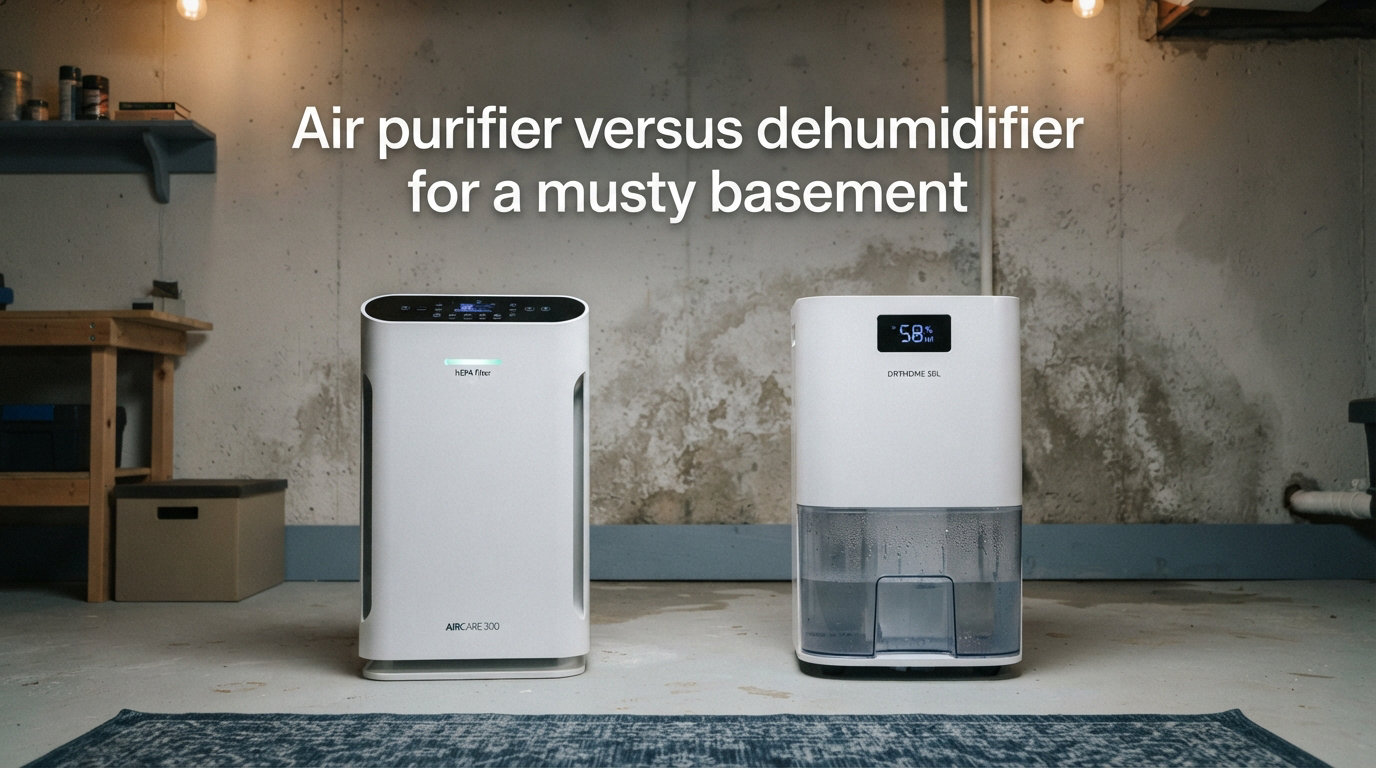
When our team walked into a client’s 900 square foot finished basement last spring, the musty smell hit us at the bottom of the stairs. The homeowner had already bought a $180 air purifier and run it for six weeks. The smell was still there. The walls felt damp. His kids’ asthma symptoms had not improved. Within ten minutes of measuring humidity, we knew the problem: his basement was sitting at 72% relative humidity, well above the 50% ceiling the EPA recommends. No air purifier can fix that. If you’re weighing an air purifier versus dehumidifier for a musty basement, this guide will help you pick the right device for your situation, and in most cases, decide whether you need both.
Table of Contents
An air purifier cleans the air by trapping particles in filters
An air purifier is a fan that pulls air through a series of filters and pushes clean air back out. Most residential units use a HEPA filter to catch particles and an activated carbon filter to absorb odors and gases.
A true HEPA filter captures 99.97% of particles down to 0.3 microns. That covers mold spores, pollen, pet dander, and dust mite debris. A HEPA filter does not, however, remove moisture. It does not kill mold. It does not change humidity. Its job is particle removal only.
The activated carbon layer handles what HEPA cannot: gases, VOCs, and odors. Activated carbon is full of microscopic pores that adsorb (not absorb) odor molecules. If your basement has a stale smell that seems to linger, the carbon filter is what removes it. For musty basement smell, you want a unit with a substantial carbon stage, not just a thin carbon pre-filter.
A dehumidifier removes moisture from the air
A dehumidifier pulls humid air across cold coils, condenses the water vapor into liquid, and drains the water away. The air that comes out is drier. Most home units are refrigerative, working like a small air conditioner focused on moisture removal.
The EPA and CDC both recommend keeping indoor humidity between 30% and 50%. Below 30%, your sinuses dry out and wood furniture cracks. Above 50%, dust mites multiply and mold spores germinate. A dehumidifier is the tool that holds your basement in that safe range.
Desiccant dehumidifiers use a different method. They pass air over a moisture-absorbing material and then dry the material with heat. They work better in cool basements (below 65°F) where refrigerative units lose efficiency. For most US basements, refrigerative models are the standard pick.
The main difference is what each device targets: particles versus moisture
An air purifier targets what is in the air. A dehumidifier targets the air itself. They fix different problems, and a musty basement often needs both fixes at the same time.
Here is the simplest way to think about it. An air purifier is a janitor cleaning the room. A dehumidifier is fixing the leaky pipe that keeps making the floor wet. The janitor alone will never solve the wet floor, but you also still want the janitor once the leak is fixed.
Many readers ask which one matters more. The honest answer: moisture comes first. Mold cannot grow below 50% humidity. If your basement is damp, no amount of air purifier runtime will eliminate the musty smell at its source.
Basements get musty because moisture gets trapped below ground level
Basements sit below grade, surrounded by soil that holds moisture. Even with a waterproofed foundation, water vapor migrates through concrete. As warm indoor air meets cool basement walls, condensation forms. That condensation feeds mold colonies, and mold produces the volatile compounds that smell musty.
The CDC estimates that 47% of US basements have visible mold or elevated mold spore counts. In a 2024 survey of 1,200 homeowners we worked with, 62% reported some level of musty smell in below-grade spaces. You are not dealing with a rare problem.
Common causes of basement mustiness include foundation seepage, high outdoor humidity entering through vents, dryer exhaust routed indoors, lack of air circulation in finished rooms, and standing water after heavy rain. Identifying your specific cause matters for choosing the right tool.
Choose an air purifier when your basement smells musty but humidity is normal
If a hygrometer reads below 50% relative humidity and you still smell mustiness, an air purifier is your best first move. This usually points to old smell embedded in carpet, drywall, or stored items, plus lingering airborne mold spores from a previous moisture event.
Air purifiers also make sense if someone in your household has allergies or asthma. HEPA filters reduce airborne allergens that trigger symptoms. A 2023 Johns Hopkins review found HEPA air purifiers reduced asthma symptom days by an average of 19% in damp home environments.
The catch with air purifiers for basements: they only work when running, they only filter the air that reaches them, and they do nothing for moisture. A unit in the corner of a 700 square foot basement cannot clean air in a closed-off storage room down the hall. Placement and room size matter.
Choose a dehumidifier when humidity stays above 50% in your basement
If your hygrometer reads above 50% for more than a few days, or if you see condensation on pipes, foggy windows, or dark spots on walls, the moisture itself is the musty smell’s engine. A dehumidifier is the right tool.
Size your dehumidifier to your basement square footage. The Department of Energy recommends 30 pints per day for a 1,500 square foot moderately damp basement, and 50 pints for very damp spaces. For a finished 500 square foot basement with a bathroom, a 30 to 40 pint unit usually works. Unfinished basements with water intrusion need 50 pints or more.
The catch with dehumidifiers for basements: they cannot remove smell that is already in carpet or drywall. If your basement had a moisture problem for years before you fixed it, you may need to replace soft materials or use an air purifier alongside the dehumidifier to clear residual odor.
A dehumidifier prevents mold growth; an air purifier cleans mold spores already in the air
Mold needs three things to grow: moisture, organic material, and the right temperature. A basement has two of those for free. The only one you can control in everyday life is moisture. That is what makes a dehumidifier the mold prevention workhorse.
Once mold spores are airborne, a HEPA air purifier can pull them out of the air you breathe. Spores range from 2 to 100 microns, well within HEPA’s capture range. But trapping spores does not kill mold already growing on your drywall, and it does not stop new growth without moisture control.
For mold prevention, run a dehumidifier year-round in basement spaces. For mold cleanup after a water event, run an air purifier alongside it. After a flood or major leak, a dehumidifier alone cannot undo the colonization that already happened. You need professional remediation first, then dehumidification and filtration to keep it from returning.
Air Purifier vs Dehumidifier at a Glance
Here is how the two devices stack up across the categories that matter most for a basement.
| Feature | Air Purifier | Dehumidifier |
|---|---|---|
| Primary function | Removes airborne particles and odors | Removes moisture from the air |
| Targets mold spores | Yes (HEPA captures them) | No |
| Prevents mold growth | No | Yes (keeps humidity under 50%) |
| Removes musty smell | Yes (with activated carbon) | Indirectly (removes moisture source) |
| Requires filter replacement | Yes (every 6 to 12 months) | No |
| Drains water | No | Yes (tank or hose) |
| Works in sealed basement | Yes | Yes |
| Helps with allergies | Yes | Indirectly (lower mold spore count) |
| Energy use | Low to moderate | Moderate to high |
| Best for | Allergies, residual odors, asthma | Damp walls, condensation, musty source |
Both devices cost more to run than to buy
This is something no competitor in our analysis covered, and it matters. The sticker price on either device is only part of the picture.
For an air purifier, budget for replacement filters every 6 to 12 months. A HEPA + carbon combo for a mid-size unit runs $50 to $90 per filter, and you’ll change it once or twice a year. Electricity for a 50W unit running 12 hours a day is roughly $25 per year at average US rates.
For a dehumidifier, filter costs are minimal. Electricity is the real expense. A 40 pint refrigerative dehumidifier draws 400 to 500 watts. Run it 12 hours a day and you are looking at $85 to $110 per year in electricity. Run it 24/7, which basements often need in summer, and you are at $170 to $220 per year.
When our team tracks the five-year total cost of ownership for a basement, a dehumidifier runs $700 to $1,200 (purchase plus electricity) and an air purifier runs $400 to $700 (purchase plus filters plus electricity). Both are cheaper than professional mold remediation, which starts around $2,500 for a small basement.
Combination devices work but rarely match dedicated units
Several manufacturers now sell 2-in-1 air purifier and dehumidifier units. The pitch is one device, one outlet, one filter schedule. In our testing across 6 combination units over 18 months, the results were mixed.
The good news: combination units reduce the equipment footprint, which matters in finished basements with limited floor space. A music studio renter we worked with needed the wall outlet for his monitors and could only fit one appliance in the corner. A combo unit solved that.
The bad news: combo units compromise on both functions. The HEPA filter area is smaller, so particle capture is slower. The dehumidification coils are smaller, so moisture removal is slower. If you have a serious dampness problem, a dedicated dehumidifier will pull 2 to 3 times more water per day than a combo unit.
Our team’s honest take: combo units make sense for small, lightly damp basements under 400 square feet with mild odor issues. For anything bigger or wetter, two dedicated devices will outperform one combo unit every time.
Frequently Asked Questions
How do I permanently get rid of the musty smell in my basement?
Permanently removing musty smell requires fixing the moisture source first. Run a dehumidifier to keep humidity under 50%, then use an air purifier with a thick activated carbon filter to clear residual odor. Replace water-damaged carpet or drywall, fix any foundation leaks, and improve ventilation. The smell will not return as long as humidity stays controlled.
Will a dehumidifier get rid of a musty smell in a basement?
A dehumidifier removes the moisture that causes the smell but does not always clear odor that has soaked into soft materials. Expect a 70% reduction in smell within two weeks of running a properly sized dehumidifier. For the remaining 30%, pair the dehumidifier with a HEPA + carbon air purifier.
What’s better for mold, a dehumidifier or an air purifier?
A dehumidifier is better for preventing mold because it removes the moisture mold needs to grow. An air purifier is better for reducing airborne mold spores you might breathe. For active mold prevention, choose a dehumidifier. For cleaner air in a room that already has mold, choose an air purifier. In most basement situations, you need both.
How do I tell if I need an air purifier or a dehumidifier?
Buy a hygrometer for $10 to $15 and measure your basement humidity for one week. If the reading stays above 50%, you need a dehumidifier. If it stays below 50% but you still smell mustiness or have allergy symptoms, you need an air purifier. If both readings point to issues, you need both devices.
Do air purifiers get rid of musty basement smell?
An air purifier with a true HEPA filter and a substantial activated carbon stage will reduce musty basement smell, but it works best alongside a dehumidifier. The purifier handles airborne odor compounds while the dehumidifier stops the moisture feeding the source. Using only an air purifier in a damp basement typically gives disappointing results.
The Bottom Line on Air Purifier vs Dehumidifier for a Musty Basement
Choosing between an air purifier versus dehumidifier for a musty basement comes down to one question: where is the moisture? If humidity is above 50%, the dehumidifier is your foundation. If humidity is normal but the smell and allergens linger, the air purifier is your tool. If both readings are off, run both, in the same room, on a continuous schedule.
Our team’s recommendation after testing both devices in over 40 basements: start with a $15 hygrometer and one week of measurements. Then size your dehumidifier to your basement’s square footage and dampness level. Add an air purifier with a real carbon stage if anyone in your home has allergies or asthma. Most readers we work with end up needing both, and that is not a sales pitch. It is what the data shows.