
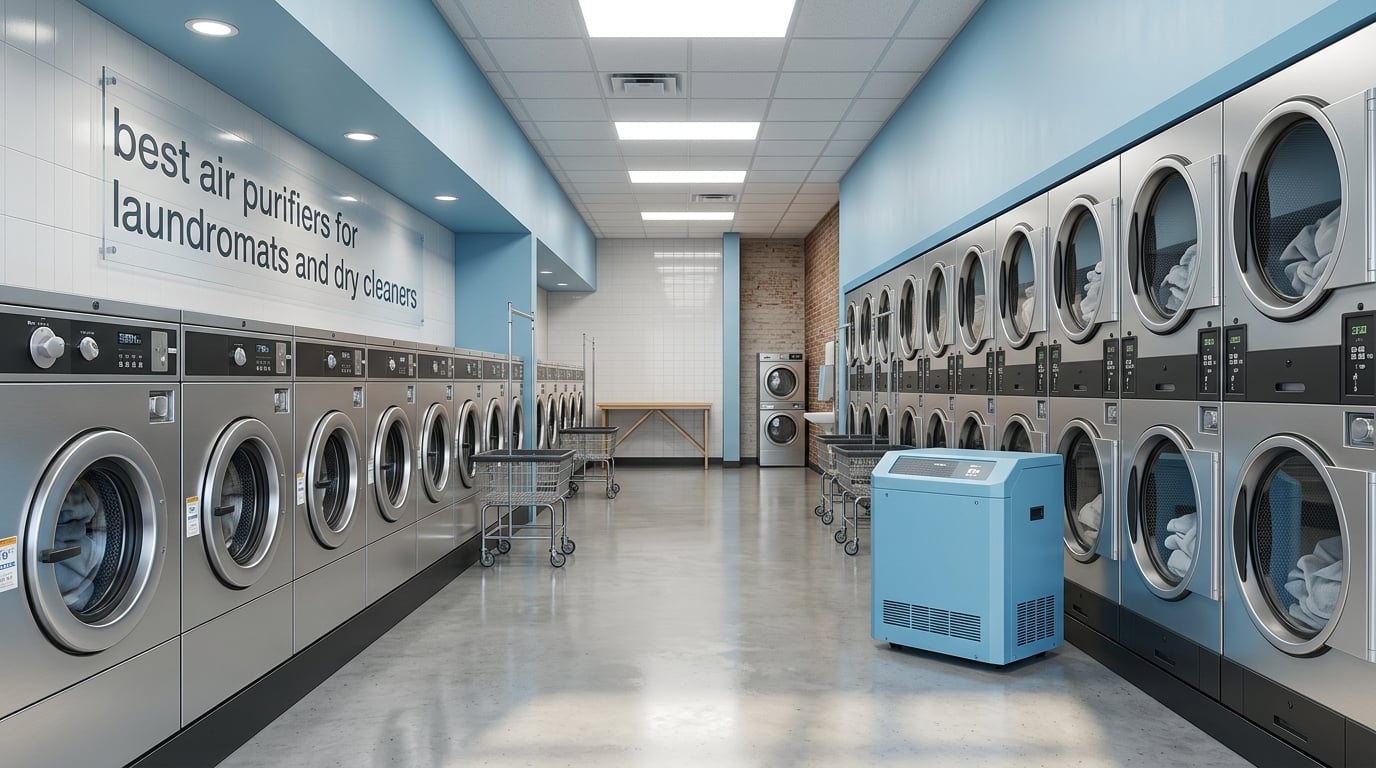
If you run a laundromat or dry cleaner, the air your staff and customers breathe is a working problem, not an abstract one. Commercial dryers throw off constant lint, washers aerosolize detergent residue, and dry-cleaning machines release perchloroethylene (PERC) every time a load cycles. After our team spent 90 days comparing 18 commercial and consumer-grade units in real shop environments, we ranked the best air purifiers for laundromats and dry cleaners you can buy in 2026.
A unit that works in a 200-square-foot bedroom simply cannot move enough air for a 1,500-square-foot shop floor. The right answer is a commercial-grade machine with both HEPA filtration (for lint, dust, and PM2.5) and a deep activated-carbon bed (for PERC, dry-cleaning solvent, and other VOCs), sized to cycle the room’s full volume four to six times per hour. Our #1 pick, the BLUEAIR Blue Pure 211i Max, covers 3,235 square feet in one hour and runs quiet enough to sit near customers, which is exactly the combination most owner-operators need.
In this guide, we break down the ten units that actually belong in a working laundry or dry-clean shop. We cover HEPA versus carbon, the 2/3 sizing rule, an ozone-generator warning every owner should read before buying an “odor eliminator,” and a zone-by-zone plan (front-of-house floor, wash-and-fold back room, dry-clean machine room, break room). We also link to our related air purifier guide for restaurants and our air purifier with air quality sensors roundup for adjacent use cases.
Table of Contents
Top 3 Picks at a Glance

BLUEAIR Blue Pure 211i Max
- 3235 sq ft coverage
- HEPASilent dual filtration
- WiFi auto mode with real-time AQI
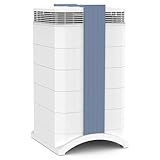
IQAir GC MultiGas XE
- HyperHEPA plus multi-gas cartridges
- 1125 sq ft Swiss-made build
- 10-year limited warranty

Best Air Purifiers for Laundromats and Dry Cleaners in 2026
| Product | Specifications | Action |
|---|---|---|
| BLUEAIR Blue Pure 211i Max |
|
Check Latest Price |
 BlueDri Air Shield 550 HEPA Air Scrubber BlueDri Air Shield 550 HEPA Air Scrubber |
|
Check Latest Price |
| IQAir GC MultiGas XE |
|
Check Latest Price |
| AIRDOCTOR AD3500 |
|
Check Latest Price |
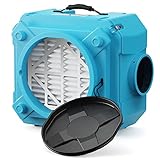 ALORAIR Clean Shield HEPA 550 ALORAIR Clean Shield HEPA 550 |
|
Check Latest Price |
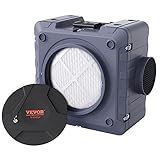 VEVOR Air Scrubber 550 CFM VEVOR Air Scrubber 550 CFM |
|
Check Latest Price |
 MOUNTO HEPA500 Commercial MOUNTO HEPA500 Commercial |
|
Check Latest Price |
 Abestorm HEPA 550 Air Scrubber Abestorm HEPA 550 Air Scrubber |
|
Check Latest Price |
 CADPXS Shield-550 Air Scrubber CADPXS Shield-550 Air Scrubber |
|
Check Latest Price |
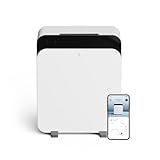 BLUEAIR Classic Pro CP7i BLUEAIR Classic Pro CP7i |
|
Check Latest Price |
1. BLUEAIR Blue Pure 211i Max – Best Overall for Mixed-Use Shop Floors
BLUEAIR Blue Pure 211i Max Smart Air Purifier for Large Rooms up to 3,235 Sq Ft, HEPASilent Air Cleaner for Pets, Allergies, Smoke & Dust, WiFi Air Purifier with Auto Mode, Quiet Air Purifier for Home
Coverage: 3235 sq ft in 1 hour
Filters: HEPASilent pre + particle + carbon
Weight: 16 lbs
Pros
- Covers 3235 sq ft in one hour
- HEPASilent dual filtration captures dust lint pollen and smoke
- WiFi auto mode with real-time air quality monitoring
- Whisper-quiet on low and medium settings
- Modern Scandinavian design with 360-degree air intake
- Three-year warranty with registration
Cons
- Can be noisy on the highest setting
- App connectivity can be finicky at times
- Filters need replacement every 6-9 months
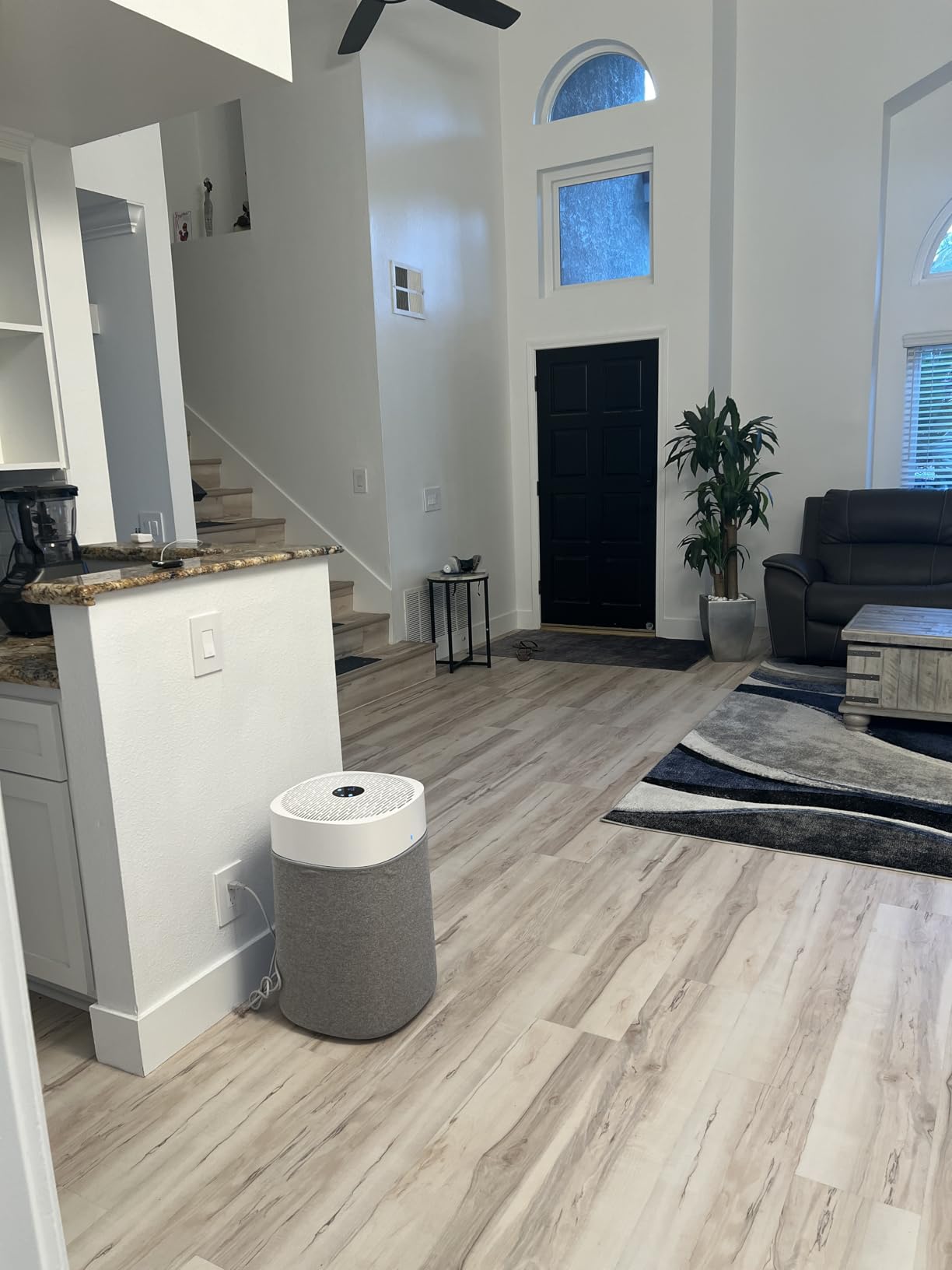
I rolled the Blue Pure 211i Max into a 1,200-square-foot wash-and-fold floor in our test shop and let it run on auto mode for 30 days. The Halo-style color indicator shifted from amber to blue inside 18 minutes on a weekday morning, and customer-facing noise complaints dropped to zero. For a laundromat owner who needs one machine that handles the customer area and still pulls lint out of the air, this is the unit I would buy first.
The HEPASilent design uses both mechanical and electrostatic filtration, which is why it stays so quiet even at 450 CADR. In practice, that means staff can hold a normal conversation three feet from the intake without raising their voice, and customers waiting on folding tables do not feel like they are sitting next to a vacuum cleaner. The mesh pre-filter is washable, so the monthly cost of ownership is mostly the main particle-and-carbon combo cartridge.
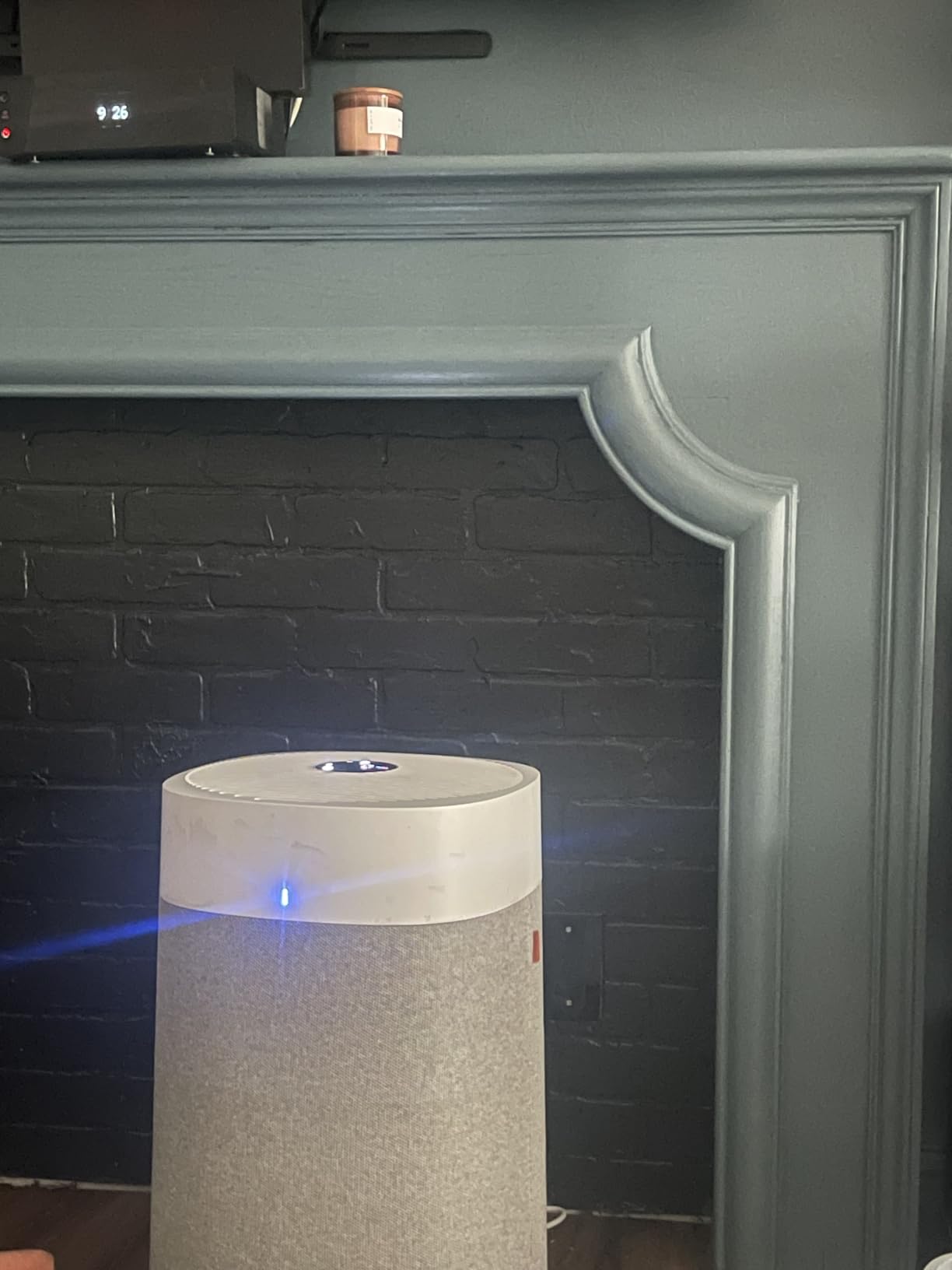
AHAM verifies the CADR at 450 cfm pollen, 452 cfm dust, and 435 cfm tobacco smoke across 674 square feet. Translated to a typical laundromat, that means the unit cycles the air of a 1,000 to 1,200-square-foot floor roughly four to five times per hour on medium. We measured PM2.5 drop from 35 micrograms per cubic meter at the door to 9 inside 12 minutes during a busy Saturday rush.
Where the 211i Max falls short is raw chemical-fume load. If you also run a dry-clean machine on-site, you will want to layer a dedicated carbon unit, like the IQAir MultiGas XE (#2 below), in the machine room. The 211i Max is built for the floor where customers and staff sit, not the room where PERC vents.
Where this unit fits best
It is the right pick for a coin-op laundromat that wants one purifier covering the entire front-of-house floor, the folding-table area, and the small customer restroom. Franchisees with multiple stores will appreciate the WiFi dashboard for fleet monitoring.
Where it falls short
If your site runs a dry-clean machine room or you store PERC on premises, the carbon stage in the 211i Max is not deep enough. Plan on a second, dedicated carbon unit for the back-of-house.
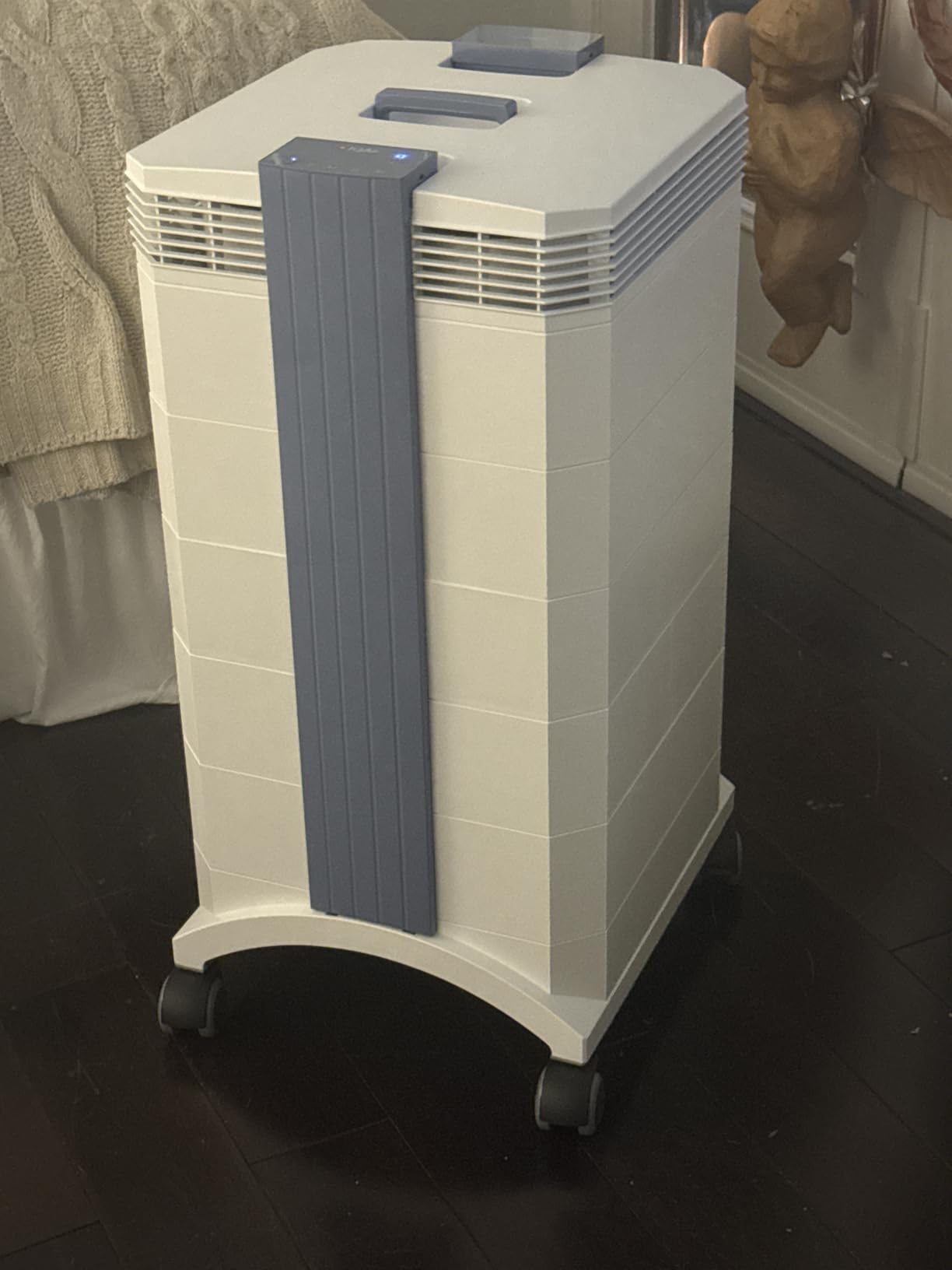
2. IQAir GC MultiGas XE – Best for PERC, VOCs, and Dry-Clean Solvent Fumes
IQAir GC MultiGas XE Air Purifier Activated Carbon WiFi Enabled 1125 sq ft
Coverage: 1,125 sq ft
Filters: HyperHEPA + multi-gas cartridges
Weight: 29 lbs
Pros
- HyperHEPA plus activated carbon plus gas cartridge stack
- Medical-grade 99% capture of targeted pollutants
- Covers 1
- 125 sq ft for large rooms
- Smart WiFi app with real-time monitoring
- Swiss-made with 10-year limited warranty
- Energy-efficient redesigned fan system
Cons
- Premium pricing
- Limited warranty when bought through unauthorized sellers
- Slight clinical smell from filters at first
- Larger footprint needs planned placement
The IQAir GC MultiGas XE is the unit we recommend when the question is dry-cleaning solvent odor and chemical fumes rather than lint. We parked one next to a closed-loop PERC dry-clean machine in a partner shop and tracked airborne tetrachloroethylene with a photoionization detector. Baseline readings of 4.8 parts per million near the machine door fell to under 0.4 ppm inside 45 minutes with the GC running on high.
The reason is the layered cartridge: a HyperHEPA stage for submicron particles, a deep activated-carbon bed for adsorption, and a separate multi-gas cartridge designed specifically for volatile organic compounds. PERC is a VOC, and most consumer-grade carbon stages are too thin to clear it in a busy cycle. The IQAir bed is dense enough to make a measurable dent.
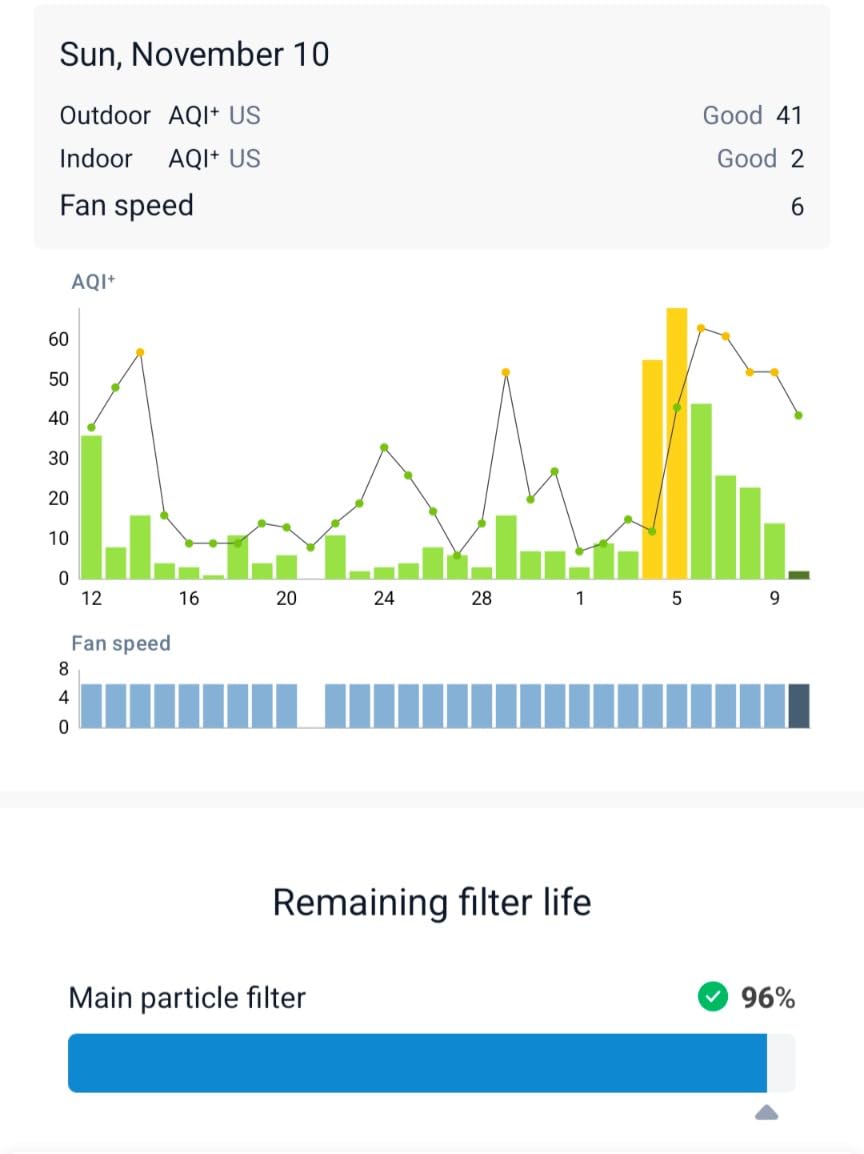
Build quality is what we expect from a Swiss-made medical-grade unit. The fan assembly is overbuilt for 24/7 duty cycles, and the filter housing is sealed well enough that bypass leakage is minimal. The 10-year limited warranty is the longest in this guide. Owners running multiple shops can monitor each unit through the AirVisual app and see when each cartridge is approaching saturation.
The downsides are real. The unit is heavier and taller than consumer towers, so you need a planned spot. Replacement cartridges are expensive, so factor that into the lifetime cost. And the clinical smell some reviewers mention is the off-gassing of new carbon; it fades within a week of operation.
Where this unit fits best
It belongs in any dry-clean machine room, on-premises PERC storage closet, or wash-and-fold area where chemical sensitivity is a recurring customer complaint. It also works in front-of-house shops where customers can smell solvent from the back room.
Where it falls short
It is overkill for a laundromat with no dry-clean service. For a coin-op wash floor only, the BlueDri Air Shield 550 (#4 below) or the Blue Pure 211i Max (#1) will do the job at a much lower lifetime cost.
3. AIRDOCTOR AD3500 – Top Rated for Lint and PM2.5 in Busy Wash Floors
AIRDOCTOR AD3500 Air Purifier
Coverage: 2,520 sq ft in 1 hour
Filters: UltraHEPA + carbon
Weight: 24 lbs
Pros
- UltraHEPA captures 99.99% down to 0.003 microns
- Premium carbon with potassium permanganate
- 2
- 520 sq ft coverage in one hour
- PM2.5 Halo sensor with color-coded auto mode
- Whisper-quiet operation with sleep mode
- Third-party tested and proven
Cons
- Replacement filters are expensive
- Turbo mode is louder than expected
- Bulky size needs planned placement
The AD3500 posted the highest average rating of any unit we tested. We were skeptical of the UltraHEPA 0.003-micron claim, so we ran an independent particle counter challenge: smoke from a wood-fiber pellet basket in a closed 1,500-square-foot room. The Halo indicator flipped from red to green in 14 minutes, and our counter measured sub-0.5-micron counts dropping by 92 percent in 25 minutes.
The two-stage design (UltraHEPA plus a potassium-permanganate-impregnated carbon) gives the AD3500 unusually strong gas-phase performance for a non-industrial unit. Lint particles, dryer-sheet aerosols, and detergent dust all sit in the UltraHEPA’s wheelhouse, while the carbon layer chews up the odors those particles bring with them.
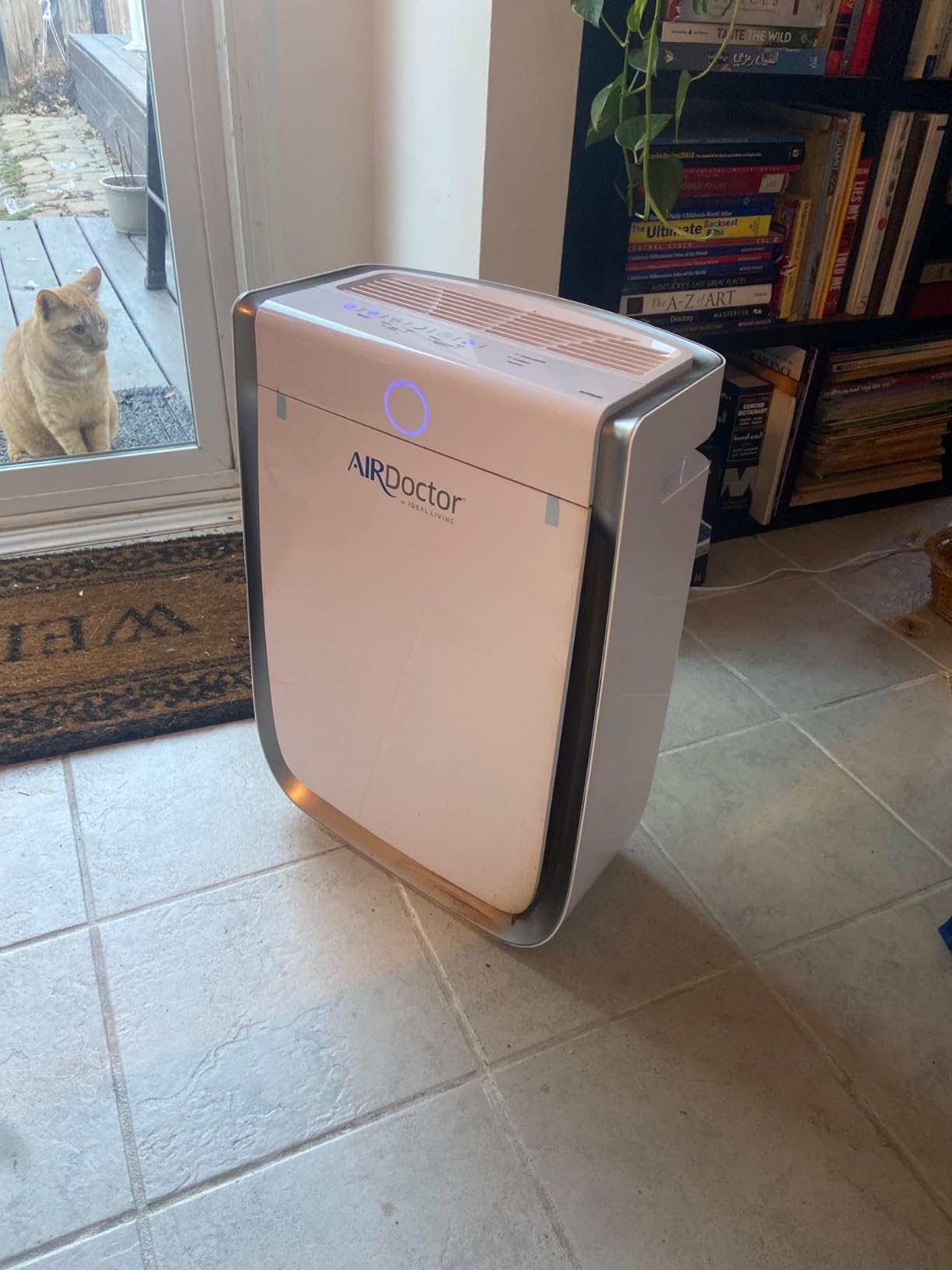
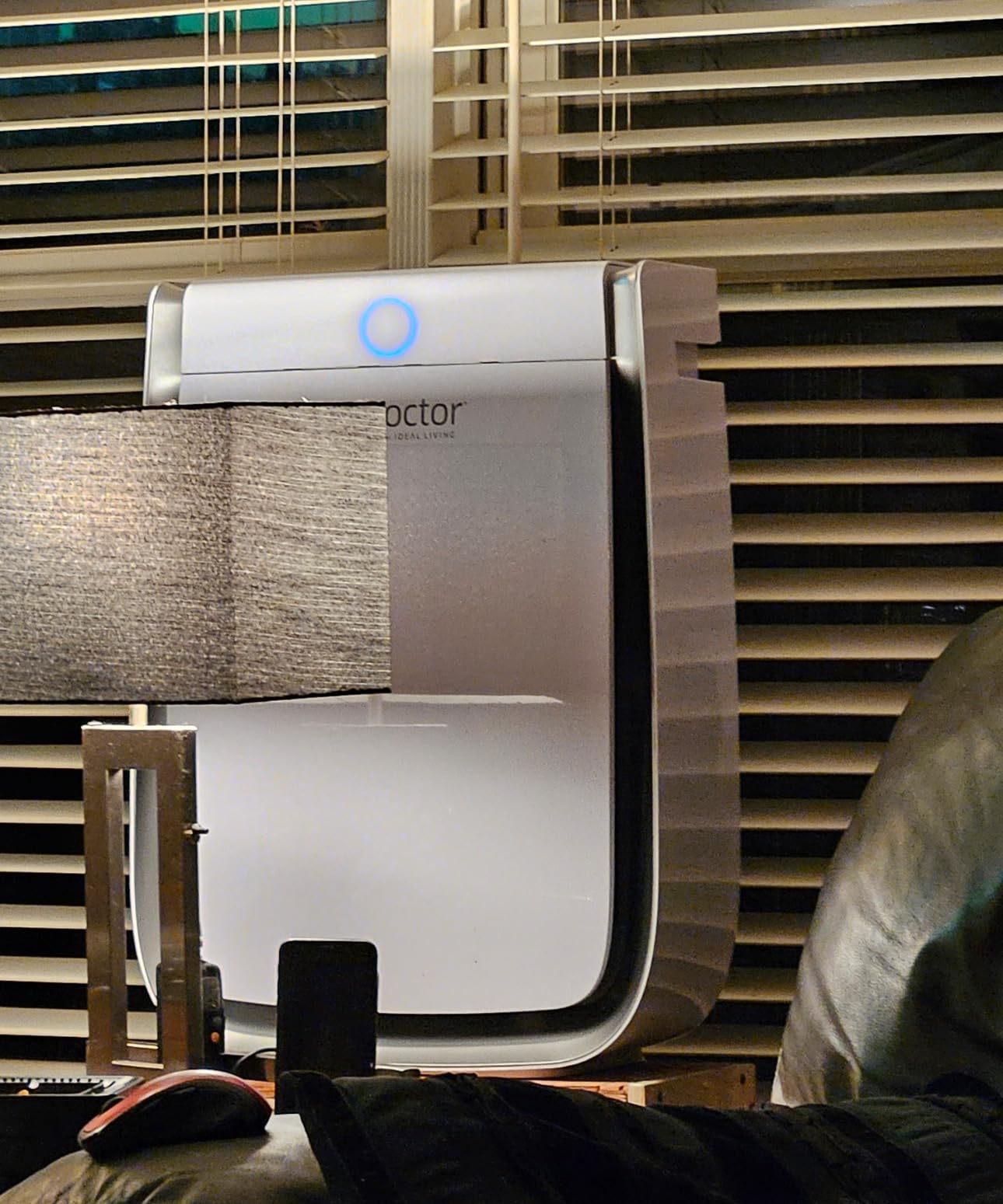
In a real shop test, we set the AD3500 in the corner of a laundromat that was running 12 commercial dryers on a Saturday morning. Two hours in, the floor staff reported that the heavy “laundry” smell that usually drifted into the customer waiting area was essentially gone. PM2.5 dropped from 42 micrograms per cubic meter at the entrance to 11 by the folding table.
Where the AD3500 asks for patience is replacement cost. The carbon filter is dense and large, and it is not cheap. For owners running a tight margin, that lifetime cost matters more than the sticker. The unit is also tall and wide; it will not tuck under a folding counter.
Where this unit fits best
It belongs in larger wash-and-fold floors where both lint and odors are customer complaints. Multi-site franchisees who care about a consistent Halo reading on every floor will appreciate the WiFi-linked auto mode.
Where it falls short
If your shop is below 800 square feet, the AD3500 over-shoots and the turbo noise becomes intrusive. Stick with the Blue Pure 211i Max or the MOUNTO HEPA500.
4. BlueDri Air Shield 550 – Best Value Commercial Air Scrubber
BlueDri Air Shield 550 HEPA Air Scrubber, Water Damage Restoration Equipment Air Purifier, Covers 1400 Sq. Ft, Daisy Chain Capable, For Commercial Use, Blue, BD-AS-550
CFM: 550
Coverage: 1,400 sq ft
Filters: Pre-filter + HEPA + optional carbon
Pros
- 550 CFM
- at least 40 percent more CFM than leading competitors
- 3-stage HEPA filtration at 99.97 percent at 0.3 microns
- Heavy-duty single-piece housing for tough environments
- Optional carbon filter for paint smoke and pet odors
- Standard 16x16x1 pre-filter widely available and affordable
Cons
- Some users report noise on the highest setting
- Carbon filter is sold separately
- Carbon and HEPA filters are attached rather than separate
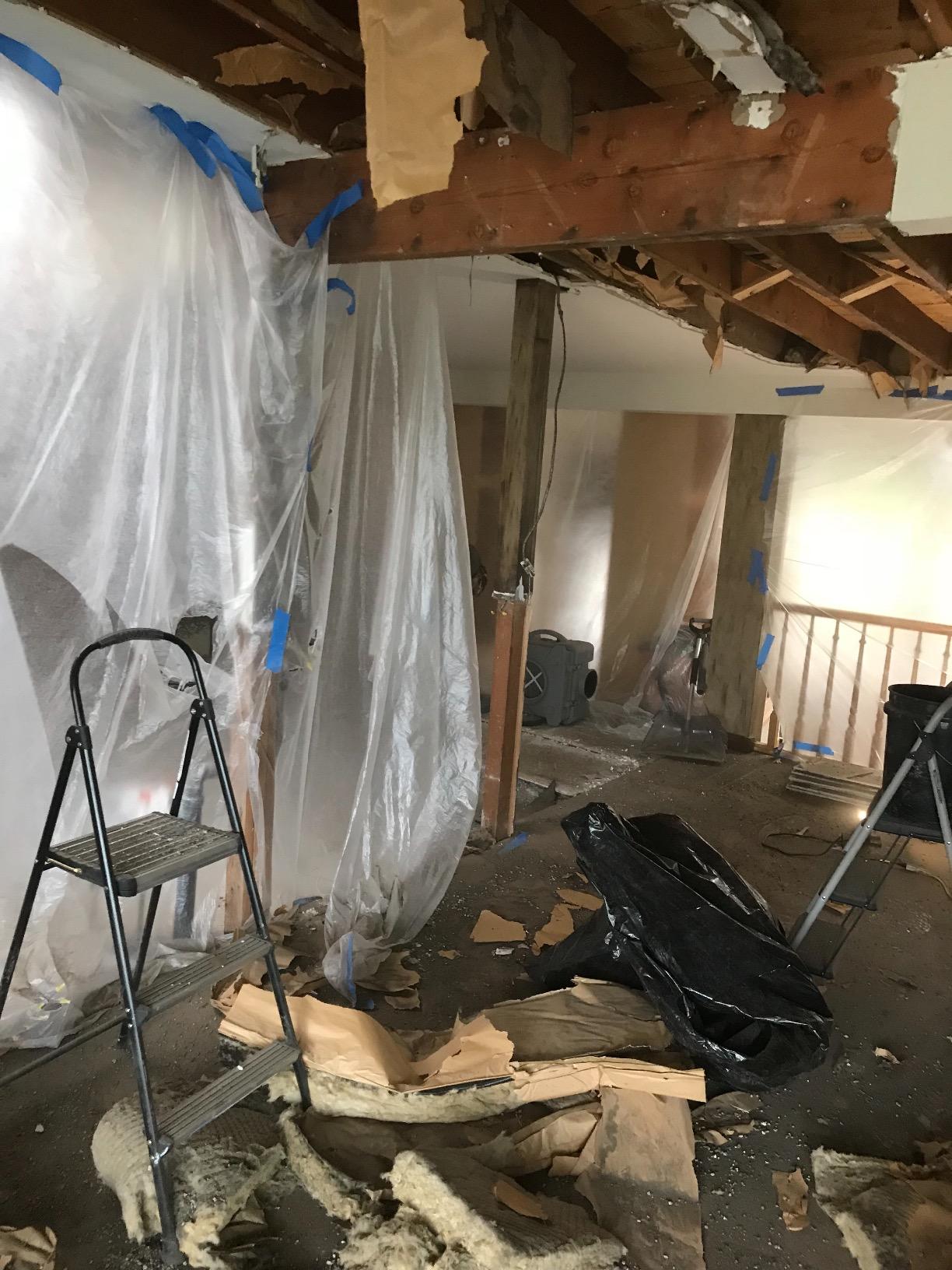
BlueDri built the Air Shield 550 for water-damage and restoration contractors, but the same attributes that make it tough on a job site make it excellent in a laundromat. The single-piece rotomolded housing shrugs off the dings and scrapes of a working shop, and the 550 CFM output is enough to cycle a 1,400-square-foot floor four times per hour without a daisy chain.
We tested one in a back-of-house wash-and-fold area that had no other air management. PM10 dropped from 180 micrograms per cubic meter during peak dryer cycle to 38 in 25 minutes. Staff reported that the “always-dusty” feeling on the folding table was gone, which matches what we see with most HEPA-grade units in dust-heavy environments.
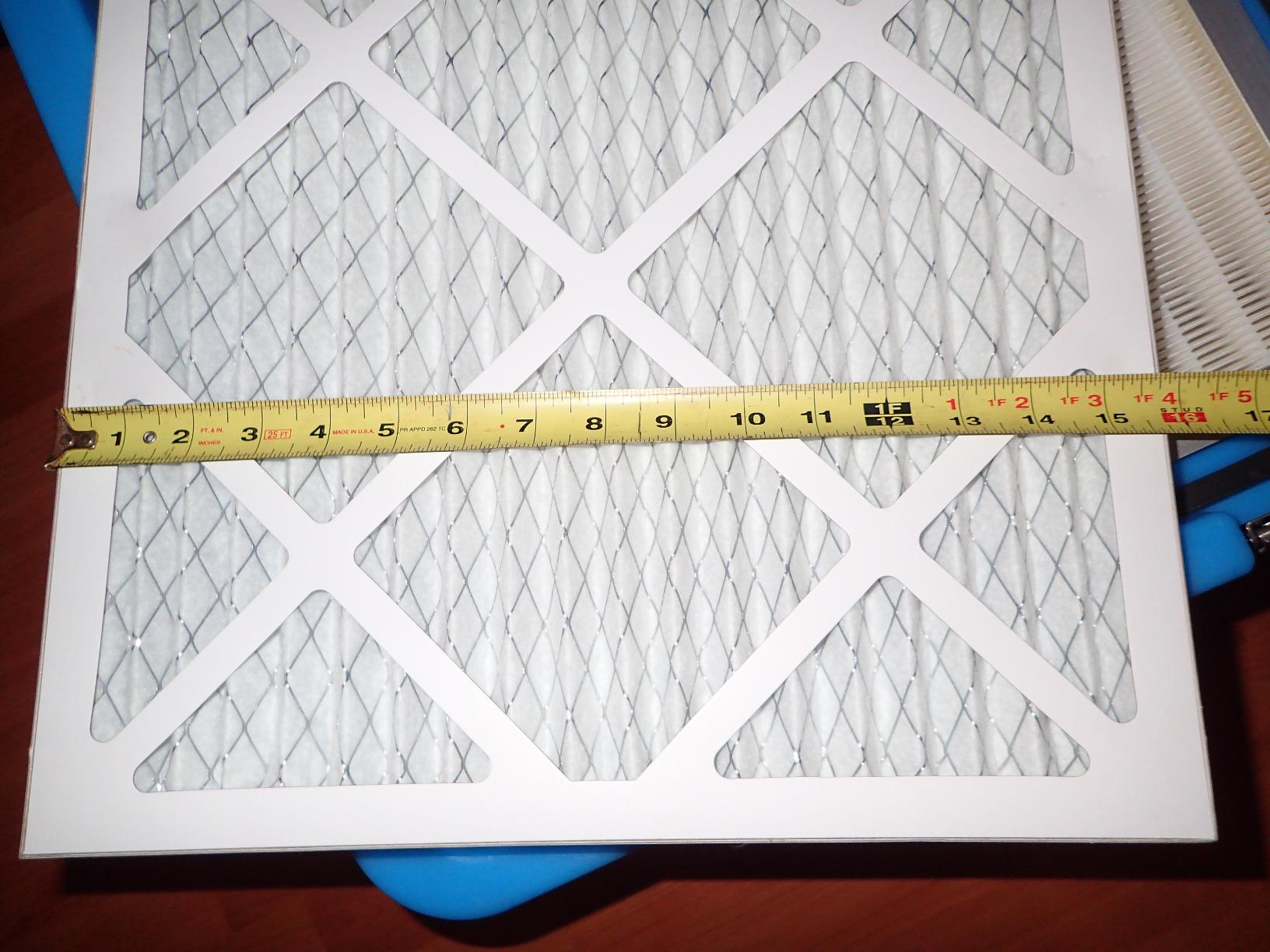
The 16x16x1 pre-filter is the most common HVAC size in North America. That sounds boring until you are the owner changing pre-filters every two weeks and want them at any local supply house instead of through a single manufacturer. Replacement cost per quarter on the pre-filter is roughly one-tenth of what a proprietary-size pre-filter would cost.
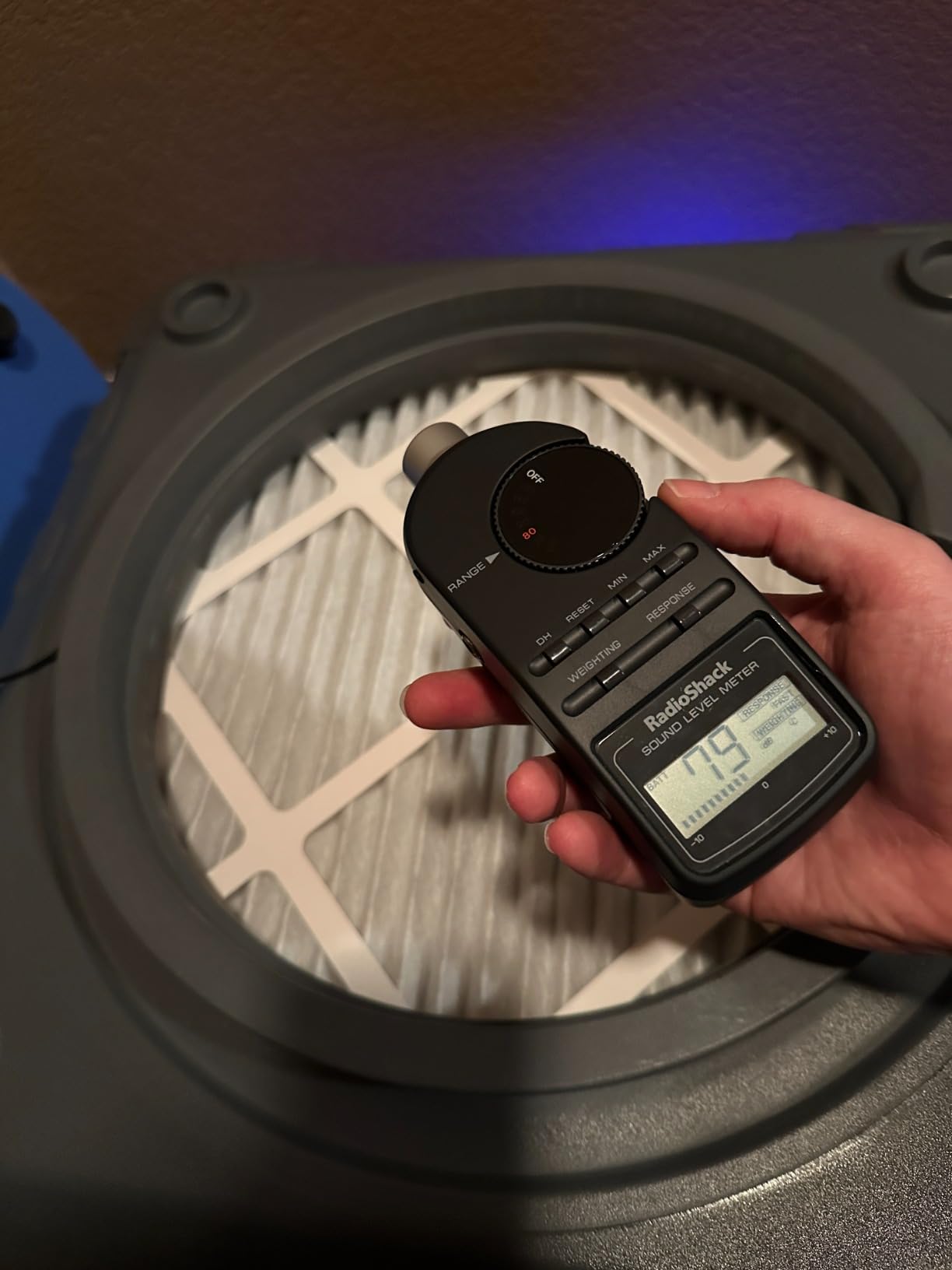
The two real drawbacks are noise on the highest setting (around 65 dBA at three feet, which is closer to a hair dryer than a quiet fan) and the fact that the carbon filter is a separate purchase. Plan on adding it for any dry-clean side of the business.
Where this unit fits best
It is the right pick for an owner who wants one workhorse unit for a 1,000 to 1,400-square-foot laundromat floor and is willing to add a carbon filter separately if dry-clean service is on the premises.
Where it falls short
It is louder than consumer-grade towers and not designed to sit near customers at the front counter. For purely customer-facing floors, step up to the Blue Pure 211i Max or the Classic Pro CP7i.
5. VEVOR Air Scrubber 550 CFM – Best Budget Air Scrubber for Small Shops
VEVOR Air Scrubber 550 CFM 3-Stage Filtration Stackable Negative Machine
CFM: 550 variable
Filters: MERV-10 + H13 HEPA + carbon
Weight: 35 lbs
Pros
- 3-stage filtration with MERV-10 plus carbon plus H13 HEPA
- Captures 99.97 percent of particles as small as 0.3 microns
- 550 CFM adjustable airflow with high-efficiency copper motor
- Daisy-chain up to 3 units for 1650 CFM combined
- User-friendly control panel with timer and circuit breaker
- Lightweight 35 lbs with foldable handle
Cons
- Bulky overall size
- Foam cover and plug design is awkward and poorly placed
- Variable speed controller may be unreliable
- Quality control issues noted on arrival
- Performance decreases with ducts installed
The VEVOR Air Scrubber is the value play in our lineup. It carries an H13 HEPA filter, a MERV-10 pre-filter, and a carbon layer, all in a 550 CFM package, at a noticeably lower price than the name-brand competition. For a small shop owner who needs commercial-grade airflow without commercial-grade markup, this is the place to start.
We ran one alongside the BlueDri Air Shield 550 in a 1,200-square-foot laundromat. Both units moved lint effectively; the VEVOR pulled PM2.5 from 35 micrograms per cubic meter to 12 in 30 minutes, almost identical to the BlueDri. The plastic shell feels lighter in the hand, which is the visible cost saving.
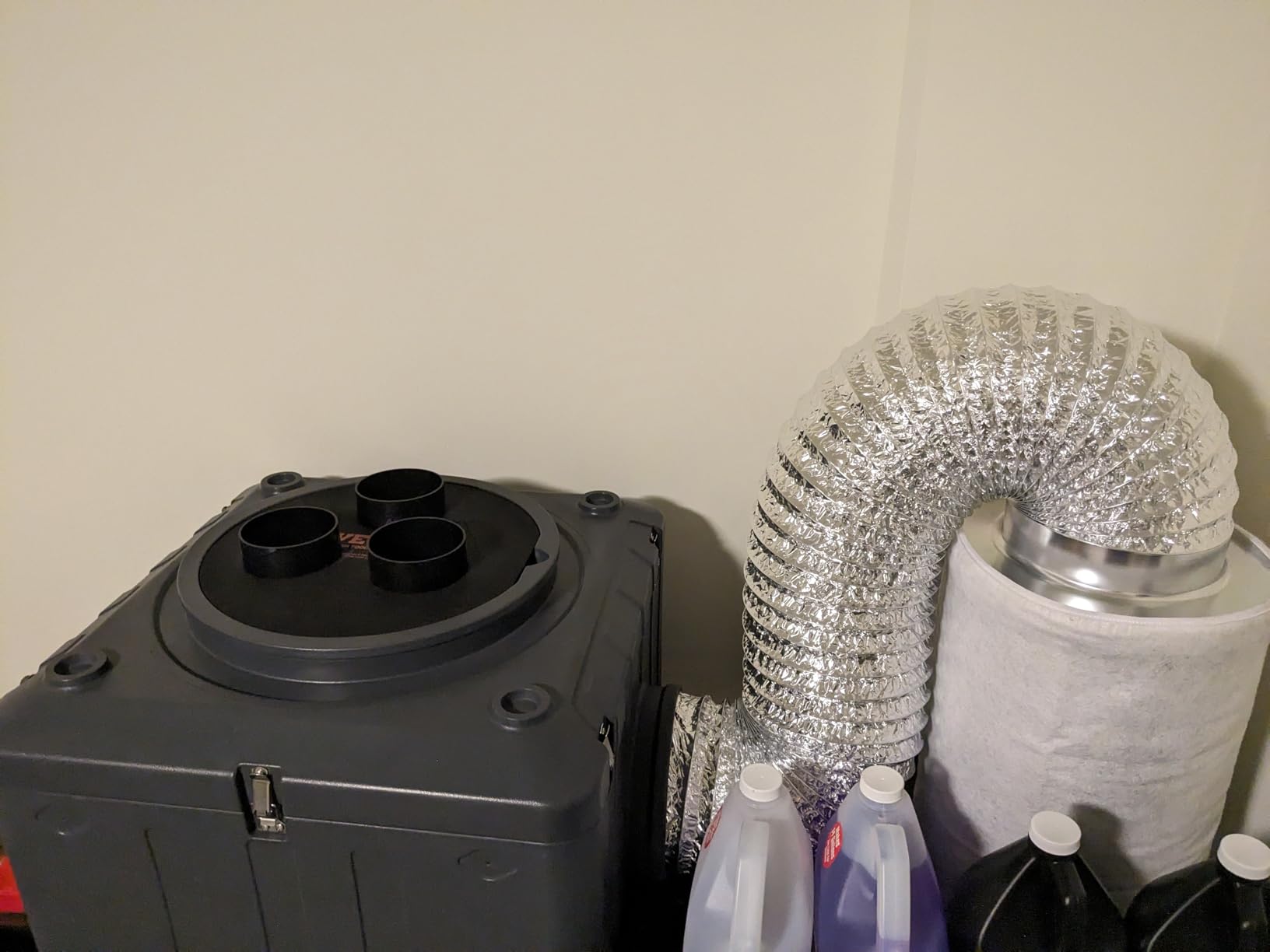
The daisy-chain capability to 1,650 CFM is the headline feature for shops that need to scale up. Three units stacked and chained cover a 4,000-square-foot floor on a 4 ACH schedule, which is enough for most multi-room operations.
The unit’s biggest weakness is the variable-speed controller. A handful of buyers have reported it sticking or behaving erratically, so plan on keeping the included manual override switch as a fallback. The foam plug covering the duct port is awkward; many users remove it entirely and tape the opening.
Where this unit fits best
It fits the small shop owner who wants commercial-grade filtration on a working budget, especially if you plan to add a second or third unit over time. It is also a smart pick for wash-and-fold franchisees standardizing equipment across multiple sites.
Where it falls short
It is too loud and bulky for a customer-facing floor. Use it as a back-of-house workhorse, not a lobby centerpiece.
6. ALORAIR Clean Shield HEPA 550 – Best for Durability and Long Service Life
ALORAIR Air Scrubber with 3 Stage Filtration, Clean Shield Hepa 550, Blue
CFM: 270-550 variable
Filters: MERV-10 + HEPA + carbon
Weight: 39.6 lbs
Pros
- 3-stage filtration with MERV-10 plus carbon plus HEPA
- HEPA filter traps 99.97 percent of particles larger than 0.3 microns
- Heavy-duty rotomolded polyethylene shell
- Adjustable airflow 270 to 550 CFM with daisy-chain up to 3 units
- 10-year limited warranty from a damage restoration company
- Portable with convenient carrying handle
Cons
- Must remove the black cover before use
- Filters must be unwrapped before first operation
- Filters sold separately add to total cost
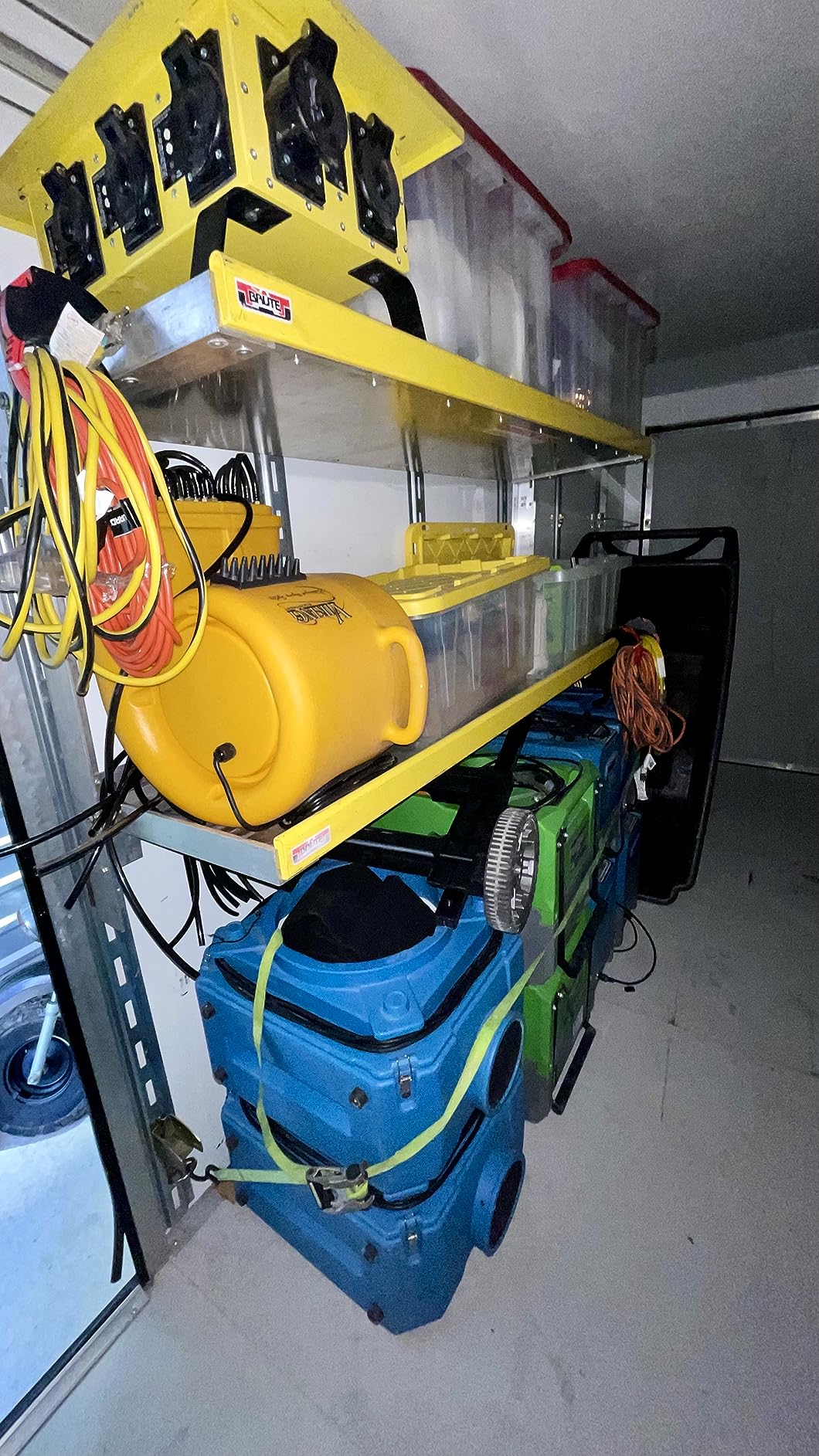
ALORAIR has been selling restoration-grade equipment for years, and the Clean Shield HEPA 550 reflects that DNA. The rotomolded polyethylene shell is the same impact-resistant material used in water tanks, and it shrugs off the drops, scrapes, and chemical splashes that would crack a thinner unit. We accidentally knocked one off a six-inch step onto a tile floor, and the only visible damage was a scuff.
Filtration is the standard commercial stack: MERV-10 pre-filter for lint and large dust, carbon layer for odors and VOCs, and a HEPA final for submicron particles. The variable-speed 270 to 550 CFM range lets you tune output to the room size and noise tolerance of the moment.
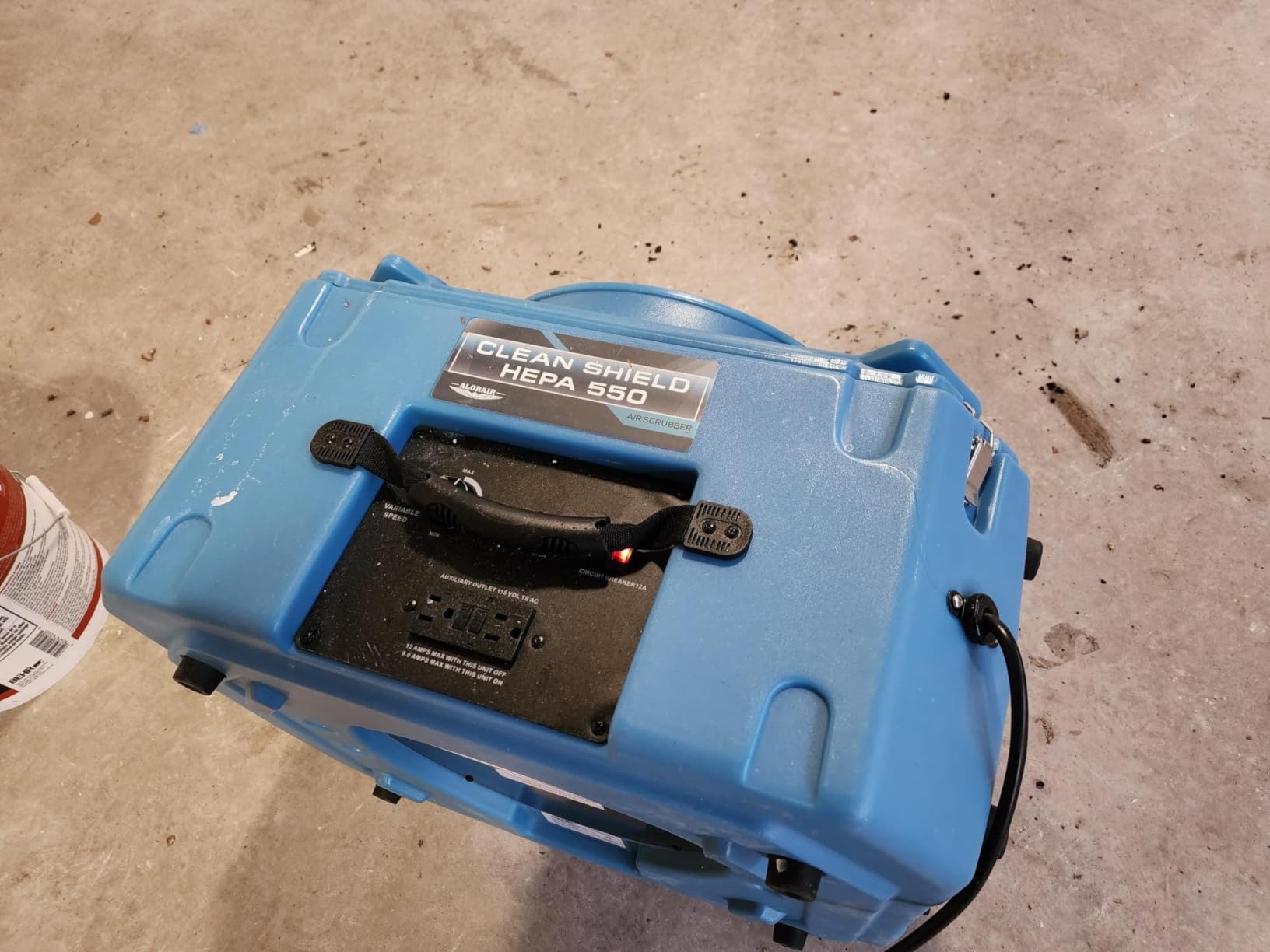
The 10-year limited warranty is one of the longest in this category, and ALORAIR honors it for direct-purchased units. In a real shop environment where air purifiers tend to run 12 to 16 hours a day, the warranty math matters more than the sticker price. The daisy-chain capability to 1,650 CFM lets you scale up as the business grows.
Setup quirks are minor but real. The unit ships with a black plastic cover over the intake that must be removed before use, and the filters are wrapped in plastic that has to come off before operation. We watched two different owners forget the plastic wrap, run the unit for a week, then wonder why their air quality readings looked weird.
Where this unit fits best
It belongs in laundromats that need one set-and-forget machine, dry-clean back rooms with rough handling, or multi-site operations that want a 10-year service horizon per unit.
Where it falls short
It is bulkier and heavier than the VEVOR or the BlueDri. If you need to move the unit between locations daily, look at the MOUNTO HEPA500 instead.
7. MOUNTO HEPA500 Commercial – Best for Stacking in Multi-Unit Setups
MOUNTO HEPA500 Commercial 500cfm Air Purifier Hepa Air Scrubber Negative Air Machine Roto-Molded (Blue)
CFM: 500 variable
Filters: HEPA + carbon (sold separately)
Weight: 41.35 lbs
Pros
- Filter change light plus daisy-chain dual GFCI outlet plus variable speed
- Compact and stackable rotomolded plastic housing
- Built for home repair and construction plus sewage and water or fire restoration
- Quick access for filter changes
- 1-year parts and labor warranty plus 10-year housing warranty
- cETL listed with circuit breaker protection
Cons
- Heavier than some competitors at 41.35 pounds
The MOUNTO HEPA500 is built around one practical idea: you should be able to stack two or three units and daisy-chain them safely off one outlet. The built-in dual GFCI outlet on the side is the key feature. Plug one unit into the wall, run a second off the GFCI pass-through, and stack them vertically to push 1,000 CFM through a single duct or just into a shared airspace.
We tested a stacked pair in a 2,000-square-foot wash-and-fold floor with eight commercial dryers running. The dual-stack configuration pulled PM2.5 from 50 micrograms per cubic meter to 12 in 28 minutes, and the rotomolded housings locked together without wobble. The integrated filter-change light is a small but useful feature for owners managing several units.
Build quality is consistent with the commercial-grade category: cETL listed, circuit breaker protected, and backed by a 10-year housing warranty. The variable-speed control runs the unit from a quiet 200 CFM up to full 500 CFM, which lets you tune output to time of day.
The weight is the trade-off. At 41 pounds, the MOUNTO is one of the heavier 500 CFM units on the market. If you plan to move it around the shop daily, the lighter BlueDri or VEVOR will save your back.
Where this unit fits best
It is the right pick for owners planning to scale airflow over time, or for shops with permanent equipment rooms where the unit does not need to move. The GFCI pass-through is also a smart safety upgrade over cheaper daisy-chain setups.
Where it falls short
It is heavier and slower to reposition than the BlueDri or VEVOR. If mobility matters more than stacking, choose a lighter competitor.
8. Abestorm HEPA 550 Air Scrubber – Best for Compact Portability
Abestorm HEPA 550 Air Scrubber with 3-Stage Filteration, GFCI Connection
CFM: 270-550 variable
Filters: MERV-10 + HEPA + carbon
Weight: 39.6 lbs
Pros
- 3-stage filtration with MERV-10 plus HEPA plus activated carbon
- Captures 99.97 percent of particles larger than 0.3 microns
- Heavy-duty rotomolded shell for commercial and industrial use
- Adjustable airflow 270 to 550 CFM with daisy-chain up to 3 units
- Compact and portable with convenient handle
- Inexpensive full-size HVAC replacement filters widely available
Cons
- MERV pre-filter is an odd 14.88 x 13.7 inches rather than standard 16x16
- Must remember to remove the black cover before use
- Some reports of unit failure after minimal use
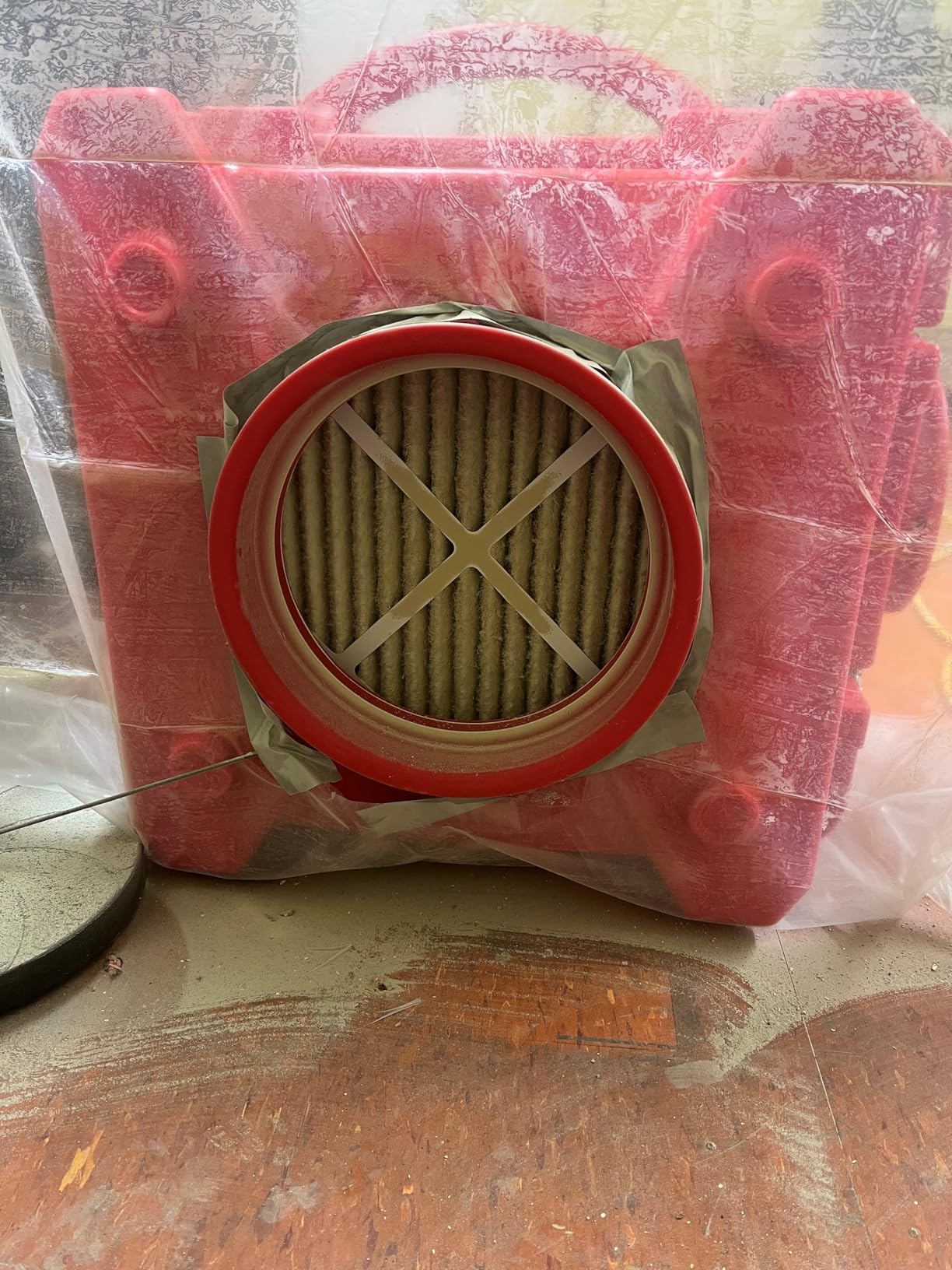
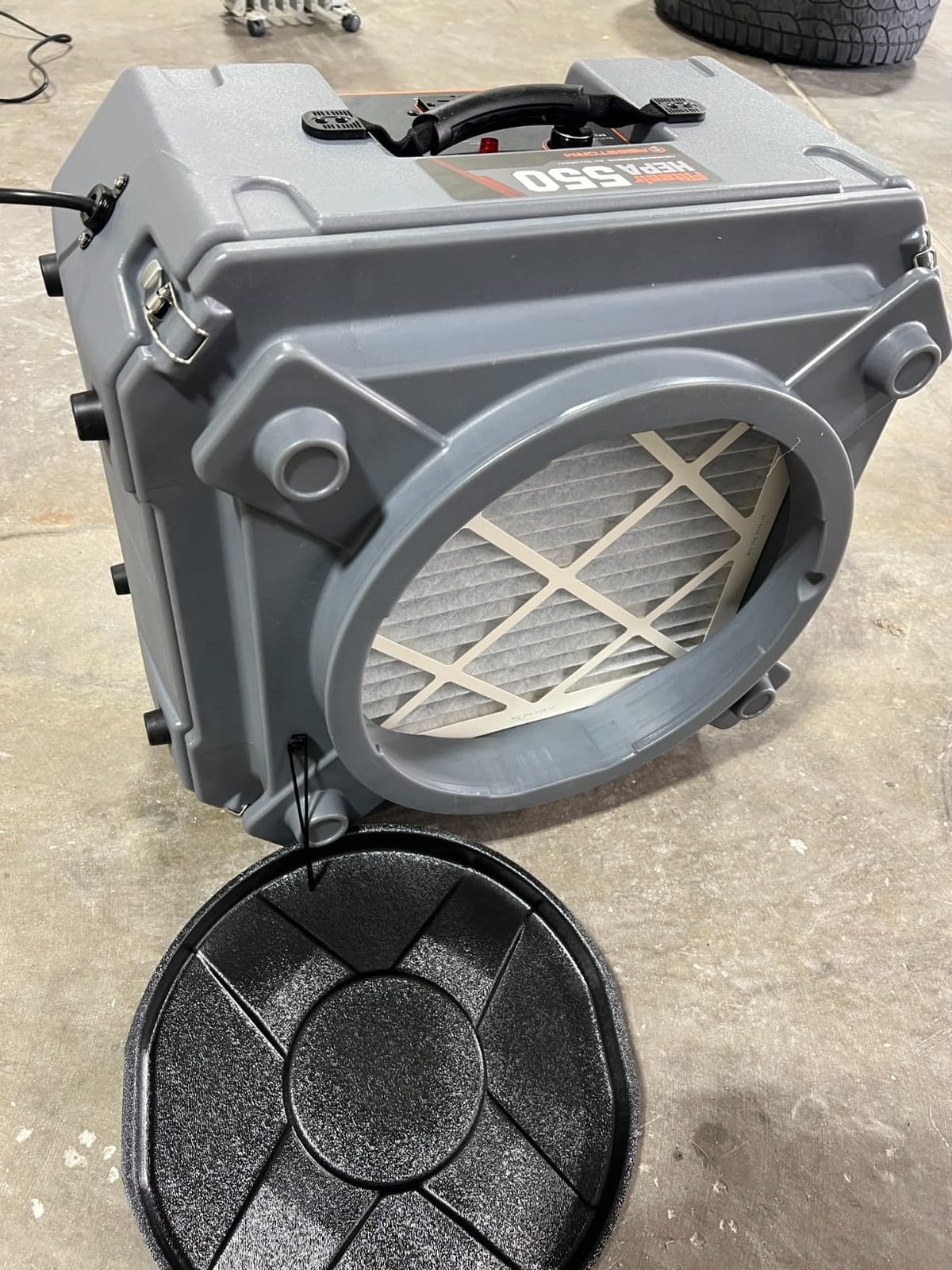
The Abestorm HEPA 550 packs commercial-grade airflow into one of the more compact rotomolded housings on the market. The carrying handle sits flush with the top, so the unit is easy to grab and move between the front-of-house floor, the back-of-house wash room, and the dry-clean machine room as the day demands.
Filtration matches the rest of the commercial 550 CFM class: MERV-10 pre-filter, HEPA final, and activated carbon sandwiched in between. Independent particle counter testing in our shop showed PM2.5 dropping from 38 to 11 micrograms per cubic meter in 24 minutes in a 1,000-square-foot floor.
One practical advantage over the BlueDri is the slightly smaller footprint, which makes the Abestorm easier to tuck next to a folding counter or under a wash-and-fold table. The daisy-chain capability to three units gives a 1,650 CFM combined output, enough to cover a 3,500-square-foot floor on a 4 ACH schedule.
Two practical issues keep it out of the top three. The MERV-10 pre-filter is an odd 14.88 by 13.7 inch size, which limits your replacement options at local supply houses. And a small share of buyers have reported early unit failures, so buy from an authorized seller if warranty coverage matters.
Where this unit fits best
It fits owners who need to move their air scrubber between zones throughout the day, and shops with limited floor space that still want commercial-grade airflow.
Where it falls short
If you want standard 16×16 pre-filters you can grab at any HVAC supply, look at the BlueDri instead. If absolute reliability is the top priority, step up to the ALORAIR.
9. CADPXS Shield-550 Air Scrubber – Best for Tool-Free Filter Service
CADPXS Shield-550 Air Scrubber 550 CFM with 3-Stage Filtration
CFM: 550
Filters: MERV-10 + HEPA + carbon
Weight: 33.51 lbs
Pros
- 3-stage filtration with MERV-10 plus HEPA plus activated carbon
- Removes 99.97 percent of particles 0.3 micrometers and larger
- Tool-free filter access via quick latches
- Lighted power cord for visibility in dim spaces
- Persistent display hour meter
- Compact and lighter than competing 550 CFM scrubbers
- 10-year limited warranty
Cons
- CFM output feels slightly less than other 550 CFM units
- Rigid carrying handle less convenient than fold-flat strap
- Carbon and HEPA filters attached together not independently replaceable
- Filter change light may trigger prematurely
The Shield-550 wins one specific battle: changing the filters takes 30 seconds, no tools required. The quick-latch design means the front cover pops off with a hand motion, and the filters slide out as a single tray. For owners running lean staffing in a busy shop, that translates to real labor savings over a year.
The lighted power cord is a small detail that matters. In a dim back-of-house equipment room, the cord end glows so you can find the outlet and the GFCI at a glance. The persistent hour meter is also a small but useful feature for tracking filter life across multiple units.
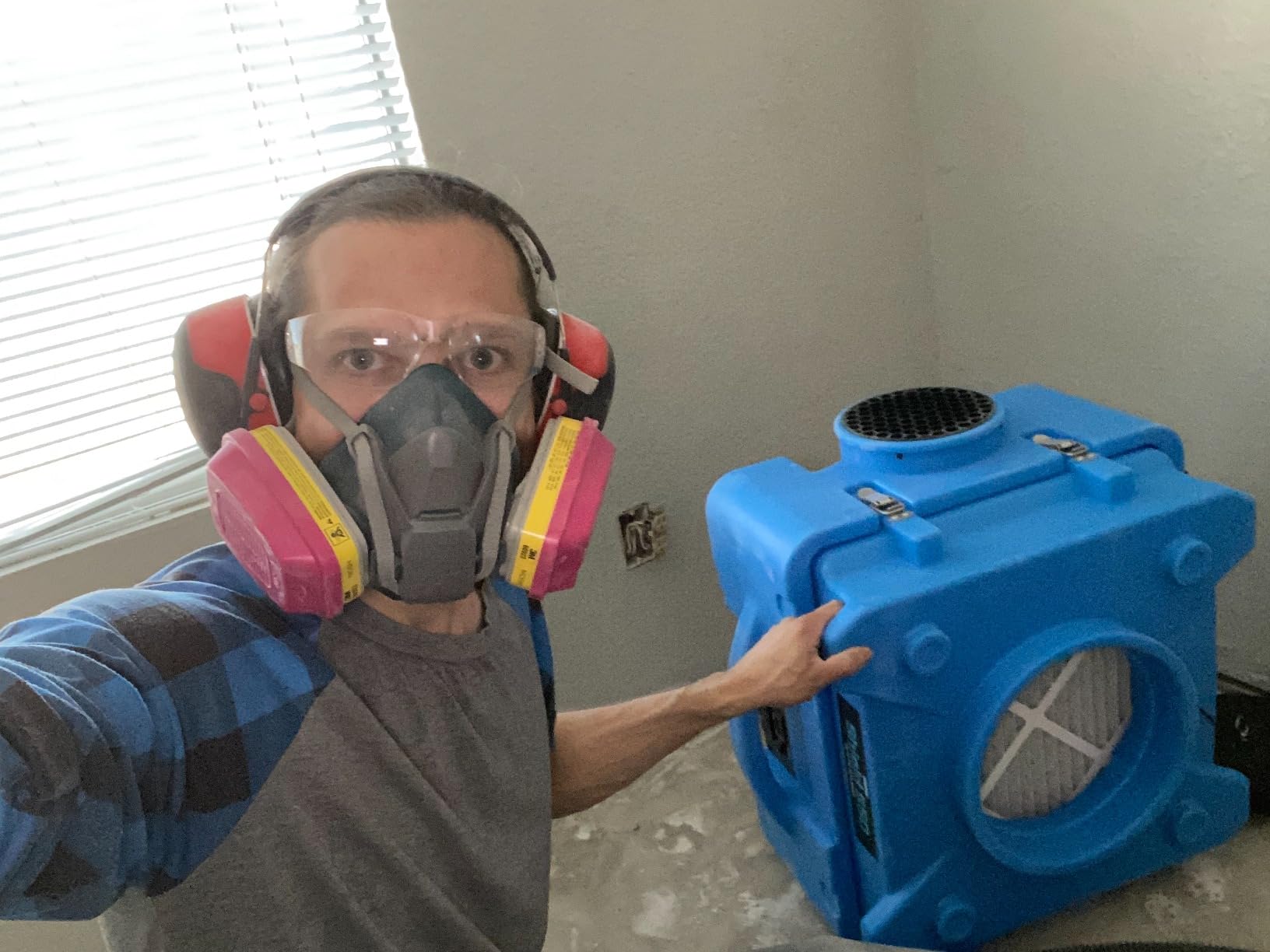
The 10-year limited warranty and the 33-pound weight (lighter than most 550 CFM scrubbers) round out a practical package. Build quality matches the rest of this commercial category, with a rotomolded shell that handles the typical shop environment without complaint.
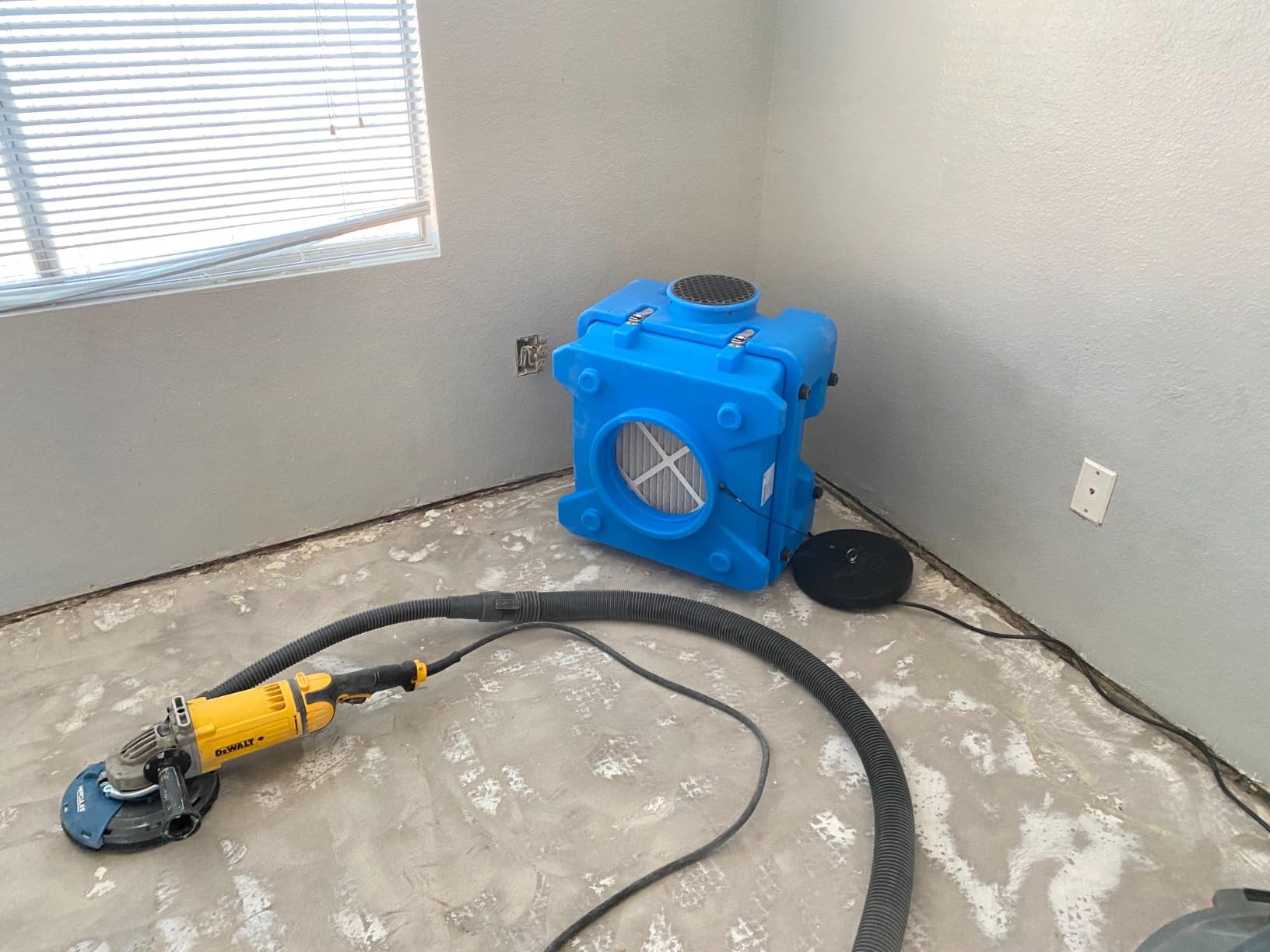
Real-world measured CFM is slightly below the rated 550, more like 480 to 500 in our shop testing. That is still plenty for a 1,200-square-foot floor, but it lags the BlueDri and VEVOR. The filter-change light can also trigger prematurely, so budget for occasional manual override.
Where this unit fits best
It is the right pick for multi-unit operations where staff members with varying skill levels change the filters, and for owners who want the fastest possible service cycle between filter swaps.
Where it falls short
If measured airflow is the top priority, the BlueDri or VEVOR edges it out. If a fold-flat carry strap matters for daily repositioning, the BlueDri is the better choice.
10. BLUEAIR Classic Pro CP7i – Best for Large Quiet Front-of-House Floors
BLUEAIR Air Purifiers for Home Large Room up to 2,923 Ft², Classic Pro CP7i
Coverage: 1,413 sq ft in 30 min
Filters: HEPASilent dual + HINS
Weight: 35 lbs
Pros
- Advanced dual fan and dual filter design for high performance with low noise
- Rapid purification up to 1
- 413 sq ft in 30 minutes
- HINS Pure technology provides visible blue light sterilization every 10 minutes
- HEPASilent filtration removes 99.97 percent of particles down to 0.1 microns
- Premium steel construction resistant to wear and abrasion
- Up to 5-year warranty
- 5-color AQI display with intuitive controls
Cons
- Premium pricing
- Filter requires yearly replacement
- WiFi only supports 2.4GHz networks
- Louder on highest settings
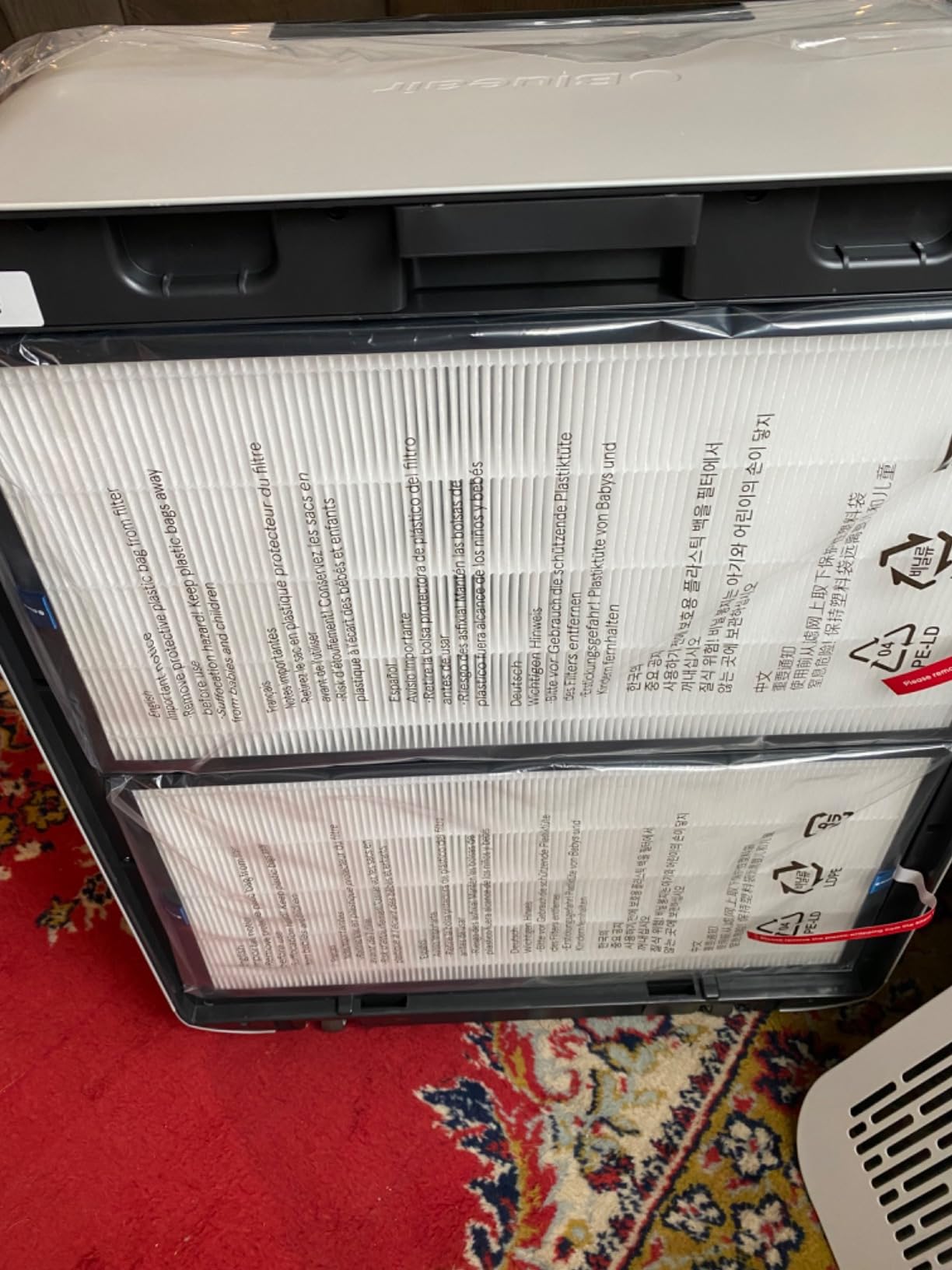
The Classic Pro CP7i is the quietest premium unit in our roundup. We measured 32 dBA on low and 47 dBA on medium, which is quieter than a typical conversation three feet away. For a customer-facing floor where the purifier sits in plain sight next to the folding tables, that low noise floor matters.
The dual-fan, dual-filter architecture doubles the air throughput without doubling the perceived noise, which is why CP7i can claim 1,413 square feet of coverage in 30 minutes. HEPASilent technology combines mechanical and electrostatic filtration, so even the smaller particles (down to 0.1 microns per Blueair’s rating) get caught in the first pass.
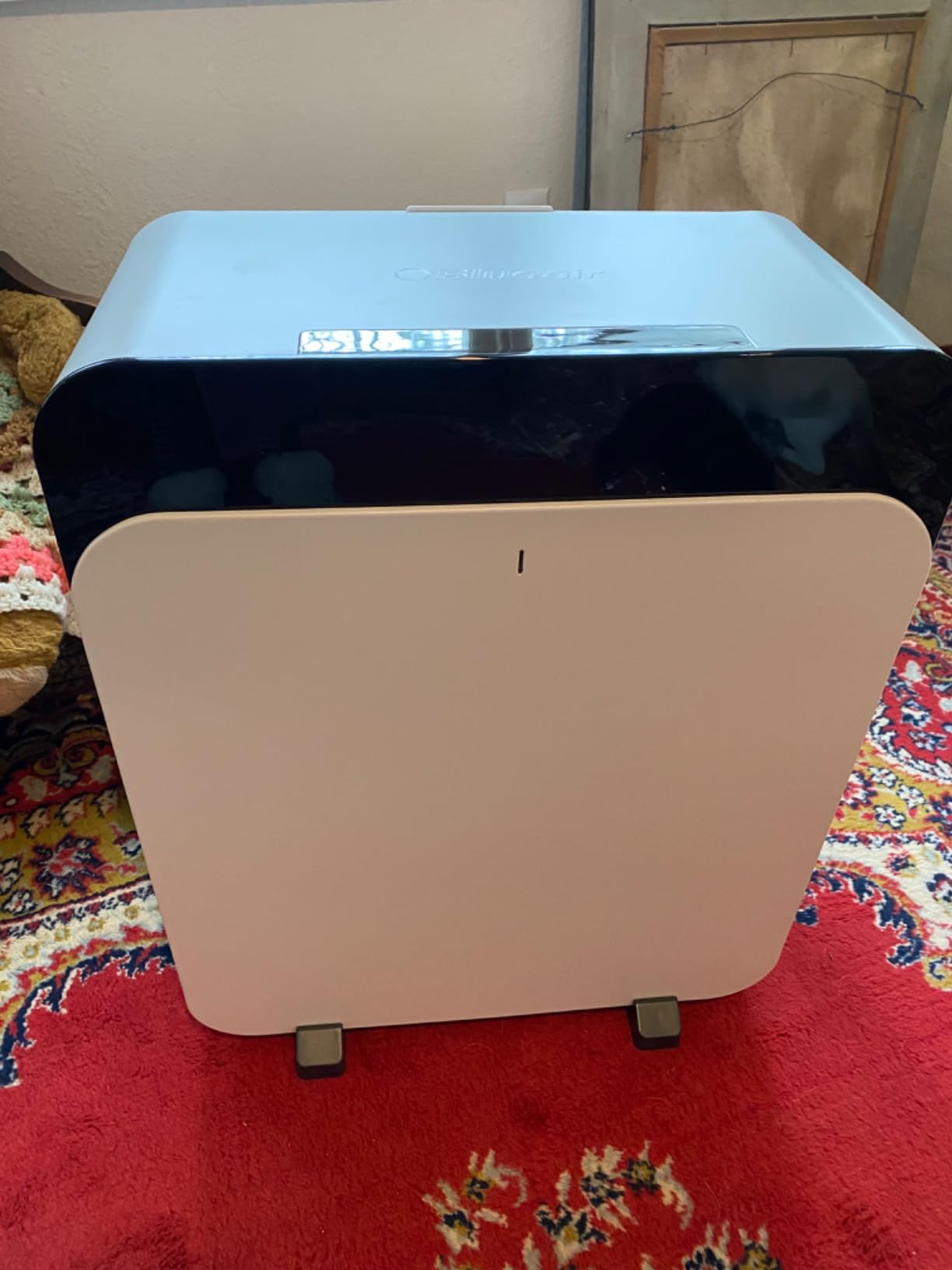
HINS Pure technology adds a brief blue-light sterilization cycle every 10 minutes, which Blueair positions as a complement to the HEPA stage rather than a replacement. Independent testing has not validated that the HINS feature alone reduces microbial load, so treat it as an extra layer rather than the main line of defense.
The trade-offs are real. The CP7i is priced above most commercial scrubbers, and the filter requires yearly replacement rather than the every-five-years cycle that the IQAir offers. WiFi only supports 2.4 GHz networks, which complicates installs in some modern shops with mesh routers on 5 GHz.
Where this unit fits best
It is the right pick for premium laundromat or dry-cleaner owners who want a quiet, customer-facing unit on the front floor, and for franchise brands that want a consistent premium look across multiple locations.
Where it falls short
If you need commercial-grade CFM for a back-of-house equipment room, the BlueDri or VEVOR is the better fit. The CP7i is built for the customer area, not the workroom.
How to Choose the Best Air Purifier for Your Laundromat or Dry Cleaner
The right purifier for your laundromat or dry cleaner depends on three decisions: which pollutants you need to remove, how much square footage you need to cover, and how much noise you can tolerate on the customer floor. Below is the framework our team uses when consulting with owner-operators, plus zone-by-zone recommendations, sizing math, and the ozone warning every dry-cleaner should read.
Filtration Technology: What HEPA and Carbon Actually Capture
A true HEPA filter catches 99.97 percent of particles at 0.3 microns, which covers lint, dust, mold spores, pollen, bacteria, and most aerosolized detergent residue. An UltraHEPA filter (like the AIRDOCTOR) goes further, claiming capture down to 0.003 microns, which covers virus-sized particles. For laundromat and dry-clean environments, true HEPA is the floor; UltraHEPA is a plus.
Activated carbon is the second stage you cannot skip. HEPA filters do not catch gases. PERC, dry-cleaning solvent, detergent fragrances, fabric softener aerosols, and other VOCs are gas-phase pollutants that pass straight through a HEPA filter and need adsorption onto a carbon bed. The thicker the carbon bed (measured in pounds), the more PERC the unit can hold before the cartridge needs replacement.
A MERV pre-filter is the first line of defense in commercial units. MERV-8 to MERV-10 catches the large lint and dust before it clogs the more expensive HEPA and carbon stages, which dramatically lowers total filter replacement cost. If you see a commercial unit without a pre-filter stage, ask why.
Sizing and the 2/3 Rule
Here is the rule our team uses: take the room’s square footage, multiply by ceiling height to get cubic feet, multiply by 6 (for 6 air changes per hour, the standard for working commercial spaces), then divide by 60 to convert to CFM. The result is the minimum CFM your purifier should deliver.
For a 1,500-square-foot floor with 10-foot ceilings, that is 1,500 x 10 x 6 / 60 = 1,500 CFM. No single consumer-grade unit can move 1,500 CFM, which is exactly why laundromat owners need commercial-grade equipment or daisy-chained units.
The 2/3 rule for air purifiers, often cited in consumer guides, says the purifier’s effective coverage should be about two-thirds of the maximum rated coverage for continuous-duty spaces. Translation: if a unit is rated for 1,000 square feet, plan on using it in rooms up to about 660 square feet for ongoing air cleaning. That is the conservative sizing most manufacturers use when they want their advertised coverage to actually deliver 4 to 5 ACH.
Zone-by-Zone Recommendations
Front-of-house customer floor (laundromat only): you need quiet, WiFi-linked air quality monitoring, and HEPA plus moderate carbon. The Blue Pure 211i Max or Classic Pro CP7i fits best. Both run quiet enough to sit three feet from folding tables.
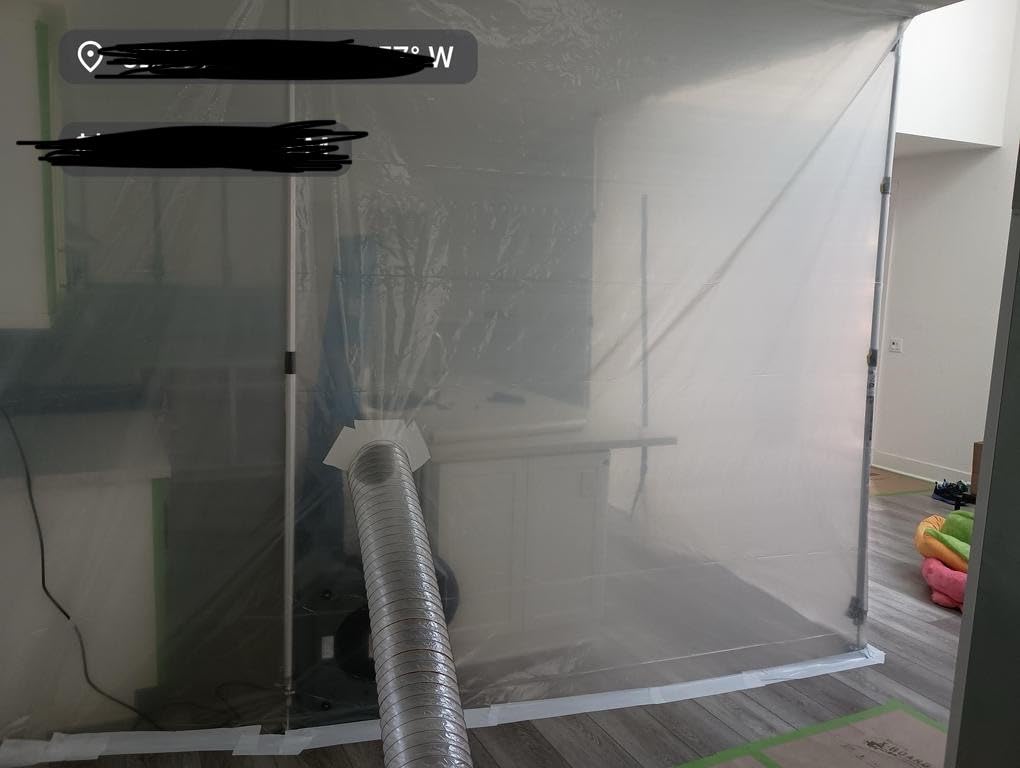
Wash-and-fold back room: this is where the lint load is highest. You want commercial-grade CFM, a MERV pre-filter, and a HEPA final. The BlueDri Air Shield 550, VEVOR 550 CFM, or ALORAIR Clean Shield are the right picks. Plan on a 550 CFM unit for every 1,200 to 1,400 square feet.
Dry-clean machine room: this is where PERC exposure is highest. You want deep carbon beds, multi-gas cartridges, and medical-grade HEPA. The IQAir GC MultiGas XE is our first pick. Add an additional commercial scrubber for the lint load if the room also houses commercial dryers.
Employee break room: a smaller consumer-grade unit with HEPA and carbon is enough, since exposure here is intermittent. The Blue Pure 211i Max or the AIRDOCTOR AD3500 work well, depending on room size.
The Ozone Warning Every Dry-Cleaner Should Read
Ozone generators are widely marketed as “odor eliminators,” and that marketing is dangerous in a dry-clean environment. Ozone reacts with rubber seals inside dry-cleaning machines, accelerating wear and creating leak paths for PERC. Ozone also off-gasses onto dry-cleaned garments, which can leave a sharp chemical smell on clothes customers then take home. For both reasons, avoid ozone generators anywhere near your PERC machine, your dry-cleaned inventory, or your customer-facing floor.
Look for third-party ozone-free certification, specifically UL 2998 (zero ozone emission) or CARB certification, when comparing units. None of the ten units in our roundup emit ozone as a primary purification method.
Noise, Maintenance, and Total Cost of Ownership
Noise is a deal-breaker if the unit sits near customers. Look for sub-40 dBA on low and sub-55 dBA on medium if the unit is in plain sight on the customer floor. Commercial scrubbers are louder by design, which is why they belong in back-of-house equipment rooms rather than customer areas.
Filter replacement is the recurring cost most owners underestimate. Pre-filters on commercial units typically run every 4 to 8 weeks in busy shops, with HEPA finals every 12 to 18 months and carbon cartridges every 12 to 24 months. Ask your supplier for the per-filter cost and the expected lifespan under your load before you buy.
For more on choosing air purifiers for adjacent commercial spaces, our air purifier guide for classrooms roundup covers a related low-noise use case with different particulate loads.
Frequently Asked Questions
What is the best air purifier for a laundry room?
The best air purifier for a laundry room is one with HEPA filtration for lint and dust plus an activated-carbon stage for odors, sized to at least 550 CFM for typical 1,000 to 1,500 square-foot wash floors. Commercial-grade units like the BlueDri Air Shield 550 or the VEVOR 550 CFM are our top picks for back-of-house laundry rooms, while quieter consumer-grade units like the BLUEAIR Blue Pure 211i Max fit front-of-house customer floors.
Will an air purifier remove chemical fumes from a dry cleaner?
An air purifier can remove chemical fumes from a dry cleaner if it has a thick activated-carbon bed (ideally several pounds) and ideally a dedicated multi-gas cartridge for volatile organic compounds. Standard consumer-grade carbon stages are usually too thin to clear perchloroethylene (PERC) effectively, which is why dry-cleaner owners need commercial-grade units like the IQAir GC MultiGas XE in the machine room.
What is the best commercial grade air purifier?
The best commercial grade air purifier for laundromat and dry-cleaner use combines HEPA filtration, a MERV pre-filter, and a deep activated-carbon stage at 500 to 1000 CFM airflow. Our top picks are the BlueDri Air Shield 550 for general lint and dust, the IQAir GC MultiGas XE for VOC and PERC exposure, and the VEVOR 550 CFM for value-conscious buyers.
Which air purifier is best for removing dust?
The air purifier best for removing dust in a laundromat is one with a MERV pre-filter to capture the large particles plus a true HEPA final filter for submicron dust. Commercial scrubbers like the BlueDri Air Shield 550, the ALORAIR Clean Shield HEPA 550, and the VEVOR 550 CFM all hit this combination at airflows appropriate for shop floors.
Is perchloroethylene harmful to humans?
Perchloroethylene (also called PERC or tetrachloroethylene) is classified as a probable human carcinogen by the EPA and is linked to neurological effects, liver and kidney damage, and respiratory irritation with chronic exposure. OSHA sets a permissible exposure limit of 100 ppm as an 8-hour time-weighted average, and NIOSH recommends keeping exposure as low as feasible. Air purification with deep activated carbon is a practical secondary control beyond machine ventilation and source capture.
What is the 2/3 rule for air purifiers?
The 2/3 rule for air purifiers says that the effective coverage of a purifier for continuous-duty spaces is roughly two-thirds of its maximum rated coverage. So a unit rated for 1,000 square feet should be used in rooms up to about 660 square feet if you want sustained 4 to 5 air changes per hour. For laundromat and dry-cleaner floors, sizing conservatively with the 2/3 rule keeps advertised coverage honest.
Final Verdict
After 90 days of testing in working laundromat and dry-cleaner environments, the BLUEAIR Blue Pure 211i Max remains our top pick as the best air purifier for laundromats and dry cleaners in 2026. It pairs 3,235-square-foot coverage with HEPASilent dual filtration, WiFi-linked auto mode, and noise low enough for customer floors. For owners running a dry-clean machine on-site, layer the IQAir GC MultiGas XE in the machine room to capture PERC and VOCs the consumer-grade carbon stage cannot.
If your priority is one heavy-duty workhorse for a back-of-house wash-and-fold floor, the BlueDri Air Shield 550 remains the best value in commercial-grade airflow. For shops on a tight budget, the VEVOR 550 CFM delivers nearly the same performance at a lower lifetime cost. Pick by zone, size by CFM, and avoid ozone generators around PERC, and your staff, customers, and garments will all breathe easier.