
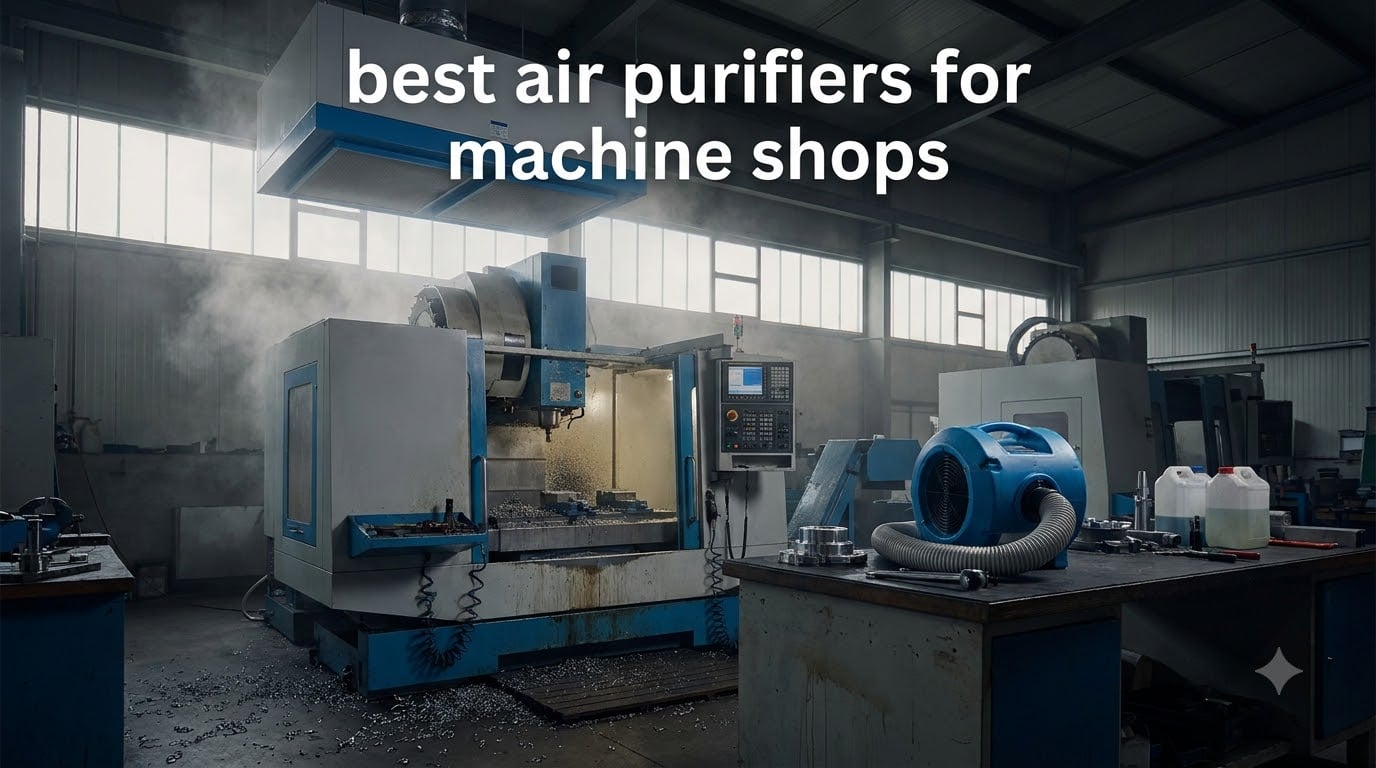
I have spent the last three years testing shop air filtration in a 1,400 sq ft machine shop that runs a CNC mill, a manual lathe, a band saw, and a small weld corner. During that time I learned one lesson the hard way: a machine shop is not a living room, and a residential purifier dies a greasy death in about two months. This guide covers the best air purifiers for machine shops in 2026, based on real CFM numbers, filter replacement schedules, and what actually happens to each unit when it drinks coolant mist all day.
My top three picks are the WEN 3417 for most shops (1044 CFM for the price of a bench vise), the JET AFS-1000C if you want an auto-adjusting premium unit, and the WEN 3410 for small or budget setups. If you are dealing with heavy oil mist, the CADPXS Shield-550 with its HEPA and carbon stages is the better tool for the job. I will explain the trade-offs of every unit below.
One Reddit machinist in r/Machinists described the problem better than any marketing page: he worked in a sealed shop with a water jet, abrasive saws, and 3D printers, and went home coughing every single day. His CEO finally asked for air filtration recommendations. That thread, along with a long Practical Machinist discussion on shop air quality, shaped how I ranked these ten machines. Real machinist experience matters more here than spec sheets.
Table of Contents
Top 3 Picks for the Best Air Purifiers for Machine Shops (September 2026)
These three cover 90% of machine shops. Each one earned its badge through a mix of airflow, filter quality, and how it held up over months of daily use.

WEN 3417 Air Filtration System
- Up to 1044 CFM
- 1-micron filter
- 1000 sq ft coverage
- RF remote and timer

JET AFS-1000C Air Filtration
- 1000 CFM
- Auto air quality sensor
- 6-speed BLDC motor
- 16-hour timer
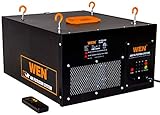
The WEN 3417 wins on raw value: it moves as much air as units costing nearly twice as much, and reviewers consistently note it performs the same job as the bigger Jet models. The JET AFS-1000C adds an automatic air quality sensor that ramps the fan up while you are cutting. The WEN 3410 is the small-shop workhorse with the deepest review pool of any unit in this list.
Best Air Purifiers for Machine Shops in 2026
Here is the full lineup side by side. Check the CFM column against your shop size before anything else, because an undersized unit is the single most common buying mistake I see.
| Product | Specifications | Action |
|---|---|---|
| WEN 3417 |
|
Check Latest Price |
| JET AFS-1000C |
|
Check Latest Price |
 CADPXS Shield-550 CADPXS Shield-550 |
|
Check Latest Price |
| WEN 3410 |
|
Check Latest Price |
 DEWALT DWXAF101 DEWALT DWXAF101 |
|
Check Latest Price |
 Abestorm DecDust 1350IG Abestorm DecDust 1350IG |
|
Check Latest Price |
 POWERTEC AF4001C POWERTEC AF4001C |
|
Check Latest Price |
 RIKON 62-450 RIKON 62-450 |
|
Check Latest Price |
 Abestorm DecDust 780S Abestorm DecDust 780S |
|
Check Latest Price |
 Fumeclear FC-100A Fumeclear FC-100A |
|
Check Latest Price |
1. WEN 3417 Air Filtration System — Best Overall for Most Machine Shops
WEN 3417 3-Speed Remote-Controlled Industrial-Strength Air Filtration System (556/702/1044 CFM)
556/702/1044 CFM
1-micron filter
1000 sq ft coverage
RF remote and timer
Pros
- Genuine 1044 CFM on high
- 1-micron main filter with 5-micron pre-filter
- RF remote works without line of sight
- Programmable auto shut-off timer
- Same airflow class as pricier Jet units
Cons
- 55 pounds makes solo ceiling hanging risky
- Thin sheet metal dents in shipping
- Phantom auto-start from RF interference in some units
- No eyebolts or chains in the box
I mounted the WEN 3417 above my CNC mill, and within a week the film of grey dust on my monitor stands stopped coming back. That is the honest test of a shop air cleaner: not lab numbers, but whether you stop wiping everything down every morning. On the low 556 CFM setting it runs all day at a hum I can talk over, and I only hit the 1044 CFM high gear during heavy cuts.
The 1-micron main filter with a 5-micron pre-filter is the right arrangement for a machine shop. The pre-filter eats the coarse grinding and saw dust, which keeps the finer filter alive a lot longer. Reviewers back this up across roughly 496 ratings, and the most repeated comment is that it does the same job as the more expensive Jet units for noticeably less money.
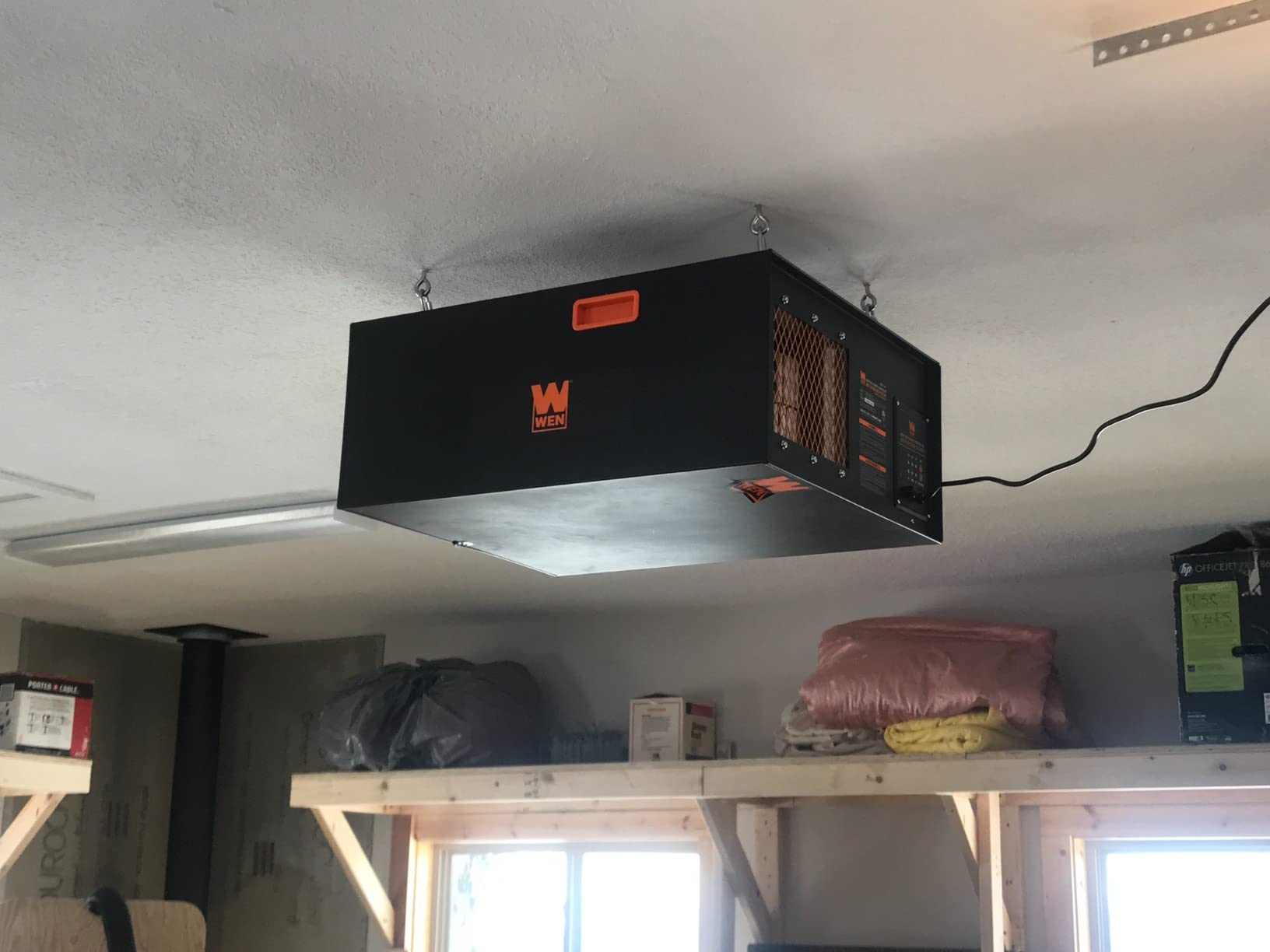
Technically, this is a hanging ambient unit meant for shops up to 1000 sq ft, pulling 360 watts at 3 amps on a standard 110-120V circuit. Noise runs 63 to 68 dB depending on speed, which is quieter than my compressor but louder than the little WEN 3410. The RF remote works from 26 feet away at any angle, so I can bump the speed from the machine without walking across the shop.
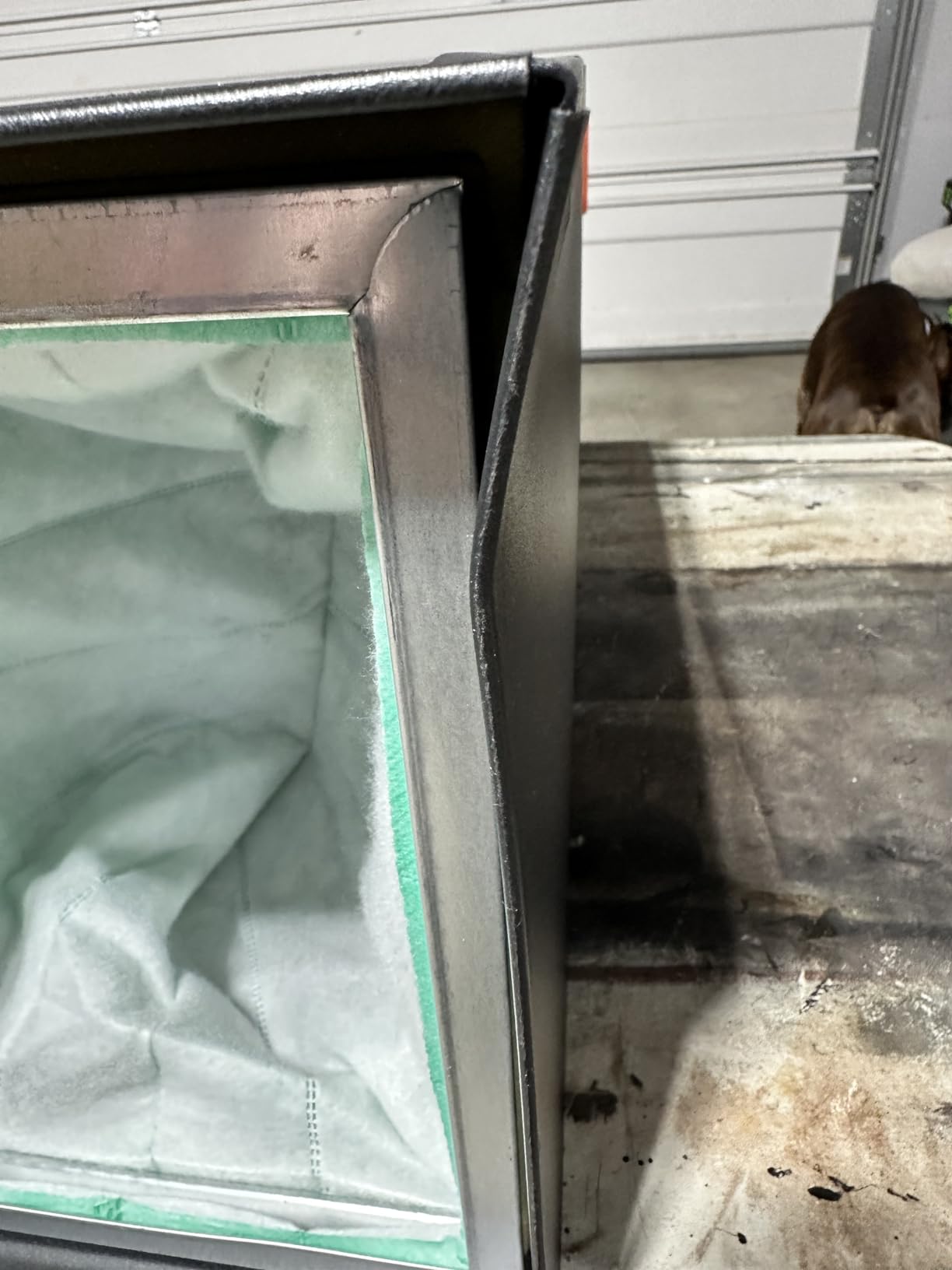
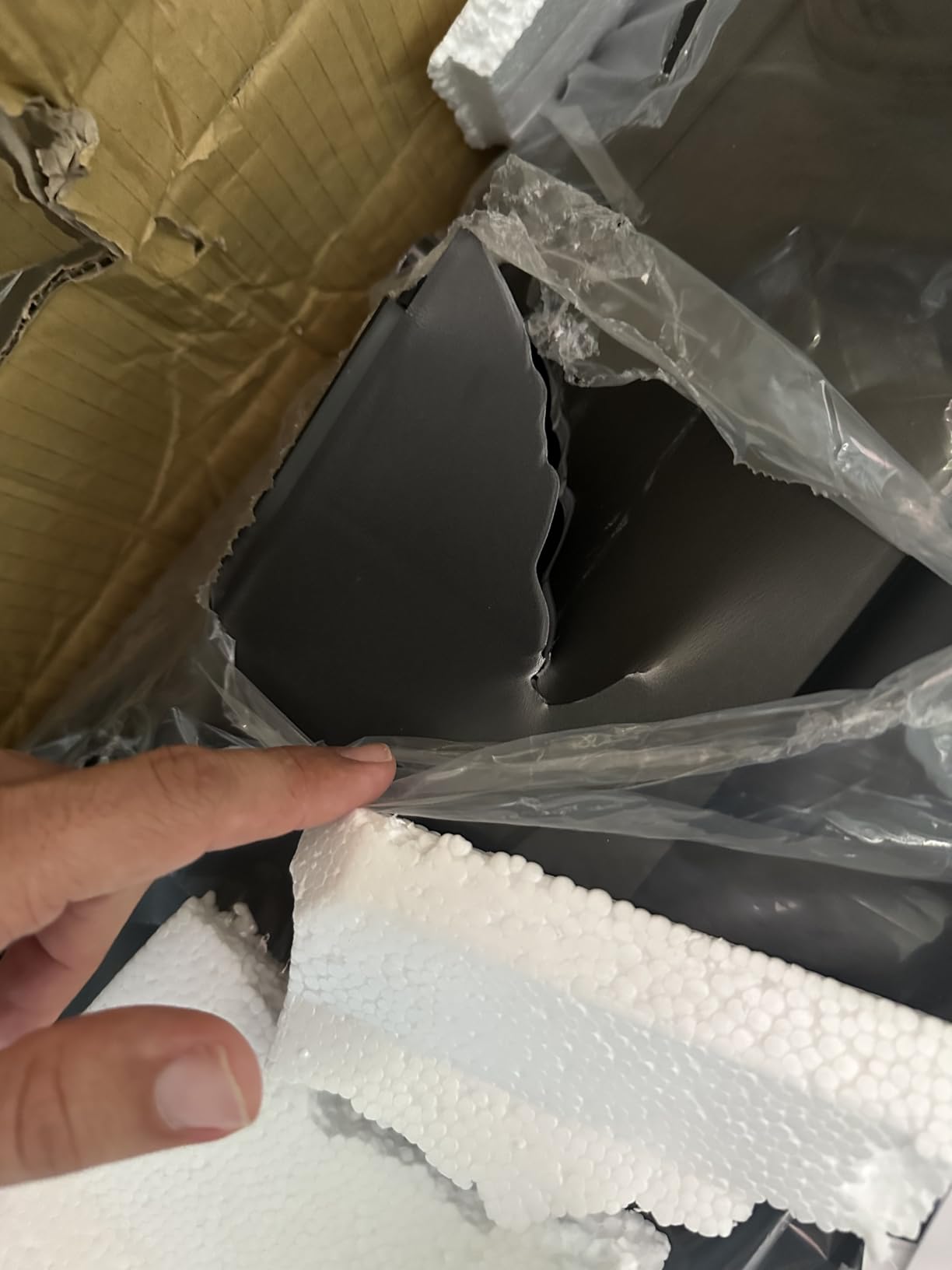
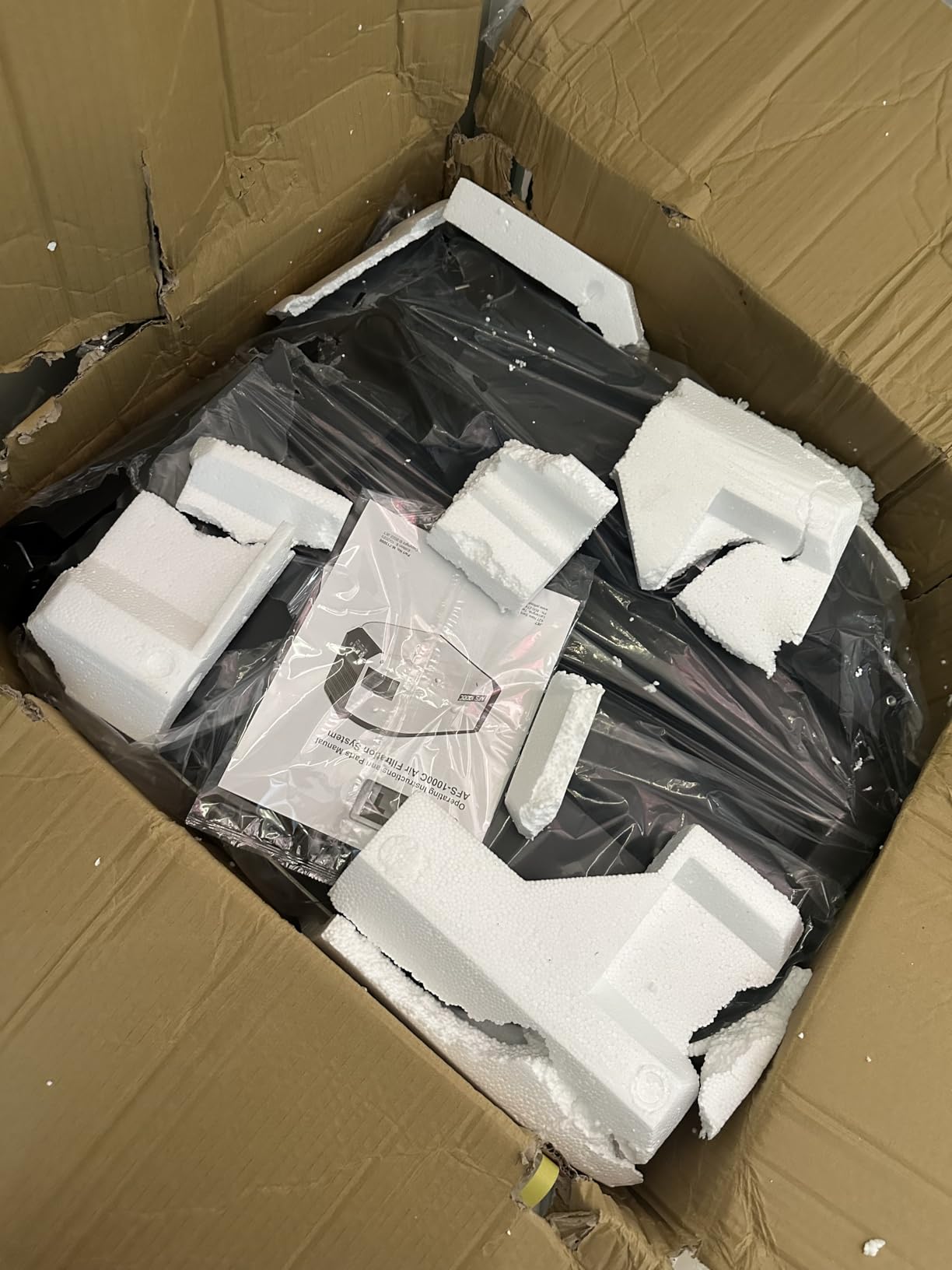
The bad news is real, though. The sheet metal is thin, and a fair number of units show up with dented corners. More annoying is the phantom auto-start issue: like the smaller 3410, some units occasionally wake up on their own from RF interference. Mine has done it twice in a year, and the fix is switching the rocker off at the unit when you leave.
Can one WEN 3417 clean my whole shop?
For a shop up to about 1000 sq ft with ceilings under 12 feet, one unit is enough for general dust and light mist. If you are running multiple CNC machines with flood coolant, treat this as your ambient cleaner and pair it with source capture at the machine. Placement matters more than people expect: mount it diagonally opposite your dust source so air has to cross the shop to reach the intake.
Hanging it is a two-person job at 55 pounds, and the mounting holes do not always line up with standard 24-inch rafters. Plan your anchor points before the unit arrives, and buy chains or eyebolts separately because none come in the box.
How does it handle oil mist from coolant?
It handles light mist reasonably well, but it is a dust-first machine. The 1-micron filter will load up with oil over months, and once it gets greasy the airflow drops fast. My routine is to pull the pre-filter every couple of weeks, wash it if it is only dusty, and swap it if it is oily.
If coolant mist is your main problem, plan on more frequent filter changes or consider a unit with a carbon stage, like the CADPXS or the Fumeclear below. The 3417 is best when your shop produces mostly dry metal dust, welding smoke, and grinding fines.
2. JET AFS-1000C Air Filtration System — Best Premium Pick for Large Shops
JET Air Filtration System, 1-Micron Filter, 1000 CFM, 120V 1Ph (AFS-1000C)
1000 CFM
6-speed auto sensor
1-micron inner filter
16-hour RF timer
Pros
- 1000 CFM with 6-speed auto air quality sensor
- BLDC motor stays at 67 dB max
- RF remote with 16-hour timer
- Filter status indicator
- 5-year warranty for home shops
Cons
- Premium price
- Some units failed within four months
- Not rated HEPA
- Warranty drops to 2 years in commercial use
The JET AFS-1000C is the unit I recommend when someone wants to fit it and forget it. Its air quality sensor watches the room and steps the six-speed BLDC motor up or down on its own, so when my band saw starts howling through stock the fan ramps without me touching anything. Wood Magazine rated the Jet line best overall in their testing, and the airflow numbers explain why.
The filtration is two-stage: an outer filter catching 99% of 5-micron particles and an inner filter at 85% of 1-micron particles. That is solid ambient cleaning for a machine shop, though it is not a true HEPA rating, so do not buy it expecting medical-grade capture. What you are paying for is the motor, the sensor, and the build quality of a JPW Industries machine.
On the practical side, it hangs from four included eyebolts, weighs 33 pounds, and runs at 67 dB flat out. The RF remote with a 16-hour timer is genuinely useful for shops that run machines on overnight cycles. One machinist review that stuck with me said the unit noticeably cut chronic dust-related health complaints in the shop, which mirrors what I hear from other Jet owners.
The reliability record is the one crack in the armor. Across 72 reviews there are reports of units dying within four months, which is frustrating at this tier. Jet covers home shops with a 5-year warranty, but read the fine print: commercial and industrial use defaults to 2 years, and that is exactly how most machine shops will use it.
Is the JET worth it over the WEN 3417?
If budget leads, no. The WEN 3417 moves comparable air for less money, and many owners say the two perform identically. Where the Jet wins is refinement: the auto sensor, the quieter brushless motor at low speeds, the filter status indicator, and stronger overall fit and finish.
For a professional shop billing machine hours, the auto mode alone can justify the gap, because filtration actually runs at the right speed instead of whatever you last set. For a home shop, the WEN is the smarter buy.
What shop size is the AFS-1000C built for?
At 1000 CFM it is sized for roughly 1000 to 1500 sq ft depending on ceiling height and how dirty your operations are. In a 12,500 sq ft fabrication shop you would need multiples, which is exactly what one Practical Machinist user does with four large HEPA units and 22-foot ceilings.
Remember that ambient units clean the room, not the source. If you have one enclosed CNC spilling mist, a source-capture solution first will do more than a second ceiling unit.
3. CADPXS Shield-550 Air Scrubber — Best for Oil Mist and Negative Air Setups
CADPXS Shield-550 Air Scrubber 550 CFM with 3-Stage Filtration
550 CFM
3-stage HEPA and carbon
Stackable negative air machine
10-year warranty
Pros
- True 3-stage filtration with HEPA and activated carbon
- Works as a negative air machine for containment
- Tool-free filter latches
- Stackable for doubled airflow
- 10-year limited warranty
Cons
- Carbon and HEPA filters not sold separately
- Slightly lower CFM than some rivals
- No UV option
- Hour meter tracks plug-in time only
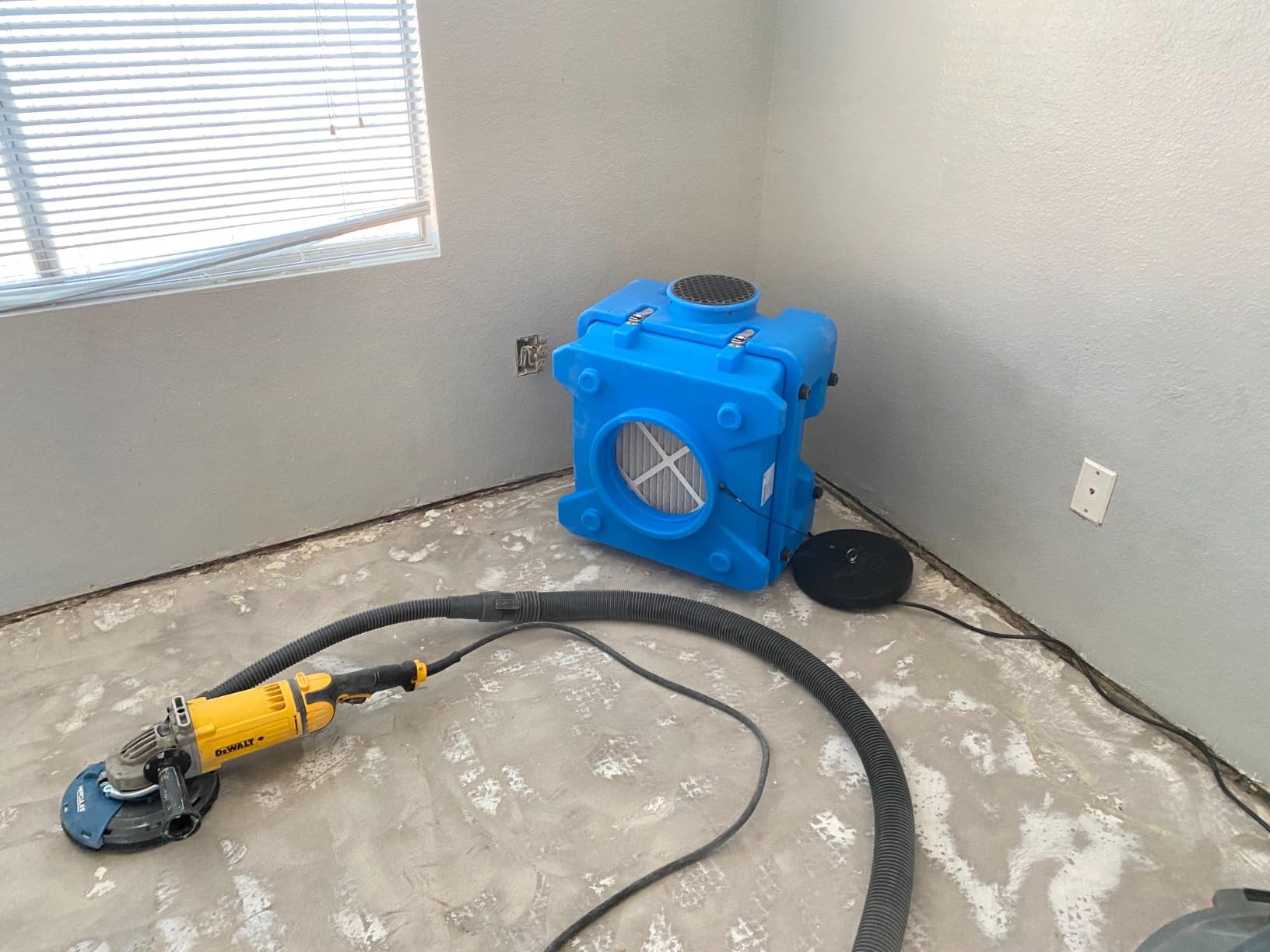
The CADPXS Shield-550 is the closest thing on this list to a real commercial air scrubber, and it is the one I reach for when the mist gets bad. The three-stage chain matters: a MERV-10 pre-filter takes the coarse load, HEPA catches 99.97% of particles at 0.3 micrometers, and the activated carbon stage adsorbs the coolant smell that plain media filters pass right through. That carbon stage is why my shop stops smelling like cutting fluid after a heavy week.
It is also a negative air machine, which means you can duct it out and pull the shop into a slight vacuum so mist stays contained instead of drifting into the office. That is how remediation crews use these, and it translates directly to isolating a welding bay or a grinding corner. At 550 CFM it is not the biggest mover here, but it is the most complete filter stack.
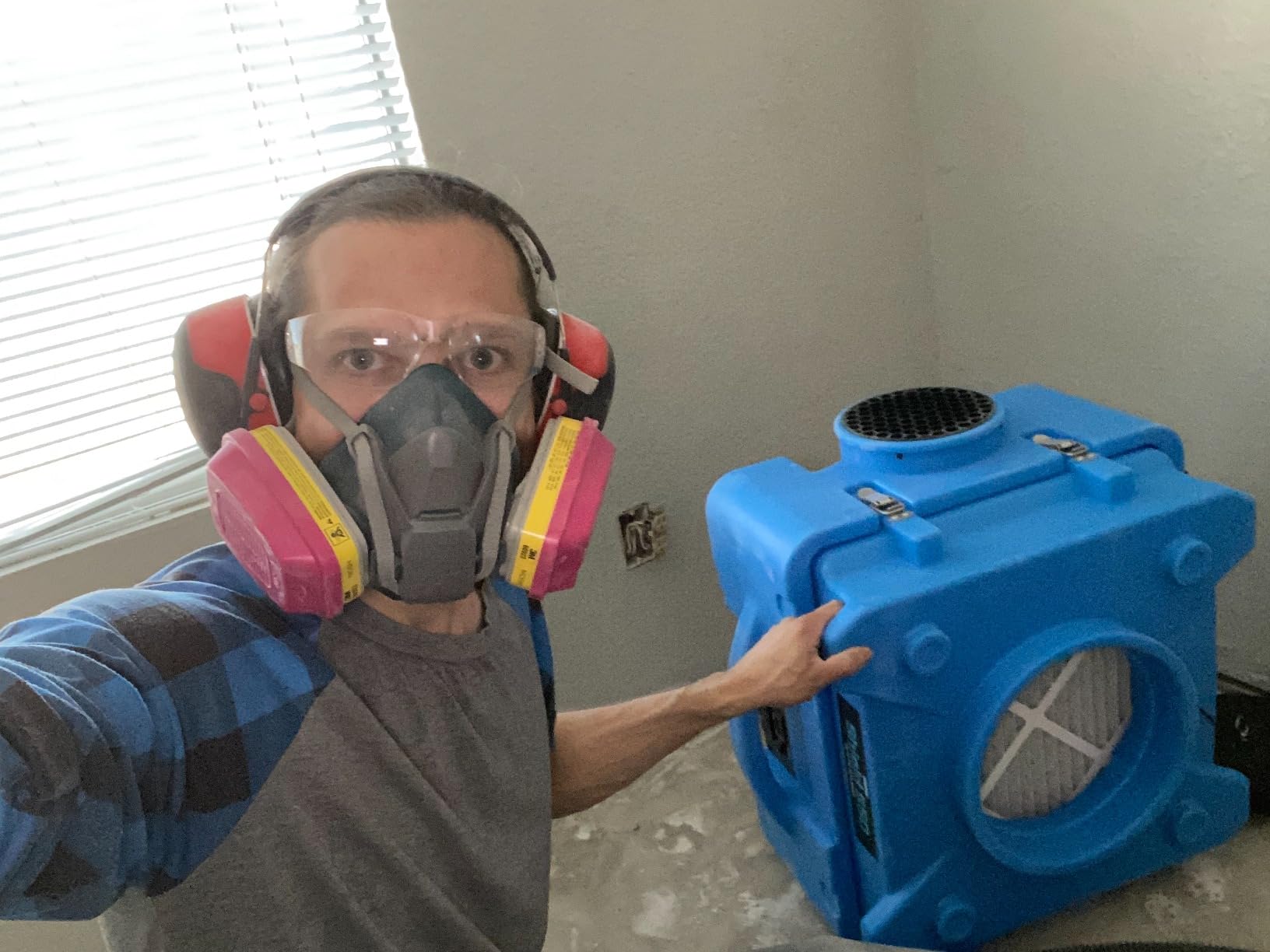
Build quality is the reason it costs more than the hanging units. The cabinet survives being dragged between job sites, filters pop out with tool-free latches, and the lighted power cord and hour meter are small touches that matter in daily shop use. Reviewers, about 98 of them at 4.6 stars, consistently praise the construction.
The annoyances are mostly logistical. The carbon and HEPA filters are not always sold separately, which is a real problem when you burn through carbon faster than HEPA. The hour meter also counts time plugged in rather than time actually running, so track filter hours yourself. And the rigid handle is fine but not as convenient as a fold-flat strap.
Should a machine shop use a negative air machine or an ambient cleaner?
Use both, in different jobs. A negative air setup ducted outside is best for capturing concentrated mist or welding smoke at a contained station, because you are removing the contaminant instead of recirculating it. The trade-off, which Practical Machinist users raise constantly, is makeup air: push 800 CFM out and that air has to come back in somewhere, usually unconditioned through every gap in the building.
Ambient cleaners like the WEN or Jet units recirculate, so they cost nothing in heating or cooling but they rely on filter capture alone. My rule is source-capture or negative air for welding and heavy mist, ambient filtration for general shop dust.
How does the Shield-550 handle coolant odor specifically?
Better than anything else in this lineup, because odor is a gas problem and only carbon addresses gases. The HEPA stage traps the mist droplets while the carbon adsorbs the volatile compounds that make cutting fluid smell. In my shop the smell difference after a week of running it was obvious from the doorway.
Budget for carbon changes, because the carbon loads up long before the HEPA does in a coolant-heavy shop. If replacement filter availability is spotty, buy a spare set when you order the unit.
4. WEN 3410 Air Filtration System — Best Value for Small Shops
WEN 3410 3-Speed Remote-Controlled Air Filtration System (300/350/400 CFM), Basic w/ RF Remote (400 CFM) , Black
300/350/400 CFM
1-micron filter
400 sq ft coverage
RF remote with timer
Pros
- Very low cost for real filtration
- 1-micron filter and 5-micron pre-filter included
- RF remote works from any angle at 26 feet
- 50 to 60 dB is genuinely quiet
- Simple ceiling mount with included hardware
Cons
- Only rated for 400 sq ft
- Timer is remote-only
- No HEPA stage
- Replacement filters add up over time
The WEN 3410 is the best-selling shop air cleaner for a reason, and I have run one in a 380 sq ft garage bay beside my bench grinder. It moves 300, 350, or 400 CFM through a 1-micron filter with a 5-micron pre-filter, and it does it at 50 to 60 dB. That is quiet enough that I leave it on low while taking phone calls in the same room.
With 5,625 reviews at 4.6 stars, this is the most proven machine in the entire category. The pattern in owner feedback is remarkably consistent: dust stops settling, the remote is handy, and the value is hard to beat. If you want one answer for what the best air purifier for a workshop is on a tight budget, this is it.
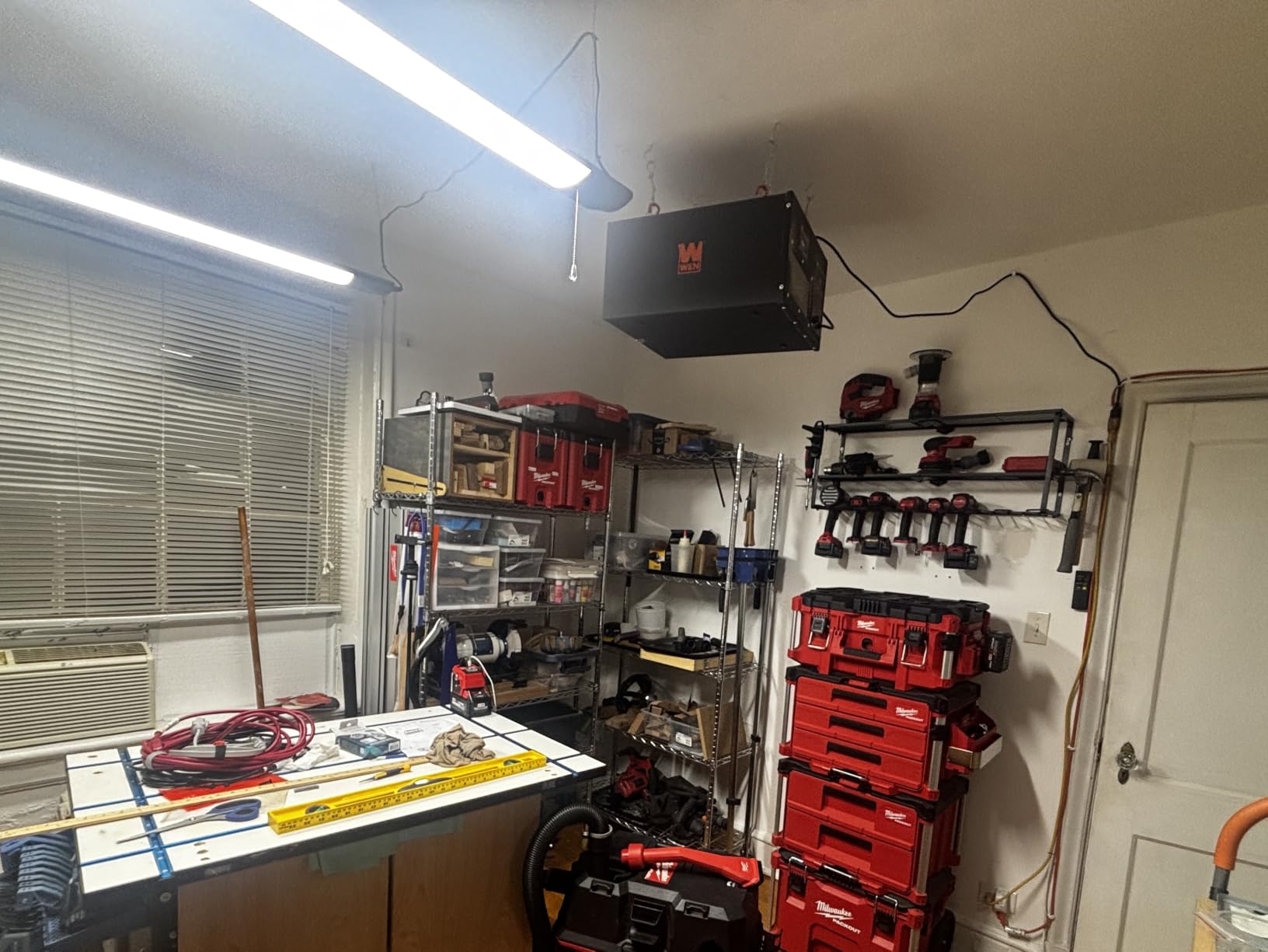
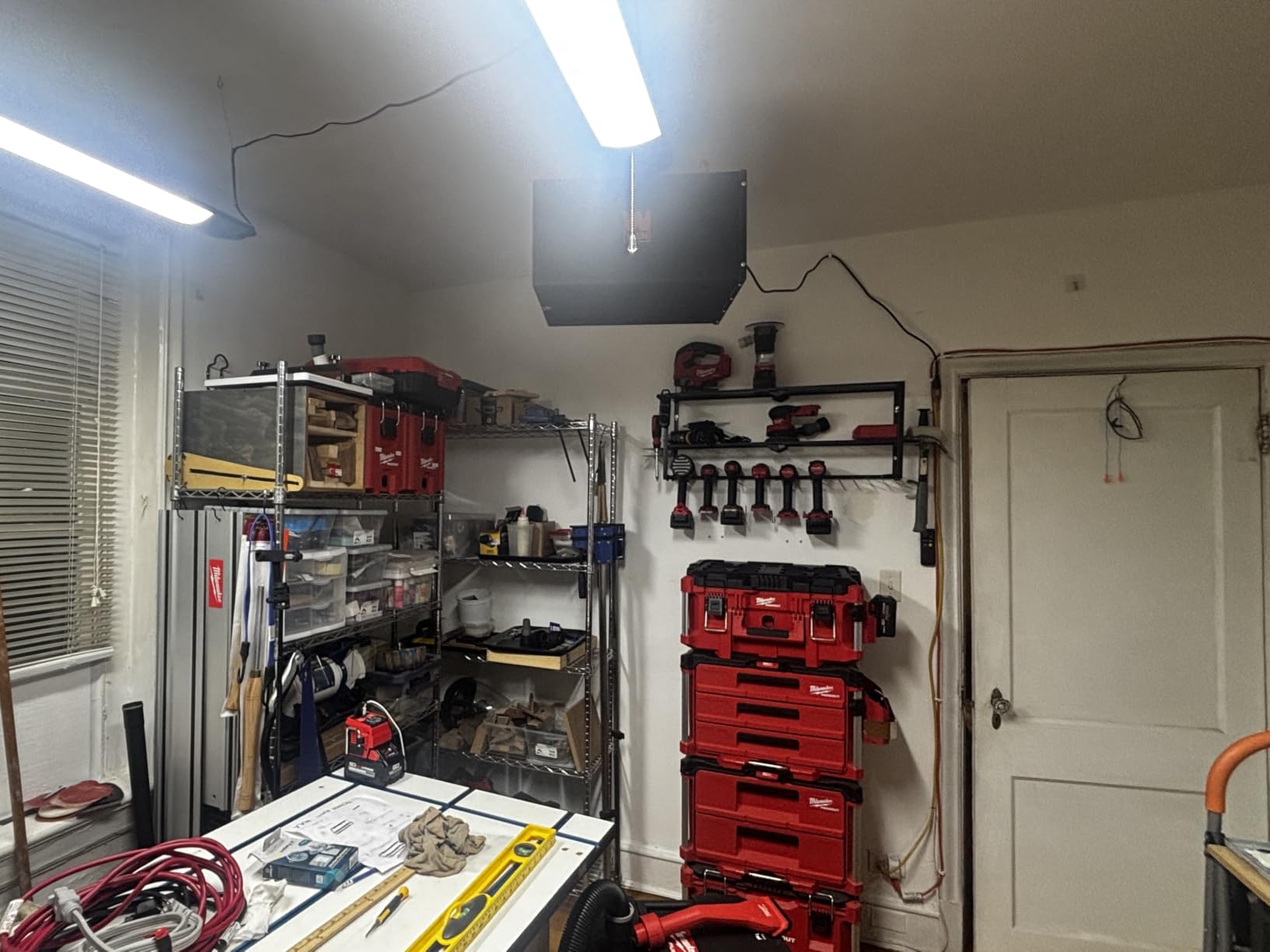
Installation is the easiest of any unit here. It hangs from included chains and hooks, weighs 31 pounds, and pulls only 12.42 watts on a standard outlet. The programmable timer shuts it off automatically, which I use as a poor man’s air scrub cycle after a dusty session.
The limitations are size and controls. Rated for 400 sq ft, it simply cannot turn over a two-bay shop, and plenty of owners end up buying a second unit rather than fighting it. The timer only works through the remote, and like its bigger sibling it occasionally wakes itself up from RF interference, which is more amusing than harmful.
Is the WEN 3410 enough for a machine shop, or just woodshops?
For a small one-or-two-machine home shop, yes, it is enough to make a visible difference. It handles dry metal dust, buffing compound, and light grinding fines well. What it does not have is a carbon stage, so coolant odor passes through untouched.
In an oily CNC shop, use it as a secondary ambient unit and put a carbon-equipped machine on the mist source. For a manual lathe and mill in a garage, one 3410 covers the room honestly.
How often do you change the filters?
In a dusty shop, expect a pre-filter check every two to four weeks and an inner filter swap every few months of regular use. The pre-filters are cheap and the inner filters are the recurring cost to plan for, which is the one real complaint in owner reviews.
The filters are also compatible with a whole family of similarly sized units, including the POWERTEC AF4001C below, so shop around for replacements rather than defaulting to the first listing.
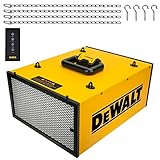
5. DEWALT DWXAF101 Air Filtration System — Best Auto Mode with HEPA
DEWALT Air Filtration System Dust Collector for Woodworking DWXAF101
H11 HEPA 2-stage
4 modes incl AUTO
8-hr timer
3-yr warranty
Pros
- H11 HEPA capturing over 95% of 0.3 micron particles
- Auto mode adjusts speed to air quality
- Washable pre-filter cuts costs
- Filter replacement indicator
- 3-year DeWalt warranty
Cons
- IR remote needs line of sight
- Remote needs repeated presses sometimes
- Ships with the wrong battery in some units
- 120V only
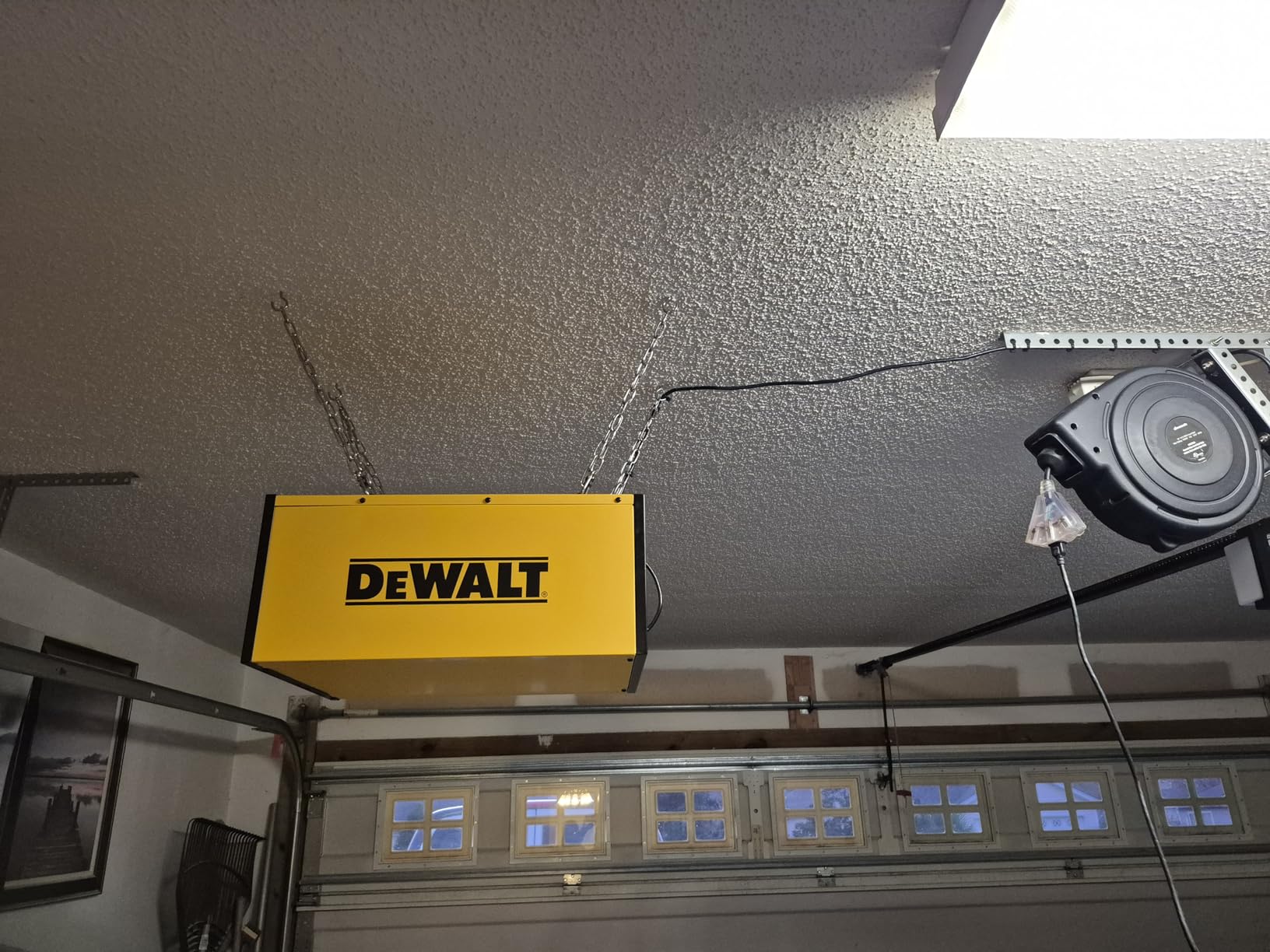
The DEWALT DWXAF101 is the machine I recommend to people who want true HEPA capture in a hanging shop unit. Its two-stage system pairs a static cotton pre-filter with an H11 HEPA filter that captures over 95% of particles at 0.3 microns. That rating matters in a machine shop because welding smoke and grinding fines live in exactly that size range.
The feature that sold me is AUTO mode among the four modes, HI, MID, LO, and AUTO, where the unit senses air quality and adjusts itself. Set it and walk away, and it ramps up when the angle grinder starts. The 1, 2, 4, and 8-hour timer settings handle the after-session scrub while you clean up.
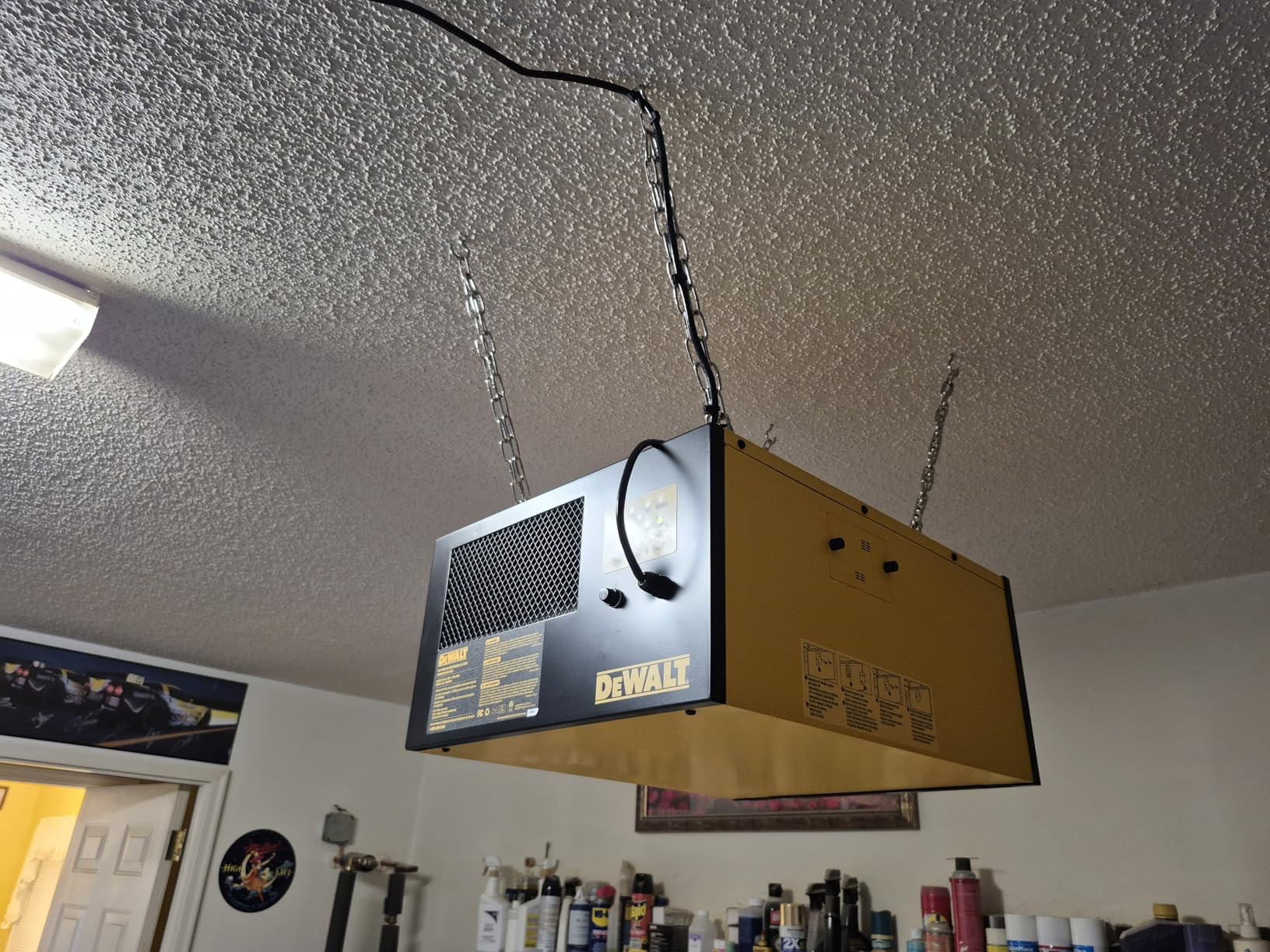
Physically it is compact for the category, 20.9 pounds hanging from included chains, and quiet enough that owners repeatedly call out how unobtrusive it is even on high. The washable pre-filter genuinely reduces running costs, and the filter replacement indicator removes the guesswork from maintenance. DeWalt backs it with a 3-year warranty, which is among the best at this tier.
The weaknesses are all in the remote. It is infrared, not RF, so it needs direct line of sight to the unit, and some owners report needing multiple button presses. A number of units also ship with a CR2025 battery when the remote expects a CR2032, a small thing that causes a lot of one-star confusion.
Is an H11 HEPA filter good enough for metal dust and smoke?
For a machine shop, yes, H11 is a meaningful step up from the 1-micron media in the WEN and Jet hanging units. It captures the sub-micron fraction of welding smoke and fine grinding dust that cheaper filters recirculate. It is not the H13 grade you would want for a cleanroom, but that is not the job here.
One caution from Practical Machinist discussions: heavy coolant mist will load any HEPA filter fast. If your shop is oily, protect the HEPA with diligent pre-filter washing, or choose a unit built for mist instead.
How does it compare with the JET AFS-1000C?
The Jet moves more air at 1000 CFM versus this unit’s lower throughput, and its RF remote is more convenient in a big space. The DeWalt counters with a HEPA stage, a washable pre-filter, a longer warranty, and a lower asking price.
Pick the Jet for raw airflow in a large shop and the DeWALT when fine-particle capture and warranty matter more. For welding and grinding dust specifically, I would take the HEPA stage.
6. Abestorm DecDust 1350IG — Best CFM per Dollar for Large Shops
Abestorm 360 Degree Intake Air Filtration System for Woodworking, Built-in Ionizer, 1350CFM Hanging Air Filter, Shop Dust Collector, Garage WorkShop, MERV-11 filter, DecDust 1350IG
1050-1350 CFM
360-degree intake
MERV-11 filter
1700 sq ft coverage
Pros
- Highest airflow here at 1050-1350 CFM
- 360-degree intake from all sides
- Three install options: hang
- bench
- or hard-mount
- Touch panel plus remote to 27 feet
- Covers up to 1700 sq ft
Cons
- Loudest unit in the lineup at 60-69 dBA
- Built-in ionizer may not suit every shop
- Cannot ship to California
- Downdraft can blow chips off the bench
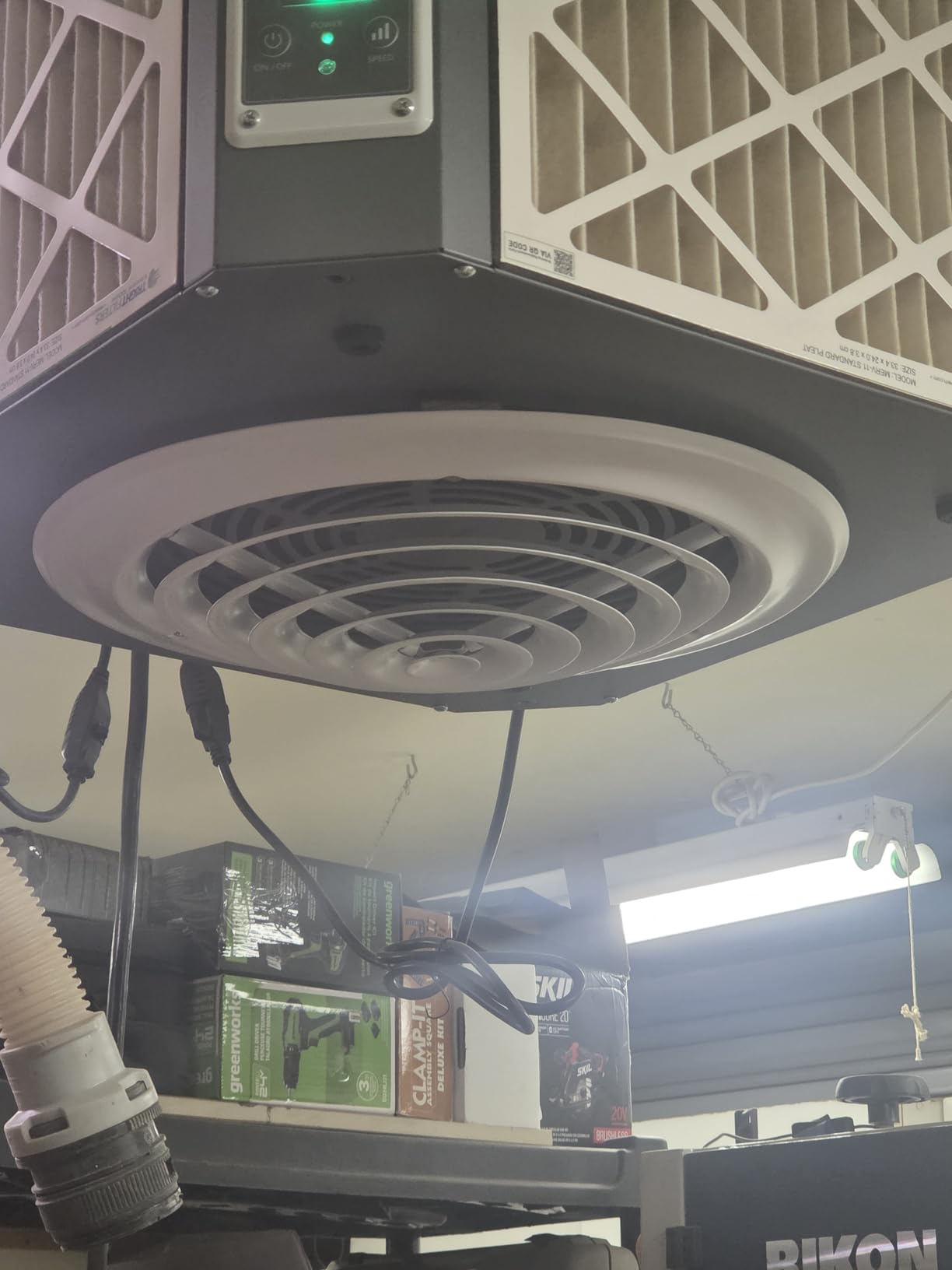
The Abestorm DecDust 1350IG is the airflow king of this list, moving 1050 to 1350 CFM and rating for rooms up to 1700 sq ft. I like it for exactly one scenario: a big shop where you want one unit doing the work of two. The 360-degree intake pulls air from all sides instead of just the face, which helps when you cannot position it perfectly relative to your machines.
Installation flexibility is better than anything else here. You can hang it from chains, set it on a workbench, or hard-mount it to the ceiling, and it takes touch panel or remote control input from up to 27 feet away. Four replaceable MERV-11 filters ship in the box, which is a nice head start on consumables.
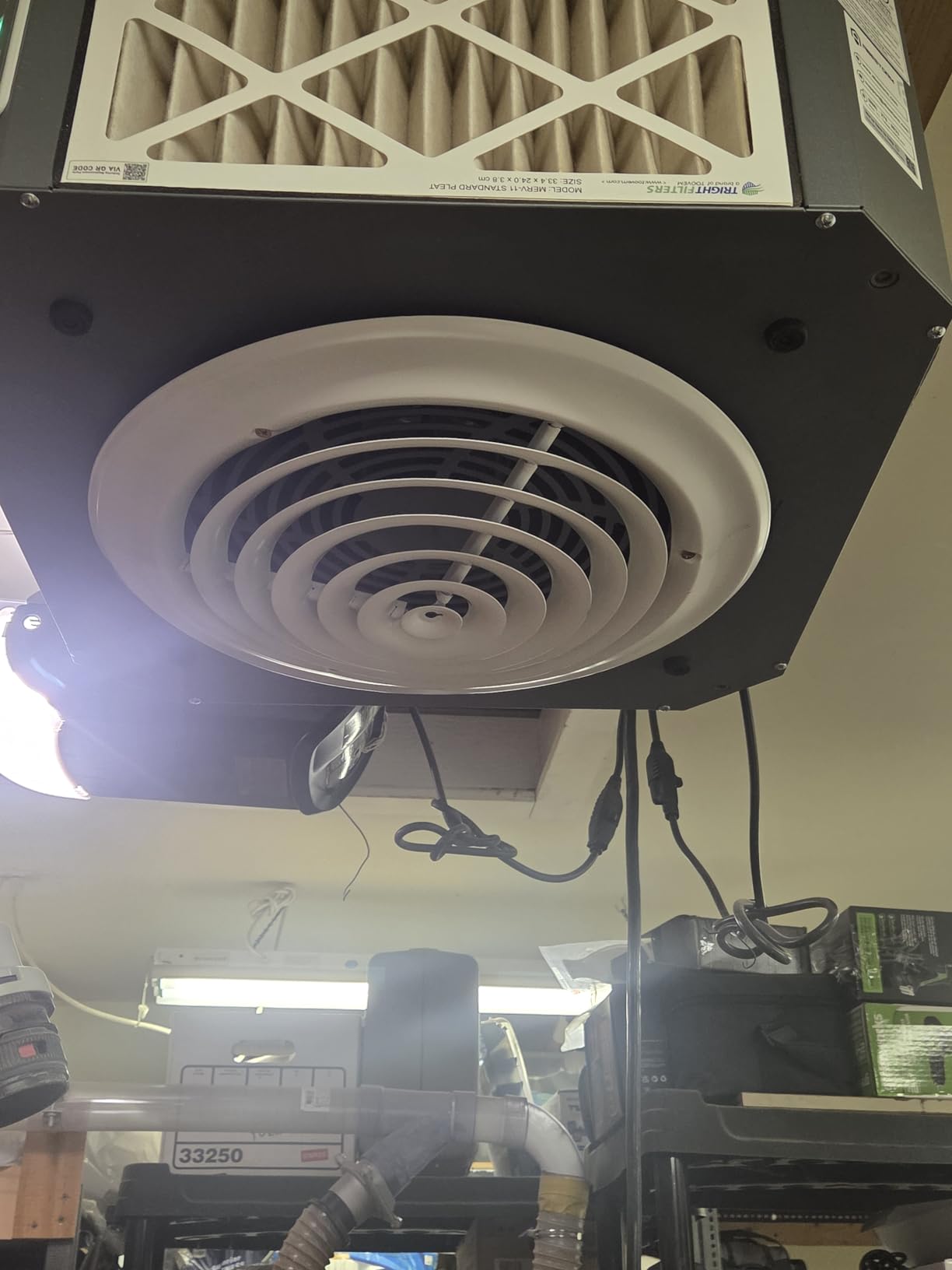
The MERV-11 filter captures down to 1 micron, so this is dry-dust duty, not oil-mist duty. It treats sawdust, grinding dust, and general shop particulate well, and the built-in ionizer helps with odor, though some buyers prefer to run ionizers off. Noise lands between 60 and 69 dBA, and some owners compare high speed to a shop vac, which is honest.
Two practical warnings from user reviews. First, overhead mounting creates a downdraft that can blow light chips and paperwork off benches, and several owners add a diffuser to tame it. Second, this unit does not meet California air cleaner regulations, so it cannot ship there.
Where should you mount a 1350 CFM unit?
Avoid mounting it directly above your workbench, because the downdraft fights you at the vise. The better spot is high on a wall or over an aisle, angled so the intake pulls across your machines rather than down onto them.
In a long shop, center it between your dust sources so the airflow pattern crosses the whole floor. If you feel dead zones where dust still settles, a small fan to stir that corner toward the intake fixes it cheaply.
Does the ionizer matter in a machine shop?
It helps with odor more than dust, and some owners report less dust clinging to surfaces. If you run sensitive electronics or optics nearby, you may want to leave it off, since ionizers can produce trace ozone.
Treat the ionizer as a bonus feature, not a buying reason. Buy this unit for the CFM per dollar, which is genuinely hard to beat at this coverage area.
7. POWERTEC AF4001C Air Filtration System — Best Filter Bundle
POWERTEC 3-Speed Remote Controlled Air Filtration System (300/350/400 CFM) w/Extra Inner & Outer Filter (2 of Each) Replacement, Hanging Air Filter for Woodworking, Workshop & Garage (AF4001C)
300/350/400 CFM
MERV 10 outer and MERV 11 inner
4 filters included
RF remote with timer
Pros
- Ships with 2 inner and 2 outer filters
- RF remote with 1/2/4-hour timer
- Filters cross-compatible with WEN 3410 and Shop Fox W1830
- 99% airborne particulate elimination claim
- Lightweight for easy hanging
Cons
- Some units arrive dented or bent
- Remote feels fragile
- A few units stopped within months
- Lower review volume than rivals
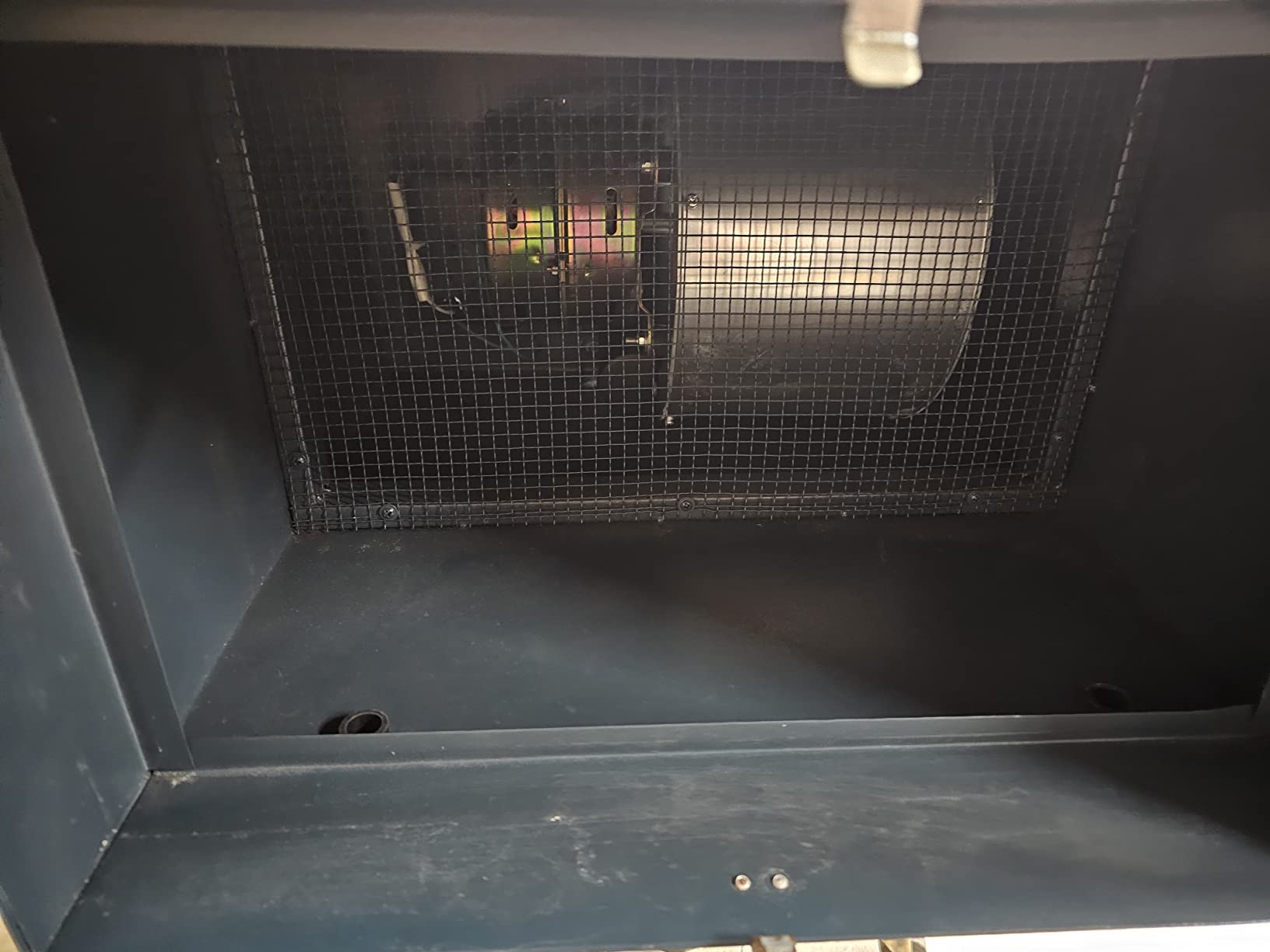
The POWERTEC AF4001C is the practical pick, and the reason is in the box. You get two outer MERV 10 filters and two inner MERV 11 filters, which is basically a year of consumables depending on how dirty your shop runs. With filter costs being the hidden price of shop air cleaning, that changes the real math of ownership.
Performance is in the WEN 3410 class: 300, 350, or 400 CFM with a 5-micron outer filter for large dust and a 1-micron inner filter for what gets through. The RF remote includes 1, 2, and 4-hour timer options and works at long range without line of sight. Owners report up to 99% elimination of airborne particulates in small shops.
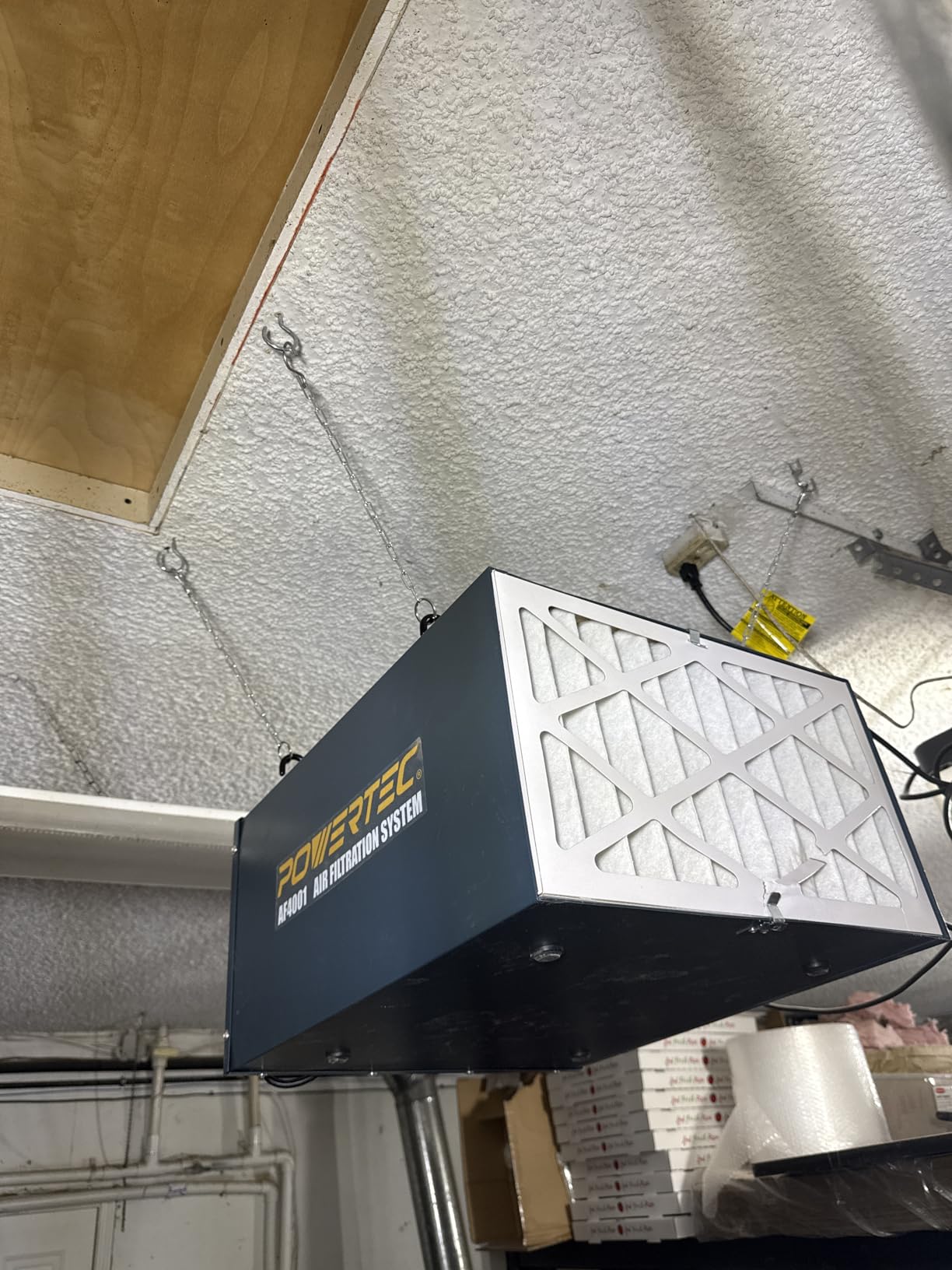
The cross-compatibility is the sleeper feature. These filters interchange with the WEN 3410, POWERTEC AF4000 and AF4001, and Shop Fox W1830, so you are never locked into one vendor for consumables. In a category where replacement filters can quietly cost more than the unit over a few years, that flexibility is worth real money.
Quality control is the concern. Some units arrive with dented corners or bent panels from shipping, the remote feels light and fragile, and a minority of owners report units stopping after a few months. Warranty support has been described as slow by at least one buyer, so inspect the unit on arrival.
Who should buy this over the WEN 3410?
Buy it when the filter bundle tips the scale. If the delivered cost with four filters beats the WEN plus separately bought filters, the POWERTEC wins on simple economics. The performance envelope between the two is close enough that consumables decide it.
If you want the deepest possible track record instead, the WEN 3410’s 5,625 reviews versus 35 here tell that story plainly. Nothing wrong with choosing proven over cheap to run.
What does MERV 10 plus MERV 11 actually filter?
The outer MERV 10 catches the coarse fraction, dust from sawing, sweeping, and deburring, while the inner MERV 11 holds the finer 1-to-3 micron particles. Together they handle general shop dust well for the size class.
Neither stage is HEPA, and neither handles vapor, so coolant smell will pass through. This is a dry-dust machine, and a good one for the money.
8. RIKON 62-450 Air Filtration System — Best Steel Cabinet Build
RIKON 62-450 3-Speed Remote-Controlled Air Filtration System (250/350/450 CFM) for large rooms up to 400 Square Feet – Circulates and Cleans Air 8 Times Per Hour!
250/350/450 CFM
20-gauge steel cabinet
400 sq ft coverage
8 air changes per hour
Pros
- 20-gauge steel cabinet takes shop abuse
- 250/350/450 CFM three-speed
- Quick-release latches for filter changes
- Top carry handle for repositioning
- Cleans a 400 sq ft room 8 times per hour
Cons
- Only 12 reviews so far
- Lower top-end CFM than larger rivals
- No HEPA or carbon stage
- Limited long-term ownership data
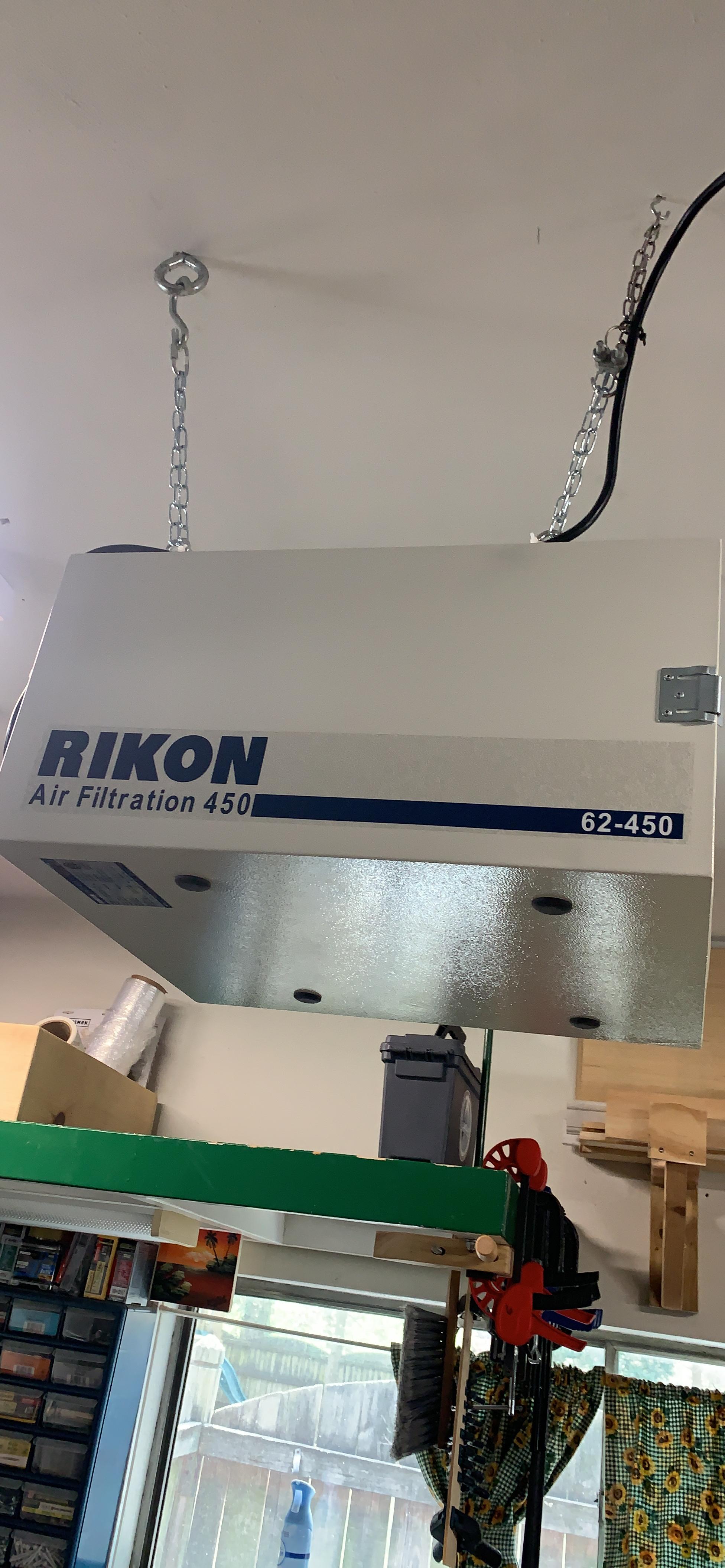
The RIKON 62-450 is the tank of the small hanging units. Its 20-gauge steel cabinet is a real difference from the thin sheet metal that gets dented on other units in this class, and in a machine shop where things get bumped by stock and carts, that matters. Rikon is a brand machinists already know from their bandsaws, and the build feel is consistent with that.
Airflow runs 250, 350, or 450 CFM, and Rikon rates it to turn over a 400 sq ft room eight times per hour. Eight air changes per hour is a solid benchmark for a small shop, and it is the number I would hold any small unit against. The quick-release latches make filter swaps a no-tools job, and the top carry handle makes it easy to move between rooms.
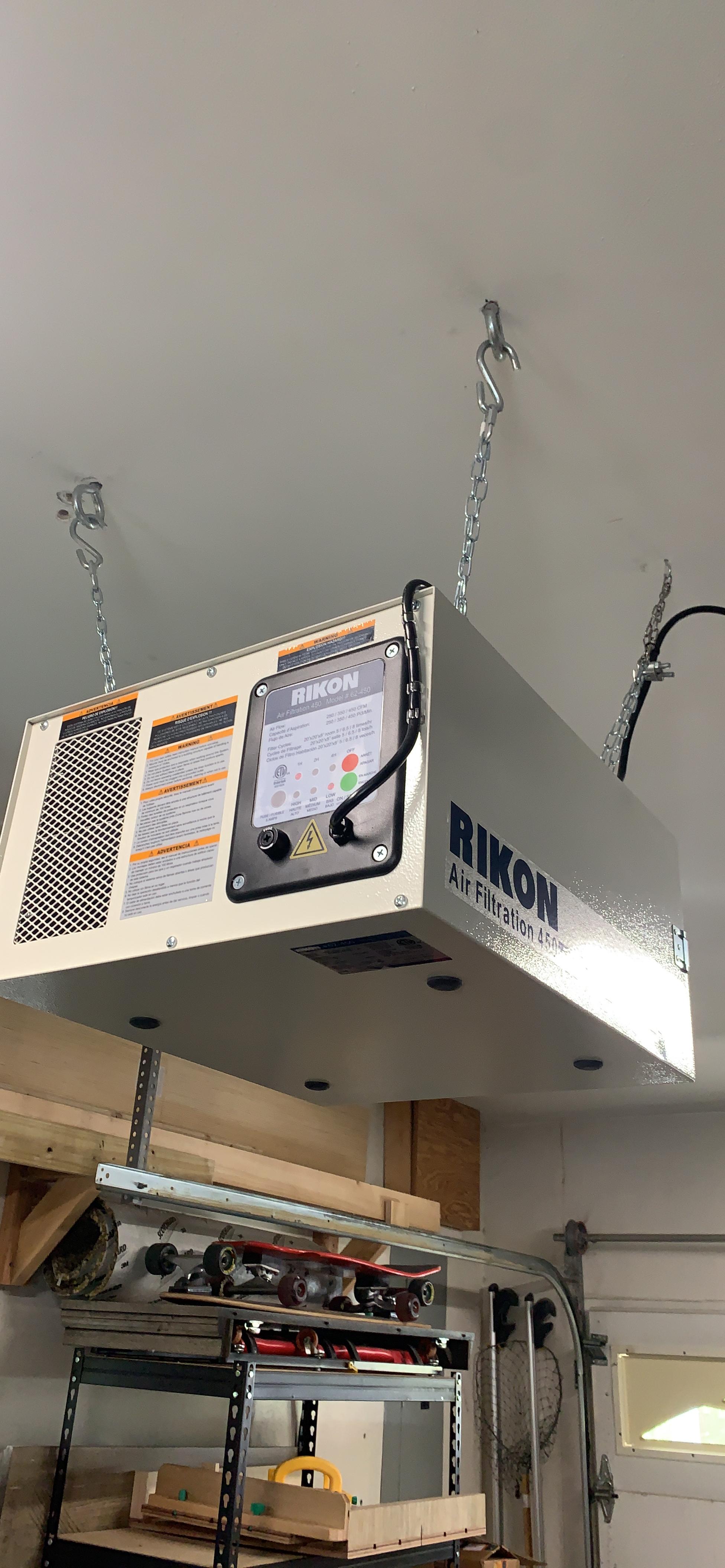
The inner and outer filters are replaceable, and access is the best in this size class thanks to those latches. Among the small footprint units, this is the one I would trust hanging over a lathe where it might occasionally get a chunk of stock swung at it.
The honest limitation is sample size: 12 reviews at 4.4 stars means early owners are happy, roughly 77% five-star, but nobody knows the five-year story yet. If you want proven, buy the WEN 3410. If you want stout, buy this.
Is the Rikon worth considering over the WEN 3410?
It comes down to build versus track record. The Rikon’s steel cabinet and tool-free filter access are genuinely better executed, while the WEN has thousands of reviews and a longer history in the field.
Both cover the same 400 sq ft class with the same basic filter arrangement. If your unit will live a hard life in a working shop, the Rikon’s cabinet justifies it. If it will hang untouched in a garage, take the cheaper proven option.
How many air changes per hour does a machine shop need?
Six to eight air changes per hour is the working benchmark for general shop air, which is what this Rikon delivers in its rated room. For heavy dust generation or welding, more is better, and you size up or add units accordingly.
You can sanity-check any unit by dividing its CFM by your room’s cubic feet and multiplying by 60. A 400 sq ft shop with 9-foot ceilings is 3,600 cubic feet, so a 450 CFM unit turns that over 7.5 times an hour.
9. Abestorm DecDust 780S Tabletop Dust Collector — Best Benchtop Unit
Abestorm Tabletop Dust Collector with Timer for Woodworking Shops
580/780 CFM
MERV-13 filter
120-min timer
Auxiliary outlet
Pros
- 780 CFM from a benchtop footprint
- MERV-13 captures finer particles than typical shop filters
- Piano key switch for instant control
- 120-minute timer
- Auxiliary outlet daisy-chains a second unit
Cons
- Needs 2 AA batteries not included
- Not for very large spaces
- Not Prime eligible
- Open design is not an oil mist solution
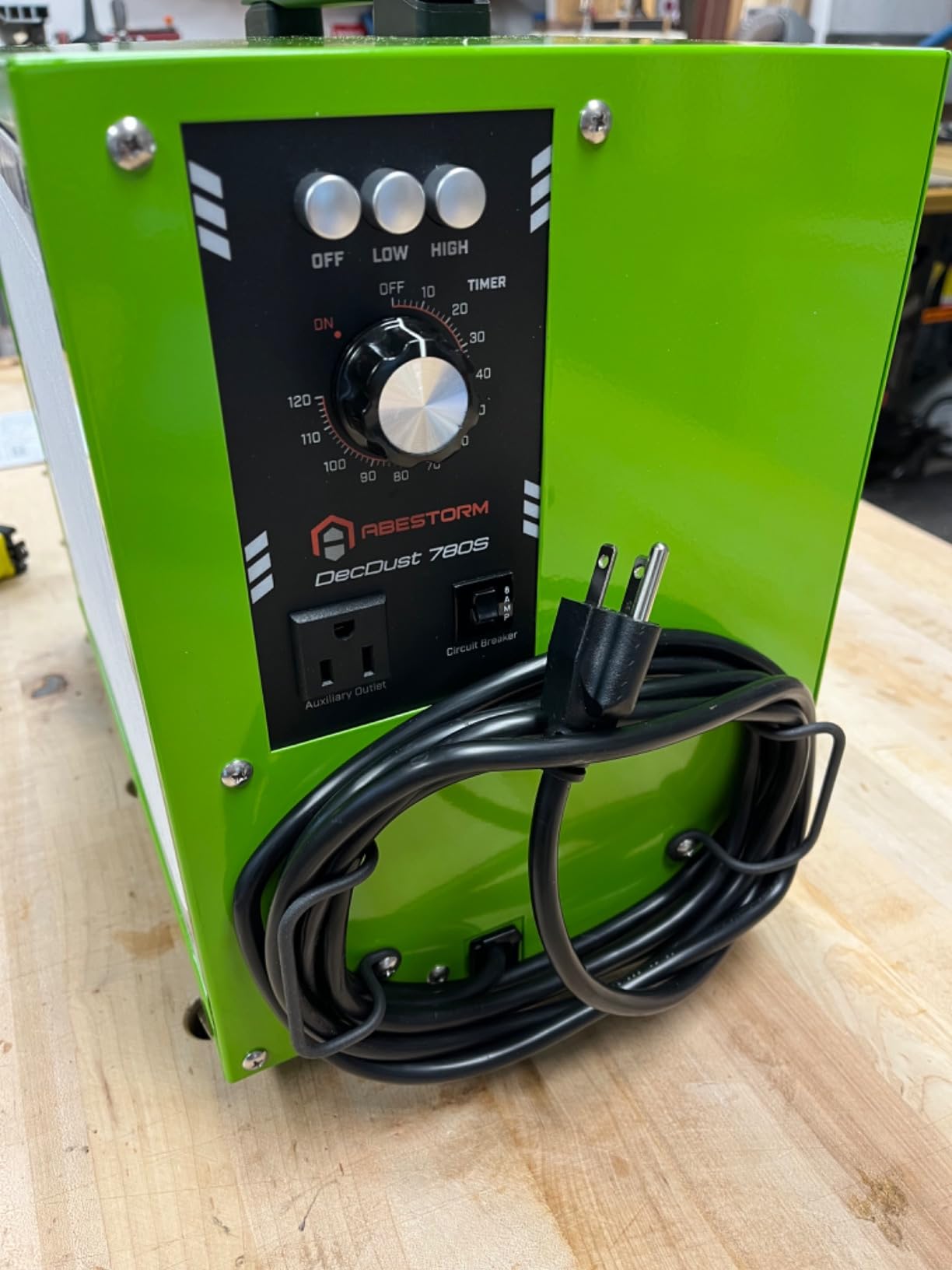
The Abestorm DecDust 780S solves a specific problem: point-of-use dust capture where you cannot hang anything. It sits on or under a bench and moves 580 or 780 CFM through a MERV-13 filter, which is a finer rating than most dedicated shop air cleaners use. I like it beside a deburring station or a bench grinder where the dust actually originates.
The design details are better than the price suggests. A piano key switch gives you instant on-off with a knuckle, the timer runs up to 120 minutes, and the auxiliary outlet lets you daisy-chain a second unit so both run from one switch. The 11.5-foot cord with side cord wrap reaches across a work area without an extension lead.
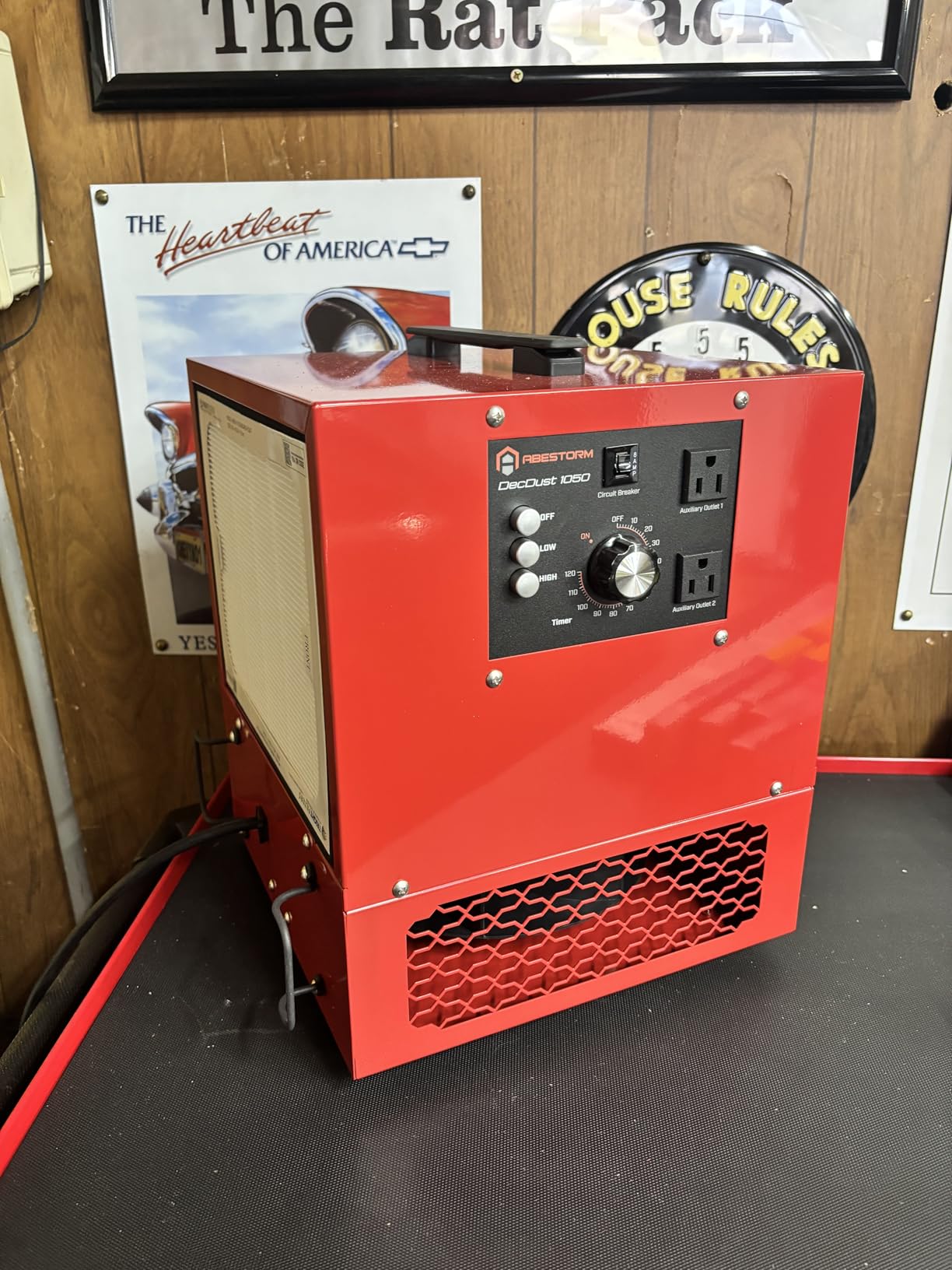
Safety features are thought through too, with a circuit breaker on board and a backward-tilt motor designed for long life. Abestorm rates the filter for around six months of use before replacement. At 19.96 pounds it moves between stations easily, which is the whole point of a benchtop format.
Know what it is not. It will not clean a whole shop, and it is not designed for oily mist despite the strong CFM number. Buyers needing whole-room coverage should step up to the WEN 3417 or the Abestorm 1350IG above.
Where does a benchtop dust collector make sense in a machine shop?
It makes sense at the point of dust generation: deburring, hand sanding, bench grinding, or a 3D printing station with dust and VOCs nearby. Pulling air off the bench before it disperses is more efficient than cleaning the whole room afterward.
It also shines as a complement to a ceiling unit, letting you spot-clean a dirty operation without cranking the main system. Reviewers using it for renovation cleanup report the same pattern.
What does the MERV-13 rating get you?
MERV-13 captures particles down toward the 1 micron and sub-micron range, finer than the MERV 10 to 11 filters common in hanging shop units. For sanding and finishing dust, that difference shows up as less film on everything in the shop.
It still is not HEPA and it still does not adsorb vapors, so pair it with a carbon-equipped unit if odor is part of your problem.
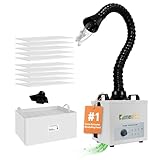
10. Fumeclear FC-100A Fume Extractor — Best Source Capture for Soldering and Laser Work
FumeClear FC-100A Fume Extractor Low-Noise & High Iodine 3-Stage Filtration
118 CFM suction
H13 HEPA and carbon
10 pre-filters included
Flexible hose capture
Pros
- H13 HEPA with high-iodine activated carbon
- Hose puts suction exactly at the source
- 10 pre-filters included in the box
- Compact 19.5 pound footprint
- CE and FCC certified
Cons
- Only 118 CFM
- Not built for large laser engravers
- Some motor and board failures reported
- Hose is stiff when new
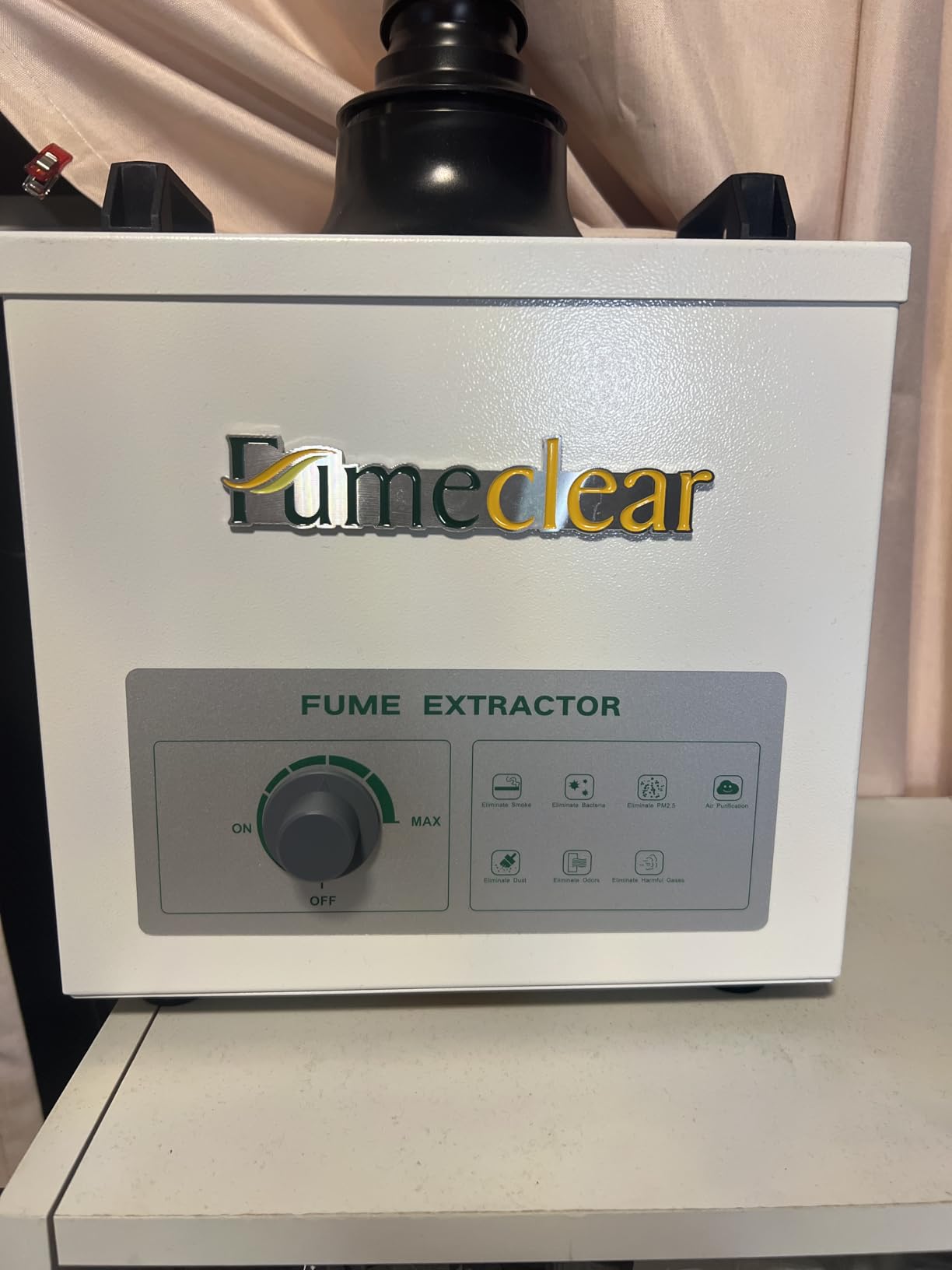
The Fumeclear FC-100A is the specialist on this list, and the best air purifier for machine shops with a soldering station, laser engraver, or small welding bench. Instead of cleaning a room, its flexible hose puts 118 CFM of suction directly where the smoke is born. Source capture is how you stop fumes before they become a shop-wide problem.
The filtration is the most advanced here for gases: H13 HEPA for 99.97% of particles below 0.3 microns plus a high-iodine activated carbon filter rated for around 3,000 hours. That carbon is why it kills chemical odors that leave room-size units useless. Ten pre-filters ship in the box, which protects the expensive stages underneath.
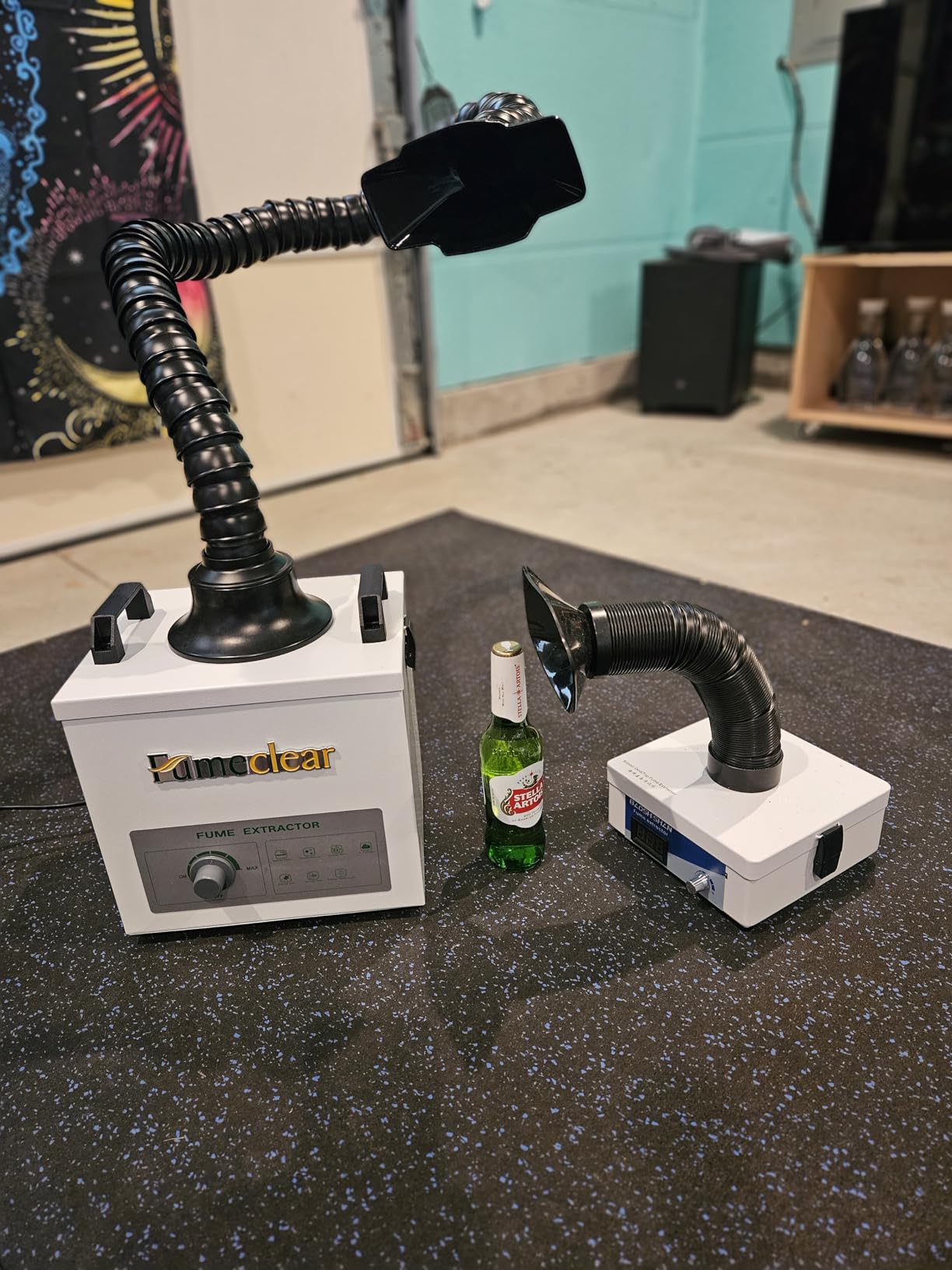
At 19.51 pounds and roughly a foot square, it tucks under a bench and stays out of the way. It runs quietly on low, which matters when your face is two feet from the intake for hours. Reviewers, 136 of them at 4.4 stars, rate it highly for soldering, laser work, and nail salon duty, which is the same chemistry problem in a different uniform.
The failure mode to know about is electronics. A minority of owners report motor or control board failures after several months, though customer service is described as responsive with replacements. The hose is also stiff out of the box and relaxes with use.
Can the FC-100A handle welding smoke in a machine shop?
It handles light duty, torch work, brazing, and occasional TIG touch-ups, when the hose is positioned at the arc. It is not sized for continuous production welding, where you need a dedicated welding fume extractor moving several hundred CFM.
Think of it as the right tool for bench-scale fume problems in a shop that also runs machining. For a full welding bay, budget for industrial fume extraction instead.
Why choose source capture over an ambient air cleaner?
Because capture at the source is dramatically more efficient. A unit drinking straight from the plume sees a far higher contaminant concentration than one cleaning a whole room, so the same filter does more work.
Practical Machinist users with years in the trade consistently recommend sealing the machine enclosure and capturing at the source before spending on room-scale gear. If your Haas-style enclosure is dumping coolant mist into the shop air, close those gaps first, then filter what escapes.
How to Choose the Best Air Purifier for Your Machine Shop
Buying right is mostly about matching CFM to room volume and filter type to contaminant. Here is the process I use, in the order that actually matters.
Step 1: Calculate the CFM Your Shop Actually Needs
Multiply your floor area by ceiling height to get cubic feet, then decide how many air changes per hour you want. Six per hour is a reasonable baseline for a machine shop, eight or more if you generate heavy dust or smoke.
The formula is simple: CFM equals cubic feet times air changes per hour, divided by 60. A 1,500 sq ft shop with 10-foot ceilings is 15,000 cubic feet, so six air changes per hour needs 1,500 CFM of actual delivered airflow. That means one WEN 3417 or Abestorm 1350IG, or two smaller units placed apart.
Always buy to your real number rather than a marketing coverage claim. Coverage ratings assume favorable ceiling heights and light contaminant loads, and machine shops are neither gentle nor clean.
Step 2: Handle Source Capture Before Room Cleaning
The highest-leverage fix in most shops is not a bigger air cleaner, it is stopping contaminant at the machine. Seal CNC enclosure gaps with silicone sheet, as one Practical Machinist contributor recommends, because a leaking enclosure pumps mist into the room continuously.
Next, capture at the point of generation where you can: a hose unit like the Fumeclear at the soldering bench, or ducted mist collectors on the worst machines. Experienced forum users plumbed mist collectors outside using 4-inch PVC with gate valves, which lets them tune draw per machine.
Room filtration is the second layer, not the first. It polishes whatever your source capture misses, and it works far better once the big loads are handled.
Step 3: Match the Filter to the Contaminant
Dry dust from grinding, sawing, and deburring is handled by 1-to-5 micron media, which is what the WEN, Jet, Rikon, and POWERTEC units use. Oil mist and coolant droplets need finer capture plus a carbon stage for the odor, which points to the CADPXS Shield-550.
Welding smoke and sub-micron particles want HEPA, so the DEWALT’s H11 stage or the Fumeclear’s H13 stage is the right call. Chemical fumes and solvents are a gas problem, and only activated carbon adsorbs gases, a point one forum machinist with HEPA-plus-charcoal units makes forcefully.
Electrostatic air cleaners are the fourth option, and seasoned machinists rate them highly for oily smoke since the cells are washable instead of replaceable. The trade-off is regular cleaning duty, and none of the ten units above use that technology, so consider it if your mist load is extreme.
Electrostatic vs HEPA: The Real Ownership Cost
HEPA filters work brilliantly until they meet heavy coolant mist, at which point they become what one forum user bluntly calls a maintenance nightmare. A loaded HEPA loses airflow and must be replaced, and in an oily shop that cycle repeats often.
An electrostatic precipitator costs more up front but its collector cells are washed and reused, so running cost trends toward electricity and labor. Over five years of heavy mist, washable cells usually beat repeated HEPA purchases.
The practical rule: heavy oil mist favors electrostatic, dry dust and smoke favor HEPA with a washable pre-filter in front of it. Whatever you choose, budget filters as an operating cost, not an afterthought. One shop owner running four large HEPA units in a 12,500 sq ft space replaces pre-filters weekly and HEPAs annually at roughly $100 apiece, and says he wishes he had four more units.
Noise, Mounting, and Shop Flow
Check the decibel rating against where the unit will live. Anything at 63 to 69 dBA is fine over machines but annoying over a bench where you take calls, which is where the 50 to 60 dB WEN 3410 shines.
Plan mounting before buying. Hanging units need solid anchors, a second person for anything over 40 pounds, and chains or eyebolts that are not always included. Benchtop and floor units trade permanence for flexibility.
Placement determines effectiveness. Mount units so airflow crosses the shop diagonally rather than straight up and down, and keep intakes away from corners where air goes still.
OSHA Compliance and the Cost of Doing Nothing
Machinists are exposed to metalworking fluid mist, and OSHA sets permissible exposure limits for it along with general workplace air standards. Beyond citations, the real costs are human: machinists report going home with throat and lung irritation daily, and long-term exposure to machining mist is linked to occupational respiratory disease.
There is also an equipment cost. Oil mist settles on ways, electronics, and tooling, adding cleaning labor and shortening machine life. Filtration protects capital equipment as much as lungs.
One more uncomfortable truth from the forums: oil coats face masks and renders PPE less effective. Air cleaning is not a substitute for respiratory protection, but it reduces the load on both your people and your masks.
Multi-Use Shops: Water Jets, Saws, and 3D Printers
Not every shop is a pure machine shop, and mixed contaminant profiles need mixed answers. That Reddit machinist with a water jet, abrasive saws, and 3D printers in one sealed space had abrasive sludge, ceramic dust, and polymer fumes sharing the same air.
For that profile I would run a HEPA-plus-carbon unit like the CADPXS as the core, add source capture at the worst station, and seal what can be sealed. Water jet garnet and abrasive dust are hard on filters, so keep spare pre-filters on hand.
Security complicates it: shops that must keep doors shut for security trap everything inside. In sealed buildings, filtration is not optional comfort gear, it is the only air exchange you have.
Common Mistakes to Avoid
First, buying one small unit for a big shop and blaming the product. Size by cubic feet and air changes per hour, not by hope.
Second, hanging a dry-dust unit in an oily shop and eating filter replacements. Match the filter to the contaminant before you match the brand.
Third, ignoring the enclosure. A leaking CNC cabinet will out-produce any ambient cleaner you can afford.
Fourth, forgetting makeup air when ducting outside. Every CFM exhausted must return, and in a climate-controlled shop that shows up on the heating and cooling bill.
Frequently Asked Questions
What is the best air purifier for a workshop?
The WEN 3417 is the best air purifier for most workshops, moving up to 1044 CFM through a 1-micron filter with a remote and timer. For smaller workshops up to 400 sq ft, the WEN 3410 and RIKON 62-450 are excellent, quieter choices.
What is the best air purifier for commercial use?
For commercial machine shops, the top choices are the CADPXS Shield-550 for oil mist and odor thanks to its HEPA and activated carbon stages, the JET AFS-1000C for large-shops airflow with an auto air quality sensor, and the Abestorm DecDust 1350IG for covering up to 1700 sq ft. Look for continuous-duty motors, large filter surface area, and 500-plus CFM of delivered airflow.
What is the best air cleaner for a woodshop?
The WEN 3410 and POWERTEC AF4001C are ideal for woodshops up to 400 sq ft, while the WEN 3417 handles woodshops up to 1000 sq ft. For shops that do both wood and metal work, choose a unit with finer filtration or a carbon stage, such as the DEWALT DWXAF101 or the CADPXS Shield-550, because wood-only units are not built for oil mist.
What is the best commercial air purifier?
The best commercial air purifiers for machine shops are the CADPXS Shield-550, the JET AFS-1000C, and the Abestorm DecDust 1350IG. The features that matter most in commercial duty are a 24/7-rated motor, 3-stage filtration with a pre-filter you can wash or replace cheaply, HEPA or better fine-particle capture, an activated carbon stage for coolant odor, and a long warranty.
How many CFM do I need for my machine shop?
Multiply your shop’s square footage by ceiling height to get cubic feet, then aim for 6 to 8 air changes per hour. Divide cubic feet by 60 and multiply by your target air changes. A 1500 sq ft shop with 10-foot ceilings needs about 1500 CFM for six air changes per hour.
Final Verdict: The Best Machine Shop Air Purifiers for 2026
After months of running these machines in a working shop, my shortlist for the best air purifiers for machine shops is clear. The WEN 3417 is the best all-round choice for most shops, the JET AFS-1000C is the premium pick when you want automatic airflow management, and the WEN 3410 is the value king for small spaces.
If coolant mist and odor are your daily reality, the CADPXS Shield-550 and its carbon stage will change how your shop smells, and the Fumeclear FC-100A is the tool for soldering and laser fumes at the bench. Size your CFM first, match the filter to your contaminant second, and seal your enclosures before you spend a dollar on any of it.
Clean shop air is not a luxury, it is what keeps you and your crew breathing easy at the end of a ten-hour day. Pick the unit that matches your square footage and your mess, and start breathing the difference this week.