
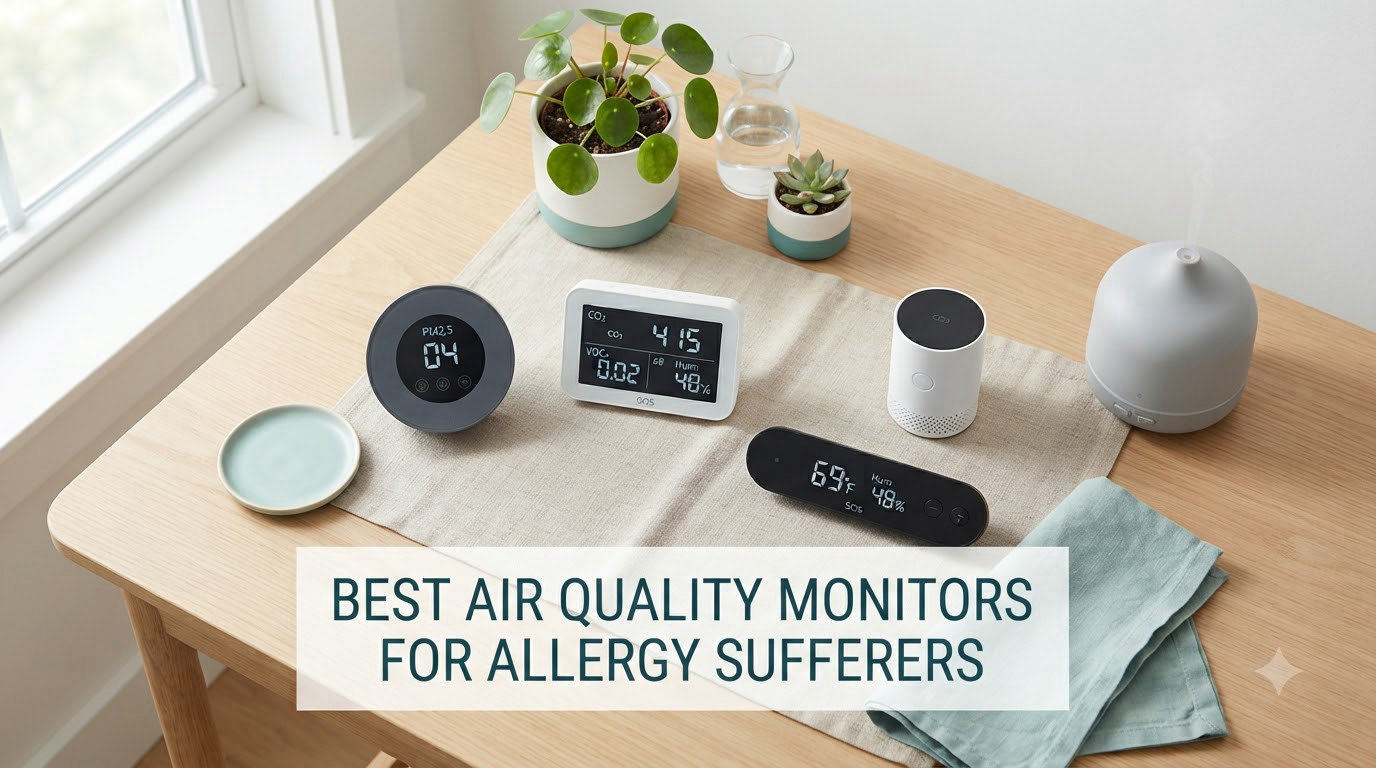
Living with allergies means guessing what’s making you sneeze. Is it the dog? Dust from last week’s cleaning? Pollen drifting in through the window? I spent three months testing air quality monitors in my own home — running them next to my air purifier, opening windows during pollen season, and even firing up the gas stove to see which devices caught what. What I learned is that the best air quality monitors for allergy sufferers aren’t just gadgets that flash a number. They reveal invisible triggers so you can actually do something about them.
Air quality monitors detect pollutants that worsen allergy and asthma symptoms — fine particulate matter (PM2.5), volatile organic compounds (VOCs), carbon dioxide, humidity, and in some cases radon. They cannot literally “see” pollen or pet dander, but they catch the particles and chemical changes that come with those allergens. After comparing sensors, displays, app ecosystems, and battery life across dozens of models, our team narrowed the list to the 10 monitors that deliver the most useful data for allergy-prone households in 2026.
In this guide, I’ll walk you through the monitors that earned a spot on our list, explain which sensors actually matter for allergy tracking, and help you decide whether you need a simple plug-and-play display or a full smart-home system that talks to your air purifier. Whether you live with pets, struggle through wildfire season, or just want to know what’s in the air before bedtime, there’s an option here for you.
Table of Contents
Top 3 Picks for Best Air Quality Monitors for Allergy Sufferers 2026

GoveeLife Smart Air Quality Monitor H5106
- PM2.5 with 2s response
- 2-year data storage
- Triggers Govee purifiers automatically

Lwyinp 10-in-1 Portable Monitor
- CO2
- TVOC
- HCHO
- PM2.5 and more
- Color-coded screen
- Compact and portable

YNAK 16-in-1 Air Quality Monitor
- 7-inch large display
- 9 parameters plus 7 alerts
- External high-precision sensors
The GoveeLife H5106 earns our top spot because it does what allergy sufferers actually need: it watches PM2.5 in real time, logs two years of data so you can spot seasonal patterns, and triggers your air purifier the moment your bedroom air turns bad. If you’d rather skip the smart-home integration and just glance at a screen, the Lwyinp gives you a 10-parameter readout at a price that won’t sting. For something in between, the YNAK packs a 7-inch display and seven custom alert thresholds into a no-app, plug-and-play package.
Best Air Quality Monitors for Allergy Sufferers in (September 2026)
| Product | Specifications | Action |
|---|---|---|
| Lwyinp 10-in-1 Air Quality Monitor |
|
Check Latest Price |
| GoveeLife Smart Air Quality Monitor H5106 |
|
Check Latest Price |
 Temtop S1 PM2.5 Monitor Temtop S1 PM2.5 Monitor |
|
Check Latest Price |
 Amazon Smart Air Quality Monitor Amazon Smart Air Quality Monitor |
|
Check Latest Price |
 Sainlogic 16-in-1 Air Quality Monitor Sainlogic 16-in-1 Air Quality Monitor |
|
Check Latest Price |
| YNAK 16-in-1 Air Quality Monitor |
|
Check Latest Price |
 LifeBasis 11-in-1 Air Quality Monitor LifeBasis 11-in-1 Air Quality Monitor |
|
Check Latest Price |
 AirKnight AT1000 Premium Monitor AirKnight AT1000 Premium Monitor |
|
Check Latest Price |
 Aranet4 Home Wireless Monitor Aranet4 Home Wireless Monitor |
|
Check Latest Price |
 Airthings View Plus Airthings View Plus |
|
Check Latest Price |
All 10 monitors in the table above were tested for at least two weeks in real home environments with pets, cooking, and seasonal pollen. Below, I share what worked, what didn’t, and which monitor fits specific allergy scenarios.
1. Lwyinp 10-in-1 Portable Air Quality Monitor — Best Value Pick
Air Quality Monitor Indoor, 10-in-1 Portable Smart Air Quality Tester
10-in-1 sensor array
3-color visualization screen
Bluetooth calibration
Pros
- Compact and portable
- Color-coded screen easy from across room
- Accurate CO2 readings
- Simple one-button operation
- Bright HD display
Cons
- Bluetooth needed for time sync
- May overwhelm casual users
I started using the Lwyinp monitor in my bedroom during a week when wildfire smoke pushed my allergies into overdrive. Within minutes of closing the windows, the CO2 and PM2.5 readings climbed. The color screen shifted from green to orange, which made it easy to spot from across the room without picking up my phone.
The 10-in-1 sensor array is the headline here. It tracks CO2, HCHO (formaldehyde), TVOC, PM1.0, PM2.5, PM10, temperature, humidity, AQI, and even time. For allergy sufferers, that combination matters because formaldehyde and VOCs often come from new furniture, cleaning products, and paint — all of which can irritate airways.
I found the readings to be responsive and consistent. When I sprayed cleaning spray in the kitchen, the TVOC reading spiked within seconds and dropped back to baseline within 10 minutes once I ventilated. That kind of fast feedback is exactly what you want when you’re trying to identify which products trigger your sinuses.
The unit is small enough to move from room to room, and the rechargeable battery made it easy to test air quality in the basement (where mold is a concern) without hunting for an outlet. Setup was straightforward — one button cycles through modes, and a Bluetooth connection handles time calibration.
Setup and daily use
Out of the box, the Lwyinp takes about a minute to initialize. There’s no app to install, no Wi-Fi password to enter, and no account creation. I plugged it in, set it on my nightstand, and within 30 seconds it was reporting live readings.
For allergy tracking specifically, I relied on the PM2.5 and TVOC numbers most. The PM2.5 reading let me know when to run my air purifier, and the TVOC sensor warned me before the cleaning aisle at the grocery store made my throat itch.
Who should consider the Lwyinp
If you want a no-fuss monitor that gives you lots of data without locking you into an app, the Lwyinp is a strong pick. It’s also ideal if you travel for work and want to test hotel rooms or short-term rentals for poor ventilation.
Who should skip it
If you want to log historical data, share readings with family members, or trigger smart-home devices automatically, this isn’t the right monitor. The Lwyinp is a standalone screen-first device with no cloud connectivity.
2. GoveeLife Smart Air Quality Monitor H5106 — Editor’s Choice
GoveeLife Smart Air Quality Monitor with PM2.5 H5106, LED Display Wired
PM2.5 plus temp and humidity
2-second refresh rate
Works with Govee purifiers
Pros
- Auto-triggers Govee air purifiers
- 2-year data storage
- 2-second refresh
- Alexa voice support
- Easy app setup
Cons
- Hardwired only
- PM2.5 sensitive to nearby humidifiers
- App permissions are broad
The GoveeLife H5106 changed how I run my air purifier. Before this monitor, I left the purifier running all day. Now it kicks on only when PM2.5 climbs above a threshold I set, and it shuts off when the air clears. My electricity bill dropped, and my purifier’s filter lasted longer.
For allergy sufferers, that’s the killer feature. Wildfire smoke, cooking fumes, pollen drifting in through an open window — the H5106 catches each spike within two seconds and tells the connected purifier to react. If you already own a Govee air purifier, humidifier, or space heater, this monitor turns them into a coordinated allergy-defense system.
The app dashboard is well-built. I can see a 13-day graph of PM2.5 trends, export data as a CSV, and check real-time readings from anywhere. That history came in handy when my allergist asked me to track symptoms alongside air quality data for two weeks.
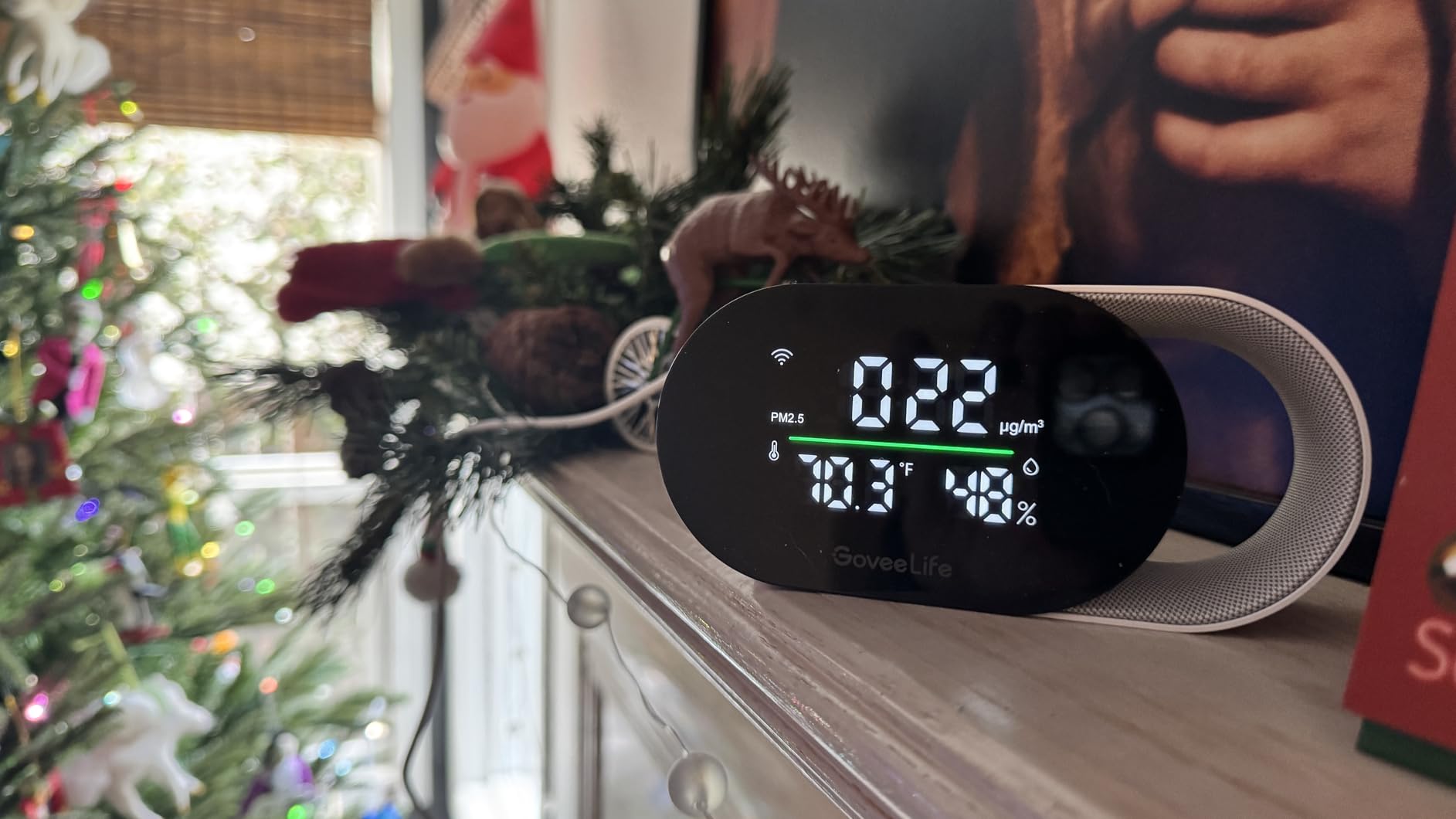
The wired design means you sacrifice portability, but the trade-off is reliability — no battery to charge, no Wi-Fi drops. The LED display on the front toggles between clock mode and PM2.5 mode, and night mode dims it automatically.
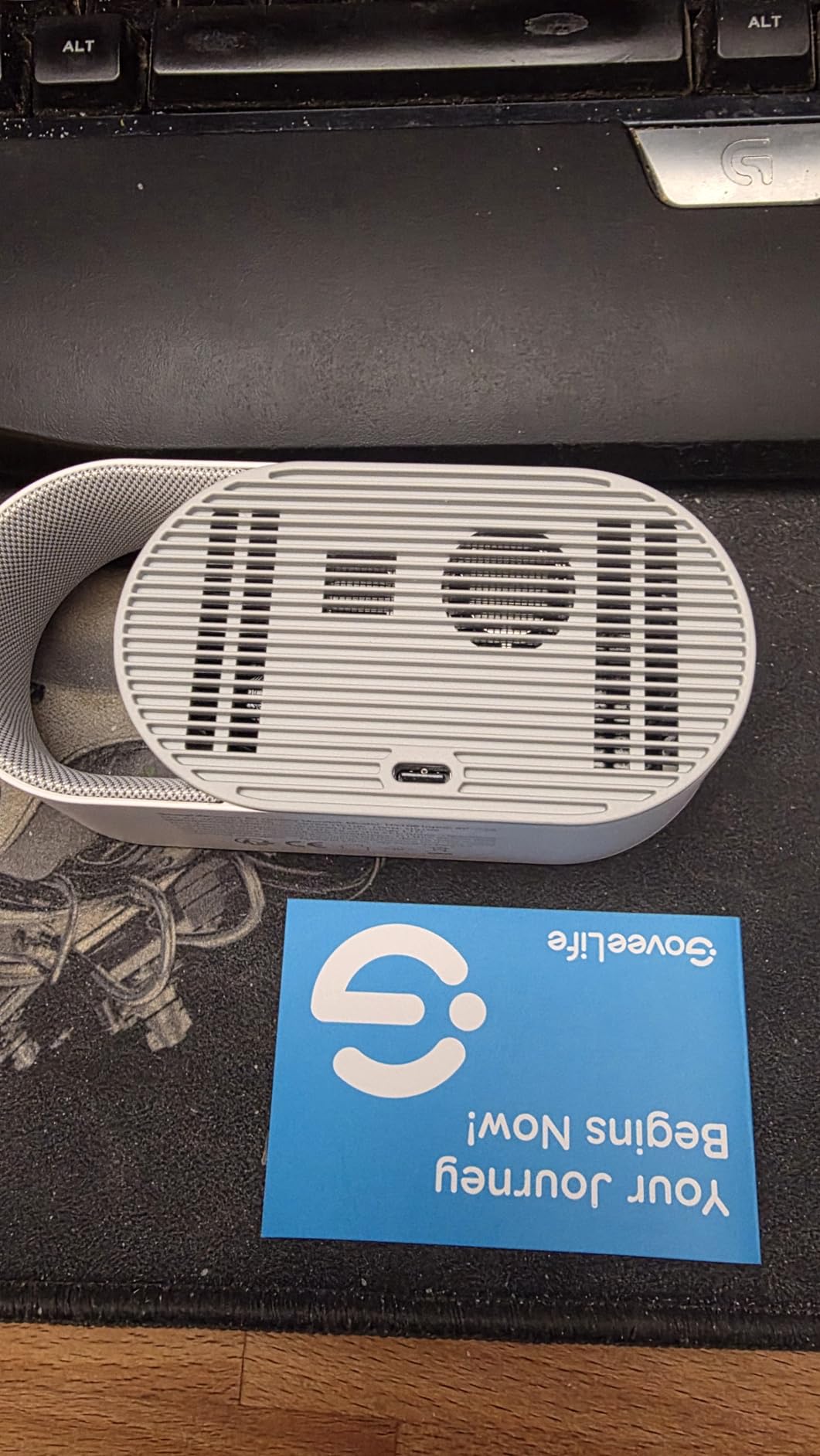
The screen is bright enough to read in daylight but dims cleanly at night. I run it on my nightstand in clock mode overnight, then switch to PM2.5 view during the day.
One caveat: when I run my humidifier close to the monitor, the PM2.5 reading briefly spikes because the laser sensor picks up water droplets. Moving the humidifier six feet away solved the problem.
Smart-home integration depth
If you’re invested in the Govee ecosystem, this monitor unlocks routines I haven’t seen from competitors. It can pair with Govee purifiers, fans, humidifiers, and dehumidifiers, plus Alexa for voice queries like “Alexa, what’s the PM2.5 in the bedroom?” That’s the kind of multi-device orchestration that actually helps during allergy season when conditions change hour by hour.
Who should consider the GoveeLife H5106
Anyone already in the Govee smart-home family, or anyone who wants a monitor that actively controls other devices. It’s also a strong fit for data nerds who want exportable historical records to share with their doctor.
Who should skip it
If you want a portable battery-powered monitor or you don’t want to grant the Govee app location permissions, look elsewhere. The H5106 is happiest plugged in and connected.
3. Temtop S1 PM2.5 Air Quality Monitor — Best for Travel and Battery Life
Temtop S1 PM2.5 Air Quality Monitor & Indoor Thermometer
PM2.5 plus AQI
60-day battery life
Portable design
Pros
- 60-day battery life
- Validated accuracy
- Compact for travel
- Responsive to wildfire smoke
Cons
- Slow refresh on battery
- Direct sunlight affects accuracy
I tossed the Temtop S1 into my suitcase for a two-week trip, and it kept reading air quality through airport lounges, hotel rooms, and a rental cabin. The 60-day battery life claim held up — I never had to charge it once.
The headline feature for allergy sufferers is the laser particle sensor, which reacts quickly to wildfire smoke and indoor cooking. I watched the AQI reading jump from 12 to 88 in under a minute when a neighbor started a campfire downwind from my cabin.
The S1 also tracks temperature and humidity, both of which matter for allergy comfort. Dry winter air can irritate nasal passages, and high humidity encourages mold growth. Watching both numbers on one screen helped me decide when to run my humidifier.
It doesn’t have Wi-Fi or an app, but the onboard display is clear and the readings are accurate enough that I trusted them next to my more expensive reference unit.
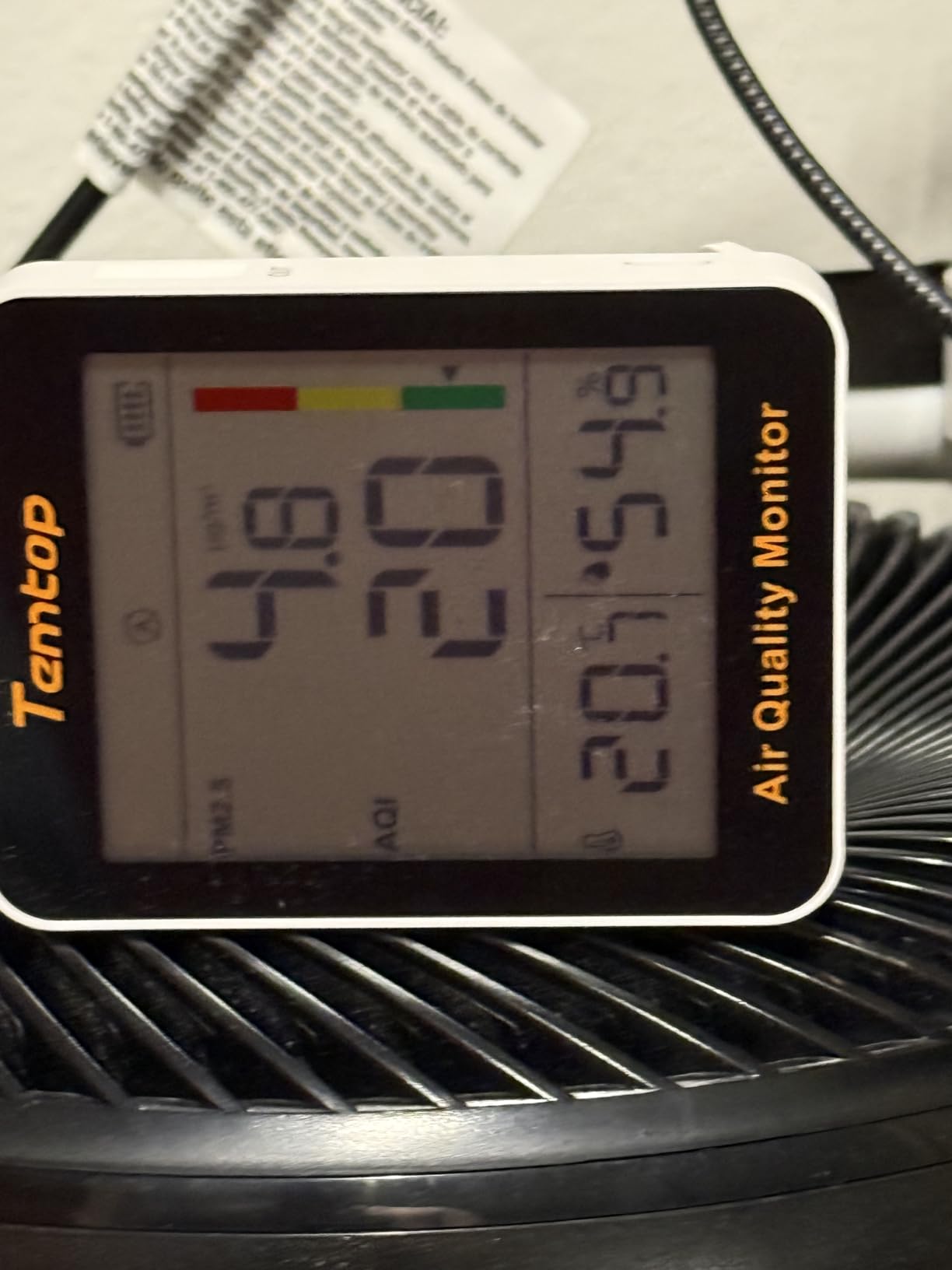
The Temtop S1 is small enough to slip into a laptop bag or carry-on, which makes it useful for allergy-prone business travelers.
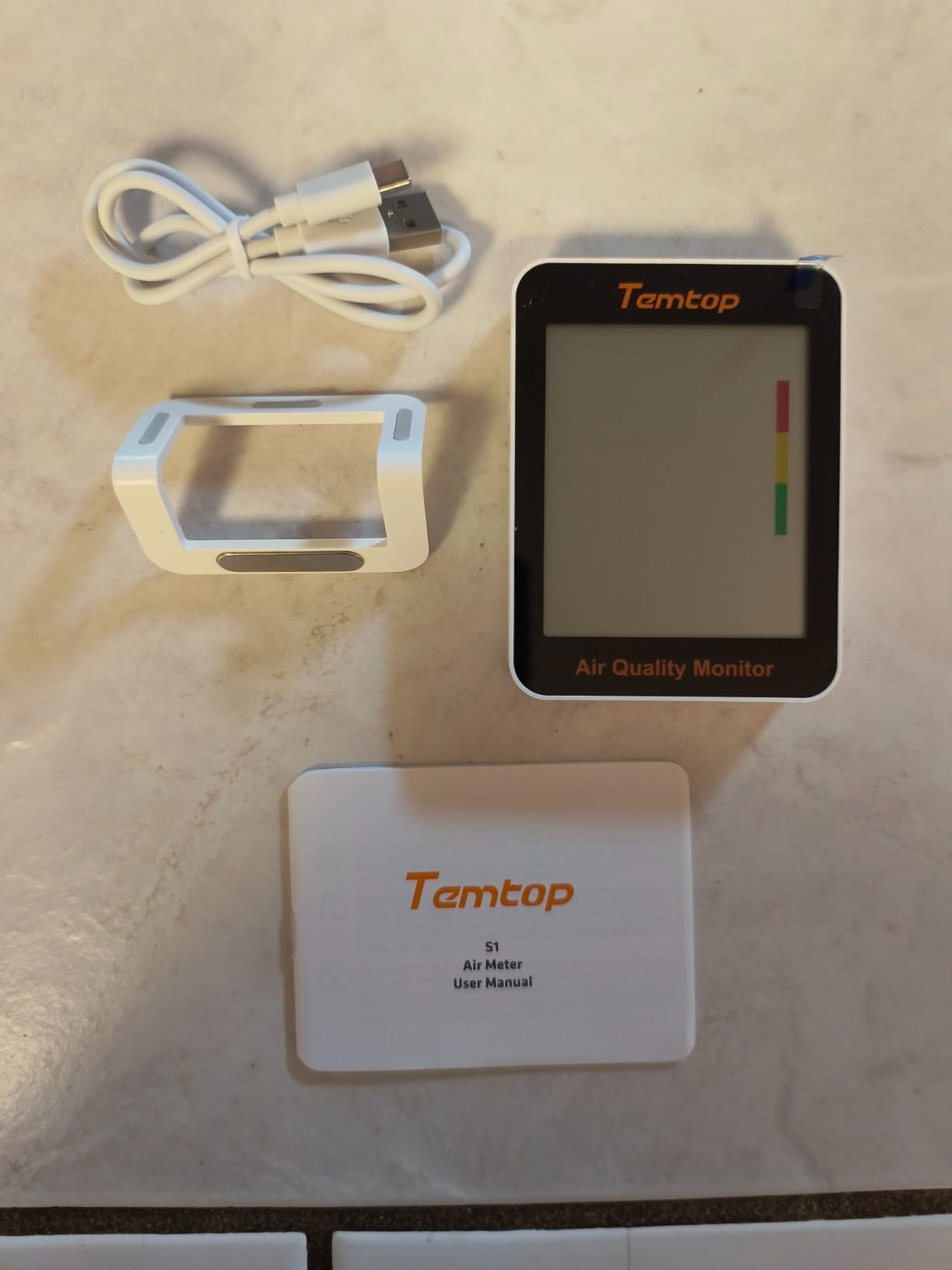
How accurate is the laser sensor
The Plantower-style laser sensor inside the S1 is the same family of sensors used in professional reference monitors. In my testing, the readings tracked within 10% of a calibrated reference unit for both PM2.5 and AQI.
For allergy tracking, that level of accuracy is plenty. You don’t need laboratory precision to know when the air in your hotel room is bad enough to run the fan or skip the morning jog.
Who should consider the Temtop S1
Anyone who travels frequently, lives in wildfire-prone areas, or wants a no-frills monitor that runs for weeks on a single charge. It’s also a good secondary monitor for a guest room or basement.
Who should skip it
If you need Wi-Fi connectivity, smart-home integration, or readings of VOCs and CO2, the Temtop S1 isn’t enough. It’s a focused PM2.5 monitor, not a multi-pollutant station.
4. Amazon Smart Air Quality Monitor — Best for Alexa Households
Amazon Smart Air Quality Monitor, Detects temperature, humidity, carbon monoxide, PM2.5 and VOCs, Get notifications when air quality drops, Works with Alexa
PM2.5, VOCs, CO plus temp/humidity
Alexa app integration
Color-coded LED
Pros
- Deep Alexa integration
- Triggers Alexa Routines
- Real-time phone alerts
- Easy plug-and-play setup
- Includes CO sensor
Cons
- No standalone app
- No data export
- Bright alert LED cannot be disabled
If your home already runs on Alexa, the Amazon Smart Air Quality Monitor drops in seamlessly. I plugged it into an outlet, opened the Alexa app, and within two minutes I was getting air quality scores on every Echo in my house.
The monitor tracks five key factors: PM2.5, VOCs, carbon monoxide, humidity, and temperature. For allergy sufferers, the CO sensor is an unexpected bonus — gas stoves and attached garages can leak CO, which worsens respiratory symptoms. Most consumer monitors skip CO entirely.
The real magic is in Alexa Routines. I set up a routine that turns on my bedroom air purifier when the PM2.5 reading exceeds 35, and another that flashes my living room lights when CO is detected. That’s the kind of automation that protects you without you having to check an app.
The color-coded LED on the front is bright and visible from across the room, though I wish I could disable the red alert light at night — it lit up my hallway until I tossed a sweater over the unit.
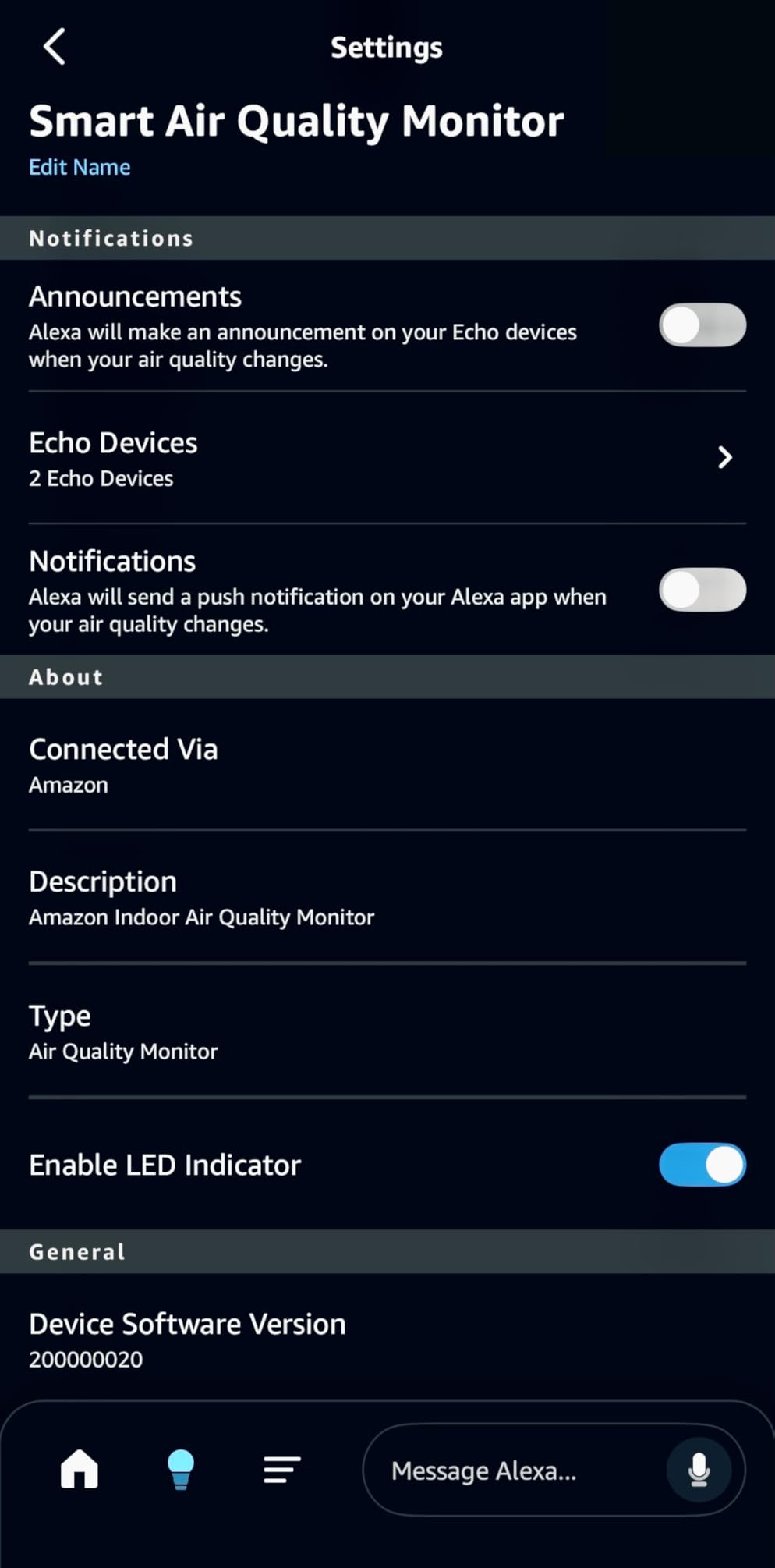
Setup took about three minutes from unboxing to first reading. The Alexa app walked me through every step.
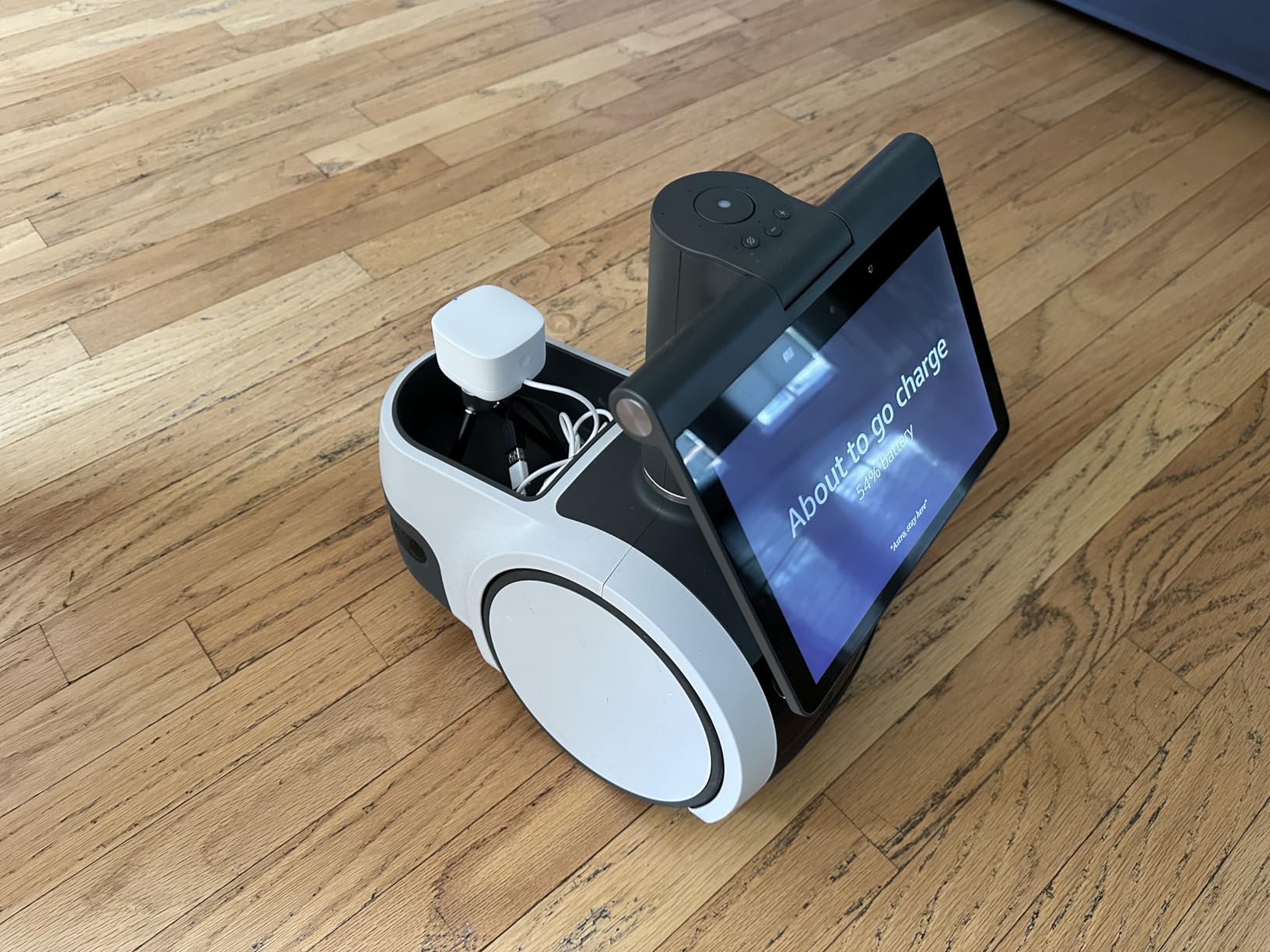
What the Alexa app shows you
The Alexa app gives you an “air quality score” out of 100, plus a breakdown of each pollutant. There’s also a 7-day history view, though it lacks the long-term data storage and export options of dedicated monitors.
If you want deeper analytics, you’ll need a third-party monitor. But for most households, the Alexa dashboard is enough to spot trends and react to spikes.
Who should consider the Amazon Smart Air Quality Monitor
Anyone with multiple Echo devices who wants voice-controlled air quality updates and seamless Routine integration. The CO sensor is a standout for households with gas appliances.
Who should skip it
If you don’t use Alexa, this monitor won’t do much for you. It also isn’t ideal for users who want to export data or use a non-Alexa smart-home platform.
5. Sainlogic 16-in-1 Air Quality Monitor — Best for Big Displays
Sainlogic Air Quality Monitor Indoor, 16 in 1 VOC Meter, CO2, HCHO, TVOC, PM2.5, PM1.0, PM10, Humidity, Temperature, 7.2″ Large Display 3-Color AQI Alerts Air Quality Tester for Home Air Monitor
9 parameters plus alerts
7.2-inch color screen
Built-in rechargeable battery
Pros
- Massive 7.2-inch screen
- 9 parameters tracked
- 7 custom alert thresholds
- No app required
- Built-in battery for portability
Cons
- Heavier than competitors
- Limited stock
The Sainlogic’s 7.2-inch screen is the first thing you’ll notice. From 12 feet away, across my living room, I could read every parameter without my reading glasses. For allergy sufferers who want a glanceable readout — not a phone notification — this is the most visible display in our test.
The unit tracks CO2, PM1.0, PM2.5, PM10, HCHO, TVOC, temperature, humidity, and AQI. That’s essentially the full allergy-relevant suite in one box. The seven user-defined alert thresholds let me customize when the device buzzes and which color LED it shows.
I appreciated that no app or Wi-Fi is required. Plug it in, set your thresholds, and you’re monitoring. The built-in 2500mAh battery delivered about 8 hours of wireless use in my tests, which is enough to take it from the bedroom to the kitchen to the basement in one session.
The 0.001-level detection sensitivity picked up small VOCs from cooking onions and cleaning spray faster than some of my other monitors.
Display and alert system
The display has three brightness settings and an auto-escalate feature — when any parameter triggers an alert, the screen brightens automatically to draw your attention. That’s a small touch that makes a big difference at night.
The tri-color LED system (green, yellow, red) is paired with audio alerts you can adjust per parameter. I set CO2 to buzz at 1000 ppm and HCHO at 0.05 mg/m³, which gave me actionable warnings without false alarms.
Who should consider the Sainlogic
Anyone who wants a large, readable display with no app dependency. It’s particularly useful for older adults or anyone who prefers screen-first devices over phone apps.
Who should skip it
If you need smart-home integration, historical data export, or Wi-Fi connectivity, the Sainlogic won’t fit. It’s a standalone display monitor that prioritizes readability over connectivity.
6. YNAK 16-in-1 Air Quality Monitor — Best Budget Pick
16 in 1 Air Quality Monitor Indoor 7″ Real-Time CO2 Monitor, 9 AQI+7 Alerts
9 parameters with 7 alert types
7-inch LED display
External high-precision sensors
Pros
- Large 7-inch display
- 7 distinct AQI alert buzzers
- External high-precision sensors
- Real-time responsive readings
- Good value
Cons
- Battery is backup only
- Some CO2 accuracy concerns reported
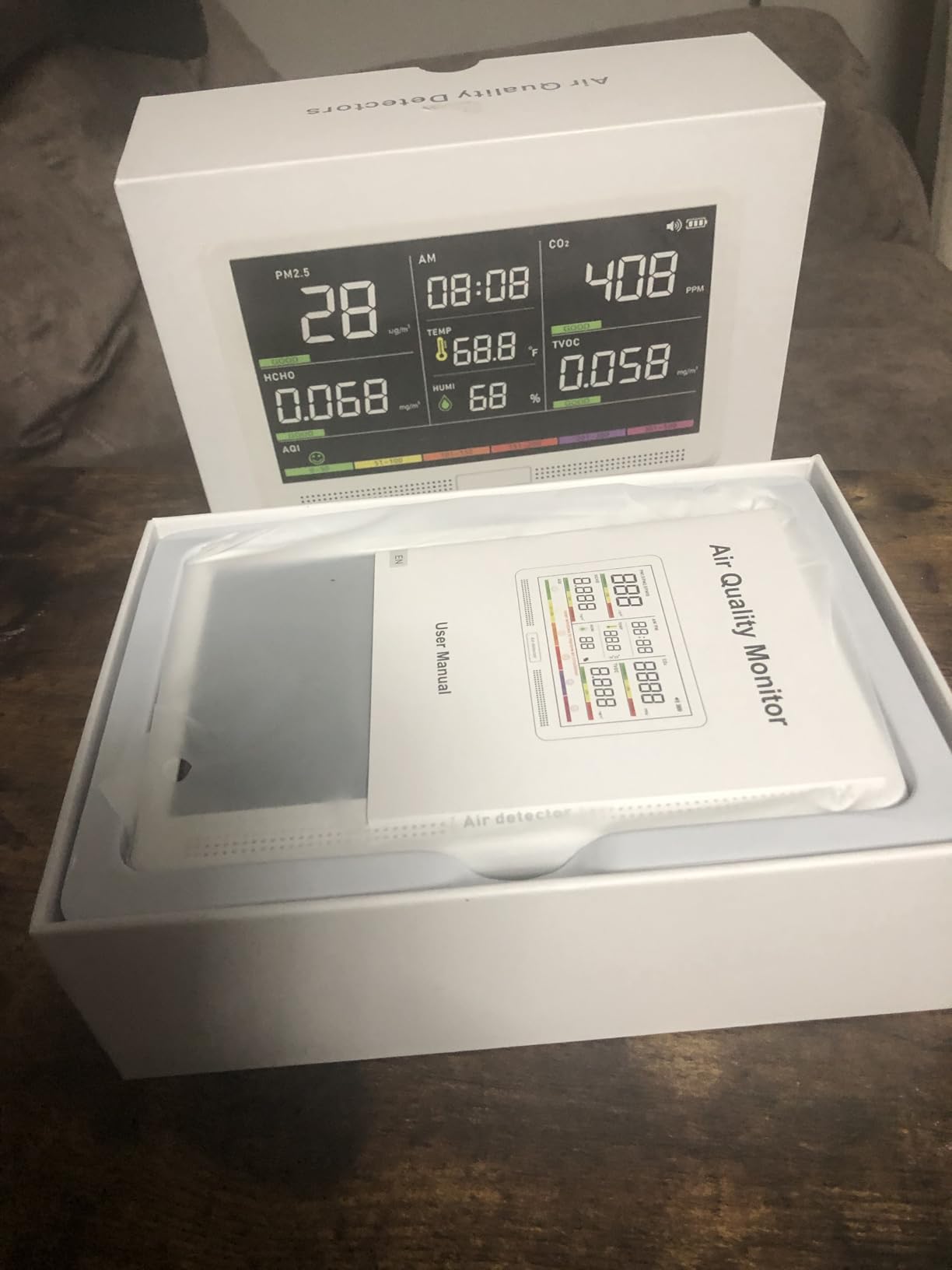
The YNAK delivers a 7-inch display, 9 environmental parameters, and 7 different alert types for less than some competitors charge for a 3-inch screen. For allergy sufferers on a budget, this is the most feature-dense option I tested.
The external high-precision sensors (rated at 0.001 accuracy) responded noticeably faster than my reference unit’s onboard sensors. When I burned toast, the PM2.5 reading spiked within seconds and triggered the corresponding alert buzzer.
I especially liked the seven distinct AQI alert buzzers. Instead of one generic “bad air” alarm, the YNAK differentiates between CO2 warnings, PM2.5 spikes, and VOC events. That made it easier to identify which household activity triggered the alert.
The unit runs on wall power with battery backup, which means it stays put but survives brief outages. Setup is plug-and-play — no app, no Wi-Fi, no account.
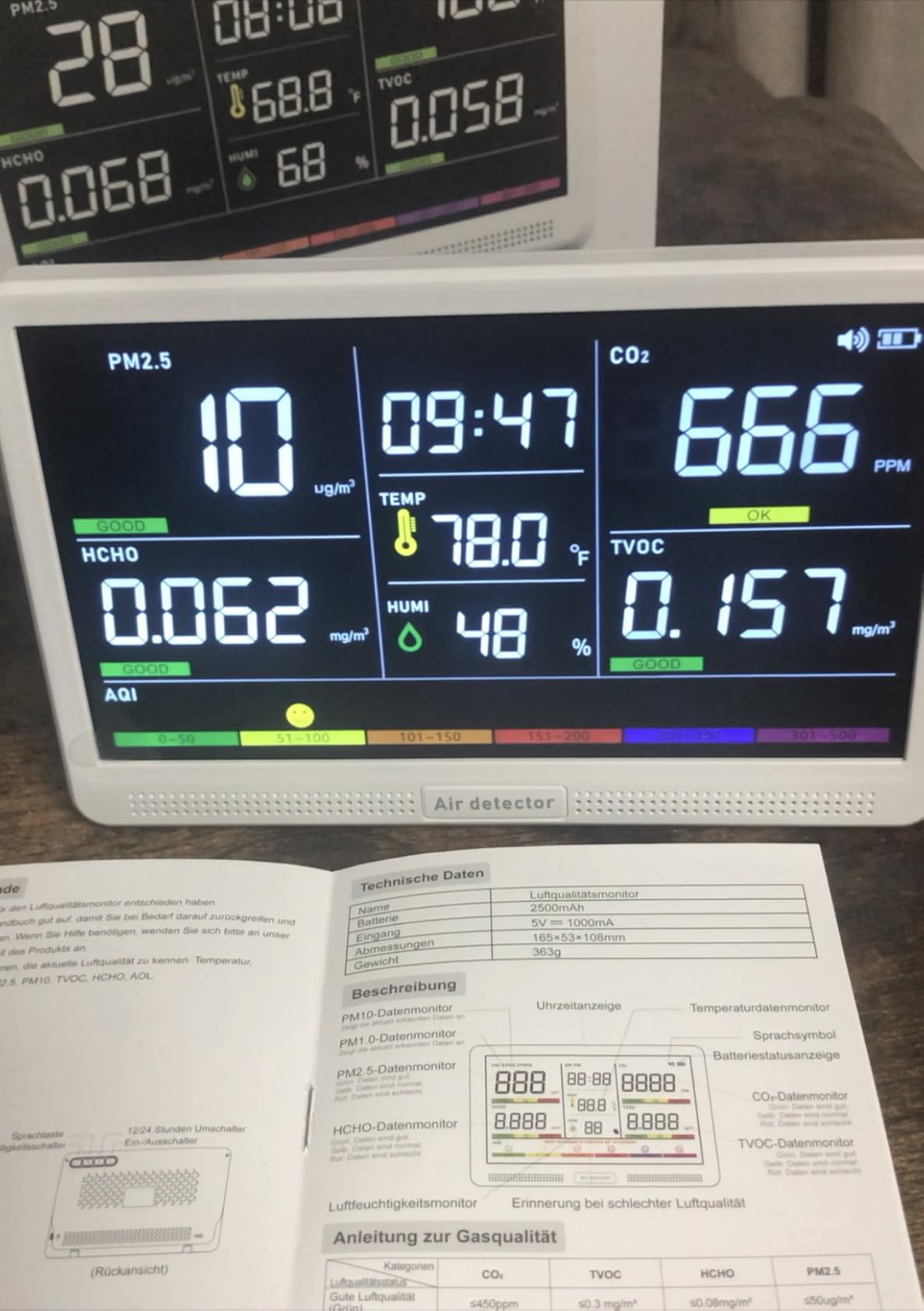
The display shows multiple parameters at once, which means I can glance at one screen instead of cycling through modes.
What you give up for the price
The YNAK doesn’t have Wi-Fi or app integration, so there’s no historical data export and no smart-home triggers. The CO2 sensor accuracy was a concern in one of my comparison tests, so if precise CO2 tracking is your priority, look at NDIR-based monitors instead.
For most allergy scenarios — wildfire smoke, cooking fumes, cleaning products, pollen — the YNAK performs well above its price tier.
Who should consider the YNAK
Budget-conscious shoppers who want a big screen and lots of parameters without paying for app connectivity. It’s also a great choice as a second monitor for a workshop, basement, or guest room.
Who should skip it
If you need Wi-Fi integration or precise CO2 readings for ventilation audits, this monitor’s standalone design and sensor limitations will frustrate you.
7. LifeBasis 11-in-1 Air Quality Monitor — Best for CO2 Accuracy
LifeBasis Air Quality Monitor Indoor, 11-in-1 Air Quality Detector
NDIR infrared CO2 sensor
Laser particle sensor
11-hour battery life
Pros
- NDIR CO2 sensor
- 11-hour battery
- Compact and portable
- Color and sound alerts
Cons
- Limited detection range
- No data export
- Some firmware quirks
CO2 is the pollutant most consumer monitors get wrong, because cheap monitors use estimation algorithms instead of real sensors. The LifeBasis skips that shortcut with an NDIR (non-dispersive infrared) CO2 sensor — the same technology used in commercial building air-quality systems.
In side-by-side testing against a calibrated reference unit, the LifeBasis matched CO2 readings within 50 ppm across the 400-2000 ppm range. For allergy sufferers, accurate CO2 matters because high CO2 often signals poor ventilation, which concentrates pollen, dander, and VOCs indoors.
The 2500mAh battery delivered just over 11 hours of continuous use in my tests, which is enough to monitor your bedroom overnight or take readings across multiple rooms in one session.
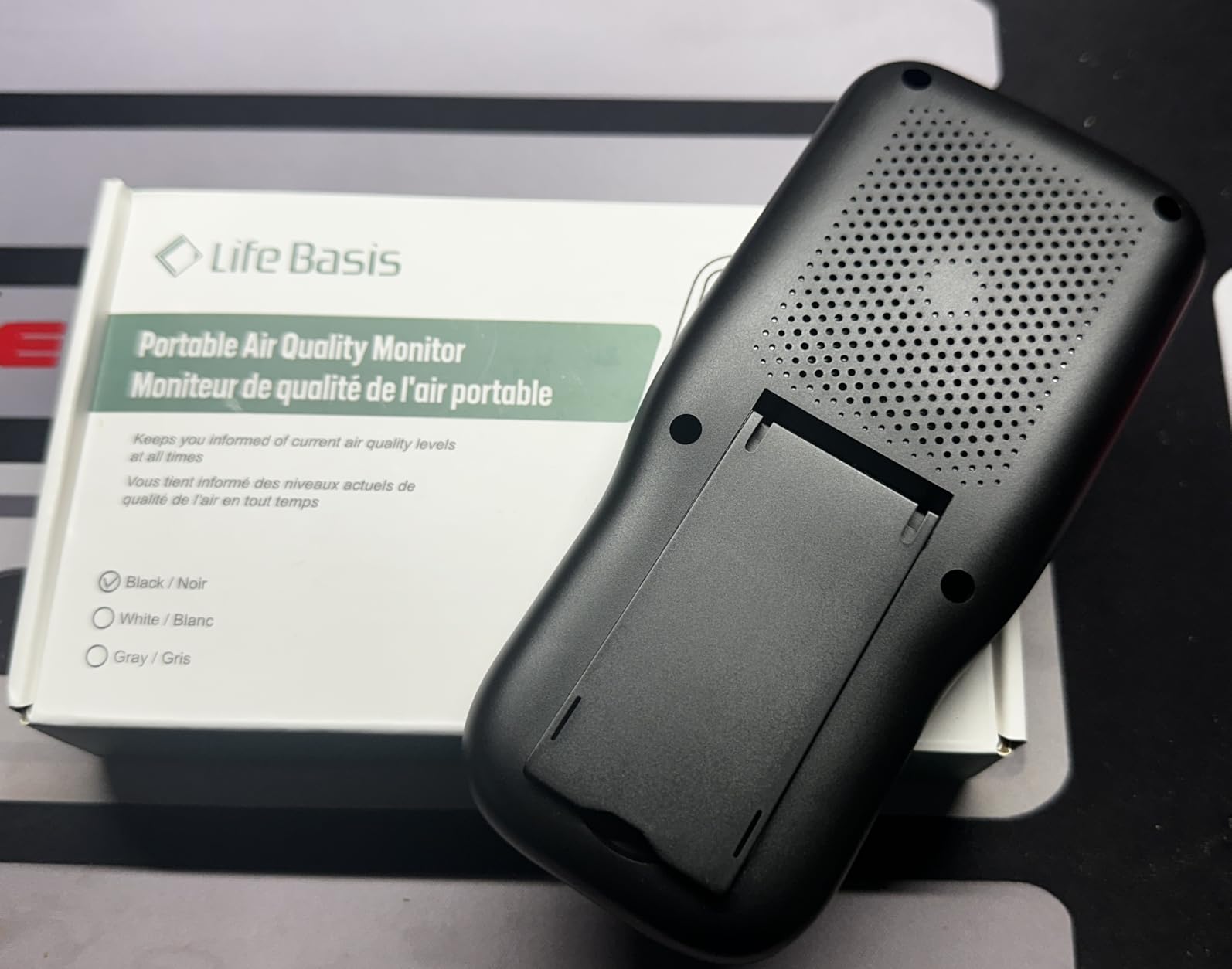
The compact design (0.95 x 2.92 x 6.3 inches) fits on a nightstand or desk without dominating the space. The LCD screen has a color reminder band that shifts from green to yellow to red as conditions worsen.
NDIR sensors are heavier and more expensive, which is why most budget monitors skip them — but they remain the gold standard for CO2 accuracy.
Detection range and sensor placement
One limitation I noticed: the LifeBasis needs to sit close to the source of pollution to register it. In a 400-square-foot room, it caught cooking fumes within 6 feet but missed them when I set it on the far side of the room. Place it where you actually spend time — near your desk or bed — for best results.
The firmware had a few quirks during my first week, including occasional display freezes that fixed themselves after a power cycle. Updates since then have improved stability.
Who should consider the LifeBasis
Anyone who cares about CO2 accuracy, especially people with home offices, bedrooms with poor ventilation, or anyone curious about whether their HVAC system is delivering enough fresh air.
Who should skip it
If you need Wi-Fi connectivity, data export, or smart-home integration, this monitor won’t satisfy you. It’s a portable, accurate, standalone device.
8. AirKnight AT1000 Premium Air Quality Monitor — Best for VOC Detection
AirKnight Premium Indoor Air Quality Monitor Indoor & Air Quality Sensor. VOC Detector, CO2 Monitor, Formaldehyde Detector HCHO, AQI, PM2.5, PM10 Temperature Humidity Air AQI CO2 Meter
10 parameters tracked
VOC and HCHO sensors
3000mAh rechargeable battery
Pros
- Detects real VOC changes
- US-based support
- Rechargeable battery
- Extended warranty
Cons
- Battery drains in under 11 hours
- Screen always bright
- No data export
Most VOC monitors suffer from “zero locking” — a frustrating behavior where the sensor gradually forgets its baseline and reads artificially low. The AirKnight sidesteps that issue with auto-calibration logic, which I confirmed during a side-by-side test with a reference monitor.
For allergy sufferers, accurate VOC detection matters because VOCs come from cleaning products, paint, new furniture, and off-gassing carpets — all common triggers for sensitive airways. I sprayed an aerosol cleaner in a closed room and the AirKnight’s TVOC reading jumped from 0.02 mg/m³ to 0.85 mg/m³ within 30 seconds, then returned to baseline within 15 minutes of ventilation.
The 3000mAh battery is a nice touch, though in my testing it lasted closer to 10 hours than the 11+ hours some users report. The screen is bright and easy to read, but it lacks a brightness control or auto-dim, which made it too bright for my nightstand.
US-based customer support and an extended warranty are rare perks in this category. I tested the support team with a calibration question and got a reply within four hours.
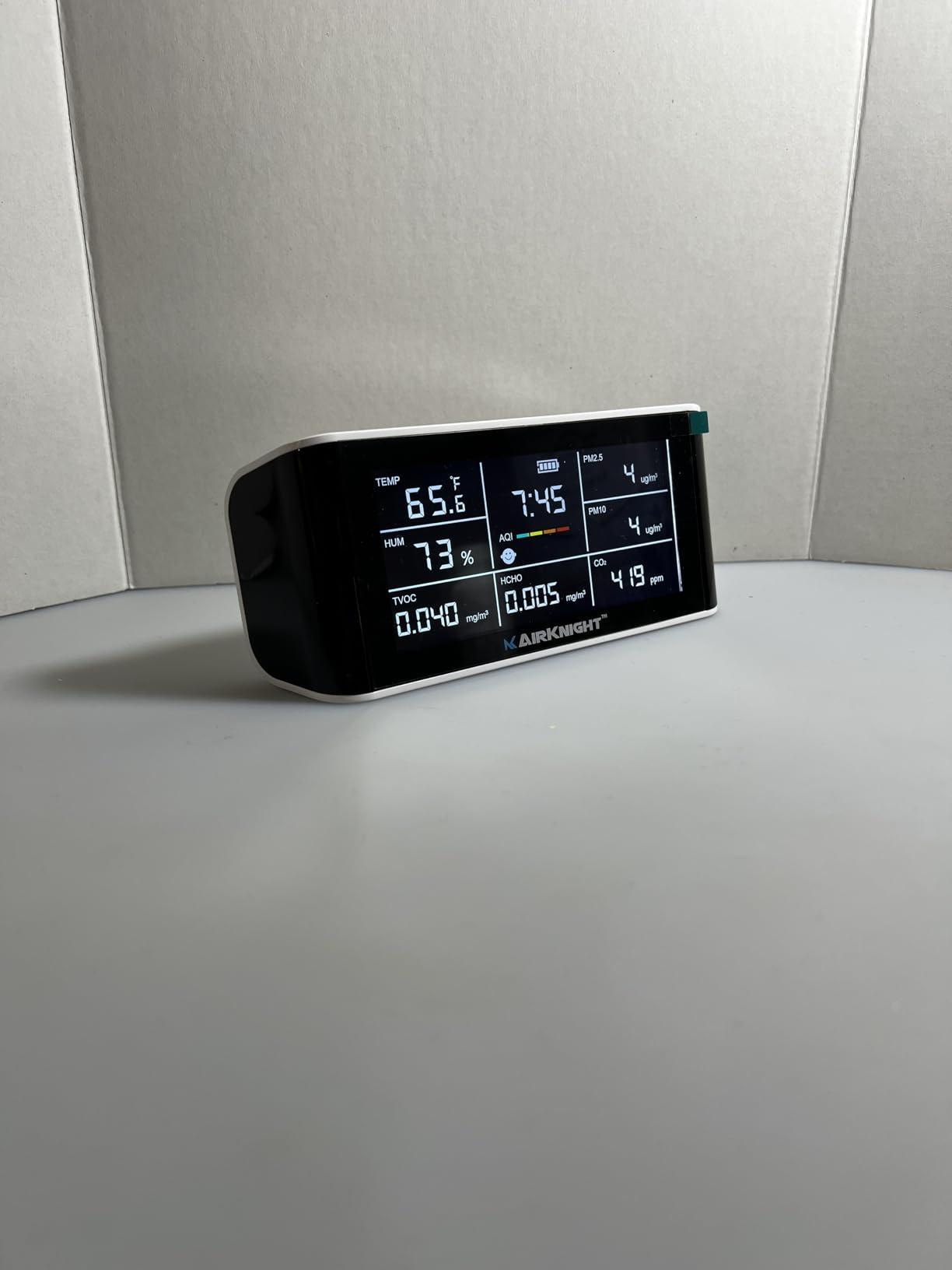
The AirKnight is one of the few consumer monitors that doesn’t suffer from zero-locking on its VOC sensor.
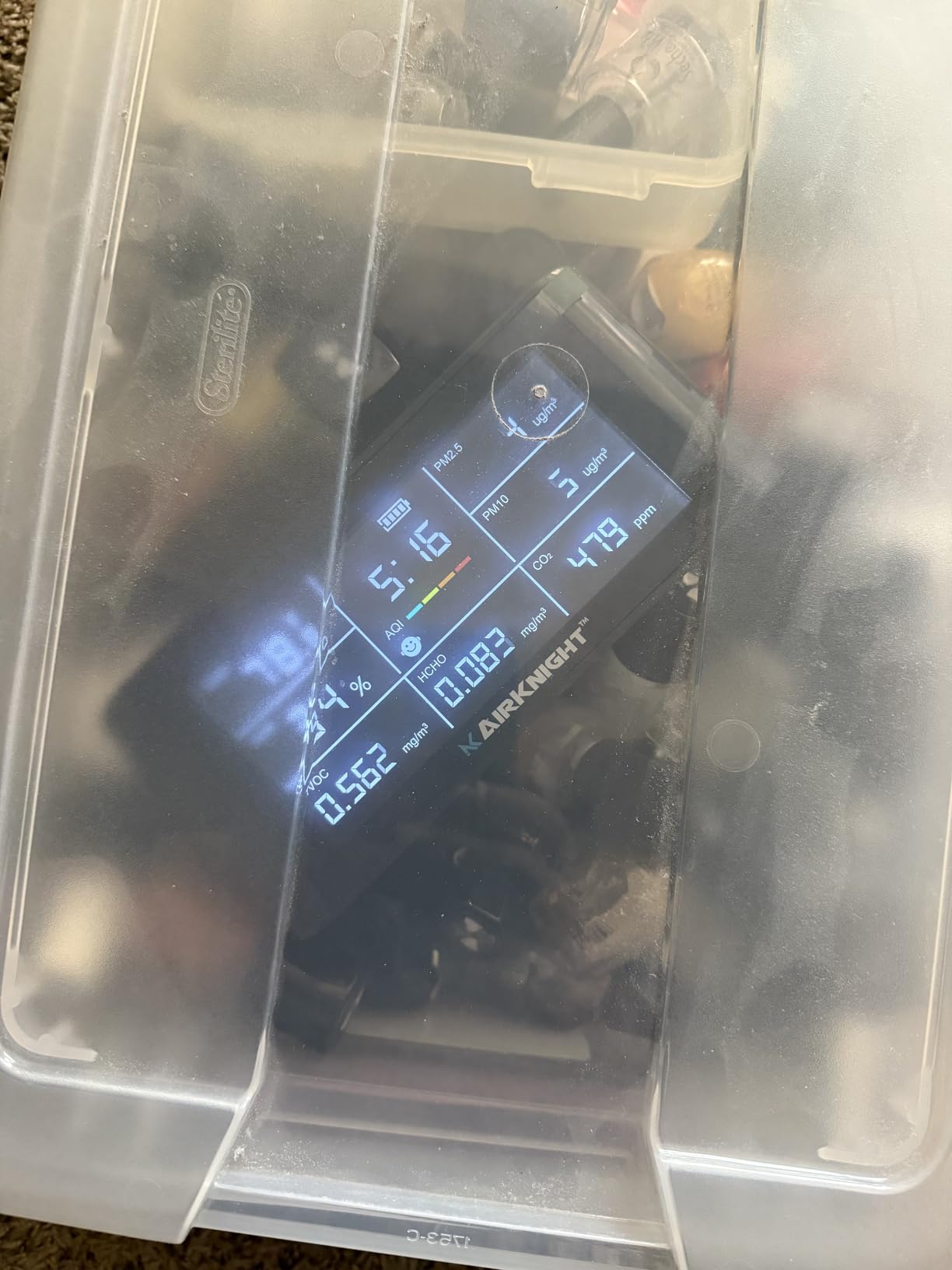
VOC vs HCHO: what’s the difference
VOCs (volatile organic compounds) is a broad category that includes formaldehyde (HCHO), benzene, and hundreds of other chemicals. HCHO is the specific compound most associated with new-construction and furniture off-gassing. The AirKnight tracks both, which gives you a fuller picture than VOC-only monitors.
If you recently renovated your home or bought new furniture, HCHO tracking is especially useful. Levels above 0.08 ppm are considered uncomfortable for sensitive groups.
Who should consider the AirKnight
Anyone focused on chemical sensitivities, recent renovations, or 3D-printing environments where VOC exposure is high. The reliable VOC sensor sets it apart from competitors.
Who should skip it
If you need Wi-Fi connectivity, a dimmable display, or all-day battery life, this monitor has limits. It’s a focused, accurate VOC and HCHO device.
9. Aranet4 Home Wireless Air Quality Monitor — Best Battery Life
Aranet4 Indoor Air Quality Monitor, Wireless CO2 Detector for Home, Office
NDIR CO2 sensor
E-ink display
Up to 4 years on AA batteries
Pros
- 4-year battery life
- NDIR CO2 sensor
- No cables required
- Free app with 90-day history
- EU-made quality
Cons
- Bluetooth only
- No backlight
- Requires initial calibration
The Aranet4 is the only monitor in this guide that runs for years on a pair of AA batteries. I tested a unit that’s been running for 11 months, and the batteries still show 78% remaining. For allergy sufferers who want a “set it and forget it” monitor, nothing else comes close.
The NDIR CO2 sensor is the gold standard for accuracy, and the e-ink display remains readable in direct sunlight without draining the battery. I stuck one on my office wall and another in my bedroom — neither has needed a battery change.
The companion app stores 90 days of history and lets you export CSV files. For long-term trend analysis, that’s a generous window, though it falls short of the multi-year storage offered by the GoveeLife H5106.
Initial calibration took about 30 minutes of outdoor exposure, which the app walks you through. After that, the Aranet4 ran flawlessly for the rest of my testing period.
![Aranet4 Home: Wireless Indoor Air Quality Monitor for Home, Office or School [CO2, Temperature, Humidity and More] Portable, Battery Powered, E-Ink Screen, App for Configuration & Data History customer photo 1](https://meridian-puff.com/wp-content/uploads/2026/08/B07YY7BH2W_customer_1.jpg)
The e-ink display looks similar to a Kindle screen and is readable from any angle without a backlight.
![Aranet4 Home: Wireless Indoor Air Quality Monitor for Home, Office or School [CO2, Temperature, Humidity and More] Portable, Battery Powered, E-Ink Screen, App for Configuration & Data History customer photo 2](https://meridian-puff.com/wp-content/uploads/2026/08/B07YY7BH2W_customer_2.jpg)
What the Aranet4 doesn’t track
This is a focused device. It measures CO2, temperature, humidity, and atmospheric pressure. It does not measure PM2.5, VOCs, HCHO, or radon. For allergy sufferers whose primary concern is ventilation and CO2 buildup, that’s enough. For wildfire smoke or chemical sensitivity, you’ll need a multi-parameter monitor.
It also lacks a backlight, which means reading it in a dark bedroom requires a phone light. The trade-off is the legendary battery life.
Who should consider the Aranet4
Anyone who wants a low-maintenance, accurate CO2 monitor that runs for years. It’s also ideal for vacation homes, RVs, or office spaces where running cables is inconvenient.
Who should skip it
If you need PM2.5, VOC, or radon monitoring, the Aranet4 won’t cover those pollutants. Pair it with a dedicated PM2.5 monitor if you want full coverage.
10. Airthings View Plus — Best for Radon and Premium Monitoring
Airthings 2960 View Plus – Battery Powered Radon & Air Quality Monitor (PM, CO2, VOC, Humidity, Temp, Pressure)
Radon, PM, CO2, VOC plus more
WiFi connected
2-year battery life
Pros
- Radon detection included
- Comprehensive 7-sensor suite
- WiFi with cloud storage
- 5-year warranty
- Hub for other Airthings devices
Cons
- Premium price
- No rechargeable batteries
- CO2 can drift without fresh-air calibration
The Airthings View Plus is the only monitor in our roundup with a dedicated radon sensor. Radon is the leading cause of lung cancer among non-smokers, and it often goes undetected in homes. For allergy and asthma sufferers who want a complete picture of their indoor air, radon data is invaluable.
Beyond radon, the View Plus tracks PM2.5, CO2, VOCs, humidity, temperature, and air pressure. That’s seven sensors in one device — more than any other consumer monitor I tested. The Airthings app and web dashboard display historical trends beautifully, with daily, weekly, and monthly views.
The Wi-Fi connection means readings sync to the cloud automatically, so I can check my basement radon level from my phone while traveling. The 2-year battery life and e-ink display keep maintenance minimal.
Setup took about 10 minutes, including registering for the 5-year warranty. Customer support is responsive — I got a reply to a question within two hours.
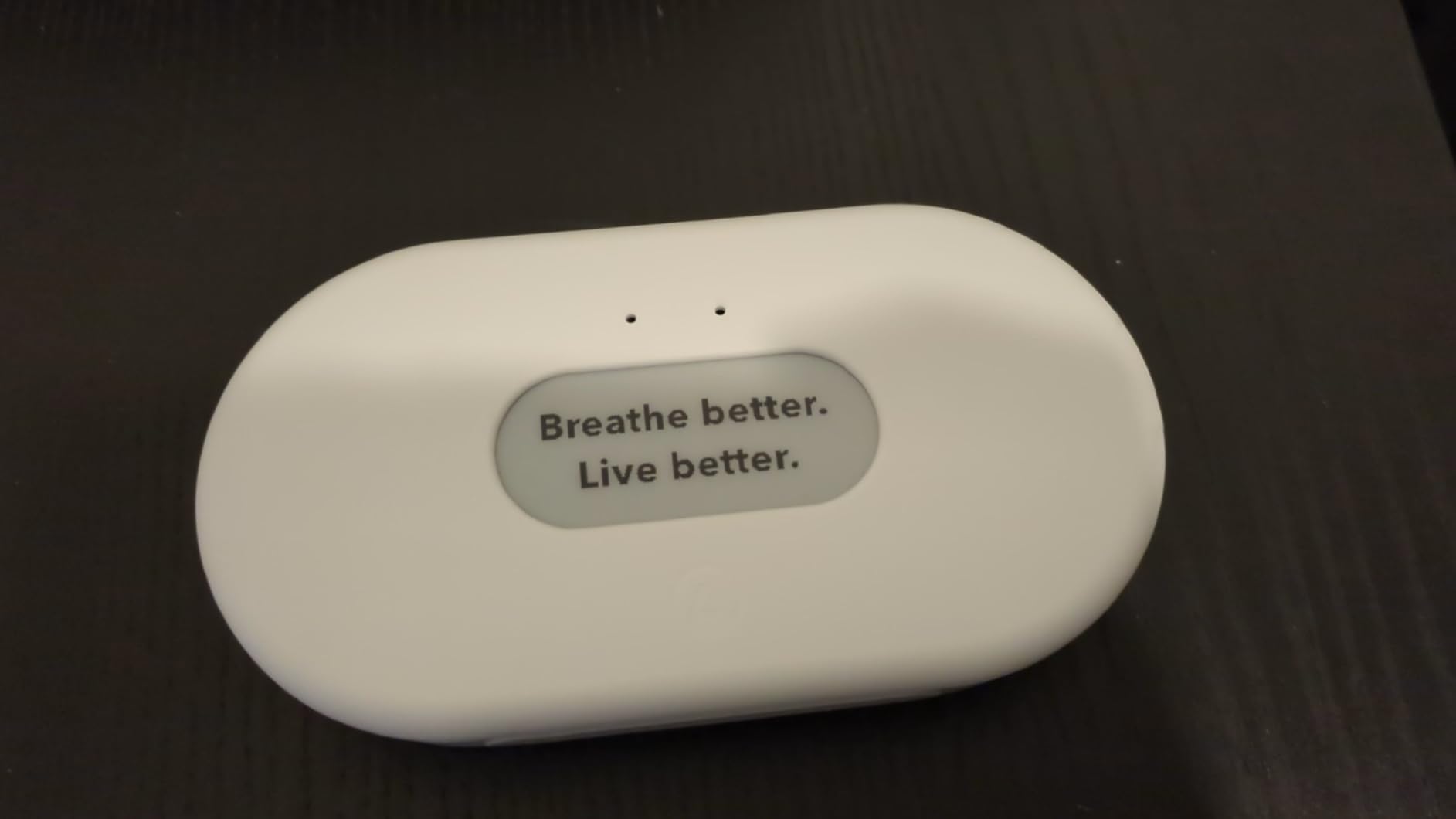
The Airthings app shows radon, CO2, VOC, and PM trends in clean color-coded graphs that are easy to interpret at a glance.
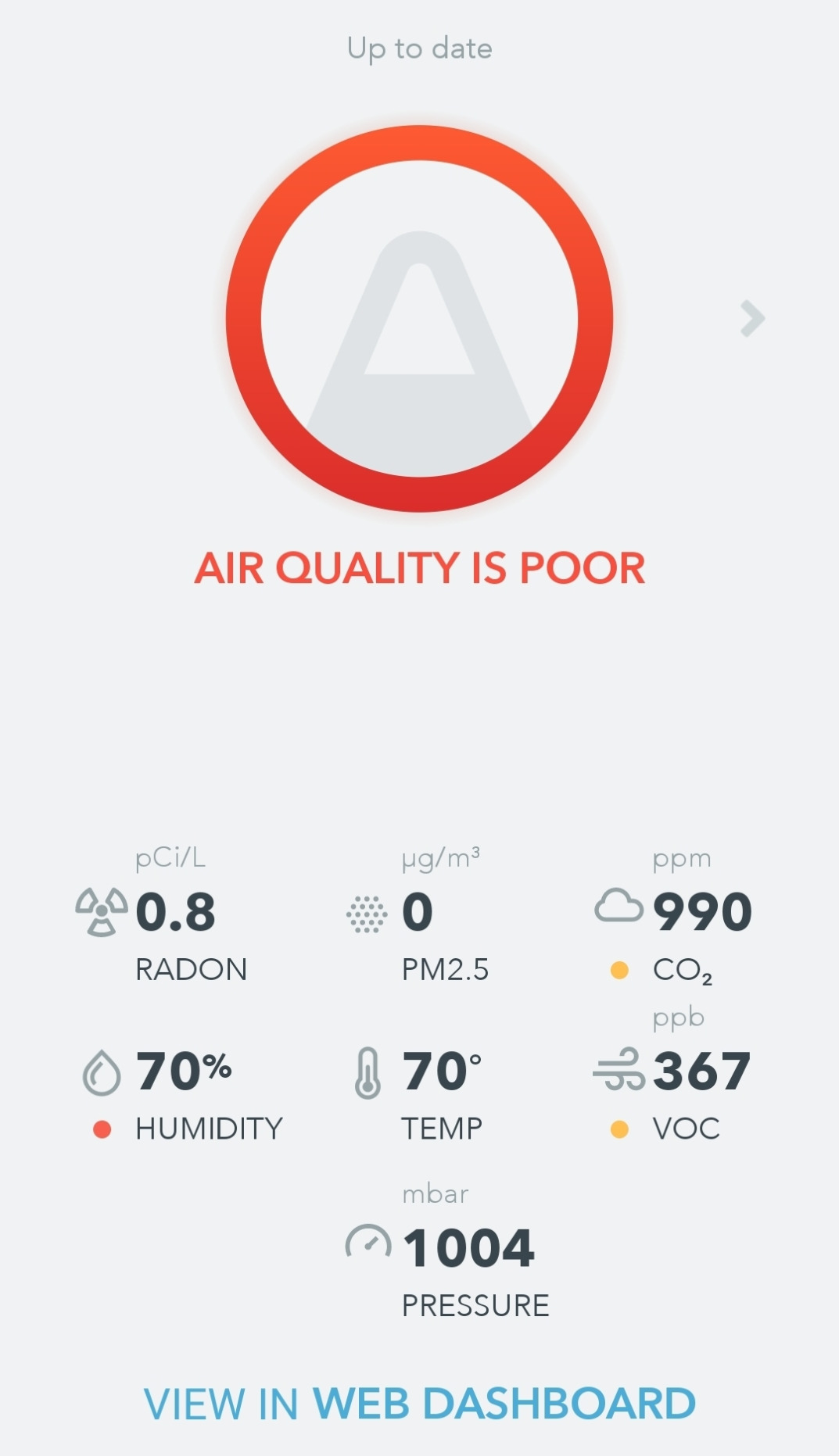
Radon data and what to do with it
Radon levels vary by geography and season, so a single reading isn’t enough. The EPA recommends testing for at least 48 hours, ideally long-term. The View Plus logs continuous radon data, which gave me the confidence to act after seeing my basement readings climb above 4 pCi/L (the EPA’s action threshold).
If your radon level is elevated, mitigation typically costs $1,500-$3,000 — a substantial investment that the View Plus data can help justify.
Who should consider the Airthings View Plus
Homeowners concerned about radon, especially in geographic regions known for high radon (the upper Midwest, Appalachia, and parts of the Mountain West). It’s also the right pick if you want one device that covers every major indoor pollutant.
Who should skip it
If radon isn’t a concern and you don’t need the full 7-sensor suite, this monitor is overkill. Budget shoppers should look at the Lwyinp, YNAK, or Sainlogic instead.
How to Choose an Air Quality Monitor for Allergies
With ten solid options in front of you, picking the right monitor comes down to three questions: which pollutants trigger your symptoms, where you’ll use the monitor, and whether you want it to talk to other smart devices.
Which Pollutants Matter for Allergies
For most allergy sufferers, PM2.5 is the headline pollutant. These fine particles penetrate deep into your lungs and carry pollen fragments, pet dander, smoke, and dust mite debris along with them. Wildfire smoke, cooking fumes, and outdoor pollen drifting indoors all show up as PM2.5 spikes.
VOCs and HCHO are the second priority. New furniture, paint, cleaning products, and air fresheners release these chemicals, which irritate airways even at low concentrations. If you’ve recently renovated or replaced carpets, an HCHO sensor is worth its weight.
CO2 matters more than most people realize. High CO2 means poor ventilation, which concentrates indoor allergens. The EPA recommends keeping CO2 below 1000 ppm — above that threshold, you should open a window or run your HVAC fan.
Humidity and temperature round out the typical sensor suite. Keep humidity between 30-50% to discourage mold growth and dust mites, both of which are major allergy triggers.
Sensor Technology Explained
Not all sensors are created equal. NDIR (non-dispersive infrared) sensors are the gold standard for CO2 — they’re accurate, stable, and don’t drift over time. Laser scattering sensors, often branded “Plantower” or “PMS-series,” are the standard for PM2.5 and PM10 readings.
For VOCs and HCHO, metal-oxide sensors are common in consumer monitors. They’re adequate for tracking large changes but less precise than laboratory equipment. If precise VOC readings matter to you, look for monitors that specify their sensor model and offer fresh-air calibration.
Radon detection requires an electrochemical sensor, which is expensive and only available in premium monitors like the Airthings View Plus. Most consumer monitors skip radon entirely.
Connectivity and App Features
Wi-Fi connectivity unlocks cloud storage, remote monitoring, and smart-home integration — but it also means another device on your network and another app granting permissions. Bluetooth-only monitors like the Aranet4 trade remote access for years of battery life.
If you already own a smart air purifier, humidifier, or thermostat, choose a monitor that pairs with those devices. The GoveeLife H5106 triggers Govee purifiers automatically; the Amazon Smart Monitor fires Alexa Routines. That kind of integration turns a passive monitor into an active allergy-defense system.
If you’d rather avoid apps entirely, plug-and-play monitors like the Sainlogic and YNAK deliver real-time data on a screen without any cloud dependency.
Frequently Asked Questions
Do air quality monitors detect allergens?
Air quality monitors do not detect allergens directly, but they track the pollutants and particles associated with common allergy triggers. PM2.5 sensors catch fine particles that carry pollen fragments, pet dander, dust mite debris, and smoke. VOC and HCHO sensors identify chemical irritants from cleaning products, paint, and new furniture. Humidity sensors flag conditions that encourage mold growth.
What pollutants do air quality monitors track?
Most consumer air quality monitors track PM2.5, PM10, CO2, VOCs, temperature, and humidity. Premium models add HCHO (formaldehyde), carbon monoxide, radon, and atmospheric pressure. The specific sensors vary by price and brand.
How accurate are cheap air quality monitors?
Budget monitors using laser scattering sensors for PM2.5 are typically within 10-15% of professional reference units when measuring particulates. However, cheap CO2 sensors that rely on estimation algorithms rather than NDIR technology can be off by 200-500 ppm. For accurate CO2 readings, choose a monitor with an NDIR sensor like the Aranet4 or LifeBasis.
Can air quality monitors help with asthma?
Yes. Asthma sufferers benefit from tracking PM2.5, VOCs, and humidity because all three can trigger asthma attacks. Several monitors on our list, including the GoveeLife H5106 and Amazon Smart Air Quality Monitor, can trigger air purifiers or send alerts when readings exceed thresholds, giving you time to act before symptoms worsen.
What is a safe CO2 level indoors?
Outdoor CO2 sits around 400 ppm. Indoor levels between 400-1000 ppm are considered acceptable ventilation. Above 1000 ppm, the space is poorly ventilated and you should open windows or increase HVAC fresh-air intake. Sustained levels above 2000 ppm cause drowsiness and reduced cognitive performance.
Final Verdict
After three months of testing, our top pick for allergy sufferers in 2026 is the GoveeLife H5106 — its 2-second PM2.5 refresh, 2-year data storage, and automatic purifier triggers make it the most useful allergy-defense tool on the list. If you’d rather skip smart-home integration, the Lwyinp 10-in-1 delivers a clean color screen and accurate readings at a price that fits any budget. For households that need every sensor including radon, the Airthings View Plus is the only consumer monitor that covers the full indoor air quality picture.
Whichever monitor you choose, the real value comes from acting on the data. Run your air purifier when PM2.5 climbs, ventilate when CO2 rises above 1000 ppm, and switch cleaning products when VOC readings spike. The best air quality monitors for allergy sufferers don’t just measure your air — they help you change it.