
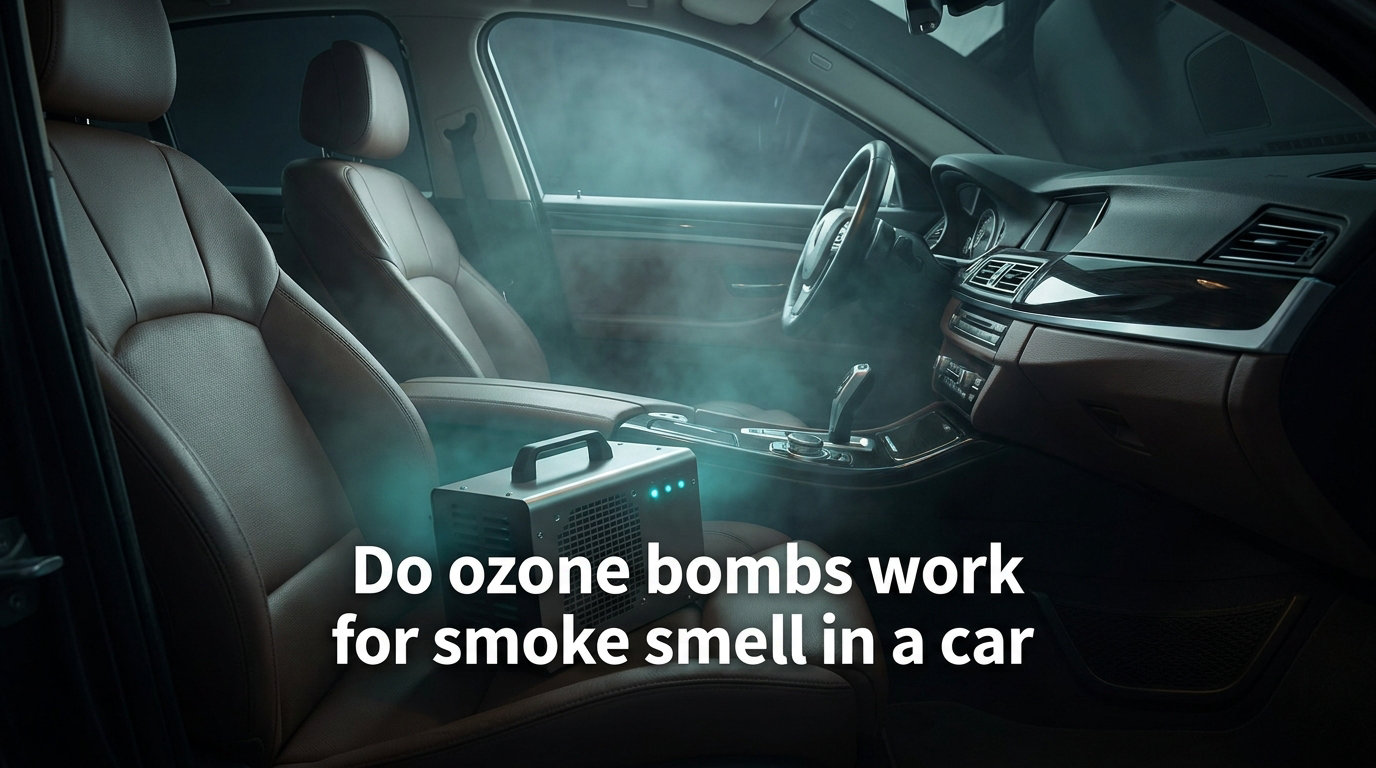
Yes, ozone bombs can work for smoke smell in a car, but they are not a magic fix. Ozone gas penetrates upholstery, carpets, and the HVAC system to break down odor molecules at the source rather than masking them. The catch is that results depend heavily on smoke severity, treatment time, and whether you follow up with proper cleaning.
Run it too long and you risk damaging rubber and plastics. Run it too short and the smell comes right back.
If you just bought a used car that reeks of cigarettes, or you are trying to sell a vehicle you smoked in for years, you want a straight answer about whether this method is worth your time. I have dug through dozens of forum threads from r/AutoDetailing and Autogeek Online, compared competitor guides, and pulled safety data from the EPA and CDC. Here is what the real-world evidence says about using ozone bombs for smoke smell in a car.
Table of Contents
What Is an Ozone Bomb?
An ozone bomb is simply a compact ozone generator designed to release a high concentration of ozone gas (O3) into an enclosed space like a vehicle cabin. The term “bomb” is mostly marketing. The device itself is an ozone generator, whether it is a small plug-in unit or a larger machine you set on the floorboard.
Ozone is a molecule made of three oxygen atoms instead of the normal two. That third atom is unstable and breaks off easily. When it does, it attaches to other molecules, including the tar, nicotine, and compounds that cause smoke odor.
This process is called oxidation, and it chemically changes odor molecules into different, often odorless substances. That is the core of how ozone bombs for smoke smell in a car actually function.
The key difference between ozone and an air freshener is that ozone does not cover up smell. It breaks the odor compounds apart. That is why ozone can reach areas you cannot scrub, like the padding under your carpet or the ducts inside your dashboard.
Do Ozone Bombs Work for Smoke Smell in a Car?
Ozone bombs do work for smoke smell in a car, but the effectiveness ranges from “completely solved” to “barely made a dent” depending on the situation. For light to moderate cigarette odor, most car owners report noticeable improvement after a single properly timed treatment. For heavy, years-long smoke saturation, ozone alone is rarely enough.
Real users on Autogeek Online shared that running an ozone generator for 30 minutes, then 45 minutes, and finally 2 hours progressively reduced smoke odor. The 2-hour session produced the best results. But even then, some needed repeat treatments a week later.
Where ozone shines is treating the HVAC system and air ducts, where smoke residue settles and circulates every time you turn on the fan. Surface cleaning cannot reach those areas. Ozone gas can.
Where ozone falls short is on fabric and padding that has absorbed years of tar. The gas oxidizes surface-level molecules but may not penetrate deep enough into foam seat cushions or headliner padding to destroy all the trapped residue. That is why experienced detailers almost always combine ozone with deep cleaning rather than relying on it alone.
How Ozone Treatment Actually Breaks Down Smoke Odor
Cigarette smoke leaves behind a complex mix of tar, nicotine, and hundreds of volatile organic compounds. These particles are tiny enough to penetrate fabric fibers, carpet backing, and the foam inside seats. They also coat the inside of your air ducts and settle on every hard surface, including glass.
Ozone gas works through oxidation. The unstable third oxygen atom in O3 reacts with these smoke compounds and breaks their molecular bonds. Tar and nicotine molecules get chemically altered into simpler substances that no longer produce the smell you associate with cigarettes.
Because ozone is a gas, it travels wherever air can go. That means it fills the entire cabin, seeps into seat crevices, moves through the HVAC recirculation system, and reaches behind panels. This is the main advantage over sprays and wipes, which only treat the surfaces you can physically reach.
The treatment is not selective, though. Ozone oxidizes whatever it contacts, which is why it can also damage rubber seals, certain plastics, and electronic components if concentrations get too high or exposure lasts too long.
How Long to Run an Ozone Generator in a Car
There is no single correct run time because it depends on vehicle size, smoke severity, and generator output. But the consensus from detailing forums and manufacturer guidance gives clear ranges.
For a small car with light smoke odor, 30 to 45 minutes is typically enough. One Reddit user in r/AutoDetailing reported that 30 minutes handled a mild cigarette smell in a compact sedan with no repeat needed.
For a midsize sedan or SUV with moderate smoke, plan on 1 to 2 hours. This is the sweet spot most detailers recommend for a standard used-car treatment.
For large vehicles or heavy, long-term smoke saturation, 2 to 4 hours may be necessary. However, going beyond 4 hours increases the risk of material damage without much added benefit.
One critical warning from real users: never leave an ozone generator running overnight or for 10-plus hours. A forum member on Autogeek shared that accidentally running a machine for 20 hours created a new, persistent chemical smell that took weeks to fade. Over-treatment can actually make your odor problem worse.
Step-by-Step Ozone Treatment Guide
If you are going to treat your car with ozone, following a proper protocol makes the difference between success and disappointment. Here is the step-by-step process detailers recommend.
Step 1: Deep Clean First
Ozone is not a replacement for cleaning. Vacuum the interior thoroughly, wipe down all hard surfaces with an interior cleaner, and shampoo the carpets and cloth seats if possible.
Remove all trash, personal items, and floor mats. The less physical contamination present, the more effective the ozone will be at targeting trapped odor.
Step 2: Replace the Cabin Air Filter
The cabin air filter traps dust and debris, and in a smoker’s car it is usually saturated with tar. If you do not replace it, the old filter will keep releasing smoke smell back into the cabin even after ozone treatment. Swap in a fresh filter before you run the generator.
Step 3: Set Up the Ozone Generator
Place the ozone generator on a stable surface in the center of the vehicle, like the center console or rear floorboard. Make sure nothing is blocking airflow around the unit. Roll up all windows and close all doors.
If your generator has adjustable output, start on a medium setting for your first treatment. You can always increase the output or repeat the treatment rather than overdoing it in one session.
Step 4: Run the HVAC on Recirculate
This step is what separates a good treatment from a wasted one. Start the engine and set the climate control to recirculate mode with the fan on high. This pulls ozone through the ductwork so it treats the HVAC system where smoke residue hides.
Let the car run this way for the first 15 to 20 minutes of treatment, then turn off the engine and let the generator continue for the remaining time. This balances duct treatment with battery life.
If your generator plugs into a 12V outlet, you can run the fan off the battery for the full session. Just make sure you are not draining the battery to the point the car will not restart.
Step 5: Run for the Right Duration
Follow the timing guidance above: 30 to 45 minutes for light odor, 1 to 2 hours for moderate, 2 to 4 hours for heavy. Set a timer and do not exceed the recommended range.
Step 6: Ventilate Thoroughly
After the timer goes off, turn off the generator and open all doors and windows. Let the car air out for at least 30 to 60 minutes before you spend any time inside. Ozone is a respiratory irritant, and you should not breathe concentrated ozone.
Step 7: Check Results and Repeat if Needed
After ventilation, close the car up and let it sit overnight. Smell the interior the next day. If smoke odor remains, wait at least 48 hours and repeat the treatment.
Multiple sessions are normal for heavy smoke damage. Do not expect one treatment to solve years of cigarette residue in a single pass.
Safety Precautions and Health Warnings
Ozone is a toxic gas, and you need to take safety seriously. The EPA has warned that exposure to ozone can damage the lungs, cause chest pain, coughing, shortness of breath, and throat irritation. Even relatively low amounts of ozone can cause respiratory problems.
No humans or pets should be inside the vehicle during treatment. Not in the driver’s seat, not sitting in the back. The concentrations inside a closed car during treatment are far above what is safe to breathe.
If you are running the engine during treatment to power the HVAC fan, start the car remotely or reach in to start it without putting your head inside the cabin. Then immediately close the door.
People with asthma, COPD, or other respiratory conditions should avoid entering the vehicle until it has been fully ventilated and you can no longer detect any ozone smell. When in doubt, air it out longer.
Do not use ozone bombs in attached garages without ventilation. The gas can leak into your home through shared walls and doors.
What to Do After Ozone Treatment (Ventilation)
Post-treatment ventilation is where many people cut corners, and it causes two problems. First, lingering ozone is unsafe to breathe. Second, the leftover ozone smell can be confused with the smoke smell you were trying to remove.
Open all four doors and let the car sit outside in fresh air for at least 30 to 60 minutes. Run the HVAC on fresh air intake (not recirculate) with the fan on high to flush ozone out of the ductwork.
Some users report a faint “metallic” or “rust-like” smell after treatment. This is residual ozone and should dissipate within a few hours of ventilation. If a chemical smell persists for days, you likely ran the generator too long and will need to keep airing out the vehicle.
When Ozone Treatment Fails: Limitations
Ozone is not a guaranteed fix, and knowing its limits saves you frustration and wasted money. The treatment is most likely to fail in specific scenarios.
Heavy, decades-long smoke damage is the biggest challenge. If a previous owner smoked in the car for 10 or 15 years, tar has soaked deep into seat foam, headliner material, and sound deadening padding. Ozone gas cannot fully penetrate dense foam, so some odor remains trapped below the surface.
Yellowed headliners are a red flag. If the fabric above your head is stained brown or yellow, that is baked-in nicotine and tar. Ozone may reduce the smell but will not remove the staining or fully eliminate deep contamination.
If your car still smells like smoke after two full ozone treatments, the problem is source contamination that ozone alone cannot solve. You need to physically remove or replace contaminated materials.
Can Ozone Damage Your Car Interior?
Yes, ozone can damage certain materials if used incorrectly or for too long. The same oxidation process that destroys smoke odor also degrades rubber, certain plastics, and some fabrics.
Rubber components are the most vulnerable. Door seals, window weatherstripping, and rubber floor mat edges can become brittle or cracked after excessive ozone exposure. One prolonged treatment is unlikely to cause visible damage, but repeated over-treatments add up.
Plastic trim and dashboard components may fade or become slightly brittle with repeated heavy treatments. Leather and vinyl generally hold up well, but extended high-concentration ozone can dry them out.
The fix is simple: stick to recommended treatment times, do not run the generator for more than 4 hours in a single session, and always allow time between repeat treatments.
Alternative Smoke Odor Removal Methods
Ozone works best as part of a combined approach. Here are the methods that pair well with it or serve as alternatives.
Deep cleaning and shampooing is the foundation. Steam clean or hot-extract the carpets, cloth seats, and floor mats. This physically removes tar and residue that ozone can only partially break down.
Cabin air filter replacement is mandatory. A smoke-soaked filter will keep feeding odor into your cabin regardless of any other treatment.
Enzyme cleaners target the organic compounds in smoke residue. Spray them on fabric surfaces before shampooing to break down odor-causing molecules chemically.
Activated charcoal bags or bowls left in the car for several days absorb lingering odors after treatment. They are slow but effective as a finishing step.
Baking soda sprinkled on carpets and left overnight before vacuuming is a cheap, low-effort odor absorber that helps with mild smoke smell.
Professional vs DIY Ozone Treatment
Professional detailers and car dealerships do use ozone treatment. It is one of the standard tools for preparing used cars for sale, especially vehicles that came from smokers. A professional service typically runs between $50 and $150 depending on your area and the vehicle size.
DIY is cheaper if you already own or can rent a generator. Rental units from hardware stores and detail supply shops usually run $30 to $50 per day. Buying a consumer ozone generator runs $50 to $200, and it pays for itself after a few uses.
The advantage of going to a professional is that they know the right duration for your situation and often combine ozone with full interior detailing. The advantage of DIY is cost savings and the ability to repeat treatments as needed.
For heavy smoke damage, professional detailing that includes ozone is usually worth the investment because they address the source contamination too.
FAQs
What neutralizes smoke smell in a car?
Ozone gas, enzyme cleaners, activated charcoal, and baking soda all neutralize smoke smell to varying degrees. Deep cleaning and shampooing combined with ozone treatment and cabin filter replacement is the most effective approach. No single method fully removes heavy smoke damage on its own.
How long does it take for ozone to remove smoke smell?
For light smoke odor, 30 to 45 minutes of ozone treatment is usually enough. Moderate smoke requires 1 to 2 hours, and heavy long-term smoke may need 2 to 4 hours. Multiple treatments spaced 48 hours apart are often necessary for stubborn odors. Always ventilate for at least 30 to 60 minutes after each session.
Can an ozone generator remove smoke smell from a car?
Yes, an ozone generator can remove smoke smell from a car by oxidizing the tar and nicotine molecules that cause the odor. It is most effective on light to moderate smoke and reaches areas like HVAC ducts that surface cleaning cannot. For heavy smoke saturation, combine ozone with deep cleaning and cabin filter replacement.
Does ozone remove smoke smell permanently?
Ozone can permanently destroy the odor molecules it reaches, but it does not prevent new odors from forming. If the source of smoke is still present, such as a saturated cabin filter or deep contamination in seat foam, the smell can return. Removing or replacing contaminated materials gives the most lasting result.
Do car dealerships use ozone?
Yes, many car dealerships use ozone generators as part of their used car reconditioning process, especially for vehicles previously owned by smokers. It is a standard tool for odor removal alongside interior detailing and cabin filter replacement.
Can ozone damage my car interior?
Yes, excessive ozone exposure can degrade rubber seals, make plastics brittle, and dry out leather or vinyl. Sticking to recommended treatment times of 4 hours or less per session and spacing out repeat treatments minimizes this risk. One properly timed treatment rarely causes visible damage.
The Bottom Line
So, do ozone bombs work for smoke smell in a car? Yes, they genuinely do for most situations, but they work best as one part of a full odor removal strategy.
Clean first, replace the cabin filter, run the ozone for the right amount of time, ventilate properly, and repeat if needed. If you follow that process and your smoke odor is moderate, you should see a major improvement. For heavy contamination, pair ozone with professional deep cleaning for the best chance of permanently clearing the air.