
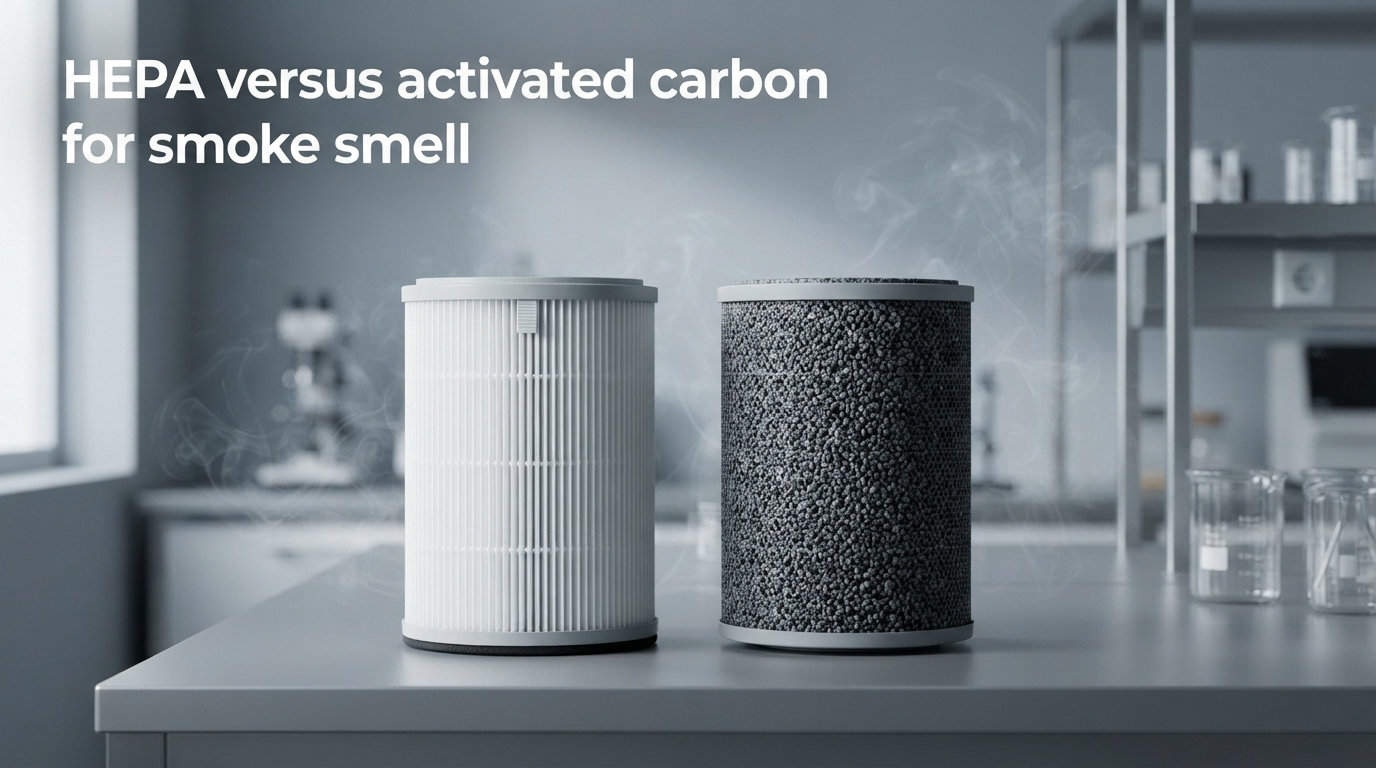
Smoke smell is one of the most stubborn indoor air problems a household can face, and the filter you choose decides whether that smell actually leaves or just hides for a few days. This guide breaks down HEPA versus activated carbon for smoke smell so you understand exactly what each technology can and cannot do before you spend money on an air purifier.
The short answer: HEPA filters capture the visible and invisible particles floating in smoke, but they cannot remove the odor itself. Activated carbon is the only filter media that actually traps the gas molecules responsible for smoke smell. Most people dealing with cigarette, wildfire, or cooking smoke need both filters working together.
I will walk through how each technology works, why cheap carbon filters disappoint so many buyers, and the exact scenarios where HEPA alone, carbon alone, or a combination setup is the right call. We have spent months digging through air purifier reviews, Reddit threads, and lab filtration data to bring you answers that cut through the marketing.
Table of Contents
What HEPA filtration does and how it captures particles
HEPA stands for High-Efficiency Particulate Air, and it is a mechanical filter made from a tightly woven mat of randomly arranged fiberglass fibers. The standard requires it to capture at least 99.97 percent of airborne particles that are 0.3 microns in diameter. That 0.3 micron size is not a coincidence. It is the Most Penetrating Particle Size, the hardest particle for a HEPA filter to catch.
Particles larger or smaller than 0.3 microns are actually easier for HEPA to trap. The filter uses three capture mechanisms working at the same time. Large particles crash directly into fibers through a process called impaction. Mid-sized particles ride the air current and graze a fiber through interception. The smallest particles bounce around randomly until they stick to a fiber through diffusion.
What HEPA removes from smoky air
A true HEPA filter handles the solid and liquid particulates inside smoke. That includes ash, soot, tar droplets, dust from combustion, pollen that gets stirred up alongside smoke, mold spores, and pet dander. After wildfire smoke rolls through a neighborhood, the haze you can see is mostly particulate matter in the PM2.5 range, and HEPA is excellent at clearing it from indoor air.
For allergy and asthma sufferers, this particle removal is a serious quality of life upgrade. Run a HEPA air purifier in a smoky room and within an hour the visible haze often disappears. The air looks cleaner. Breathing feels easier.
What HEPA cannot do for smoke smell
Here is where most buyers get burned. HEPA filtration cannot remove smoke odor, period. The molecules that make cigarette smoke, wildfire smoke, or burnt food smell the way they do are gas molecules, not particles. They slip right through even a true HEPA filter because they are thousands of times smaller than the 0.3 micron particles the filter is rated for.
Users on Reddit’s r/AirPurifiers frequently report running a HEPA-only purifier and watching the visible smoke clear while the smell hangs around for hours, days, or longer. That is expected behavior, not a defective filter. HEPA is the wrong tool for the odor job, the same way a fishing net cannot catch dissolved salt.
What activated carbon filtration does and how it traps odors
Activated carbon is a form of carbon that has been treated with heat and steam to develop a massive network of microscopic pores. A single gram of activated carbon can have an internal surface area larger than a football field. That porosity is the entire point. As air passes through, gas molecules from smoke, VOCs, and other odors physically stick to the carbon surface through a process called adsorption.
Adsorption is different from absorption. Absorption soaks a substance into a material, like a sponge taking in water. Adsorption locks molecules onto a surface, where they stay trapped until the carbon is saturated or replaced. Smoke odor molecules, formaldehyde, benzene, and hundreds of other volatile organic compounds all stick to activated carbon instead of recirculating into your room.
Why carbon mass determines whether your filter works
This is the most under-discussed topic in the entire HEPA versus activated carbon for smoke smell conversation, and it is exactly where most air purifiers fail. Carbon only adsorbs a finite amount of gas before every pore is filled. Once saturated, the filter stops working and odor returns instantly. The more carbon a filter contains, the longer it lasts and the more smell it can actually remove.
Forum users on r/BuyItForLife and r/vaporents are blunt about this. They repeatedly warn that thin carbon sheets, often just a sprayed-on coating or a single carbon-impregnated pad, are basically useless for real smoke odor. A filter needs real granular carbon, packed deep, to handle cigarette or wildfire smoke for more than a week.
As a rough benchmark, a quality carbon filter for smoke removal should contain at least a pound of activated carbon, ideally closer to two or three pounds for heavy smoke environments. Pelletized or granular carbon beats impregnated foam every time. If the marketing only says “carbon filter” without listing weight, treat it as suspect.
HEPA versus activated carbon for smoke smell: a direct comparison
The fastest way to settle the HEPA versus activated carbon for smoke smell debate is to look at what each filter is built to capture. HEPA handles the solid and liquid particles. Activated carbon handles the gas molecules that cause odor. Neither one covers the full smoke problem on its own.
Here is a side-by-side breakdown of how the two technologies compare across the criteria that matter most when smoke is the issue.
Primary mechanism: HEPA uses mechanical capture in a fiber mesh. Activated carbon uses adsorption onto porous carbon surfaces.
Particle size handled: HEPA captures particles down to 0.3 microns at 99.97 percent efficiency. Activated carbon is essentially blind to particles but excels at gas molecules thousands of times smaller.
Smoke particles (PM2.5, soot, ash): HEPA removes them. Activated carbon does not.
Smoke odor molecules (gas-phase): Activated carbon adsorbs them. HEPA lets them pass straight through.
VOCs and formaldehyde: Activated carbon handles these. HEPA does not.
Effect on smell: HEPA has no direct effect on odor. Activated carbon reduces smell in proportion to its carbon mass.
Filter lifespan for smoke: HEPA lasts 6 to 12 months. Carbon in a heavy smoke environment may saturate in 3 to 6 months or faster if the carbon mass is small.
Cost over time: HEPA replacements are pricier per unit but last longer. Cheap carbon is cheap upfront but needs frequent replacing.
Notice that the two technologies are not really competitors. They handle completely different pollutant categories, which is why every serious smoke air purifier on the market uses both in sequence.
When HEPA alone is the right choice
If your only concern is particulate pollution, HEPA alone gets the job done. This applies if you have allergies or asthma triggered by dust, pollen, pet dander, or mold spores, and smoke odor is not part of your problem. It also applies when visible wildfire smoke haze has entered your home but the actual smell has not lingered, or when you already have a separate dedicated carbon unit handling odor elsewhere.
HEPA-only units are also a reasonable pick for cleanrooms, hospital isolation wards, and industrial dust control where particulate capture is the entire goal.
When activated carbon alone is the right choice
Activated carbon alone makes sense when odor and gases are the only problem. That covers lingering cigarette smell in a guest room, cooking odors from a kitchen with no particle problem, paint fumes or new furniture off-gassing, and chemical sensitivity to VOCs. In these cases the particles are not the issue, so paying for HEPA filtration adds cost without benefit.
Grow tents, vaping rooms, and the famous “weed tent with activated carbon canister and inline fan” setups popular on Reddit are pure carbon applications. They exist specifically to scrub gas-phase odor from the air before it leaves the space.
When you need HEPA and activated carbon together
Most real smoke problems need both filters running together. Cigarette smoke carries both tar particles and odor gases. Wildfire smoke carries fine PM2.5 particles plus a toxic stew of VOCs and the characteristic campfire smell. Burnt food releases soot and acrid odors. A fireplace sends ash into the room along with wood smoke smell.
In each of these cases the HEPA filter clears the visible particulates that irritate lungs, and the carbon filter adsorbs the odor molecules that HEPA cannot touch. Run only one of the two and you solve half the problem. The combination is why nearly every air purifier marketed for smoke uses a multi-stage filter stack: pre-filter, carbon layer, HEPA layer, sometimes in that order.
The trick is making sure the carbon layer is substantial enough to actually do its job. A combo filter with a thin carbon sheet and a great HEPA still leaves the smell in the room.
Why cheap carbon filters fail at removing smoke smell
Buyer frustration with smoke odor removal almost always traces back to one culprit: an undersized carbon filter sold as if it were a serious odor solution. Understanding why cheap carbon fails helps you avoid the most common trap in this category.
A thin carbon sheet, sometimes only a few millimeters thick, simply does not have enough adsorption surface area to capture meaningful amounts of smoke gas. The carbon saturates within days or weeks, and the smell returns. Worse, many combo filters position a thin carbon pad directly against the HEPA media. Once the carbon is full, the HEPA keeps running and the smell keeps flowing through it.
The carbon mass threshold you should look for
For genuine smoke smell removal, aim for filters that list their carbon weight. A useful minimum for light smoke exposure is around 0.5 to 1 pound of activated carbon. For cigarette smoke in a regularly used room, 1 to 2 pounds gives you months of real performance. For heavy wildfire smoke, dedicated commercial units with 3 to 5 pounds of carbon or more are the only realistic option.
Pelletized and granular carbon outperforms carbon-impregnated foam or sprayed carbon coatings because the gas actually has time and surface area to adsorb. Look for filters that describe themselves as packed-bed carbon, granular carbon, or deep-bed carbon rather than just “carbon layer.”
Combo filters versus dedicated carbon units
Combo filter cartridges are convenient because you replace one piece. They are also the reason many users conclude carbon filters are a scam. The carbon portion is often too thin to handle real smoke. Reddit users repeatedly recommend separate, dedicated carbon canisters or inline carbon filters for anyone serious about odor removal.
A dedicated carbon unit, paired with a separate HEPA unit, almost always outperforms a single combo unit at the same total cost. The tradeoff is floor space and the inconvenience of running two machines. For a single room with occasional smoke, a quality combo unit with substantial carbon mass is usually enough. For a chronic smoke environment, split the workload.
Real-world smoke scenarios and the filter that actually wins
General advice is useful, but smoke comes in enough varieties that the right filter choice depends on what kind of smoke you are fighting. Let me break down the most common scenarios our team fields questions about.
Cigarette and cigar smoke
Cigarette smoke is one of the hardest indoor air challenges because it combines fine particulate tar with hundreds of odor-causing gas molecules, many of them VOCs. A serious cigarette smoke problem demands both HEPA and a heavy carbon load. Light cigarette use in a single room can be handled by a combo unit with at least a pound of granular carbon. A heavy smoker household typically needs multiple units or a dedicated carbon scrubber alongside the HEPA.
Replace the carbon more often than the manufacturer suggests if the smell returns. Saturation in a smoking environment happens fast.
Wildfire smoke events
Wildfire smoke is a two-part problem. The visible haze is fine particulate matter, mostly PM2.5, that HEPA removes effectively. The smell comes from a complex mix of gases, including VOCs released from burning vegetation and building materials. Both can irritate lungs, but only the carbon actually clears the smell.
During wildfire season in 2026, run a HEPA-rated purifier sized for the room to handle particulates and add a carbon layer for odor. If you only have a HEPA unit, run it on high during smoke events and seal the room against outdoor air infiltration. Once the smoke event passes, ventilate to clear any residual gas-phase odor.
Cooking smoke and kitchen odors
Cooking smoke is mostly particulate from aerosolized oil combined with strong gas-phase odors. A range hood that vents outside is the first line of defense. Beyond that, a portable air purifier with both HEPA and a serviceable carbon filter handles the rest. Light cooking in a small kitchen rarely saturates a normal carbon layer. Heavy frying, grilling indoors, or spicy cuisine may push the carbon to exhaustion within months.
Fireplace and wood stove smoke
A wood stove or fireplace that occasionally backdrafts sends ash and creosote odors into the room. HEPA captures the ash particulates. The smoky smell, which is largely creosote and combustion gases, requires carbon. A combo unit near the fireplace usually covers occasional exposure. For daily wood heat users, plan on frequent carbon replacement.
Choosing the right filter setup for your smoke problem
Picking the right filtration system for smoke smell comes down to three things: what kind of smoke, how much of it, and how big the space is. Once you know those answers, the filter choice gets much simpler.
Start by sizing the air purifier to the room. A unit rated for a small bedroom will not keep up with smoke in an open-concept living area, no matter how good its filters are. Match the Clean Air Delivery Rate to the square footage, then evaluate the filter media separately.
Carbon mass guidelines by smoke level
For light or occasional smoke exposure, a combo unit with 0.5 to 1 pound of activated carbon usually works. Replace the carbon every 4 to 6 months. For regular cigarette or cooking smoke, look for 1 to 2 pounds of granular carbon and replace every 3 to 4 months. For heavy wildfire smoke, dedicated smoking rooms, or industrial fume exposure, you want 3 pounds or more of carbon, often in a separate dedicated unit, replaced on a 2 to 3 month cycle.
HEPA filter lifespan
A true HEPA filter typically lasts 6 to 12 months under normal residential use. In a heavy smoke environment, expect closer to 6 months before airflow drops noticeably. A pre-filter extends HEPA life by catching larger particles first. Replace the pre-filter monthly in smoky conditions.
Combination units versus dedicated machines
If floor space and budget allow, two dedicated machines, one focused on HEPA particulate removal and one focused on a deep-bed carbon scrubber, outperform almost any single combo unit. The combo is fine for typical household use. The split setup wins for serious smoke problems.
Watch for combo units that bury a thin carbon sheet between a pre-filter and HEPA media. Those filters often saturate within weeks in any real smoke scenario, leaving you with the smell you bought the purifier to remove.
HEPA versus activated carbon for smoke smell: the bottom line
After laying out the HEPA versus activated carbon for smoke smell comparison, the takeaway is straightforward. HEPA handles the particles. Activated carbon handles the odor. For anything more than a passing whiff of smoke, you want both filters working together, and the carbon needs real mass to do its job.
Buy for your actual smoke scenario. Match the unit size to the room, demand a carbon weight specification before purchase, and replace filters on the schedule your smoke load actually demands rather than the optimistic timeline on the box. Get those three things right and the smoke smell, along with the haze, will leave your air for good.
FAQs
Does activated carbon remove smoke smell?
Yes. Activated carbon is the filter media that actually removes smoke odor by adsorbing the gas molecules responsible for the smell onto its porous carbon surface. The effectiveness depends on how much carbon the filter contains, with at least a pound of granular or pelletized carbon recommended for real smoke odor removal.
Does HEPA help with smoke smell?
No, HEPA does not remove smoke smell. HEPA filters mechanically capture solid and liquid particles like soot, ash, and tar droplets, but the odor molecules in smoke are gases thousands of times smaller than the 0.3 micron particles HEPA is rated for. Those gases pass straight through the fiber mesh.
Is HEPA better than activated carbon?
Neither is universally better. They handle different pollutant categories. HEPA is better for particles like dust, pollen, smoke haze, and allergens. Activated carbon is better for gases, VOCs, and odors. For most smoke problems, the right answer is using both filters together in sequence.
What filter is best for smoke smell?
For smoke smell specifically, the best filter is activated carbon with a substantial carbon mass. For overall smoke removal, including both visible haze and odor, the best setup is a combination of a true HEPA filter for particles and a deep-bed activated carbon filter for gas-phase odor, sized to the room and the smoke load.
How much activated carbon is needed to remove smoke smell?
For light smoke exposure, aim for at least 0.5 to 1 pound of activated carbon. For regular cigarette or cooking smoke, 1 to 2 pounds is recommended. For heavy wildfire smoke or dedicated smoking rooms, look for 3 pounds or more, ideally in a granular or pelletized form rather than a thin impregnated sheet.
How often should I replace carbon filters for smoke?
In a heavy smoke environment, replace carbon filters every 2 to 4 months because they saturate quickly once the pores fill. Light smoke exposure may extend the replacement cycle to 4 to 6 months. If the smoke smell returns before the recommended replacement date, the carbon is saturated and needs changing regardless of the schedule.