
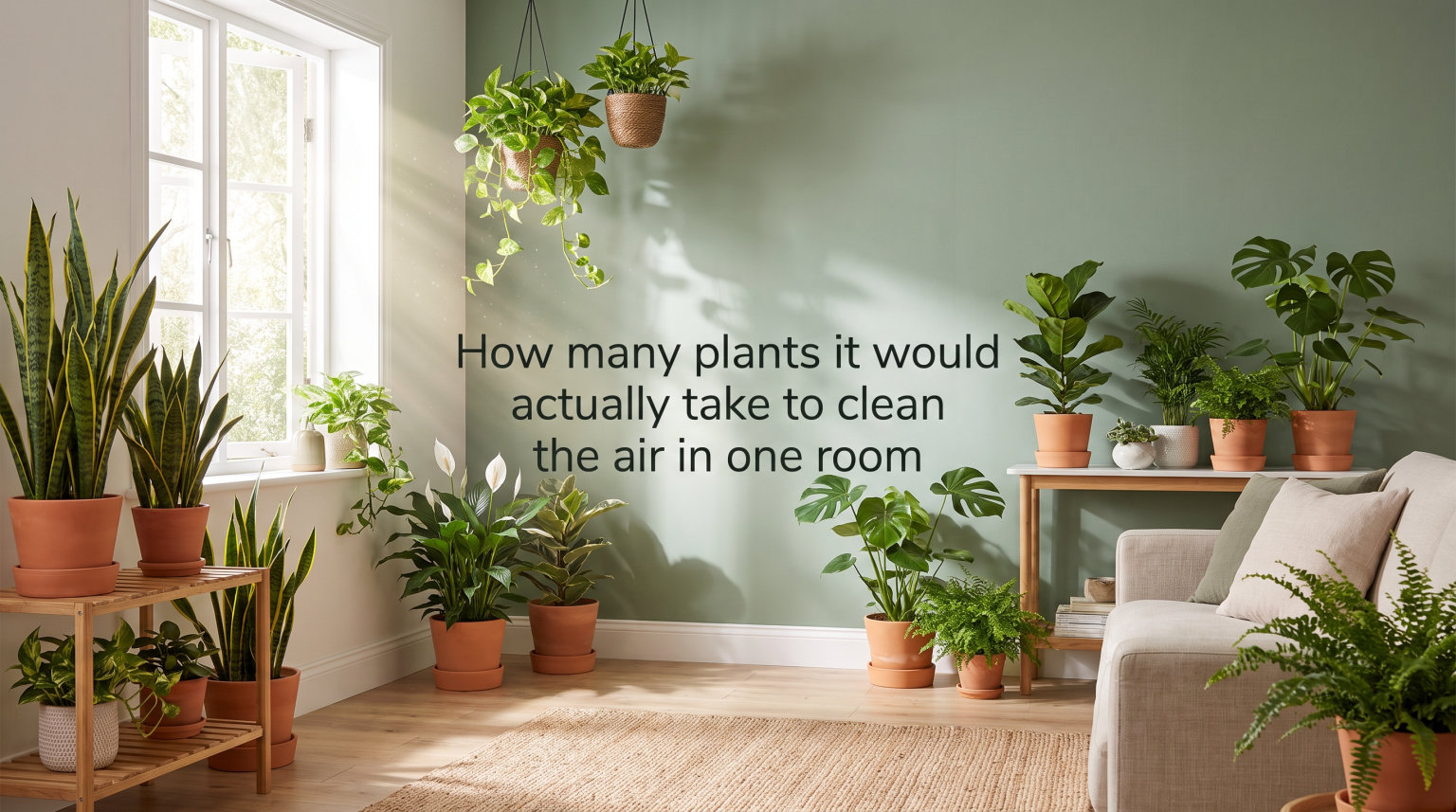
If you have ever wondered how many plants to clean air in a room actually make a difference, the honest answer might surprise you. The real number, according to peer-reviewed research, is somewhere between 10 and 1,000 plants per square meter of floor space. That is not a typo.
I have spent weeks digging through the science, and the gap between what plant blogs claim and what laboratories measure is enormous. Most of us grew up hearing that a few spider plants or snake plants would scrub our indoor air clean.
The idea came from a famous NASA study, and it spread through gardening magazines, Pinterest boards, and plant shops like wildfire. But the truth is that a typical living room would need a jungle, not a windowsill, to meaningfully reduce indoor pollution.
That does not mean plants are useless. They just do a different job than most people think.
In this guide, I will walk you through the actual numbers, the science behind how plants interact with air, which species work best, and why you might still want to fill your home with greenery even if the air-cleaning benefits are smaller than advertised.
Table of Contents
How Many Plants to Clean Air in a Room: The Short Answer
Here is the bottom line based on the most credible research available in 2026. To achieve a measurable improvement in indoor air quality, you would need an impractical number of plants in a single room.
The figures below come from the Cummings and Waring 2019 review published in the Journal of Exposure Science and Environmental Epidemiology, which analyzed decades of plant air purification studies.
For a measurable difference: Between 10 and 1,000 plants per square meter of floor space, depending on the plant species and the pollutant.
For a typical 100 square foot bedroom: Roughly 93 to 9,290 plants to match the ventilation rate of a single open window.
Wolverton’s practical recommendation: At least two good-sized plants per 100 square feet of indoor space, which improves air slightly but falls far short of meaningful purification.
Reality check: No realistic number of houseplants can replace proper ventilation or a dedicated air purifier.
The American Lung Association has echoed this conclusion, noting that while plants do remove trace amounts of pollutants, the effect is negligible compared to the air exchange that happens every time you open a door or run an HVAC system.
The NASA Clean Air Study: Where the Myth Began
To understand why so many people believe a handful of plants can purify a room, we have to go back to 1989. That year, NASA researcher B.C. Wolverton published the Interior Landscape Plants for Indoor Air Pollution Abatement study, commonly called the NASA Clean Air Study.
Wolverton and his team placed individual plants inside sealed chambers, injected known concentrations of volatile organic compounds like formaldehyde and benzene, and measured how quickly the pollutants disappeared.
The results were impressive. Spider plants, peace lilies, and English ivy removed significant percentages of VOCs from the sealed chambers within hours.
Wolverton extrapolated these findings and suggested that 15 to 18 good-sized plants in an 1,800-square-foot home could improve air quality. Plant nurseries ran with the headline, and a myth was born.
Here is the problem. Those experiments took place in small, completely sealed Plexiglas chambers with no air exchange whatsoever.
A real bedroom or living room is nothing like a sealed box. Air leaks in and out constantly through doors, windows, vents, and wall gaps.
A typical room experiences several complete air exchanges per hour, meaning any pollutant a plant absorbs is quickly diluted or replaced by fresh air from outside. The plant simply cannot keep up.
Think of it like trying to bail water out of a boat with a teaspoon while someone keeps pouring more in. The teaspoon works, technically. But the water level barely changes because the inflow overwhelms the outflow.
That is exactly what happens when a few houseplants try to keep up with the constant air exchange in a real home. The math does not work in their favor.
Wolverton himself later revised his recommendations upward, acknowledging that more plants were needed than his initial estimates suggested. But by then, the simplified version of his findings had already become conventional wisdom.
How Plants Actually Clean Air: The Science
Plants do interact with indoor air pollution, and nobody is disputing that. The mechanism is a process called phytoremediation, and it works through two main pathways.
The first pathway happens through the leaves. Plants absorb gases through tiny pores called stomata, which they open and close to take in carbon dioxide for photosynthesis.
When stomata are open, some airborne VOCs like formaldehyde and benzene slip inside along with the carbon dioxide. Once inside the leaf, the plant’s cells break down or store these compounds.
The second pathway happens underground. The soil and root zone of a potted plant contains microorganisms, bacteria, and fungi that feed on organic compounds.
Many of these microbes can metabolize VOCs that settle into the potting mix. In some studies, the soil microorganisms actually removed more pollutants than the leaves themselves.
Both pathways are real and measurable. The issue is scale.
A single plant processes a tiny volume of air relative to the total air in a room. Bryan Cummings and Michael Waring quantified this in their 2019 review by converting chamber study results into a standardized metric called clean air delivery rate, measured in cubic meters per hour.
When they compared plant delivery rates to typical room ventilation rates, the mismatch was staggering. To match the pollutant removal of standard room ventilation, a 100-square-foot room would need somewhere between 10 and 1,000 plants.
The low end assumes highly efficient species in ideal conditions. The high end accounts for less efficient plants and higher pollutant loads.
Either way, you are talking about a greenhouse, not a bedroom. That is why the real-world effect of houseplants on air quality is so small.
VOCs Explained: What Plants Are Up Against
Before going further into the numbers, it helps to understand what plants are trying to remove. Indoor air contains two main categories of pollution, and plants handle them very differently.
The first category is volatile organic compounds, or VOCs. These are gases emitted by everyday materials and products.
Formaldehyde off-gasses from pressed wood furniture, laminate flooring, and insulation. Benzene appears in tobacco smoke, paint, and synthetic fibers.
Toluene comes from nail polish, paint thinners, and adhesives. Xylene shows up in printing ink and cleaning products. The average home has dozens of VOC sources emitting continuously.
VOCs are exactly what plants and their soil microbes are best at processing. This is why the NASA study focused on them.
But even the most efficient VOC-removing plant can only handle a fraction of what a room produces. This is especially true when new furniture, fresh paint, or cleaning products add to the pollutant load.
The second category is particulate matter, the microscopic solid and liquid particles floating in indoor air. Dust, pollen, smoke, and pet dander all qualify.
Plants can capture some particles on their leaf surfaces through a process called dry deposition. Basically, particles stick to leaves the way they stick to any surface.
But this is passive capture, not active filtration. A plant does not pull air across its leaves the way a fan-driven air purifier pulls air through a HEPA filter.
This distinction matters because many people buy plants hoping to reduce dust or allergens. For particulate pollution, plants are among the least effective tools available.
Opening a window or running an air purifier with a HEPA filter does dramatically more. The gap is not even close.
The Real Numbers: Plants Per Room Calculation
Let me break this down with concrete room examples so you can see what the research actually implies for your home. These calculations use the Cummings and Waring framework, which compares plant clean air delivery rates to standard residential ventilation.
Small Bedroom (100 Square Feet)
A 100-square-foot bedroom is roughly 10 by 10 feet, about the size of a typical guest room or child’s room. To achieve pollutant removal comparable to the natural ventilation of that space, you would need somewhere between 93 and 9,290 plants.
That range depends on species efficiency and pollutant concentration. Even the optimistic low end means covering nearly every inch of floor space with foliage.
If you go with Wolverton’s more practical recommendation of two plants per 100 square feet, you would place two good-sized plants in this room. You would see a tiny improvement in VOC levels, but nothing that would register as meaningful on an air quality monitor.
Medium Living Room (250 Square Feet)
A 250-square-foot living room, roughly 16 by 16 feet, is one of the largest rooms in most homes. The realistic plant count for measurable air cleaning here ranges from 232 to 23,225 plants.
That is not a typo. The high end represents what you would need to match ventilation if you had significant VOC sources like new carpet or fresh paint.
Using Wolverton’s rule, you would aim for five plants in this space. Many plant enthusiasts already have this many, and they report loving the look and feel of the room.
Just do not expect air quality readings to change. The plants are decoration and mood boosters, not air scrubbers.
Large Open-Plan Space (500 Square Feet)
An open-plan living and dining area of 500 square feet would require between 465 and 46,450 plants for meaningful purification. Even the most dedicated plant parent tops out around 20 to 30 plants in a space this size.
The gap between what looks like a lot of plants and what actually moves the needle on air quality is massive. This is why I always tell people to set realistic expectations.
These numbers can feel discouraging, but they are important. They explain why no serious indoor air quality expert recommends plants as a primary purification strategy. The math simply does not work in a normally ventilated room.
Best Plants for Air Purification
If you are going to add plants to your home anyway, and you want species that at least maximize what little air-cleaning benefit exists, some perform better than others. Here are the top contenders based on laboratory testing.
English Ivy (Hedera helix) consistently ranks as one of the most efficient VOC removers in chamber studies. It is particularly effective against formaldehyde and benzene.
Some research also suggests it can reduce airborne mold particles, which is why you will see claims about mold reduction associated with this plant. English ivy is also easy to grow and thrives in hanging baskets.
Snake Plant (Sansevieria trifasciata) is a favorite for bedrooms because it uses Crassulacean acid metabolism, or CAM photosynthesis. CAM plants keep their stomata closed during the day and open them at night.
This means they continue absorbing some gases while you sleep. The nighttime benefit is modest, but it is something most other plants cannot do.
Peace Lily (Spathiphyllum) scored well in the NASA study for removing acetone, formaldehyde, and benzene. It has a large leaf surface area relative to its pot size, which helps with passive gas absorption.
Peace lilies are also relatively easy to grow in low light. That makes them a practical choice for rooms without much natural sunlight.
Spider Plant (Chlorophytum comosum) was one of Wolverton’s original star performers. It removes formaldehyde and xylene efficiently in sealed chamber tests.
Spider plants are also nearly impossible to kill, making them a practical choice even if the air benefit is small. They produce offshoots you can propagate and share with friends.
Pothos (Epipremnum aureum) is another low-maintenance option that showed decent VOC removal in lab settings. Its fast growth means it develops substantial leaf surface area quickly, which theoretically increases its air contact.
Boston Fern (Nephrolepis exaltata) excels at removing formaldehyde and adds humidity to the air. That humidity boost can be a plus in dry climates or during winter heating season.
If you want a single species that purifies the most air per plant, English ivy and peace lily tend to top the charts in controlled studies. But remember, even the best performer operates at a tiny fraction of what a room actually needs.
Plants vs Air Purifiers: Which Actually Works
This is the question I see over and over in plant forums on Reddit. People ask whether they need an air purifier if they already have a lot of plants, and the answer from every credible source is the same.
Yes, you still need an air purifier if indoor air quality is your goal. A single portable air purifier with a HEPA filter and activated carbon can process 100 to 300 cubic feet of air per minute.
That is orders of magnitude more than even 50 houseplants combined. An air purifier actively draws air through dense filtration media, captures particles as small as 0.3 microns, and adsorbs VOCs onto carbon surfaces.
Plants, by contrast, rely on passive diffusion. Air has to happen to reach the leaf or soil surface for any removal to occur.
There is no fan, no airflow, no active circulation. The difference in clean air delivery rate between a typical air purifier and a collection of houseplants is not even close.
From a cost perspective, the comparison is equally stark. To approach the pollutant removal of one mid-range air purifier, you would need hundreds of plants costing thousands of dollars.
And those plants require ongoing maintenance, watering, and space that an air purifier does not. A single device on a shelf quietly does what a forest of potted plants cannot.
The real solution for indoor air quality is not plants or air purifiers alone. It is a combination of source control, ventilation, and mechanical filtration.
Open windows when outdoor air is clean. Run range hoods while cooking and use exhaust fans in bathrooms. Avoid smoking indoors and choose low-VOC products whenever possible.
And if you want extra filtration, invest in a quality air purifier sized for your room. Plants complement this approach, but they do not replace it.
None of this means plants are a waste of money. It just means they solve a different problem than the one most people buy them for.
Nighttime Air Cleaning: Do CAM Plants Help in Bedrooms
One question that comes up frequently is whether certain plants clean air at night. Most plants close their stomata after dark and stop absorbing gases, which would seem to make them useless for overnight air purification in a bedroom.
A small group of plants, called CAM plants, flip this schedule. Snake plants, aloe vera, and certain succulents keep their stomata closed during the day to conserve water and open them at night instead.
This means they can absorb some carbon dioxide and VOCs while you sleep. The nighttime benefit is real but small.
A single snake plant in a bedroom processes a negligible amount of air relative to the room volume. You would still need dozens of CAM plants to approach meaningful purification.
But if you are choosing between a snake plant and a non-CAM plant for a bedroom, the snake plant at least offers something after dark. That makes it my default recommendation for people who want plants near their bed.
Why You Should Still Fill Your Home With Plants
After all this talk about why plants do not clean air the way we thought, you might be wondering whether they are worth buying at all. They absolutely are, just for different reasons.
Multiple studies have shown that indoor plants reduce stress, lower blood pressure, and improve mood. Hospital patients with plants in their rooms recover faster and report less pain than those without.
Office workers with plants nearby report higher job satisfaction and reduced fatigue. The psychological benefits of being around greenery are well documented and significant.
Plants also add humidity to dry indoor air, which can ease respiratory discomfort during winter months. They look beautiful, soften harsh architectural lines, and make a house feel like a home.
Many people find that caring for plants becomes a rewarding hobby that adds structure and calm to their daily routine. That alone is worth the price of a few pots and some potting soil.
So yes, buy the plants. Fill your shelves and windowsills. Just do it because they make you happier, not because you expect them to scrub your air clean.
FAQs
What plant removes 78% of airborne mold naturally?
English ivy (Hedera helix) is the plant most commonly cited for reducing airborne mold spores, with some studies reporting up to 78% reduction in sealed chamber tests. However, those results come from controlled lab environments and do not translate to real rooms, where air exchange and ventilation overwhelm the plant’s modest filtering capacity.
What plant purifies the most air?
English ivy and peace lily consistently rank as the most efficient air-purifying houseplants in laboratory studies. Both show strong removal rates for formaldehyde, benzene, and other VOCs in sealed chamber tests. Spider plants, snake plants, and Boston ferns also perform well, but all houseplants operate at a tiny fraction of what a room actually needs for measurable improvement.
How long does it take plants to purify air?
In sealed chamber studies, plants begin absorbing VOCs within hours, with measurable reductions occurring over 6 to 24 hours depending on the species and pollutant. In a real, ventilated room, the effect is so small that it would take days to weeks to see any detectable change, and continuous air exchange means pollutants are constantly being replaced.
Do I need an air purifier if I have a lot of plants?
Yes. Even a home with 50 or more houseplants cannot match the clean air delivery rate of a single portable air purifier with a HEPA filter and activated carbon. Plants remove trace amounts of VOCs through passive absorption, while air purifiers actively force large volumes of air through dense filtration media. For genuine indoor air quality improvement, use an air purifier alongside proper ventilation.
How many plants does it take to purify the air in a room?
According to the 2019 review by Cummings and Waring, you would need between 10 and 1,000 plants per square meter of floor space to achieve a measurable improvement in indoor air quality. For a typical 100-square-foot bedroom, that translates to roughly 93 to 9,290 plants. No realistic number of houseplants can replace ventilation or mechanical air purification.
Does having plants in your room clean the air?
Plants do remove small amounts of VOCs and capture some particles on their leaves, so technically yes, they clean the air to a tiny degree. However, the effect is so small relative to normal room ventilation that it does not meaningfully improve air quality. The real benefits of bedroom plants are psychological, including stress reduction, improved mood, and a more pleasant environment.
The Bottom Line on Plants and Indoor Air
When someone asks how many plants to clean air in a room actually make a measurable difference, the honest answer is hundreds to thousands. The science is clear on this point, and no amount of wishful thinking changes the math.
But plants still belong in our homes. They reduce stress, boost mood, add beauty, and connect us to nature in ways that air purifiers never will.
Buy plants because they make you happy, and invest in ventilation and a good air purifier if you want cleaner indoor air. Both have their place, and understanding the difference is what really matters.